

IEC 61512-1:2026
(Main)Batch control - Part 1: Models and terminology
General Information
- Abstract
IEC 61512-1:2026 applies to systems, specifications, and their use for implementing batch and related procedure-oriented manufacturing controls in the process industries. This document establishes a reference model framework for procedure-oriented control, defines terms to help explain the model relationships and usage, and describes general criteria for evaluating conformance. This follows the principle of separation between recipe procedural elements and equipment procedural elements enabling operations to define recipes without the need of changes in equipment procedures.
This second edition cancels and replaces the first edition published in 1997. This edition constitutes a technical revision.
This edition includes the following significant technical changes with respect to the previous edition:
a) Models and text are modified to provide more detail and clarity. Key clarifications are:
1) Two types of equipment modules are defined: generic and recipe-aware. All recipe-aware equipment modules contain procedural control and can be used as phases in the recipe.
2) Execution of all procedural control contained directly in units is part of the Unit Supervision activity.
3) The relationships between types of recipes, recipe components, and equipment control are more fully described and illustrated.
4) Entity relationship diagrams have been replaced with more intuitive UML instance diagrams, except for the equipment entity model.
5) The transition diagram for the procedural states example has been updated with a more intuitive and complete UML state diagram.
6) References to other standards in the series and to IEC 62264 are included to provide direction for further clarification of selected topics.
7) Activity names are capitalised to help prevent confusion with similar terms, such as their underlying functions.
b) Previous Clauses 4 through 6 (now Clauses 4 through 8) were rearranged to provide a clearer top-down organisation of the document. Key changes are:
1) Removing the lower levels of the physical (role-based equipment) model (see 4.4.2) to eliminate redundancy because their groupings are defined by the associated functionality in the equipment entity model and are not meaningful for batch control without those associations.
2) Describing equipment control and the equipment entity model immediately after the physical (role-based equipment) model and describing each level as completely as possible without excessive use of forward references (see 4.4.3).
3) Combining the descriptions of basic, procedural, and coordination control with their usage in each type of equipment entity, providing a single consolidated discussion of each type of control (see Clause 5)
4) Additional considerations to support application of the models have been grouped in Clause 7 to clarify their supporting relationship to the core models.
c) Clause 9 was added to define completeness, compliance, and conformance in relation to this document.
d) Annex B was added to provide a more expansive procedural state reference model. The model found in Clause 7 can be considered a collapsed version of this more general model.
e) Annex C was added to clarify a number of points concerning the models, their application, and the new Clause 9 on conformance and compliance.
f) Annex E was added to more fully describe the changes in this update to IEC 61512-1:1997.
- Status
- Published
- Publication Date
- 19-Feb-2026
- Technical Committee
- SC 65A - System aspects
- Drafting Committee
- MT 61512 - TC 65/SC 65A/MT 61512
- Current Stage
- PPUB - Publication issued
- Start Date
- 20-Feb-2026
- Completion Date
- 09-Jan-2026
Buy Documents
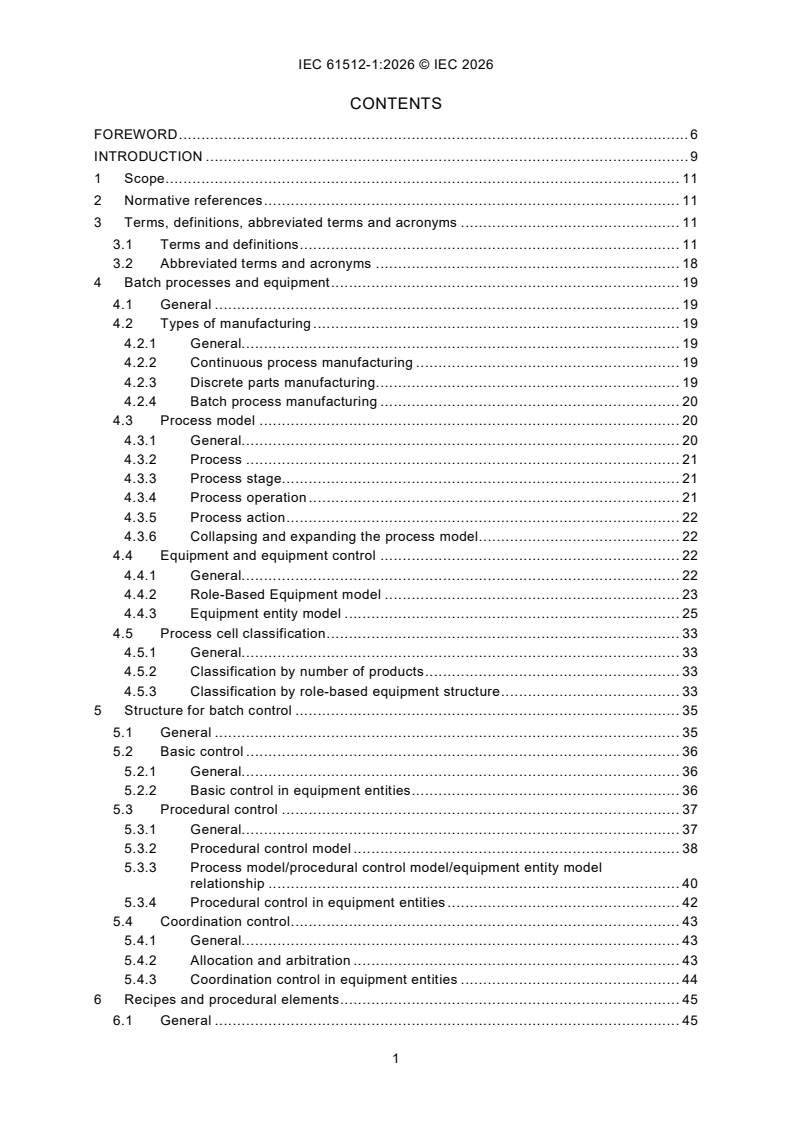
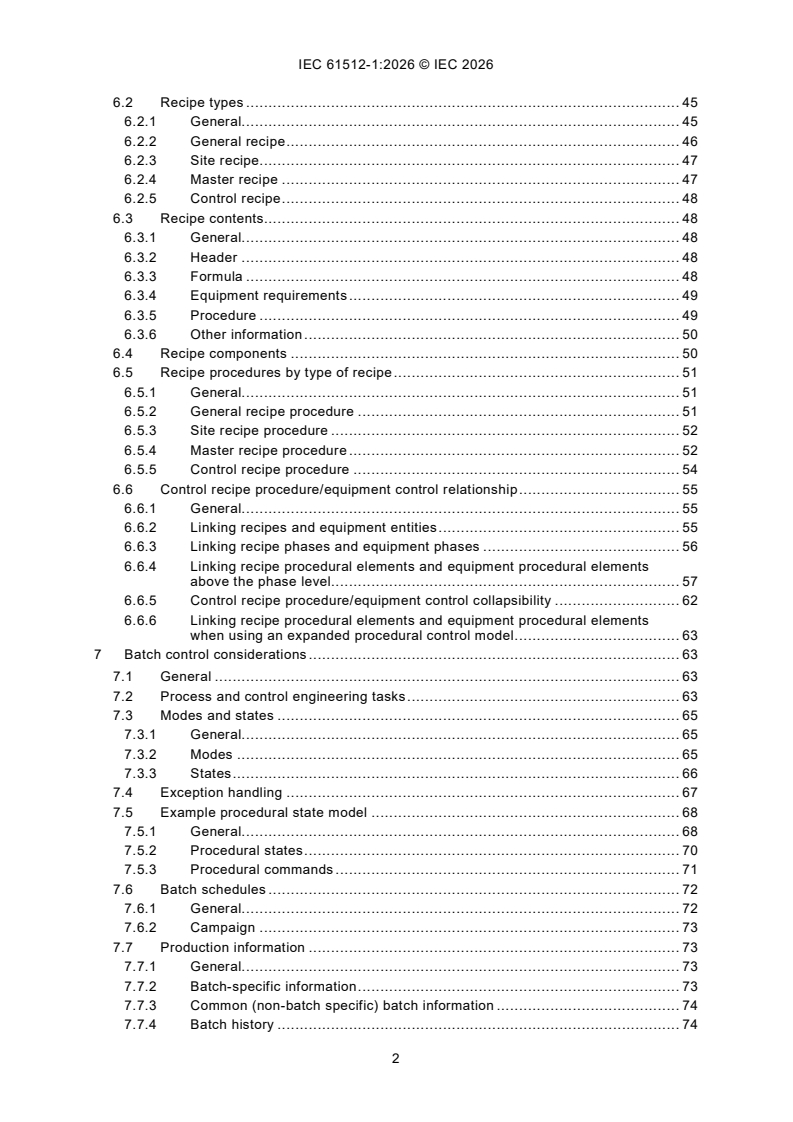
IEC 61512-1:2026 - Batch control - Part 1: Models and terminology
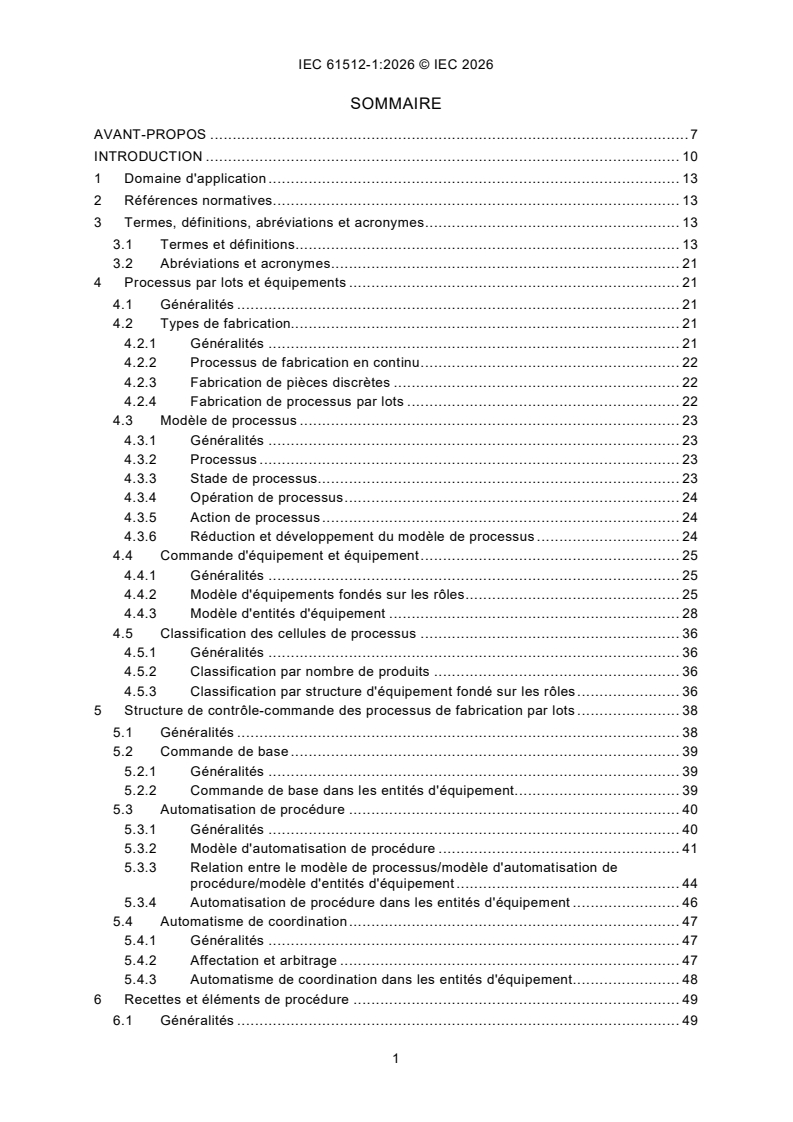
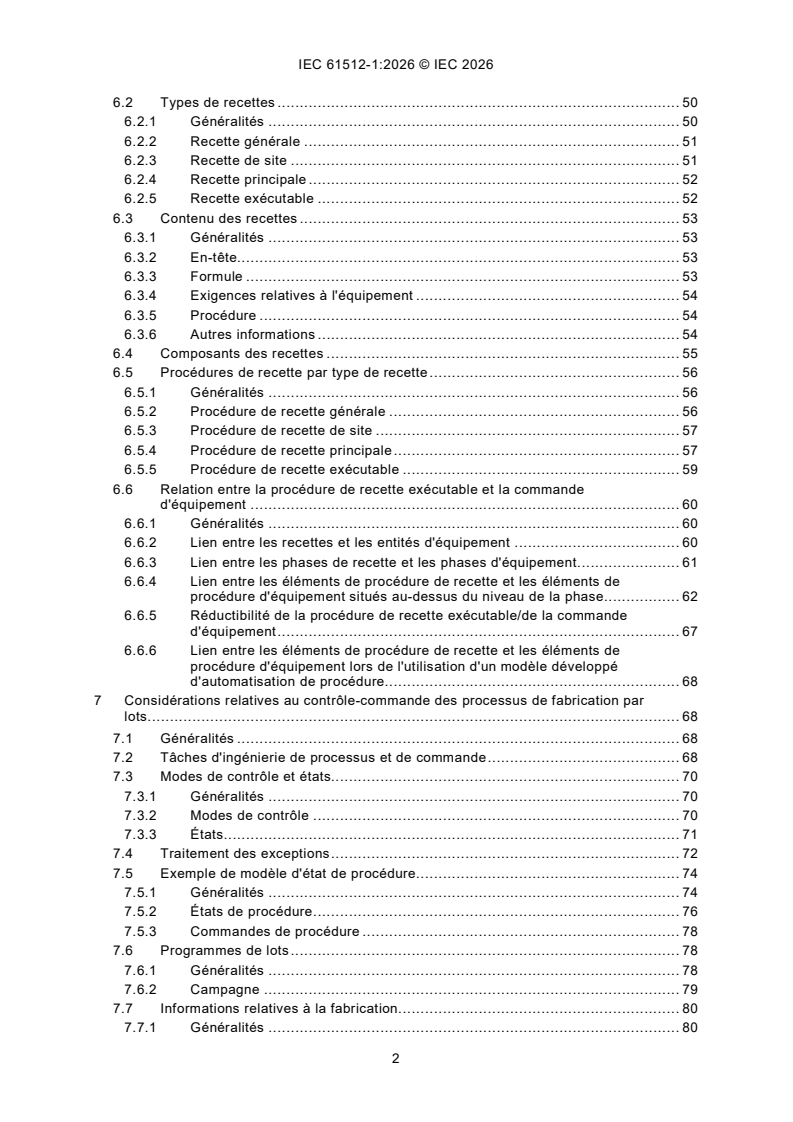
IEC 61512-1:2026 - Contrôle-commande des processus de fabrication par lots (batch) - Partie 1: Modèles et terminologie
IEC 61512-1:2026 - Batch control - Part 1: Models and terminology
Overview
IEC 61512-1:2026 - Batch control - Part 1: Models and terminology is the leading international standard designed to support modern batch process industries. Prepared and published by the International Electrotechnical Commission (IEC), this standard establishes a comprehensive framework for procedure-oriented manufacturing control, with a strong focus on batch and related process controls.
The core objective of IEC 61512-1:2026 is to provide a reference model for batch control systems, introduce precise terminology to ease communication and model implementation, and present general criteria for determining compliance and conformance. By defining models and separating recipe procedural elements from equipment procedural elements, this standard enables operations to develop and update recipes without requiring modifications to equipment procedures - a key advancement for flexibility and scalability in process manufacturing.
As a significant update to the 1997 first edition, this second edition brings enhanced clarity, updated diagrams (including intuitive UML diagrams), formalizes relationships between recipes and equipment control, and strengthens guidance for conformance assessment.
Key Topics
IEC 61512-1:2026 addresses a range of batch control system essentials for the process industries, including:
- Reference Model Framework: Provides a top-down reference model for procedure-oriented control, ensuring common understanding and consistent implementation across different systems and organizations.
- Process and Equipment Models: Defines clear models for batch processes, stages, operations, and equipment, eliminating redundancies and improving functional mapping.
- Control Structures: Details three main control layers-basic, procedural, and coordination control-explaining their interrelation and roles in robust batch control architecture.
- Recipe Types and Elements: Clarifies the structure and content of general, site, master, and control recipes, streamlining recipe management and reuse.
- Linking Recipes and Equipment: Directly supports flexible integration between procedural recipes and underlying equipment controls, enabling more efficient process design and automation.
- Conformance and Compliance: Defines criteria for completeness and compliance, helping organizations assess and document alignment with the standard’s requirements.
- Procedural States and Diagrams: Introduces more comprehensive and intuitive models using UML instance and state diagrams for greater transparency in process visualization.
Applications
IEC 61512-1:2026 is highly valuable to a broad range of stakeholders in the process industries, including batch process manufacturers, automation suppliers, systems integrators, and standards bodies. Typical applications include:
- Batch Process Automation: Implementing modular and scalable control solutions for chemical, food & beverage, pharmaceutical, and biotechnology manufacturing.
- Recipe Management: Supporting flexible product changeovers by enabling independent modification of recipes and process equipment controls.
- System Specification and Procurement: Serving as a reference for defining system requirements and evaluating supplier solutions for batch automation.
- Compliance and Quality Assurance: Providing frameworks for documenting and verifying conformance to international batch control requirements, critical for audit and regulatory purposes.
- Process Optimization: Facilitating the reuse of standardized process models and recipes, improving operational efficiency and reducing engineering time.
Related Standards
To maximize value and interoperability, IEC 61512-1:2026 references and aligns with additional standards, most notably:
- IEC 61512 Series: Additional parts in the IEC 61512 series provide detailed guidance on further aspects of batch control.
- IEC 62264: For enterprise-control system integration, especially on hierarchical models and interface definitions relevant to batch manufacturing environments.
Implementing IEC 61512-1:2026 alongside these related standards ensures seamless integration from shop-floor operations to business systems, supporting end-to-end process efficiency, traceability, and digital transformation in manufacturing.
Keywords: IEC 61512-1, batch control, batch process automation, procedure-oriented manufacturing, recipe management, process industry standards, manufacturing control systems, industrial automation, compliance, UML diagrams, equipment modularity, international standards.
Relations
- Effective Date
- 05-Sep-2023
Buy Documents
IEC 61512-1:2026 - Batch control - Part 1: Models and terminology
IEC 61512-1:2026 - Contrôle-commande des processus de fabrication par lots (batch) - Partie 1: Modèles et terminologie
IEC 61512-1:2026 - Batch control - Part 1: Models and terminology
Get Certified
Connect with accredited certification bodies for this standard

DVS-ZERT GmbH
German welding certification society.
CARES (UK Certification Authority for Reinforcing Steels)
UK certification for reinforcing steels and construction.
EWF/IIW (European/International Welding Federation)
International welding personnel certification.
Sponsored listings
Frequently Asked Questions
IEC 61512-1:2026 is a standard published by the International Electrotechnical Commission (IEC). Its full title is "Batch control - Part 1: Models and terminology". This standard covers: IEC 61512-1:2026 applies to systems, specifications, and their use for implementing batch and related procedure-oriented manufacturing controls in the process industries. This document establishes a reference model framework for procedure-oriented control, defines terms to help explain the model relationships and usage, and describes general criteria for evaluating conformance. This follows the principle of separation between recipe procedural elements and equipment procedural elements enabling operations to define recipes without the need of changes in equipment procedures. This second edition cancels and replaces the first edition published in 1997. This edition constitutes a technical revision. This edition includes the following significant technical changes with respect to the previous edition: a) Models and text are modified to provide more detail and clarity. Key clarifications are: 1) Two types of equipment modules are defined: generic and recipe-aware. All recipe-aware equipment modules contain procedural control and can be used as phases in the recipe. 2) Execution of all procedural control contained directly in units is part of the Unit Supervision activity. 3) The relationships between types of recipes, recipe components, and equipment control are more fully described and illustrated. 4) Entity relationship diagrams have been replaced with more intuitive UML instance diagrams, except for the equipment entity model. 5) The transition diagram for the procedural states example has been updated with a more intuitive and complete UML state diagram. 6) References to other standards in the series and to IEC 62264 are included to provide direction for further clarification of selected topics. 7) Activity names are capitalised to help prevent confusion with similar terms, such as their underlying functions. b) Previous Clauses 4 through 6 (now Clauses 4 through 8) were rearranged to provide a clearer top-down organisation of the document. Key changes are: 1) Removing the lower levels of the physical (role-based equipment) model (see 4.4.2) to eliminate redundancy because their groupings are defined by the associated functionality in the equipment entity model and are not meaningful for batch control without those associations. 2) Describing equipment control and the equipment entity model immediately after the physical (role-based equipment) model and describing each level as completely as possible without excessive use of forward references (see 4.4.3). 3) Combining the descriptions of basic, procedural, and coordination control with their usage in each type of equipment entity, providing a single consolidated discussion of each type of control (see Clause 5) 4) Additional considerations to support application of the models have been grouped in Clause 7 to clarify their supporting relationship to the core models. c) Clause 9 was added to define completeness, compliance, and conformance in relation to this document. d) Annex B was added to provide a more expansive procedural state reference model. The model found in Clause 7 can be considered a collapsed version of this more general model. e) Annex C was added to clarify a number of points concerning the models, their application, and the new Clause 9 on conformance and compliance. f) Annex E was added to more fully describe the changes in this update to IEC 61512-1:1997.
IEC 61512-1:2026 applies to systems, specifications, and their use for implementing batch and related procedure-oriented manufacturing controls in the process industries. This document establishes a reference model framework for procedure-oriented control, defines terms to help explain the model relationships and usage, and describes general criteria for evaluating conformance. This follows the principle of separation between recipe procedural elements and equipment procedural elements enabling operations to define recipes without the need of changes in equipment procedures. This second edition cancels and replaces the first edition published in 1997. This edition constitutes a technical revision. This edition includes the following significant technical changes with respect to the previous edition: a) Models and text are modified to provide more detail and clarity. Key clarifications are: 1) Two types of equipment modules are defined: generic and recipe-aware. All recipe-aware equipment modules contain procedural control and can be used as phases in the recipe. 2) Execution of all procedural control contained directly in units is part of the Unit Supervision activity. 3) The relationships between types of recipes, recipe components, and equipment control are more fully described and illustrated. 4) Entity relationship diagrams have been replaced with more intuitive UML instance diagrams, except for the equipment entity model. 5) The transition diagram for the procedural states example has been updated with a more intuitive and complete UML state diagram. 6) References to other standards in the series and to IEC 62264 are included to provide direction for further clarification of selected topics. 7) Activity names are capitalised to help prevent confusion with similar terms, such as their underlying functions. b) Previous Clauses 4 through 6 (now Clauses 4 through 8) were rearranged to provide a clearer top-down organisation of the document. Key changes are: 1) Removing the lower levels of the physical (role-based equipment) model (see 4.4.2) to eliminate redundancy because their groupings are defined by the associated functionality in the equipment entity model and are not meaningful for batch control without those associations. 2) Describing equipment control and the equipment entity model immediately after the physical (role-based equipment) model and describing each level as completely as possible without excessive use of forward references (see 4.4.3). 3) Combining the descriptions of basic, procedural, and coordination control with their usage in each type of equipment entity, providing a single consolidated discussion of each type of control (see Clause 5) 4) Additional considerations to support application of the models have been grouped in Clause 7 to clarify their supporting relationship to the core models. c) Clause 9 was added to define completeness, compliance, and conformance in relation to this document. d) Annex B was added to provide a more expansive procedural state reference model. The model found in Clause 7 can be considered a collapsed version of this more general model. e) Annex C was added to clarify a number of points concerning the models, their application, and the new Clause 9 on conformance and compliance. f) Annex E was added to more fully describe the changes in this update to IEC 61512-1:1997.
IEC 61512-1:2026 is classified under the following ICS (International Classification for Standards) categories: 01.040.25 - Manufacturing engineering (Vocabularies); 25.040.40 - Industrial process measurement and control. The ICS classification helps identify the subject area and facilitates finding related standards.
IEC 61512-1:2026 has the following relationships with other standards: It is inter standard links to IEC 61512-1:1997. Understanding these relationships helps ensure you are using the most current and applicable version of the standard.
IEC 61512-1:2026 is available in PDF format for immediate download after purchase. The document can be added to your cart and obtained through the secure checkout process. Digital delivery ensures instant access to the complete standard document.
Standards Content (Sample)
IEC 61512-1 ®
Edition 2.0 2026-02
INTERNATIONAL
STANDARD
Batch control -
Part 1: Models and terminology
ICS 25.040.40; 01.040.25 ISBN 978-2-8327-1031-9
All rights reserved. Unless otherwise specified, no part of this publication may be reproduced or utilized in any form or
by any means, electronic or mechanical, including photocopying and microfilm, without permission in writing from either
IEC or IEC's member National Committee in the country of the requester. If you have any questions about IEC copyright
or have an enquiry about obtaining additional rights to this publication, please contact the address below or your local
IEC member National Committee for further information.
IEC Secretariat Tel.: +41 22 919 02 11
3, rue de Varembé info@iec.ch
CH-1211 Geneva 20 www.iec.ch
Switzerland
About the IEC
The International Electrotechnical Commission (IEC) is the leading global organization that prepares and publishes
International Standards for all electrical, electronic and related technologies.
About IEC publications
The technical content of IEC publications is kept under constant review by the IEC. Please make sure that you have the
latest edition, a corrigendum or an amendment might have been published.
IEC publications search - IEC Products & Services Portal - products.iec.ch
webstore.iec.ch/advsearchform Discover our powerful search engine and read freely all the
The advanced search enables to find IEC publications by a
publications previews, graphical symbols and the glossary.
variety of criteria (reference number, text, technical With a subscription you will always have access to up to date
committee, …). It also gives information on projects, content tailored to your needs.
replaced and withdrawn publications.
Electropedia - www.electropedia.org
IEC Just Published - webstore.iec.ch/justpublished The world's leading online dictionary on electrotechnology,
Stay up to date on all new IEC publications. Just Published containing more than 22 500 terminological entries in English
details all new publications released. Available online and and French, with equivalent terms in 25 additional languages.
once a month by email. Also known as the International Electrotechnical Vocabulary
(IEV) online.
IEC Customer Service Centre - webstore.iec.ch/csc
If you wish to give us your feedback on this publication or
need further assistance, please contact the Customer
Service Centre: sales@iec.ch.
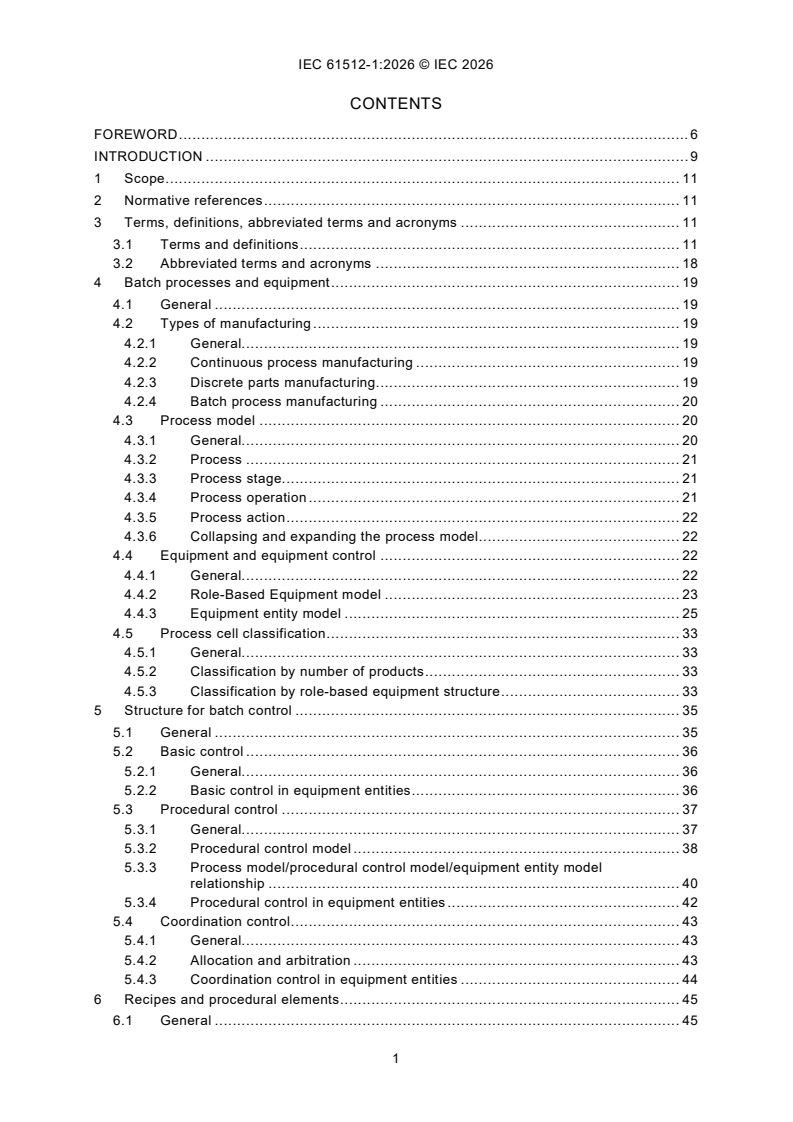
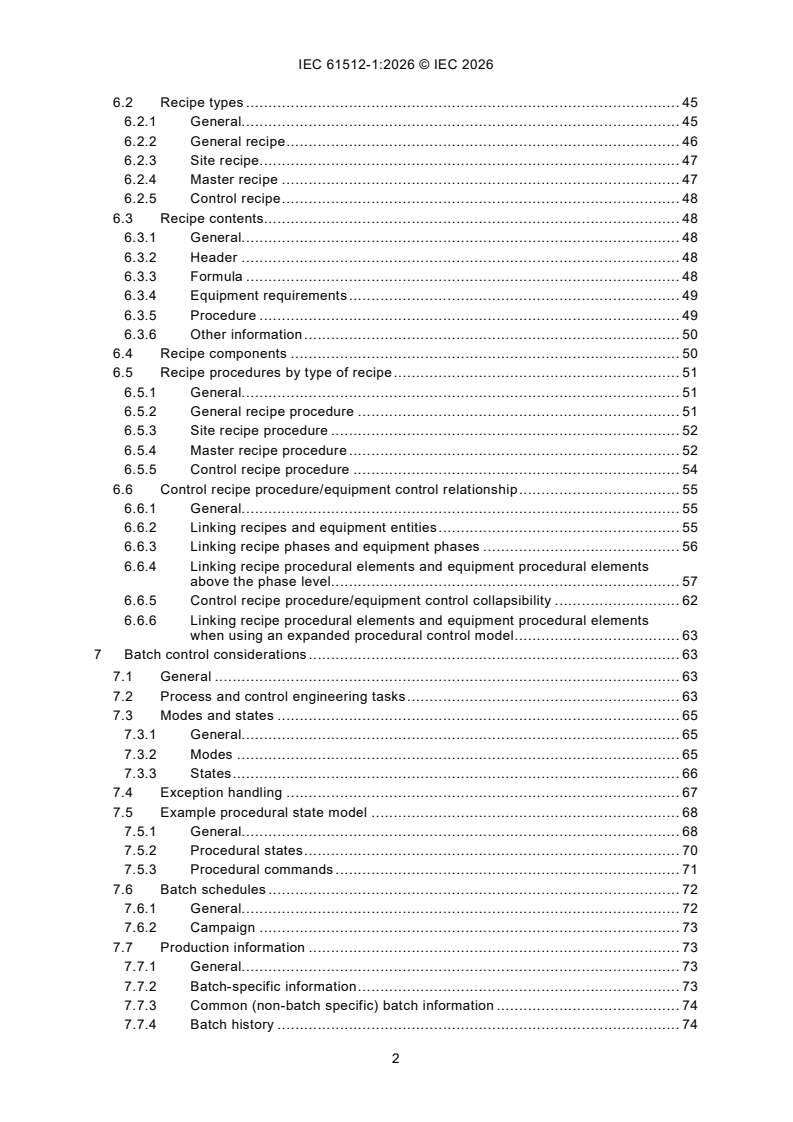
CONTENTS
FOREWORD . 6
INTRODUCTION . 9
1 Scope . 11
2 Normative references . 11
3 Terms, definitions, abbreviated terms and acronyms . 11
3.1 Terms and definitions . 11
3.2 Abbreviated terms and acronyms . 18
4 Batch processes and equipment . 19
4.1 General . 19
4.2 Types of manufacturing . 19
4.2.1 General. 19
4.2.2 Continuous process manufacturing . 19
4.2.3 Discrete parts manufacturing . 19
4.2.4 Batch process manufacturing . 20
4.3 Process model . 20
4.3.1 General. 20
4.3.2 Process . 21
4.3.3 Process stage. 21
4.3.4 Process operation . 21
4.3.5 Process action . 22
4.3.6 Collapsing and expanding the process model . 22
4.4 Equipment and equipment control . 22
4.4.1 General. 22
4.4.2 Role-Based Equipment model . 23
4.4.3 Equipment entity model . 25
4.5 Process cell classification . 33
4.5.1 General. 33
4.5.2 Classification by number of products . 33
4.5.3 Classification by role-based equipment structure . 33
5 Structure for batch control . 35
5.1 General . 35
5.2 Basic control . 36
5.2.1 General. 36
5.2.2 Basic control in equipment entities . 36
5.3 Procedural control . 37
5.3.1 General. 37
5.3.2 Procedural control model . 38
5.3.3 Process model/procedural control model/equipment entity model
relationship . 40
5.3.4 Procedural control in equipment entities . 42
5.4 Coordination control . 43
5.4.1 General. 43
5.4.2 Allocation and arbitration . 43
5.4.3 Coordination control in equipment entities . 44
6 Recipes and procedural elements . 45
6.1 General . 45
6.2 Recipe types . 45
6.2.1 General. 45
6.2.2 General recipe . 46
6.2.3 Site recipe . 47
6.2.4 Master recipe . 47
6.2.5 Control recipe . 48
6.3 Recipe contents. 48
6.3.1 General. 48
6.3.2 Header . 48
6.3.3 Formula . 48
6.3.4 Equipment requirements . 49
6.3.5 Procedure . 49
6.3.6 Other information . 50
6.4 Recipe components . 50
6.5 Recipe procedures by type of recipe . 51
6.5.1 General. 51
6.5.2 General recipe procedure . 51
6.5.3 Site recipe procedure . 52
6.5.4 Master recipe procedure . 52
6.5.5 Control recipe procedure . 54
6.6 Control recipe procedure/equipment control relationship . 55
6.6.1 General. 55
6.6.2 Linking recipes and equipment entities . 55
6.6.3 Linking recipe phases and equipment phases . 56
6.6.4 Linking recipe procedural elements and equipment procedural elements
above the phase level. 57
6.6.5 Control recipe procedure/equipment control collapsibility . 62
6.6.6 Linking recipe procedural elements and equipment procedural elements
when using an expanded procedural control model . 63
7 Batch control considerations . 63
7.1 General . 63
7.2 Process and control engineering tasks . 63
7.3 Modes and states . 65
7.3.1 General. 65
7.3.2 Modes . 65
7.3.3 States . 66
7.4 Exception handling . 67
7.5 Example procedural state model . 68
7.5.1 General. 68
7.5.2 Procedural states . 70
7.5.3 Procedural commands . 71
7.6 Batch schedules . 72
7.6.1 General. 72
7.6.2 Campaign . 73
7.7 Production information . 73
7.7.1 General. 73
7.7.2 Batch-specific information . 73
7.7.3 Common (non-batch specific) batch information . 74
7.7.4 Batch history . 74
7.7.5 Batch reports . 75
8 Activities and functions in batch control. 75
8.1 General . 75
8.2 Control activity model . 75
8.2.1 General. 75
8.2.2 Information handling . 76
8.3 Recipe Management . 78
8.3.1 General. 78
8.3.2 Manage general recipes . 78
8.3.3 Define general recipe procedural elements . 79
8.3.4 Manage site recipes . 79
8.3.5 Manage master recipes . 79
8.3.6 Define master recipe procedural elements . 80
8.4 Production Planning and Scheduling . 81
8.5 Production Information Management . 81
8.5.1 General. 81
8.5.2 Receiving and storing batch history information. 82
8.5.3 Manipulating historical data . 85
8.5.4 Producing batch reports . 85
8.6 Process Cell Management . 86
8.6.1 General. 86
8.6.2 Manage batches . 88
8.6.3 Track and allocate process cell resources . 89
8.6.4 Collect batch and process cell information . 90
8.7 Unit Supervision . 90
8.7.1 General. 90
8.7.2 Acquire and execute procedural elements . 91
8.7.3 Manage unit resources . 92
8.7.4 Collect batch and unit information . 92
8.8 Process Control . 93
8.8.1 General. 93
8.8.2 Execute equipment procedural control. 94
8.8.3 Execute basic control . 94
8.8.4 Collect data . 94
8.9 Personnel and Environmental Protection . 95
9 Completeness, compliance, and conformance . 95
9.1 Completeness . 95
9.2 Compliance . 96
9.3 Conformance. 96
Annex A (informative) Model philosophy . 97
Annex B (informative) Reference procedural state model . 98
B.1 General . 98
B.2 Procedural states . 103
B.3 Procedural commands . 105
B.4 Using collapsed or expanded versions of the Reference Procedural State
Model . 105
Annex C (informative) Frequently asked questions . 107
C.1 Conformance and compliance . 107
C.2 Batch manufacturing roles . 107
C.3 Exception handling details . 108
C.4 Further description of basic control . 109
C.5 Further description of equipment modules . 110
C.6 Recipe building blocks . 111
C.7 Processing a recipe . 111
C.8 Multiple batches through units . 112
Annex D (informative) Software entities explanation . 113
D.1 General . 113
D.2 Enhanced PID configurations . 113
D.3 Advanced process control . 113
D.4 Virtual (soft) sensors based on a single measurement . 113
D.5 Virtual (soft) sensors based on multiple measurements . 113
D.6 Permanent software interlocks . 113
D.7 Data validity checking, data reduction, etc. algorithms . 114
Annex E (informative) Overview of IEC 61512-1:2025 changes . 115
E.1 General . 115
E.2 Key clarifications . 115
E.3 Changes in definitions . 116
E.4 Changes in structure . 116
E.5 Changes in models . 120
E.5.1 What has been updated . 120
E.5.2 What has been added . 125
E.5.3 What has been removed . 127
E.6 Other changes . 128
E.7 Summary . 128
Bibliography . 129
Figure 1 – Process model (instance diagram) when not collapsed or expanded . 21
Figure 2 – Example of Role-Based Equipment model . 24
Figure 3 – Equipment entity model . 26
Figure 4 – Equipment entity model example 1 . 32
Figure 5 – Equipment entity model example 2 . 32
Figure 6 – Single-path structure . 33
Figure 7 – Multiple-path structure . 34
Figure 8 – Network structure . 35
Figure 9 – Procedural control model (instance diagram) when not collapsed or
expanded . 38
Figure 10 – Typical process/procedure/equipment mapping to achieve process
functionality . 41
Figure 11 – Recipe types model . 46
Figure 12 – Master recipe component encapsulation . 50
Figure 13 – General recipe procedure model . 52
Figure 14 – Master recipe procedure model. 53
Figure 15 – Information flow from general recipe to equipment entity . 56
Figure 16 – Control recipe procedure referencing equipment procedural elements at
the phase level . 57
Figure 17 – Control recipe referencing equipment procedural elements at the operation
level; equipment procedural control structure undefined . 58
Figure 18 – Control recipe referencing equipment procedural elements at the operation
level; combination implements the full procedural control model . 59
Figure 19 – Control recipe referencing equipment procedural elements at the unit
procedure level; equipment procedural control structure undefined . 59
Figure 20 – Control recipe referencing equipment procedural elements at the unit
procedure level; combination implements the full procedural control model . 60
Figure 21 – Control recipe referencing equipment procedural elements at the
procedure level; equipment procedural control structure undefined . 60
Figure 22 – Control recipe referencing equipment procedural elements at the
procedure level; combination implements the full procedural control model . 61
Figure 23 – Referencing equipment procedural elements at different levels within the
same recipe procedure. 62
Figure 24 – Control recipe procedure/equipment procedure collapsibility examples . 63
Figure 25 – Simultaneous definition/selection of procedural elements and equipment
entities . 64
Figure 26 – State transition diagram for example states for procedural elements. 69
Figure 27 – Control activity model . 76
Figure 28 – Recipe Management . 78
Figure 29 – Process Cell Management. 87
Figure 30 – Unit Supervision . 91
Figure 31 – Process Control . 93
Figure B.1 – State transition diagram for the reference procedural state model . 101
Figure E.1 – Changes in structure (1 of 4) . 117
Figure E.2 – Changes in structure (2 of 4) . 118
Figure E.3 – Changes in structure (3 of 4) . 118
Figure E.4 – Changes in structure (4 of 4) . 119
Figure E.5 – Updated: Process model . 120
Figure E.6 – Updated: Role-based Equipment role . 121
Figure E.7 – Updated: Process cell path structures . 122
Figure E.8 – Updated: Process/procedure/equipment mapping to achieve process
functionality . 123
Figure E.9 – Updated: Recipe types model . 123
Figure E.10 – Updated: Control recipe procedure linking examples . 124
Figure E.11 – Updated: Procedure/equipment procedure collapsibility examples . 124
Figure E.12 – Updated: Example state model . 125
Figure E.13 – Removed: Procedural element relationships in the site recipe and master
recipe . 127
Figure E.14 – Removed: Control recipe procedure/equipment control separation . 127
Table 1 – Example modes . 66
Table 2 – State transition matrix for example states for procedural elements . 70
Table 3 – State descriptions in the example procedural state model . 70
Table B.1 – State transition matrix for the reference procedural state model . 101
Table B.2 – State descriptions in the reference procedural state model . 103
INTERNATIONAL ELECTROTECHNICAL COMMISSION
____________
Batch control -
Part 1: Models and terminology
FOREWORD
1) The International Electrotechnical Commission (IEC) is a worldwide organization for standardization comprising
all national electrotechnical committees (IEC National Committees). The object of IEC is to promote international
co-operation on all questions concerning standardization in the electrical and electronic fields. To this end and
in addition to other activities, IEC publishes International Standards, Technical Specifications, Technical Reports,
Publicly Available Specifications (PAS) and Guides (hereafter referred to as "IEC Publication(s)"). Their
preparation is entrusted to technical committees; any IEC National Committee interested in the subject dealt with
may participate in this preparatory work. International, governmental and non-governmental organizations liaising
with the IEC also participate in this preparation. IEC collaborates closely with the International Organization for
Standardization (ISO) in accordance with conditions determined by agreement between the two organizations.
2) The formal decisions or agreements of IEC on technical matters express, as nearly as possible, an international
consensus of opinion on the relevant subjects since each technical committee has representation from all
interested IEC National Committees.
3) IEC Publications have the form of recommendations for international use and are accepted by IEC National
Committees in that sense. While all reasonable efforts are made to ensure that the technical content of IEC
Publications is accurate, IEC cannot be held responsible for the way in which they are used or for any
misinterpretation by any end user.
4) In order to promote international uniformity, IEC National Committees undertake to apply IEC Publications
transparently to the maximum extent possible in their national and regional publications. Any divergence between
any IEC Publication and the corresponding national or regional publication shall be clearly indicated in the latter.
5) IEC itself does not provide any attestation of conformity. Independent certification bodies provide conformity
assessment services and, in some areas, access to IEC marks of conformity. IEC is not responsible for any
services carried out by independent certification bodies.
6) All users should ensure that they have the latest edition of this publication.
7) No liability shall attach to IEC or its directors, employees, servants or agents including individual experts and
members of its technical committees and IEC National Committees for any personal injury, property damage or
other damage of any nature whatsoever, whether direct or indirect, or for costs (including legal fees) and
expenses arising out of the publication, use of, or reliance upon, this IEC Publication or any other IEC
Publications.
8) Attention is drawn to the Normative references cited in this publication. Use of the referenced publications is
indispensable for the correct application of this publication.
9) IEC draws attention to the possibility that the implementation of this document may involve the use of (a)
patent(s). IEC takes no position concerning the evidence, validity or applicability of any claimed patent rights in
respect thereof. As of the date of publication of this document, IEC had not received notice of (a) patent(s), which
may be required to implement this document. However, implementers are cautioned that this may not represent
the latest information, which may be obtained from the patent database available at https://patents.iec.ch. IEC
shall not be held responsible for identifying any or all such patent rights.
IEC 61512-1 has been prepared by subcommittee 65A: System aspects, of IEC technical
committee 65: Industrial-process measurement and control. It is an International Standard.
This second edition cancels and replaces the first edition published in 1997. This edition
constitutes a technical revision.
This edition includes the following significant technical changes with respect to the previous
edition:
a) Models and text are modified to provide more detail and clarity. Key clarifications are:
1) Two types of equipment modules are defined: generic and recipe-aware. All recipe-
aware equipment modules contain procedural control and can be used as phases in the
recipe.
2) Execution of all procedural control contained directly in units is part of the Unit
Supervision activity.
3) The relationships between types of recipes, recipe components, and equipment control
are more fully described and illustrated.
4) Entity relationship diagrams have been replaced with more intuitive UML instance
diagrams, except for the equipment entity model.
5) The transition diagram for the procedural states example has been updated with a more
intuitive and complete UML state diagram.
6) References to other standards in the series and to IEC 62264 are included to provide
direction for further clarification of selected topics.
7) Activity names are capitalised to help prevent confusion with similar terms, such as their
underlying functions.
b) Previous Clauses 4 through 6 (now Clauses 4 through 8) were rearranged to provide a
clearer top-down organisation of the document. Key changes are:
1) Removing the lower levels of the physical (role-based equipment) model (see 4.4.2) to
eliminate redundancy because their groupings are defined by the associated
functionality in the equipment entity model and are not meaningful for batch control
without those associations.
2) Describing equipment control and the equipment entity model immediately after the
physical (role-based equipment) model and describing each level as completely as
possible without excessive use of forward references (see 4.4.3).
3) Combining the descriptions of basic, procedural, and coordination control with their
usage in each type of equipment entity, providing a single consolidated discussion of
each type of control (see Clause 5).
4) Additional considerations to support application of the models have been grouped in
Clause 7 to clarify their supporting relationship to the core models.
c) Clause 9 was added to define completeness, compliance, and conformance in relation to
this document.
d) Annex B was added to provide a more expansive procedural state reference model. The
model found in Clause 7 can be considered a collapsed version of this more general model.
e) Annex C was added to clarify a number of points concerning the models, their application,
and the new Clause 9 on conformance and compliance.
f) Annex E was added to more fully describe the changes in this update to IEC 61512-1:1997.
The text of this International Standard is based on the following documents:
Draft Report on voting
65A/1178/FDIS 65A/1197/RVD
Full information on the voting for its approval can be found in the report on voting indicated in
the above table.
The language used for the development of this International Standard is English.
This document was drafted in accordance with ISO/IEC Directives, Part 2, and developed in
accordance with ISO/IEC Directives, Part 1 and ISO/IEC Directives, IEC Supplement, available
at www.iec.ch/members_experts/refdocs. The main document types developed by IEC are
described in greater detail at www.iec.ch/publications.
In this standard, the following print type is used:
Defined terms are italicised in the body of this document to avoid misinterpretation based on
meanings outside of the IEC 61512 series.
A list of all parts in the IEC 61512 series, published under the general title Batch control, can
be found on the IEC website.
The committee has decided that the contents of this document will remain unchanged until the
stability date indicated on the IEC website under webstore.iec.ch in the data related to the
specific document. At this date, the document will be
– reconfirmed,
– withdrawn, or
– revised.
INTRODUCTION
The IEC 61512 series of standards comprises several parts. This document describes an
overarching framework of models and definitions for batch manufacturing. Other parts of the
series describe in more detail particular focus areas within this framework.
All IEC documents follow a fixed structure consisting of Clause 1 “Scope”, Clause 2 “Normative
references” and Clause 3 “Terms and definitions”. This document therefore contains a
Normative references clause even if it is empty.
Clause 3 provides terms and definitions that are important for the understanding of certain terms
used in the document. Each definition can be considered a summary statement for the
associated term. Since this document defines models and terminology as a whole, all of its
provisions contribute to each term’s full meaning and to its relationship to the models.
Clauses 4 through 8 incrementally complete these definitions by starting at a very high level,
progressively detailing a set of conceptual models, and describing how they collectively interact
to control of a production of a batch. The models are presumed to be complete as indicated.
However, they can be collapsed and expanded as described in the explanation of each model.
Clause 4 Batch processes and equipment is normative. The intent of this clause is to provide
models and terminology that describe batch processes and the equipment used to perform
them.
Clause 5 Structure for batch control is normative. The intent is to describe three types of control
used in batch processing and their relationships to the previously defined process and
equipment models.
Clause 6 Recipes and procedural elements is normative. The intent is to describe the roles and
contents of four types of recipes used in batch manufacturing, their use of the previously defined
process and procedural control models, and their connection to equipment control.
Clause 7 Batch control considerations is normative. The intent is to describe additional
considerations related to iterative design, exception handling, modes and states, production
plans and schedules, and production information.
Clause 8 Activities and functions in batch control is normative. The intent is to describe the
control activities that are necessary to address the diverse control requirements of batch
manufacturing.
Clause 9 Completeness, compliance, and conformance is normative. The intent is to define
compliance and conformance relative to the normative models and terminology in this
document.
Annex A is informative. It provides guidance towards understanding the model types used in
this document. Usage of UML instance diagrams and state diagrams is described in Annex A
and contrasted with the corresponding figures of IEC 61512-1:1997 as shown in Annex E.
Annex B is informative. It provides a more expansive procedural state reference model. The
model found in 7.5 can be considered a collapsed version of this more general model.
Annex C is informative. It provides answers to typical questions that can arise in applying this
document.
Annex D is informative. It provides further explanation of the software entities listed in 4.2.
Annex E is informative. It provides a summary of the changes made in this update as compared
with IEC 61512-1:1997.
The bibliography is informative, giving references for further investigation concerning safety
and other relevant standards.
This document is intended for those who are
• involved in the design, operation, or both of batch manufacturing plants,
• responsible for specifying controls and the associated application programs for batch
manufacturing plants, or
• involved in the design and marketing of products in the area of batch control.
This document defines standard models and terminology for specifying the control requirements
for batch manufacturing plants. The models and terminology
• emphasise good practices for the design and operation of batch manufacturing plants,
• can be used to improve control of batch manufacturing plants, and
• can be applied regardless of the degree of automation.
This document provides standard terminology and a consistent set of concepts and models for
batch manufacturing plants and batch control that are intended to
• improve communications between all parties involved,
• reduce the user's time to reach full production levels for new products,
• enable vendors to supply appropriate tools for implementing batch control,
• enable users to better identify their needs,
• make recipe development straightforward enough to be accomplished without the services
of a control systems engineer,
• reduce the cost of automating batch processes, and
• reduce life-cycle engineering efforts.
It is not the intent of this document to
• suggest that there is only one way to implement or apply batch control,
• force users to abandon their current way of dealing with their batch processes, or
• restrict development in the area of batch control.
The key concepts defined in this document are:
• description of recipes, procedures, their contents, and their structure;
• definition of levels of recipes and procedures;
• recognition of product specific recipes and procedures that are separate from process-
oriented equipment and its direct control;
• identification of a hierarchy of manufacturing equipment and its dedicated control;
• recognition of equipment capabilities that are utilised during recipe and procedure driven
production; and
• recognition of the need for modular and reusable control functionality.
1 Scope
This part of IEC 61512 applies to systems, specifications, and their use for implementing batch
and related procedure-oriented manufacturing controls in the process industries. This document
establishes a reference model framework for procedure-oriented control, defines terms to help
explain the model relationships and usage, and describes general criteria for evaluating
conformance. This follows the principle of separation between recipe procedural elements and
equipment procedural elements enabling operations to define recipes without the need of
changes in equipment procedures.
2 Normative references
There are no normative references in this document.
3 Terms, definitions, abbreviated terms and acronyms
3.1 Terms and definitions
For the purposes of this document, the following terms and definitions apply.
ISO and IEC maintain terminology databases for use in standardization at the following
addresses:
– IEC Electropedia: available at https://www.electropedia.org/
– ISO Online browsing platform: available at https://www.iso.org/obp
3.1.1
allocation
form of coordination control that assigns a resource or part of a resource to a recipe, a
procedural element, or an equipment entity as appropriate
3.1.2
arbitration
form of coordination control that determines how a resource should be allocated when there are
more requests for the resource than can be accommodated at one time
3.1.3
area
role-based equipment entity or component of a site that is identified by physical, geographical,
operational, or logical segmentation within the site
Note 1 to entry: The area can contain process cells, production units, production lines, and storage zones.
3.1.4
basic control
control dedicated to estab
...
IEC 61512-1 ®
Edition 2.0 2026-02
NORME
INTERNATIONALE
Contrôle-commande des processus de fabrication par lots (batch) -
Partie 1: Modèles et terminologie
ICS 25.040.40; 01.040.25 ISBN 978-2-8327-1031-9
Droits de reproduction réservés. Sauf indication contraire, aucune partie de cette publication ne peut être reproduite ni
utilisée sous quelque forme que ce soit et par aucun procédé, électronique ou mécanique, y compris la photocopie et
les microfilms, sans l'accord écrit de l'IEC ou du Comité national de l'IEC du pays du demandeur. Si vous avez des
questions sur le copyright de l'IEC ou si vous désirez obtenir des droits supplémentaires sur cette publication, utilisez
les coordonnées ci-après ou contactez le Comité national de l'IEC de votre pays de résidence.
IEC Secretariat Tel.: +41 22 919 02 11
3, rue de Varembé info@iec.ch
CH-1211 Geneva 20 www.iec.ch
Switzerland
A propos de l'IEC
La Commission Electrotechnique Internationale (IEC) est la première organisation mondiale qui élabore et publie des
Normes internationales pour tout ce qui a trait à l'électricité, à l'électronique et aux technologies apparentées.
A propos des publications IEC
Le contenu technique des publications IEC est constamment revu. Veuillez vous assurer que vous possédez l’édition la
plus récente, un corrigendum ou amendement peut avoir été publié.
Recherche de publications IEC - IEC Products & Services Portal - products.iec.ch
webstore.iec.ch/advsearchform Découvrez notre puissant moteur de recherche et consultez
La recherche avancée permet de trouver des publications gratuitement tous les aperçus des publications, symboles
IEC en utilisant différents critères (numéro de référence, graphiques et le glossaire. Avec un abonnement, vous aurez
texte, comité d’études, …). Elle donne aussi des toujours accès à un contenu à jour adapté à vos besoins.
informations sur les projets et les publications remplacées
ou retirées. Electropedia - www.electropedia.org
Le premier dictionnaire d'électrotechnologie en ligne au
IEC Just Published - webstore.iec.ch/justpublished monde, avec plus de 22 500 articles terminologiques en
Restez informé sur les nouvelles publications IEC. Just anglais et en français, ainsi que les termes équivalents
Published détaille les nouvelles publications parues. dans 25 langues additionnelles. Egalement appelé
Disponible en ligne et une fois par mois par email. Vocabulaire Electrotechnique International (IEV) en ligne.
Service Clients - webstore.iec.ch/csc
Si vous désirez nous donner des commentaires sur cette
publication ou si vous avez des questions contactez-
nous: sales@iec.ch.
SOMMAIRE
AVANT-PROPOS . 7
INTRODUCTION . 10
1 Domaine d'application . 13
2 Références normatives . 13
3 Termes, définitions, abréviations et acronymes . 13
3.1 Termes et définitions. 13
3.2 Abréviations et acronymes . 21
4 Processus par lots et équipements . 21
4.1 Généralités . 21
4.2 Types de fabrication. 21
4.2.1 Généralités . 21
4.2.2 Processus de fabrication en continu . 22
4.2.3 Fabrication de pièces discrètes . 22
4.2.4 Fabrication de processus par lots . 22
4.3 Modèle de processus . 23
4.3.1 Généralités . 23
4.3.2 Processus . 23
4.3.3 Stade de processus. 23
4.3.4 Opération de processus . 24
4.3.5 Action de processus . 24
4.3.6 Réduction et développement du modèle de processus . 24
4.4 Commande d'équipement et équipement . 25
4.4.1 Généralités . 25
4.4.2 Modèle d'équipements fondés sur les rôles . 25
4.4.3 Modèle d'entités d'équipement . 28
4.5 Classification des cellules de processus . 36
4.5.1 Généralités . 36
4.5.2 Classification par nombre de produits . 36
4.5.3 Classification par structure d'équipement fondé sur les rôles . 36
5 Structure de contrôle-commande des processus de fabrication par lots . 38
5.1 Généralités . 38
5.2 Commande de base . 39
5.2.1 Généralités . 39
5.2.2 Commande de base dans les entités d'équipement . 39
5.3 Automatisation de procédure . 40
5.3.1 Généralités . 40
5.3.2 Modèle d'automatisation de procédure . 41
5.3.3 Relation entre le modèle de processus/modèle d'automatisation de
procédure/modèle d'entités d'équipement . 44
5.3.4 Automatisation de procédure dans les entités d'équipement . 46
5.4 Automatisme de coordination . 47
5.4.1 Généralités . 47
5.4.2 Affectation et arbitrage . 47
5.4.3 Automatisme de coordination dans les entités d'équipement. 48
6 Recettes et éléments de procédure . 49
6.1 Généralités . 49
6.2 Types de recettes . 50
6.2.1 Généralités . 50
6.2.2 Recette générale . 51
6.2.3 Recette de site . 51
6.2.4 Recette principale . 52
6.2.5 Recette exécutable . 52
6.3 Contenu des recettes . 53
6.3.1 Généralités . 53
6.3.2 En-tête. 53
6.3.3 Formule . 53
6.3.4 Exigences relatives à l'équipement . 54
6.3.5 Procédure . 54
6.3.6 Autres informations . 54
6.4 Composants des recettes . 55
6.5 Procédures de recette par type de recette . 56
6.5.1 Généralités . 56
6.5.2 Procédure de recette générale . 56
6.5.3 Procédure de recette de site . 57
6.5.4 Procédure de recette principale . 57
6.5.5 Procédure de recette exécutable . 59
6.6 Relation entre la procédure de recette exécutable et la commande
d'équipement . 60
6.6.1 Généralités . 60
6.6.2 Lien entre les recettes et les entités d'équipement . 60
6.6.3 Lien entre les phases de recette et les phases d'équipement . 61
6.6.4 Lien entre les éléments de procédure de recette et les éléments de
procédure d'équipement situés au-dessus du niveau de la phase . 62
6.6.5 Réductibilité de la procédure de recette exécutable/de la commande
d'équipement . 67
6.6.6 Lien entre les éléments de procédure de recette et les éléments de
procédure d'équipement lors de l'utilisation d'un modèle développé
d'automatisation de procédure . 68
7 Considérations relatives au contrôle-commande des processus de fabrication par
lots . 68
7.1 Généralités . 68
7.2 Tâches d'ingénierie de processus et de commande . 68
7.3 Modes de contrôle et états. 70
7.3.1 Généralités . 70
7.3.2 Modes de contrôle . 70
7.3.3 États . 71
7.4 Traitement des exceptions . 72
7.5 Exemple de modèle d'état de procédure . 74
7.5.1 Généralités . 74
7.5.2 États de procédure . 76
7.5.3 Commandes de procédure . 78
7.6 Programmes de lots . 78
7.6.1 Généralités . 78
7.6.2 Campagne . 79
7.7 Informations relatives à la fabrication . 80
7.7.1 Généralités . 80
7.7.2 Informations spécifiques à un lot . 80
7.7.3 Informations communes aux lots (non spécifiques à un lot) . 81
7.7.4 Historique du lot . 81
7.7.5 Rapports de lots . 82
8 Activités et fonctions de contrôle-commande des processus de fabrication par lots . 82
8.1 Généralités . 82
8.2 Modèle d'activité de commande . 82
8.2.1 Généralités . 82
8.2.2 Traitement des informations . 83
8.3 Gestion de recette . 85
8.3.1 Généralités . 85
8.3.2 Gestion des recettes générales . 86
8.3.3 Définition des éléments de procédure de la recette générale . 86
8.3.4 Gestion des recettes de site . 87
8.3.5 Gestion des recettes principales . 87
8.3.6 Définition des éléments de procédure de la recette principale . 87
8.4 Planification et programmation de la fabrication . 88
8.5 Gestion des informations relatives à la fabrication . 89
8.5.1 Généralités . 89
8.5.2 Réception et stockage des informations relatives à l'historique du lot . 90
8.5.3 Manipulation des données historiques . 93
8.5.4 Production de rapports de lots . 94
8.6 Gestion de cellule de processus . 95
8.6.1 Généralités . 95
8.6.2 Gestion des lots . 97
8.6.3 Traçage et affectation des ressources de cellule de processus . 98
8.6.4 Recueil des informations relatives au lot et à la cellule de processus . 99
8.7 Supervision d'unité . 100
8.7.1 Généralités . 100
8.7.2 Acquisition et exécution des éléments de procédure . 101
8.7.3 Gestion des ressources d'unité . 101
8.7.4 Recueil des informations relatives au lot et à l'unité . 102
8.8 Commande de processus . 102
8.8.1 Généralités . 102
8.8.2 Exécution de l'automatisation de procédure de l'équipement . 103
8.8.3 Exécution de la commande de base . 104
8.8.4 Recueil de données. 104
8.9 Sécurité du personnel et protection de l'environnement . 104
9 Complétude, conformité des spécifications et conformité de l'application . 105
9.1 Complétude . 105
9.2 Conformité des spécifications . 106
9.3 Conformité de l'application . 106
Annexe A (informative) Philosophie du modèle . 107
Annexe B (informative) Modèle de référence d'état de procédure . 108
B.1 Généralités . 108
B.2 États de procédure . 114
B.3 Commandes de procédure . 116
B.4 Utilisation des versions réduites ou développées du Modèle de référence
d'état de procédure . 117
Annexe C (informative) Foire aux questions . 119
C.1 Conformité de l'application et conformité des spécifications . 119
C.2 Rôles impliqués dans la fabrication par lots . 119
C.3 Détails relatifs au traitement des exceptions . 120
C.4 Description supplémentaire de la commande de base. 121
C.5 Description détaillée des modules d'équipement . 122
C.6 Blocs de construction de recette. 123
C.7 Traitement d'une recette . 124
C.8 Lots multiples à travers les unités. 124
Annexe D (informative) Explication d'entités logicielles . 126
D.1 Généralités . 126
D.2 Configurations PID améliorées . 126
D.3 Commande de processus avancée . 126
D.4 Capteurs virtuels (logiciels) fondés sur une mesure unique . 126
D.5 Capteurs virtuels (logiciels) fondés sur plusieurs mesures . 126
D.6 Verrouillages logiciels permanents . 127
D.7 Vérification de la validité des données, réduction des données, etc.,
algorithmes . 127
Annexe E (informative) Vue d'ensemble des modifications de l'IEC 61512-1:2025 . 128
E.1 Généralités . 128
E.2 Principales clarifications . 128
E.3 Modifications apportées aux définitions . 129
E.4 Modifications dans la structure . 129
E.5 Modifications apportées aux modèles . 133
E.5.1 Éléments mis à jour . 133
E.5.2 Éléments ajoutés . 138
E.5.3 Éléments supprimés . 140
E.6 Autres modifications. 141
E.7 Récapitulatif . 142
Bibliographie . 143
Figure 1 – Modèle de processus (diagramme d'instance) lorsqu'il n'est ni réduit ni
développé . 23
Figure 2 – Exemple de modèle d'équipements fondés sur les rôles . 26
Figure 3 – Modèle d'entités d'équipement . 28
Figure 4 – Exemple de modèle d'entités d'équipement 1 . 35
Figure 5 – Exemple de modèle d'entités d'équipement 2 . 35
Figure 6 – Structure à cheminement simple . 36
Figure 7 – Structure à cheminement multiple . 37
Figure 8 – Structure en réseau. 38
Figure 9 – Modèle d'automatisation de procédure (diagramme d'instance) lorsqu'il n'est
ni réduit ni développé. 41
Figure 10 – Description type des processus, des procédures et des équipements en
vue d'assurer la fonctionnalité de processus . 45
Figure 11 – Modèle des types de recettes . 50
Figure 12 – Encapsulage d'un composant de la recette principale . 55
Figure 13 – Modèle de procédure de recette générale . 57
Figure 14 – Modèle de procédure de recette principale. 58
Figure 15 – Flux d'informations entre une recette générale et une entité d'équipement . 61
Figure 16 – Procédure de la recette exécutable faisant référence aux éléments de
procédure d'équipement au niveau de la phase . 62
Figure 17 – Recette exécutable faisant référence aux éléments de procédure
d'équipement au niveau opérationnel; structure de commande de procédure de
l'équipement non définie . 63
Figure 18 – Recette exécutable faisant référence aux éléments de procédure
d'équipement au niveau opérationnel; combinaison mettant en œuvre le modèle
d'automatisation de procédure complet . 64
Figure 19 – Recette exécutable faisant référence aux éléments de procédure
d'équipement au niveau de la procédure d'unité; structure de commande de procédure
de l'équipement non définie . 64
Figure 20 – Recette exécutable faisant référence aux éléments de procédure
d'équipement au niveau de la procédure d'unité; combinaison mettant en œuvre le
modèle d'automatisation de procédure complet . 65
Figure 21 – Recette exécutable faisant référence aux éléments de procédure
d'équipement au niveau de la procédure; structure de commande de procédure de
l'équipement non définie . 65
Figure 22 – Recette exécutable faisant référence aux éléments de procédure
d'équipement au niveau de la procédure; combinaison mettant en œuvre le modèle
d'automatisation de procédure complet . 66
Figure 23 – Référencement d'éléments de procédure d'équipement à différents niveaux
dans la même procédure de recette. 67
Figure 24 – Exemples de réductibilité de la procédure de recette exécutable/ de la
procédure d'équipement . 68
Figure 25 – Définition/sélection simultanée des éléments de procédure et des entités
d'équipement . 69
Figure 26 – Diagramme de transition d'état pour les exemples d'états concernant les
éléments de procédure. 75
Figure 27 – Modèle d'activité de commande . 83
Figure 28 – Gestion de recette . 86
Figure 29 – Gestion de cellule de processus . 96
Figure 30 – Supervision d'unité . 100
Figure 31 – Commande de processus . 103
Figure B.1 – Schéma de transition d'états pour le modèle de référence d'état de
procédure . 111
Figure E.1 – Modifications de structure (1 sur 4) . 130
Figure E.2 – Modifications de structure (2 sur 4) . 131
Figure E.3 – Modifications de structure (3 sur 4) . 131
Figure E.4 – Modifications de structure (4 sur 4) . 132
Figure E.5 – Mise à jour: Modèle de processus . 133
Figure E.6 – Mise à jour: Rôle des équipements fondés sur les rôles . 134
Figure E.7 – Mise à jour: Structures du cheminement de cellule de processus . 135
Figure E.8 – Mise à jour: Mapping de processus/de procédures/d'équipements pour
atteindre la fonctionnalité de processus . 136
Figure E.9 – Mise à jour: Modèle des types de recettes . 136
Figure E.10 – Mise à jour: Exemples de procédures de mise en relation de recette de
commande . 137
Figure E.11 – Mise à jour: Exemples de réduction de procédure/procédure
d'équipement . 137
Figure E.12 – Mise à jour: Exemple de modèle d'état . 138
Figure E.13 – Supprimée: Relations entre les éléments de procédure de la recette de
site et ceux de la recette principale . 140
Figure E.14 – Supprimée: Séparation de la procédure de recette exécutable et de la
commande d'équipement . 141
Tableau 1 – Exemples de modes de contrôle. 71
Tableau 2 – Matrice de transition d'état pour les exemples d'états concernant les
éléments de procédure. 76
Tableau 3 – Descriptions des états dans l'exemple de modèle d'état de procédure . 77
Tableau B.1 – Matrice de transition d'états pour le modèle de référence d'état de
procédure . 111
Tableau B.2 – Description des états dans le modèle de référence d'état de procédure . 114
COMMISSION ÉLECTROTECHNIQUE INTERNATIONALE
____________
Contrôle-commande des processus de fabrication par lots (batch) -
Partie 1: Modèles et terminologie
AVANT-PROPOS
1) La Commission Électrotechnique Internationale (IEC) est une organisation mondiale de normalisation composée
de l'ensemble des comités électrotechniques nationaux (Comités nationaux de l'IEC). L'IEC a pour objet de
favoriser la coopération internationale pour toutes les questions de normalisation dans les domaines de
l'électricité et de l'électronique. À cet effet, l'IEC – entre autres activités – publie des Normes internationales,
des Spécifications techniques, des Rapports techniques, des Spécifications accessibles au public (PAS) et des
Guides (ci-après dénommés "Publication(s) de l'IEC"). Leur élaboration est confiée à des comités d'études, aux
travaux desquels tout Comité national intéressé par le sujet traité peut participer. Les organisations
internationales, gouvernementales et non gouvernementales, en liaison avec l'IEC, participent également aux
travaux. L'IEC collabore étroitement avec l'Organisation Internationale de Normalisation (ISO), selon des
conditions fixées par accord entre les deux organisations.
2) Les décisions ou accords officiels de l'IEC concernant les questions techniques représentent, dans la mesure du
possible, un accord international sur les sujets étudiés, étant donné que les Comités nationaux de l'IEC intéressés
sont représentés dans chaque comité d'études.
3) Les Publications de l'IEC se présentent sous la forme de recommandations internationales et sont agréées
comme telles par les Comités nationaux de l'IEC. Tous les efforts raisonnables sont entrepris afin que l'IEC
s'assure de l'exactitude du contenu technique de ses publications; l'IEC ne peut pas être tenue responsable de
l'éventuelle mauvaise utilisation ou interprétation qui en est faite par un quelconque utilisateur final.
4) Dans le but d'encourager l'uniformité internationale, les Comités nationaux de l'IEC s'engagent, dans toute la
mesure possible, à appliquer de façon transparente les Publications de l'IEC dans leurs publications nationales
et régionales. Toutes divergences entre toutes Publications de l'IEC et toutes publications nationales ou
régionales correspondantes doivent être indiquées en termes clairs dans ces dernières.
5) L'IEC elle-même ne fournit aucune attestation de conformité. Des organismes de certification indépendants
fournissent des services d'évaluation de conformité et, dans certains secteurs, accèdent aux marques de
conformité de l'IEC. L'IEC n'est responsable d'aucun des services effectués par les organismes de certification
indépendants.
6) Tous les utilisateurs doivent s'assurer qu'ils sont en possession de la dernière édition de cette publication.
7) Aucune responsabilité ne doit être imputée à l'IEC, à ses administrateurs, employés, auxiliaires ou mandataires,
y compris ses experts particuliers et les membres de ses comités d'études et des Comités nationaux de l'IEC,
pour tout préjudice causé en cas de dommages corporels et matériels, ou de tout autre dommage de quelque
nature que ce soit, directe ou indirecte, ou pour supporter les coûts (y compris les frais de justice) et les dépenses
découlant de la publication ou de l'utilisation de cette Publication de l'IEC ou de toute autre Publication de l'IEC,
ou au crédit qui lui est accordé.
8) L'attention est attirée sur les références normatives citées dans cette publication. L'utilisation de publications
référencées est obligatoire pour une application correcte de la présente publication.
9) L'IEC attire l'attention sur le fait que la mise en application du présent document peut entraîner l'utilisation d'un
ou de plusieurs brevets. L'IEC ne prend pas position quant à la preuve, à la validité et à l'applicabilité de tout
droit de brevet revendiqué à cet égard. À la date de publication du présent document, l'IEC n'avait pas reçu
notification qu'un ou plusieurs brevets pouvaient être nécessaires à sa mise en application. Toutefois, il y a lieu
d'avertir les responsables de la mise en application du présent document que des informations plus récentes
sont susceptibles de figurer dans la base de données de brevets, disponible à l'adresse https://patents.iec.ch.
L'IEC ne saurait être tenue pour responsable de ne pas avoir identifié tout ou partie de tels droits de brevet.
L'IEC 61512-1 a été établie par le sous-comité 65A: Aspects systèmes, du comité études 65 de
l'IEC: Mesure et commande dans les processus industriels. Il s'agit d'une Norme internationale.
Cette deuxième édition annule et remplace la première édition parue en 1997. Cette édition
constitue une révision technique.
Cette édition inclut les modifications techniques majeures suivantes par rapport à l'édition
précédente:
a) Les modèles et le texte sont modifiés afin de fournir plus de détails et de clarté. Les
principales clarifications suivantes ont été effectuées:
1) Deux types de modules d'équipement sont définis: modules d'équipement génériques et
modules d'équipement spécifiques aux recettes. Tous les modules d'équipement
spécifiques aux recettes comportent une automatisation de procédure et peuvent être
utilisés comme des phases dans la recette.
2) L'exécution de toutes les automatisations de procédures contenues directement dans
les unités relève de l'activité Supervision d'unité.
3) Les relations entre les types de recettes, les composants des recettes et la commande
d'équipement sont décrites et représentées de manière plus détaillée.
4) Les schémas entité-relation ont été remplacés par des diagrammes d'instance UML plus
intuitifs, à l'exception du modèle d'entités d'équipement.
5) Le schéma de transition d'états pour l'exemple d'états de procédure a été mis à jour
avec un schéma d'états UML plus intuitif et complet.
6) Des références à d'autres normes de la série et à l'IEC 62264 sont incluses afin de
fournir des indications permettant de clarifier certains sujets.
7) La première lettre des noms d'activités est écrite en majuscule pour éviter toute
confusion avec des termes similaires, comme leurs fonctions sous-jacentes.
b) Les Articles 4 à 6 de la version précédente (désormais numérotés Articles 4 à 8) ont été
réorganisés afin de fournir une organisation descendante plus claire du document. Les
principales modifications suivantes ont été apportées:
1) Suppression des niveaux inférieurs du modèle physique (équipements fondés sur les
rôles) (voir le 4.4.2) pour éliminer la redondance, car leurs regroupements sont définis
par la fonctionnalité associée dans le modèle d'entités d'équipement et ne sont pas
pertinents pour le contrôle-commande des processus de fabrication par lots sans ces
associations.
2) Description de la commande d'équipement et du modèle d'entités d'équipement
immédiatement après le modèle physique (équipements fondés sur les rôles) et
description la plus complète possible de chaque niveau sans abuser des références
directes (voir le 4.4.3).
3) Association des descriptions concernant les commandes de base, les automatisations
des procédures et les automatismes de coordination, à leur utilisation dans chaque type
d'entité d'équipement, permettant ainsi une discussion consolidée unique sur chaque
type de commande (voir l'Article 5).
4) Des considérations supplémentaires sur l'usage des modèles ont été regroupées à
l'Article 7 afin de clarifier leurs relations connexes avec les modèles fondamentaux.
c) L'Article 9 a été ajouté pour définir la complétude, la conformité des spécifications et la
conformité de l'application par rapport au présent document.
d) L'Annexe B a été ajoutée pour fournir un modèle de référence d'état de procédure plus
vaste. Le modèle décrit à l'Article 7 peut être considéré comme une version réduite de ce
modèle plus général.
e) L'Annexe C a été ajoutée pour clarifier un certain nombre de points sur les modèles et leur
application, ainsi que sur le nouvel Article 9 relatif à la conformité de l'application et la
conformité des spécifications.
f) L'Annexe E a été ajoutée pour décrire de manière plus détaillée les modifications apportées
par la présente mise à jour de l'IEC 61512-1:1997.
Le texte de cette Norme internationale est issu des documents suivants:
Projet Rapport de vote
65A/1178/FDIS 65A/1197/RVD
Le rapport de vote indiqué dans le tableau ci-dessus donne toute information sur le vote ayant
abouti à son approbation.
La langue employée pour l'élaboration de cette Norme internationale est l'anglais.
Ce document a été rédigé selon les Directives ISO/IEC, Partie 2, il a été développé selon les
Directives ISO/IEC, Partie 1 et les Directives ISO/IEC, Supplément IEC, disponibles sous
www.iec.ch/members_experts/refdocs. Les principaux types de documents développés par
l'IEC sont décrits plus en détail sous www.iec.ch/publications.
Dans la présente norme, les caractères d'imprimerie suivants sont utilisés:
Les termes définis sont écrits en italique dans le corps du présent document pour éviter toute
interprétation erronée en raison de significations autres que celles fournies dans la série
IEC 61512.
Une liste de toutes les parties de la série IEC 61512, publiées sous le titre général
Contrôle-commande des processus de fabrication par lots (batch), se trouve sur le site web de
l'IEC.
Le comité a décidé que le contenu de ce document ne sera pas modifié avant la date de stabilité
indiquée sur le site web de l'IEC sous webstore.iec.ch dans les données relatives au document
recherché. À cette date, le document sera
– reconduit,
– supprimé, ou
– révisé.
INTRODUCTION
La série de normes IEC 61512 comporte plusieurs parties. Le présent document décrit un cadre
global de modèles et de définitions pour la fabrication par lots. D'autres parties de la série
décrivent de manière plus détaillée certains points particuliers de ce cadre.
Tous les documents de l'IEC suivent une structure fixe composée de l'Article 1 "Domaine
d'application", de l'Article 2 "Références normatives" et de l'Article 3 "Termes et définitions". Le
présent document contient donc un article "Références normatives", même s'il est vide.
L'Article 3 contient des termes et des définitions importants pour la compréhension de certains
termes utilisés dans le présent document. Chaque définition peut être considérée comme un
énoncé général pour le terme associé. Étant donné que le présent document définit les modèles
et la terminologie comme un ensemble, l'ensemble des dispositions contribue à la signification
complète de chaque terme et à sa relation avec les modèles.
Les Articles 4 à 8 complètent ces définitions en commençant à un niveau très élevé, en
décrivant progressivement un ensemble de modèles conceptuels et en décrivant comment
ceux-ci interagissent collectivement pour commander la production d'un lot. Il est présumé que
les modèles ont été complétés de la manière indiquée. Cependant, ils peuvent être réduits ou
développés, comme cela est décrit dans l'explication de chaque modèle.
L'Article 4, Processus par lots et équipement, est normatif. L'objectif de cet article est de fournir
des modèles et une terminologie qui décrivent les processus par lots et les équipements utilisés
pour les exécuter.
L'Article 5, Structure de contrôle-commande des processus de fabrication par lots, est normatif.
L'objectif est de décrire trois types de commandes utilisés dans le traitement par lots, ainsi que
leurs relations avec les modèles de processus et d'équipements précédemment définis.
L'Article 6, Recettes et éléments de procédure, est normatif. L'objectif est de décrire les rôles
et le contenu de quatre types de recettes utilisées dans la fabrication par lots, leur utilisation
dans le processus précédemment défini et les modèles d'automatisation de procédures, ainsi
que leur connexion avec la commande d'équipement.
L'Article 7, Considérations relatives au contrôle-commande des processus de fabrication par
lots, est normatif. L'objectif est de décrire des considérations supplémentaires relatives à la
conception itérative, au traitement des exceptions, aux modes de contrôle et états, aux plans
et programmes de fabrication, ainsi qu'aux informations de production.
L'Article 8, Activités et fonctions de contrôle-commande des processus de fabrication par lots,
est normatif. L'objectif est de décrire les activités de commande nécessaires pour répondre aux
différentes exigences de la fabrication par lots.
L'Article 9, Complétude, conformité des spécifications et conformité de l'application, est
normatif. L'objectif est de définir la conformité des spécifications et la conformité de l'application
par rapport aux modèles normatifs et à la terminologie du présent document.
L'Annexe A est informative. Elle fournit des recommandations pour la compréhension des
différents types de modèles utilisés dans le présent document. L'utilisation de diagrammes
d'instance UML et de diagrammes d'états est décrite à l'Annexe A et est mise en parallèle avec
les figures correspondantes de l'IEC 61512-1:1997 comme cela est indiqué à l'Annexe E.
L'Annexe B est informative. Elle fournit un modèle de référence d'état de procédure plus vaste.
Le modèle décrit au 7.5 peut être considéré comme une version réduite de ce modèle plus
général.
L'Annexe C est informative. Elle fournit des réponses aux questions types qui peuvent se poser
lors de l'application du présent document.
L'Annexe D est informative. Elle fournit une explication supplémentaire sur les entités
logicielles répertoriées au 4.2.
L'Annexe E est informative. Elle récapitule les modifications apportées à la présente mise à
jour par rapport à l'IEC 61512-1:1997.
La bibliographie est informative et fournit des références en vue d'une étude plus approfondie
concernant la sécurité et d'autres normes pertinentes.
Le présent document es
...
IEC 61512-1 ®
Edition 2.0 2026-02
INTERNATIONAL
STANDARD
NORME
INTERNATIONALE
Batch control -
Part 1: Models and terminology
Contrôle-commande des processus de fabrication par lots (batch) -
Partie 1: Modèles et terminologie
ICS 25.040.40, 01.040.25 ISBN 978-2-8327-1031-9
All rights reserved. Unless otherwise specified, no part of this publication may be reproduced or utilized in any form or
by any means, electronic or mechanical, including photocopying and microfilm, without permission in writing from either
IEC or IEC's member National Committee in the country of the requester. If you have any questions about IEC copyright
or have an enquiry about obtaining additional rights to this publication, please contact the address below or your local
IEC member National Committee for further information.
Droits de reproduction réservés. Sauf indication contraire, aucune partie de cette publication ne peut être reproduite ni
utilisée sous quelque forme que ce soit et par aucun procédé, électronique ou mécanique, y compris la photocopie et
les microfilms, sans l'accord écrit de l'IEC ou du Comité national de l'IEC du pays du demandeur. Si vous avez des
questions sur le copyright de l'IEC ou si vous désirez obtenir des droits supplémentaires sur cette publication, utilisez
les coordonnées ci-après ou contactez le Comité national de l'IEC de votre pays de résidence.
IEC Secretariat Tel.: +41 22 919 02 11
3, rue de Varembé info@iec.ch
CH-1211 Geneva 20 www.iec.ch
Switzerland
About the IEC
The International Electrotechnical Commission (IEC) is the leading global organization that prepares and publishes
International Standards for all electrical, electronic and related technologies.
About IEC publications
The technical content of IEC publications is kept under constant review by the IEC. Please make sure that you have the
latest edition, a corrigendum or an amendment might have been published.
IEC publications search - IEC Products & Services Portal - products.iec.ch
webstore.iec.ch/advsearchform Discover our powerful search engine and read freely all the
The advanced search enables to find IEC publications by a publications previews, graphical symbols and the glossary.
variety of criteria (reference number, text, technical With a subscription you will always have access to up to date
committee, …). It also gives information on projects, content tailored to your needs.
replaced and withdrawn publications.
Electropedia - www.electropedia.org
IEC Just Published - webstore.iec.ch/justpublished The world's leading online dictionary on electrotechnology,
Stay up to date on all new IEC publications. Just Published containing more than 22 500 terminological entries in English
details all new publications released. Available online and and French, with equivalent terms in 25 additional languages.
once a month by email. Also known as the International Electrotechnical Vocabulary
(IEV) online.
IEC Customer Service Centre - webstore.iec.ch/csc
If you wish to give us your feedback on this publication or
need further assistance, please contact the Customer
Service Centre: sales@iec.ch.
A propos de l'IEC
La Commission Electrotechnique Internationale (IEC) est la première organisation mondiale qui élabore et publie des
Normes internationales pour tout ce qui a trait à l'électricité, à l'électronique et aux technologies apparentées.
A propos des publications IEC
Le contenu technique des publications IEC est constamment revu. Veuillez vous assurer que vous possédez l’édition la
plus récente, un corrigendum ou amendement peut avoir été publié.
Recherche de publications IEC - IEC Products & Services Portal - products.iec.ch
webstore.iec.ch/advsearchform Découvrez notre puissant moteur de recherche et consultez
La recherche avancée permet de trouver des publications gratuitement tous les aperçus des publications, symboles
IEC en utilisant différents critères (numéro de référence, graphiques et le glossaire. Avec un abonnement, vous aurez
texte, comité d’études, …). Elle donne aussi des toujours accès à un contenu à jour adapté à vos besoins.
informations sur les projets et les publications remplacées
ou retirées. Electropedia - www.electropedia.org
Le premier dictionnaire d'électrotechnologie en ligne au
IEC Just Published - webstore.iec.ch/justpublished monde, avec plus de 22 500 articles terminologiques en
Restez informé sur les nouvelles publications IEC. Just anglais et en français, ainsi que les termes équivalents
Published détaille les nouvelles publications parues. dans 25 langues additionnelles. Egalement appelé
Disponible en ligne et une fois par mois par email. Vocabulaire Electrotechnique International (IEV) en ligne.
Service Clients - webstore.iec.ch/csc
Si vous désirez nous donner des commentaires sur cette
publication ou si vous avez des questions contactez-
nous: sales@iec.ch.
CONTENTS
FOREWORD . 6
INTRODUCTION . 9
1 Scope . 11
2 Normative references . 11
3 Terms, definitions, abbreviated terms and acronyms . 11
3.1 Terms and definitions . 11
3.2 Abbreviated terms and acronyms . 18
4 Batch processes and equipment . 19
4.1 General . 19
4.2 Types of manufacturing . 19
4.2.1 General. 19
4.2.2 Continuous process manufacturing . 19
4.2.3 Discrete parts manufacturing . 19
4.2.4 Batch process manufacturing . 20
4.3 Process model . 20
4.3.1 General. 20
4.3.2 Process . 21
4.3.3 Process stage. 21
4.3.4 Process operation . 21
4.3.5 Process action . 22
4.3.6 Collapsing and expanding the process model . 22
4.4 Equipment and equipment control . 22
4.4.1 General. 22
4.4.2 Role-Based Equipment model . 23
4.4.3 Equipment entity model . 25
4.5 Process cell classification . 33
4.5.1 General. 33
4.5.2 Classification by number of products . 33
4.5.3 Classification by role-based equipment structure . 33
5 Structure for batch control . 35
5.1 General . 35
5.2 Basic control . 36
5.2.1 General. 36
5.2.2 Basic control in equipment entities . 36
5.3 Procedural control . 37
5.3.1 General. 37
5.3.2 Procedural control model . 38
5.3.3 Process model/procedural control model/equipment entity model
relationship . 40
5.3.4 Procedural control in equipment entities . 42
5.4 Coordination control . 43
5.4.1 General. 43
5.4.2 Allocation and arbitration . 43
5.4.3 Coordination control in equipment entities . 44
6 Recipes and procedural elements . 45
6.1 General . 45
6.2 Recipe types . 45
6.2.1 General. 45
6.2.2 General recipe . 46
6.2.3 Site recipe . 47
6.2.4 Master recipe . 47
6.2.5 Control recipe . 48
6.3 Recipe contents. 48
6.3.1 General. 48
6.3.2 Header . 48
6.3.3 Formula . 48
6.3.4 Equipment requirements . 49
6.3.5 Procedure . 49
6.3.6 Other information . 50
6.4 Recipe components . 50
6.5 Recipe procedures by type of recipe . 51
6.5.1 General. 51
6.5.2 General recipe procedure . 51
6.5.3 Site recipe procedure . 52
6.5.4 Master recipe procedure . 52
6.5.5 Control recipe procedure . 54
6.6 Control recipe procedure/equipment control relationship . 55
6.6.1 General. 55
6.6.2 Linking recipes and equipment entities . 55
6.6.3 Linking recipe phases and equipment phases . 56
6.6.4 Linking recipe procedural elements and equipment procedural elements
above the phase level. 57
6.6.5 Control recipe procedure/equipment control collapsibility . 62
6.6.6 Linking recipe procedural elements and equipment procedural elements
when using an expanded procedural control model . 63
7 Batch control considerations . 63
7.1 General . 63
7.2 Process and control engineering tasks . 63
7.3 Modes and states . 65
7.3.1 General. 65
7.3.2 Modes . 65
7.3.3 States . 66
7.4 Exception handling . 67
7.5 Example procedural state model . 68
7.5.1 General. 68
7.5.2 Procedural states . 70
7.5.3 Procedural commands . 71
7.6 Batch schedules . 72
7.6.1 General. 72
7.6.2 Campaign . 73
7.7 Production information . 73
7.7.1 General. 73
7.7.2 Batch-specific information . 73
7.7.3 Common (non-batch specific) batch information . 74
7.7.4 Batch history . 74
7.7.5 Batch reports . 75
8 Activities and functions in batch control. 75
8.1 General . 75
8.2 Control activity model . 75
8.2.1 General. 75
8.2.2 Information handling . 76
8.3 Recipe Management . 78
8.3.1 General. 78
8.3.2 Manage general recipes . 78
8.3.3 Define general recipe procedural elements . 79
8.3.4 Manage site recipes . 79
8.3.5 Manage master recipes . 79
8.3.6 Define master recipe procedural elements . 80
8.4 Production Planning and Scheduling . 81
8.5 Production Information Management . 81
8.5.1 General. 81
8.5.2 Receiving and storing batch history information. 82
8.5.3 Manipulating historical data . 85
8.5.4 Producing batch reports . 85
8.6 Process Cell Management . 86
8.6.1 General. 86
8.6.2 Manage batches . 88
8.6.3 Track and allocate process cell resources . 89
8.6.4 Collect batch and process cell information . 90
8.7 Unit Supervision . 90
8.7.1 General. 90
8.7.2 Acquire and execute procedural elements . 91
8.7.3 Manage unit resources . 92
8.7.4 Collect batch and unit information . 92
8.8 Process Control . 93
8.8.1 General. 93
8.8.2 Execute equipment procedural control. 94
8.8.3 Execute basic control . 94
8.8.4 Collect data . 94
8.9 Personnel and Environmental Protection . 95
9 Completeness, compliance, and conformance . 95
9.1 Completeness . 95
9.2 Compliance . 96
9.3 Conformance. 96
Annex A (informative) Model philosophy . 97
Annex B (informative) Reference procedural state model . 98
B.1 General . 98
B.2 Procedural states . 103
B.3 Procedural commands . 105
B.4 Using collapsed or expanded versions of the Reference Procedural State
Model . 105
Annex C (informative) Frequently asked questions . 107
C.1 Conformance and compliance . 107
C.2 Batch manufacturing roles . 107
C.3 Exception handling details . 108
C.4 Further description of basic control . 109
C.5 Further description of equipment modules . 110
C.6 Recipe building blocks . 111
C.7 Processing a recipe . 111
C.8 Multiple batches through units . 112
Annex D (informative) Software entities explanation . 113
D.1 General . 113
D.2 Enhanced PID configurations . 113
D.3 Advanced process control . 113
D.4 Virtual (soft) sensors based on a single measurement . 113
D.5 Virtual (soft) sensors based on multiple measurements . 113
D.6 Permanent software interlocks . 113
D.7 Data validity checking, data reduction, etc. algorithms . 114
Annex E (informative) Overview of IEC 61512-1:2025 changes . 115
E.1 General . 115
E.2 Key clarifications . 115
E.3 Changes in definitions . 116
E.4 Changes in structure . 116
E.5 Changes in models . 120
E.5.1 What has been updated . 120
E.5.2 What has been added . 125
E.5.3 What has been removed . 127
E.6 Other changes . 128
E.7 Summary . 128
Bibliography . 129
Figure 1 – Process model (instance diagram) when not collapsed or expanded . 21
Figure 2 – Example of Role-Based Equipment model . 24
Figure 3 – Equipment entity model . 26
Figure 4 – Equipment entity model example 1 . 32
Figure 5 – Equipment entity model example 2 . 32
Figure 6 – Single-path structure . 33
Figure 7 – Multiple-path structure . 34
Figure 8 – Network structure . 35
Figure 9 – Procedural control model (instance diagram) when not collapsed or
expanded . 38
Figure 10 – Typical process/procedure/equipment mapping to achieve process
functionality . 41
Figure 11 – Recipe types model . 46
Figure 12 – Master recipe component encapsulation . 50
Figure 13 – General recipe procedure model . 52
Figure 14 – Master recipe procedure model. 53
Figure 15 – Information flow from general recipe to equipment entity . 56
Figure 16 – Control recipe procedure referencing equipment procedural elements at
the phase level . 57
Figure 17 – Control recipe referencing equipment procedural elements at the operation
level; equipment procedural control structure undefined . 58
Figure 18 – Control recipe referencing equipment procedural elements at the operation
level; combination implements the full procedural control model . 59
Figure 19 – Control recipe referencing equipment procedural elements at the unit
procedure level; equipment procedural control structure undefined . 59
Figure 20 – Control recipe referencing equipment procedural elements at the unit
procedure level; combination implements the full procedural control model . 60
Figure 21 – Control recipe referencing equipment procedural elements at the
procedure level; equipment procedural control structure undefined . 60
Figure 22 – Control recipe referencing equipment procedural elements at the
procedure level; combination implements the full procedural control model . 61
Figure 23 – Referencing equipment procedural elements at different levels within the
same recipe procedure. 62
Figure 24 – Control recipe procedure/equipment procedure collapsibility examples . 63
Figure 25 – Simultaneous definition/selection of procedural elements and equipment
entities . 64
Figure 26 – State transition diagram for example states for procedural elements. 69
Figure 27 – Control activity model . 76
Figure 28 – Recipe Management . 78
Figure 29 – Process Cell Management. 87
Figure 30 – Unit Supervision . 91
Figure 31 – Process Control . 93
Figure B.1 – State transition diagram for the reference procedural state model . 101
Figure E.1 – Changes in structure (1 of 4) . 117
Figure E.2 – Changes in structure (2 of 4) . 118
Figure E.3 – Changes in structure (3 of 4) . 118
Figure E.4 – Changes in structure (4 of 4) . 119
Figure E.5 – Updated: Process model . 120
Figure E.6 – Updated: Role-based Equipment role . 121
Figure E.7 – Updated: Process cell path structures . 122
Figure E.8 – Updated: Process/procedure/equipment mapping to achieve process
functionality . 123
Figure E.9 – Updated: Recipe types model . 123
Figure E.10 – Updated: Control recipe procedure linking examples . 124
Figure E.11 – Updated: Procedure/equipment procedure collapsibility examples . 124
Figure E.12 – Updated: Example state model . 125
Figure E.13 – Removed: Procedural element relationships in the site recipe and master
recipe . 127
Figure E.14 – Removed: Control recipe procedure/equipment control separation . 127
Table 1 – Example modes . 66
Table 2 – State transition matrix for example states for procedural elements . 70
Table 3 – State descriptions in the example procedural state model . 70
Table B.1 – State transition matrix for the reference procedural state model . 101
Table B.2 – State descriptions in the reference procedural state model . 103
INTERNATIONAL ELECTROTECHNICAL COMMISSION
____________
Batch control -
Part 1: Models and terminology
FOREWORD
1) The International Electrotechnical Commission (IEC) is a worldwide organization for standardization comprising
all national electrotechnical committees (IEC National Committees). The object of IEC is to promote international
co-operation on all questions concerning standardization in the electrical and electronic fields. To this end and
in addition to other activities, IEC publishes International Standards, Technical Specifications, Technical Reports,
Publicly Available Specifications (PAS) and Guides (hereafter referred to as "IEC Publication(s)"). Their
preparation is entrusted to technical committees; any IEC National Committee interested in the subject dealt with
may participate in this preparatory work. International, governmental and non-governmental organizations liaising
with the IEC also participate in this preparation. IEC collaborates closely with the International Organization for
Standardization (ISO) in accordance with conditions determined by agreement between the two organizations.
2) The formal decisions or agreements of IEC on technical matters express, as nearly as possible, an international
consensus of opinion on the relevant subjects since each technical committee has representation from all
interested IEC National Committees.
3) IEC Publications have the form of recommendations for international use and are accepted by IEC National
Committees in that sense. While all reasonable efforts are made to ensure that the technical content of IEC
Publications is accurate, IEC cannot be held responsible for the way in which they are used or for any
misinterpretation by any end user.
4) In order to promote international uniformity, IEC National Committees undertake to apply IEC Publications
transparently to the maximum extent possible in their national and regional publications. Any divergence between
any IEC Publication and the corresponding national or regional publication shall be clearly indicated in the latter.
5) IEC itself does not provide any attestation of conformity. Independent certification bodies provide conformity
assessment services and, in some areas, access to IEC marks of conformity. IEC is not responsible for any
services carried out by independent certification bodies.
6) All users should ensure that they have the latest edition of this publication.
7) No liability shall attach to IEC or its directors, employees, servants or agents including individual experts and
members of its technical committees and IEC National Committees for any personal injury, property damage or
other damage of any nature whatsoever, whether direct or indirect, or for costs (including legal fees) and
expenses arising out of the publication, use of, or reliance upon, this IEC Publication or any other IEC
Publications.
8) Attention is drawn to the Normative references cited in this publication. Use of the referenced publications is
indispensable for the correct application of this publication.
9) IEC draws attention to the possibility that the implementation of this document may involve the use of (a)
patent(s). IEC takes no position concerning the evidence, validity or applicability of any claimed patent rights in
respect thereof. As of the date of publication of this document, IEC had not received notice of (a) patent(s), which
may be required to implement this document. However, implementers are cautioned that this may not represent
the latest information, which may be obtained from the patent database available at https://patents.iec.ch. IEC
shall not be held responsible for identifying any or all such patent rights.
IEC 61512-1 has been prepared by subcommittee 65A: System aspects, of IEC technical
committee 65: Industrial-process measurement and control. It is an International Standard.
This second edition cancels and replaces the first edition published in 1997. This edition
constitutes a technical revision.
This edition includes the following significant technical changes with respect to the previous
edition:
a) Models and text are modified to provide more detail and clarity. Key clarifications are:
1) Two types of equipment modules are defined: generic and recipe-aware. All recipe-
aware equipment modules contain procedural control and can be used as phases in the
recipe.
2) Execution of all procedural control contained directly in units is part of the Unit
Supervision activity.
3) The relationships between types of recipes, recipe components, and equipment control
are more fully described and illustrated.
4) Entity relationship diagrams have been replaced with more intuitive UML instance
diagrams, except for the equipment entity model.
5) The transition diagram for the procedural states example has been updated with a more
intuitive and complete UML state diagram.
6) References to other standards in the series and to IEC 62264 are included to provide
direction for further clarification of selected topics.
7) Activity names are capitalised to help prevent confusion with similar terms, such as their
underlying functions.
b) Previous Clauses 4 through 6 (now Clauses 4 through 8) were rearranged to provide a
clearer top-down organisation of the document. Key changes are:
1) Removing the lower levels of the physical (role-based equipment) model (see 4.4.2) to
eliminate redundancy because their groupings are defined by the associated
functionality in the equipment entity model and are not meaningful for batch control
without those associations.
2) Describing equipment control and the equipment entity model immediately after the
physical (role-based equipment) model and describing each level as completely as
possible without excessive use of forward references (see 4.4.3).
3) Combining the descriptions of basic, procedural, and coordination control with their
usage in each type of equipment entity, providing a single consolidated discussion of
each type of control (see Clause 5).
4) Additional considerations to support application of the models have been grouped in
Clause 7 to clarify their supporting relationship to the core models.
c) Clause 9 was added to define completeness, compliance, and conformance in relation to
this document.
d) Annex B was added to provide a more expansive procedural state reference model. The
model found in Clause 7 can be considered a collapsed version of this more general model.
e) Annex C was added to clarify a number of points concerning the models, their application,
and the new Clause 9 on conformance and compliance.
f) Annex E was added to more fully describe the changes in this update to IEC 61512-1:1997.
The text of this International Standard is based on the following documents:
Draft Report on voting
65A/1178/FDIS 65A/1197/RVD
Full information on the voting for its approval can be found in the report on voting indicated in
the above table.
The language used for the development of this International Standard is English.
This document was drafted in accordance with ISO/IEC Directives, Part 2, and developed in
accordance with ISO/IEC Directives, Part 1 and ISO/IEC Directives, IEC Supplement, available
at www.iec.ch/members_experts/refdocs. The main document types developed by IEC are
described in greater detail at www.iec.ch/publications.
In this standard, the following print type is used:
Defined terms are italicised in the body of this document to avoid misinterpretation based on
meanings outside of the IEC 61512 series.
A list of all parts in the IEC 61512 series, published under the general title Batch control, can
be found on the IEC website.
The committee has decided that the contents of this document will remain unchanged until the
stability date indicated on the IEC website under webstore.iec.ch in the data related to the
specific document. At this date, the document will be
– reconfirmed,
– withdrawn, or
– revised.
INTRODUCTION
The IEC 61512 series of standards comprises several parts. This document describes an
overarching framework of models and definitions for batch manufacturing. Other parts of the
series describe in more detail particular focus areas within this framework.
All IEC documents follow a fixed structure consisting of Clause 1 “Scope”, Clause 2 “Normative
references” and Clause 3 “Terms and definitions”. This document therefore contains a
Normative references clause even if it is empty.
Clause 3 provides terms and definitions that are important for the understanding of certain terms
used in the document. Each definition can be considered a summary statement for the
associated term. Since this document defines models and terminology as a whole, all of its
provisions contribute to each term’s full meaning and to its relationship to the models.
Clauses 4 through 8 incrementally complete these definitions by starting at a very high level,
progressively detailing a set of conceptual models, and describing how they collectively interact
to control of a production of a batch. The models are presumed to be complete as indicated.
However, they can be collapsed and expanded as described in the explanation of each model.
Clause 4 Batch processes and equipment is normative. The intent of this clause is to provide
models and terminology that describe batch processes and the equipment used to perform
them.
Clause 5 Structure for batch control is normative. The intent is to describe three types of control
used in batch processing and their relationships to the previously defined process and
equipment models.
Clause 6 Recipes and procedural elements is normative. The intent is to describe the roles and
contents of four types of recipes used in batch manufacturing, their use of the previously defined
process and procedural control models, and their connection to equipment control.
Clause 7 Batch control considerations is normative. The intent is to describe additional
considerations related to iterative design, exception handling, modes and states, production
plans and schedules, and production information.
Clause 8 Activities and functions in batch control is normative. The intent is to describe the
control activities that are necessary to address the diverse control requirements of batch
manufacturing.
Clause 9 Completeness, compliance, and conformance is normative. The intent is to define
compliance and conformance relative to the normative models and terminology in this
document.
Annex A is informative. It provides guidance towards understanding the model types used in
this document. Usage of UML instance diagrams and state diagrams is described in Annex A
and contrasted with the corresponding figures of IEC 61512-1:1997 as shown in Annex E.
Annex B is informative. It provides a more expansive procedural state reference model. The
model found in 7.5 can be considered a collapsed version of this more general model.
Annex C is informative. It provides answers to typical questions that can arise in applying this
document.
Annex D is informative. It provides further explanation of the software entities listed in 4.2.
Annex E is informative. It provides a summary of the changes made in this update as compared
with IEC 61512-1:1997.
The bibliography is informative, giving references for further investigation concerning safety
and other relevant standards.
This document is intended for those who are
• involved in the design, operation, or both of batch manufacturing plants,
• responsible for specifying controls and the associated application programs for batch
manufacturing plants, or
• involved in the design and marketing of products in the area of batch control.
This document defines standard models and terminology for specifying the control requirements
for batch manufacturing plants. The models and terminology
• emphasise good practices for the design and operation of batch manufacturing plants,
• can be used to improve control of batch manufacturing plants, and
• can be applied regardless of the degree of automation.
This document provides standard terminology and a consistent set of concepts and models for
batch manufacturing plants and batch control that are intended to
• improve communications between all parties involved,
• reduce the user's time to reach full production levels for new products,
• enable vendors to supply appropriate tools for implementing batch control,
• enable users to better identify their needs,
• make recipe development straightforward enough to be accomplished without the services
of a control systems engineer,
• reduce the cost of automating batch processes, and
• reduce life-cycle engineering efforts.
It is not the intent of this document to
• suggest that there is only one way to implement or apply batch control,
• forc
...