

IEC 62305-3:2010
(Main)Protection against lightning - Part 3: Physical damage to structures and life hazard
General Information
- Abstract
IEC 62305-3:2010 provides the requirements for protection of a structure against physical damage by means of a lightning protection system (LPS), and for protection against injury to living beings due to touch and step voltages in the vicinity of an LPS (see IEC 62305-1). This second edition cancels and replaces the first edition, published in 2006, and constitutes a technical revision. This edition includes the following significant technical changes with respect to the previous edition:
1) Minimum thicknesses of metal sheets or metal pipes given in Table 3 for air-termination systems are assumed as not able to prevent hot-spot problems.
2) Steel with electro-deposited copper is introduced as material suitable for LPS.
3) Some cross-sectional areas of LPS conductors were slightly modified.
4) For bonding purposes, isolating spark gaps are used for metal installations and SPD for internal systems.
5) Two methods simplified and detailed are provided for evaluation of separation distance.
6) Protection measures against injuries of living beings due to electric shock are considered also inside the structure.
7) Improved information for LPS in the case of structures with a risk of explosion are given in Annex D (normative).
This bilingual version (2012-06) corresponds to the monolingual English version, published in 2010-12.
- Status
- Published
- Publication Date
- 08-Dec-2010
- Technical Committee
- TC 81 - Lightning protection
- Current Stage
- DELPUB - Deleted Publication
- Start Date
- 12-Sep-2024
- Completion Date
- 28-Aug-2026
Buy Documents
IEC 62305-3:2010 - Protection against lightning - Part 3: Physical damage to structures and life hazard Released:12/9/2010
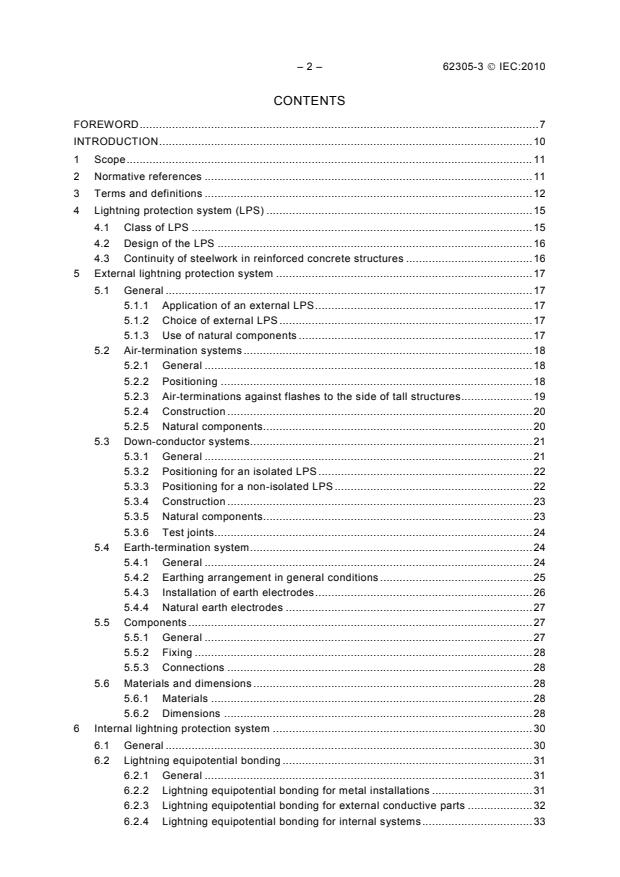
IEC 62305-3:2010 - Protection against lightning - Part 3: Physical damage to structures and life hazard Released:12/9/2010
Overview
IEC 62305-3:2010 - Protection against lightning (Part 3) specifies requirements for protecting structures from physical damage and protecting people from injury due to lightning-related touch and step voltages. Edition 2.0 (2010) updates the 2006 edition with technical revisions covering design, materials, installation, inspection and mitigation measures for a Lightning Protection System (LPS). This part is closely linked with IEC 62305-1 (general principles) and complements other parts of the IEC 62305 series.
Key topics and requirements
- Scope of protection: requirements for external and internal LPS to prevent structural damage and life hazard from lightning currents and associated voltages.
- External LPS: design of air-termination systems, down‑conductors, earth‑termination systems and use of natural components.
- Internal LPS: lightning equipotential bonding, bonding of metal installations, measures for lines entering the structure and insulation requirements.
- Touch and step voltages: measures to limit dangerous voltages in the vicinity of LPS and inside structures.
- Materials & dimensions: permitted materials (including steel with electro-deposited copper) and conductor cross-sections; revised cross-sectional requirements and guidance on minimum metal thicknesses.
- Separation distance: two simplified and detailed methods for evaluating separation distance between LPS conductors and exposed electrical equipment.
- Bonding & SPD use: guidance on bonding with isolating spark gaps for metal installations and using Surge Protective Devices (SPD) for internal systems.
- Inspection & maintenance: schedules, inspection order and maintenance practices for ensuring ongoing LPS effectiveness.
- Special cases: normative Annex D provides additional LPS information for structures with explosion risk; Annex E offers practical design and construction guidelines.
Applications and who uses it
IEC 62305-3 is used by:
- Lightning protection engineers and designers for LPS design and verification
- Electrical contractors and installers for correct installation of air‑terminations, down‑conductors and earthing
- Facility managers and building owners for risk assessment and maintenance planning
- Safety officers and inspectors ensuring compliance with national regulations and standards
- Plant designers in hazardous/explosive environments who need additional protection measures
Practical applications include protection of commercial and residential buildings, industrial plants, communication towers, substations, reinforced‑concrete structures and facilities with explosion risk.
Related standards
- IEC 62305-1: General principles (see for risk assessment methodology)
- IEC 62305-2: (storm and related topics)
- IEC 62305-4: (surge protection) Consult the IEC 62305 series for a complete, integrated approach to lightning risk management.
Keywords: IEC 62305-3, lightning protection, LPS design, touch and step voltages, air-termination, down-conductor, earthing, equipotential bonding, surge protective device, lightning protection standard.
Relations
- Effective Date
- 09-Feb-2026
- Effective Date
- 09-Feb-2026
- Effective Date
- 09-Feb-2026
- Effective Date
- 05-Sep-2023
- Effective Date
- 05-Sep-2023
Buy Documents
IEC 62305-3:2010 - Protection against lightning - Part 3: Physical damage to structures and life hazard Released:12/9/2010
IEC 62305-3:2010 - Protection against lightning - Part 3: Physical damage to structures and life hazard Released:12/9/2010
Get Certified
Connect with accredited certification bodies for this standard

DIBt (Deutsches Institut für Bautechnik)
German Institute for Building Technology.
DIN CERTCO
DIN Group product certification.

IMQ S.p.A. (Certification)
Italian electrical product certification.
Sponsored listings
Frequently Asked Questions
IEC 62305-3:2010 is a standard published by the International Electrotechnical Commission (IEC). Its full title is "Protection against lightning - Part 3: Physical damage to structures and life hazard". This standard covers: IEC 62305-3:2010 provides the requirements for protection of a structure against physical damage by means of a lightning protection system (LPS), and for protection against injury to living beings due to touch and step voltages in the vicinity of an LPS (see IEC 62305-1). This second edition cancels and replaces the first edition, published in 2006, and constitutes a technical revision. This edition includes the following significant technical changes with respect to the previous edition: 1) Minimum thicknesses of metal sheets or metal pipes given in Table 3 for air-termination systems are assumed as not able to prevent hot-spot problems. 2) Steel with electro-deposited copper is introduced as material suitable for LPS. 3) Some cross-sectional areas of LPS conductors were slightly modified. 4) For bonding purposes, isolating spark gaps are used for metal installations and SPD for internal systems. 5) Two methods simplified and detailed are provided for evaluation of separation distance. 6) Protection measures against injuries of living beings due to electric shock are considered also inside the structure. 7) Improved information for LPS in the case of structures with a risk of explosion are given in Annex D (normative). This bilingual version (2012-06) corresponds to the monolingual English version, published in 2010-12.
IEC 62305-3:2010 provides the requirements for protection of a structure against physical damage by means of a lightning protection system (LPS), and for protection against injury to living beings due to touch and step voltages in the vicinity of an LPS (see IEC 62305-1). This second edition cancels and replaces the first edition, published in 2006, and constitutes a technical revision. This edition includes the following significant technical changes with respect to the previous edition: 1) Minimum thicknesses of metal sheets or metal pipes given in Table 3 for air-termination systems are assumed as not able to prevent hot-spot problems. 2) Steel with electro-deposited copper is introduced as material suitable for LPS. 3) Some cross-sectional areas of LPS conductors were slightly modified. 4) For bonding purposes, isolating spark gaps are used for metal installations and SPD for internal systems. 5) Two methods simplified and detailed are provided for evaluation of separation distance. 6) Protection measures against injuries of living beings due to electric shock are considered also inside the structure. 7) Improved information for LPS in the case of structures with a risk of explosion are given in Annex D (normative). This bilingual version (2012-06) corresponds to the monolingual English version, published in 2010-12.
IEC 62305-3:2010 is classified under the following ICS (International Classification for Standards) categories: 29.020 - Electrical engineering in general; 91.120.40 - Lightning protection. The ICS classification helps identify the subject area and facilitates finding related standards.
IEC 62305-3:2010 has the following relationships with other standards: It is inter standard links to EN ISO 21789:2022, EN ISO 16904:2016, EN ISO 20257-1:2020, IEC 62305-3:2024, IEC 62305-3:2006. Understanding these relationships helps ensure you are using the most current and applicable version of the standard.
IEC 62305-3:2010 is available in PDF format for immediate download after purchase. The document can be added to your cart and obtained through the secure checkout process. Digital delivery ensures instant access to the complete standard document.
Standards Content (Sample)
IEC 62305-3 ®
Edition 2.0 2010-12
INTERNATIONAL
STANDARD
colour
inside
Protection against lightning –
Part 3: Physical damage to structures and life hazard
All rights reserved. Unless otherwise specified, no part of this publication may be reproduced or utilized in any form
or by any means, electronic or mechanical, including photocopying and microfilm, without permission in writing from
either IEC or IEC's member National Committee in the country of the requester.
If you have any questions about IEC copyright or have an enquiry about obtaining additional rights to this publication,
please contact the address below or your local IEC member National Committee for further information.
IEC Central Office
3, rue de Varembé
CH-1211 Geneva 20
Switzerland
Email: inmail@iec.ch
Web: www.iec.ch
About the IEC
The International Electrotechnical Commission (IEC) is the leading global organization that prepares and publishes
International Standards for all electrical, electronic and related technologies.
About IEC publications
The technical content of IEC publications is kept under constant review by the IEC. Please make sure that you have the
latest edition, a corrigenda or an amendment might have been published.
§ Catalogue of IEC publications: www.iec.ch/searchpub
The IEC on-line Catalogue enables you to search by a variety of criteria (reference number, text, technical committee,…).
It also gives information on projects, withdrawn and replaced publications.
§ IEC Just Published: www.iec.ch/online_news/justpub
Stay up to date on all new IEC publications. Just Published details twice a month all new publications released. Available
on-line and also by email.
§ Electropedia: www.electropedia.org
The world's leading online dictionary of electronic and electrical terms containing more than 20 000 terms and definitions
in English and French, with equivalent terms in additional languages. Also known as the International Electrotechnical
Vocabulary online.
§ Customer Service Centre: www.iec.ch/webstore/custserv
If you wish to give us your feedback on this publication or need further assistance, please visit the Customer Service
Centre FAQ or contact us:
Email: csc@iec.ch
Tel.: +41 22 919 02 11
Fax: +41 22 919 03 00
IEC 62305-3 ®
Edition 2.0 2010-12
INTERNATIONAL
STANDARD
colour
inside
Protection against lightning –
Part 3: Physical damage to structures and life hazard
INTERNATIONAL
ELECTROTECHNICAL
COMMISSION
PRICE CODE
XG
ICS 29.020; 91.120.40 ISBN 978-2-88912-282-0
– 2 – 62305-3 Ó IEC:2010(E)
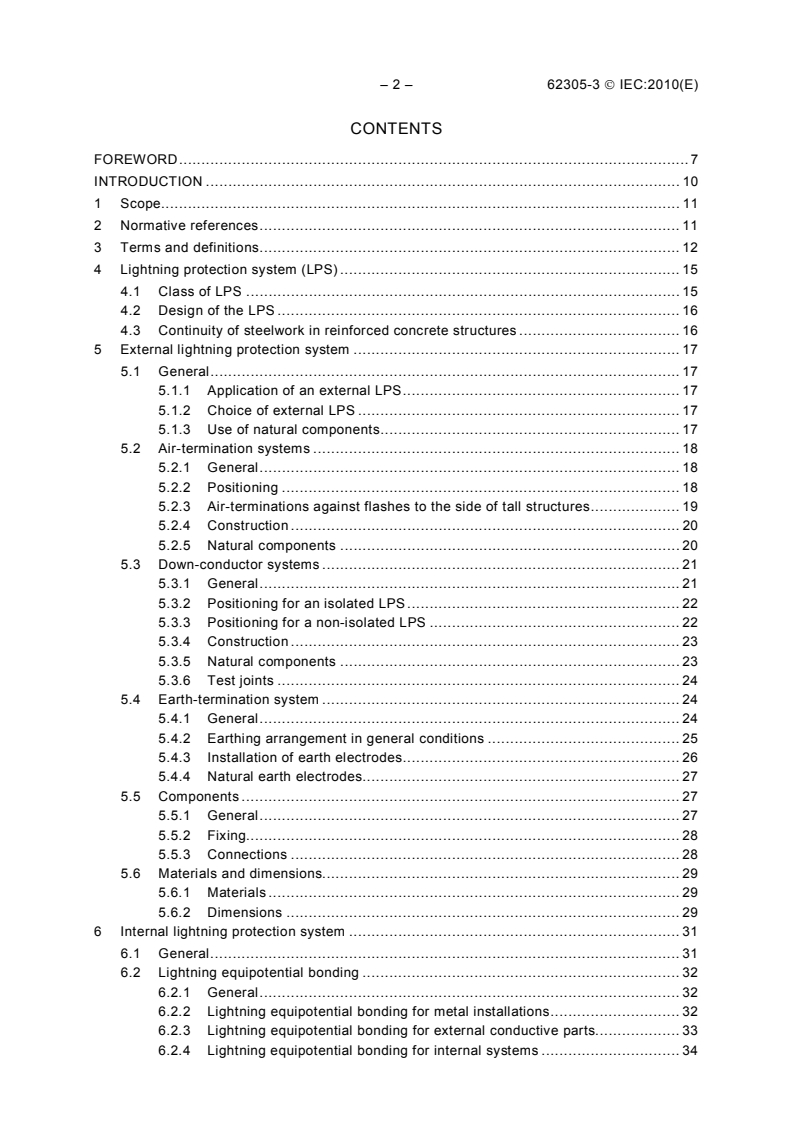
CONTENTS
FOREW ORD . 7
INTRODUCTION . 10
1 Scope . 11
2 Normative references . 11
3 Terms and definitions . 12
4 Lightning protection system (LPS) . 15
4.1 Class of LPS . 15
4.2 Design of the LPS . 16
4.3 Continuity of steelwork in reinforced concrete structures . 16
5 External lightning protection system . 17
5.1 General . 17
5.1.1 Application of an external LPS . 17
5.1.2 Choice of external LPS . 17
5.1.3 Use of natural components . 17
5.2 Air-termination systems . 18
5.2.1 General . 18
5.2.2 Positioning . 18
5.2.3 Air-terminations against flashes to the side of tall structures . 19
5.2.4 Construction . 20
5.2.5 Natural components . 20
5.3 Down-conductor systems . 21
5.3.1 General . 21
5.3.2 Positioning for an isolated LPS . 22
5.3.3 Positioning for a non-isolated LPS . 22
5.3.4 Construction . 23
5.3.5 Natural components . 23
5.3.6 Test joints . 24
5.4 Earth-termination system . 24
5.4.1 General . 24
5.4.2 Earthing arrangement in general conditions . 25
5.4.3 Installation of earth electrodes . 26
5.4.4 Natural earth electrodes. 27
5.5 Components . 27
5.5.1 General . 27
5.5.2 Fixing. 28
5.5.3 Connections . 28
5.6 Materials and dimensions. 29
5.6.1 Materials . 29
5.6.2 Dimensions . 29
6 Internal lightning protection system . 31
6.1 General . 31
6.2 Lightning equipotential bonding . 32
6.2.1 General . 32
6.2.2 Lightning equipotential bonding for metal installations . 32
6.2.3 Lightning equipotential bonding for external conductive parts. 33
6.2.4 Lightning equipotential bonding for internal systems . 34
62305-3 Ó IEC:2010(E) – 3 –
6.2.5 Lightning equipotential bonding for lines connected to the structure to
be protected . 34
6.3 Electrical insulation of the external LPS . 35
6.3.1 General . 35
6.3.2 Simplified approach . 36
6.3.3 Detailed approach . 36
7 Maintenance and inspection of an LPS . 37
7.1 General . 37
7.2 Application of inspections . 37
7.3 Order of inspections . 37
7.4 Maintenance . 37
8 Protection measures against injury to living beings due to touch and step voltages . 37
8.1 Protection measures against touch voltages . 37
8.2 Protection measures against step voltages . 38
Annex A (normative) Positioning the air-termination system . 39
Annex B (normative) Minimum cross-section of the entering cable screen in order to
avoid dangerous sparking. 45
Annex C (informative) Evaluation of the separation distance s. 46
Annex D (normative) Additional information for LPS in the case of structures with a
risk of explosion . 52
Annex E (informative) Guidelines for the design, construction, maintenance and
inspection of lightning protection systems . 59
Bibliography . 156
Figure 1 – Protection angle corresponding to the class of LPS . 19
Figure 2 – Loop in a down-conductor . 23
Figure 3 – Minimum length l of each earth electrode according to the class of LPS . 25
Figure A.1 – Volume protected by a vertical air-termination rod . 39
Figure A.2 – Volume protected by a vertical air-termination rod . 40
Figure A.3 – Volume protected by a wire air-termination system . 40
Figure A.4 – Volume protected by isolated wires combined in a mesh according to the
protection angle method and rolling sphere method . 41
Figure A.5 – Volume protected by non-isolated wires combined in a mesh according to
the mesh method and the protection angle method . 42
Figure A.6 – Design of an air-termination system according to the rolling sphere
method . 43
Figure C.1 – Values of coefficient k in the case of a wire air-termination system . 46
c
Figure C.2 – Values of coefficient k in the case of multiple down-conductors system . 47
c
Figure C.3 – Values of coefficient k in the case of a sloped roof with air-termination on
c
the ridge . 49
Figure C.4 – Examples of calculation of the separation distance in the case of multiple
down-conductors with an interconnecting ring of the down-conductors at each level . 50
Figure C.5 – Values of coefficient k in the case of a meshed air-termination system,
c
with a multiple down-conductors system . 51
Figure E.1 – LPS design flow diagram . 61
Figure E.2 – LPS design for a cantilevered part of a structure . 67
Figure E.3 – Measuring the overall electrical resistance . 68
– 4 – 62305-3 Ó IEC:2010(E)
Figure E.4 – Equipotential bonding in a structure with a steel reinforcement . 70
Figure E.5 – Typical methods of joining reinforcing rods in concrete (where permitted) . 71
Figure E.6 – Example of clamps used as joints between reinforcing rods and
conductors . 72
Figure E.7 – Examples for connection points to the reinforcement in a reinforced
concrete wall. 73
Figure E.8 – Use of metallic facade as natural down-conductor system and connection
of facade supports . 77
Figure E.9 – Connection of the continuous strip windows to a metal facade covering . 78
Figure E.10 – Internal down-conductors in industrial structures . 81
Figure E.11 – Installation of bonding conductors in reinforced concrete structures and
flexible bonds between two reinforced concrete parts . 83
Figure E.12 – Protection angle method air-termination design for different heights
according to Table 2 . 87
Figure E.13 – Isolated external LPS using two isolated air-termination masts designed
according to the protection angle air-termination design method . 88
Figure E.14 – Isolated external LPS using two isolated air-termination masts,
interconnected by horizontal catenary wire . 89
Figure E.15 – Example of design of an air-termination of a non-isolated LPS by air-
termination rods . 90
Figure E.16 – Example of design of an air-termination of a non isolated LPS by a
horizontal wire according to the protection angle air-termination design method . 91
Figure E.17 – Protected volume of an air- termination rod on a sloped surface using
the protection angle design method . 92
Figure E.18 – Design of an LPS air-termination conductor network on a structure with
complicated shape . 93
Figure E.19 – Design of an LPS air-termination according to the protection angle
method, mesh method and general arrangement of air-termination elements . 94
Figure E.20 – Space protected by two parallel air-termination horizontal wires or two
air-termination rods (r > h ) . 95
t
Figure E.21 – Three examples of design of non-isolated LPS air-termination according
to the mesh method air-termination design . 98
Figure E.22 – Four examples of details of an LPS on a structure with sloped tiled roofs . 100
Figure E.23 – Air-termination and visually concealed conductors for buildings less
than 20 m high, with sloping roofs . 101
Figure E.24 – Construction of an LPS using natural components on the roof of the
structure . 103
Figure E.25 – Positioning of the external LPS on a structure made of isolating material
e.g. wood or bricks with a height up to 60 m with flat roof and with roof fixtures . 104
Figure E.26 – Construction of air-termination network on a roof with conductive
covering where puncturing of the covering is not acceptable . 105
Figure E.27 – Construction of external LPS on a structure of steel-reinforced concrete
using the reinforcement of the outer walls as natural components . 106
Figure E.28 – Example of an air-termination stud used on car park roofs . 107
Figure E.29 – Air-termination rod used for protection of a metallic roof fixture with
electric power installations which are not bonded to the air-termination system . 108
Figure E.30 – Method of achieving electrical continuity on metallic parapet capping . 109
Figure E.31 – Metallic roof fixture protected against direct lightning interception,
connected to air-termination system . 112
62305-3 Ó IEC:2010(E) – 5 –
Figure E.32 – Examplesof lightning protection of a house with a TV antenna . 115
Figure E.33 – Installation of lightning protection of metallic equipment on a roof against
a direct lightning flash . 116
Figure E.34 – Connection of natural air-termination rod to air-termination conductor . 118
Figure E.35 – Construction of the bridging between the segments of the metallic
facade plates . 119
Figure E.36 – Installation of external LPS on a structure of insulating material with
different roof levels . 122
Figure E.37 – Five examples of geometry of LPS conductors . 123
Figure E.38 – Construction of an LPS using only two down-conductors and foundation
earth electrodes . 124
Figure E.39 – Four examples of connection of earth-termination to the LPS of
structures using natural down-conductors (girders) and detail of a test joint. 128
Figure E.40 – Construction of foundation earth ring for structures of different
foundation design . 132
Figure E.41 – Two examples of vertical electrodes in type A earthing arrangement . 134
Figure E.42 – Meshed earth-termination system of a plant . 137
Figure E.43 – Example of an equipotential bonding arrangement . 144
Figure E.44 – Example of bonding arrangement in a structure with multiple point
entries of external conductive parts using a ring electrode for interconnection of
bonding bars . 145
Figure E.45 – Example of bonding in the case of multiple point entries of external
conductive parts and an electric power or communication line using an internal ring
conductor for interconnection of the bonding bars . 146
Figure E.46 – Example of bonding arrangement in a structure with multiple point
entries of external conductive parts entering the structure above ground level . 147
Figure E.47 – Directions for calculations of the separation distance, s, for a worst case
lightning interception point at a distance l from the reference point according to 6.3 . 149
Table 1 – Relation between lightning protection levels (LPL) and class of LPS (see
IEC 62305-1) . 16
Table 2 – Maximum values of rolling sphere radius, mesh size and protection angle
corresponding to the class of LPS . 19
Table 3 – Minimum thickness of metal sheets or metal pipes in air-termination systems . 21
Table 4 – Typical preferred values of the distance between down-conductors
according to the class of LPS . 22
Table 5 – LPS materials and conditions of use . 28
Table 6 – Material, configuration and minimum cross-sectional area of air-termination
conductors, air-termination rods, earth lead-in rods and down-conductors . 30
Table 7 – Material, configuration and minimum dimensions of earth electrodes . 31
Table 8 – Minimum dimensions of conductors connecting different bonding bars or
connecting bonding bars to the earth-termination system . 33
Table 9 – Minimum dimensions of conductors connecting internal metal installations to
the bonding bar . 33
Table 10 – Isolation of external LPS – Values of coefficient k . 35
i
Table 11 – Isolation of external LPS – Values of coefficient k . 35
m
Table 12 – Isolation of external LPS – Approximated values of coefficient k . 36
c
Table B.1 – Cable length to be considered according to the condition of the screen . 45
Table E.1 – Suggested fixing centres. 99
– 6 – 62305-3 Ó IEC:2010(E)
Table E.2 – Maximum period between inspections of an LPS . 151
62305-3 Ó IEC:2010(E) – 7 –
INTERNATIONAL ELECTROTECHNICAL COMMISSION
_____________
PROTECTION AGAINST LIGHTNING –
Part 3: Physical damage to structures and life hazard
FOREWORD
1) The International Electrotechnical Commission (IEC) is a worldwide organization for standardization comprising
all national electrotechnical committees (IEC National Committees). The object of IEC is to promote
international co-operation on all questions concerning standardization in the electrical and electronic fields. To
this end and in addition to other activities, IEC publishes International Standards, Technical Specifications,
Technical Reports, Publicly Available Specifications (PAS) and Guides (hereafter referred to as “IEC
Publication(s)”). Their preparation is entrusted to technical committees; any IEC National Committee interested
in the subject dealt with may participate in this preparatory work. International, governmental and non-
governmental organizations liaising with the IEC also participate in this preparation. IEC collaborates closely
with the International Organization for Standardization (ISO) in accordance with conditions determined by
agreement between the two organizations.
2) The formal decisions or agreements of IEC on technical matters express, as nearly as possible, an international
consensus of opinion on the relevant subjects since each technical committee has representation from all
interested IEC National Committees.
3) IEC Publications have the form of recommendations for international use and are accepted by IEC National
Committees in that sense. While all reasonable efforts are made to ensure that the technical content of IEC
Publications is accurate, IEC cannot be held responsible for the way in which they are used or for any
misinterpretation by any end user.
4) In order to promote international uniformity, IEC National Committees undertake to apply IEC Publications
transparently to the maximum extent possible in their national and regional publications. Any divergence
between any IEC Publication and the corresponding national or regional publication shall be clearly indicated in
the latter.
5) IEC itself does not provide any attestation of conformity. Independent certification bodies provide conformity
assessment services and, in some areas, access to IEC marks of conformity. IEC is not responsible for any
services carried out by independent certification bodies.
6) All users should ensure that they have the latest edition of this publication.
7) No liability shall attach to IEC or its directors, employees, servants or agents including individual experts and
members of its technical committees and IEC National Committees for any personal injury, property damage or
other damage of any nature whatsoever, whether direct or indirect, or for costs (including legal fees) and
expenses arising out of the publication, use of, or reliance upon, this IEC Publication or any other IEC
Publications.
8) Attention is drawn to the Normative references cited in this publication. Use of the referenced publications is
indispensable for the correct application of this publication.
9) Attention is drawn to the possibility that some of the elements of this IEC Publication may be the subject of
patent rights. IEC shall not be held responsible for identifying any or all such patent rights.
International Standard IEC 62305-3 has been prepared by IEC technical committee 81:
Lightning protection.
This second edition cancels and replaces the first edition, published in 2006, and constitutes
a technical revision.
This edition includes the following significant technical changes with respect to the previous
edition:
1) Minimum thicknesses of metal sheets or metal pipes given in Table 3 for air-termination
systems are assumed as not able to prevent hot-spot problems.
2) Steel with electro-deposited copper is introduced as material suitable for LPS.
3) Some cross-sectional areas of LPS conductors were slightly modified.
4) For bonding purposes, isolating spark gaps are used for metal installations and SPD for
internal systems.
– 8 – 62305-3 Ó IEC:2010(E)
5) Two methods – simplified and detailed – are provided for evaluation of separation
distance.
6) Protection measures against injuries of living beings due to electric shock are considered
also inside the structure.
7) Improved information for LPS in the case of structures with a risk of explosion are given in
Annex D (normative).
The text of this standard is based on the following documents:
FDIS Report on voting
81/372/FDIS 81/382/RVD
Full information on the voting for the approval of this standard can be found in the report on
voting indicated in the above table.
This publication has been drafted, as closely as possible, in accordance with the ISO/IEC
Directives, Part 2.
A list of all the parts in the IEC 62305 series, under the general title Protection against
lightning, can be found on the IEC website.
62305-3 Ó IEC:2010(E) – 9 –
The committee has decided that the contents of this publication will remain unchanged until
the stability date indicated on the IEC web site under "http://webstore.iec.ch" in the data
related to the specific publication. At this date, the publication will be
reconfirmed,
withdrawn,
replaced by a revised edition, or
amended.
In the United States, based on the requirements of NFPA 780: Standard for the Installation of Lightning Protection
[1]
Systems:2008 and practical experience in the use of horizontal earth electrodes, the minimum length of
horizontal earth electrodes is not required to be twice that required for vertical electrodes.
In France and Portugal:
– natural components cannot substitute as lightning protection components but may be used to
complete/enhance the LPS;
– aluminium solid round diameters should be increased from 8 mm to 10 mm;
– stranded conductors cannot be used as down-conductors;
– diameter of solid round conductors should be increased from 16 mm to 18 mm;
– hot dip galvanized steel solid tape thickness should be increased from 2 mm to 3,5 mm.
In Russia the use of piping carrying and tanks containing readily-combustible or explosive materials as air-
termination natural components or down-conductor natural components are not allowed in any case.
In Japan the minimum values of the cross-section are reduced from:
2 2 2 2
– 16 mm to 14 mm for copper and 25 mm to 22 mm for aluminium, for bonding conductors connecting
different bonding bars and conductors connecting the bars to the earth-termination system;
2 2 2 2 2 2
– 6 mm to 5 mm for copper, 10 mm to 8 mm for aluminium and 16 mm to 14 mm for steel, for bonding
conductors connecting internal metal installations to the bonding bars.
A bilingual version of this publication may be issued at a later date.
IMPORTANT – The 'colour inside' logo on the cover page of this publication indicates
that it contains colours which are considered to be useful for the correct
understanding of its contents. Users should therefore print this document using a
colour printer.
———————
References in square brackets refer to the bibliography.
– 10 – 62305-3 Ó IEC:2010(E)
INTRODUCTION
This part of IEC 62305 deals with the protection, in and around a structure, against physical
damage and injury to living beings due to touch and step voltages.
The main and most effective measure for protection of structures against physical damage is
considered to be the lightning protection system (LPS). It usually consists of both external
and internal lightning protection systems.
An external LPS is intended to
a) intercept a lightning flash to the structure (with an air-termination system),
b) conduct the lightning current safely towards earth (using a down-conductor system),
c) disperse the lightning current into the earth (using an earth-termination system).
An internal LPS prevents dangerous sparking within the structure using either equipotential
bonding or a separation distance (and hence electrical insulation) between the external LPS
(as defined in 3.2) components and other electrically conducting elements internal to the
structure.
Main protection measures against injury to living beings due to touch and step voltages are
intended to:
1) reduce the dangerous current flowing through bodies by insulating exposed conductive
parts, and/or by increasing the surface soil resistivity,
2) reduce the occurrence of dangerous touch and step voltages by physical restrictions
and/or warning notices.
The type and location of an LPS should be carefully considered in the initial design of a new
structure, thereby enabling maximum advantage to be taken of the electrically conductive
parts of the structure. By doing so, design and construction of an integrated installation is
made easier, the overall aesthetic aspects can be improved, and the effectiveness of the LPS
can be increased at minimum cost and effort.
Access to the ground and the proper use of foundation steelwork for the purpose of forming
an effective earth-termination may well be impossible once construction work on a site has
commenced. Therefore, soil resistivity and the nature of the earth should be considered at the
earliest possible stage of a project. This information is fundamental to the design of an earth-
termination system and may influence the foundation design work for the structure.
Regular consultation between LPS designers and installers, architects and builders is
essential in order to achieve the best result at minimum cost.
If lightning protection is to be added to an existing structure, every effort should be made to
ensure that it conforms to the principles of this standard. The design of the type and location
of an LPS should take into account the features of the existing structure.
62305-3 Ó IEC:2010(E) – 11 –
PROTECTION AGAINST LIGHTNING –
Part 3: Physical damage to structures and life hazard
1 Scope
This part of IEC 62305 provides the requirements for protection of a structure against physical
damage by means of a lightning protection system (LPS), and for protection against injury to
living beings due to touch and step voltages in the vicinity of an LPS (see IEC 62305-1).
This standard is applicable to:
a) design, installation, inspection and maintenance of an LPS for structures without limitation
of their height,
b) establishment of measures for protection against injury to living beings due to touch and
step voltages.
NOTE 1 Specific requirements for an LPS in structures dangerous to their surroundings due to the risk of explosion are
under consideration. Additional information is provided in Annex D for use in the interim.
NOTE 2 This part of IEC 62305 is not intended to provide protection against failures of electrical and electronic
systems due to overvoltages. Specific requirements for such cases are provided in IEC 62305-4.
[2]
NOTE 3 Specific requirements for protection against lightning of wind turbines are reported in IEC 61400-24 .
2 Normative references
The following referenced documents are indispensable for the application of this document.
For dated references, only the edition cited applies. For undated references, the latest edition
of the referenced document (including any amendments) applies.
IEC 60079-10-1:2008, Explosive atmospheres – Part 10-1: Classification of areas – Explosive
gas atmospheres
IEC 60079-10-2:2009, Explosive atmospheres – Part 10-2: Classification of areas –
Combustible dust atmospheres
IEC 60079-14:2007, Explosive atmospheres – Part 14: Electrical installations design,
selection and erection
IEC 61557-4, Electrical safety in low-voltage distribution systems up to 1 000 V a.c. and 1 500
V d.c. – Equipment for testing, measuring or monitoring of protective measures – Part 4:
Resistance of earth connection and equipotential bonding
IEC 61643-1, Low-voltage surge protective devices – Part 1: Surge protective devices
connected to low-voltage power distribution systems – Requirements and tests
IEC 61643-21, Low-voltage surge protective devices – Part 21: Surge protective devices
connected to telecommunications and signalling networks – Performance requirements and
testing methods
IEC 62305-1, Protection against lightning – Part 1: General principles
IEC 62305-2, Protection against lightning – Part 2: Risk management
– 12 – 62305-3 Ó IEC:2010(E)
IEC 62305-4, Protection against lightning – Part 4: Electrical and electronic systems within
structures
IEC 62561 (all parts) , Lightning protection system components (LPSC)
IEC 62561-1 , Lightning protection system components (LPSC) – Part 1: Requirements for
connection components
IEC 62561-3 , Lightning protection system components (LPSC) – Part 3: Requirements for
isolating spark gaps
ISO 3864-1, Graphical symbols – Safety colours and safety signs – Part 1: Design principles
for safety signs in workplaces and public areas
3 Terms and definitions
For the purposes of this document, the following terms and definitions, some of which have
already been cited in Part 1 but are repeated here for ease of reference, as well as those
given in other parts of IEC 62305, apply.
3.1
lightning protection system
LPS
complete system used to reduce physical damage due to lightning flashes to a structure
NOTE It consists of both external and internal lightning protection systems.
3.2
external lightning protection system
part of the LPS consisting of an air-termination system, a down-conductor system and an
earth-termination system
3.3
external LPS isolated from the structure to be protected
LPS with an air-termination system and down-conductor system positioned in such a way that
the path of the lightning current has no contact with the structure to be protected
NOTE In an isolated LPS, dangerous sparks between the LPS and the structure are avoided.
3.4
external LPS not isolated from the structure to be protected
LPS with an air-termination system and down-conductor system positioned in such a way that
the path of the lightning current can be in contact with the structure to be protected
3.5
internal lightning protection system
part of the LPS consisting of lightning equipotential bonding and/or electrical insulation of
external LPS
3.6
air-termination system
part of an external LPS using metallic elements such as rods, mesh conductors or catenary
wires intended to intercept lightning flashes
———————
In preparation.
62305-3 Ó IEC:2010(E) – 13 –
3.7
down-conductor system
part of an external LPS intended to conduct lightning current between the air-termination
system and the earth-termination system
3.8
ring conductor
conductor forming a loop around the structure and interconnecting the down-conductors for
distribution of lightning current among them
3.9
earth-termination system
part of an external LPS which is intended to conduct and disperse lightning current into the
earth
3.10
earth electrode
part or a group of parts of the earth-termination system which provides direct electrical
contact with the earth and disperses lightning current to the earth
3.11
ring earth electrode
earth electrode forming a closed loop around the structure below or on the surface of the
earth
3.12
foundation earth electrode
conductive part buried in the soil under a building foundation or, preferably, embedded in
concrete of a building foundation, generally in form of a closed loop
[3]
[IEC 60050-826:2004, 826-13-08]
3.13
conventional earth impedance
ratio of the peak values of the earth-termination voltage and the earth-termination current
which, in general, do not occur simultaneously
3.14
earth-termination voltage
potential difference between the earth-termination system and the remote earth
3.15
natural component of LPS
conductive component installed not specifically for lightning protection which can be used in
addition to the LPS or in some cases could provide the function of one or more parts of the
LPS
NOTE Examples of the use of this term include:
– natural air-termination;
– natural down-conductor;
– natural earth electrode.
3.16
connecting component
part of an LPS which is used for the connection of conductors to each other or to metallic
installations
NOTE This also includes bridging component and expansion piece.
– 14 – 62305-3 Ó IEC:2010(E)
3.17
fixing component
part of an LPS which is used to fix the elements of the LPS to the structure to be protected
3.18
metal installations
extended metal items in the structure to be protected which may form a path for lightning
current, such as pipework, staircases, elevator guide rails, ventilation, heating and air-
conditioning ducts, interconnected reinforcing steel, structural metal parts
3.19
external conductive parts
extended metal items entering or leaving the structure to be protected such as pipework,
metallic cable elements, metal ducts, etc. which may carry a part of the lightning current
3.20
electrical system
system incorporating low-voltage power supply components
3.21
electronic system
system incorporating sensitive electronic components such as telecommunication equipment,
computer, control and instrumentation systems, radio systems, power electronic installations
3.22
internal systems
electrical and electronic systems within a structure
3.23
lightning equipotential bonding
EB
bonding to the LPS of separated conductive parts, by direct connections or via surge
protective devices, to reduce potential differences caused by lightning current
3.24
bonding bar
metal bar on which metal installations, external conductive parts, electric power and tele-
communication lines and other cables can be bonded to an LPS
3.25
bonding conductor
conductor connecting separated conductive parts to LPS
3.26
interconnected reinforcing steel
steelwork within a concrete structure which is considered electrically continuous
3.27
dangerous sparking
electrical discharge due to lightning which causes physical damage in the structure to be
protected
3.28
separation distance
distance between two conductive parts at which no dangerous sparking can occur
62305-3 Ó IEC:2010(E) – 15 –
3.29
surge protective device
SPD
device intended to limit transient overvoltages and divert surge currents; contains at least one
non linear component
3.30
test joint
joint designed to facilitate electrical testing and measurement of LPS components
3.31
class of LPS
number denoting the classification of an LPS according to the lightning protection level for
which it is designed
3.32
lightning protection designer
specialist competent and skilled in the design of the LPS
3.33
lightning protection installer
person competent and skilled in the installation of the LPS
3.34
structures with risk of explosion
structures containing solid explosives materials or hazardous zones as determined in
accordance with IEC 60079-10-1 and IEC 60079-10-2
3.35
isolating spark gap
ISG
component with discharge distance for isolating electrically conductive installation sections
NOTE In the event of a lightning strike, the installation sections are temporarily connected conductively as the
result of response to the discharge.
3.36
isolating interfaces
devices which are capable of reducing conducted surges on lines entering the LPZ
NOTE 1 These include isolation transformers with earthed screen between windings, metal-free fibre optic cables
and opto-isolators.
NOTE 2 Insulation withstand characteristics of these devices are suitable for this application intrinsically or via
SPD.
4 Lightning protection system (LPS)
4.1 Class of LPS
The characteristics of an LPS are determined by the characteristics of the structure to be
protected and by the considered lightning protection level.
Four classes of LPS (I to IV), as shown in Table 1, are defined in this standard corresponding
to lightning protection levels defined in IEC 62305-1.
– 16 – 62305-3 Ó IEC:2010(E)
Table 1 – Relation between lightning protection levels (LPL)
and class of LPS (see IEC 62305-1)
LPL Class of LPS
I I
II II
III III
IV IV
Each class of LPS is characterized by the following:
a) Data dependent upon the class of LPS:
– lightning parameters (see Tables 3 and 4 in IEC 62305-1:2010);
– rolling sphere radius, mesh size and protection angle (see 5.2.2);
– typical preferred distances between down-conductors (see 5.3.3);
– separation distance against dangerous sparking (see 6.3);
– minimum length of earth electrodes (see 5.4.2).
b) Factors not dependent upon the class of LPS:
– lightning equipotential bonding (see 6.2);
– minimum thickness of metal sheets or metal pipes in air-termination systems
(see 5.2.5);
– LPS materials and conditions of use (see 5.5.1);
– material, configuration and minimum dimensions for air-terminations, dow
...
IEC 62305-3 ®
Edition 2.0 2010-12
INTERNATIONAL
STANDARD
NORME
INTERNATIONALE
colour
inside
Protection against lightning –
Part 3: Physical damage to structures and life hazard
Protection contre la foudre –
Partie 3: Dommages physiques sur les structures et risques humains
All rights reserved. Unless otherwise specified, no part of this publication may be reproduced or utilized in any form
or by any means, electronic or mechanical, including photocopying and microfilm, without permission in writing from
either IEC or IEC's member National Committee in the country of the requester.
If you have any questions about IEC copyright or have an enquiry about obtaining additional rights to this publication,
please contact the address below or your local IEC member National Committee for further information.
Droits de reproduction réservés. Sauf indication contraire, aucune partie de cette publication ne peut être reproduite ni
utilisée sous quelque forme que ce soit et par aucun procédé, électronique ou mécanique, y compris la photocopie et les
microfilms, sans l'accord écrit de la CEI ou du Comité national de la CEI du pays du demandeur.
Si vous avez des questions sur le copyright de la CEI ou si vous désirez obtenir des droits supplémentaires sur cette
publication, utilisez les coordonnées ci-après ou contactez le Comité national de la CEI de votre pays de résidence.
IEC Central Office Tel.: +41 22 919 02 11
3, rue de Varembé Fax: +41 22 919 03 00
CH-1211 Geneva 20 info@iec.ch
Switzerland www.iec.ch
About the IEC
The International Electrotechnical Commission (IEC) is the leading global organization that prepares and publishes
International Standards for all electrical, electronic and related technologies.
About IEC publications
The technical content of IEC publications is kept under constant review by the IEC. Please make sure that you have the
latest edition, a corrigenda or an amendment might have been published.
Useful links:
IEC publications search - www.iec.ch/searchpub Electropedia - www.electropedia.org
The advanced search enables you to find IEC publications The world's leading online dictionary of electronic and
by a variety of criteria (reference number, text, technical electrical terms containing more than 30 000 terms and
committee,…). definitions in English and French, with equivalent terms in
It also gives information on projects, replaced and additional languages. Also known as the International
withdrawn publications. Electrotechnical Vocabulary (IEV) on-line.
IEC Just Published - webstore.iec.ch/justpublished Customer Service Centre - webstore.iec.ch/csc
Stay up to date on all new IEC publications. Just Published If you wish to give us your feedback on this publication
details all new publications released. Available on-line and or need further assistance, please contact the
also once a month by email. Customer Service Centre: csc@iec.ch.
A propos de la CEI
La Commission Electrotechnique Internationale (CEI) est la première organisation mondiale qui élabore et publie des
Normes internationales pour tout ce qui a trait à l'électricité, à l'électronique et aux technologies apparentées.
A propos des publications CEI
Le contenu technique des publications de la CEI est constamment revu. Veuillez vous assurer que vous possédez
l’édition la plus récente, un corrigendum ou amendement peut avoir été publié.
Liens utiles:
Recherche de publications CEI - www.iec.ch/searchpub Electropedia - www.electropedia.org
La recherche avancée vous permet de trouver des Le premier dictionnaire en ligne au monde de termes
publications CEI en utilisant différents critères (numéro de électroniques et électriques. Il contient plus de 30 000
référence, texte, comité d’études,…). termes et définitions en anglais et en français, ainsi que
Elle donne aussi des informations sur les projets et les les termes équivalents dans les langues additionnelles.
publications remplacées ou retirées. Egalement appelé Vocabulaire Electrotechnique
International (VEI) en ligne.
Just Published CEI - webstore.iec.ch/justpublished
Service Clients - webstore.iec.ch/csc
Restez informé sur les nouvelles publications de la CEI.
Just Published détaille les nouvelles publications parues. Si vous désirez nous donner des commentaires sur
Disponible en ligne et aussi une fois par mois par email. cette publication ou si vous avez des questions
contactez-nous: csc@iec.ch.
IEC 62305-3 ®
Edition 2.0 2010-12
INTERNATIONAL
STANDARD
NORME
INTERNATIONALE
colour
inside
Protection against lightning –
Part 3: Physical damage to structures and life hazard
Protection contre la foudre –
Partie 3: Dommages physiques sur les structures et risques humains
INTERNATIONAL
ELECTROTECHNICAL
COMMISSION
COMMISSION
ELECTROTECHNIQUE
PRICE CODE
INTERNATIONALE
CODE PRIX XG
ICS 29.020; 91.120.40 ISBN 978-2-83220-129-9
– 2 – 62305-3 IEC:2010
CONTENTS
FOREWORD . 7
INTRODUCTION . 10
1 Scope . 11
2 Normative references . 11
3 Terms and definitions . 12
4 Lightning protection system (LPS) . 15
4.1 Class of LPS . 15
4.2 Design of the LPS . 16
4.3 Continuity of steelwork in reinforced concrete structures . 16
5 External lightning protection system . 17
5.1 General . 17
5.1.1 Application of an external LPS . 17
5.1.2 Choice of external LPS . 17
5.1.3 Use of natural components . 17
5.2 Air-termination systems . 18
5.2.1 General . 18
5.2.2 Positioning . 18
5.2.3 Air-terminations against flashes to the side of tall structures . 19
5.2.4 Construction . 20
5.2.5 Natural components. 20
5.3 Down-conductor systems. 21
5.3.1 General . 21
5.3.2 Positioning for an isolated LPS . 22
5.3.3 Positioning for a non-isolated LPS . 22
5.3.4 Construction . 23
5.3.5 Natural components. 23
5.3.6 Test joints. 24
5.4 Earth-termination system . 24
5.4.1 General . 24
5.4.2 Earthing arrangement in general conditions . 25
5.4.3 Installation of earth electrodes . 26
5.4.4 Natural earth electrodes . 27
5.5 Components . 27
5.5.1 General . 27
5.5.2 Fixing . 28
5.5.3 Connections . 28
5.6 Materials and dimensions . 28
5.6.1 Materials . 28
5.6.2 Dimensions . 28
6 Internal lightning protection system . 30
6.1 General . 30
6.2 Lightning equipotential bonding . 31
6.2.1 General . 31
6.2.2 Lightning equipotential bonding for metal installations . 31
6.2.3 Lightning equipotential bonding for external conductive parts . 32
6.2.4 Lightning equipotential bonding for internal systems . 33
62305-3 IEC:2010 – 3 –
6.2.5 Lightning equipotential bonding for lines connected to the structure to
be protected . 33
6.3 Electrical insulation of the external LPS . 34
6.3.1 General . 34
6.3.2 Simplified approach . 35
6.3.3 Detailed approach . 35
7 Maintenance and inspection of an LPS . 35
7.1 General . 35
7.2 Application of inspections . 36
7.3 Order of inspections . 36
7.4 Maintenance . 36
8 Protection measures against injury to living beings due to touch and step voltages . 36
8.1 Protection measures against touch voltages . 36
8.2 Protection measures against step voltages . 37
Annex A (normative) Positioning the air-termination system . 38
Annex B (normative) Minimum cross-section of the entering cable screen in order to
avoid dangerous sparking . 43
Annex C (informative) Evaluation of the separation distance s . 44
Annex D (normative) Additional information for LPS in the case of structures with a
risk of explosion . 50
Annex E (informative) Guidelines for the design, construction, maintenance and
inspection of lightning protection systems . 57
Bibliography . 154
Figure 1 – Protection angle corresponding to the class of LPS . 19
Figure 2 – Loop in a down-conductor . 23
Figure 3 – Minimum length l of each earth electrode according to the class of LPS . 25
Figure A.1 – Volume protected by a vertical air-termination rod . 38
Figure A.2 – Volume protected by a vertical air-termination rod . 39
Figure A.3 – Volume protected by a wire air-termination system . 39
Figure A.4 – Volume protected by isolated wires combined in a mesh according to the
protection angle method and rolling sphere method . 40
Figure A.5 – Volume protected by non-isolated wires combined in a mesh according to
the mesh method and the protection angle method . 41
Figure A.6 – Design of an air-termination system according to the rolling sphere
method . 42
Figure C.1 – Values of coefficient k in the case of a wire air-termination system . 44
c
Figure C.2 – Values of coefficient k in the case of multiple down-conductors system . 45
c
Figure C.3 – Values of coefficient k in the case of a sloped roof with air-termination on
c
the ridge . 47
Figure C.4 – Examples of calculation of the separation distance in the case of multiple
down-conductors with an interconnecting ring of the down-conductors at each level . 48
Figure C.5 – Values of coefficient k in the case of a meshed air-termination system,
c
with a multiple down-conductors system . 49
Figure E.1 – LPS design flow diagram . 59
Figure E.2 – LPS design for a cantilevered part of a structure . 65
Figure E.3 – Measuring the overall electrical resistance . 66
– 4 – 62305-3 IEC:2010
Figure E.4 – Equipotential bonding in a structure with a steel reinforcement . 68
Figure E.5 – Typical methods of joining reinforcing rods in concrete (where permitted) . 69
Figure E.6 – Example of clamps used as joints between reinforcing rods and
conductors . 70
Figure E.7 – Examples for connection points to the reinforcement in a reinforced
concrete wall . 71
Figure E.8 – Use of metallic facade as natural down-conductor system and connection
of facade supports . 75
Figure E.9 – Connection of the continuous strip windows to a metal facade covering . 76
Figure E.10 – Internal down-conductors in industrial structures. 79
Figure E.11 – Installation of bonding conductors in reinforced concrete structures and
flexible bonds between two reinforced concrete parts . 81
Figure E.12 – Protection angle method air-termination design for different heights
according to Table 2 . 85
Figure E.13 – Isolated external LPS using two isolated air-termination masts designed
according to the protection angle air-termination design method . 86
Figure E.14 – Isolated external LPS using two isolated air-termination masts,
interconnected by horizontal catenary wire . 87
Figure E.15 – Example of design of an air-termination of a non-isolated LPS by air-
termination rods . 88
Figure E.16 – Example of design of an air-termination of a non isolated LPS by a
horizontal wire according to the protection angle air-termination design method . 89
Figure E.17 – Protected volume of an air- termination rod on a sloped surface using
the protection angle design method . 90
Figure E.18 – Design of an LPS air-termination conductor network on a structure with
complicated shape . 91
Figure E.19 – Design of an LPS air-termination according to the protection angle
method, mesh method and general arrangement of air-termination elements . 92
Figure E.20 – Space protected by two parallel air-termination horizontal wires or two
air-termination rods (r > h ) . 93
t
Figure E.21 – Three examples of design of non-isolated LPS air-termination according
to the mesh method air-termination design . 95
Figure E.22 – Four examples of details of an LPS on a structure with sloped tiled roofs . 98
Figure E.23 – Air-termination and visually concealed conductors for buildings less
than 20 m high, with sloping roofs . 99
Figure E.24 – Construction of an LPS using natural components on the roof of the
structure . 101
Figure E.25 – Positioning of the external LPS on a structure made of isolating material
e.g. wood or bricks with a height up to 60 m with flat roof and with roof fixtures . 102
Figure E.26 – Construction of air-termination network on a roof with conductive
covering where puncturing of the covering is not acceptable . 103
Figure E.27 – Construction of external LPS on a structure of steel-reinforced concrete
using the reinforcement of the outer walls as natural components . 104
Figure E.28 – Example of an air-termination stud used on car park roofs . 105
Figure E.29 – Air-termination rod used for protection of a metallic roof fixture with
electric power installations which are not bonded to the air-termination system . 106
Figure E.30 – Method of achieving electrical continuity on metallic parapet capping . 107
Figure E.31 – Metallic roof fixture protected against direct lightning interception,
connected to air-termination system. 110
62305-3 IEC:2010 – 5 –
Figure E.32 – Examplesof lightning protection of a house with a TV antenna . 113
Figure E.33 – Installation of lightning protection of metallic equipment on a roof against
a direct lightning flash . 114
Figure E.34 – Connection of natural air-termination rod to air-termination conductor . 116
Figure E.35 – Construction of the bridging between the segments of the metallic
facade plates . 117
Figure E.36 – Installation of external LPS on a structure of insulating material with
different roof levels . 120
Figure E.37 – Five examples of geometry of LPS conductors . 121
Figure E.38 – Construction of an LPS using only two down-conductors and foundation
earth electrodes . 122
Figure E.39 – Four examples of connection of earth-termination to the LPS of
structures using natural down-conductors (girders) and detail of a test joint . 126
Figure E.40 – Construction of foundation earth ring for structures of different
foundation design . 130
Figure E.41 – Two examples of vertical electrodes in type A earthing arrangement . 131
Figure E.42 – Meshed earth-termination system of a plant . 135
Figure E.43 – Example of an equipotential bonding arrangement . 142
Figure E.44 – Example of bonding arrangement in a structure with multiple point
entries of external conductive parts using a ring electrode for interconnection of
bonding bars . 143
Figure E.45 – Example of bonding in the case of multiple point entries of external
conductive parts and an electric power or communication line using an internal ring
conductor for interconnection of the bonding bars . 144
Figure E.46 – Example of bonding arrangement in a structure with multiple point
entries of external conductive parts entering the structure above ground level . 145
Figure E.47 – Directions for calculations of the separation distance, s, for a worst case
lightning interception point at a distance l from the reference point according to 6.3 . 147
Table 1 – Relation between lightning protection levels (LPL) and class of LPS (see
IEC 62305-1) . 16
Table 2 – Maximum values of rolling sphere radius, mesh size and protection angle
corresponding to the class of LPS . 19
Table 3 – Minimum thickness of metal sheets or metal pipes in air-termination systems . 21
Table 4 – Typical preferred values of the distance between down-conductors
according to the class of LPS. 22
Table 5 – LPS materials and conditions of use . 27
Table 6 – Material, configuration and minimum cross-sectional area of air-termination
conductors, air-termination rods, earth lead-in rods and down-conductors . 29
Table 7 – Material, configuration and minimum dimensions of earth electrodes . 30
Table 8 – Minimum dimensions of conductors connecting different bonding bars or
connecting bonding bars to the earth-termination system . 32
Table 9 – Minimum dimensions of conductors connecting internal metal installations to
the bonding bar . 32
Table 10 – Isolation of external LPS – Values of coefficient k . 34
i
Table 11 – Isolation of external LPS – Values of coefficient k . 34
m
Table 12 – Isolation of external LPS – Approximated values of coefficient k . 35
c
Table B.1 – Cable length to be considered according to the condition of the screen . 43
Table E.1 – Suggested fixing centres . 96
– 6 – 62305-3 IEC:2010
Table E.2 – Maximum period between inspections of an LPS . 149
62305-3 IEC:2010 – 7 –
INTERNATIONAL ELECTROTECHNICAL COMMISSION
_____________
PROTECTION AGAINST LIGHTNING –
Part 3: Physical damage to structures and life hazard
FOREWORD
1) The International Electrotechnical Commission (IEC) is a worldwide organization for standardization comprising
all national electrotechnical committees (IEC National Committees). The object of IEC is to promote
international co-operation on all questions concerning standardization in the electrical and electronic fields. To
this end and in addition to other activities, IEC publishes International Standards, Technical Specifications,
Technical Reports, Publicly Available Specifications (PAS) and Guides (hereafter referred to as “IEC
Publication(s)”). Their preparation is entrusted to technical committees; any IEC National Committee interested
in the subject dealt with may participate in this preparatory work. International, governmental and non-
governmental organizations liaising with the IEC also participate in this preparation. IEC collaborates closely
with the International Organization for Standardization (ISO) in accordance with conditions determined by
agreement between the two organizations.
2) The formal decisions or agreements of IEC on technical matters express, as nearly as possible, an international
consensus of opinion on the relevant subjects since each technical committee has representation from all
interested IEC National Committees.
3) IEC Publications have the form of recommendations for international use and are accepted by IEC National
Committees in that sense. While all reasonable efforts are made to ensure that the technical content of IEC
Publications is accurate, IEC cannot be held responsible for the way in which they are used or for any
misinterpretation by any end user.
4) In order to promote international uniformity, IEC National Committees undertake to apply IEC Publications
transparently to the maximum extent possible in their national and regional publications. Any divergence
between any IEC Publication and the corresponding national or regional publication shall be clearly indicated in
the latter.
5) IEC itself does not provide any attestation of conformity. Independent certification bodies provide conformity
assessment services and, in some areas, access to IEC marks of conformity. IEC is not responsible for any
services carried out by independent certification bodies.
6) All users should ensure that they have the latest edition of this publication.
7) No liability shall attach to IEC or its directors, employees, servants or agents including individual experts and
members of its technical committees and IEC National Committees for any personal injury, property damage or
other damage of any nature whatsoever, whether direct or indirect, or for costs (including legal fees) and
expenses arising out of the publication, use of, or reliance upon, this IEC Publication or any other IEC
Publications.
8) Attention is drawn to the Normative references cited in this publication. Use of the referenced publications is
indispensable for the correct application of this publication.
9) Attention is drawn to the possibility that some of the elements of this IEC Publication may be the subject of
patent rights. IEC shall not be held responsible for identifying any or all such patent rights.
International Standard IEC 62305-3 has been prepared by IEC technical committee 81:
Lightning protection.
This second edition cancels and replaces the first edition, published in 2006, and constitutes
a technical revision.
This edition includes the following significant technical changes with respect to the previous
edition:
1) Minimum thicknesses of metal sheets or metal pipes given in Table 3 for air-termination
systems are assumed as not able to prevent hot-spot problems.
2) Steel with electro-deposited copper is introduced as material suitable for LPS.
3) Some cross-sectional areas of LPS conductors were slightly modified.
4) For bonding purposes, isolating spark gaps are used for metal installations and SPD for
internal systems.
– 8 – 62305-3 IEC:2010
5) Two methods – simplified and detailed – are provided for evaluation of separation
distance.
6) Protection measures against injuries of living beings due to electric shock are considered
also inside the structure.
7) Improved information for LPS in the case of structures with a risk of explosion are given in
Annex D (normative).
This bilingual version (2012-06) corresponds to the monolingual English version, published in
2010-12.
The text of this standard is based on the following documents:
FDIS Report on voting
81/372/FDIS 81/382/RVD
Full information on the voting for the approval of this standard can be found in the report on
voting indicated in the above table.
The French version of this standard has not been voted upon.
This publication has been drafted, as closely as possible, in accordance with the ISO/IEC
Directives, Part 2.
A list of all the parts in the IEC 62305 series, under the general title Protection against
lightning, can be found on the IEC website.
The committee has decided that the contents of this publication will remain unchanged until
the stability date indicated on the IEC web site under "http://webstore.iec.ch" in the data
related to the specific publication. At this date, the publication will be
• reconfirmed,
• withdrawn,
• replaced by a revised edition, or
• amended.
In the United States, based on the requirements of NFPA 780: Standard for the Installation of Lightning Protection
[1]
Systems:2008 and practical experience in the use of horizontal earth electrodes, the minimum length of
horizontal earth electrodes is not required to be twice that required for vertical electrodes.
In France and Portugal:
– natural components cannot substitute as lightning protection components but may be used to
complete/enhance the LPS;
– aluminium solid round diameters should be increased from 8 mm to 10 mm;
– stranded conductors cannot be used as down-conductors;
– diameter of solid round conductors should be increased from 16 mm to 18 mm;
– hot dip galvanized steel solid tape thickness should be increased from 2 mm to 3,5 mm.
In Russia the use of piping carrying and tanks containing readily-combustible or explosive materials as air-
termination natural components or down-conductor natural components are not allowed in any case.
In Japan the minimum values of the cross-section are reduced from:
2 2 2 2
– 16 mm to 14 mm for copper and 25 mm to 22 mm for aluminium, for bonding conductors connecting
different bonding bars and conductors connecting the bars to the earth-termination system;
2 2 2 2 2 2
– 6 mm to 5 mm for copper, 10 mm to 8 mm for aluminium and 16 mm to 14 mm for steel, for bonding
conductors connecting internal metal installations to the bonding bars.
———————
References in square brackets refer to the bibliography.
62305-3 IEC:2010 – 9 –
IMPORTANT – The 'colour inside' logo on the cover page of this publication indicates
ins colours which are considered to be useful for the correct
that it conta
understanding of its contents. Users should therefore print this document using a
colour printer.
– 10 – 62305-3 IEC:2010
INTRODUCTION
This part of IEC 62305 deals with the protection, in and around a structure, against physical
damage and injury to living beings due to touch and step voltages.
The main and most effective measure for protection of structures against physical damage is
considered to be the lightning protection system (LPS). It usually consists of both external
and internal lightning protection systems.
An external LPS is intended to
a) intercept a lightning flash to the structure (with an air-termination system),
b) conduct the lightning current safely towards earth (using a down-conductor system),
c) disperse the lightning current into the earth (using an earth-termination system).
An internal LPS prevents dangerous sparking within the structure using either equipotential
bonding or a separation distance (and hence electrical insulation) between the external LPS
(as defined in 3.2) components and other electrically conducting elements internal to the
structure.
Main protection measures against injury to living beings due to touch and step voltages are
intended to:
1) reduce the dangerous current flowing through bodies by insulating exposed conductive
parts, and/or by increasing the surface soil resistivity,
2) reduce the occurrence of dangerous touch and step voltages by physical restrictions
and/or warning notices.
The type and location of an LPS should be carefully considered in the initial design of a new
structure, thereby enabling maximum advantage to be taken of the electrically conductive
parts of the structure. By doing so, design and construction of an integrated installation is
made easier, the overall aesthetic aspects can be improved, and the effectiveness of the LPS
can be increased at minimum cost and effort.
Access to the ground and the proper use of foundation steelwork for the purpose of forming
an effective earth-termination may well be impossible once construction work on a site has
commenced. Therefore, soil resistivity and the nature of the earth should be considered at the
earliest possible stage of a project. This information is fundamental to the design of an earth-
termination system and may influence the foundation design work for the structure.
Regular consultation between LPS designers and installers, architects and builders is
essential in order to achieve the best result at minimum cost.
If lightning protection is to be added to an existing structure, every effort should be made to
ensure that it conforms to the principles of this standard. The design of the type and location
of an LPS should take into account the features of the existing structure.
62305-3 IEC:2010 – 11 –
PROTECTION AGAINST LIGHTNING –
Part 3: Physical damage to structures and life hazard
1 Scope
This part of IEC 62305 provides the requirements for protection of a structure against physical
damage by means of a lightning protection system (LPS), and for protection against injury to
living beings due to touch and step voltages in the vicinity of an LPS (see IEC 62305-1).
This standard is applicable to:
a) design, installation, inspection and maintenance of an LPS for structures without limitation
of their height,
b) establishment of measures for protection against injury to living beings due to touch and
step voltages.
NOTE 1 Specific requirements for an LPS in structures dangerous to their surroundings due to the risk of explosion are
under consideration. Additional information is provided in Annex D for use in the interim.
NOTE 2 This part of IEC 62305 is not intended to provide protection against failures of electrical and electronic
systems due to overvoltages. Specific requirements for such cases are provided in IEC 62305-4.
[2]
NOTE 3 Specific requirements for protection against lightning of wind turbines are reported in IEC 61400-24 .
2 Normative references
The following referenced documents are indispensable for the application of this document.
For dated references, only the edition cited applies. For undated references, the latest edition
of the referenced document (including any amendments) applies.
IEC 60079-10-1:2008, Explosive atmospheres – Part 10-1: Classification of areas – Explosive
gas atmospheres
IEC 60079-10-2:2009, Explosive atmospheres – Part 10-2: Classification of areas –
Combustible dust atmospheres
IEC 60079-14:2007, Explosive atmospheres – Part 14: Electrical installations design,
selection and erection
IEC 61557-4, Electrical safety in low-voltage distribution systems up to 1 000 V a.c. and 1 500
V d.c. – Equipment for testing, measuring or monitoring of protective measures – Part 4:
Resistance of earth connection and equipotential bonding
IEC 61643-1, Low-voltage surge protective devices – Part 1: Surge protective devices
connected to low-voltage power distribution systems – Requirements and tests
IEC 61643-21, Low-voltage surge protective devices – Part 21: Surge protective devices
connected to telecommunications and signalling networks – Performance requirements and
testing methods
IEC 62305-1, Protection against lightning – Part 1: General principles
IEC 62305-2, Protection against lightning – Part 2: Risk management
– 12 – 62305-3 IEC:2010
IEC 62305-4, Protection against lightning – Part 4: Electrical and electronic systems within
structures
IEC 62561 (all parts) , Lightning protection system components (LPSC)
IEC 62561-1 , Lightning protection system components (LPSC) – Part 1: Requirements for
connection components
IEC 62561-3 , Lightning protection system components (LPSC) – Part 3: Requirements for
isolating spark gaps
ISO 3864-1, Graphical symbols – Safety colours and safety signs – Part 1: Design principles
for safety signs in workplaces and public areas
3 Terms and definitions
For the purposes of this document, the following terms and definitions, some of which have
already been cited in Part 1 but are repeated here for ease of reference, as well as those
given in other parts of IEC 62305, apply.
3.1
lightning protection system
LPS
complete system used to reduce physical damage due to lightning flashes to a structure
NOTE It consists of both external and internal lightning protection systems.
3.2
external lightning protection system
part of the LPS consisting of an air-termination system, a down-conductor system and an
earth-termination system
3.3
external LPS isolated from the structure to be protected
LPS with an air-termination system and down-conductor system positioned in such a way that
the path of the lightning current has no contact with the structure to be protected
NOTE In an isolated LPS, dangerous sparks between the LPS and the structure are avoided.
3.4
external LPS not isolated from the structure to be protected
LPS with an air-termination system and down-conductor system positioned in such a way that
the path of the lightning current can be in contact with the structure to be protected
3.5
internal lightning protection system
part of the LPS consisting of lightning equipotential bonding and/or electrical insulation of
external LPS
3.6
air-termination system
part of an external LPS using metallic elements such as rods, mesh conductors or catenary
wires intended to intercept lightning flashes
———————
In preparation.
62305-3 IEC:2010 – 13 –
3.7
down-conductor system
part of an external LPS intended to conduct lightning current between the air-termination
system and the earth-termination system
3.8
ring conductor
conductor forming a loop around the structure and interconnecting the down-conductors for
distribution of lightning current among them
3.9
earth-termination system
part of an external LPS which is intended to conduct and disperse lightning current into the
earth
3.10
earth electrode
part or a group of parts of the earth-termination system which provides direct electrical
contact with the earth and disperses lightning current to the earth
3.11
ring earth electrode
earth electrode forming a closed loop around the structure below or on the surface of the
earth
3.12
foundation earth electrode
conductive part buried in the soil under a building foundation or, preferably, embedded in
concrete of a building foundation, generally in form of a closed loop
[3]
[IEC 60050-826:2004, 826-13-08]
3.13
conventional earth impedance
ratio of the peak values of the earth-termination voltage and the earth-termination current
which, in general, do not occur simultaneously
3.14
earth-termination voltage
potential difference between the earth-termination system and the remote earth
3.15
natural component of LPS
conductive component installed not specifically for lightning protection which can be used in
addition to the LPS or in some cases could provide the function of one or more parts of the
LPS
NOTE Examples of the use of this term include:
– natural air-termination;
– natural down-conductor;
– natural earth electrode.
3.16
connecting component
part of an LPS which is used for the connection of conductors to each other or to metallic
installations
NOTE This also includes bridging component and expansion piece.
– 14 – 62305-3 IEC:2010
3.17
fixing component
part of an LPS which is used to fix the elements of the LPS to the structure to be protected
3.18
metal installations
extended metal items in the structure to be protected which may form a path for lightning
current, such as pipework, staircases, elevator guide rails, ventilation, heating and air-
conditioning ducts, interconnected reinforcing steel, structural metal parts
3.19
external conductive parts
extended metal items entering or leaving the structure to be protected such as pipework,
metallic cable elements, metal ducts, etc. which may carry a part of the lightning current
3.20
electrical system
system incorporating low-voltage power supply components
3.21
electronic system
system incorporating sensitive electronic components such as telecommunication equipment,
computer, control and instrumentation systems, radio systems, power electronic installations
3.22
internal systems
electrical and electronic systems within a structure
3.23
lightning equipotential bonding
EB
bonding to the LPS of separated conductive parts,
...