

IEC TS 62056-8-20:2016
(Main)Electricity metering data exchange - The DLMS/COSEM suite - Part 8-20: Mesh communication profile for neighbourhood networks
General Information
- Abstract
IEC TS 62056-8-20:2016(E) specifies a DLMS/COSEM communication profile that can be used in a smart metering system in which the Neighbourhood Networks (NN) are mesh networks. This profile may be considered as an adaptation and extension of the UDP/IP communication profile specified in IEC 62056-9-7:2013. It specifies a number of features essential to the efficient operation of a large scale AMI using mesh NNs.
- Status
- Published
- Publication Date
- 07-Nov-2016
- Technical Committee
- TC 13 - Electrical energy measurement and control
- Current Stage
- PPUB - Publication issued
- Start Date
- 08-Nov-2016
- Completion Date
- 15-Jan-2017
Overview
IEC TS 62056-8-20:2016 is a technical specification developed by the International Electrotechnical Commission (IEC). It defines a mesh communication profile within the DLMS/COSEM suite for electricity metering data exchange, specifically tailored for smart metering systems where Neighbourhood Networks (NN) are built on mesh network topologies.
This standard extends and adapts existing UDP/IP communication frameworks, enabling efficient, reliable, and scalable interaction between devices in large-scale Advanced Metering Infrastructure (AMI) deployments. With its focus on supporting IPv6-based communication, IEC TS 62056-8-20 addresses the unique challenges of mesh networking, such as device mobility, dynamic addressing, and robust group management.
Key Topics
DLMS/COSEM Communication Profile for Mesh Networks
- Adaptation of UDP/IP protocols for mesh environments
- Support for IPv6 to enable large-scale device connectivity
Efficient Large-Scale AMI Operations
- Mechanisms for reliable device identification and connectivity even as devices move or change IP addresses
- Support for dynamic registration and address management
Secure and Flexible Data Exchange
- Advanced security features at the application layer
- Capability to organize devices into groups for selective broadcasting and controlled responses
Protocol Layer Interoperability
- Use of existing open standards (such as 6LoWPAN and RPL) to ensure flexibility in physical and MAC layer choices
- Focus on connectionless UDP transport; TCP is not supported in mesh profile
Applications
IEC TS 62056-8-20 plays a critical role in the creation and operation of smart metering systems and integrated AMI solutions, enabling:
- Scalable Meter Data Collection: Supports large urban or rural deployments where meters and smart devices form self-healing, resilient mesh networks, ensuring reliable data aggregation by central Head End Systems (HES).
- Flexible Device Integration: Facilitates communication with a variety of utility meters (electricity, water, gas, heat) and smart end-devices, whether directly connected to the mesh or through local gateways.
- Dynamic Network Management: Provides mechanisms for automatic device registration, address update, and mobility management, essential for networks where devices join, leave, or move between mesh segments.
- Secure Utility Communications: Implements security functions to guard application layer communications, supporting privacy and integrity in meter reading and control signals.
- Utility Automation and Control: Allows group broadcasting with selective device response, useful for network-wide commands such as tariff changes, load control, or firmware updates.
Related Standards
IEC TS 62056-8-20 is part of the broader IEC 62056 DLMS/COSEM suite of standards, which together provide a comprehensive reference for smart metering data exchange. Related key standards include:
- IEC 62056-1-0: Smart metering standardization framework
- IEC 62056-4-7: Transport layer for IP networks
- IEC 62056-5-3: Application layer specification
- IEC 62056-6-1 and 6-2: Object Identification System (OBIS) and COSEM interface classes
- IEC 62056-9-7: Communication profile for TCP-UDP/IP networks (precursor and reference for mesh adaptation)
- IETF RFCs: Including RFC 2460 (IPv6), RFC 768 (UDP), RFC 4944 and RFC 6282 (6LoWPAN for efficient IPv6 over low-power networks), and RFC 6550 (RPL routing protocol for mesh networks)
Practical Value
By implementing IEC TS 62056-8-20, utilities and technology providers benefit from:
- Interoperable Smart Metering Systems that scale efficiently using mesh technology
- Resilient, reliable data collection for billing, analytics, and grid management
- Support for evolving network technologies while maintaining compliance with DLMS/COSEM architectures
- Improved operational efficiency through simplified management and remote upgrade capabilities
IEC TS 62056-8-20:2016 enables future-ready, standardized smart grid communications in complex neighbourhood mesh environments, supporting global efforts toward more intelligent, flexible, and secure electricity distribution.
Get Certified
Connect with accredited certification bodies for this standard

BSI Group
BSI (British Standards Institution) is the business standards company that helps organizations make excellence a habit.

DIBt (Deutsches Institut für Bautechnik)
German Institute for Building Technology.
DIN CERTCO
DIN Group product certification.
Sponsored listings
Frequently Asked Questions
IEC TS 62056-8-20:2016 is a technical specification published by the International Electrotechnical Commission (IEC). Its full title is "Electricity metering data exchange - The DLMS/COSEM suite - Part 8-20: Mesh communication profile for neighbourhood networks". This standard covers: IEC TS 62056-8-20:2016(E) specifies a DLMS/COSEM communication profile that can be used in a smart metering system in which the Neighbourhood Networks (NN) are mesh networks. This profile may be considered as an adaptation and extension of the UDP/IP communication profile specified in IEC 62056-9-7:2013. It specifies a number of features essential to the efficient operation of a large scale AMI using mesh NNs.
IEC TS 62056-8-20:2016(E) specifies a DLMS/COSEM communication profile that can be used in a smart metering system in which the Neighbourhood Networks (NN) are mesh networks. This profile may be considered as an adaptation and extension of the UDP/IP communication profile specified in IEC 62056-9-7:2013. It specifies a number of features essential to the efficient operation of a large scale AMI using mesh NNs.
IEC TS 62056-8-20:2016 is classified under the following ICS (International Classification for Standards) categories: 17.220 - Electricity. Magnetism. Electrical and magnetic measurements; 35.110 - Networking; 91.140.50 - Electricity supply systems. The ICS classification helps identify the subject area and facilitates finding related standards.
IEC TS 62056-8-20:2016 is available in PDF format for immediate download after purchase. The document can be added to your cart and obtained through the secure checkout process. Digital delivery ensures instant access to the complete standard document.
Standards Content (Sample)
IEC TS 62056-8-20 ®
Edition 1.0 2016-11
TECHNICAL
SPECIFICATION
colour
inside
Electricity metering data exchange – The DLMS/COSEM suite –
Part 8-20: Mesh communication profile for neighbourhood networks
All rights reserved. Unless otherwise specified, no part of this publication may be reproduced or utilized in any form
or by any means, electronic or mechanical, including photocopying and microfilm, without permission in writing from
either IEC or IEC's member National Committee in the country of the requester. If you have any questions about IEC
copyright or have an enquiry about obtaining additional rights to this publication, please contact the address below or
your local IEC member National Committee for further information.
IEC Central Office Tel.: +41 22 919 02 11
3, rue de Varembé Fax: +41 22 919 03 00
CH-1211 Geneva 20 info@iec.ch
Switzerland www.iec.ch
About the IEC
The International Electrotechnical Commission (IEC) is the leading global organization that prepares and publishes
International Standards for all electrical, electronic and related technologies.
About IEC publications
The technical content of IEC publications is kept under constant review by the IEC. Please make sure that you have the
latest edition, a corrigenda or an amendment might have been published.
IEC Catalogue - webstore.iec.ch/catalogue Electropedia - www.electropedia.org
The stand-alone application for consulting the entire The world's leading online dictionary of electronic and
bibliographical information on IEC International Standards, electrical terms containing 20 000 terms and definitions in
Technical Specifications, Technical Reports and other English and French, with equivalent terms in 15 additional
documents. Available for PC, Mac OS, Android Tablets and languages. Also known as the International Electrotechnical
iPad. Vocabulary (IEV) online.
IEC publications search - www.iec.ch/searchpub IEC Glossary - std.iec.ch/glossary
The advanced search enables to find IEC publications by a 65 000 electrotechnical terminology entries in English and
variety of criteria (reference number, text, technical French extracted from the Terms and Definitions clause of
committee,…). It also gives information on projects, replaced IEC publications issued since 2002. Some entries have been
and withdrawn publications. collected from earlier publications of IEC TC 37, 77, 86 and
CISPR.
IEC Just Published - webstore.iec.ch/justpublished
Stay up to date on all new IEC publications. Just Published IEC Customer Service Centre - webstore.iec.ch/csc
details all new publications released. Available online and If you wish to give us your feedback on this publication or
also once a month by email. need further assistance, please contact the Customer Service
Centre: csc@iec.ch.
IEC TS 62056-8-20 ®
Edition 1.0 2016-11
TECHNICAL
SPECIFICATION
colour
inside
Electricity metering data exchange – The DLMS/COSEM suite –
Part 8-20: Mesh communication profile for neighbourhood networks
INTERNATIONAL
ELECTROTECHNICAL
COMMISSION
ICS 17.220; 35.110; 91.140.50 ISBN 978-2-8322-3682-6
– 2 – IEC TS 62056-8-20:2016 © IEC 2016
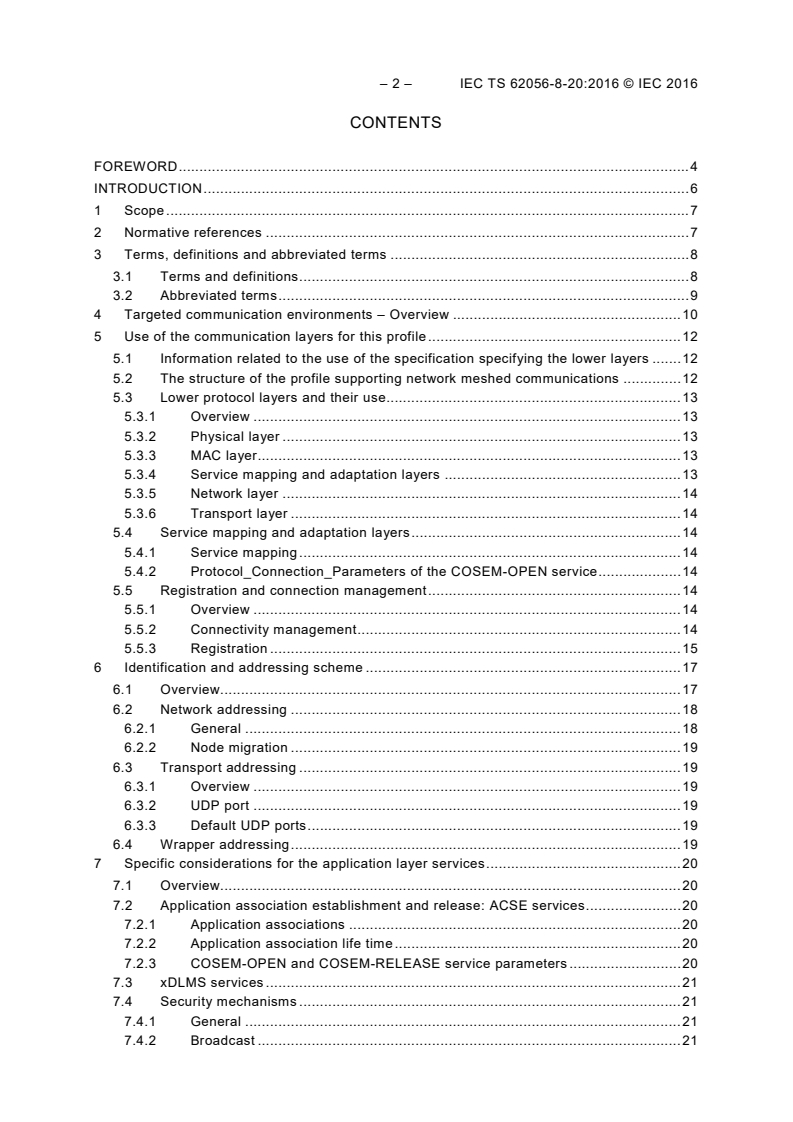
CONTENTS
FOREWORD . 4
INTRODUCTION . 6
1 Scope . 7
2 Normative references . 7
3 Terms, definitions and abbreviated terms . 8
3.1 Terms and definitions . 8
3.2 Abbreviated terms . 9
4 Targeted communication environments – Overview . 10
5 Use of the communication layers for this profile . 12
5.1 Information related to the use of the specification specifying the lower layers . 12
5.2 The structure of the profile supporting network meshed communications . 12
5.3 Lower protocol layers and their use. 13
5.3.1 Overview . 13
5.3.2 Physical layer . 13
5.3.3 MAC layer. 13
5.3.4 Service mapping and adaptation layers . 13
5.3.5 Network layer . 14
5.3.6 Transport layer . 14
5.4 Service mapping and adaptation layers . 14
5.4.1 Service mapping . 14
5.4.2 Protocol_Connection_Parameters of the COSEM-OPEN service . 14
5.5 Registration and connection management . 14
5.5.1 Overview . 14
5.5.2 Connectivity management . 14
5.5.3 Registration . 15
6 Identification and addressing scheme . 17
6.1 Overview. 17
6.2 Network addressing . 18
6.2.1 General . 18
6.2.2 Node migration . 19
6.3 Transport addressing . 19
6.3.1 Overview . 19
6.3.2 UDP port . 19
6.3.3 Default UDP ports . 19
6.4 Wrapper addressing . 19
7 Specific considerations for the application layer services . 20
7.1 Overview. 20
7.2 Application association establishment and release: ACSE services . 20
7.2.1 Application associations . 20
7.2.2 Application association life time . 20
7.2.3 COSEM-OPEN and COSEM-RELEASE service parameters . 20
7.3 xDLMS services . 21
7.4 Security mechanisms . 21
7.4.1 General . 21
7.4.2 Broadcast . 21
7.4.3 Lower layers security . 21
7.5 Transferring long application messages . 22
7.6 Media access, bandwidth and timing considerations . 22
7.7 Other considerations . 22
8 Communication configuration and management . 22
8.1 Overview. 22
8.2 Group management . 22
8.3 Delayed and randomized response . 22
9 The COSEM application process . 23
10 Additional considerations for the use of this profile . 23
Annex A (informative) Address management process example . 24
A.1 Registration management . 24
A.2 IP address publication . 24
A.2.1 General . 24
A.2.2 Address lookup . 25
Figure 1 – Mesh neighbourhood network within an AMI environment. 10
Figure 2 – Entities and interfaces of a smart metering system . 12
Figure 3 – The DLMS/COSEM mesh communication profile . 13
Figure 4 – Identification and addressing scheme . 18
Figure A.1 – Registration management process . 25
Table 1 – Send_destination_and_method attribute . 16
Table 2 – Address registration data . 16
Table 3 – Address update data . 16
Table 4 – Client and server SAPs . 19
– 4 – IEC TS 62056-8-20:2016 © IEC 2016
INTERNATIONAL ELECTROTECHNICAL COMMISSION
____________
ELECTRICITY METERING DATA EXCHANGE –
THE DLMS/COSEM SUITE –
Part 8-20: Mesh communication profile
for neighbourhood networks
FOREWORD
1) The International Electrotechnical Commission (IEC) is a worldwide organization for standardization comprising
all national electrotechnical committees (IEC National Committees). The object of IEC is to promote
international co-operation on all questions concerning standardization in the electrical and electronic fields. To
this end and in addition to other activities, IEC publishes International Standards, Technical Specifications,
Technical Reports, Publicly Available Specifications (PAS) and Guides (hereafter referred to as “IEC
Publication(s)”). Their preparation is entrusted to technical committees; any IEC National Committee interested
in the subject dealt with may participate in this preparatory work. International, governmental and non-
governmental organizations liaising with the IEC also participate in this preparation. IEC collaborates closely
with the International Organization for Standardization (ISO) in accordance with conditions determined by
agreement between the two organizations.
2) The formal decisions or agreements of IEC on technical matters express, as nearly as possible, an international
consensus of opinion on the relevant subjects since each technical committee has representation from all
interested IEC National Committees.
3) IEC Publications have the form of recommendations for international use and are accepted by IEC National
Committees in that sense. While all reasonable efforts are made to ensure that the technical content of IEC
Publications is accurate, IEC cannot be held responsible for the way in which they are used or for any
misinterpretation by any end user.
4) In order to promote international uniformity, IEC National Committees undertake to apply IEC Publications
transparently to the maximum extent possible in their national and regional publications. Any divergence
between any IEC Publication and the corresponding national or regional publication shall be clearly indicated in
the latter.
5) IEC itself does not provide any attestation of conformity. Independent certification bodies provide conformity
assessment services and, in some areas, access to IEC marks of conformity. IEC is not responsible for any
services carried out by independent certification bodies.
6) All users should ensure that they have the latest edition of this publication.
7) No liability shall attach to IEC or its directors, employees, servants or agents including individual experts and
members of its technical committees and IEC National Committees for any personal injury, property damage or
other damage of any nature whatsoever, whether direct or indirect, or for costs (including legal fees) and
expenses arising out of the publication, use of, or reliance upon, this IEC Publication or any other IEC
Publications.
8) Attention is drawn to the Normative references cited in this publication. Use of the referenced publications is
indispensable for the correct application of this publication.
9) Attention is drawn to the possibility that some of the elements of this IEC Publication may be the subject of
patent rights. IEC shall not be held responsible for identifying any or all such patent rights.
The International Electrotechnical Commission (IEC) draws attention to the fact that it is claimed that compliance
with this Technical Specification may involve the use of a maintenance service concerning the stack of protocols on
which the present specification IEC 62056-8-20 is based.
The IEC takes no position concerning the evidence, validity and scope of this maintenance service.
The provider of the maintenance service has assured the IEC that he is willing to provide services under
reasonable and non-discriminatory terms and conditions for applicants throughout the world. In this respect, the
statement of the provider of the maintenance service is registered with the IEC. Information may be obtained from:
DLMS User Association
Zug/Switzerland
www.dlms.com
The main task of IEC technical committees is to prepare International Standards. In
exceptional circumstances, a technical committee may propose the publication of a technical
specification when
• the required support cannot be obtained for the publication of an International Standard,
despite repeated efforts, or
• the subject is still under technical development or where, for any other reason, there is the
future but no immediate possibility of an agreement on an International Standard.
Technical specifications are subject to review within three years of publication to decide
whether they can be transformed into International Standards.
IEC TS 62056-8-20, which is a technical specification, has been prepared by technical
committee 13: Electrical energy measurement and control.
The text of this technical specification is based on the following documents:
Enquiry draft Report on voting
13/1673/DTS 13/1704/RVC
Full information on the voting for the approval of this technical specification can be found in
the report on voting indicated in the above table.
This document has been drafted in accordance with the ISO/IEC Directives, Part 2.
A list of all parts in the IEC 62056 series, published under the general title Electricity metering
data exchange – The DLMS/COSEM suite, can be found on the IEC website.
The committee has decided that the contents of this publication will remain unchanged until
the stability date indicated on the IEC website under "http://webstore.iec.ch" in the data
related to the specific publication. At this date, the publication will be
• transformed into an International standard,
• reconfirmed,
• withdrawn,
• replaced by a revised edition, or
• amended.
A bilingual version of this publication may be issued at a later date.
IMPORTANT – The 'colour inside' logo on the cover page of this publication indicates
that it contains colours which are considered to be useful for the correct
understanding of its contents. Users should therefore print this document using a
colour printer.
– 6 – IEC TS 62056-8-20:2016 © IEC 2016
INTRODUCTION
As defined in IEC 62056-1-0, the IEC 62056 DLMS/COSEM suite provides specific
communication profile standards for communication media relevant for smart metering.
Such communication profile standards specify how the COSEM data model and the
DLMS/COSEM application layer can be used on the lower communication media-specific
protocol layers.
Communication profile standards refer to communication standards that are part of the
IEC 62056 DLMS/COSEM suite or to any other open communication standard.
This Technical Specification specifies a DLMS/COSEM IPv6 based communication profile that
can be used in large scale AMI deployments where the Neighbourhood Networks are mesh
networks.
The communication profile specified in this Technical Specification can be used over various
suitable technologies providing a Neighbourhood Network with mesh topology, as long as they
are capable to carry IPv6 traffic.
This specification follows the rules defined in IEC 62056-5-3:2016, Annex A.
The communication profile specified in this specification addresses the specificities resulting
from the properties of the mesh network and the large quantity of devices to be managed.
ELECTRICITY METERING DATA EXCHANGE –
THE DLMS/COSEM SUITE –
Part 8-20: Mesh communication profile
for neighbourhood networks
1 Scope
This part of IEC 62056 specifies a DLMS/COSEM communication profile that can be used in a
smart metering system in which the Neighbourhood Networks (NN) are mesh networks.
This profile may be considered as an adaptation and extension of the UDP/IP communication
profile specified in IEC 62056-9-7:2013. As in that standard, the PHY and MAC layers are out
of the Scope.
This Technical Specification specifies a number of features essential to the efficient operation
of a large scale AMI using mesh NNs. These features include:
• identification of the DLMS/COSEM client and server participating in an application
association (AA) with their system title, so that this identification does not change when
the IP address of the server changes, see Clause 6;
• a mechanism to inform the client of the binding between the server’s system title and its
current IP address(es), see 5.5.3;
• the use of the DLMS/COSEM UDP based transport layer, that allows keeping
DLMS/COSEM AAs open for long periods, while the device may leave and join the mesh
NN and/or its IP address may change, see 7.2.2;
• DLMS/COSEM application layer and application process level security features that can
be used in a mesh environment, see 7.4.2;
• a mechanism to organize servers to one or more groups based on various conditions, so
that the requests can be broadcasted to all devices attached to the mesh network, but only
those servers belonging to the group carry out the request and respond, see 8.2;
• a mechanism that allows to send the response to a request in designated time windows
and with a randomized delay, see 8.3.
• the use of a specific UDP port that allows efficient UDP header compression, see 6.3.3.
The Scope of this communication profile specification is restricted to aspects concerning the
use of communication protocols in conjunction with the COSEM data model and the
DLMS/COSEM application layer. Any project specific definitions of data structures and data
contents may be provided in project specific companion specifications.
2 Normative references
The following documents are referred to in the text in such a way that some or all of their
content constitutes requirements of this document. For dated references, only the edition
cited applies. For undated references, the latest edition of the referenced document (including
any amendments) applies.
IEC 60050 (all parts), International Electrotechnical Vocabulary (IEV) (available at
www.electropedia.org)
IEC TR 62051, Electricity metering – Glossary of terms
– 8 – IEC TS 62056-8-20:2016 © IEC 2016
IEC TR 62051-1, Electricity metering – Data exchange for meter reading, tariff and load
control – Glossary of terms – Part 1: Terms related to data exchange with metering
equipment using DLMS/COSEM
IEC 62056-1-0, Electricity metering data exchange – The DLMS/COSEM suite – Part 1-0:
Smart metering standardisation framework
IEC 62056-4-7, Electricity metering data exchange – The DLMS/COSEM suite – Part 4-7:
DLMS/COSEM transport layer for IP networks
IEC 62056-5-3:2016, Electricity metering data exchange – The DLMS/COSEM suite –
Part 5-3: DLMS/COSEM application layer
IEC 62056-6-1, Electricity metering data exchange – The DLMS/COSEM suite – Part 6-1:
Object Identification System (OBIS)
IEC 62056-6-2, Electricity metering data exchange – The DLMS/COSEM suite – Part 6-2:
COSEM interface classes
IEC 62056-9-7:2013, Electricity metering data exchange – The DLMS/COSEM suite –
Part 9-7: Communication profile for TCP-UDP/IP networks
RFC 768, User Datagram Protocol Edited by J. Postel. August 1980. Available from
https://www.ietf.org/rfc/rfc768.txt
RFC 2460, Internet Protocol, Version 6 (Ipv6) Specification [online]. Edited by R. Hinden, S.
Deering. December 1998. Available from http://tools.ietf.org/html/rfc2460
RFC 3315, Dynamic Host Configuration Protocol for IPv6 (DHCPv6) Edited by R. Droms, J.
Bound, B. Volz, T. Lemon, C. Perkins, M. Carney. July 2003. Available from
http://www.ietf.org/rfc/rfc3315.txt
RFC 4291, IP Version 6 Addressing Architecture [online]. Edited by R. Hinden, S. Deering.
February 2006. Available from http://tools.ietf.org/html/rfc4291
RFC 4862, IPv6 Stateless Address Autoconfiguration. Edited by S. Thomson, T.Narten, T.
Jinmei September 2007. Available from https://tools.ietf.org/html/rfc4862
RFC 4944, Transmission of IPv6 Packets over IEEE 802.15.4 Networks [online]. Edited by G.
Montenegro, N. Kushalnagar, D. Culler. September 2007. Available from
http://tools.ietf.org/html/rfc4944
RFC 6282, Compression Format for IPv6 Datagrams over IEEE 802.15.4-Based Networks.
Available from http://tools.ietf.org/html/rfc6282
RFC 6550, IPv6 Routing Protocol for Low-Power and Lossy Networks, Edited by T. Winter, P.
Thubert, A. Brandt, J. Hui, R. Kelsey, P. Lewis, K. Pister, R. Struik, JP. Vasseur, R.
Alexander. March 2012. Available from https://tools.ietf.org/html/rfc6550
3 Terms, definitions and abbreviated terms
3.1 Terms and definitions
For the purposes of this document, the definitions given in IEC 60050, IEC 62051, IEC 62051-
1 as well as the following apply.
NOTE Where there is a difference between the definitions in the glossary and those contained in product
standards produced by TC 13, then the latter take precedence in applications of the relevant standard.
ISO and IEC maintain terminological databases for use in standardization at the following
addresses:
• IEC Electropedia: available at http://www.electropedia.org/
• ISO Online browsing platform: available at http://www.iso.org/obp
3.1.1
mesh network
functional unit for the transfer of data between several participants for data processing, via
one or a number of redundant transmission paths, whereby each participant is able to pass on
data that do not concern themselves to one or more neighbours
3.1.2
Head End System
HES
Central Data System exchanging data via the AMI of various meters in its service area
Note 1 to entry: The HES may communicate via WAN directly to the end devices or via NNAPs and LNAPs.
3.2 Abbreviated terms
AA Application Association
ACSE Association Control Service Element
AL Application Layer
AMI Advanced Metering Infrastructure
AP Application Process
ASE Application Service Element
COSEM Companion Specification for Energy Metering
DCS Data Collection System
DHCPv6 Dynamic Host Configuration Protocol for IPv6
DLMS Device Language Message Specification
DNS Domain Name System
IP Internet Protocol
HES Head End System
HLS High Level Security mechanism
IANA Internet Assigned Numbers Authority
LAN Local Area Network
LN Local Network
LNAP Local Network Access Point
MAC Media Access Control sublayer of the Data Link Layer as specified in the OSI
Open Systems Interconnection Model
NN Neighbourhood Network
NNAP Neighbourhood Network Access Point
PHY Physical Layer as specified in the OSI Open Systems Interconnection Model
RF Radio Frequency
RPL Routing Protocol for Low-Power and Lossy Networks
SAP Service Access Point
TCP Transmission Control Protocol
– 10 – IEC TS 62056-8-20:2016 © IEC 2016
UDP User Datagram Protocol
WAN Wide Area Network
xDLMS Extended DLMS
4 Targeted communication environments – Overview
The objectives of defining a DLMS/COSEM communication profile for mesh neighbourhood
networks are the following:
a) centralized management of a large number of end devices by a single central Head End
System (HES) hosting a (set of) DLMS/COSEM client(s);
b) efficient end-to-end communication between DLMS/COSEM clients and different kind of
devices over Neighbourhood Networks using mesh topology;
c) reliability and efficiency of accessing devices via the mesh network;
d) management of adding, removing and relocating devices using existing open standards.
A segment of an AMI network with devices communicating over a mesh network is shown in
Figure 1.
HES
NNAP1 NNAP2 NNAP3 NNAP4
NN1
NN2
End device
NN3
NN4
DLMS/COSEM
LNAP
End device server
End device
DLMS/COSEM DLMS/COSEM
DLMS/COSEM
server server
End device
server LNAP
DLMS/COSEM
DLMS/COSEM
server
server
End device LNAP
DLMS/COSEM DLMS/COSEM
LNAP
server server
DLMS/COSEM
server
End device End device
DLMS/COSEM DLMS/COSEM
End device
server server
DLMS/COSEM
End device
End device
server
DLMS/COSEM End device
End device
server
End device
DLMS/COSEM
End device
server
IEC
Figure 1 – Mesh neighbourhood network within an AMI environment
Figure 1 depicts a centralized meter data collection and management system.
rd
NOTE 1 It may be managed by a Utility or some other 3 party entity but this aspect is out of the Scope of this
document.
There may be many NNs with a single NNAP each. The NNAP provides access for the HES to
the mesh NN. On the one hand, an NNAP has an interface towards the WAN and the NN. On
the other hand, it acts as the coordinator of the NN, managing the discovery and registration
Local network Neighbourhood Mesh network Wide Area Network
of devices on the mesh network. Concerning DLMS/COSEM data exchange, the NNAP
provides only a routing function.
End devices may be:
• various kind of utility meters e.g. electricity, gas, heat, water meters or other devices with
smart metering and control functions;
• DLMS/COSEM servers, or they may implement another application protocol (e.g. M-Bus or
ZigBee® );
• mains powered or battery powered (electricity meters are always mains powered);
• directly connected to the mesh network, or connected via LNAPs;
• IP capable or not.
The functionality of LNAPs depends on the kind of end devices connected to them:
• when the end devices are mains powered and IP capable DLMS/COSEM servers that are
not directly connected to the mesh network, the LNAP is simply a router;
• when the end devices are mains powered not IP capable DLMS/COSEM servers that
therefore cannot be directly connected to the mesh network, the LNAP acts as a
DLMS/COSEM gateway and as a master of the LN;
• when the end devices are battery powered DLMS/COSEM servers that cannot be directly
connected to the mesh network, the LNAP acts as a proxy that exchanges data with the
end devices when they are awake and that can store requests to and responses from the
DLMS/COSEM servers. The LNAP also acts as a master of the LN;
• when the end devices are not DLMS/COSEM servers, then the LNAP acts as a master for
tho
...