

IEC GUIDE 118:2024
(Main)Preparation of basic and group energy efficiency publications including energy efficiency aspects
General Information
- Abstract
IEC Guide 118:2024 is addressed to all TCs and intends to support their work on energy efficiency publications within their specific scope.
This document defines procedures for the preparation and revision of basic and group energy efficiency (EE) publications including energy efficiency aspects (EEAs).
This second edition cancels and replaces the first edition published in 2017. This second edition also replaces the first edition of IEC Guide 119 published in 2017.
The main changes with respect to the previous edition are as follows:
a) merging of IEC Guide 118 edition 1 with IEC Guide 119 edition 1;
b) elimination of duplication;
c) addition of definitions.
- Status
- Published
- Publication Date
- 08-Feb-2024
- Technical Committee
- IEC/TC - IEC/TC
- Current Stage
- PPUB - Publication issued
- Start Date
- 09-Feb-2024
- Completion Date
- 03-Oct-2022
Overview
IEC GUIDE 118:2024, issued by the International Electrotechnical Commission (IEC), is a comprehensive guide designed to support technical committees (TCs) in preparing and revising publications addressing energy efficiency (EE) and energy efficiency aspects (EEAs). This second edition merges the earlier IEC Guide 118:2017 and IEC Guide 119:2017 editions to eliminate duplication and introduces additional energy efficiency definitions, providing a unified and updated framework.
The guide emphasizes standardized procedures for the development of basic and group energy efficiency publications, enhancing consistency and facilitating the integration of energy efficiency considerations across diverse electrotechnical sectors. Its aim aligns with global energy policies and the United Nations Sustainable Development Goals by fostering wider adoption of energy-efficient technologies and systems.
Key Topics
Energy Efficiency Framework
The guide defines a systems approach to energy efficiency, focusing on boundary descriptions that include inputs, outputs, driving parameters, and key performance indicators (KPIs). This holistic perspective ensures that all relevant energy aspects are considered across components and systems.Preparation of Publications
IEC GUIDE 118:2024 delineates the process for creating basic EE publications (which focus on foundational energy efficiency principles) and group EE publications (covering integrated or collaborative aspects across multiple products or systems). It also addresses product-specific publications and how to reference related materials.Energy Efficiency Aspects (EEAs)
Identification, categorization, and inclusion of various EEAs are highlighted to ensure consistent treatment of energy efficiency within technical publications. This includes practical examples and guidance on incorporating EEAs effectively.Roles and Responsibilities
The guide outlines the responsibilities of the Advisory Committee on Energy Efficiency (ACEE), TCs with horizontal EE functions, and product-specific TCs. It clarifies coordination processes, informing relevant committees, and managing requests for new work related to EE.Boundary and Systems Approach
Practical boundary-setting examples demonstrate how to define operational scopes, both for independent solutions and complex systems. These examples assist in clarifying the energy flow and interactions between components, promoting collaborative standardization efforts.Overcoming Market Barriers
Informative annexes discuss common market barriers to energy efficiency deployment and suggest ways standardization can help overcome these obstacles through harmonized methods and terminology.
Applications
IEC GUIDE 118:2024 plays a vital role in:
Standardizing Energy Efficiency Criteria
It aids in harmonizing the specification, measurement, and assessment of energy efficiency across electrical and electronic technologies, enabling reliable benchmarking and comparison.Supporting Sustainable Development
By promoting the adoption of energy-efficient practices, the guide supports environmental preservation and energy policy targets at national and international levels.Facilitating Inter-Committee Collaboration
The guidance on shared responsibilities encourages joint development of standards where multiple technical committees are involved, optimizing resource use and ensuring consistency.Enhancing Product and System Design
Manufacturers and designers can utilize this guide to integrate energy efficiency aspects into product development and system optimization, boosting performance and compliance with energy regulations.Improving Market Transparency
The standard supports the creation of clear, consistent energy efficiency documentation that helps consumers and regulators make informed decisions.
Related Standards
IEC GUIDE 118:2024 complements and integrates elements from related IEC guides and standards by:
Replacing the earlier editions of IEC Guide 118 and IEC Guide 119 (both 2017 editions), consolidating their content for streamlined reference.
Aligning with IEC’s broader body of international standards focused on electrical and electronic technologies and contributing to ongoing work in energy management, measurement, and sustainable technology deployment.
Providing foundational principles that support standards targeting specific products, processes, or systems, such as IEC 61800-9-1, which is referenced as a collaborative example within the guide.
Encouraging harmonization with ISO/IEC directives and collaboration with ISO standards to ensure compatibility across international frameworks.
Keywords: IEC Guide 118:2024, energy efficiency publications, energy efficiency aspects, IEC standard, electrotechnical standardization, energy efficiency KPIs, systems approach, Advisory Committee on Energy Efficiency, sustainable development, energy efficiency barriers, product group publications, standardization procedures.
Relations
- Effective Date
- 05-Sep-2023
- Effective Date
- 05-Sep-2023
Get Certified
Connect with accredited certification bodies for this standard

DNV
DNV is an independent assurance and risk management provider.

Lloyd's Register
Lloyd's Register is a global professional services organisation specialising in engineering and technology.
DNV Energy Systems
Energy and renewable energy certification.
Sponsored listings
Frequently Asked Questions
IEC GUIDE 118:2024 is a guide published by the International Electrotechnical Commission (IEC). Its full title is "Preparation of basic and group energy efficiency publications including energy efficiency aspects". This standard covers: IEC Guide 118:2024 is addressed to all TCs and intends to support their work on energy efficiency publications within their specific scope. This document defines procedures for the preparation and revision of basic and group energy efficiency (EE) publications including energy efficiency aspects (EEAs). This second edition cancels and replaces the first edition published in 2017. This second edition also replaces the first edition of IEC Guide 119 published in 2017. The main changes with respect to the previous edition are as follows: a) merging of IEC Guide 118 edition 1 with IEC Guide 119 edition 1; b) elimination of duplication; c) addition of definitions.
IEC Guide 118:2024 is addressed to all TCs and intends to support their work on energy efficiency publications within their specific scope. This document defines procedures for the preparation and revision of basic and group energy efficiency (EE) publications including energy efficiency aspects (EEAs). This second edition cancels and replaces the first edition published in 2017. This second edition also replaces the first edition of IEC Guide 119 published in 2017. The main changes with respect to the previous edition are as follows: a) merging of IEC Guide 118 edition 1 with IEC Guide 119 edition 1; b) elimination of duplication; c) addition of definitions.
IEC GUIDE 118:2024 is classified under the following ICS (International Classification for Standards) categories: 27.015 - Energy efficiency. Energy conservation in general. The ICS classification helps identify the subject area and facilitates finding related standards.
IEC GUIDE 118:2024 has the following relationships with other standards: It is inter standard links to IEC GUIDE 119:2017, IEC GUIDE 118:2017. Understanding these relationships helps ensure you are using the most current and applicable version of the standard.
IEC GUIDE 118:2024 is available in PDF format for immediate download after purchase. The document can be added to your cart and obtained through the secure checkout process. Digital delivery ensures instant access to the complete standard document.
Standards Content (Sample)
IEC GUIDE 118 ®
Edition 2.0 2024-02
GUIDE
GUIDE
colour
inside
Preparation of basic and group energy efficiency publications including energy
efficiency aspects
Élaboration des publications fondamentales et de groupe sur l'efficacité
énergétique, y compris les aspects d'efficacité énergétique
All rights reserved. Unless otherwise specified, no part of this publication may be reproduced or utilized in any form
or by any means, electronic or mechanical, including photocopying and microfilm, without permission in writing from
either IEC or IEC's member National Committee in the country of the requester. If you have any questions about IEC
copyright or have an enquiry about obtaining additional rights to this publication, please contact the address below or
your local IEC member National Committee for further information.
Droits de reproduction réservés. Sauf indication contraire, aucune partie de cette publication ne peut être reproduite ni
utilisée sous quelque forme que ce soit et par aucun procédé, électronique ou mécanique, y compris la photocopie et
les microfilms, sans l'accord écrit de l'IEC ou du Comité national de l'IEC du pays du demandeur. Si vous avez des
questions sur le copyright de l'IEC ou si vous désirez obtenir des droits supplémentaires sur cette publication, utilisez
les coordonnées ci-après ou contactez le Comité national de l'IEC de votre pays de résidence.
IEC Secretariat Tel.: +41 22 919 02 11
3, rue de Varembé info@iec.ch
CH-1211 Geneva 20 www.iec.ch
Switzerland
About the IEC
The International Electrotechnical Commission (IEC) is the leading global organization that prepares and publishes
International Standards for all electrical, electronic and related technologies.
About IEC publications
The technical content of IEC publications is kept under constant review by the IEC. Please make sure that you have the
latest edition, a corrigendum or an amendment might have been published.
IEC publications search - webstore.iec.ch/advsearchform IEC Products & Services Portal - products.iec.ch
The advanced search enables to find IEC publications by a Discover our powerful search engine and read freely all the
variety of criteria (reference number, text, technical publications previews. With a subscription you will always have
committee, …). It also gives information on projects, replaced access to up to date content tailored to your needs.
and withdrawn publications.
Electropedia - www.electropedia.org
IEC Just Published - webstore.iec.ch/justpublished
The world's leading online dictionary on electrotechnology,
Stay up to date on all new IEC publications. Just Published
containing more than 22 300 terminological entries in English
details all new publications released. Available online and once
and French, with equivalent terms in 19 additional languages.
a month by email.
Also known as the International Electrotechnical Vocabulary
(IEV) online.
IEC Customer Service Centre - webstore.iec.ch/csc
If you wish to give us your feedback on this publication or need
further assistance, please contact the Customer Service
Centre: sales@iec.ch.
A propos de l'IEC
La Commission Electrotechnique Internationale (IEC) est la première organisation mondiale qui élabore et publie des
Normes internationales pour tout ce qui a trait à l'électricité, à l'électronique et aux technologies apparentées.
A propos des publications IEC
Le contenu technique des publications IEC est constamment revu. Veuillez vous assurer que vous possédez l’édition la
plus récente, un corrigendum ou amendement peut avoir été publié.
Recherche de publications IEC - Découvrez notre puissant moteur de recherche et consultez
webstore.iec.ch/advsearchform gratuitement tous les aperçus des publications. Avec un
La recherche avancée permet de trouver des publications IEC abonnement, vous aurez toujours accès à un contenu à jour
en utilisant différents critères (numéro de référence, texte, adapté à vos besoins.
comité d’études, …). Elle donne aussi des informations sur les
projets et les publications remplacées ou retirées. Electropedia - www.electropedia.org
Le premier dictionnaire d'électrotechnologie en ligne au monde,
IEC Just Published - webstore.iec.ch/justpublished
avec plus de 22 300 articles terminologiques en anglais et en
Restez informé sur les nouvelles publications IEC. Just
français, ainsi que les termes équivalents dans 19 langues
Published détaille les nouvelles publications parues.
additionnelles. Egalement appelé Vocabulaire
Disponible en ligne et une fois par mois par email.
Electrotechnique International (IEV) en ligne.
Service Clients - webstore.iec.ch/csc
Si vous désirez nous donner des commentaires sur cette
publication ou si vous avez des questions contactez-nous:
sales@iec.ch.
IEC Products & Services Portal - products.iec.ch
IEC GUIDE 118 ®
Edition 2.0 2024-02
GUIDE
GUIDE
colour
inside
Preparation of basic and group energy efficiency publications including energy
efficiency aspects
Élaboration des publications fondamentales et de groupe sur l'efficacité
énergétique, y compris les aspects d'efficacité énergétique
INTERNATIONAL
ELECTROTECHNICAL
COMMISSION
COMMISSION
ELECTROTECHNIQUE
INTERNATIONALE
ICS 27.015 ISBN 978-2-8322-5610-7
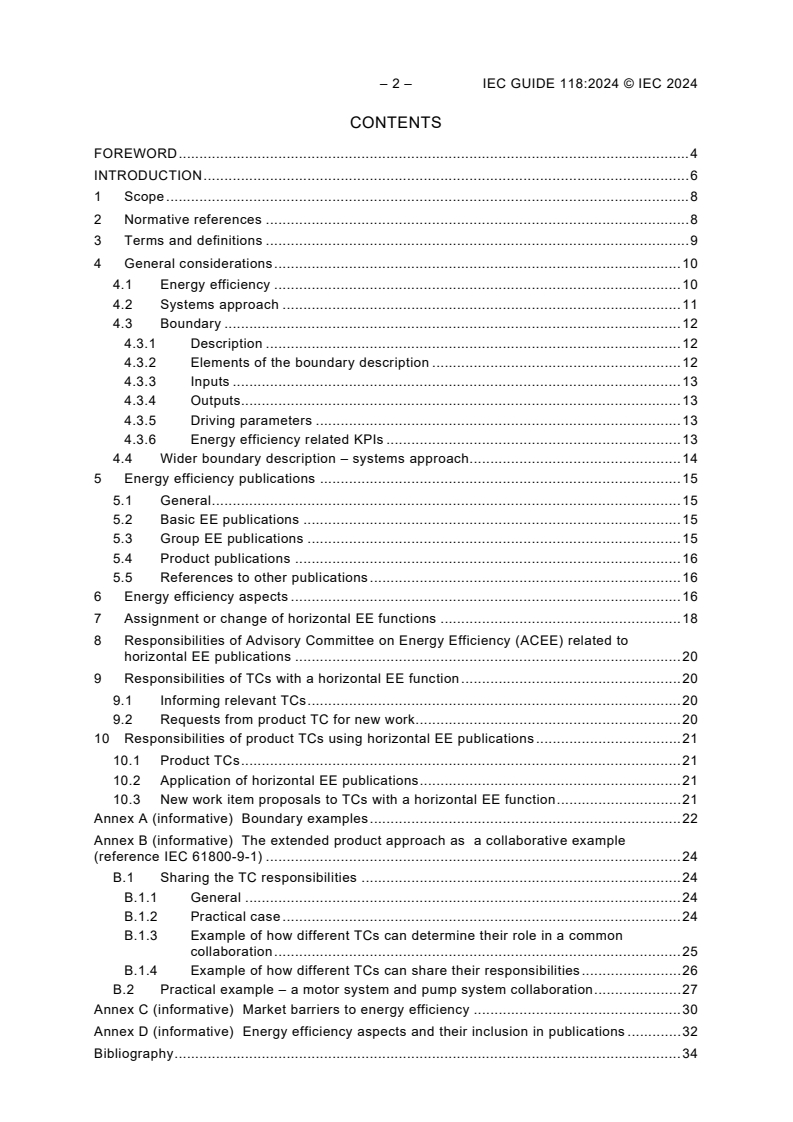
– 2 – IEC GUIDE 118:2024 © IEC 2024
CONTENTS
FOREWORD . 4
INTRODUCTION . 6
1 Scope . 8
2 Normative references . 8
3 Terms and definitions . 9
4 General considerations . 10
4.1 Energy efficiency . 10
4.2 Systems approach . 11
4.3 Boundary . 12
4.3.1 Description . 12
4.3.2 Elements of the boundary description . 12
4.3.3 Inputs . 13
4.3.4 Outputs. 13
4.3.5 Driving parameters . 13
4.3.6 Energy efficiency related KPIs . 13
4.4 Wider boundary description – systems approach. 14
5 Energy efficiency publications . 15
5.1 General . 15
5.2 Basic EE publications . 15
5.3 Group EE publications . 15
5.4 Product publications . 16
5.5 References to other publications . 16
6 Energy efficiency aspects . 16
7 Assignment or change of horizontal EE functions . 18
8 Responsibilities of Advisory Committee on Energy Efficiency (ACEE) related to
horizontal EE publications . 20
9 Responsibilities of TCs with a horizontal EE function . 20
9.1 Informing relevant TCs . 20
9.2 Requests from product TC for new work. 20
10 Responsibilities of product TCs using horizontal EE publications . 21
10.1 Product TCs . 21
10.2 Application of horizontal EE publications . 21
10.3 New work item proposals to TCs with a horizontal EE function . 21
Annex A (informative) Boundary examples . 22
Annex B (informative) The extended product approach as a collaborative example
(reference IEC 61800-9-1) . 24
B.1 Sharing the TC responsibilities . 24
B.1.1 General . 24
B.1.2 Practical case . 24
B.1.3 Example of how different TCs can determine their role in a common
collaboration . 25
B.1.4 Example of how different TCs can share their responsibilities . 26
B.2 Practical example – a motor system and pump system collaboration . 27
Annex C (informative) Market barriers to energy efficiency . 30
Annex D (informative) Energy efficiency aspects and their inclusion in publications . 32
Bibliography . 34
Figure 1 – Boundary description and its elements . 13
Figure 2 – Wider boundary description . 14
Figure 3 – Flow chart showing the assignment process for a horizontal function
involving an advisory committee (AC) . 19
Figure A.1 – Boundary setting example: three boundaries for independent solution . 22
Figure A.2 – Boundary setting example: a boundary of a group . 22
Figure A.3 – A boundary of group with systematic solution . 23
Figure B.1 – Relation between different components at different levels . 25
Figure B.2 – Link between each box's corresponding TCs . 26
Figure B.3 – TCs responsibilities with EE key parameters at the different levels,
starting from the plant level and going down to individual components . 27
Figure B.4 – Interaction between the two semi-analytical models (SAMs) . 28
Figure B.5 – The semi-analytical models (SAMs) of the pump system (the extended
product) and the motor system . 29
Table 1 – Energy efficiency aspect categories and examples . 17
Table C.1 – Examples of generic market barriers to energy efficiency and possible
measures to overcome them from a standardization point of view . 30
Table D.1 – Energy efficiency aspects and examples of their inclusion in publications . 32
– 4 – IEC GUIDE 118:2024 © IEC 2024
INTERNATIONAL ELECTROTECHNICAL COMMISSION
____________
PREPARATION OF BASIC AND GROUP ENERGY EFFICIENCY
PUBLICATIONS INCLUDING ENERGY EFFICIENCY ASPECTS
FOREWORD
1) The International Electrotechnical Commission (IEC) is a worldwide organization for standardization comprising
all national electrotechnical committees (IEC National Committees). The object of IEC is to promote international
co-operation on all questions concerning standardization in the electrical and electronic fields. To this end and
in addition to other activities, IEC publishes International Standards, Technical Specifications, Technical Reports,
Publicly Available Specifications (PAS) and Guides (hereafter referred to as "IEC Publication(s)"). Their
preparation is entrusted to technical committees; any IEC National Committee interested in the subject dealt with
may participate in this preparatory work. International, governmental and non-governmental organizations liaising
with the IEC also participate in this preparation. IEC collaborates closely with the International Organization for
Standardization (ISO) in accordance with conditions determined by agreement between the two organizations.
2) The formal decisions or agreements of IEC on technical matters express, as nearly as possible, an international
consensus of opinion on the relevant subjects since each technical committee has representation from all
interested IEC National Committees.
3) IEC Publications have the form of recommendations for international use and are accepted by IEC National
Committees in that sense. While all reasonable efforts are made to ensure that the technical content of IEC
Publications is accurate, IEC cannot be held responsible for the way in which they are used or for any
misinterpretation by any end user.
4) In order to promote international uniformity, IEC National Committees undertake to apply IEC Publications
transparently to the maximum extent possible in their national and regional publications. Any divergence between
any IEC Publication and the corresponding national or regional publication shall be clearly indicated in the latter.
5) IEC itself does not provide any attestation of conformity. Independent certification bodies provide conformity
assessment services and, in some areas, access to IEC marks of conformity. IEC is not responsible for any
services carried out by independent certification bodies.
6) All users should ensure that they have the latest edition of this publication.
7) No liability shall attach to IEC or its directors, employees, servants or agents including individual experts and
members of its technical committees and IEC National Committees for any personal injury, property damage or
other damage of any nature whatsoever, whether direct or indirect, or for costs (including legal fees) and
expenses arising out of the publication, use of, or reliance upon, this IEC Publication or any other IEC
Publications.
8) Attention is drawn to the Normative references cited in this publication. Use of the referenced publications is
indispensable for the correct application of this publication.
9) IEC draws attention to the possibility that the implementation of this document may involve the use of (a)
patent(s). IEC takes no position concerning the evidence, validity or applicability of any claimed patent rights in
respect thereof. As of the date of publication of this document, IEC had not received notice of (a) patent(s), which
may be required to implement this document. However, implementers are cautioned that this may not represent
the latest information, which may be obtained from the patent database available at https://patents.iec.ch. IEC
shall not be held responsible for identifying any or all such patent rights.
This second edition of IEC Guide 118 has been prepared, in accordance with ISO/IEC Directives,
Part 1, Annex A, by the IEC Advisory Committee on Energy Efficiency (ACEE).
This second edition cancels and replaces the first edition published in 2017. This second edition
also replaces the first edition of IEC Guide 119 published in 2017.
The main changes with respect to the previous edition are as follows:
a) merging of IEC Guide 118 edition 1 with IEC Guide 119 edition 1;
b) elimination of duplication;
c) addition of definitions.
The text of this IEC Guide is based on the following documents:
Draft Report on voting
SMBNC/37/DV SMBNC/45/RV
Full information on the voting for its approval can be found in the report on voting indicated in
the above table.
The language used for the development of this Guide is English.
This document was drafted in accordance with ISO/IEC Directives, Part 2, and developed in
accordance with ISO/IEC Directives, Part 1 and ISO/IEC Directives, IEC Supplement, available
at www.iec.ch/members_experts/refdocs. The main document types developed by IEC are
described in greater detail at www.iec.ch/publications.
IMPORTANT – The 'colour inside' logo on the cover page of this publication indicates that it
contains colours which are considered to be useful for the correct understanding of its
contents. Users should therefore print this document using a colour printer.
– 6 – IEC GUIDE 118:2024 © IEC 2024
INTRODUCTION
Energy efficiency (EE) is key to support energy policies while preserving the environment, thus
contributing to UN Sustainable Development Goals (https://www.iec.ch/sdg).
Many energy efficient technologies and solutions are already available and cost-effective;
nevertheless, a variety of barriers inhibit the deployment of these technologies and impede
harvesting their energy efficiency potential.
Standardization can play an important role to help overcome these barriers and to disseminate
and promote energy efficient technologies, solutions and services in order to overcome some
of the barriers to the implementation of energy efficient technologies and solutions.
Examples include:
• common measurement and test methods to assess the use of energy and reductions
attained through new technologies and processes;
• calculation methods so that sound comparisons of alternatives can be made in specific
situations and can help with adaptation of infrastructure to integrate new technologies and
interoperability;
• means to codify best practices and management processes for efficient energy use and
energy conservation;
• design checklists and guides that can be applied to both the design of new systems as well
as the retrofit of existing systems;
• common efficiency classifications, tolerances and minimum energy performance standards;
• the definition of possible energy efficiency metrics.
When developing IEC publications, barriers to energy efficiency should be considered, with the
goal to contribute to overcoming such barriers through standardization activity. Annex C
provides some examples.
This Guide aims to give advice to technical committees (TCs) on the way energy efficiency
should be considered and included in IEC publications.
IEC publications may deal exclusively with energy efficiency or may include clauses specific to
energy efficiency; however, TCs are encouraged to:
• consider energy efficiency in their standardization work;
• identify which aspects of energy efficiency are relevant for their standardization;
• use a structured approach when addressing energy efficiency;
• use a systems approach when addressing energy efficiency.
This Guide helps to fulfil IEC Energy Efficiency Policy by indicating how energy efficiency can
be included in electrotechnical publications.
TCs with subjects relating to energy efficiency for the whole, or for a specific part of their
activities, are invited to follow the provisions of this Guide.
___________
White Paper: Coping with the Energy Challenge. The IEC’s role from 2010 to 2030. Smart electrification – The
key to energy efficiency.
In this Guide, the term "technical committees" (TCs) includes "subcommittees" (SCs) and
"systems committees" (SyCs). The term "publication" includes International Standard, Publicly
Available Specification, Technical Report, Technical Specification and Guide.
In addition, the term "product" includes "process", "service" and combinations thereof,
commonly known as "systems".
– 8 – IEC GUIDE 118:2024 © IEC 2024
PREPARATION OF BASIC AND GROUP ENERGY EFFICIENCY
PUBLICATIONS INCLUDING ENERGY EFFICIENCY ASPECTS
1 Scope
This document is addressed to all TCs and intends to support their work on energy efficiency
publications within their specific scope.
This document defines procedures for the preparation and revision of basic and group energy
efficiency (EE) publications including energy efficiency aspects (EEAs).
This document:
• describes the contributions of IEC publications to energy efficiency;
• describes the concept of an energy efficiency aspect;
• provides categories of energy efficiency aspects and a list of energy efficiency aspects to
be considered by TCs.
• helps in harmonizing the systematic approach to energy efficiency;
• promotes the use of a systems approach when addressing energy efficiency aspects in the
context of standardization;
• raises awareness that provisions in IEC publications can affect the energy performance of
the product itself (taken individually) and of the entire application (embedding the product),
in both negative and positive ways;
• helps TCs to identify energy efficiency aspects that contribute to energy efficiency
improvement of the product itself and of the entire application;
• describes the relationship between TCs with basic and group EE functions.
In the context of this document, "EE" refers to energy efficiency of products, systems and
organizations.
It uses the boundary concept to address energy efficiency aspects in the context of a systems
approach.
It is beyond the scope of this Guide to cover or list all possible aspects relevant for all possible
products within the scope of IEC.
NOTE The IEC Standardization Management Board (SMB) has decided that Guides such as this one can have
mandatory requirements which shall be followed by all IEC committees developing technical work that falls within the
scope of the Guide, as well as guidance which may or may not be followed. The mandatory requirements in this
Guide are identified by the use of "shall". Statements that are only for guidance are identified by using the verb
"should". (See ISO/IEC Directives, IEC Supplement:2021, A.1.1).
2 Normative references
The following documents are referred to in the text in such a way that some or all of their content
constitutes requirements of this document. For dated references, only the edition cited applies.
For undated references, the latest edition of the referenced document (including any
amendments) applies.
IEC Guide 108, Guidelines for ensuring the coherency of IEC publications – Application of
horizontal standards
ISO/IEC 13273-1, Energy efficiency and renewable energy sources – Common international
terminology – Part 1: Energy efficiency
3 Terms and definitions
For the purposes of this document, the terms and definitions given in ISO/IEC 13273-1 and
the following apply.
ISO and IEC maintain terminological databases for use in standardization at the following
addresses:
• IEC Electropedia: available at http://www.electropedia.org/
• ISO Online browsing platform: available at http://www.iso.org/obp
3.1
energy efficiency
EE
ratio or other quantitative relationship between an output of performance, service, goods or
energy and an input of energy taking into account the driving parameters and the boundaries
EXAMPLE Conversion efficiency; energy required/energy used; output/input; theoretical energy used to
operate/energy used to operate.
Note 1 to entry: Both input and output need to be clearly specified in quantity and quality, and be measurable.
[SOURCE: ISO/IEC 13273-1:2015, 3.4.1, modified – "taking into account the driving parameters
and the boundaries" has been added to the definition. The symbol "E " has been replaced by
f
the abbreviated term "EE".]
3.2
energy efficiency aspect
EEA
specific way of treating a product in the area of EE application
3.3
energy performance
measurable results related to energy efficiency, energy use and energy consumption
[SOURCE: ISO/IEC 13273-1:2015, 3.3.1]
3.4
energy efficiency improvement
increase in energy efficiency as a result of technological, design, behavioural or economic
changes
[SOURCE: ISO/IEC 13273-1:2015, 3.4.3]
3.5
horizontal EE function
task assigned to a technical committee to prepare one or more horizontal EE publications
related to a given scope
Note 1 to entry: The assignment of a horizontal EE function to a technical committee (TC) is a pre-condition for a
TC to prepare horizontal EE publications.
3.6
horizontal EE publication
document dealing with energy efficiency aspects common to a number of technical committees
to ensure the coherence amongst publications
– 10 – IEC GUIDE 118:2024 © IEC 2024
3.7
basic EE publication
BEEP
horizontal publication on the fundamental principles, graphical symbols, terminology or
technical characteristics covering energy efficiency aspects applied by the relevant product
publications
Note 1 to entry: A basic EE publication is applicable to products within the scope of two or more technical
committees.
3.8
group EE publication
GEEP
horizontal publication covering a specific group of products, covering energy efficiency aspects
applied by the relevant product publications
Note 1 to entry: A product publication that is developed for a particular product can be designated as a group
publication to apply to a group of products covered by one or more technical committees, applicable to a specific
boundary.
3.9
product publication
document covering a specific product or family of related products within the scope of a single
product committee
[SOURCE: IEC Guide 108:2019, 3.1.4]
3.10
EE publication
publication covering energy efficiency aspects
Note 1 to entry: An EE publication can be a basic EE publication, a group EE publication or a product publication.
3.11
group EE function
task assigned to a technical committee to prepare group EE publications
3.12
basic EE function
task assigned to a technical committee to prepare basic EE publications
3.13
boundary
physical or organizational units
[SOURCE: ISO 50001:2018, 3.1.3, modified – The example and note to entry have been
deleted.]
4 General considerations
4.1 Energy efficiency
EE shall be a requirement for products, systems and organizations.
EE improvement shall not compromise safety or electromagnetic compatibility (EMC) impacts,
nor affect negatively the level of services.
It is key for energy efficiency to not reduce the given service but to optimize the energy input
for a given service.
NOTE 1 Examples of an activity include processes, services, etc.
NOTE 2 Energy performance and energy efficiency are different concepts. The concept of energy performance
includes energy use and energy consumption; energy performance, for instance, can be improved without necessarily
affecting energy efficiency. Energy efficiency is one aspect of energy performance and is a frequently used metric
for measuring energy performance.
NOTE 3 Implementation of energy efficiency improvement can be based on energy price consideration.
Implementation of relevant EE improvement should be in balance with economic and market
constraints.
It is not sufficient to improve the energy efficiency of a single product without considering its
application.
EE of a product should be in balance with the depletion or voiding of environmental resources
that have been used to produce it.
It can be necessary to accept the higher losses of one product if they are offset by an overall
improvement of energy efficiency in the entire system, considering its environment, economic
impact and application.
4.2 Systems approach
This subclause explains how TCs should consider the systems approach in their work where
several TCs need to collaborate. This Guide proposes a way of collaboration between TCs.
Energy efficiency needs to be analysed using a systems approach.
The main part of this approach is a standardized description of this boundary which defines the
object of energy efficiency evaluation and improvement as well as the interfaces between the
TCs.
The definition of energy efficiency can vary when boundaries change.
EXAMPLE The energy efficiency of an electric motor, the energy efficiency of that motor driving a pump, the energy
efficiency of the pumping system made of that motor and pump.
A systems approach to energy efficiency does not only consider the energy performance of the
single components. It also considers how efficiently these components are used within the
application and its boundary and how much energy is required to provide a targeted service.
A systems approach to energy efficiency implies that the energy efficiency of one or more
components can be maximized in order to achieve the optimum efficiency in the considered
application and boundary.
A systems approach to energy efficiency is likely to optimize energy efficiency improvements
for the following reasons:
• the components and the application are considered together;
• the gains in energy efficiency of an optimized system can be much higher than the gains of
a maximized individual component;
NOTE An optimized system does not necessarily mean that all of its components are in their own optimized
conditions.
• an energy efficiency improvement at component level can be totally useless if this high
efficiency component is used in poor operating conditions;
• the interactions and dependencies of the components are considered in a specific
application.
– 12 – IEC GUIDE 118:2024 © IEC 2024
4.3 Boundary
4.3.1 Description
The description of the boundary should include information about the service(s) that are to be
provided. This description will make no assumptions about physical implementation needed to
realize the service(s). Examples of services are providing steam, producing metallic parts,
converting heat.
The boundary description should be understood by each TC involved.
Boundaries should be defined in terms of:
• intended use (relevant applications);
• energy inputs;
• outputs;
• driving parameters other than internal process parameters (relevant variables, static
factors);
NOTE 1 Driving parameters, other than internal process parameters, are all factors that affect energy efficiency
and include weather conditions, operating parameters (indoor temperature, lighting levels, etc.), production
volume, range of products, etc.; this includes the relevant variables and static factors as defined by ISO 50006.
• EE key performance indicators (KPIs);
• interactions between components of the system;
• possible interactions with other systems.
Boundaries can include a device, a product or a system depending on the application
considered. Physical product boundaries include:
• physical limits of the product;
• power inputs or outputs;
• communication interfaces;
• any measurable inputs or outputs.
Functional boundaries (e.g. in the case of a service) include:
• the starting of a specification;
• the conclusion of a specification;
• the defined transfer of information, of material, or of other services;
• status of operation.
4.3.2 Elements of the boundary description
The boundary description and its elements are shown in Figure 1.
Figure 1 – Boundary description and its elements
The boundary description may include a list of services or a list of the technical elements and
their relation (technical implementation) that are within the chosen boundary.
4.3.3 Inputs
The boundary description has inputs necessary to perform the intended service, which can be
defined by the following elements:
• type of input,
• quality of input,
• quantity of input.
Examples are materials, parts, information or energy.
4.3.4 Outputs
The boundary description has outputs as result(s) of the intended service which can be defined
by the following elements:
• type of output,
• quality of output,
• quantity of output
Examples are products, service, information, reusable and waste material or energy.
4.3.5 Driving parameters
The driving parameters are all external factors that affect energy efficiency. Examples include:
regulation, environmental conditions, occupancy, energy prices and management requirements,
mode of operation, duty cycle, yearly load curves, status, operating parameters, indoor
temperature, lighting levels, production volume, range of products, etc.
NOTE Driving parameters includes the relevant variables and static factors as defined by ISO 50002 and ISO 50006,
respectively.
4.3.6 Energy efficiency related KPIs
The key performance indicators (KPIs) such as those defined in this document should be
provided in the relevant publications. All KPIs related to energy efficiency will be dependent on
the boundary description.
– 14 – IEC GUIDE 118:2024 © IEC 2024
4.4 Wider boundary description – systems approach
Elements of the wider boundary description are shown in Figure 2.
Figure 2 – Wider boundary description
The energy efficiency of a complex system needs to be analysed using a systems approach
instead by seeking to optimize the performance of each single component. This means that it
is advisable to consider wider boundary descriptions including several services and components
in order to achieve further improvements. The choice of the boundary is central for the possible
EE improvements. Some examples of this approach are shown in Annex A.
In these cases, several TCs need to collaborate in order to sufficiently deal with the product
(including systems, processes) under consideration. This includes all TCs which deal with
significant energy use components that are a relevant part of the boundary description.
Together the TCs need to develop the specific boundary descriptions of all elements of the
wider boundary description. This includes the services and elements, inputs, outputs and
boundary conditions to perform the intended service. Information requirements of all inputs and
outputs, including energy loss, and the specific boundary condition descriptions inside the wider
boundary description are also important so that a systematic solution can be assessed.
The boundary will give an indication of whether a single TC is able to deal with analysing the
boundary itself or whether collaboration with other TCs is necessary.
Annex B describes the systems approach as a collaborative example. Whenever a group of TCs
is necessary to develop a boundary description, this should lead to a group EE publication.
If an individual TC is able to develop a boundary description for a product in its own scope, this
should be done in the product publication.
5 Energy efficiency publications
5.1 General
Basic and group EE publications shall contain aspects relevant to the basic or group EE function
and shall be written in a manner understandable by the TCs. General and horizontal
requirements, methodologies, measurements, calculations, benchmarking, KPIs, etc. shall be
defined in a way applicable to all TCs in the area of similar products or systems. This document
shall be normatively referenced in the basic and group EE publications.
5.2 Basic EE publications
Basic EE publications shall explain the principles on which they are based in order to assist
TCs. Guidance shall be given to TCs on how to apply a basic EE publication. Standardized
methods for representing common characteristics which are used for evaluation and
improvement of overall energy efficiency could be an example of a basic EE publication.
The focus of basic EE publications is the general tools and agreed methods for describing or
achieving EE improvement in a defined boundary. These publications shall therefore describe
EEAs such as measurement, calculation and further methods like benchmarking, and
calculation of KPIs related to EE.
A basic EE publication shall include in its scope the essence of the text given below:
"This basic EE publication is primarily intended for use by TCs in the preparation of standards
in accordance with the principles laid down in IEC Guide 118. It is not intended for use by
manufacturers or certification bodies."
One of the responsibilities of a TC is, wherever applicable, to make use of basic EE publications
in the preparation of its publications. The publications shall define the EEAs which apply for the
whole of IEC work for EE: test methods, conditions, measurement, conformity assessment,
definition of system boundaries, load profile, KPIs, etc.
In some cases, a basic EE publication can be intended for use as a standalone publication. In
such cases, the first paragraph shall be modified accordingly.
It is essential that a basic EE publication is not frequently amended or frequently revised so
that the involved TCs are given sufficient time to align their related publications.
5.3 Group EE publications
The EEAs retained shall be listed in group EE publications.
Guidance shall be given to TCs on how to apply information from a group EE publication, for
example, how to define boundaries for a particular application (e.g. interrelation between light
fixture, motion detector, outside shading, etc.).
A group EE publication shall include in its scope the essence of the text given below:
"This group EE publication is primarily intended to be used as an EE standard for the products
mentioned in the scope, but is also intended to be used by TCs in the preparation of publications
for products which are included in the boundary mentioned in the scope of this document."
A group EE publication should include IEC Guide 118 in its list of normative references if used.
It is essential that group EE publications are not frequently amended or frequently revised so
that TCs are given time to align their publications with the current edition.
– 16 – IEC GUIDE 118:2024 © IEC 2024
5.4 Product publications
EEAs specific for an individual product in the scope of a TC are described in product
publications, especially providing information about boundary, input (energy), output (service),
additional information (e.g. mode of operation, duty cycle, state) and KPIs in a standardized
way.
A product publication related to EE shall cover all relevant EEAs of the products within its scope.
A product publication related to EE should define the EE goal and not include specific technical
requirements which unnecessarily restrict design or construction or impede technical progress
and development. Products should be designed to allow the installation of additional EE
components (measurements, sensors, etc.) for future improvements.
5.5 References to other publications
Where possible, references to particular text should be used instead of repeating the original
source material, since repetition increases the possibility of errors in quoting, and adds to the
length of the publication. If it is not possible to avoid repetition of original material, its source
should be identified.
6 Energy efficiency aspects
This Clause 6 describes the energy efficiency aspects to be considered for inclusion in IEC
publications, when this is relevant for the TCs.
In the context of this document, energy efficiency aspects are elements or services that a
standard can provide to contribute to overcoming market barriers to energy efficiency (refer to
Annex D). Energy efficiency aspects include tools, methods, activities, measures, checklists
and guides.
It is the task of the TCs to identify and support all necessary energy efficiency aspects in their
publications.
Every proposal for preparing or revising a publication should identify which aspects of energy
efficiency are to be included.
The following categories of energy efficiency aspects should be considered (some of these
might not be relevant to a given publication):
• define energy efficiency;
• determine energy efficiency;
• assess energy efficiency;
• improve energy efficiency;
• enable energy efficiency.
Examples of energy efficiency aspects and energy efficiency aspect categories are presented
in Table 1, which is not necessarily complete. Additional EEAs can be identified by individual
TCs. Annex D provides additional information on the inclusion of energy efficiency aspects in
IEC publications.
Table 1 – Energy efficiency aspect categories and examples
Energy efficiency aspect categories Energy efficiency aspect
Terminology
System boundaries (including the scope for energy efficiency)
EE KPIs (energy efficiency key performance indicators)
Energy baseline
Define energy efficiency
Driving parameters
Reference applications
Reference load profiles
Reference control strategies
Test methods
Measurement methods
Determine energy efficiency Measurement plans
Calculation methods
Classes
Energy audits
Assess energy efficiency Benchmarking methods
Energy efficiency investment evaluation
Energy management system
Design criteria guidelines
Application guidelines
Improve energy efficiency
Best practices
Loss reduction
Standby losses
Interoperability
Communication
Enable energy efficiency Standardized data format
Qualification of energy efficiency services
Measurement infrastructure
Energy efficiency aspects (EEAs) related to definition, measurement and assessment of energy
efficiency are typical domains of standardization. EEAs related to energy efficiency
improvement shall not involve technological solutions and matters of design.
Legal requirements shall not be defined in IEC publications; however, IEC publications may
consider providing support for conformity assessment (testing, labelling, energy efficiency
classes or classifications, etc.).
EEAs can be a property of the product and its way of use, which can be used to influence the
product energy efficiency.
There is only a limited number of g
...