


IEC GUIDE 119:2017
(Main)Preparation of energy efficiency publications and the use of basic energy efficiency publications and group energy efficiency publications
General Information
- Abstract
IEC Guide 119:2017(E) defines procedures for the preparation of energy efficiency (EE) publications and describes the relationship between technical committees (TCs) with group EE functions.
In the context of this Guide, “EE” refers to energy efficiency of products, systems and organizations.
It uses the boundary concept to address energy efficiency aspects (see IEC Guide 118) in the context of a systems approach.
This Guide is relevant to every TC which would like to publish a document dealing with EE.
- Status
- Replaced
- Publication Date
- 27-Mar-2017
- Technical Committee
- IEC/TC - IEC/TC
- Current Stage
- DELPUB - Deleted Publication
- Start Date
- 20-Feb-2024
- Completion Date
- 28-Aug-2026
Relations
- Effective Date
- 05-Sep-2023
Get Certified
Connect with accredited certification bodies for this standard

DNV
DNV is an independent assurance and risk management provider.

Lloyd's Register
Lloyd's Register is a global professional services organisation specialising in engineering and technology.
DNV Energy Systems
Energy and renewable energy certification.
Sponsored listings
Frequently Asked Questions
IEC GUIDE 119:2017 is a guide published by the International Electrotechnical Commission (IEC). Its full title is "Preparation of energy efficiency publications and the use of basic energy efficiency publications and group energy efficiency publications". This standard covers: IEC Guide 119:2017(E) defines procedures for the preparation of energy efficiency (EE) publications and describes the relationship between technical committees (TCs) with group EE functions. In the context of this Guide, “EE” refers to energy efficiency of products, systems and organizations. It uses the boundary concept to address energy efficiency aspects (see IEC Guide 118) in the context of a systems approach. This Guide is relevant to every TC which would like to publish a document dealing with EE.
IEC Guide 119:2017(E) defines procedures for the preparation of energy efficiency (EE) publications and describes the relationship between technical committees (TCs) with group EE functions. In the context of this Guide, “EE” refers to energy efficiency of products, systems and organizations. It uses the boundary concept to address energy efficiency aspects (see IEC Guide 118) in the context of a systems approach. This Guide is relevant to every TC which would like to publish a document dealing with EE.
IEC GUIDE 119:2017 is classified under the following ICS (International Classification for Standards) categories: 27.015 - Energy efficiency. Energy conservation in general. The ICS classification helps identify the subject area and facilitates finding related standards.
IEC GUIDE 119:2017 has the following relationships with other standards: It is inter standard links to IEC GUIDE 118:2024. Understanding these relationships helps ensure you are using the most current and applicable version of the standard.
IEC GUIDE 119:2017 is available in PDF format for immediate download after purchase. The document can be added to your cart and obtained through the secure checkout process. Digital delivery ensures instant access to the complete standard document.
Standards Content (Sample)
IEC GUIDE 119 ®
Edition 1.0 2017-03
GUIDE
colour
inside
Preparation of energy efficiency publications and the use of basic energy
efficiency publications and group energy efficiency publications
All rights reserved. Unless otherwise specified, no part of this publication may be reproduced or utilized in any form
or by any means, electronic or mechanical, including photocopying and microfilm, without permission in writing from
either IEC or IEC's member National Committee in the country of the requester. If you have any questions about IEC
copyright or have an enquiry about obtaining additional rights to this publication, please contact the address below or
your local IEC member National Committee for further information.
IEC Central Office Tel.: +41 22 919 02 11
3, rue de Varembé Fax: +41 22 919 03 00
CH-1211 Geneva 20 info@iec.ch
Switzerland www.iec.ch
About the IEC
The International Electrotechnical Commission (IEC) is the leading global organization that prepares and publishes
International Standards for all electrical, electronic and related technologies.
About IEC publications
The technical content of IEC publications is kept under constant review by the IEC. Please make sure that you have the
latest edition, a corrigenda or an amendment might have been published.
IEC Catalogue - webstore.iec.ch/catalogue Electropedia - www.electropedia.org
The stand-alone application for consulting the entire The world's leading online dictionary of electronic and
bibliographical information on IEC International Standards, electrical terms containing 20 000 terms and definitions in
Technical Specifications, Technical Reports and other English and French, with equivalent terms in 16 additional
documents. Available for PC, Mac OS, Android Tablets and languages. Also known as the International Electrotechnical
iPad. Vocabulary (IEV) online.
IEC publications search - www.iec.ch/searchpub IEC Glossary - std.iec.ch/glossary
The advanced search enables to find IEC publications by a 65 000 electrotechnical terminology entries in English and
variety of criteria (reference number, text, technical French extracted from the Terms and Definitions clause of
committee,…). It also gives information on projects, replaced IEC publications issued since 2002. Some entries have been
and withdrawn publications. collected from earlier publications of IEC TC 37, 77, 86 and
CISPR.
IEC Just Published - webstore.iec.ch/justpublished
Stay up to date on all new IEC publications. Just Published IEC Customer Service Centre - webstore.iec.ch/csc
details all new publications released. Available online and If you wish to give us your feedback on this publication or
also once a month by email. need further assistance, please contact the Customer Service
Centre: csc@iec.ch.
IEC GUIDE 119 ®
Edition 1.0 2017-03
GUIDE
colour
inside
Preparation of energy efficiency publications and the use of basic energy
efficiency publications and group energy efficiency publications
INTERNATIONAL
ELECTROTECHNICAL
COMMISSION
ICS 27.015 ISBN 978-2-8322-4116-5
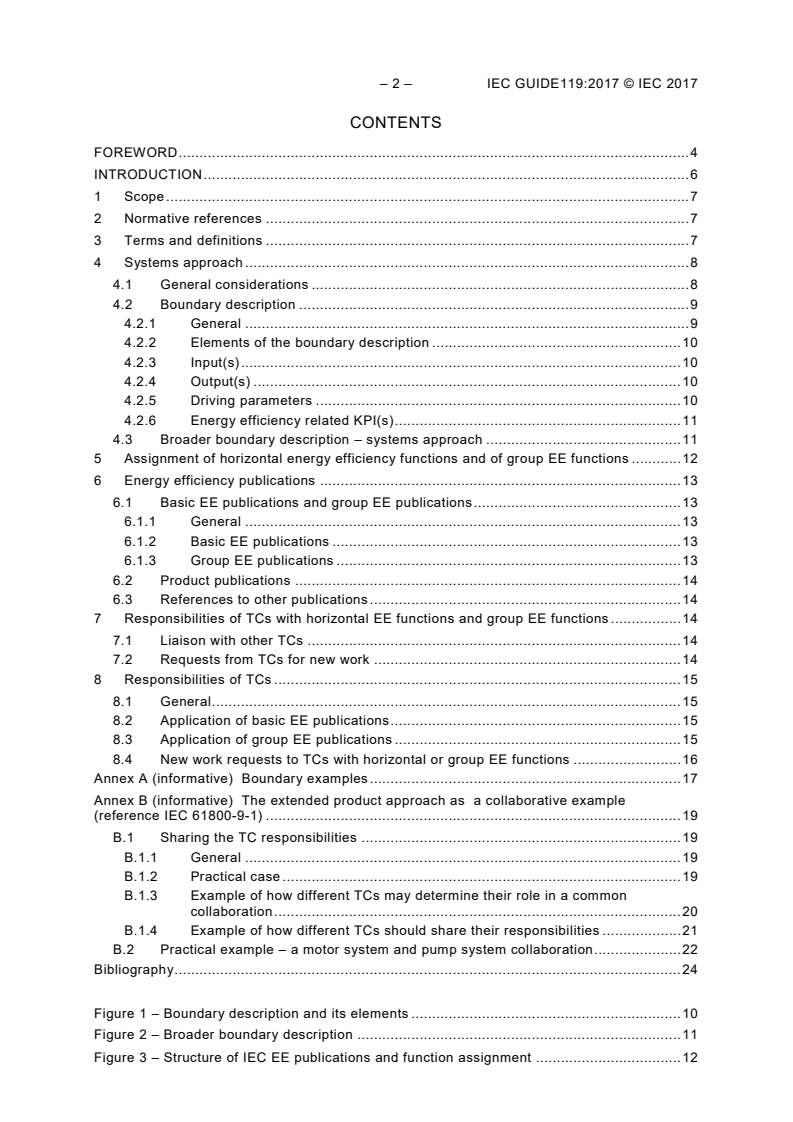
– 2 – IEC GUIDE119:2017 © IEC 2017
CONTENTS
FOREWORD . 4
INTRODUCTION . 6
1 Scope . 7
2 Normative references . 7
3 Terms and definitions . 7
4 Systems approach . 8
4.1 General considerations . 8
4.2 Boundary description . 9
4.2.1 General . 9
4.2.2 Elements of the boundary description . 10
4.2.3 Input(s) . 10
4.2.4 Output(s) . 10
4.2.5 Driving parameters . 10
4.2.6 Energy efficiency related KPI(s) . 11
4.3 Broader boundary description – systems approach . 11
5 Assignment of horizontal energy efficiency functions and of group EE functions . 12
6 Energy efficiency publications . 13
6.1 Basic EE publications and group EE publications . 13
6.1.1 General . 13
6.1.2 Basic EE publications . 13
6.1.3 Group EE publications . 13
6.2 Product publications . 14
6.3 References to other publications . 14
7 Responsibilities of TCs with horizontal EE functions and group EE functions . 14
7.1 Liaison with other TCs . 14
7.2 Requests from TCs for new work . 14
8 Responsibilities of TCs . 15
8.1 General . 15
8.2 Application of basic EE publications . 15
8.3 Application of group EE publications . 15
8.4 New work requests to TCs with horizontal or group EE functions . 16
Annex A (informative) Boundary examples . 17
Annex B (informative) The extended product approach as a collaborative example
(reference IEC 61800-9-1) . 19
B.1 Sharing the TC responsibilities . 19
B.1.1 General . 19
B.1.2 Practical case . 19
B.1.3 Example of how different TCs may determine their role in a common
collaboration . 20
B.1.4 Example of how different TCs should share their responsibilities . 21
B.2 Practical example – a motor system and pump system collaboration . 22
Bibliography . 24
Figure 1 – Boundary description and its elements . 10
Figure 2 – Broader boundary description . 11
Figure 3 – Structure of IEC EE publications and function assignment . 12
IEC GUIDE119:2017 © IEC 2017 – 3 –
Figure A.1 – Boundary setting example: three boundaries for independent solution . 17
Figure A.2 – Boundary setting example: a boundary of a group . 17
Figure A.3 – A boundary of group with systematic solution . 18
Figure B.1 – Relation between different components at different levels . 20
Figure B.2 – Link between every box’s corresponding TCs . 21
Figure B.3 – TC’s responsibilities with EE key parameters at the different levels,
starting from the plant level and going down to individual components . 22
Figure B.4 – Interaction between the two SAMs . 22
Figure B.5 – The SAMs of the pump system (the extended product) and the motor
system . 23
– 4 – IEC GUIDE119:2017 © IEC 2017
INTERNATIONAL ELECTROTECHNICAL COMMISSION
____________
PREPARATION OF ENERGY EFFICIENCY PUBLICATIONS
AND THE USE OF BASIC ENERGY EFFICIENCY PUBLICATIONS
AND GROUP ENERGY EFFICIENCY PUBLICATIONS
FOREWORD
1) The International Electrotechnical Commission (IEC) is a worldwide organization for standardization comprising
all national electrotechnical committees (IEC National Committees). The object of IEC is to promote
international co-operation on all questions concerning standardization in the electrical and electronic fields. To
this end and in addition to other activities, IEC publishes International Standards, Technical Specifications,
Technical Reports, Publicly Available Specifications (PAS) and Guides (hereafter referred to as “IEC
Publication(s)”). Their preparation is entrusted to technical committees; any IEC National Committee interested
in the subject dealt with may participate in this preparatory work. International, governmental and non-
governmental organizations liaising with the IEC also participate in this preparation. IEC collaborates closely
with the International Organization for Standardization (ISO) in accordance with conditions determined by
agreement between the two organizations.
2) The formal decisions or agreements of IEC on technical matters express, as nearly as possible, an international
consensus of opinion on the relevant subjects since each technical committee has representation from all
interested IEC National Committees.
3) IEC Publications have the form of recommendations for international use and are accepted by IEC National
Committees in that sense. While all reasonable efforts are made to ensure that the technical content of IEC
Publications is accurate, IEC cannot be held responsible for the way in which they are used or for any
misinterpretation by any end user.
4) In order to promote international uniformity, IEC National Committees undertake to apply IEC Publications
transparently to the maximum extent possible in their national and regional publications. Any divergence
between any IEC Publication and the corresponding national or regional publication shall be clearly indicated in
the latter.
5) IEC itself does not provide any attestation of conformity. Independent certification bodies provide conformity
assessment services and, in some areas, access to IEC marks of conformity. IEC is not responsible for any
services carried out by independent certification bodies.
6) All users should ensure that they have the latest edition of this publication.
7) No liability shall attach to IEC or its directors, employees, servants or agents including individual experts and
members of its technical committees and IEC National Committees for any personal injury, property damage or
other damage of any nature whatsoever, whether direct or indirect, or for costs (including legal fees) and
expenses arising out of the publication, use of, or reliance upon, this IEC Publication or any other IEC
Publications.
8) Attention is drawn to the Normative references cited in this publication. Use of the referenced publications is
indispensable for the correct application of this publication.
9) Attention is drawn to the possibility that some of the elements of this IEC Publication may be the subject of
patent rights. IEC shall not be held responsible for identifying any or all such patent rights.
This first edition of IEC Guide 119 has been prepared, in accordance with ISO/IEC Directives,
Part 1, Annex A, by the IEC Advisory Committee on Energy Efficiency (ACEE). Clauses 5
through 8 of this guide are mandatory, in accordance with SMB Decision 136/8.
The text of this IEC Guide is based on the following documents:
Four months' vote Report on voting
C/1980A/DV C/2003/RV
Full information on the voting for the approval of this IEC Guide can be found in the report on
voting indicated in the above table.
IEC GUIDE119:2017 © IEC 2017 – 5 –
This document has been drafted in accordance with the ISO/IEC Directives, Part 2.
A bilingual version of this publication may be issued at a later date.
IMPORTANT – The 'colour inside' logo on the cover page of this publication indicates
that it contains colours which are considered to be useful for the correct
understanding of its contents. Users should therefore print this document using a
colour printer.
– 6 – IEC GUIDE119:2017 © IEC 2017
INTRODUCTION
Technical committees dealing with subjects relating to energy efficiency for the whole, or for a
specific part, of their activities, are invited by SMB Decision 136/8 to follow the provisions of
this Guide.
In this Guide, the term “technical committee” (TC) also includes subcommittees and system
committees. The term “publication” includes “International Standard”, “Technical Report”,
“Technical Specification” and “Guide”. In addition, the term “product” includes “process”,
“service” and combinations thereof, commonly known as “systems”.
IEC GUIDE119:2017 © IEC 2017 – 7 –
PREPARATION OF ENERGY EFFICIENCY PUBLICATIONS
AND THE USE OF BASIC ENERGY EFFICIENCY PUBLICATIONS
AND GROUP ENERGY EFFICIENCY PUBLICATIONS
1 Scope
This Guide defines procedures for the preparation of energy efficiency (EE) publications and
describes the relationship between technical committees (TCs) with group EE functions.
In the context of this Guide, “EE” refers to energy efficiency of products, systems and
organizations.
It uses the boundary concept to address energy efficiency aspects (see IEC Guide 118) in the
context of a systems approach.
This Guide is relevant to every TC which would like to publish a document dealing with EE.
2 Normative references
The following documents are referred to in the text in such a way that some or all of their
content constitutes requirements of this document. For dated references, only the edition
cited applies. For undated references, the latest edition of the referenced document (including
any amendments) applies.
lEC Guide 118, Inclusion of energy efficiency aspects in electrotechnical publications
ISO/IEC 13273-1:2015, Energy efficiency and renewable energy sources – Common
international terminology – Part 1: Energy efficiency
3 Terms and definitions
For the purposes of this document, the terms and definitions given in ISO/IEC 13273-1 and
the following apply.
ISO and IEC maintain terminological databases for use in standardization at the following
addresses:
• IEC Electropedia: available at http://www.electropedia.org/
• ISO Online browsing platform: available at http://www.iso.org/obp
3.1
basic EE publication
publication covering energy efficiency aspects (EEA), applicable to products within the scope
of two or more TCs
3.2
group EE publication
publication covering energy efficiency aspects (EEA), applicable to a specific boundary
including products within the scope of two or more TCs
– 8 – IEC GUIDE119:2017 © IEC 2017
3.3
EE publication
publication covering energy efficiency aspects (EEA)
Note 1 to entry: An EE publication can be a basic EE publication, a group EE publication or a product publication.
[SOURCE: IEC 60050-901:2013, 901-02-12, modified – The term and definition have been
modified for the specific context of energy efficiency.]
3.4
energy efficiency
EE
ratio or other quantitative relationship between an output of performance, service, goods or
energy and an input of energy taking into account the driving parameters and the boundaries
EXAMPLE Conversion efficiency; energy required/energy used; output/input; theoretical energy used to
operate/energy used to operate.
Note 1 to entry: Both input and output need to be clearly specified in quantity and quality, and be measurable.
[SOURCE: ISO/IEC 13273-1:2015, 3.4.1, modified – “taking into account the driving
parameters and the boundaries” has been added to the definition.]
3.5
group EE function
task assigned to a TC to prepare group EE publications
3.6
horizontal EE function
task assigned to a TC to prepare basic EE publications
4 Systems approach
4.1 General considerations
Energy efficiency should be a requirement for products, systems and organizations.
EE measures shall not compromise safety nor affect the level of services.
Implementation of relevant EE measures should be in balance with economic and market
constraints.
It may not be sufficient to improve the energy efficiency of a single product without
considering its application.
EE of a product should be in balance to the depletion or voiding of environmental resources
that have been used to produce it.
Conversely, it can be necessary to accept the higher losses of one product if they are off-set
by an overall improvement of energy efficiency in the entire system, considering its
environment, economy and application. Clause 4 explains how technical committees should
consider the systems approach in their work where several TCs have to collaborate. This
Guide proposes a way of collaboration between TCs on the bases of the boundaries between
their respective responsibilities.
The main part of this approach is a standardized description of this boundary which defines
the object of energy efficiency evaluation and improvement as well as the interfaces between
the TCs.
IEC GUIDE119:2017 © IEC 2017 – 9 –
The description of the boundary (physical or conceptual) should include information about the
service(s) that are to be provided. This description will make no assumptions about physical
implementation needed to realize the service(s). Examples of services are, for example,
providing steam, producing metallic parts, converting heat.
4.2 Boundary description
4.2.1 General
The boundary description should be understood by each TC.
Boundaries should be defined in terms of:
• intended use (relevant applications),
• energy inputs,
• outputs,
• driving parameters other than internal process parameters (relevant variables, static
factors),
• key performance indicator (KPI),
KPIs are related to EE.
• interactions between components of the system,
• possible interactions with other systems.
Boundaries can include a device, a product or a system depending on the application
considered. Physical product boundaries include:
• the physical limits of the product,
• power inputs or outputs,
• communication interfaces,
• any measurable inputs or outputs.
Functional boundaries (e.g. in the case of a service) include:
• the starting of a specification,
• the conclusion of a specification,
• the defined transfer of information, of material, or of other services,
• status of operation.
– 10 – IEC GUIDE119:2017 © IEC 2017
4.2.2 Elements of the boundary description
The boundary description and its elements are shown in Figure 1.
IEC
Figure 1 – Boundary description and its elements
The boundary description may include a list of services (conceptual boundary) or a list of the
technical elements and their relation (technical implementation) that are within the chosen
boundary. The further elements of the boundary description are given in 4.2.3 to 4.2.6.
4.2.3 Input(s)
The boundary description has input(s) necessary to perform the intended service, which can
be defined by the following elements:
• type of input,
• quality of input,
• quantity of input.
Examples are materials, parts or energy.
4.2.4 Output(s)
The boundary description has output(s) as result(s) of the intended service which can be
defined by the following elements:
• type of output,
• quality of output,
• quantity of output
Examples are products, service (including information), reusable material, reusable energy,
and waste.
4.2.5 Driving parameters
The driving parameters should be defined. These are all external factors that affect energy
efficiency. Examples include: regulation, environmental conditions, occupancy, energy prices
IEC GUIDE119:2017 © IEC 2017 – 11 –
and management requirements, mode of operation, duty cycle, load curves, state, operating
parameters, indoor temperature, lighting levels, production volume, range of products, etc.
NOTE Driving parameters concept includes the concept of relevant variable and static factors as defined by
ISO 50002 and ISO 50006, respectively.
4.2.6 Energ
...