

IEC 63445:2025
(Main)System referencing conductor switching device
General Information
- Abstract
IEC 63445:2025 applies to system referencing conductor switching device (SRCSD) for household and similar uses within a Prosumer’s electrical installations (PEI).
The SRCSD provides functions as described in IEC 60364-8-82:2022 [2], 82.8.2.2.4.
PEI intended for operating by either being connected to a distribution network or disconnected from the distribution network is an islandable PEI.
Intentional disconnection from and connection to the distribution network relies on the local earthing system being switched by the SRCSD. In addition, unintentional loss of distribution network is covered.
The SRCSD is a single pole device intended to connect one live conductor of the power system to an earthing arrangement.
- Status
- Published
- Publication Date
- 07-Sep-2025
- Technical Committee
- SC 23K - Electrical Energy Efficiency products
- Drafting Committee
- PT 63445 - TC 23/SC 23K/PT 63445
- Current Stage
- PPUB - Publication issued
- Start Date
- 08-Sep-2025
- Completion Date
- 15-Aug-2025
Buy Documents
IEC 63445:2025 - System referencing conductor switching device Released:9/8/2025
IEC 63445:2025 - Appareil de connexion du conducteur de référence du systeme Released:9/8/2025
IEC 63445:2025 - System referencing conductor switching device Released:9/8/2025
Overview
IEC 63445:2025 - System referencing conductor switching device (SRCSD) defines safety, performance and testing requirements for SRCSDs used in household and similar Prosumer Electrical Installations (PEI). Published as Edition 1.0 (2025‑09), the standard covers single‑pole devices that switch a live conductor to an earthing arrangement to support intentional islanding (islandable PEI) and to manage unintentional loss of the distribution network. It implements the functions referenced in IEC 60364‑8‑82:2022 (clause 82.8.2.2.4) and is intended for use where local earthing must be switched for safe disconnection and reconnection.
Key Topics
- Scope & classification
- Applicability to household/similar prosumer installations and islandable PEI
- Classification by operation method, interlocking, isolation type, mounting and terminal type
- Electrical and mechanical characteristics
- Rated cross‑section, rated leakage current, operational voltage and frequency
- Rated short‑circuit capability (making and withstand), switching sequence and operation type
- Construction & safety requirements
- Clearances, creepage distances and solid insulation
- Terminals and connections, protection against electric shock, temperature‑rise limits
- Testing and verification
- Dielectric, insulation resistance and impulse withstand tests
- Mechanical and electrical endurance, short‑circuit tests, temperature and fire resistance
- Electromagnetic compatibility (EMC), climatic and ageing tests
- Product information & marking
- Identification, classification and required markings for safe installation and certification
- Annexes
- Normative test sequences and sample requirements, measurement of creepage/clearance, terminal examples
Applications
- Ensuring safe earthing switching in residential PV, battery and hybrid inverter systems operating in grid‑connected and islanded modes
- Enabling compliant islanding and reconnection procedures in prosumer installations
- Providing test and certification criteria for manufacturers and conformity assessment bodies
Who uses this standard
- Manufacturers of SRCSDs and earthing switching devices
- Designers and installers of prosumer electrical installations (household PV/battery systems)
- Test laboratories and certification bodies performing product evaluation and type testing
- Utilities and regulators specifying safety and interconnection requirements
Related Standards
- IEC 60364‑8‑82:2022 (functions referenced for PEI earthing and switching)
- Other IEC standards for EMC, environmental testing and electrical safety referenced within IEC 63445
For acquisition and the latest corrigenda, obtain IEC 63445:2025 from the IEC webstore (products.iec.ch). Keywords: IEC 63445, SRCSD, system referencing conductor switching device, prosumer electrical installation, islandable PEI, earthing switching device, household PV safety, IEC standard.
Buy Documents
IEC 63445:2025 - System referencing conductor switching device Released:9/8/2025
IEC 63445:2025 - Appareil de connexion du conducteur de référence du systeme Released:9/8/2025
IEC 63445:2025 - System referencing conductor switching device Released:9/8/2025
Get Certified
Connect with accredited certification bodies for this standard

DNV
DNV is an independent assurance and risk management provider.

Lloyd's Register
Lloyd's Register is a global professional services organisation specialising in engineering and technology.
DNV Energy Systems
Energy and renewable energy certification.
Sponsored listings
Frequently Asked Questions
IEC 63445:2025 is a standard published by the International Electrotechnical Commission (IEC). Its full title is "System referencing conductor switching device". This standard covers: IEC 63445:2025 applies to system referencing conductor switching device (SRCSD) for household and similar uses within a Prosumer’s electrical installations (PEI). The SRCSD provides functions as described in IEC 60364-8-82:2022 [2], 82.8.2.2.4. PEI intended for operating by either being connected to a distribution network or disconnected from the distribution network is an islandable PEI. Intentional disconnection from and connection to the distribution network relies on the local earthing system being switched by the SRCSD. In addition, unintentional loss of distribution network is covered. The SRCSD is a single pole device intended to connect one live conductor of the power system to an earthing arrangement.
IEC 63445:2025 applies to system referencing conductor switching device (SRCSD) for household and similar uses within a Prosumer’s electrical installations (PEI). The SRCSD provides functions as described in IEC 60364-8-82:2022 [2], 82.8.2.2.4. PEI intended for operating by either being connected to a distribution network or disconnected from the distribution network is an islandable PEI. Intentional disconnection from and connection to the distribution network relies on the local earthing system being switched by the SRCSD. In addition, unintentional loss of distribution network is covered. The SRCSD is a single pole device intended to connect one live conductor of the power system to an earthing arrangement.
IEC 63445:2025 is classified under the following ICS (International Classification for Standards) categories: 27.015 - Energy efficiency. Energy conservation in general; 29.020 - Electrical engineering in general. The ICS classification helps identify the subject area and facilitates finding related standards.
IEC 63445:2025 is available in PDF format for immediate download after purchase. The document can be added to your cart and obtained through the secure checkout process. Digital delivery ensures instant access to the complete standard document.
Standards Content (Sample)
IEC 63445 ®
Edition 1.0 2025-09
INTERNATIONAL
STANDARD
System referencing conductor switching device
ICS 27.015; 29.020 ISBN 978-2-8327-0676-3
All rights reserved. Unless otherwise specified, no part of this publication may be reproduced or utilized in any form or
by any means, electronic or mechanical, including photocopying and microfilm, without permission in writing from either
IEC or IEC's member National Committee in the country of the requester. If you have any questions about IEC copyright
or have an enquiry about obtaining additional rights to this publication, please contact the address below or your local
IEC member National Committee for further information.
IEC Secretariat Tel.: +41 22 919 02 11
3, rue de Varembé info@iec.ch
CH-1211 Geneva 20 www.iec.ch
Switzerland
About the IEC
The International Electrotechnical Commission (IEC) is the leading global organization that prepares and publishes
International Standards for all electrical, electronic and related technologies.
About IEC publications
The technical content of IEC publications is kept under constant review by the IEC. Please make sure that you have the
latest edition, a corrigendum or an amendment might have been published.
IEC publications search - IEC Products & Services Portal - products.iec.ch
webstore.iec.ch/advsearchform Discover our powerful search engine and read freely all the
publications previews, graphical symbols and the glossary.
The advanced search enables to find IEC publications by a
variety of criteria (reference number, text, technical With a subscription you will always have access to up to date
committee, …). It also gives information on projects, content tailored to your needs.
replaced and withdrawn publications.
Electropedia - www.electropedia.org
The world's leading online dictionary on electrotechnology,
IEC Just Published - webstore.iec.ch/justpublished
Stay up to date on all new IEC publications. Just Published containing more than 22 500 terminological entries in English
details all new publications released. Available online and and French, with equivalent terms in 25 additional languages.
once a month by email. Also known as the International Electrotechnical Vocabulary
(IEV) online.
IEC Customer Service Centre - webstore.iec.ch/csc
If you wish to give us your feedback on this publication or
need further assistance, please contact the Customer
Service Centre: sales@iec.ch.
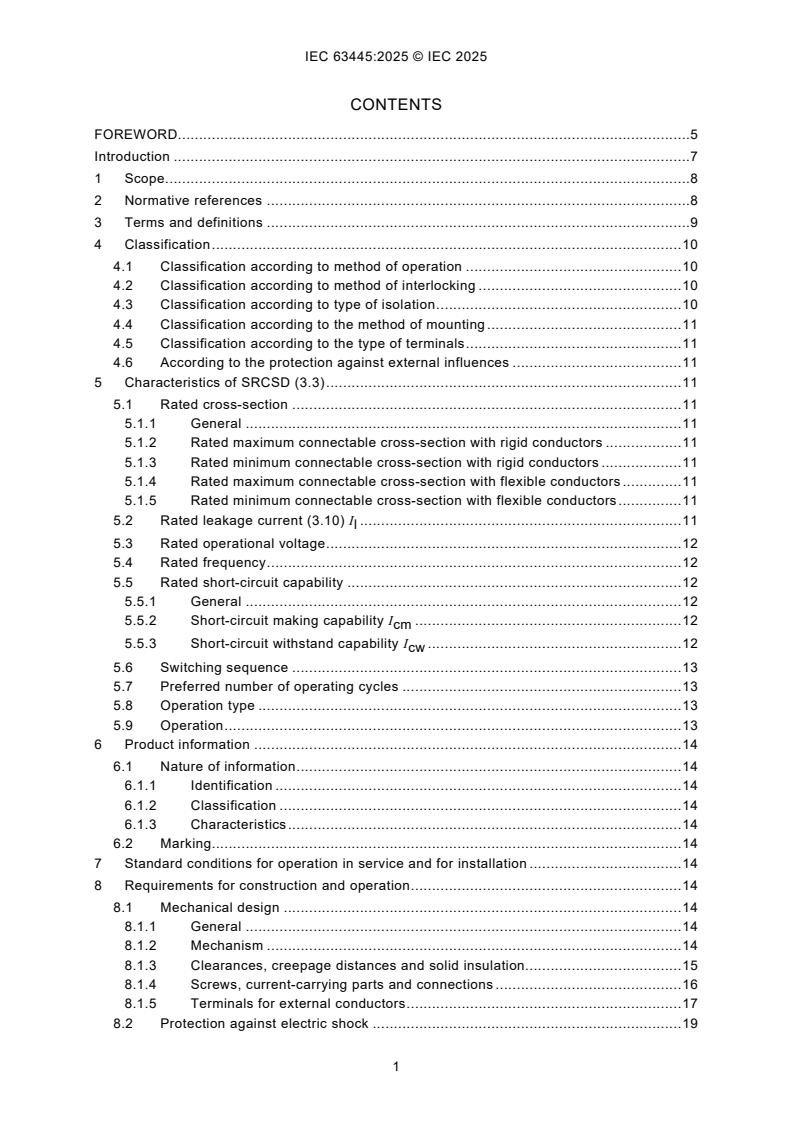
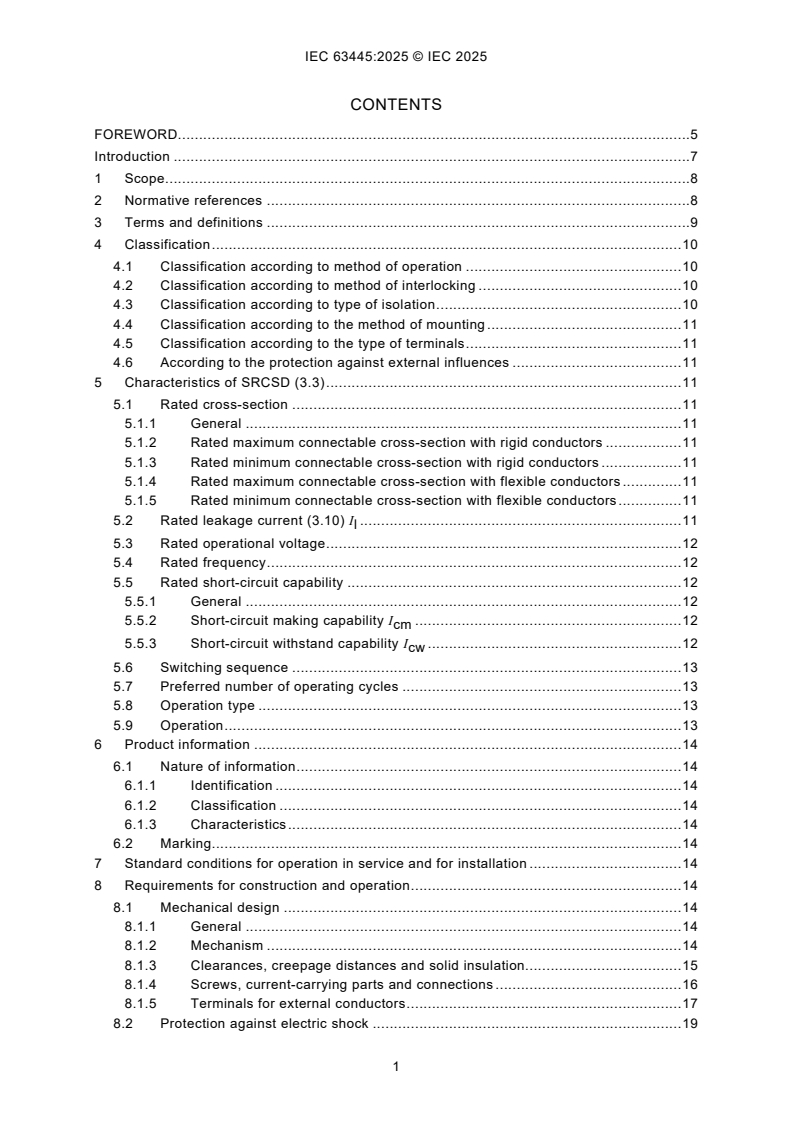
CONTENTS
FOREWORD. 5
Introduction . 7
1 Scope . 8
2 Normative references . 8
3 Terms and definitions . 9
4 Classification . 10
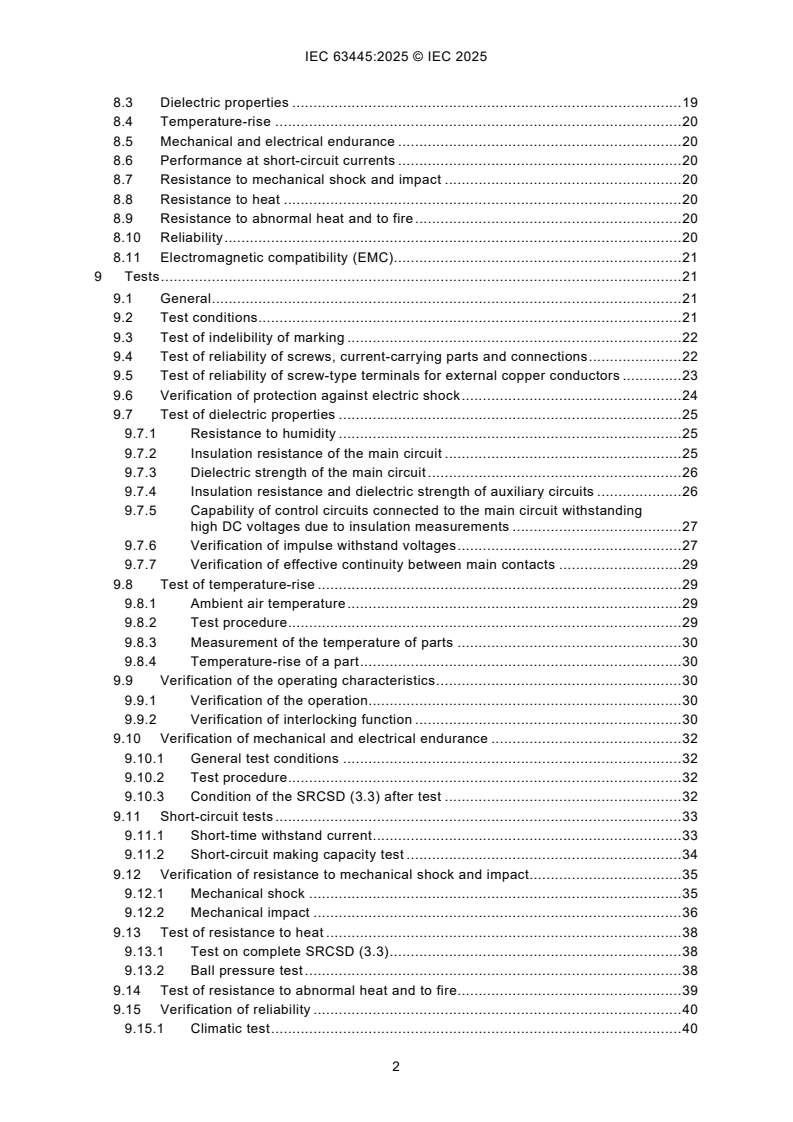
4.1 Classification according to method of operation . 10
4.2 Classification according to method of interlocking . 10
4.3 Classification according to type of isolation . 10
4.4 Classification according to the method of mounting . 11
4.5 Classification according to the type of terminals . 11
4.6 According to the protection against external influences . 11
5 Characteristics of SRCSD (3.3) . 11
5.1 Rated cross-section . 11
5.1.1 General . 11
5.1.2 Rated maximum connectable cross-section with rigid conductors . 11
5.1.3 Rated minimum connectable cross-section with rigid conductors . 11
5.1.4 Rated maximum connectable cross-section with flexible conductors . 11
5.1.5 Rated minimum connectable cross-section with flexible conductors . 11
5.2 Rated leakage current (3.10) I . 11
l
5.3 Rated operational voltage . 12
5.4 Rated frequency . 12
5.5 Rated short-circuit capability . 12
5.5.1 General . 12
5.5.2 Short-circuit making capability I . 12
cm
5.5.3 Short-circuit withstand capability I . 12
cw
5.6 Switching sequence . 13
5.7 Preferred number of operating cycles . 13
5.8 Operation type . 13
5.9 Operation . 13
6 Product information . 14
6.1 Nature of information . 14
6.1.1 Identification . 14
6.1.2 Classification . 14
6.1.3 Characteristics . 14
6.2 Marking . 14
7 Standard conditions for operation in service and for installation . 14
8 Requirements for construction and operation . 14
8.1 Mechanical design . 14
8.1.1 General . 14
8.1.2 Mechanism . 14
8.1.3 Clearances, creepage distances and solid insulation . 15
8.1.4 Screws, current-carrying parts and connections . 16
8.1.5 Terminals for external conductors . 17
8.2 Protection against electric shock . 19
8.3 Dielectric properties . 19
8.4 Temperature-rise . 20
8.5 Mechanical and electrical endurance . 20
8.6 Performance at short-circuit currents . 20
8.7 Resistance to mechanical shock and impact . 20
8.8 Resistance to heat . 20
8.9 Resistance to abnormal heat and to fire . 20
8.10 Reliability . 20
8.11 Electromagnetic compatibility (EMC) . 21
9 Tests . 21
9.1 General . 21
9.2 Test conditions . 21
9.3 Test of indelibility of marking . 22
9.4 Test of reliability of screws, current-carrying parts and connections . 22
9.5 Test of reliability of screw-type terminals for external copper conductors . 23
9.6 Verification of protection against electric shock . 24
9.7 Test of dielectric properties . 25
9.7.1 Resistance to humidity . 25
9.7.2 Insulation resistance of the main circuit . 25
9.7.3 Dielectric strength of the main circuit . 26
9.7.4 Insulation resistance and dielectric strength of auxiliary circuits . 26
9.7.5 Capability of control circuits connected to the main circuit withstanding
high DC voltages due to insulation measurements . 27
9.7.6 Verification of impulse withstand voltages . 27
9.7.7 Verification of effective continuity between main contacts . 29
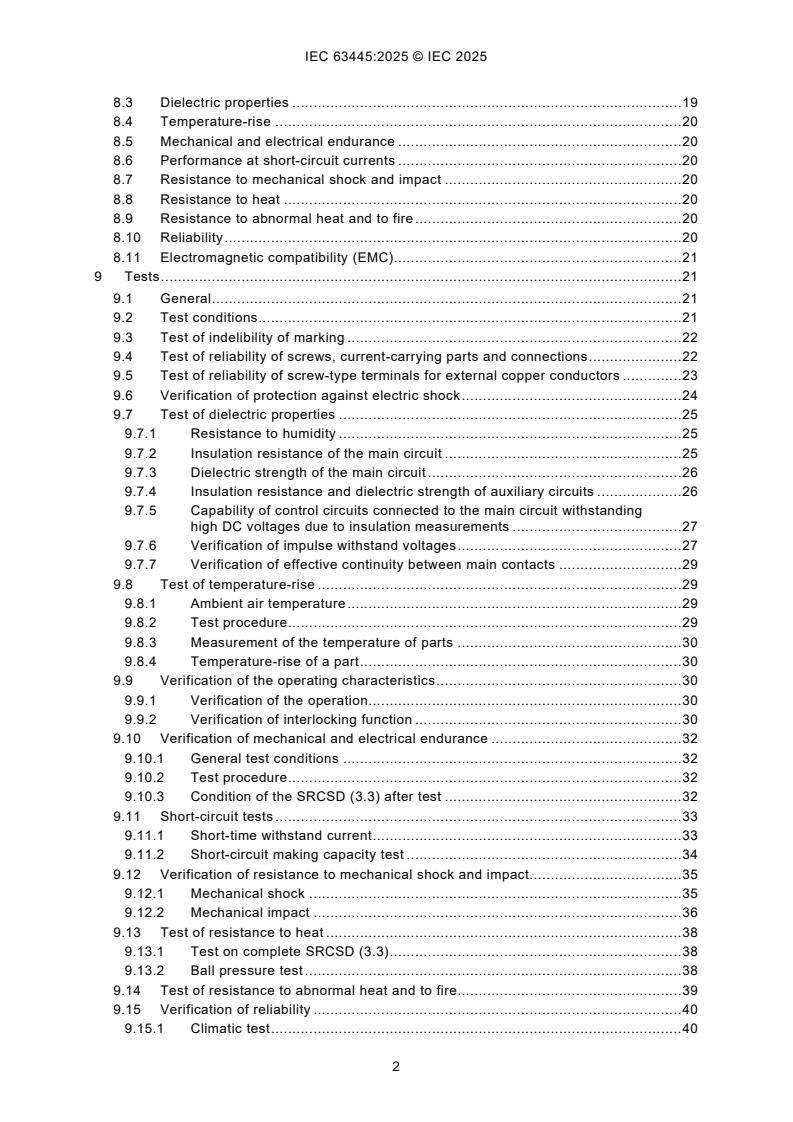
9.8 Test of temperature-rise . 29
9.8.1 Ambient air temperature . 29
9.8.2 Test procedure . 29
9.8.3 Measurement of the temperature of parts . 30
9.8.4 Temperature-rise of a part . 30
9.9 Verification of the operating characteristics . 30
9.9.1 Verification of the operation . 30
9.9.2 Verification of interlocking function . 30
9.10 Verification of mechanical and electrical endurance . 32
9.10.1 General test conditions . 32
9.10.2 Test procedure . 32
9.10.3 Condition of the SRCSD (3.3) after test . 32
9.11 Short-circuit tests . 33
9.11.1 Short-time withstand current . 33
9.11.2 Short-circuit making capacity test . 34
9.12 Verification of resistance to mechanical shock and impact . 35
9.12.1 Mechanical shock . 35
9.12.2 Mechanical impact . 36
9.13 Test of resistance to heat . 38
9.13.1 Test on complete SRCSD (3.3) . 38
9.13.2 Ball pressure test . 38
9.14 Test of resistance to abnormal heat and to fire . 39
9.15 Verification of reliability . 40
9.15.1 Climatic test . 40
9.15.2 Test with temperature of 40 °C . 42
9.16 Verification of withstand against ageing . 42
9.17 Electromagnetic compatibility (EMC) . 43
9.17.1 General . 43
9.17.2 Electromagnetic emission . 43
9.17.3 Electromagnetic immunity . 43
9.18 Test of resistance to rusting . 46
Annex A (normative) Test sequence and number of samples to be submitted for
certification purposes . 65
A.1 Test sequences . 65
A.2 Number of samples to be submitted for full test procedure . 66
Annex B (normative) Determination of clearances and creepage distances . 67
B.1 General . 67
B.2 Orientation and location of a creepage distance . 67
B.3 Creepage distances where more than one material is used . 67
B.4 Creepage distances split by floating conductive part . 67
B.5 Measurement of creepage distances and clearances . 67
Annex C (informative) Examples of terminal designs . 71
Bibliography . 74
Figure 1 – Example of grid connected PEI architecture . 7
Figure 2 – Operation of an SRCSD (3.3) . 13
Figure 3 – Standard test finger. 55
Figure 4 – Mechanical shock test apparatus . 55
Figure 5 – Mechanical impact test apparatus . 56
Figure 6 – Striking element for pendulum impact test apparatus . 57
Figure 7 – Mounting support for sample for mechanical impact test . 58
Figure 8 – Example of mounting an unenclosed SRCSD (3.3) for mechanical impact
test . 59
Figure 9 – Example of mounting of panel mounting type SRCSD (3.3) for the
mechanical impact test . 60
Figure 10 – Application of force for mechanical test of rail mounted SRCSD (3.3) . 61
Figure 11 – Ball-pressure test apparatus . 61
Figure 12 – Stabilizing period for reliability test . 62
Figure 13 – Reliability test cycle . 63
Figure 14 – Diagrammatic representation for glow-wire test . 64
Figure B.1 – Examples of methods of measuring creepage distances and clearances . 70
Figure C.1 – Examples of pillar terminals . 71
Figure C.2 – Examples of screw terminals and stud terminals . 72
Figure C.3 – Examples of saddle terminals . 72
Figure C.4 – Examples of lug terminals . 73
Table 1 – Immunity tests (overview) . 43
Table 2 – Performance criteria . 43
Table 3 – Voltage dip test values . 44
Table 4 – Short-interruption test values . 44
Table 5 – Surge test voltages . 44
Table 6 – Fast transient test values . 45
Table 7 – Requirements and position for markings and other product information . 46
Table 8 – Rated impulse withstand voltage as a function of the nominal voltage of the
installation . 48
Table 9 – Minimum clearances and creepage distances . 48
Table 10 – Test voltage of auxiliary circuits . 51
Table 11 – Test voltage for verification of rated impulse withstand voltage . 51
Table 12 – Test voltage for verifying the suitability for isolation, referred to the rated
impulse withstand voltage of the SRCSD (3.3) and the altitude where the test is carried
out . 51
Table 13 – Screw thread diameters and applied torques . 51
Table 14 – Pulling forces . 52
Table 15 – Temperature-rise values . 52
Table 16 – Values of influencing quantities . 52
Table A.1 – Test sequences. 65
Table A.2 – Number of samples for full test procedure . 66
INTERNATIONAL ELECTROTECHNICAL COMMISSION
____________
System referencing conductor switching device
FOREWORD
1) The International Electrotechnical Commission (IEC) is a worldwide organization for
standardization comprising all national electrotechnical committees (IEC National Committees).
The object of IEC is to promote international co-operation on all questions concerning
standardization in the electrical and electronic fields. To this end and in addition to other
activities, IEC publishes International Standards, Technical Specifications, Technical Reports,
Publicly Available Specifications (PAS) and Guides (hereafter referred to as “IEC
Publication(s)”). Their preparation is entrusted to technical committees; any IEC National
Committee interested in the subject dealt with may participate in this preparatory work.
International, governmental and non-governmental organizations liaising with the IEC also
participate in this preparation. IEC collaborates closely with the International Organization for
Standardization (ISO) in accordance with conditions determined by agreement between the two
organizations.
2) The formal decisions or agreements of IEC on technical matters express, as nearly as
possible, an international consensus of opinion on the relevant subjects since each technical
committee has representation from all interested IEC National Committees.
3) IEC Publications have the form of recommendations for international use and are accepted
by IEC National Committees in that sense. While all reasonable efforts are made to ensure that
the technical content of IEC Publications is accurate, IEC cannot be held responsible for the
way in which they are used or for any misinterpretation by any end user.
4) In order to promote international uniformity, IEC National Committees undertake to apply IEC
Publications transparently to the maximum extent possible in their national and regional
publications. Any divergence between any IEC Publication and the corresponding national or
regional publication shall be clearly indicated in the latter.
5) IEC itself does not provide any attestation of conformity. Independent certification bodies
provide conformity assessment services and, in some areas, access to IEC marks of conformity.
IEC is not responsible for any services carried out by independent certification bodies.
6) All users should ensure that they have the latest edition of this publication.
7) No liability shall attach to IEC or its directors, employees, servants or agents including
individual experts and members of its technical committees and IEC National Committees for
any personal injury, property damage or other damage of any nature whatsoever, whether direct
or indirect, or for costs (including legal fees) and expenses arising out of the publication, use
of, or reliance upon, this IEC Publication or any other IEC Publications.
8) Attention is drawn to the Normative references cited in this publication. Use of the referenced
publications is indispensable for the correct application of this publication.
9) IEC draws attention to the possibility that the implementation of this document may involve
the use of (a) patent(s). IEC takes no position concerning the evidence, validity or applicability
of any claimed patent rights in respect thereof. As of the date of publication of this document,
IEC [had/had not] received notice of (a) patent(s), which may be required to implement this
document. However, implementers are cautioned that this may not represent the latest
information, which may be obtained from the patent database available at https://patents.iec.ch.
IEC shall not be held responsible for identifying any or all such patent rights.
IEC 63445 has been prepared by subcommittee SC 23K: Electrical Energy Efficiency products,
of IEC technical committee 23: Electrical accessories. It is an International Standard.
The text of this International Standard is based on the following documents:
Draft Report on voting
23K/123/FDIS 23K/127/RVD
Full information on the voting for its approval can be found in the report on voting indicated in
the above table.
The language used for the development of this International Standard is English.
This document was drafted in accordance with ISO/IEC Directives, Part 2, and developed in
accordance with ISO/IEC Directives, Part 1 and ISO/IEC Directives, IEC Supplement, available
at www.iec.ch/members_experts/refdocs. The main document types developed by IEC are
described in greater detail at www.iec.ch/publications.
The committee has decided that the contents of this document will remain unchanged until the
stability date indicated on the IEC website under webstore.iec.ch in the data related to the
specific document. At this date, the document will be
– reconfirmed,
– withdrawn, or
– revised.
INTRODUCTION
IEC 60364-8-82 [1] has the objective to ensure that the low-voltage electrical installation is
compatible with the existing and future ways to deliver safely and functionally the electrical
energy to current-using equipment wherever the electrical energy comes from the DSO or local
generation. IEC 60364-8-82 [1] provides requirements and recommendations that apply to low-
voltage electrical installations connected or not to a distribution network able to operate:
– with local power supplies, and/or
– with local storage units,
and that monitors and controls the energy from the locally connected sources delivering it to:
– current-using equipment, and/or
– local storage units, and/or
– distribution networks.
Such electrical installations are designated as Prosumer's electrical installations (PEIs (3.1)).
To realize such a PEI (3.1) IEC 60364-8-82 [1] specifies some parts. In case of an islandable
PEI (3.7) (principle overview out of IEC 60364-8-82:2022 [2]: Figure 1 - Example of islandable
PEI (3.7) architecture) there is a System referencing conductor switching device (3.3) (SRCSD),
identified as device 5 in Figure 1.
Figure 1 – Example of grid connected PEI architecture
The objective of this document is to define the functionality and requirements of a system
referencing conductor (3.2) switching device (SRCSD (3.3)) which is in line with the
specification given in IEC 60364-8-82 [1].
1 Scope
This document applies to system referencing conductor switching devices (3.3) (SRCSD) for
household and similar uses within a Prosumer’s electrical installations (PEI (3.1)).
The SRCSD (3.3) provides functions as described in IEC 60364-8-82:2022 [2], 82.8.2.2.4.
PEI (3.1) intended for operating by either being connected to a distribution network or
disconnected from the distribution network is an islandable PEI (3.7).
Intentional disconnection from and connection to the distribution network relies on the local
earthing system being switched by the SRCSD (3.3). In addition, unintentional loss of
distribution network is covered.
The SRCSD (3.3) is a single pole device intended to connect one live conductor of the power
system to an earthing arrangement.
In general the neutral conductor is earthed.
Switching the SRCSD (3.3) can change the local type of system earthing if types of system
earthing are different in island and grid connected modes.
The system referencing conductor switching device (3.3) (SRCSD) is interlocked with the
switching device for islanding (3.4) (SDFI) of a Prosumer electrical installation.
SRCSD (3.3) can be integrated in a device with other functions e.g. with a SDFI (3.4).
NOTE 1 See also IEC 60364-8-82 [1].
This document applies to SRCSD (3.3) for rated voltages not exceeding 440 V AC with rated
frequencies of 50 Hz, 60 Hz or 50/60 Hz.
NOTE 2 SRCSD (3.3) for DC operations is under consideration.
2 Normative references
The following documents are referred to in the text in such a way that some or all of their content
constitutes requirements of this document. For dated references, only the edition cited applies.
For undated references, the latest edition of the referenced document (including any
amendments) applies.
IEC 60364-8-82, Low-voltage electrical installations - Part 8-82: Functional aspects -
Prosumer's low-voltage electrical installations
IEC 61000-4-2:2008, Electromagnetic compatibility (EMC) - Part 4-2: Testing and measurement
techniques - Electrostatic discharge immunity test
IEC 61000-4-3, Electromagnetic compatibility (EMC) - Part 4-3 : Testing and measurement
techniques - Radiated, radio-frequency, electromagnetic field immunity test
IEC 61000-4-4, Electromagnetic compatibility (EMC) - Part 4-4: Testing and measurement
techniques - Electrical fast transient/burst immunity test
IEC 61000-4-5, Electromagnetic compatibility (EMC) - Part 4-5: Testing and measurement
techniques - Surge immunity test
IEC 61000-4-6, Electromagnetic compatibility (EMC) - Part 4-6: Testing and measurement
techniques - Immunity to conducted disturbances, induced by radio-frequency fields
IEC 61000-4-11, Electromagnetic compatibility (EMC) - Part 4-11: Testing and measurement
techniques - Voltage dips, short interruptions and voltage variations immunity tests for
equipment with input current up to 16 A per phase
3 Terms and definitions
For the purposes of this document, the following terms and definitions apply.
ISO and IEC maintain terminology databases for use in standardization at the following
addresses:
– IEC Electropedia: available at https://www.electropedia.org/
– ISO Online browsing platform: available at https://www.iso.org/obp
3.1
PEI
prosumer's electrical installation
low-voltage electrical installation connected or not to a distribution network able to operate:
– with local power supplies, and/or
– with local storage units,
that monitors and controls the energy from the connected sources delivering it to:
– current-using equipment, and/or
– local storage units, and/or
– distribution networks
[SOURCE: IEC 60364-8-82:2022 [2], 82.3.6]
3.2
system referencing conductor
conductor that connects one live conductor of the power system to an earthing arrangement
Note 1 to entry: The live conductor connected is the neutral or the mid-point if existing, or a line conductor when
not existing.
[SOURCE: IEC 60364-8-82:2022 [2], 82.3.18]
3.3
system referencing conductor switching device
SRCSD
device connected between the system referencing conductor (3.2) and the local earthing
arrangement of the PEI (3.1)
3.4
switching device for island mode
SDFI
device dedicated to change from grid connected mode (3.5) to island mode (3.6) and from island
mode (3.6) to grid connected mode (3.5) for an islandable PEI (3.7)
Note 1 to entry: In IEC TS 62786 [3] the term used for switching device for islanding is "interface switch".
3.5
connected mode
operating mode in which the PEI (3.1) is connected to the distribution network
[SOURCE: IEC 60364-8-82:2022 [2], 82.3.11, modified - removed the Example]
3.6
island mode
operating mode in which the PEI (3.1) is disconnected from the distribution network
Note 1 to entry: An island mode (3.6) can be either the result of the action of automatic protections or the result of
a deliberate action.
[SOURCE: IEC 60364-8-82:2022 [2], 82.3.12]
3.7
islandable PEI
PEI (3.1) intended for operating either being connected to a distribution network or being
disconnected from the distribution network
Note 1 to entry: An islandable PEI (3.7) is in a connected mode (3.5) or an intentionally island mode (3.6).
[SOURCE: IEC 60364-8-82:2022 [2], 82.3.15]
3.8
transition time to close
time between the order to connect to local earth until the feedback that local earth connection
is established
3.9
transition time to open
time between the order to disconnect local earth until the feedback that local earth connection
is opened
3.10
rated leakage current
maximum permanent current to ground carried by the SRCSD (3.3) in island mode (3.6)
3.11
interlock
prevents simultaneous closing of SRCSD (3.3) and SDFI (3.4),
under all conditions
4 Classification
4.1 Classification according to method of operation
– Electrically controlled
– Manually (non-electrically) controlled
– Electrically and manually controlled
NOTE 1 The operation of SRCSD (3.3) is interlocked with SDFI (3.4).
NOTE 2 Ensure the operation is controlled in a coordinated way.
4.2 Classification according to method of interlocking
– Electrically
– Mechanically
4.3 Classification according to type of isolation
– Suitable for isolation
– Non-suitable for isolation
IEC 60364-8-82 [1] requires isolation for SRCSD (3.3).
4.4 Classification according to the method of mounting
– Panel board type SRCSD (3.3), also referred to as distribution board type.
NOTE These types can be intended to be mounted on rails e.g. IEC 60715 [4].
– Busbar mounted SRSCD (3.3).
– Integrated SRCSD (3.3).
4.5 Classification according to the type of terminals
4.5.1 SRCSD (3.3) with screw-type terminals for external copper conductors.
4.5.2 SRCSD (3.3) with screwless type terminals for external copper conductors.
4.5.3 SRCSD (3.3) with flat quick-connect terminals for external copper conductors.
4.6 According to the protection against external influences
4.6.1 Enclosed-type SRCSD (3.3) (not requiring an appropriate enclosure).
4.6.2 Unenclosed-type SRCSD (3.3) (for use with an appropriate enclosure).
5 Characteristics of SRCSD (3.3)
5.1 Rated cross-section
5.1.1 General
The cross section of a SRCSD (3.3) should be in line with the required cross-section for the
local source.
5.1.2 Rated maximum connectable cross-section with rigid conductors
Maximum connectable cross-section for rigid conductor.
5.1.3 Rated minimum connectable cross-section with rigid conductors
Minimum connectable cross-section for rigid conductor.
5.1.4 Rated maximum connectable cross-section with flexible conductors
Maximum connectable cross-section for flexible conductor.
5.1.5 Rated minimum connectable cross-section with flexible conductors
Minimum connectable cross-section for flexible conductor.
5.2 Rated leakage current (3.10) I
l
The SRCSD (3.3) operates without a voltage difference but shall be capable to carry
permanently its rated leakage current (3.10). The preferred rated leakage current (3.10) values
are 1 A, 3 A, 5 A, 10 A, 16 A, 20 A, 32 A, 63 A, 80 A, 100 A, 125 A with a minimum value of 1
A.
NOTE The rated current of the SRCSD (3.3) is usually the maximum leakage current to ground allowed in island
mode (3.6).
5.3 Rated operational voltage
The rated operational voltage of an SRCSD (3.3) is the value of voltage, assigned by the
manufacturer, to which its performance is referred. Standard values of rated operational voltage
are : 120 V – 230 V – 400 V.
5.4 Rated frequency
The rated frequency of an SRCSD (3.3) is the power frequency for which the SRCSD (3.3) is
designed and to which the values of the other characteristics correspond.
Standard values of rated frequency: 50 Hz – 60 Hz – 50/60 Hz.
5.5 Rated short-circuit capability
5.5.1 General
The SRCSD (3.3) operates without a voltage difference but shall be capable to make and carry
its rated short-circuit capability.
NOTE 1 Rated short circuit capability of the SRCSD (3.3) is usually calculated depending on the maximum short
circuit current delivered by the source(s) used in island mode (3.6).
NOTE 2 Rated short circuit capability of the SRCSD (3.3) is usually between one and two times the rated current
of sources using power converters, when in island mode (3.6).
5.5.2 Short-circuit making capability I
cm
In case SRCSD (3.3) is closing to island mode (3.6) on a phase to ground short circuit.
5.5.3 Short-circuit withstand capability I
cw
In case a phase to ground short circuit occurs while SRCSD (3.3) is closed, the preferred
withstand capability values are, for a preferred duration of 500 ms, 1 s or 5 s (see IEC 60364-
4-41:2005 [5], 411):
– 16 A
– 25 A
– 32 A
– 63 A
– 100 A
– 125 A
– 160 A
– 250 A
– 400 A
– 630 A
– 800 A
– 1 000 A
– 1 250 A
– 1 600 A
– 3 kA
– 4,5 kA
– 6 kA
– 10 kA
– 20 kA
– 25 kA
5.6 Switching sequence
– Closing time
– Opening time
IEC 60364-8-82 [1] recommends that in case of transition between the modes, operation without
reference the system to earth does not exceed 5 s.
5.7 Preferred number of operating cycles
– 4 000 (minimum number of operating cycles),
– 6 000,
– 12 000,
– 25 000
5.8 Operation type
The SRSCD (3.3) shall have two stable states. After loss of supply the position of the switch
shall not change.
5.9 Operation
The operation of the SRCSD (3.3) is shown in Figure 2.
Operation to switch from connected mode (3.5) to islanding mode. The SRCSD (3.3) shall be
closed after the SDFI (3.4) opens.
Operation to switch from islanding mode to connected mode (3.5). The SRCSD (3.3) shall be
opened before the SDFI (3.4) closes.
Unless the SRCSD (3.3) is integrated in one device with an SDFI (3.4), SRCSD (3.3) shall be
provided with the required means to interlock (3.11) with a SDFI (3.4), together with installation
instructions.
Figure 2 – Operation of an SRCSD (3.3)
6 Product information
6.1 Nature of information
6.1.1 Identification
a) Manufacturer's name or trade mark;
b) Type designation or serial number;
c) Reference to the product standard.
6.1.2 Classification
a) Method of operation (see 4.1);
b) Method of interlocking (see 4.2);
c) Type of isolation (see 4.3);
d) Method of mounting (see 4.4);
e) Type of terminals (see 4.5).
6.1.3 Characteristics
a) Rated short-circuit making capability (see 5.5.2);
b) Rated short-circuit withstand capability (see 5.5.3);
c) transition time to close (3.8) (see 5.6);
d) transition time to open (3.9) (see 5.6);
e) Operating cycles (see 5.7).
6.2 Marking
Identification of SRCSD (3.3) shall comply with Table 7.
Markings shall be easily legible, durable and indelible. They shall not be placed on screws,
washers or other removable parts.
Compliance is checked by inspection and by the tests of 9.3. Markings made by impression,
moulding or engraving are not subjected to this test.
7 Standard conditions for operation in service and for installation
SRCSD (3.3) shall be capable of operating under the standard conditions shown in Table 10.
8 Requirements for construction and operation
8.1 Mechanical design
8.1.1 General
An SRCSD (3.3) shall be designed and constructed so that, in normal use, there is no danger
to the user or to the environment.
8.1.2 Mechanism
The SRCSD (3.3) shall be designed and constructed so that in case of loss of control supply or
re-establishment of voltage of the control supply the position remains unchanged. The contacts
of SRCSD (3.3) shall have two rest positions.
Closed position shall be reliable to ensure continuity of the earth connexion in islanded mode.
The means of indication of the contact position shall be reliable in each position (locally and
remotely if relevant). If SRCSD (3.3) is combined with an SDFI (3.4) in one device, the local
indication can be a combined one.
If in island mode (3.6) the SRCSD (3.3) is in open position, the SRCSD (3.3) shall be provided
with means to initiate the disconnection of all local sources.
NOTE 1 The disconnection is not intended to be performed by the SRCSD (3.3).
NOTE 2 An example of such means is an auxiliary switch.
The indication of the closed position shall not be indicated, if the contacts are opened
The indication of the closed position shall be indicated, if the contacts are closed
Compliance is checked by inspection and test of 9.9.1.
8.1.3 Clearances, creepage distances and solid insulation
8.1.3.1 General
The minimum required clearances and creepage distances are given in Table 9 which is based
on the SRCSD (3.3) being designed for operating in an environment with pollution degree 2.
Parts of PCBs connected to the live parts protected against pollution by the use of a type 2
protection according to IEC 60664-3 [6] are exempt from this verification.
The insulating materials are classified into material groups on the basis of their comparative
tracking index (CTI) according to IEC 60664-1:2020 [7].
NOTE 1 The comparative tracking index (CTI) is declared by the manufacturer on the basis of tests carried out on
the insulating material.
NOTE 2 Information on the requirements for design of solid insulation is provided in IEC 60664-1 [8].
For clearances on printed wiring material, Note c in Table F.2 of IEC 60664-1:2020 [7] applies:
"For printed wiring material, the values for pollution degree 1 apply except that the value shall
not be less than 0,04 mm, as specified in Table F.2 of IEC 60664-1:2020 [7]. A protection by
means of a solder resist of high quality is the minimum requirement to allow this clearance
reduction".
All measurements required in 8.1.3.1 are carried out in Test Sequence A on one sample. Tests
according to 9.7 are carried out in Test Sequence B on three samples.
8.1.3.2 Clearances
For SRCSD (3.3) suitable for Isolation (4.3) Compliance for item 1 in Table 9 is checked by
measurement and by the tests of 9.7.6.3. The test is carried out with samples not submitted to
the humidity treatment described in 9.7.1.
For SRCSD (3.3) non-suitable for Isolation (4.3) Clearance of the opened contacts shall be 4
mm.
Compliance for items 2 and 4 in Table 9 is checked by measurement and, if the clearances are
reduced, by the tests in 9.7.6.2.
The clearances of items 2 and 4 (except accessible surface after installation) may be reduced
provided that the measured clearances are not shorter than the minimum allowed in IEC 60664-
1 [8] for homogenous field conditions. In this case, compliance for items 2 and 4 is always
checked by the test of 9.7.6.2.
NOTE Accessible surface after installation means any surface accessible by the user when the RCD is installed
according to the manufacturer's instructions. The test finger can be applied to determine whether a surface is
accessible or not.
Compliance for item 3 in Table 9 is checked by measurement.
8.1.3.3 Creepage distances
Compliance for items 1, 2, 3 and 4 in Table 9 is checked by measurement.
8.1.3.4 Solid insulation
Compliance is checked by the tests according to 9.7.2, 9.7.3, 9.7.4, and 9.7.6 as applicable.
8.1.3.5 Additional requirements for control circuits connected to the main circuit
Compliance is checked by the test of 9.7.5.
8.1.4 Screws, current-carrying parts and connections
8.1.4.1 Connections
Connections, whether electrical or mechanical, shall withstand the stresses occurring in normal
use.
Screws operated when mounting the SRCSD (3.3) during installation shall not be of the thread-
cutting type.
NOTE 1 Scre
...
IEC 63445 ®
Edition 1.0 2025-09
NORME
INTERNATIONALE
Appareil de connexion du conducteur de référence du système
ICS 27.015; 29.020 ISBN 978-2-8327-0676-3
Droits de reproduction réservés. Sauf indication contraire, aucune partie de cette publication ne peut être reproduite ni
utilisée sous quelque forme que ce soit et par aucun procédé, électronique ou mécanique, y compris la photocopie et
les microfilms, sans l'accord écrit de l'IEC ou du Comité national de l'IEC du pays du demandeur. Si vous avez des
questions sur le copyright de l'IEC ou si vous désirez obtenir des droits supplémentaires sur cette publication, utilisez
les coordonnées ci-après ou contactez le Comité national de l'IEC de votre pays de résidence.
IEC Secretariat Tel.: +41 22 919 02 11
3, rue de Varembé info@iec.ch
CH-1211 Geneva 20 www.iec.ch
Switzerland
A propos de l'IEC
La Commission Electrotechnique Internationale (IEC) est la première organisation mondiale qui élabore et publie des
Normes internationales pour tout ce qui a trait à l'électricité, à l'électronique et aux technologies apparentées.
A propos des publications IEC
Le contenu technique des publications IEC est constamment revu. Veuillez vous assurer que vous possédez l’édition la
plus récente, un corrigendum ou amendement peut avoir été publié.
Recherche de publications IEC - IEC Products & Services Portal - products.iec.ch
webstore.iec.ch/advsearchform Découvrez notre puissant moteur de recherche et consultez
La recherche avancée permet de trouver des publications gratuitement tous les aperçus des publications, symboles
IEC en utilisant différents critères (numéro de référence, graphiques et le glossaire. Avec un abonnement, vous aurez
texte, comité d’études, …). Elle donne aussi des toujours accès à un contenu à jour adapté à vos besoins.
informations sur les projets et les publications remplacées
ou retirées. Electropedia - www.electropedia.org
Le premier dictionnaire d'électrotechnologie en ligne au
IEC Just Published - webstore.iec.ch/justpublished monde, avec plus de 22 500 articles terminologiques en
Restez informé sur les nouvelles publications IEC. Just anglais et en français, ainsi que les termes équivalents
Published détaille les nouvelles publications parues. dans 25 langues additionnelles. Egalement appelé
Disponible en ligne et une fois par mois par email. Vocabulaire Electrotechnique International (IEV) en ligne.
Service Clients - webstore.iec.ch/csc
Si vous désirez nous donner des commentaires sur cette
publication ou si vous avez des questions contactez-
nous: sales@iec.ch.
SOMMAIRE
AVANT-PROPOS . 5
Introduction . 7
1 Domaine d'application . 9
2 Références normatives . 9
3 Termes et définitions . 10
4 Classification . 12
4.1 Classification selon le mode de fonctionnement . 12
4.2 Classification selon le mode d'interverrouillage . 12
4.3 Classification selon le type de sectionnement . 12
4.4 Classification selon la méthode de montage . 12
4.5 Classification selon le type de borne . 12
4.6 Selon la protection contre les influences externes . 12
5 Caractéristiques des SRCSD . 12
5.1 Section assignée . 12
5.1.1 Généralités . 12
5.1.2 Section maximale assignée raccordable avec des conducteurs rigides . 13
5.1.3 Section minimale assignée raccordable avec des conducteurs rigides . 13
5.1.4 Section maximale assignée raccordable avec des conducteurs souples . 13
5.1.5 Section minimale assignée raccordable avec des conducteurs souples . 13
5.2 Courant de fuite assigné I . 13
5.3 Tension d'emploi assignée . 13
5.4 Fréquence assignée . 13
5.5 Capacité de tenue en court-circuit assignée . 13
5.5.1 Généralités . 13
5.5.2 Pouvoir de fermeture en court-circuit I . 13
cm
5.5.3 Capacité de tenue en court-circuit I . 14
cw
5.6 Séquence de commutation . 14
5.7 Nombre préférentiel de cycles de manœuvres. 14
5.8 Type de manœuvre . 14
5.9 Manœuvre . 14
6 Informations sur le produit . 15
6.1 Nature de l'information . 15
6.1.1 Identification . 15
6.1.2 Classification . 15
6.1.3 Caractéristiques . 15
6.2 Marquage . 16
7 Conditions normalisées de fonctionnement en service et d'installation . 16
8 Exigences de construction et de fonctionnement . 16
8.1 Conception mécanique . 16
8.1.1 Généralités . 16
8.1.2 Mécanisme . 16
8.1.3 Distances d'isolement, lignes de fuite et isolation solide. 17
8.1.4 Vis, parties parcourues par un courant et connexions . 18
8.1.5 Bornes pour conducteurs externes . 19
8.2 Protection contre les chocs électriques . 21
8.3 Propriétés diélectriques . 21
8.4 Échauffement . 22
8.5 Endurance mécanique et électrique . 22
8.6 Tenue aux courants de court-circuit . 22
8.7 Résistance aux secousses et aux chocs mécaniques . 22
8.8 Résistance à la chaleur . 22
8.9 Résistance à la chaleur anormale et au feu . 22
8.10 Fiabilité . 23
8.11 Compatibilité électromagnétique (CEM) . 23
9 Essais . 23
9.1 Généralités . 23
9.2 Conditions d'essai . 23
9.3 Essai d'indélébilité du marquage . 24
9.4 Essai de fiabilité des vis, des parties parcourues par un courant et des
connexions . 24
9.5 Essai de fiabilité des bornes à vis pour conducteurs externes en cuivre . 25
9.6 Vérification de la protection contre les chocs électriques . 26
9.7 Essai des propriétés diélectriques . 27
9.7.1 Résistance à l'humidité . 27
9.7.2 Résistance d'isolement du circuit principal . 28
9.7.3 Rigidité diélectrique du circuit principal . 28
9.7.4 Résistance d'isolement et rigidité diélectrique des circuits auxiliaires . 29
9.7.5 Tenue des circuits de commande connectés au circuit principal vis-à-vis
des tensions continues élevées dues aux mesures d'isolement . 30
9.7.6 Vérification des tensions de tenue aux chocs . 30
9.7.7 Vérification de la continuité effective entre les contacts principaux . 32
9.8 Essai d'échauffement . 32
9.8.1 Température de l'air ambiant . 32
9.8.2 Procédure d'essai . 32
9.8.3 Mesurage de la température des parties . 32
9.8.4 Échauffement d'une partie . 33
9.9 Vérification des caractéristiques de fonctionnement . 33
9.9.1 Vérification du fonctionnement . 33
9.9.2 Vérification de la fonction d'interverrouillage . 33
9.10 Vérification de l'endurance mécanique et électrique . 35
9.10.1 Conditions d'essai générales . 35
9.10.2 Procédure d'essai . 35
9.10.3 État du SRCSD après l'essai . 36
9.11 Essais de court-circuit . 36
9.11.1 Courant assigné de courte durée admissible . 36
9.11.2 Essai de pouvoir de fermeture en court-circuit . 37
9.12 Vérification de la résistance aux secousses et aux chocs mécaniques . 38
9.12.1 Secousses mécaniques . 38
9.12.2 Chocs mécaniques . 39
9.13 Essai de résistance à la chaleur . 41
9.13.1 Essai sur le SRCSD complet . 41
9.13.2 Essai de pression à la bille . 42
9.14 Essai de la résistance à la chaleur anormale et au feu . 43
9.15 Vérification de la fiabilité . 44
9.15.1 Essai climatique . 44
9.15.2 Essai à la température de 40 °C . 46
9.16 Vérification de la tenue au vieillissement . 46
9.17 Compatibilité électromagnétique (CEM) . 46
9.17.1 Généralités . 46
9.17.2 Émission électromagnétique . 47
9.17.3 Immunité électromagnétique. 47
9.18 Essai de résistance à la rouille . 50
Annexe A (normative) Séquence d'essais et nombre d'échantillons à soumettre à
l'essai en vue de la certification. 69
A.1 Séquences d'essais . 69
A.2 Nombre d'échantillons à soumettre à la procédure d'essai complète . 70
Annexe B (normative) Détermination des distances d'isolement et des lignes de fuite . 71
B.1 Généralités . 71
B.2 Orientation et emplacement d'une ligne de fuite . 71
B.3 Lignes de fuite pour lesquelles plusieurs matériaux sont utilisés . 71
B.4 Lignes de fuite divisées par une partie conductrice flottante . 71
B.5 Mesurage des lignes de fuite et des distances d'isolement . 71
Annexe C (informative) Exemples de conceptions de bornes . 76
Bibliographie . 79
Figure 1 – Exemple d'architecture de PEI connectée au réseau . 7
Figure 2 – Manœuvre d'un SRCSD . 15
Figure 3 – Doigt d'épreuve normalisé . 58
Figure 4 – Appareillage d'essai de secousse mécanique . 59
Figure 5 – Appareillage d'essai de choc mécanique . 60
Figure 6 – Pièce de frappe pour l'appareillage d'essai de choc au pendule . 61
Figure 7 – Support de montage de l'échantillon pour l'essai de choc mécanique . 62
Figure 8 – Exemple de fixation d'un SRCSD ouvert pour l'essai de choc mécanique . 63
Figure 9 – Exemple de fixation d'un SRCSD pour montage en tableau pour l'essai de
choc mécanique . 64
Figure 10 – Application de la force dans l'essai mécanique des SRCSD pour montage
sur rail . 65
Figure 11 – Appareillage d'essai de pression à la bille . 65
Figure 12 – Période de stabilisation pour l'essai de fiabilité . 66
Figure 13 – Cycle d'essai de fiabilité . 67
Figure 14 – Représentation schématique pour l'essai au fil incandescent . 68
Figure B.1 – Exemples de méthodes de mesure des lignes de fuite et des distances
d'isolement . 75
Figure C.1 – Exemples de bornes à trou . 76
Figure C.2 – Exemples de bornes à serrage sous tête de vis et de bornes à goujon
fileté . 77
Figure C.3 – Exemples de bornes à plaquette . 78
Figure C.4 – Exemples de bornes pour cosses et barrettes . 78
Tableau 1 – Essais d'immunité (vue d'ensemble) . 47
Tableau 2 – Critères de performance . 47
Tableau 3 – Valeurs d'essai de creux de tension . 48
Tableau 4 – Valeurs d'essai de coupures brèves . 48
Tableau 5 – Tensions d'essai aux ondes de choc . 48
Tableau 6 – Valeur d'essai de transitoires rapides . 49
Tableau 7 – Exigences et positions des marquages et autres informations sur le
produit . 50
Tableau 8 – Tension assignée de tenue aux chocs en fonction de la tension nominale
de l'installation . 51
Tableau 9 – Distances d'isolement et lignes de fuite minimales . 52
Tableau 10 – Tension d'essai des circuits auxiliaires . 55
Tableau 11 – Tension d'essai pour la vérification de la tension assignée de tenue aux
chocs . 55
Tableau 12 – Tension d'essai en fonction de la tension assignée de tenue aux chocs
du SRCSD et de l'altitude à laquelle est effectué l'essai, pour la vérification de
l'aptitude au sectionnement . 55
Tableau 13 – Diamètres des filetages et couples appliqués . 55
Tableau 14 – Forces de traction . 56
Tableau 15 – Valeurs des échauffements . 56
Tableau 16 – Valeur des grandeurs d'influence . 57
Tableau A.1 – Séquences d'essais . 69
Tableau A.2 – Nombre d'échantillons à soumettre à la procédure d'essai complète . 70
COMMISSION ÉLECTROTECHNIQUE INTERNATIONALE
____________
Appareil de connexion du conducteur de référence du système
AVANT-PROPOS
a) La Commission Électrotechnique Internationale (IEC) est une organisation mondiale de normalisation composée
de l'ensemble des comités électrotechniques nationaux (Comités nationaux de l'IEC). L'IEC a pour objet de
favoriser la coopération internationale pour toutes les questions de normalisation dans les domaines de
l'électricité et de l'électronique. À cet effet, l'IEC – entre autres activités – publie des Normes internationales,
des Spécifications techniques, des Rapports techniques, des Spécifications accessibles au public (PAS) et des
Guides (ci-après dénommés "Publication(s) de l'IEC"). Leur élaboration est confiée à des comités d'études, aux
travaux desquels tout Comité national intéressé par le sujet traité peut participer. Les organisations
internationales, gouvernementales et non gouvernementales, en liaison avec l'IEC, participent également aux
travaux. L'IEC collabore étroitement avec l'Organisation Internationale de Normalisation (ISO), selon des
conditions fixées par accord entre les deux organisations.
b) Les décisions ou accords officiels de l'IEC concernant les questions techniques représentent, dans la mesure du
possible, un accord international sur les sujets étudiés, étant donné que les Comités nationaux de l'IEC
intéressés sont représentés dans chaque comité d'études.
c) Les Publications de l'IEC se présentent sous la forme de recommandations internationales et sont agréées
comme telles par les Comités nationaux de l'IEC. Tous les efforts raisonnables sont entrepris afin que l'IEC
s'assure de l'exactitude du contenu technique de ses publications; l'IEC ne peut pas être tenue responsable de
l'éventuelle mauvaise utilisation ou interprétation qui en est faite par un quelconque utilisateur final.
d) Dans le but d'encourager l'uniformité internationale, les Comités nationaux de l'IEC s'engagent, dans toute la
mesure possible, à appliquer de façon transparente les Publications de l'IEC dans leurs publications nationales
et régionales. Toutes divergences entre toutes Publications de l'IEC et toutes publications nationales ou
régionales correspondantes doivent être indiquées en termes clairs dans ces dernières.
e) L'IEC elle-même ne fournit aucune attestation de conformité. Des organismes de certification indépendants
fournissent des services d'évaluation de conformité et, dans certains secteurs, accèdent aux marques de
conformité de l'IEC. L'IEC n'est responsable d'aucun des services effectués par les organismes de certification
indépendants.
f) Tous les utilisateurs doivent s'assurer qu'ils sont en possession de la dernière édition de cette publication.
g) Aucune responsabilité ne doit être imputée à l'IEC, à ses administrateurs, employés, auxiliaires ou mandataires,
y compris ses experts particuliers et les membres de ses comités d'études et des Comités nationaux de l'IEC,
pour tout préjudice causé en cas de dommages corporels et matériels, ou de tout autre dommage de quelque
nature que ce soit, directe ou indirecte, ou pour supporter les coûts (y compris les frais de justice) et les
dépenses découlant de la publication ou de l'utilisation de cette Publication de l'IEC ou de toute autre Publication
de l'IEC, ou au crédit qui lui est accordé.
h) L'attention est attirée sur les références normatives citées dans cette publication. L'utilisation de publications
référencées est obligatoire pour une application correcte de la présente publication.
i) L'IEC attire l'attention sur le fait que la mise en application du présent document peut entraîner l'utilisation d'un
ou de plusieurs brevets. L'IEC ne prend pas position quant à la preuve, à la validité et à l'applicabilité de tout
droit de brevet revendiqué à cet égard. À la date de publication du présent document, l'IEC [avait/n'avait pas]
reçu notification qu'un ou plusieurs brevets pouvaient être nécessaires à sa mise en application. Toutefois, il y
a lieu d'avertir les responsables de la mise en application du présent document que des informations plus
récentes sont susceptibles de figurer dans la base de données de brevets, disponible à l'adresse
https://patents.iec.ch. L'IEC ne saurait être tenue pour responsable de ne pas avoir identifié de tels droits de
brevets.
L'IEC 63445 a été établie par le sous-comité 23K: Produits pour l'efficacité énergétique
électrique, du comité d'études 23 de l'IEC: Petit appareillage. Il s'agit d'une Norme
internationale.
Le texte de cette Norme internationale est issu des documents suivants:
Projet Rapport de vote
23K/123/FDIS 23K/127/RVD
Le rapport de vote indiqué dans le tableau ci-dessus donne toute information sur le vote ayant
abouti à son approbation.
La langue employée pour l'élaboration de cette Norme internationale est l'anglais.
Ce document a été rédigé selon les Directives ISO/IEC, Partie 2, il a été développé selon les
Directives ISO/IEC, Partie 1 et les Directives ISO/IEC, Supplément IEC, disponibles sous
www.iec.ch/members_experts/refdocs. Les principaux types de documents développés par
l'IEC sont décrits plus en détail sous www.iec.ch/publications.
Le comité a décidé que le contenu de ce document ne sera pas modifié avant la date de stabilité
indiquée sur le site web de l'IEC sous webstore.iec.ch dans les données relatives au document
recherché. À cette date, le document sera
– reconduit,
– supprimé, ou
– révisé.
Introduction
L'IEC 60364-8-82 [1] a pour objet d'assurer la compatibilité de l'installation électrique à basse
tension avec les moyens, actuels et à venir, de fourniture de l'énergie électrique au matériel
d'utilisation, en toute sécurité et fonctionnalité, quelle que soit la provenance de cette énergie
(DSO ou production locale). L'IEC 60364-8-82 [1] fournit les exigences et recommandations qui
s'appliquent aux installations électriques à basse tension connectées ou non à un réseau de
distribution capable de fonctionner:
– avec des alimentations électriques locales; et/ou
– avec des unités de stockage locales;
et qui surveille et commande l'énergie fournie par les sources connectées localement afin
d'alimenter:
– des matériels d'utilisation; et/ou
– des unités de stockage locales; et/ou
– des réseaux de distribution.
Ces installations électriques sont appelées installations électriques du prosommateur (PEI,
Prosumer's Electrical Installations). L'IEC 60364-8-82 [1] spécifie certains éléments pour
réaliser une telle PEI. Dans le cas d'une PEI séparable (vue d'ensemble de principe tirée de
l'IEC 60364-8-82:2022 [2]: Figure 1 - Exemple d'architecture de PEI séparable), il existe un
appareil de connexion du conducteur de référence du système (SRCSD, System Referencing
Conductor Switching Device), identifié par la légende 5 sur la Figure 1.
Figure 1 – Exemple d'architecture de PEI connectée au réseau
L'objet du présent document est de définir la fonctionnalité et les exigences d'un appareil de
connexion du conducteur de référence du système (SRCSD) conforme à la spécification donnée
dans l'IEC 60364-8-82 [1].
1 Domaine d'application
Le présent document s'applique aux appareils de connexion du conducteur de référence du
système (SRCSD) pour usages domestiques et analogues dans le cadre d'installations
électriques du prosommateur (PEI).
Le SRCSD fournit les fonctions décrites dans l'IEC 60364-8-82:2022 [2], 82.8.2.2.4.
Une PEI prévue pour fonctionner soit en étant connectée à un réseau de distribution soit en
étant déconnectée du réseau de distribution est une PEI séparable.
La déconnexion intentionnelle du réseau de distribution et la connexion intentionnelle à celui-
ci reposent sur la commutation du système de mise à la terre locale par le SRCSD. La perte
non intentionnelle du réseau de distribution est en outre couverte.
Le SRCSD est un dispositif unipolaire destiné à raccorder un conducteur actif du réseau
d'énergie électrique à une installation de mise à la terre.
En général, le conducteur de neutre est relié à la terre.
La commutation du SRCSD peut modifier le type de mise à la terre locale du système, si les
types de mises à la terre du système sont différents en mode réseau séparé et en mode
connecté au réseau.
L'appareil de connexion du conducteur de référence du système (SRCSD) est interverrouillé
avec l'appareil de connexion pour le passage en réseau séparé (SDFI) d'une installation
électrique du prosommateur.
Le SRCSD peut être intégré dans un autre appareil qui a d'autres fonctions, par exemple avec
un SDFI.
NOTE 1 Voir aussi l'IEC 60364-8-82 [1].
Le présent document s'applique aux SRCSD pour des tensions assignées inférieures ou égales
à 440 V en courant alternatif et des fréquences assignées de 50 Hz, 60 Hz ou 50/60 Hz.
NOTE 2 Les SRCSD pour fonctionnement en courant continu sont à l'étude.
2 Références normatives
Les documents suivants sont cités dans le texte de sorte qu'ils constituent, pour tout ou partie
de leur contenu, des exigences du présent document. Pour les références datées, seule
l'édition citée s'applique. Pour les références non datées, la dernière édition du document de
référence s'applique (y compris les éventuels amendements).
IEC 60364-8-82, Installations électriques à basse tension - Partie 8-2: Aspects fonctionnels -
Installations électriques à basse tension du prosommateur
IEC 61000-4-2:2008, Compatibilité électromagnétique (CEM) – Partie 4-2: Techniques d'essai
et de mesure – Essai d'immunité aux décharges électrostatiques
IEC 61000-4-3, Compatibilité électromagnétique (CEM) – Partie 4-3: Techniques d'essai et de
mesure – Essai d'immunité aux champs électromagnétiques rayonnés aux fréquences
radioélectriques
IEC 61000-4-4, Compatibilité électromagnétique (CEM) – Partie 4-4: Techniques d'essai et de
mesure – Essai d'immunité aux transitoires électriques rapides en salves
IEC 61000-4-5, Compatibilité électromagnétique (CEM) – Partie 4-5: Techniques d'essai et de
mesure – Essai d'immunité aux ondes de choc
IEC 61000-4-6, Compatibilité électromagnétique (CEM) – Partie 4-6: Techniques d'essai et de
mesure – Immunité aux perturbations conduites, induites par les champs radioélectriques
IEC 61000-4-11, Compatibilité électromagnétique (CEM) – Partie 4-11: Techniques d'essai et
de mesure – Essais d'immunité aux creux de tension, coupures brèves et variations de tension
pour les appareils à courant d'entrée inférieur ou égal à 16 A par phase
3 Termes et définitions
Pour les besoins du présent document, les termes et définitions suivants s'appliquent.
L'ISO et l'IEC tiennent à jour des bases de données terminologiques destinées à être utilisées
en normalisation, consultables aux adresses suivantes:
– IEC Electropedia: disponible à l'adresse https://www.electropedia.org/
– ISO Online browsing platform: disponible à l'adresse https://www.iso.org/obp
3.1
PEI
installation électrique du prosommateur
installation électrique à basse tension raccordée ou non à un réseau de distribution, qui est
capable de fonctionner:
- avec des alimentations électriques locales; et/ou
- avec des unités de stockage locales;
qui surveille et commande l'énergie fournie par les sources connectées afin d'alimenter:
- des matériels d'utilisation; et/ou
- des unités de stockage locales; et/ou
- des réseaux de distribution
Note 1 à l'article: L'abréviation "PEI" est dérivée du terme anglais développé correspondant "prosumer's electrical
installation".
[SOURCE: IEC 60364-8-82:2022 [2], 82.3.6]
3.2
conducteur de référence du système
conducteur qui raccorde un conducteur actif du réseau d'énergie électrique à une installation
de mise à la terre
Note 1 à l'article: Le conducteur actif connecté est le point neutre ou milieu, s'il existe, ou un conducteur de ligne
s'il n'existe pas.
[SOURCE: IEC 60364-8-82:2022 [2], 82.3.18]
3.3
appareil de connexion du conducteur de référence du système
SRCSD
appareil connecté entre le conducteur de référence du système et l'installation de mise à la
terre locale de la PEI
Note 1 à l'article: L'abréviation "SRCSD" est dérivée du terme anglais développé correspondant "system
referencing conductor switching device".
3.4
appareil de connexion pour le passage en mode réseau séparé
SDFI
appareil prévu pour le passage du mode connecté au réseau au mode réseau séparé et du
mode réseau séparé au mode connecté au réseau d'une PEI séparable
Note 1 à l'article: Dans l'IEC TS 62786 [3], le terme utilisé pour désigner l'appareil de connexion pour le passage
en réseau séparé est "commutateur d'interface".
Note 2 à l'article: L'abréviation "SDFI" est dérivée du terme anglais développé correspondant "switching device for
islanding".
3.5
mode connecté
mode de fonctionnement dans lequel la PEI est connectée au réseau de distribution
[SOURCE: IEC 60364-8-82:2022 [2], 82.3.11, modifiée – L'exemple a été supprimé.]
3.6
mode réseau séparé
mode de fonctionnement dans lequel la PEI est déconnectée du réseau de distribution
Note 1 à l'article: Le mode réseau séparé peut résulter de l'action de protections automatiques ou d'une action
délibérée.
[SOURCE: IEC 60364-8-82:2022 [2], 82.3.12]
3.7
PEI séparable
PEI destinée à fonctionner soit en étant connectée à un réseau de distribution, soit en étant
déconnectée du réseau de distribution
Note 1 à l'article: Les PEI séparables sont en mode connecté ou en mode réseau séparé intentionnel.
[SOURCE: IEC 60364-8-82:2022 [2], 82.3.15]
3.8
temps de fermeture
temps qui s'écoule entre l'ordre de connexion à la terre locale et l'indication que la connexion
à la terre locale est établie
3.9
temps d'ouverture
temps qui s'écoule entre l'ordre de déconnexion de la terre locale et l'indication que la
connexion à la terre locale est ouverte
3.10
courant de fuite assigné
courant maximal permanent à la terre transporté par le SRCSD en mode réseau séparé
3.11
interverrouillage
empêche la fermeture simultanée d'un SRCSD et d'un SDFI, dans
toutes les conditions
4 Classification
4.1 Classification selon le mode de fonctionnement
– Commande électrique
– Commande manuelle (non électrique)
– Commande électrique et manuelle
NOTE 1 Le fonctionnement du SRCSD est interverrouillé avec le SDFI.
NOTE 2 S'assurer que le fonctionnement est contrôlé de manière coordonnée.
4.2 Classification selon le mode d'interverrouillage
– Électrique
– Mécanique
4.3 Classification selon le type de sectionnement
– Apte au sectionnement
– Non apte au sectionnement
L'IEC 60364-8-82 [1] exige l'aptitude au sectionnement pour le SRCSD.
4.4 Classification selon la méthode de montage
– SRCSD pour montage en tableau, aussi appelé SRCSD pour tableau de distribution.
NOTE Ces types peuvent être destinés à être montés sur des rails, par exemple l'IEC 60715 [4].
– SRCSD pour montage sur barres.
– SRCSD intégré.
4.5 Classification selon le type de borne
4.5.1 SRCSD avec bornes à vis pour conducteurs externes en cuivre
4.5.2 SRCSD avec bornes sans vis pour conducteurs externes en cuivre
4.5.3 SRCSD avec bornes plates à connexion rapide pour conducteurs externes en cuivre
4.6 Selon la protection contre les influences externes
4.6.1 SRCSD de type fermé (qui ne nécessite pas l'utilisation d'une enveloppe appropriée)
4.6.2 SRCSD de type ouvert (pour utilisation avec une enveloppe appropriée)
5 Caractéristiques des SRCSD
5.1 Section assignée
5.1.1 Généralités
Il convient que la section d'un SRCSD soit conforme à la section exigée pour la source locale.
5.1.2 Section maximale assignée raccordable avec des conducteurs rigides
Section maximale raccordable pour conducteur rigide.
5.1.3 Section minimale assignée raccordable avec des conducteurs rigides
Section minimale raccordable pour conducteur rigide.
5.1.4 Section maximale assignée raccordable avec des conducteurs souples
Section maximale raccordable pour conducteur souple.
5.1.5 Section minimale assignée raccordable avec des conducteurs souples
Section minimale raccordable pour conducteur souple.
5.2 Courant de fuite assigné I
Le SRCSD fonctionne sans différence de potentiel, mais doit être capable de conduire en
permanence son courant de fuite assigné. Les valeurs préférentielles du courant de fuite
assigné sont 1 A, 3 A, 5 A,10 A, 16 A, 20 A, 32 A, 63 A, 80 A, 100 A, 125 A, avec une valeur
minimale de 1 A.
NOTE Le courant assigné du SRCSD est habituellement le courant de fuite maximal à la terre admis en mode
réseau séparé.
5.3 Tension d'emploi assignée
La tension d'emploi assignée d'un SRCSD est la valeur de la tension attribuée par le fabricant,
à laquelle se rapportent ses performances. Les valeurs normalisées de la tension d'emploi
assignée sont les suivantes: 120 V – 230 V – 400 V.
5.4 Fréquence assignée
La fréquence assignée d'un SRCSD est la fréquence du réseau pour laquelle est conçu le
SRCSD et à laquelle correspondent les valeurs des autres caractéristiques.
Valeurs normalisées de la fréquence assignée 50 Hz – 60 Hz – 50/60 Hz.
5.5 Capacité de tenue en court-circuit assignée
5.5.1 Généralités
Le SRCSD fonctionne sans différence de potentiel, mais doit être capable d'établir et de
maintenir son courant de tenue en court-circuit assigné.
NOTE 1 La capacité de tenue en court-circuit assignée du SRCSD est habituellement calculée en fonction du
courant de court-circuit maximal fourni par la ou les sources utilisées en mode réseau séparé.
NOTE 2 La capacité de tenue en court-circuit assignée du SRCSD est habituellement comprise entre une et deux
fois le courant assigné des sources qui utilisent des convertisseurs de puissance, en mode réseau séparé.
5.5.2 Pouvoir de fermeture en court-circuit I
cm
Si le SRCSD est fermé en mode réseau séparé sur un court-circuit phase-terre.
5.5.3 Capacité de tenue en court-circuit I
cw
Si un court-circuit phase-terre se produit alors que le SRCSD est fermé, les valeurs
préférentielles de capacité de tenue en court-circuit s'appliquent pour une durée préférentielle
de 500 ms, 1 s ou 5 s (voir l'IEC 60364-4-41:2005 [5], Article 411):
– 16 A
– 25 A
– 32 A
– 63 A
– 100 A
– 125 A
– 160 A
– 250 A
– 400 A
– 630 A
– 800 A
– 1 000 A
– 1 250 A
– 1 600 A
– 3 kA
– 4,5 kA
– 6 kA
– 10 kA
– 20 kA
– 25 kA
5.6 Séquence de commutation
– Durée de fermeture
– Durée d'ouverture
L'IEC 60364-8-82 [1] recommande qu'en cas de transition entre les modes, le fonctionnement
sans référence de mise à la terre ne dépasse pas 5 s.
5.7 Nombre préférentiel de cycles de manœuvres
– 4 000 (nombre minimal de cycles de manœuvres),
– 6 000,
– 12 000,
– 25 000.
5.8 Type de manœuvre
Le SRCSD doit avoir deux états stables. Après une perte de l'alimentation, la position de
l'interrupteur ne doit pas changer.
5.9 Manœuvre
Le fonctionnement du SRCSD est représenté à la Figure 2.
Manœuvre pour passer du mode connecté au mode réseau séparé. Le SRCSD doit être fermé
après l'ouverture du SDFI.
Manœuvre pour passer du mode réseau séparé au mode connecté. Le SRCSD doit être ouvert
avant la fermeture du SDFI.
Sauf si le SRCSD est intégré dans un même appareil avec le SDFI, le SRCSD doit être
accompagné des moyens exigés pour l'interverrouillage avec un SDFI, ainsi que des
instructions d'installation.
Figure 2 – Manœuvre d'un SRCSD
6 Informations sur le produit
6.1 Nature de l'information
6.1.1 Identification
a) Nom ou marque commerciale du fabricant
b) Désignation du type ou numéro de série
c) Référence à la norme de produit
6.1.2 Classification
a) Mode de fonctionnement (voir 4.1)
b) Mode d'interverrouillage (voir 4.2)
c) Type de sectionnement (voir 4.3)
d) Méthode de montage (voir 4.4)
e) Type de borne (voir 4.5)
6.1.3 Caractéristiques
a) Pouvoir de fermeture assigné en court-circuit (voir 5.5.2)
b) Capacité de tenue en court-circuit assignée (voir 5.5.3)
c) Temps de fermeture (voir 5.6)
d) Temps d'ouverture (voir 5.6)
e) Cycles de manœuvres (voir 5.7)
6.2 Marquage
L'identification du SRCSD doit être conforme au Tableau 7.
Les marquages doivent être facilement lisibles, durables et indélébiles. Ils ne doivent pas être
placés sur des vis, des rondelles ou d'autres parties amovibles.
La conformité est vérifiée par examen et par les essais du 9.3. Les marquages par pression,
moulage ou gravure ne sont pas soumis à cet essai.
7 Conditions normalisées de fonctionnement en service et d'installation
Les SRCSD doivent être capables de fonctionner dans les conditions normalisées indiquées
dans le Tableau 10.
8 Exigences de construction et de fonctionnement
8.1 Conception mécanique
8.1.1 Généralités
Un SRCSD doit être conçu et construit de sorte que, en usage normal, il ne présente aucun
danger pour l'utilisateur ou l'environnement.
8.1.2 Mécanisme
Le SRCSD doit être conçu et construit de sorte qu'en cas de perte de l'alimentation de
commande ou de rétablissement de la tension de l'alimentation de commande, la position reste
inchangée. Les contacts du SRCSD doivent avoir deux positions de repos.
La position fermée doit être fiable pour assurer la continuité de la connexion à la terre en mode
réseau séparé.
Les moyens d'indication de la position des contacts doivent être fiables dans chaque position
(localement et à distance, le cas échéant). Si le SRCSD est combiné avec un SDFI dans un
même appareil, l'indication locale peut être une indication combinée.
Si, en mode réseau séparé, le SRCSD est en position ouverte, le SRCSD doit disposer de
moyens pour déclencher la déconnexion de toutes les sources locales.
NOTE 1 La déconnexion n'est pas destinée à être réalisée par le SRCSD.
NOTE 2 Un contact auxiliaire constitue un exemple d'un tel moyen.
La position fermée ne doit pas être indiquée si les contacts sont ouverts.
La position fermée doit être indiquée si les contacts sont fermés.
La conformité est vérifiée par examen et par l'essai du 9.9.1.
8.1.3 Distances d'isolement, lignes de fuite et isolation solide
8.1.3.1 Généralités
Les distances d'isolement et les lignes de fuite minimales exigées sont indiquées dans le
Tableau 9; les valeurs sont données pour un SRCSD conçu pour fonctionner dans des
environnements qui présentent un degré de pollution 2.
Les parties des cartes de circuits imprimés connectées aux parties actives protégées contre la
pollution par l'utilisation d'une protection de type
...
IEC 63445 ®
Edition 1.0 2025-09
INTERNATIONAL
STANDARD
NORME
INTERNATIONALE
System referencing conductor switching device
Appareil de connexion du conducteur de référence du système
ICS 27.015, 29.020 ISBN 978-2-8327-0676-3
All rights reserved. Unless otherwise specified, no part of this publication may be reproduced or utilized in any form or
by any means, electronic or mechanical, including photocopying and microfilm, without permission in writing from either
IEC or IEC's member National Committee in the country of the requester. If you have any questions about IEC copyright
or have an enquiry about obtaining additional rights to this publication, please contact the address below or your local
IEC member National Committee for further information.
Droits de reproduction réservés. Sauf indication contraire, aucune partie de cette publication ne peut être reproduite ni
utilisée sous quelque forme que ce soit et par aucun procédé, électronique ou mécanique, y compris la photocopie et
les microfilms, sans l'accord écrit de l'IEC ou du Comité national de l'IEC du pays du demandeur. Si vous avez des
questions sur le copyright de l'IEC ou si vous désirez obtenir des droits supplémentaires sur cette publication, utilisez
les coordonnées ci-après ou contactez le Comité national de l'IEC de votre pays de résidence.
IEC Secretariat Tel.: +41 22 919 02 11
3, rue de Varembé info@iec.ch
CH-1211 Geneva 20 www.iec.ch
Switzerland
About the IEC
The International Electrotechnical Commission (IEC) is the leading global organization that prepares and publishes
International Standards for all electrical, electronic and related technologies.
About IEC publications
The technical content of IEC publications is kept under constant review by the IEC. Please make sure that you have the
latest edition, a corrigendum or an amendment might have been published.
IEC publications search - IEC Products & Services Portal - products.iec.ch
webstore.iec.ch/advsearchform Discover our powerful search engine and read freely all the
The advanced search enables to find IEC publications by a publications previews, graphical symbols and the glossary.
variety of criteria (reference number, text, technical With a subscription you will always have access to up to date
committee, …). It also gives information on projects, content tailored to your needs.
replaced and withdrawn publications.
Electropedia - www.electropedia.org
IEC Just Published - webstore.iec.ch/justpublished The world's leading online dictionary on electrotechnology,
Stay up to date on all new IEC publications. Just Published containing more than 22 500 terminological entries in English
details all new publications released. Available online and and French, with equivalent terms in 25 additional languages.
Also known as the International Electrotechnical Vocabulary
once a month by email.
(IEV) online.
IEC Customer Service Centre - webstore.iec.ch/csc
If you wish to give us your feedback on this publication or
need further assistance, please contact the Customer
Service Centre: sales@iec.ch.
A propos de l'IEC
La Commission Electrotechnique Internationale (IEC) est la première organisation mondiale qui élabore et publie des
Normes internationales pour tout ce qui a trait à l'électricité, à l'électronique et aux technologies apparentées.
A propos des publications IEC
Le contenu technique des publications IEC est constamment revu. Veuillez vous assurer que vous possédez l’édition la
plus récente, un corrigendum ou amendement peut avoir été publié.
Recherche de publications IEC - IEC Products & Services Portal - products.iec.ch
webstore.iec.ch/advsearchform Découvrez notre puissant moteur de recherche et consultez
La recherche avancée permet de trouver des publications gratuitement tous les aperçus des publications, symboles
IEC en utilisant différents critères (numéro de référence, graphiques et le glossaire. Avec un abonnement, vous aurez
texte, comité d’études, …). Elle donne aussi des toujours accès à un contenu à jour adapté à vos besoins.
informations sur les projets et les publications remplacées
ou retirées. Electropedia - www.electropedia.org
Le premier dictionnaire d'électrotechnologie en ligne au
IEC Just Published - webstore.iec.ch/justpublished monde, avec plus de 22 500 articles terminologiques en
Restez informé sur les nouvelles publications IEC. Just anglais et en français, ainsi que les termes équivalents
Published détaille les nouvelles publications parues. dans 25 langues additionnelles. Egalement appelé
Disponible en ligne et une fois par mois par email. Vocabulaire Electrotechnique International (IEV) en ligne.
Service Clients - webstore.iec.ch/csc
Si vous désirez nous donner des commentaires sur cette
publication ou si vous avez des questions contactez-
nous: sales@iec.ch.
CONTENTS
FOREWORD. 5
Introduction . 7
1 Scope . 8
2 Normative references . 8
3 Terms and definitions . 9
4 Classification . 10
4.1 Classification according to method of operation . 10
4.2 Classification according to method of interlocking . 10
4.3 Classification according to type of isolation . 10
4.4 Classification according to the method of mounting . 11
4.5 Classification according to the type of terminals . 11
4.6 According to the protection against external influences . 11
5 Characteristics of SRCSD (3.3) . 11
5.1 Rated cross-section . 11
5.1.1 General . 11
5.1.2 Rated maximum connectable cross-section with rigid conductors . 11
5.1.3 Rated minimum connectable cross-section with rigid conductors . 11
5.1.4 Rated maximum connectable cross-section with flexible conductors . 11
5.1.5 Rated minimum connectable cross-section with flexible conductors . 11
5.2 Rated leakage current (3.10) I . 11
l
5.3 Rated operational voltage . 12
5.4 Rated frequency . 12
5.5 Rated short-circuit capability . 12
5.5.1 General . 12
5.5.2 Short-circuit making capability I . 12
cm
5.5.3 Short-circuit withstand capability I . 12
cw
5.6 Switching sequence . 13
5.7 Preferred number of operating cycles . 13
5.8 Operation type . 13
5.9 Operation . 13
6 Product information . 14
6.1 Nature of information . 14
6.1.1 Identification . 14
6.1.2 Classification . 14
6.1.3 Characteristics . 14
6.2 Marking . 14
7 Standard conditions for operation in service and for installation . 14
8 Requirements for construction and operation . 14
8.1 Mechanical design . 14
8.1.1 General . 14
8.1.2 Mechanism . 14
8.1.3 Clearances, creepage distances and solid insulation . 15
8.1.4 Screws, current-carrying parts and connections . 16
8.1.5 Terminals for external conductors . 17
8.2 Protection against electric shock . 19
8.3 Dielectric properties . 19
8.4 Temperature-rise . 20
8.5 Mechanical and electrical endurance . 20
8.6 Performance at short-circuit currents . 20
8.7 Resistance to mechanical shock and impact . 20
8.8 Resistance to heat . 20
8.9 Resistance to abnormal heat and to fire . 20
8.10 Reliability . 20
8.11 Electromagnetic compatibility (EMC) . 21
9 Tests . 21
9.1 General . 21
9.2 Test conditions . 21
9.3 Test of indelibility of marking . 22
9.4 Test of reliability of screws, current-carrying parts and connections . 22
9.5 Test of reliability of screw-type terminals for external copper conductors . 23
9.6 Verification of protection against electric shock . 24
9.7 Test of dielectric properties . 25
9.7.1 Resistance to humidity . 25
9.7.2 Insulation resistance of the main circuit . 25
9.7.3 Dielectric strength of the main circuit . 26
9.7.4 Insulation resistance and dielectric strength of auxiliary circuits . 26
9.7.5 Capability of control circuits connected to the main circuit withstanding
high DC voltages due to insulation measurements . 27
9.7.6 Verification of impulse withstand voltages . 27
9.7.7 Verification of effective continuity between main contacts . 29
9.8 Test of temperature-rise . 29
9.8.1 Ambient air temperature . 29
9.8.2 Test procedure . 29
9.8.3 Measurement of the temperature of parts . 30
9.8.4 Temperature-rise of a part . 30
9.9 Verification of the operating characteristics . 30
9.9.1 Verification of the operation . 30
9.9.2 Verification of interlocking function . 30
9.10 Verification of mechanical and electrical endurance . 32
9.10.1 General test conditions . 32
9.10.2 Test procedure . 32
9.10.3 Condition of the SRCSD (3.3) after test . 32
9.11 Short-circuit tests . 33
9.11.1 Short-time withstand current . 33
9.11.2 Short-circuit making capacity test . 34
9.12 Verification of resistance to mechanical shock and impact . 35
9.12.1 Mechanical shock . 35
9.12.2 Mechanical impact . 36
9.13 Test of resistance to heat . 38
9.13.1 Test on complete SRCSD (3.3) . 38
9.13.2 Ball pressure test . 38
9.14 Test of resistance to abnormal heat and to fire . 39
9.15 Verification of reliability . 40
9.15.1 Climatic test . 40
9.15.2 Test with temperature of 40 °C . 42
9.16 Verification of withstand against ageing . 42
9.17 Electromagnetic compatibility (EMC) . 43
9.17.1 General . 43
9.17.2 Electromagnetic emission . 43
9.17.3 Electromagnetic immunity . 43
9.18 Test of resistance to rusting . 46
Annex A (normative) Test sequence and number of samples to be submitted for
certification purposes . 65
A.1 Test sequences . 65
A.2 Number of samples to be submitted for full test procedure . 66
Annex B (normative) Determination of clearances and creepage distances . 67
B.1 General . 67
B.2 Orientation and location of a creepage distance . 67
B.3 Creepage distances where more than one material is used . 67
B.4 Creepage distances split by floating conductive part . 67
B.5 Measurement of creepage distances and clearances . 67
Annex C (informative) Examples of terminal designs . 71
Bibliography . 74
Figure 1 – Example of grid connected PEI architecture . 7
Figure 2 – Operation of an SRCSD (3.3) . 13
Figure 3 – Standard test finger. 55
Figure 4 – Mechanical shock test apparatus . 55
Figure 5 – Mechanical impact test apparatus . 56
Figure 6 – Striking element for pendulum impact test apparatus . 57
Figure 7 – Mounting support for sample for mechanical impact test . 58
Figure 8 – Example of mounting an unenclosed SRCSD (3.3) for mechanical impact
test . 59
Figure 9 – Example of mounting of panel mounting type SRCSD (3.3) for the
mechanical impact test . 60
Figure 10 – Application of force for mechanical test of rail mounted SRCSD (3.3) . 61
Figure 11 – Ball-pressure test apparatus . 61
Figure 12 – Stabilizing period for reliability test . 62
Figure 13 – Reliability test cycle . 63
Figure 14 – Diagrammatic representation for glow-wire test . 64
Figure B.1 – Examples of methods of measuring creepage distances and clearances . 70
Figure C.1 – Examples of pillar terminals . 71
Figure C.2 – Examples of screw terminals and stud terminals . 72
Figure C.3 – Examples of saddle terminals . 72
Figure C.4 – Examples of lug terminals . 73
Table 1 – Immunity tests (overview) . 43
Table 2 – Performance criteria . 43
Table 3 – Voltage dip test values . 44
Table 4 – Short-interruption test values . 44
Table 5 – Surge test voltages . 44
Table 6 – Fast transient test values . 45
Table 7 – Requirements and position for markings and other product information . 46
Table 8 – Rated impulse withstand voltage as a function of the nominal voltage of the
installation . 48
Table 9 – Minimum clearances and creepage distances . 48
Table 10 – Test voltage of auxiliary circuits . 51
Table 11 – Test voltage for verification of rated impulse withstand voltage . 51
Table 12 – Test voltage for verifying the suitability for isolation, referred to the rated
impulse withstand voltage of the SRCSD (3.3) and the altitude where the test is carried
out . 51
Table 13 – Screw thread diameters and applied torques . 51
Table 14 – Pulling forces . 52
Table 15 – Temperature-rise values . 52
Table 16 – Values of influencing quantities . 52
Table A.1 – Test sequences. 65
Table A.2 – Number of samples for full test procedure . 66
INTERNATIONAL ELECTROTECHNICAL COMMISSION
____________
System referencing conductor switching device
FOREWORD
1) The International Electrotechnical Commission (IEC) is a worldwide organization for
standardization comprising all national electrotechnical committees (IEC National Committees).
The object of IEC is to promote international co-operation on all questions concerning
standardization in the electrical and electronic fields. To this end and in addition to other
activities, IEC publishes International Standards, Technical Specifications, Technical Reports,
Publicly Available Specifications (PAS) and Guides (hereafter referred to as “IEC
Publication(s)”). Their preparation is entrusted to technical committees; any IEC National
Committee interested in the subject dealt with may participate in this preparatory work.
International, governmental and non-governmental organizations liaising with the IEC also
participate in this preparation. IEC collaborates closely with the International Organization for
Standardization (ISO) in accordance with conditions determined by agreement between the two
organizations.
2) The formal decisions or agreements of IEC on technical matters express, as nearly as
possible, an international consensus of opinion on the relevant subjects since each technical
committee has representation from all interested IEC National Committees.
3) IEC Publications have the form of recommendations for international use and are accepted
by IEC National Committees in that sense. While all reasonable efforts are made to ensure that
the technical content of IEC Publications is accurate, IEC cannot be held responsible for the
way in which they are used or for any misinterpretation by any end user.
4) In order to promote international uniformity, IEC National Committees undertake to apply IEC
Publications transparently to the maximum extent possible in their national and regional
publications. Any divergence between any IEC Publication and the corresponding national or
regional publication shall be clearly indicated in the latter.
5) IEC itself does not provide any attestation of conformity. Independent certification bodies
provide conformity assessment services and, in some areas, access to IEC marks of conformity.
IEC is not responsible for any services carried out by independent certification bodies.
6) All users should ensure that they have the latest edition of this publication.
7) No liability shall attach to IEC or its directors, employees, servants or agents including
individual experts and members of its technical committees and IEC National Committees for
any personal injury, property damage or other damage of any nature whatsoever, whether direct
or indirect, or for costs (including legal fees) and expenses arising out of the publication, use
of, or reliance upon, this IEC Publication or any other IEC Publications.
8) Attention is drawn to the Normative references cited in this publication. Use of the referenced
publications is indispensable for the correct application of this publication.
9) IEC draws attention to the possibility that the implementation of this document may involve
the use of (a) patent(s). IEC takes no position concerning the evidence, validity or applicability
of any claimed patent rights in respect thereof. As of the date of publication of this document,
IEC [had/had not] received notice of (a) patent(s), which may be required to implement this
document. However, implementers are cautioned that this may not represent the latest
information, which may be obtained from the patent database available at https://patents.iec.ch.
IEC shall not be held responsible for identifying any or all such patent rights.
IEC 63445 has been prepared by subcommittee SC 23K: Electrical Energy Efficiency products,
of IEC technical committee 23: Electrical accessories. It is an International Standard.
The text of this International Standard is based on the following documents:
Draft Report on voting
23K/123/FDIS 23K/127/RVD
Full information on the voting for its approval can be found in the report on voting indicated in
the above table.
The language used for the development of this International Standard is English.
This document was drafted in accordance with ISO/IEC Directives, Part 2, and developed in
accordance with ISO/IEC Directives, Part 1 and ISO/IEC Directives, IEC Supplement, available
at www.iec.ch/members_experts/refdocs. The main document types developed by IEC are
described in greater detail at www.iec.ch/publications.
The committee has decided that the contents of this document will remain unchanged until the
stability date indicated on the IEC website under webstore.iec.ch in the data related to the
specific document. At this date, the document will be
– reconfirmed,
– withdrawn, or
– revised.
INTRODUCTION
IEC 60364-8-82 [1] has the objective to ensure that the low-voltage electrical installation is
compatible with the existing and future ways to deliver safely and functionally the electrical
energy to current-using equipment wherever the electrical energy comes from the DSO or local
generation. IEC 60364-8-82 [1] provides requirements and recommendations that apply to low-
voltage electrical installations connected or not to a distribution network able to operate:
– with local power supplies, and/or
– with local storage units,
and that monitors and controls the energy from the locally connected sources delivering it to:
– current-using equipment, and/or
– local storage units, and/or
– distribution networks.
Such electrical installations are designated as Prosumer's electrical installations (PEIs (3.1)).
To realize such a PEI (3.1) IEC 60364-8-82 [1] specifies some parts. In case of an islandable
PEI (3.7) (principle overview out of IEC 60364-8-82:2022 [2]: Figure 1 - Example of islandable
PEI (3.7) architecture) there is a System referencing conductor switching device (3.3) (SRCSD),
identified as device 5 in Figure 1.
Figure 1 – Example of grid connected PEI architecture
The objective of this document is to define the functionality and requirements of a system
referencing conductor (3.2) switching device (SRCSD (3.3)) which is in line with the
specification given in IEC 60364-8-82 [1].
1 Scope
This document applies to system referencing conductor switching devices (3.3) (SRCSD) for
household and similar uses within a Prosumer’s electrical installations (PEI (3.1)).
The SRCSD (3.3) provides functions as described in IEC 60364-8-82:2022 [2], 82.8.2.2.4.
PEI (3.1) intended for operating by either being connected to a distribution network or
disconnected from the distribution network is an islandable PEI (3.7).
Intentional disconnection from and connection to the distribution network relies on the local
earthing system being switched by the SRCSD (3.3). In addition, unintentional loss of
distribution network is covered.
The SRCSD (3.3) is a single pole device intended to connect one live conductor of the power
system to an earthing arrangement.
In general the neutral conductor is earthed.
Switching the SRCSD (3.3) can change the local type of system earthing if types of system
earthing are different in island and grid connected modes.
The system referencing conductor switching device (3.3) (SRCSD) is interlocked with the
switching device for islanding (3.4) (SDFI) of a Prosumer electrical installation.
SRCSD (3.3) can be integrated in a device with other functions e.g. with a SDFI (3.4).
NOTE 1 See also IEC 60364-8-82 [1].
This document applies to SRCSD (3.3) for rated voltages not exceeding 440 V AC with rated
frequencies of 50 Hz, 60 Hz or 50/60 Hz.
NOTE 2 SRCSD (3.3) for DC operations is under consideration.
2 Normative references
The following documents are referred to in the text in such a way that some or all of their content
constitutes requirements of this document. For dated references, only the edition cited applies.
For undated references, the latest edition of the referenced document (including any
amendments) applies.
IEC 60364-8-82, Low-voltage electrical installations - Part 8-82: Functional aspects -
Prosumer's low-voltage electrical installations
IEC 61000-4-2:2008, Electromagnetic compatibility (EMC) - Part 4-2: Testing and measurement
techniques - Electrostatic discharge immunity test
IEC 61000-4-3, Electromagnetic compatibility (EMC) - Part 4-3 : Testing and measurement
techniques - Radiated, radio-frequency, electromagnetic field immunity test
IEC 61000-4-4, Electromagnetic compatibility (EMC) - Part 4-4: Testing and measurement
techniques - Electrical fast transient/burst immunity test
IEC 61000-4-5, Electromagnetic compatibility (EMC) - Part 4-5: Testing and measurement
techniques - Surge immunity test
IEC 61000-4-6, Electromagnetic compatibility (EMC) - Part 4-6: Testing and measurement
techniques - Immunity to conducted disturbances, induced by radio-frequency fields
IEC 61000-4-11, Electromagnetic compatibility (EMC) - Part 4-11: Testing and measurement
techniques - Voltage dips, short interruptions and voltage variations immunity tests for
equipment with input current up to 16 A per phase
3 Terms and definitions
For the purposes of this document, the following terms and definitions apply.
ISO and IEC maintain terminology databases for use in standardization at the following
addresses:
– IEC Electropedia: available at https://www.electropedia.org/
– ISO Online browsing platform: available at https://www.iso.org/obp
3.1
PEI
prosumer's electrical installation
low-voltage electrical installation connected or not to a distribution network able to operate:
– with local power supplies, and/or
– with local storage units,
that monitors and controls the energy from the connected sources delivering it to:
– current-using equipment, and/or
– local storage units, and/or
– distribution networks
[SOURCE: IEC 60364-8-82:2022 [2], 82.3.6]
3.2
system referencing conductor
conductor that connects one live conductor of the power system to an earthing arrangement
Note 1 to entry: The live conductor connected is the neutral or the mid-point if existing, or a line conductor when
not existing.
[SOURCE: IEC 60364-8-82:2022 [2], 82.3.18]
3.3
system referencing conductor switching device
SRCSD
device connected between the system referencing conductor (3.2) and the local earthing
arrangement of the PEI (3.1)
3.4
switching device for island mode
SDFI
device dedicated to change from grid connected mode (3.5) to island mode (3.6) and from island
mode (3.6) to grid connected mode (3.5) for an islandable PEI (3.7)
Note 1 to entry: In IEC TS 62786 [3] the term used for switching device for islanding is "interface switch".
3.5
connected mode
operating mode in which the PEI (3.1) is connected to the distribution network
[SOURCE: IEC 60364-8-82:2022 [2], 82.3.11, modified - removed the Example]
3.6
island mode
operating mode in which the PEI (3.1) is disconnected from the distribution network
Note 1 to entry: An island mode (3.6) can be either the result of the action of automatic protections or the result of
a deliberate action.
[SOURCE: IEC 60364-8-82:2022 [2], 82.3.12]
3.7
islandable PEI
PEI (3.1) intended for operating either being connected to a distribution network or being
disconnected from the distribution network
Note 1 to entry: An islandable PEI (3.7) is in a connected mode (3.5) or an intentionally island mode (3.6).
[SOURCE: IEC 60364-8-82:2022 [2], 82.3.15]
3.8
transition time to close
time between the order to connect to local earth until the feedback that local earth connection
is established
3.9
transition time to open
time between the order to disconnect local earth until the feedback that local earth connection
is opened
3.10
rated leakage current
maximum permanent current to ground carried by the SRCSD (3.3) in island mode (3.6)
3.11
interlock
prevents simultaneous closing of SRCSD (3.3) and SDFI (3.4),
under all conditions
4 Classification
4.1 Classification according to method of operation
– Electrically controlled
– Manually (non-electrically) controlled
– Electrically and manually controlled
NOTE 1 The operation of SRCSD (3.3) is interlocked with SDFI (3.4).
NOTE 2 Ensure the operation is controlled in a coordinated way.
4.2 Classification according to method of interlocking
– Electrically
– Mechanically
4.3 Classification according to type of isolation
– Suitable for isolation
– Non-suitable for isolation
IEC 60364-8-82 [1] requires isolation for SRCSD (3.3).
4.4 Classification according to the method of mounting
– Panel board type SRCSD (3.3), also referred to as distribution board type.
NOTE These types can be intended to be mounted on rails e.g. IEC 60715 [4].
– Busbar mounted SRSCD (3.3).
– Integrated SRCSD (3.3).
4.5 Classification according to the type of terminals
4.5.1 SRCSD (3.3) with screw-type terminals for external copper conductors.
4.5.2 SRCSD (3.3) with screwless type terminals for external copper conductors.
4.5.3 SRCSD (3.3) with flat quick-connect terminals for external copper conductors.
4.6 According to the protection against external influences
4.6.1 Enclosed-type SRCSD (3.3) (not requiring an appropriate enclosure).
4.6.2 Unenclosed-type SRCSD (3.3) (for use with an appropriate enclosure).
5 Characteristics of SRCSD (3.3)
5.1 Rated cross-section
5.1.1 General
The cross section of a SRCSD (3.3) should be in line with the required cross-section for the
local source.
5.1.2 Rated maximum connectable cross-section with rigid conductors
Maximum connectable cross-section for rigid conductor.
5.1.3 Rated minimum connectable cross-section with rigid conductors
Minimum connectable cross-section for rigid conductor.
5.1.4 Rated maximum connectable cross-section with flexible conductors
Maximum connectable cross-section for flexible conductor.
5.1.5 Rated minimum connectable cross-section with flexible conductors
Minimum connectable cross-section for flexible conductor.
5.2 Rated leakage current (3.10) I
l
The SRCSD (3.3) operates without a voltage difference but shall be capable to carry
permanently its rated leakage current (3.10). The preferred rated leakage current (3.10) values
are 1 A, 3 A, 5 A, 10 A, 16 A, 20 A, 32 A, 63 A, 80 A, 100 A, 125 A with a minimum value of 1
A.
NOTE The rated current of the SRCSD (3.3) is usually the maximum leakage current to ground allowed in island
mode (3.6).
5.3 Rated operational voltage
The rated operational voltage of an SRCSD (3.3) is the value of voltage, assigned by the
manufacturer, to which its performance is referred. Standard values of rated operational voltage
are : 120 V – 230 V – 400 V.
5.4 Rated frequency
The rated frequency of an SRCSD (3.3) is the power frequency for which the SRCSD (3.3) is
designed and to which the values of the other characteristics correspond.
Standard values of rated frequency: 50 Hz – 60 Hz – 50/60 Hz.
5.5 Rated short-circuit capability
5.5.1 General
The SRCSD (3.3) operates without a voltage difference but shall be capable to make and carry
its rated short-circuit capability.
NOTE 1 Rated short circuit capability of the SRCSD (3.3) is usually calculated depending on the maximum short
circuit current delivered by the source(s) used in island mode (3.6).
NOTE 2 Rated short circuit capability of the SRCSD (3.3) is usually between one and two times the rated current
of sources using power converters, when in island mode (3.6).
5.5.2 Short-circuit making capability I
cm
In case SRCSD (3.3) is closing to island mode (3.6) on a phase to ground short circuit.
5.5.3 Short-circuit withstand capability I
cw
In case a phase to ground short circuit occurs while SRCSD (3.3) is closed, the preferred
withstand capability values are, for a preferred duration of 500 ms, 1 s or 5 s (see IEC 60364-
4-41:2005 [5], 411):
– 16 A
– 25 A
– 32 A
– 63 A
– 100 A
– 125 A
– 160 A
– 250 A
– 400 A
– 630 A
– 800 A
– 1 000 A
– 1 250 A
– 1 600 A
– 3 kA
– 4,5 kA
– 6 kA
– 10 kA
– 20 kA
– 25 kA
5.6 Switching sequence
– Closing time
– Opening time
IEC 60364-8-82 [1] recommends that in case of transition between the modes, operation without
reference the system to earth does not exceed 5 s.
5.7 Preferred number of operating cycles
– 4 000 (minimum number of operating cycles),
– 6 000,
– 12 000,
– 25 000
5.8 Operation type
The SRSCD (3.3) shall have two stable states. After loss of supply the position of the switch
shall not change.
5.9 Operation
The operation of the SRCSD (3.3) is shown in Figure 2.
Operation to switch from connected mode (3.5) to islanding mode. The SRCSD (3.3) shall be
closed after the SDFI (3.4) opens.
Operation to switch from islanding mode to connected mode (3.5). The SRCSD (3.3) shall be
opened before the SDFI (3.4) closes.
Unless the SRCSD (3.3) is integrated in one device with an SDFI (3.4), SRCSD (3.3) shall be
provided with the required means to interlock (3.11) with a SDFI (3.4), together with installation
instructions.
Figure 2 – Operation of an SRCSD (3.3)
6 Product information
6.1 Nature of information
6.1.1 Identification
a) Manufacturer's name or trade mark;
b) Type designation or serial number;
c) Reference to the product standard.
6.1.2 Classification
a) Method of operation (see 4.1);
b) Method of interlocking (see 4.2);
c) Type of isolation (see 4.3);
d) Method of mounting (see 4.4);
e) Type of terminals (see 4.5).
6.1.3 Characteristics
a) Rated short-circuit making capability (see 5.5.2);
b) Rated short-circuit withstand capability (see 5.5.3);
c) transition time to close (3.8) (see 5.6);
d) transition time to open (3.9) (see 5.6);
e) Operating cycles (see 5.7).
6.2 Marking
Identification of SRCSD (3.3) shall comply with Table 7.
Markings shall be easily legible, durable and indelible. They shall not be placed on screws,
washers or other removable parts.
Compliance is checked by inspection and by the tests of 9.3. Markings made by impression,
moulding or engraving are not subjected to this test.
7 Standard conditions for operation in service and for installation
SRCSD (3.3) shall be capable of operating under the standard conditions shown in Table 10.
8 Requirements for construction and operation
8.1 Mechanical design
8.1.1 General
An SRCSD (3.3) shall be designed and constructed so that, in normal use, there is no danger
to the user or to the environment.
8.1.2 Mechanism
The SRCSD (3.3) shall be designed and constructed so that in case of loss of control supply or
re-establishment of voltage of the control supply the position remains unchanged. The contacts
of SRCSD (3.3) shall have two rest positions.
Closed position shall be reliable to ensure continuity of the earth connexion in islanded mode.
The means of indication of the contact position shall be reliable in each position (locally and
remotely if relevant). If SRCSD (3.3) is combined with an SDFI (3.4) in one device, the local
indication can be a combined one.
If in island mode (3.6) the SRCSD (3.3) is in open position, the SRCSD (3.3) shall be provided
with means to initiate the disconnection of all local sources.
NOTE 1 The disconnection is not intended to be performed by the SRCSD (3.3).
NOTE 2 An example of such means is an auxiliary switch.
The indication of the closed position shall not be indicated, if the contacts are opened
The indication of the closed position shall be indicated, if the contacts are closed
Compliance is checked by inspection and test of 9.9.1.
8.1.3 Clearances, creepage distances and solid insulation
8.1.3.1 General
The minimum required clearances and creepage distances are given in Table 9 which is based
on the SRCSD (3.3) being designed for operating in an environment with pollution degree 2.
Parts of PCBs connected to the live parts protected against pollution by the use of a type 2
protection according to IEC 60664-3 [6] are exempt from this verification.
The insulating materials are classified into material groups on the basis of their comparative
tracking index (CTI) according to IEC 60664-1:2020 [7].
NOTE 1 The comparative tracking index (CTI) is declared by the manufacturer on the basis of tests carried out on
...