

IEC TS 60815-3:2025
(Main)Selection and dimensioning of high-voltage insulators intended for use in polluted conditions - Part 3: Polymer insulators for AC systems
General Information
- Abstract
IEC TS 60815-3:2025, which is a technical specification, is applicable for the selection of polymeric insulators for AC systems, and the determination of their relevant dimensions, to be used in high voltage systems with respect to pollution. The specification applies to insulators for outdoor installation only.
This document gives specific guidelines and principles to arrive at an informed judgement on the probable behaviour of a given insulator in certain pollution environment.
The contents of this document are based on CIGRE TB 158 and CIGRE TB 361, which form a useful complement to this document for those wishing to study in greater depth the performance of insulators under pollution.
This document does not deal with the effects of snow or ice on polluted insulators. Although this subject is dealt with by CIGRE TB 158, current knowledge is very limited and practice is too diverse.
The objective of this document is to give the user means to
- determine the reference unified specific creepage distance (RUSCD) from site pollution severity (SPS) value or class,
- choose appropriate profiles,
- apply correction factors for altitude, insulator shape, size and position, etc. to the RUSCD.
This second edition of IEC TS 60815-3, together with IEC TS 60815-1, cancels and replaces the first edition of IEC TS 60815-3:2008. This edition constitutes a technical revision.
This edition includes the following significant technical changes with respect to the previous edition:
a) Terms and definitions are modified or introduced in this document;
b) From RUSCD of reference insulator to USCD of candidate insulator, the correction factors are introduced and revised, such as altitude correction, diameter correction, shed profile correction and - parallel insulator number correction;
d) The general guidance on materials is revised. The concept of hydrophobicity transfer and hydrophobicity transfer material (HTM) are introduced, recognising that a reduced creepage distance may be used for HTM insulators.
- Status
- Published
- Publication Date
- 02-Dec-2025
- Technical Committee
- TC 36 - Insulators
- Drafting Committee
- WG 11 - TC 36/WG 11
- Current Stage
- PPUB - Publication issued
- Start Date
- 03-Dec-2025
- Completion Date
- 24-Oct-2025
Buy Documents
IEC TS 60815-3:2025 - Selection and dimensioning of high-voltage insulators intended for use in polluted conditions - Part 3: Polymer insulators for AC systems Released:12/3/2025
Overview - IEC TS 60815-3:2025 (Polymer insulators for AC systems)
IEC TS 60815-3:2025 is the International Electrotechnical Commission technical specification for the selection and dimensioning of polymeric (non-ceramic) high-voltage insulators used outdoors on AC systems in polluted environments. It provides practical guidance to judge likely insulator behaviour in different pollution severities and to determine appropriate creepage distances and profiles for reliable outdoor insulation. This second edition (2025) updates definitions, introduces revised correction factors and recognises hydrophobicity transfer materials (HTM).
Key topics and technical requirements
- Scope and applicability
- Applies to outdoor polymer insulators in AC high-voltage systems exposed to pollution (does not cover snow/ice effects).
- Creepage concepts
- Defines Reference Unified Specific Creepage Distance (RUSCD) and the procedure to derive the Unified Specific Creepage Distance (USCD) for candidate insulators.
- Emphasises determination of minimum creepage distance using site pollution severity (SPS).
- Correction factors
- Introduces and revises practical correction factors to transform RUSCD → USCD, including:
- Altitude correction
- Insulator diameter correction
- Shed/profile correction
- Parallel-insulator number correction
- Corrections for mounting position and system reliability where relevant
- Introduces and revises practical correction factors to transform RUSCD → USCD, including:
- Profile and geometry guidance
- Recommendations on shed shapes, spacing, overhang, and clearance to mitigate pollution flashover.
- Tables and figures illustrate typical open, steep and alternating shed profiles and relevant dimensional checks.
- Materials and hydrophobicity
- Updated guidance on polymer housing materials.
- Introduces hydrophobicity transfer and hydrophobicity transfer material (HTM) concepts - allowing potential reduction in required creepage for HTM insulators when justified.
- Verification
- Final creepage recommendations should be confirmed by appropriate testing and evaluation.
Practical applications - who uses it and why
This technical specification is used by:
- Transmission and distribution utilities for specification and selection of insulators in polluted environments
- Substation and overhead-line designers calculating creepage and clearance needs
- Insulator manufacturers and R&D teams for product design, profile selection and material choices (including HTM)
- Testing laboratories and consultants performing confirmation tests and conformity assessments
Practical benefits include reduced risk of pollution flashover, optimized insulator dimensions, and clearer justification for using advanced polymer materials in specific site conditions.
Related standards and references
- IEC TS 60815-1:2025 - Definitions, information and general principles (companion document)
- IEC 60050-471 (IEV) - Insulator vocabulary
- IEC 60383-1 - Nominal creepage distance references
- CIGRE TB 158 and TB 361 - In-depth background on pollution performance (complements IEC TS 60815-3)
Keywords: IEC TS 60815-3:2025, polymer insulators, AC systems, pollution, creepage distance, RUSCD, USCD, hydrophobicity transfer, HTM, insulator selection, outdoor insulators.
Relations
- Effective Date
- 05-Sep-2023
Buy Documents
IEC TS 60815-3:2025 - Selection and dimensioning of high-voltage insulators intended for use in polluted conditions - Part 3: Polymer insulators for AC systems Released:12/3/2025
Get Certified
Connect with accredited certification bodies for this standard

IMQ S.p.A. (Certification)
Italian electrical product certification.

SLG Prüf- und Zertifizierungs GmbH
German testing and certification body.

UL Solutions
Global safety science company with testing, inspection and certification.
Sponsored listings
Frequently Asked Questions
IEC TS 60815-3:2025 is a technical specification published by the International Electrotechnical Commission (IEC). Its full title is "Selection and dimensioning of high-voltage insulators intended for use in polluted conditions - Part 3: Polymer insulators for AC systems". This standard covers: IEC TS 60815-3:2025, which is a technical specification, is applicable for the selection of polymeric insulators for AC systems, and the determination of their relevant dimensions, to be used in high voltage systems with respect to pollution. The specification applies to insulators for outdoor installation only. This document gives specific guidelines and principles to arrive at an informed judgement on the probable behaviour of a given insulator in certain pollution environment. The contents of this document are based on CIGRE TB 158 and CIGRE TB 361, which form a useful complement to this document for those wishing to study in greater depth the performance of insulators under pollution. This document does not deal with the effects of snow or ice on polluted insulators. Although this subject is dealt with by CIGRE TB 158, current knowledge is very limited and practice is too diverse. The objective of this document is to give the user means to - determine the reference unified specific creepage distance (RUSCD) from site pollution severity (SPS) value or class, - choose appropriate profiles, - apply correction factors for altitude, insulator shape, size and position, etc. to the RUSCD. This second edition of IEC TS 60815-3, together with IEC TS 60815-1, cancels and replaces the first edition of IEC TS 60815-3:2008. This edition constitutes a technical revision. This edition includes the following significant technical changes with respect to the previous edition: a) Terms and definitions are modified or introduced in this document; b) From RUSCD of reference insulator to USCD of candidate insulator, the correction factors are introduced and revised, such as altitude correction, diameter correction, shed profile correction and - parallel insulator number correction; d) The general guidance on materials is revised. The concept of hydrophobicity transfer and hydrophobicity transfer material (HTM) are introduced, recognising that a reduced creepage distance may be used for HTM insulators.
IEC TS 60815-3:2025, which is a technical specification, is applicable for the selection of polymeric insulators for AC systems, and the determination of their relevant dimensions, to be used in high voltage systems with respect to pollution. The specification applies to insulators for outdoor installation only. This document gives specific guidelines and principles to arrive at an informed judgement on the probable behaviour of a given insulator in certain pollution environment. The contents of this document are based on CIGRE TB 158 and CIGRE TB 361, which form a useful complement to this document for those wishing to study in greater depth the performance of insulators under pollution. This document does not deal with the effects of snow or ice on polluted insulators. Although this subject is dealt with by CIGRE TB 158, current knowledge is very limited and practice is too diverse. The objective of this document is to give the user means to - determine the reference unified specific creepage distance (RUSCD) from site pollution severity (SPS) value or class, - choose appropriate profiles, - apply correction factors for altitude, insulator shape, size and position, etc. to the RUSCD. This second edition of IEC TS 60815-3, together with IEC TS 60815-1, cancels and replaces the first edition of IEC TS 60815-3:2008. This edition constitutes a technical revision. This edition includes the following significant technical changes with respect to the previous edition: a) Terms and definitions are modified or introduced in this document; b) From RUSCD of reference insulator to USCD of candidate insulator, the correction factors are introduced and revised, such as altitude correction, diameter correction, shed profile correction and - parallel insulator number correction; d) The general guidance on materials is revised. The concept of hydrophobicity transfer and hydrophobicity transfer material (HTM) are introduced, recognising that a reduced creepage distance may be used for HTM insulators.
IEC TS 60815-3:2025 is classified under the following ICS (International Classification for Standards) categories: 29.080.10 - Insulators. The ICS classification helps identify the subject area and facilitates finding related standards.
IEC TS 60815-3:2025 has the following relationships with other standards: It is inter standard links to IEC TS 60815-3:2008. Understanding these relationships helps ensure you are using the most current and applicable version of the standard.
IEC TS 60815-3:2025 is available in PDF format for immediate download after purchase. The document can be added to your cart and obtained through the secure checkout process. Digital delivery ensures instant access to the complete standard document.
Standards Content (Sample)
IEC TS 60815-3 ®
Edition 2.0 2025-12
TECHNICAL
SPECIFICATION
Selection and dimensioning of high-voltage insulators intended for use in
polluted conditions -
Part 3: Polymer insulators for AC systems
ICS 29.080.10 ISBN 978-2-8327-0746-3
All rights reserved. Unless otherwise specified, no part of this publication may be reproduced or utilized in any form or
by any means, electronic or mechanical, including photocopying and microfilm, without permission in writing from either
IEC or IEC's member National Committee in the country of the requester. If you have any questions about IEC copyright
or have an enquiry about obtaining additional rights to this publication, please contact the address below or your local
IEC member National Committee for further information.
IEC Secretariat Tel.: +41 22 919 02 11
3, rue de Varembé info@iec.ch
CH-1211 Geneva 20 www.iec.ch
Switzerland
About the IEC
The International Electrotechnical Commission (IEC) is the leading global organization that prepares and publishes
International Standards for all electrical, electronic and related technologies.
About IEC publications
The technical content of IEC publications is kept under constant review by the IEC. Please make sure that you have the
latest edition, a corrigendum or an amendment might have been published.
IEC publications search - IEC Products & Services Portal - products.iec.ch
webstore.iec.ch/advsearchform Discover our powerful search engine and read freely all the
The advanced search enables to find IEC publications by a
publications previews, graphical symbols and the glossary.
variety of criteria (reference number, text, technical With a subscription you will always have access to up to date
committee, …). It also gives information on projects, content tailored to your needs.
replaced and withdrawn publications.
Electropedia - www.electropedia.org
IEC Just Published - webstore.iec.ch/justpublished The world's leading online dictionary on electrotechnology,
Stay up to date on all new IEC publications. Just Published containing more than 22 500 terminological entries in English
details all new publications released. Available online and and French, with equivalent terms in 25 additional languages.
once a month by email. Also known as the International Electrotechnical Vocabulary
(IEV) online.
IEC Customer Service Centre - webstore.iec.ch/csc
If you wish to give us your feedback on this publication or
need further assistance, please contact the Customer
Service Centre: sales@iec.ch.
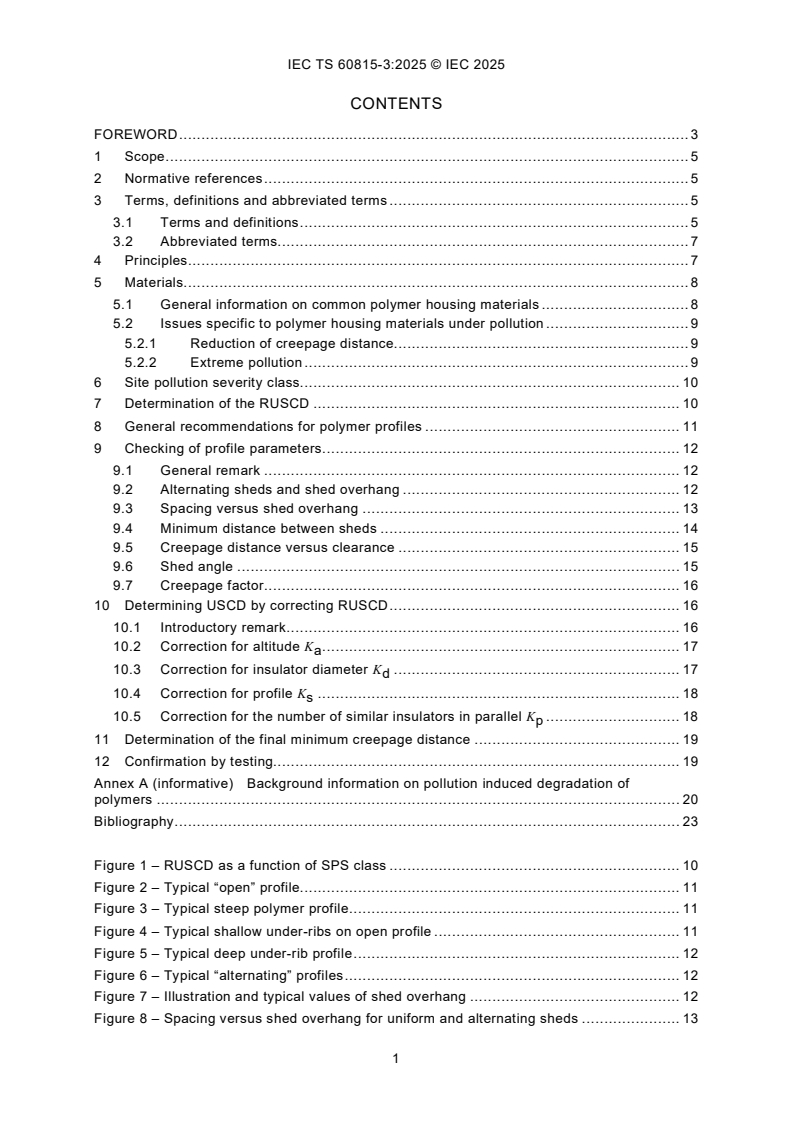
CONTENTS
FOREWORD . 3
1 Scope . 5
2 Normative references . 5
3 Terms, definitions and abbreviated terms . 5
3.1 Terms and definitions . 5
3.2 Abbreviated terms. 7
4 Principles . 7
5 Materials. 8
5.1 General information on common polymer housing materials . 8
5.2 Issues specific to polymer housing materials under pollution . 9
5.2.1 Reduction of creepage distance. 9
5.2.2 Extreme pollution . 9
6 Site pollution severity class. 10
7 Determination of the RUSCD . 10
8 General recommendations for polymer profiles . 11
9 Checking of profile parameters . 12
9.1 General remark . 12
9.2 Alternating sheds and shed overhang . 12
9.3 Spacing versus shed overhang . 13
9.4 Minimum distance between sheds . 14
9.5 Creepage distance versus clearance . 15
9.6 Shed angle . 15
9.7 Creepage factor. 16
10 Determining USCD by correcting RUSCD . 16
10.1 Introductory remark . 16
10.2 Correction for altitude K . 17
a
10.3 Correction for insulator diameter K . 17
d
10.4 Correction for profile K . 18
s
10.5 Correction for the number of similar insulators in parallel K . 18
p
11 Determination of the final minimum creepage distance . 19
12 Confirmation by testing. 19
Annex A (informative) Background information on pollution induced degradation of
polymers . 20
Bibliography . 23
Figure 1 – RUSCD as a function of SPS class . 10
Figure 2 – Typical “open” profile. 11
Figure 3 – Typical steep polymer profile . 11
Figure 4 – Typical shallow under-ribs on open profile . 11
Figure 5 – Typical deep under-rib profile . 12
Figure 6 – Typical “alternating” profiles . 12
Figure 7 – Illustration and typical values of shed overhang . 12
Figure 8 – Spacing versus shed overhang for uniform and alternating sheds . 13
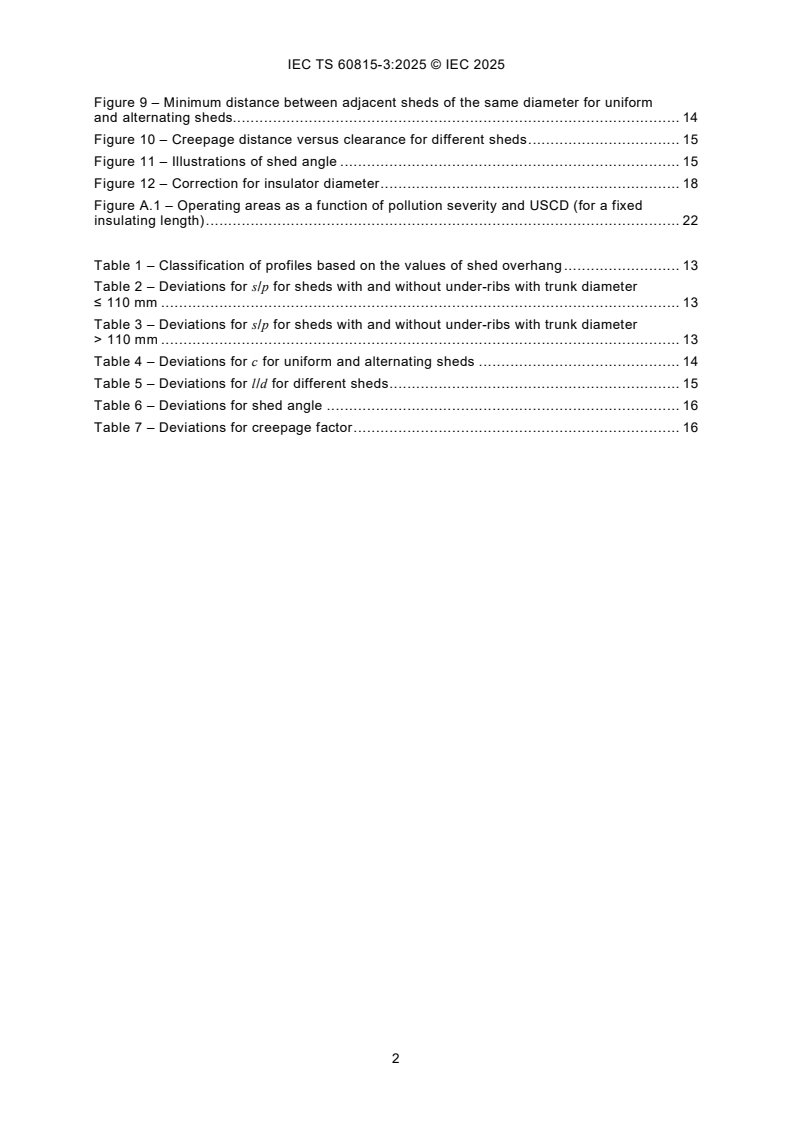
Figure 9 – Minimum distance between adjacent sheds of the same diameter for uniform
and alternating sheds. 14
Figure 10 – Creepage distance versus clearance for different sheds . 15
Figure 11 – Illustrations of shed angle . 15
Figure 12 – Correction for insulator diameter . 18
Figure A.1 – Operating areas as a function of pollution severity and USCD (for a fixed
insulating length) . 22
Table 1 – Classification of profiles based on the values of shed overhang . 13
Table 2 – Deviations for s/p for sheds with and without under-ribs with trunk diameter
≤ 110 mm . 13
Table 3 – Deviations for s/p for sheds with and without under-ribs with trunk diameter
> 110 mm . 13
Table 4 – Deviations for c for uniform and alternating sheds . 14
Table 5 – Deviations for l/d for different sheds . 15
Table 6 – Deviations for shed angle . 16
Table 7 – Deviations for creepage factor . 16
INTERNATIONAL ELECTROTECHNICAL COMMISSION
____________
Selection and dimensioning of high-voltage insulators
intended for use in polluted conditions -
Part 3: Polymer insulators for AC systems
FOREWORD
1) The International Electrotechnical Commission (IEC) is a worldwide organization for standardization comprising
all national electrotechnical committees (IEC National Committees). The object of IEC is to promote international
co-operation on all questions concerning standardization in the electrical and electronic fields. To this end and
in addition to other activities, IEC publishes International Standards, Technical Specifications, Technical Reports,
Publicly Available Specifications (PAS) and Guides (hereafter referred to as “IEC Publication(s)”). Their
preparation is entrusted to technical committees; any IEC National Committee interested in the subject dealt with
may participate in this preparatory work. International, governmental and non-governmental organizations liaising
with the IEC also participate in this preparation. IEC collaborates closely with the International Organization for
Standardization (ISO) in accordance with conditions determined by agreement between the two organizations.
2) The formal decisions or agreements of IEC on technical matters express, as nearly as possible, an international
consensus of opinion on the relevant subjects since each technical committee has representation from all
interested IEC National Committees.
3) IEC Publications have the form of recommendations for international use and are accepted by IEC National
Committees in that sense. While all reasonable efforts are made to ensure that the technical content of IEC
Publications is accurate, IEC cannot be held responsible for the way in which they are used or for any
misinterpretation by any end user.
4) In order to promote international uniformity, IEC National Committees undertake to apply IEC Publications
transparently to the maximum extent possible in their national and regional publications. Any divergence between
any IEC Publication and the corresponding national or regional publication shall be clearly indicated in the latter.
5) IEC itself does not provide any attestation of conformity. Independent certification bodies provide conformity
assessment services and, in some areas, access to IEC marks of conformity. IEC is not responsible for any
services carried out by independent certification bodies.
6) All users should ensure that they have the latest edition of this publication.
7) No liability shall attach to IEC or its directors, employees, servants or agents including individual experts and
members of its technical committees and IEC National Committees for any personal injury, property damage or
other damage of any nature whatsoever, whether direct or indirect, or for costs (including legal fees) and
expenses arising out of the publication, use of, or reliance upon, this IEC Publication or any other IEC
Publications.
8) Attention is drawn to the Normative references cited in this publication. Use of the referenced publications is
indispensable for the correct application of this publication.
9) IEC draws attention to the possibility that the implementation of this document may involve the use of (a)
patent(s). IEC takes no position concerning the evidence, validity or applicability of any claimed patent rights in
respect thereof. As of the date of publication of this document, IEC had not received notice of (a) patent(s), which
may be required to implement this document. However, implementers are cautioned that this may not represent
the latest information, which may be obtained from the patent database available at https://patents.iec.ch. IEC
shall not be held responsible for identifying any or all such patent rights.
IEC TS 60815-3 has been prepared by IEC technical committee 36: Insulators. It is a Technical
Specification.
This second edition of IEC TS 60815-3, together with IEC TS 60815-1, cancels and replaces
the first edition of IEC TS 60815-3:2008. This edition constitutes a technical revision.
This edition includes the following significant technical changes with respect to the previous
edition:
a) Terms and definitions are modified or introduced in this document;
b) From RUSCD of reference insulator to USCD of candidate insulator, the correction factors
are introduced and revised, such as altitude correction, diameter correction, shed profile
correction and parallel insulator number correction;
c) The general guidance on materials is revised. The concept of hydrophobicity transfer and
hydrophobicity transfer material (HTM) are introduced, recognising that a reduced creepage
distance may be used for HTM insulators.
The text of this Technical Specification is based on the following documents:
Draft Report on voting
36/613/DTS 36/636/RVDTS
Full information on the voting for its approval can be found in the report on voting indicated in
the above table.
The language used for the development of this Technical Specification is English.
This document was drafted in accordance with ISO/IEC Directives, Part 2, and developed in
accordance with ISO/IEC Directives, Part 1 and ISO/IEC Directives, IEC Supplement, available
at www.iec.ch/members_experts/refdocs. The main document types developed by IEC are
described in greater detail at www.iec.ch/publications.
A list of all the parts in the future IEC 60815 series, under the general title Selection and
dimensioning of high-voltage insulators intended for use in polluted conditions, can be found
on the IEC website.
The committee has decided that the contents of this document will remain unchanged until the
stability date indicated on the IEC website under webstore.iec.ch in the data related to the
specific document. At this date, the document will be
– reconfirmed,
– withdrawn, or
– revised.
1 Scope
This part of IEC 60815, which is a technical specification, is applicable for the selection of
polymeric insulators for AC systems, and the determination of their relevant dimensions, to be
used in high voltage systems with respect to pollution. The specification applies to insulators
for outdoor installation only.
This document gives specific guidelines and principles to arrive at an informed judgement on
the probable behaviour of a given insulator in certain pollution environment.
The contents of this document are based on CIGRE TB 158 and CIGRE TB 361 [1] , [2], which
form a useful complement to this document for those wishing to study in greater depth the
performance of insulators under pollution.
This document does not deal with the effects of snow or ice on polluted insulators. Although
this subject is dealt with by CIGRE TB 158 [1], current knowledge is very limited and practice
is too diverse.
The objective of this document is to give the user means to
• determine the reference unified specific creepage distance (RUSCD) from site pollution
severity (SPS) value or class,
• choose appropriate profiles,
• apply correction factors for altitude, insulator shape, size and position, etc. to the RUSCD.
2 Normative references
The following documents are referred to in the text in such a way that some or all of their content
constitutes requirements of this document. For dated references, only the edition cited applies.
For undated references, the latest edition of the referenced document (including any
amendments) applies.
IEC 60050-471, International Electrotechnical Vocabulary (IEV) - Part 471: Insulators
IEC TS 60815-1:2025, Selection and dimensioning of high-voltage insulators intended for use
in polluted conditions - Part 1: Definitions, information and general principles
3 Terms, definitions and abbreviated terms
3.1 Terms and definitions
For the purposes of this document, the terms and definitions given in IEC 60050-471 and the
following apply.
ISO and IEC maintain terminological databases for use in standardisation at the following
addresses:
– ISO Online browsing platform: available at https://www.iso.org/obp
– IEC Electropedia: available at http://www.electropedia.org/
___________
Numbers in square brackets refer to the bibliography.
3.1.1
unified specific creepage distance
USCD
creepage distance of an insulator divided by the base voltage
Note 1 to entry: This definition differs from that of specific creepage distance where the line-to-line value of the
highest voltage for the equipment is used (for AC systems usually U ). For line-to-earth insulation, this definition of
m
unified specific creepage distance will result in a value that is √3 times that given by the definition of specific creepage
distance in IEC TR 60815:1986 [3].
Note 2 to entry: The base voltage for AC is the RMS value of the highest operating voltage across the insulator.
Note 3 to entry: For 'U ' see IEC 60050-614:2016, 614-03-01 [4].
m
Note 4 to entry: It is generally expressed in mm/kV and usually expressed as a minimum.
Note 5 to entry: The total creepage distance used to calculate the USCD is the sum of the nominal, not minimum,
creepage distance of each unit of an insulator string. The nominal creepage distance is referred to in IEC 60383-1
[5].
3.1.2
nominal creepage distance
value of the creepage distance which can also be subject to a specified positive or negative
tolerance
3.1.3
reference unified specific creepage distance
RUSCD
unified specific creepage distance applying to a reference insulator for a specific pollution site
in mm/kV
Note 1 to entry: It is the starting value to evaluate the USCD of the candidate insulators. USCD can be obtained
after applying the necessary corrections to RUSCD, e.g., for size, profile, mounting position, number of insulators in
parallel and, if necessary, required system reliability (acceptable risk of flashover).
3.1.4
hydrophobicity
surface of a solid insulating material characterised by its capacity to repel water or aqueous
electrolyte solutions
Note 1 to entry: Hydrophobicity of a polymeric insulating material is, in general, a volume property by means of the
chemical composition of a material at its surface.
Note 2 to entry: Nonetheless, hydrophobicity is strongly affected by surface effects such as:
– surface structure (i. e. roughness);
– chemical interaction between water and the solid surface (adsorption, absorption, swelling of the solid material
in contact with water);
– an accumulated pollution layer.
Note 3 to entry: Furthermore, the conditions during an evaluation of hydrophobicity (temperature, pressure,
humidity), and the method for cleaning or electrostatic charges can affect the measured degree of hydrophobicity.
[SOURCE: IEC TR 62039:2021 [6], 3.1, modified – definition reworded.]
3.1.5
hydrophobicity transfer
phenomenon of a transfer of hydrophobicity from the bulk of the housing material onto the
pollution layer on its surface
3.1.6
hydrophobicity transfer material
HTM
polymeric material which exhibits hydrophobicity and the capability to transfer hydrophobicity
onto the layer of pollution, which is a combined dynamic behaviour of retention and transfer of
hydrophobicity specific to different insulator materials
Note 1 to entry: Material which is not HTM is called non-HTM.
[SOURCE: IEC TS 60815-4:2016, 3.1.4. modified –text after "pollution" added, Note to entry
deleted and Note on non-HTM added.]
3.1.7
insulator trunk
central insulating part of an insulator from which the sheds project
Note 1 to entry: Also known as shank (body) on smaller diameter insulators.
3.1.8
creepage factor
ratio between the total creepage distance and the arcing distance of the insulator
3.2 Abbreviated terms
CF creepage factor
ESDD equivalent salt deposit density
HTM hydrophobicity transfer material
MTBF mean time between flashover
NSDD non-soluble deposit density
RUSCD reference unified specific creepage distance
SDD salt deposit density
SES site equivalent salinity
SOR safe operating regions
SPS site pollution severity
USCD unified specific creepage distance
4 Principles
The overall process of insulation selection and dimensioning can be summarized as follows:
Firstly, using IEC TS 60815-1:
• determine the appropriate Approach 1, 2 or 3, or a combination thereof, as a function of
available knowledge, time and resources;
• collect the necessary input data, notably system voltage, insulation application type (line,
post, bushing, etc.) number of insulators in parallel if necessary, system performance
requirements (e.g. outages per 100 km of overhead line per year or in Mean Time Between
Flashover (MTBF), number of pollution events per year, etc);
• collect the necessary environmental data, notably SPS values and class.
At this stage a preliminary choice of possible candidate insulators suitable for the applications
and environment may be made.
Then, using this document:
• refine choice of possible candidate polymer insulators suitable for the environment;
• determine the RUSCD for the insulator types and materials, either using the indications in
the this document, or from service or test station experience in the case of Approach 1
(Clause 7);
• choose suitable profiles for the type of environment (Clause 8);
• verify that the profile satisfies certain parameters, with correction or action according to the
degree of deviation (Clause 9);
• modify, where necessary (Approaches 2 and 3), of the RUSCD by factors depending on the
size, profile, orientation, etc. of the candidate insulator (Clause 11 and Clause 12);
• verify that the resulting candidate insulators satisfy the other system and line requirements
such as those given in Table 2 of IEC TS 60815-1:2025 (e.g. imposed geometry,
dimensions, economics);
• verify the dimensioning, if required in the case of Approach 2, by laboratory tests
(see Clause 12).
NOTE Without sufficient time and resources (i.e. using Approach 3), the determination of the necessary USCD will
decrease the confidence level.
5 Materials
5.1 General information on common polymer housing materials
The present practice is to use housings manufactured from several base polymers, for instance
silicone rubbers based on dimethyl siloxane, cross linked polyolefins such as Ethylene
Propylene Diene Monomer (EPDM) rubber, or semi-crystalline ethylene copolymers such as
Ethylene Vinyl Acetate (EVA), or rigid highly cross-linked epoxy resins based on cycloaliphatic
components.
None of these polymers will give satisfactory performance in an outdoor environment without a
sophisticated additive package to modify their behaviour. Typically, such additives include anti-
tracking agents, UV screens and stabilizers, antioxidants, ionic scavengers, etc. Within each
material type the base material, the additives and even their processing can have a significant
influence on material performance. Some polymer insulators may collect more pollutants
compared to ceramic and glass insulators due to their surface characteristics, however this
does not increase surface conductivity significantly (and thus does not reduce flashover
performance) due to normally high hydrophobicity level. Pending more knowledge, it is assumed
that the contamination measured on reference ceramic insulators (see IEC TS 60815-1) applies
to polymeric insulators also.
If a polymeric insulating material presents the ability to transfer its hydrophobicity onto an
accumulated pollution layer, it is expected also to have the ability to recover after a reduction
or loss of hydrophobicity. Therefore, the term hydrophobicity transfer material (HTM) represents
the dynamic hydrophobicity properties altogether. Examples of polymeric, hydrophobic but non-
HTM are epoxy resins, EPDM or EVA. Silicone rubber is service proven as HTM, however, the
individual recipe, including treatment of fillers can play a vital role for the HTM dynamics.
5.2 Issues specific to polymer housing materials under pollution
5.2.1 Reduction of creepage distance
Polymeric insulators present certain advantages over ceramic and glass insulators due to their
profile (diameter) and materials. These advantages include a higher pollution performance
when compared to ceramic or glass insulators of the same creepage distance. Laboratory tests
and field experience have shown that even under the conditions of weak hydrophobicity (HC6),
HTM insulators will present a better pollution withstand performance than ceramic or glass
insulators with equal creepage distance. Therefore, from pollution withstand point of view, a
reduced creepage distance may be used in the dimensioning for such insulators. However, in
some cases, reduction of the creepage distance may have an impact on insulator ageing.
Some general examples of conditions (or combinations thereof) in which the use of reduced
creepage distance can be adopted are given below.
Examples include:
• Proof by line trial, test station or historic data with the same design, materials and electric
stress.
• The pollution is predominately type A, with no risk of extreme events (wetting or pollution
deposition).
• There is no frequent or daily cyclic wetting or other environmental effects liable to prolong
or inhibit HTM recovery.
• Regular inspection, maintenance, e.g. washing or cleaning when necessary in extremely
harsh environment are made.
• When necessarily used in temporary situation (e.g. emergency/temporary lines).
• There is no other solution possible due to dimensional constraints.
Annex A provides information on possible ageing effects, including the following points:
• Reduced creepage distanc
...