

IEC 62305-4:2006
(Main)Protection against lightning - Part 4: Electrical and electronic systems within structures
General Information
- Abstract
Provides information for the design, installation, inspection, maintenance and testing of a LEMP protection measures system (LPMS) for electrical and electronic systems within a structure, able to reduce the risk of permanent failures due to lightning electromagnetic impulse. This standard does not cover protection against electromagnetic interference due to lightning, which may cause malfunctioning of electronic systems. However, the information reported in Annex A can also be used to evaluate such disturbances. Protection measures against electromagnetic interference are covered in IEC 60364-4-44 and in the IEC 61000 series [1] . This standard provides guidelines for cooperation between the designer of the electrical and electronic system, and the designer of the protection measures, in an attempt to achieve optimum protection effectiveness. This standard does not deal with detailed design of the electrical and electronic systems themselves.
- Status
- Published
- Publication Date
- 16-Jan-2006
- Technical Committee
- TC 81 - Lightning protection
- Current Stage
- DELPUB - Deleted Publication
- Start Date
- 09-Dec-2010
- Completion Date
- 28-Aug-2026
Buy Documents
IEC 62305-4:2006 - Protection against lightning - Part 4: Electrical and electronic systems within structures Released:1/17/2006
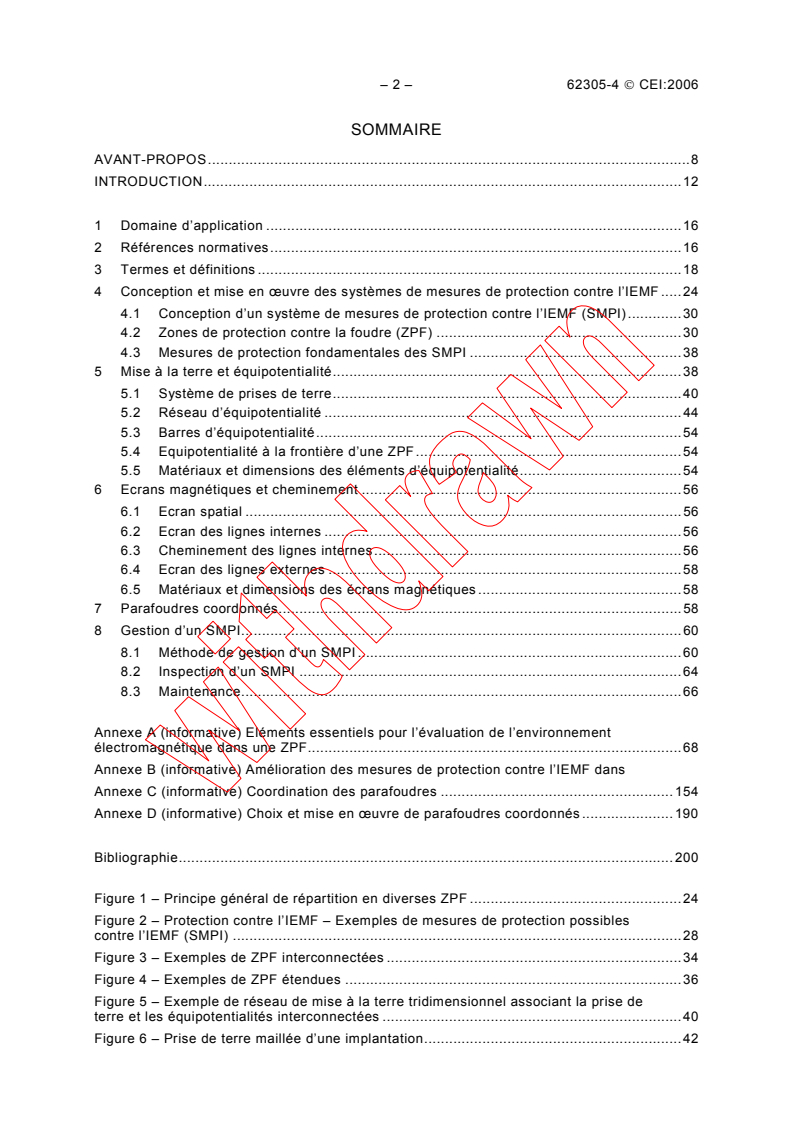
IEC 62305-4:2006 - Protection contre la foudre - Partie 4: Réseaux de puissance et de communication dans les structures Released:1/17/2006
IEC 62305-4:2006 - Protection against lightning - Part 4: Electrical and electronic systems within structures Released:1/17/2006
Overview
IEC 62305-4:2006 - Protection against lightning, Part 4 - provides guidance for the design, installation, inspection, maintenance and testing of a LEMP protection measures system (LPMS) for electrical and electronic systems within structures. Its focus is on reducing the risk of permanent failures caused by the lightning electromagnetic impulse (LEMP). The standard addresses conducted and radiated LEMP effects and promotes coordinated protection measures, while expressly not covering general electromagnetic interference (EMI) mitigation (see Related Standards).
Key topics and technical requirements
- LEMP protection measures system (LPMS): Principles for planning and implementing an LPMS to reduce permanent damage to equipment from lightning-induced impulses.
- Lightning Protection Zones (LPZ): Use of LPZ concepts to progressively reduce electromagnetic stress on internal systems.
- Earthing and bonding: Requirements and guidance for earth termination systems, bonding networks and bonding bars to achieve equipotential conditions and reduce touch/step and surge risks.
- Magnetic shielding & line routing: Techniques to limit magnetic-field coupling and induced voltages, including spatial shielding, cable routing and shield application.
- Coordinated SPD protection: Strategies for selection and coordination of surge protective devices (SPDs) across supply and signal lines to control residual overvoltages.
- Management, inspection and maintenance: Lifecycle guidance - LPMS management plans, periodic inspection, testing and maintenance to sustain protection performance.
- Informative annexes: Practical evaluation methods (Annex A), upgrading existing structures (Annex B), SPD coordination theory (Annex C) and SPD selection/installation guidance (Annex D).
Practical applications and users
IEC 62305-4 is applicable to organizations and professionals who design, operate or maintain electrical and electronic installations that require robust protection from lightning-induced damage, including:
- Data centers and IT infrastructure designers
- Industrial process control and SCADA engineers
- Telecommunications and broadcast facility planners
- Medical facilities and safety-critical system engineers
- Lightning protection consultants, installers and maintenance teams
- Facility managers responsible for asset protection and uptime
Typical applications: specifying earthing/bonding layouts, defining LPZ boundaries inside buildings, selecting and coordinating SPDs, planning cable routing and shielding, and upgrading protection in existing structures.
Related standards
- IEC 62305 (Parts 1–5) - overarching lightning protection series
- IEC 60364-4-44 and the IEC 61000 series - cover EMI / electromagnetic compatibility (EMC) and protection against electromagnetic interference not addressed in detail by Part 4
Keywords: IEC 62305-4, lightning protection, LEMP, LPMS, surge protective devices, earthing and bonding, lightning protection zones, electromagnetic interference, SPD coordination.
Relations
- Replaces
IEC 61312-1:1995 - Protection against lightning electromagnetic impulse - Part 1: General principles - Effective Date
- 05-Sep-2023
- Effective Date
- 05-Sep-2023
- Effective Date
- 05-Sep-2023
- Effective Date
- 05-Sep-2023
- Effective Date
- 10-Feb-2026
- Effective Date
- 09-Feb-2026
- Effective Date
- 05-Sep-2023
Buy Documents
IEC 62305-4:2006 - Protection against lightning - Part 4: Electrical and electronic systems within structures Released:1/17/2006
IEC 62305-4:2006 - Protection contre la foudre - Partie 4: Réseaux de puissance et de communication dans les structures Released:1/17/2006
IEC 62305-4:2006 - Protection against lightning - Part 4: Electrical and electronic systems within structures Released:1/17/2006
Get Certified
Connect with accredited certification bodies for this standard

DIBt (Deutsches Institut für Bautechnik)
German Institute for Building Technology.
DIN CERTCO
DIN Group product certification.

IMQ S.p.A. (Certification)
Italian electrical product certification.
Sponsored listings
Frequently Asked Questions
IEC 62305-4:2006 is a standard published by the International Electrotechnical Commission (IEC). Its full title is "Protection against lightning - Part 4: Electrical and electronic systems within structures". This standard covers: Provides information for the design, installation, inspection, maintenance and testing of a LEMP protection measures system (LPMS) for electrical and electronic systems within a structure, able to reduce the risk of permanent failures due to lightning electromagnetic impulse. This standard does not cover protection against electromagnetic interference due to lightning, which may cause malfunctioning of electronic systems. However, the information reported in Annex A can also be used to evaluate such disturbances. Protection measures against electromagnetic interference are covered in IEC 60364-4-44 and in the IEC 61000 series [1] . This standard provides guidelines for cooperation between the designer of the electrical and electronic system, and the designer of the protection measures, in an attempt to achieve optimum protection effectiveness. This standard does not deal with detailed design of the electrical and electronic systems themselves.
Provides information for the design, installation, inspection, maintenance and testing of a LEMP protection measures system (LPMS) for electrical and electronic systems within a structure, able to reduce the risk of permanent failures due to lightning electromagnetic impulse. This standard does not cover protection against electromagnetic interference due to lightning, which may cause malfunctioning of electronic systems. However, the information reported in Annex A can also be used to evaluate such disturbances. Protection measures against electromagnetic interference are covered in IEC 60364-4-44 and in the IEC 61000 series [1] . This standard provides guidelines for cooperation between the designer of the electrical and electronic system, and the designer of the protection measures, in an attempt to achieve optimum protection effectiveness. This standard does not deal with detailed design of the electrical and electronic systems themselves.
IEC 62305-4:2006 is classified under the following ICS (International Classification for Standards) categories: 29.020 - Electrical engineering in general; 91.120.40 - Lightning protection. The ICS classification helps identify the subject area and facilitates finding related standards.
IEC 62305-4:2006 has the following relationships with other standards: It is inter standard links to IEC 61312-1:1995, IEC TS 61312-4:1998, IEC TS 61312-3:2000, IEC TS 61312-2:1999, EN 61643-21:2001/A1:2009, EN ISO 16484-1:2010, IEC 62305-4:2010. Understanding these relationships helps ensure you are using the most current and applicable version of the standard.
IEC 62305-4:2006 is available in PDF format for immediate download after purchase. The document can be added to your cart and obtained through the secure checkout process. Digital delivery ensures instant access to the complete standard document.
Standards Content (Sample)
INTERNATIONAL IEC
STANDARD 62305-4
First edition
2006-01
Protection against lightning –
Part 4:
Electrical and electronic systems
within structures
This English-language version is derived from the original
bilingual publication by leaving out all French-language
pages. Missing page numbers correspond to the French-
language pages.
Reference number
Publication numbering
As from 1 January 1997 all IEC publications are issued with a designation in the
60000 series. For example, IEC 34-1 is now referred to as IEC 60034-1.
Consolidated editions
The IEC is now publishing consolidated versions of its publications. For example,
edition numbers 1.0, 1.1 and 1.2 refer, respectively, to the base publication, the
base publication incorporating amendment 1 and the base publication incorporating
amendments 1 and 2.
Further information on IEC publications
The technical content of IEC publications is kept under constant review by the IEC,
thus ensuring that the content reflects current technology. Information relating to
this publication, including its validity, is available in the IEC Catalogue of
publications (see below) in addition to new editions, amendments and corrigenda.
Information on the subjects under consideration and work in progress undertaken
by the technical committee which has prepared this publication, as well as the list
of publications issued, is also available from the following:
• IEC Web Site (www.iec.ch)
• Catalogue of IEC publications
The on-line catalogue on the IEC web site (www.iec.ch/searchpub) enables you to
search by a variety of criteria including text searches, technical committees
and date of publication. On-line information is also available on recently issued
publications, withdrawn and replaced publications, as well as corrigenda.
• IEC Just Published
This summary of recently issued publications (www.iec.ch/online_news/ justpub)
is also available by email. Please contact the Customer Service Centre (see
below) for further information.
• Customer Service Centre
If you have any questions regarding this publication or need further assistance,
please contact the Customer Service Centre:
Email: custserv@iec.ch
Tel: +41 22 919 02 11
Fax: +41 22 919 03 00
INTERNATIONAL IEC
STANDARD 62305-4
First edition
2006-01
Protection against lightning –
Part 4:
Electrical and electronic systems
within structures
© IEC 2006 Copyright - all rights reserved
No part of this publication may be reproduced or utilized in any form or by any means, electronic or mechanical,
including photocopying and microfilm, without permission in writing from the publisher.
International Electrotechnical Commission, 3, rue de Varembé, PO Box 131, CH-1211 Geneva 20, Switzerland
Telephone: +41 22 919 02 11 Telefax: +41 22 919 03 00 E-mail: inmail@iec.ch Web: www.iec.ch
PRICE CODE
Commission Electrotechnique Internationale XD
International Electrotechnical Commission
Международная Электротехническая Комиссия
For price, see current catalogue
62305-4 IEC:2006 – 3 –
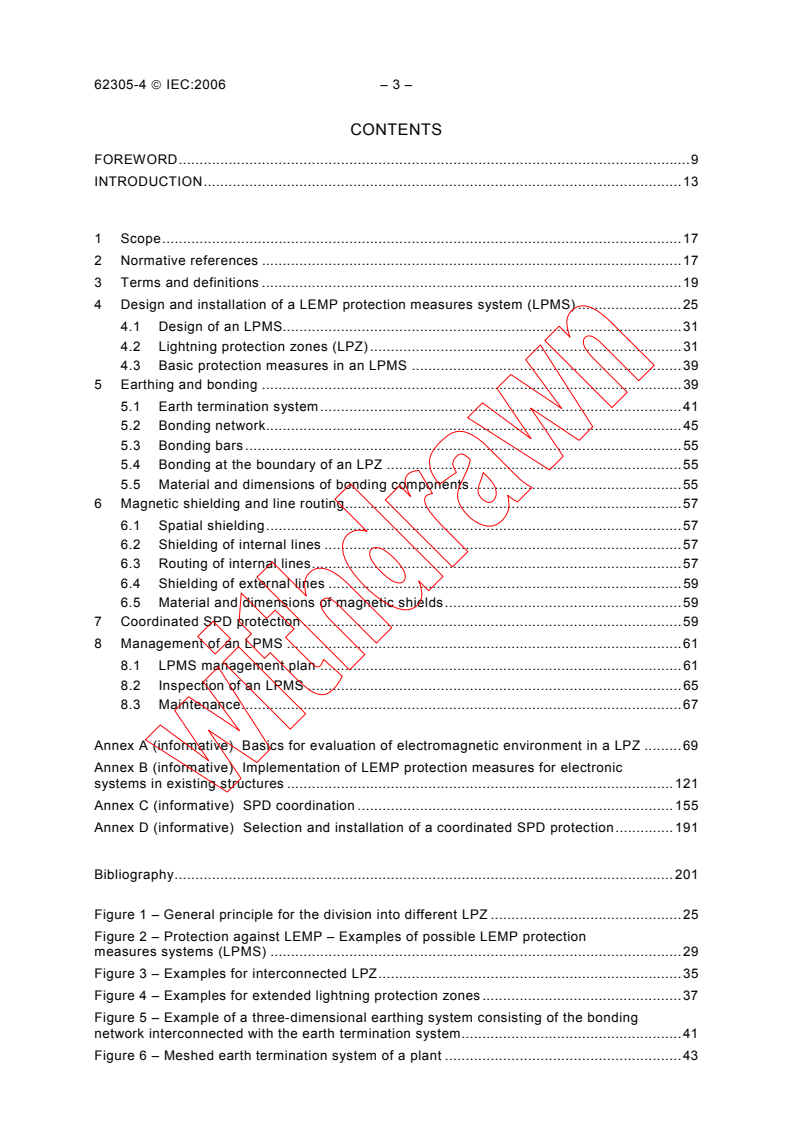
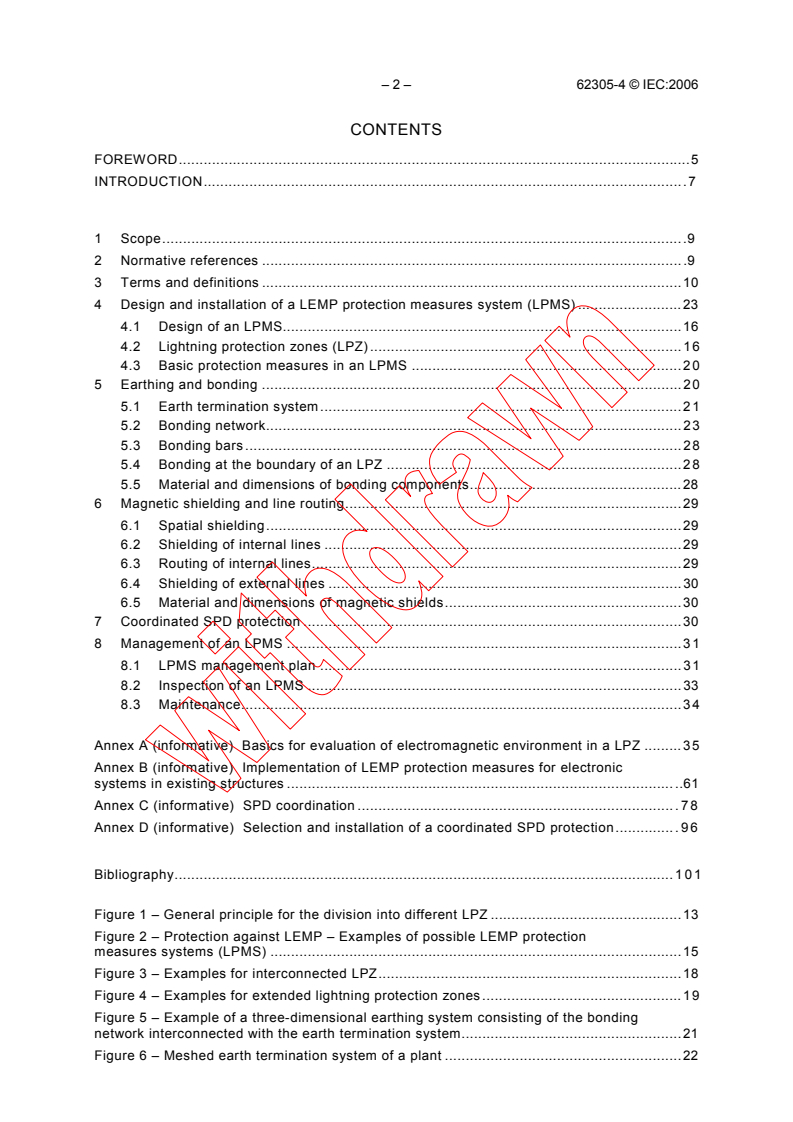
CONTENTS
FOREWORD.9
INTRODUCTION.13
1 Scope.17
2 Normative references .17
3 Terms and definitions .19
4 Design and installation of a LEMP protection measures system (LPMS) .25
4.1 Design of an LPMS.31
4.2 Lightning protection zones (LPZ) .31
4.3 Basic protection measures in an LPMS .39
5 Earthing and bonding .39
5.1 Earth termination system.41
5.2 Bonding network.45
5.3 Bonding bars .55
5.4 Bonding at the boundary of an LPZ .55
5.5 Material and dimensions of bonding components.55
6 Magnetic shielding and line routing.57
6.1 Spatial shielding.57
6.2 Shielding of internal lines .57
6.3 Routing of internal lines.57
6.4 Shielding of external lines .59
6.5 Material and dimensions of magnetic shields.59
7 Coordinated SPD protection .59
8 Management of an LPMS .61
8.1 LPMS management plan .61
8.2 Inspection of an LPMS .65
8.3 Maintenance.67
Annex A (informative) Basics for evaluation of electromagnetic environment in a LPZ .69
Annex B (informative) Implementation of LEMP protection measures for electronic
systems in existing structures .121
Annex C (informative) SPD coordination .155
Annex D (informative) Selection and installation of a coordinated SPD protection.191
Bibliography.201
Figure 1 – General principle for the division into different LPZ .25
Figure 2 – Protection against LEMP – Examples of possible LEMP protection
measures systems (LPMS) .29
Figure 3 – Examples for interconnected LPZ.35
Figure 4 – Examples for extended lightning protection zones .37
Figure 5 – Example of a three-dimensional earthing system consisting of the bonding
network interconnected with the earth termination system.41
Figure 6 – Meshed earth termination system of a plant .43
62305-4 IEC:2006 – 5 –
Figure 7 – Utilization of reinforcing rods of a structure for equipotential bonding.47
Figure 8 – Equipotential bonding in a structure with steel reinforcement .49
Figure 9 – Integration of electronic systems into the bonding network.51
Figure 10 – Combinations of integration methods of electronic systems into the
bonding network .53
Figure A.1 – LEMP situation due to lightning flash .73
Figure A.2 – Simulation of the rise of magnetic field by damped oscillations .77
Figure A.3 – Large volume shield built by metal reinforcement and metal frames.79
Figure A.4 – Volume for electrical and electronic systems inside an inner LPZ n.81
Figure A.5 – Reducing induction effects by line routing and shielding measures .85
Figure A.6 – Example of an LPMS for an office building.87
Figure A.7 – Evaluation of the magnetic field values in case of a direct lightning flash .91
Figure A.8 – Evaluation of the magnetic field values in case of a nearby lightning flash .95
Figure A.9 – Distance s depending on rolling sphere radius and structure dimensions .101
a
Figure A.10 – Types of grid-like large volume shields .105
Figure A.11 – Magnetic field strength H inside a grid-like shield Type 1.107
1/max
Figure A.12 – Magnetic field strength H inside a grid-like shield Type 1.107
1/max
Figure A.13 – Low-level test to evaluate the magnetic field inside a shielded structure .111
Figure A.14 – Voltages and currents induced into a loop built by lines .113
Figure B.1 – Upgrading of LEMP protection measures and electromagnetic
compatibility in existing structures .125
Figure B.2 – Possibilities to establish LPZs in existing structures.137
Figure B.3 – Reduction of loop area using shielded cables close to a metal plate .141
Figure B.4 – Example of a metal plate for additional shielding .143
Figure B.5 – Protection of aerials and other external equipment .147
Figure B.6 – Inherent shielding provided by bonded ladders and pipes .149
Figure B.7 – Ideal positions for lines on a mast (cross-section of steel lattice mast).151
Figure C.1 – Example for the application of SPD in power distribution systems.157
Figure C.2 – Basic model for energy coordination of SPD .161
Figure C.3 – Combination of two voltage-limiting type SPDs .163
Figure C.4 – Example with two voltage-limiting type MOV 1 and MOV 2.167
Figure C.5 – Combination of voltage-switching type spark gap and voltage-limiting type
MOV .169
Figure C.6 – Example with voltage-switching type spark gap and voltage-limiting type MOV171
Figure C.7 – Determination of decoupling inductance for 10/350 µs and 0,1kA/µs surges .173
Figure C.8 – Example with spark gap and MOV for a 10/350 µs surge .177
62305-4 IEC:2006 – 7 –
Figure C.9 – Example with spark gap and MOV for 0,1kA/µs surge.181
Figure C.10 – Coordination variant I – Voltage-limiting type SPD .183
Figure C.11 – Coordination variant II – Voltage-limiting type SPD .185
Figure C.12 – Coordination variant III – Voltage-switching type SPD and voltage-
limiting type SPD .185
Figure C.13 – Coordination variant IV – Several SPDs in one element.187
Figure C.14 – Coordination according to the “let through energy” method .187
Figure D.1 – Surge voltage between live conductor and bonding bar .193
62305-4 IEC:2006 – 9 –
INTERNATIONAL ELECTROTECHNICAL COMMISSION
____________
PROTECTION AGAINST LIGHTNING –
Part 4: Electrical and electronic systems within structures
FOREWORD
1) The International Electrotechnical Commission (IEC) is a worldwide organization for standardization comprising
all national electrotechnical committees (IEC National Committees). The object of IEC is to promote
international co-operation on all questions concerning standardization in the electrical and electronic fields. To
this end and in addition to other activities, IEC publishes International Standards, Technical Specifications,
Technical Reports, Publicly Available Specifications (PAS) and Guides (hereafter referred to as “IEC
Publication(s)”). Their preparation is entrusted to technical committees; any IEC National Committee interested
in the subject dealt with may participate in this preparatory work. International, governmental and non-
governmental organizations liaising with the IEC also participate in this preparation. IEC collaborates closely
with the International Organization for Standardization (ISO) in accordance with conditions determined by
agreement between the two organizations.
2) The formal decisions or agreements of IEC on technical matters express, as nearly as possible, an international
consensus of opinion on the relevant subjects since each technical committee has representation from all
interested IEC National Committees.
3) IEC Publications have the form of recommendations for international use and are accepted by IEC National
Committees in that sense. While all reasonable efforts are made to ensure that the technical content of IEC
Publications is accurate, IEC cannot be held responsible for the way in which they are used or for any
misinterpretation by any end user.
4) In order to promote international uniformity, IEC National Committees undertake to apply IEC Publications
transparently to the maximum extent possible in their national and regional publications. Any divergence
between any IEC Publication and the corresponding national or regional publication shall be clearly indicated in
the latter.
5) IEC provides no marking procedure to indicate its approval and cannot be rendered responsible for any
equipment declared to be in conformity with an IEC Publication.
6) All users should ensure that they have the latest edition of this publication.
7) No liability shall attach to IEC or its directors, employees, servants or agents including individual experts and
members of its technical committees and IEC National Committees for any personal injury, property damage or
other damage of any nature whatsoever, whether direct or indirect, or for costs (including legal fees) and
expenses arising out of the publication, use of, or reliance upon, this IEC Publication or any other IEC
Publications.
8) Attention is drawn to the Normative references cited in this publication. Use of the referenced publications is
indispensable for the correct application of this publication.
9) Attention is drawn to the possibility that some of the elements of this IEC Publication may be the subject of
patent rights. IEC shall not be held responsible for identifying any or all such patent rights.
International Standard IEC 62305-4 has been prepared by IEC technical committee 81:
Lightning protection.
The IEC 62305 series (Parts 1 to 5), is produced in accordance with the New Publications
Plan, approved by National Committees (81/171/RQ (2001-06-29)), which restructures in a
more simple and rational form and updates the publications of the IEC 61024 series,
IEC 61312 series and the IEC 61663 series.
The text of this first edition of IEC 62305-4 is compiled from and replaces
– IEC 61312-1, first edition (1995);
– IEC 61312-2, first edition (1998);
– IEC 61312-3, first edition (2000);
– IEC 61312-4, first edition (1998).
62305-4 IEC:2006 – 11 –
The text of this standard is based on the following documents:
FDIS Report on voting
81/265/FDIS 81/270/RVD
Full information on the voting for the approval of this standard can be found in the report on
voting indicated in the above table.
This publication has been drafted, as close as possible, in accordance with the ISO/IEC
Directives, Part 2.
IEC 62305 consists of the following parts, under the general title Protection against lightning:
Part 1: General principles
Part 2: Risk management
Part 3: Physical damage to structures and life hazard
Part 4: Electrical and electronic systems within structures
Part 5: Services
The committee has decided that the contents of this publication will remain unchanged until
the maintenance result date indicated on the IEC web site under "http://webstore.iec.ch" in
the data related to the specific publication. At this date, the publication will be
• reconfirmed;
• withdrawn;
• replaced by a revised edition, or
• amended.
———————
To be published.
62305-4 IEC:2006 – 13 –
INTRODUCTION
Lightning as a source of harm is a very high-energy phenomenon. Lightning flashes release
many hundreds of mega-joules of energy. When compared with the milli-joules of energy that
may be sufficient to cause damage to sensitive electronic equipment in electrical and
electronic systems within a structure, it is clear that additional protection measures will be
necessary to protect some of this equipment.
The need for this International Standard has arisen due to the increasing cost of failures of
electrical and electronic systems, caused by electromagnetic effects of lightning. Of particular
importance are electronic systems used in data processing and storage as well as process
control and safety for plants of considerable capital cost, size and complexity (for which plant
outages are very undesirable for cost and safety reasons).
Lightning can cause different types of damage in a structure, as defined in IEC 62305-2:
D1 injuries to living beings due to touch and step voltages;
D2 physical damage due to mechanical, thermal, chemical and explosive effects;
D3 failures of electrical and electronic systems due to electromagnetic effects.
IEC 62305-3 deals with the protection measures to reduce the risk of physical damage and
life hazard, but does not cover the protection of electrical and electronic systems.
This Part 4 of IEC 62305 therefore provides information on protection measures to reduce the
risk of permanent failures of electrical and electronic systems within structures.
Permanent failure of electrical and electronic systems can be caused by the lightning
electromagnetic impulse (LEMP) via:
a) conducted and induced surges transmitted to apparatus via connecting wiring;
b) the effects of radiated electromagnetic fields directly into apparatus itself.
Surges to the structure can be generated externally or internally:
– surges external to the structure are created by lightning flashes striking incoming lines or
the nearby ground, and are transmitted to electrical and electronic systems via these lines;
– surges internal to the structure are created by lightning flashes striking the structure or the
nearby ground.
The coupling can arise from different mechanisms:
– resistive coupling (e.g. the earth impedance of the earth termination system or the cable
shield resistance);
– magnetic field coupling (e.g. caused by wiring loops in the electrical and electronic system
or by inductance of bonding conductors);
– electric field coupling (e.g. caused by rod antenna reception).
NOTE The effects of electric field coupling are generally very small when compared to the magnetic field coupling
and can be disregarded.
62305-4 IEC:2006 – 15 –
Radiated electromagnetic fields can be generated via
– the direct lightning current flowing in the lightning channel,
– the partial lightning current flowing in conductors (e.g. in the down conductors of an
external LPS according to IEC 62305-3 or in an external spatial shield according to this
standard).
62305-4 IEC:2006 – 17 –
PROTECTION AGAINST LIGHTNING –
Part 4: Electrical and electronic systems within structures
1 Scope
This part of IEC 62305 provides information for the design, installation, inspection,
maintenance and testing of a LEMP protection measures system (LPMS) for electrical and
electronic systems within a structure, able to reduce the risk of permanent failures due to
lightning electromagnetic impulse.
This standard does not cover protection against electromagnetic interference due to lightning,
which may cause malfunctioning of electronic systems. However, the information reported in
Annex A can also be used to evaluate such disturbances. Protection measures against
electromagnetic interference are covered in IEC 60364-4-44 and in the IEC 61000 series [1] .
This standard provides guidelines for cooperation between the designer of the electrical and
electronic system, and the designer of the protection measures, in an attempt to achieve
optimum protection effectiveness.
This standard does not deal with detailed design of the electrical and electronic systems
themselves.
2 Normative references
The following referenced documents are indispensable for the application of this document.
For dated references, only the edition cited applies. For undated references, the latest edition
of the referenced document (including any amendments) applies.
IEC 60364-4-44:2001, Electrical installations of buildings – Part 4-44: Protection for safety –
Protection against voltage disturbances and electromagnetic disturbances
IEC 60364-5-53:2001, Electrical installations of building – Part 5-53: Selection and erection of
electrical equipment– Isolation, switching and control
IEC 60664-1:2002, Insulation coordination for equipment within low-voltage systems – Part 1:
Principles, requirements and tests
IEC 61000-4-5:1995, Electromagnetic compatibility (EMC) – Part 4-5: Testing and measure-
ment techniques – Surge immunity test
IEC 61000-4-9:1993, Electromagnetic compatibility (EMC) – Part 4-9: Testing and measure-
ment techniques – Pulse magnetic field immunity test
IEC 61000-4-10:1993, Electromagnetic compatibility (EMC) – Part 4-10: Testing and measure-
ment techniques – Damped oscillatory magnetic field immunity test
———————
Figures in square brackets refer to the biblography.
62305-4 IEC:2006 – 19 –
IEC 61000-5-2:1997, Electromagnetic compatibility (EMC) – Part 5: Installation and mitigation
guidelines – Section 2: Earthing and cabling
IEC 61643-1:1998, Surge protective devices connected to low-voltage power distribution
systems – Part 1: Performance requirements and testing methods
IEC 61643-12:2002, Low-voltage surge protective devices – Part 12: Surge protective devices
connected to low-voltage power distribution systems – Selection and application principles
IEC 61643-21:2000, Low voltage surge protective devices – Part 21: Surge protective devices
connected to telecommunications and signalling networks – Performance requirements and
testing methods
IEC 61643-22:2004, Low voltage surge protective devices – Part 22: Surge protective devices
connected to telecommunications and signalling networks – Part 22: Selection and application
principles
IEC 62305-1, Protection against lightning. Part 1: General principles
IEC 62305-2, Protection against lightning. Part 2: Risk management
IEC 62305-3, Protection against lightning. Part 3: Physical damage to structures and life
hazard
ITU-T Recommendation K.20:2003, Resistibility of telecommunication equipment installed in a
telecommunications centre to overvoltages and overcurrents
ITU-T Recommendation K.21:2003, Resistibility of telecommunication equipment installed in
customer premises to overvoltages and overcurrent
3 Terms and definitions
For the purposes of this document, the following terms and definitions, as well as those given
in other parts of IEC 62305, apply.
3.1
electrical system
system incorporating low voltage power supply components
3.2
electronic system
system incorporating sensitive electronic components such as communication equipment,
computer, control and instrumentation systems, radio systems, power electronic installations
3.3
internal systems
electrical and electronic systems within a structure
3.4
lightning electromagnetic impulse
LEMP
electromagnetic effects of lightning current
NOTE It includes conducted surges as well as radiated impulse electromagnetic field effects.
62305-4 IEC:2006 – 21 –
3.5
surge
transient wave appearing as overvoltage and/or overcurrent caused by LEMP
NOTE Surges caused by LEMP can arise from (partial) lightning currents, from induction effects in installation
loops and as a remaining threat downstream of SPD.
3.6
rated impulse withstand voltage level
U
w
impulse withstand voltage assigned by the manufacturer to the equipment or to a part of it,
characterizing the specified withstand capability of its insulation against overvoltages
NOTE For the purposes of this standard, only withstand voltage between live conductors and earth is considered.
3.7
lightning protection level
LPL
number related to a set of lightning current parameters values relevant to the probability that
the associated maximum and minimum design values will not be exceeded in naturally
occurring lightning
NOTE Lightning protection level is used to design protection measures according to the relevant set of lightning
current parameters.
3.8
lightning protection zone
LPZ
zone where the lightning electromagnetic environment is defined
NOTE The zone boundaries of an LPZ are not necessarily physical boundaries (e.g. walls, floor and ceiling).
3.9
LEMP protection measures system
LPMS
complete system of protection measures for internal systems against LEMP
3.10
grid-like spatial shield
magnetic shield characterized by openings
NOTE For a building or a room, it is preferably built by interconnected natural metal components of the structure
(e.g. rods of reinforcement in concrete, metal frames and metal supports).
3.11
earth-termination system
part of an external LPS which is intended to conduct and disperse lightning current into the
earth
3.12
bonding network
interconnecting network of all conductive parts of the structure and of internal systems (live
conductors excluded) to the earth-termination system
3.13
earthing system
complete system combining the earth-termination system and the bonding network
3.14
surge protective device
SPD
device intended to limit transient overvoltages and divert surge currents. It contains at least
one non linear component
62305-4 IEC:2006 – 23 –
3.15
SPD tested with I
imp
SPDs which withstand the partial lightning current with a typical waveform 10/350 µs require a
corresponding impulse test current I
imp
NOTE For power lines, a suitable test current I is defined in the Class I test procedure of IEC 61643-1.
imp
3.16
SPD tested with I
n
SPDs which withstand induced surge currents with a typical waveform 8/20 µs require a
corresponding impulse test current I
n
NOTE For power lines a suitable test current I is defined in the Class II test procedure of IEC 61643-1.
n
3.17
SPD tested with a combination wave
SPDs that withstand induced surge currents with a typical waveform 8/20 µs and require a
corresponding impulse test current I
sc
NOTE For power lines a suitable combination wave test is defined in the Class III test procedure of IEC 61643-1
defining the open circuit voltage U 1,2/50 µs and the short-circuit current I 8/20 µs of an 2 Ω combination wave
oc sc
generator.
3.18
voltage switching type SPD
SPD that has a high impedance when no surge is present, but can have a sudden change in
impedance to a low value in response to a voltage surge
NOTE 1 Common examples of components used as voltage switching devices include spark gaps, gas discharge
tubes (GDT), thyristors (silicon controlled rectifiers) and triacs. These SPD are sometimes called "crowbar type“.
NOTE 2 A voltage switching device has a discontinuous voltage/current characteristic.
3.19
voltage-limiting type SPD
SPD that has a high impedance when no surge is present, but will reduce it continuously with
increased surge current and voltage
NOTE 1 Common examples of components used as non-linear devices are varistors and suppressor diodes.
These SPDs are sometimes called "clamping type“.
NOTE 2 A voltage-limiting device has a continuous voltage/current characteristic.
3.20
combination type SPD
SPD that incorporates both voltage-switching and voltage-limiting type components and which
may exhibit voltage-switching, voltage-limiting or both voltage-switching and voltage-limiting
behaviour, depending upon the characteristics of the applied voltage
3.21
coordinated SPD protection
set of SPD properly selected, coordinated and installed to reduce failures of electrical and
electronic systems
62305-4 IEC:2006 – 25 –
4 Design and installation of a LEMP protection measures system (LPMS)
Electrical and electronic systems are subject to damage from the lightning electromagnetic
impulse (LEMP). Therefore LEMP protection measures need to be provided to avoid failure of
internal systems.
Protection against LEMP is based on the lightning protection zone (LPZ) concept: the volume
containing systems to be protected shall be divided into LPZ. These zones are theoretically
assigned volumes of space where the LEMP severity is compatible with the withstand level of
the internal systems enclosed (see Figure 1). Successive zones are characterized by
significant changes in the LEMP severity. The boundary of an LPZ is defined by the protection
measures employed (see Figure 2).
LPZ 0
Antenna
Mast or railing
Electrical
power line
Boundary
of LPZ 2
Boundary
LPZ 1
LPZ 2 of LPZ 1
Equipment
Water
Bonding
pipe Telecommunication
location
line
Bonding of incoming services directly or by suitable SPD
IEC 2187/05
NOTE This figure shows an example for dividing a structure into inner LPZs. All metal services entering the
structure are bonded via bonding bars at the boundary of LPZ 1. In addition, the conductive services entering LPZ
2 (e.g. computer room) are bonded via bonding bars at the boundary of LPZ 2.
Figure 1 – General principle for the division into different LPZ
62305-4 IEC:2006 – 27 –
I , H
0 0
LPZ 0
LPS + Shield LPZ 1
H
LPZ 1
Shield LPZ 2
H
LPZ 2
H
SPD 1/2 SPD 0/1
(SB) (MB)
Apparatus
(victim)
U , I , I U , I
2 2 U1 1 0 0
Housing
Partial lightning
current
IEC 2188/05
Figure 2a – LPMS using spatial shields and “coordinated SPD protection”– Apparatus well protected
against conducted surges (U <
2 0 2 0 2 0
LPS + Shield LPZ 1
I , H
0 0
LPZ 0
H
LPZ 1
H
SPD 0/1
(MB)
Apparatus
(victim)
U , I
1 1 U , I
0 0
Housing
Partial lightning
current
IEC 2189/05
Figure 2b – LPMS using spatial shield of LPZ 1 and SPD protection at entry of LPZ 1 – Apparatus protected
against conducted surges (U
1 0 1 0 1 0
62305-4 IEC:2006 – 29 –
I , H
LPZ 0
0 0
LPS (No shielding)
LPZ 1
H
H
2 SPD 0/1/2
(MB)
LPZ 2 H
Apparatus
(victim) U , I
2 2
U , I
0 0
Partial lightning
Shielded housing
current
or chassis etc.
IEC 2190/05
Figure 2c – LPMS using internal line shielding and SPD protection at entry of LPZ 1 – Apparatus protected
against conducted surges (U
2 0 2 0 2 0
I , H
0 0
LPS (No shielding)
LPZ 0
H
LPZ 1
H
SPD
SPD 1/2
SPD 0/1
(SA)
(SB)
(MB)
Apparatus
(victim)
U , I U , I U , I
2 2 1 1 0 0
Housing
Partial lightning
current
IEC 2191/05
Figure 2d – LPMS using “coordinated SPD protection” only – Apparatus protected against conducted
surges (U <
2 0 0 0
NOTE 1 SPDs can be located at the following points (see also D.1.2):
- at boundary of LPZ 1 (e.g. at main distribution board MB);
- at boundary of LPZ 2 (e.g. at secondary distribution board SB);
- at or close to apparatus (e.g. at socket outlet SA).
NOTE 2 For detailed installation rules see also IEC 60364-5-53.
NOTE 3 Shielded ( ) and non shielded ( ) boundary.
Figure 2 – Protection against LEMP – Examples of possible
LEMP protection measures systems (LPMS)
62305-4 IEC:2006 – 31 –
Permanent failure of electrical and electronic systems due to LEMP can be caused by:
– conducted and induced surges transmitted to apparatus via connecting wiring;
– effects of radiated electromagnetic fields impinging directly onto apparatus itself.
NOTE 1 Failures due to electromagnetic fields impinging directly onto the equipment are negligible provided that
the equipment complies with radio frequency emission tests and immunity tests as defined in the relevant EMC
product standards.
NOTE 2 For equipment not complying with relevant EMC product standards, Annex A provides information on how
to achieve protection against electromagnetic fields directly impinging onto this equipment. The equipment’s
withstand level against radiated magnetic fields needs to be selected in accordance with IEC 61000-4-9 and
IEC 61000-4-10.
4.1 Design of an LPMS
An LPMS can be designed for protection of equipment against surges and electromagnetic
fields. Figure 2 provides examples:
• An LPMS employing spatial shields and coordinated SPD protection will protect against
radiated magnetic fields and against conducted surges (see Figure 2a). Cascaded spatial
shields and coordinated SPDs can reduce magnetic field and surges to a lower threat
level.
• An LPMS employing a spatial shield of LPZ 1 and an SPD at the entry of LPZ 1 can
protect apparatus against the radiated magnetic field and against conducted surges (see
Figure 2b).
NOTE 1 The protection would not be sufficient, if the magnetic field remains too high (due to low shielding
effectiveness of LPZ 1) or if the surge magnitude remains too high (due to a high voltage protection level of the
SPD and due to the induction effects onto wiring downstream of the SPD).
• An LPMS created using shielded lines, combined with shielded equipment enclosures, will
protect against radiated magnetic fields. The SPD at the entry of LPZ 1 will provide
protection against conducted surges (see Figure 2c). To achieve a lower threat surge
level, a special SPD may be required (e.g. additional coordinated stages inside) to reach a
sufficient low voltage protection level.
• An LPMS created using a system of coordinated SPD protection, is only suitable to protect
equipment which is insensitive to radiated magnetic fields, since the SPDs will only
provide protection against conducted surges (see Figure 2d). A lower threat surge level
can be achieved using coordinated SPDs.
NOTE 2 Solutions according to Figures 2a to 2c are recommended especially for equipment, which does not
comply with relevant EMC product standards.
NOTE 3 An LPS according to IEC 62305-3, which only employs equipotential bonding SPDs, provides no effective
protection against failure of sensitive electrical and electronic systems. The LPS can be improved by reducing the
mesh dimensions and selecting suitable SPDs, so as to make it an effective component of the LPMS.
4.2 Lightning protection zones (LPZ)
With respect to lightning threat, the following LPZ are defined (see IEC 62305-1):
Outer zones
LPZ 0 Zone where the threat is due to the unattenuated lightning electromagnetic field
and where the internal systems may be subjected to full or partial lightning surge
current. LPZ 0 is subdivided into:
LPZ 0 zone where the threat is due to the direct lightning flash and the full lightning
A
electromagnetic field. The internal systems may be subjected to full lightning
surge current;
LPZ 0 zone protected against direct lightning flashes but where the threat is the full
B
lightning electromagnetic field. The internal systems may be subjected to partial
lightning surge currents.
62305-4 IEC:2006 – 33 –
Inner zones: (protected against direct lightning flashes)
LPZ 1 Zone where the surge current is limited by current sharing and by SPDs at the
boundary. Spatial shielding may attenuate the lightning electromagnetic field.
LPZ 2 . n Zone where the surge current may be further limited by current sharing and by
additional SPDs at the boundary. Additional spatial shielding may be used to
further attenuate the lightning electromagnetic field.
The LPZs are implemented by the installation of the LPMS, e.g. installation of coordinated
SPDs and/or magnetic shielding (see Figure 2). Depending on number, type and withstand
level of the equipment to be protected, suitable LPZ can be defined. These may include small
local zones (e.g. equipment enclosures) or large integral zones (e.g. the volume of the whole
structure) (see Figure B.2).
Interconnection of LPZ of the same order may be necessary if either two separate structures
are connected by electrical or signal lines, or the number of required SPDs is to be reduced
(see Figure 3).
LPZ 0
LPZ 1 LPZ 1
i
2 SPD 0/1
SPD 0/1
a
i
i
IEC 2192/05
LPZ 0
LPZ 1 LPZ 1
i
b
i i
1 2
IEC 2193/05
i , i partial lightning currents
1 2
NOTE Figure 3a shows two LPZ 1 connected by NOTE Figure 3b shows, that this problem can be
electrical or signal lines. Special care should be taken if solved using shielded cables or shielded cable ducts to
both LPZ 1 represent separate structures with separate interconnect both LPZ 1, provided that the shields are
earthing systems, spaced tens or hundreds of metres able to carry the partial lightning current. The SPD can
from each other. In this case, a large part of the be omitted, if the voltage drop along the shield is not
lightning current can flow along the connecting lines, too high.
which are not protected.
Figure 3a – Interconnecting two LPZ 1 using SPD Figure 3b – Interconnecting two LPZ 1 using
shielded cables or shielded cable ducts
62305-4 IEC:2006 – 35 –
LPZ 1
LPZ 2 LPZ 2
SPD 1/2 SPD 1/2
c
IEC 2194/05
LPZ 1
LPZ 2 LPZ 2
d
IEC 2195/05
NOTE Figure 3c shows two LPZ 2 connected by NOTE Figure 3d shows that such interference can be
electrical or signal lines. Because the lines are exposed avoided and the SPD can be omitted, if shielded cables
to the threat level of LPZ 1, SPD at the entry into each or shielded cable ducts are used to interconnect both
LPZ 2 are required. LPZ 2.
Figure 3c – Interconnecting two LPZ 2 using SPD Figure 3d – Interconnecting two LPZ 2 using
shielded cables or shielded cable ducts
Figure 3 – Examples for interconnected LPZ
Extending an LPZ into another LPZ might be needed in special cases or can be used to
reduce the number of required SPD (see Figure 4).
Detailed evaluation of the electromagnetic environment in an LPZ is described in Annex A.
62305-4 IEC:2006 – 37 –
LPZ 0 LPZ 0
LPZ 1 LPZ 1
LPZ 0
SPD 0/1
SPD 0/1
IEC 2196/05 IEC 2197/05
a
b
NOTE Figure 4a shows a structure powered by a NOTE Figure 4b shows that the problem can be solved
transformer. If the transformer is placed outside the extending LPZ 0 into LPZ 1, which requires again SPDs
structure, only the low voltage lines entering the at the low voltage side only.
structure need protection by SPD. If the transformer
should be placed inside the structure, the owner of the
building often is not allowed to adopt protection
measures on the high voltage side.
Figure 4a – Transformer outside the structure Figure 4b – Transformer inside the structure (LPZ 0
extended into LPZ 1
LPZ 1 LPZ 1
LPZ 2 LPZ 2
SPD 1/2 SPD 0/1
SPD 0/1/2
IEC 2198/05 IEC 2199/05
c d
NOTE Figure 4c shows an LPZ 2 supplied by an NOTE Figure 4d shows that the line can enter
electrical or signal line. This line needs two coordinated immediately into LPZ 2 and only one SPD is required, if
SPDs: one at the boundary of LPZ 1, the other at the LPZ 2 is extended into LPZ 1 using shielded cables or
boundary of LPZ 2. shielded cable ducts. However this SPD will reduce the
threat immediately to the level of LPZ 2.
Figure 4c – Two coordinated SPD (0/1) and SPD (1/2) Figure 4d – Only one SPD (0/1/2) needed (LPZ 2
needed extended into LPZ 1)
Figure 4 – Examples for extended lightning protection zones
62305-4 IEC:2006 – 39 –
4.3 Basic protection measures in an LPMS
Basic protection measures against LEMP include:
• Earthing and bonding (see Clause 5)
The earthing system conducts and disperses the lightning current into the earth.
The bonding network minimizes potential differences and may reduce magnetic field.
• Magnetic shielding and line routing (see Clause 6)
Spatial shielding attenuates the magnetic field inside the LPZ, arising from lightning
flashes direct to or nearby the structure, and reduces internal surges.
Shielding of internal lines, using shielded cables or cable ducts, minimizes internal
induced surges.
Routing of internal lines can minimize induction loops and reduce internal surges.
NOTE 1 Spatial shielding, shielding and routing of internal lines can be combined or used separately.
Shielding of external lines entering the structure reduces surges from being conducted
onto the internal systems.
• Coordinated SPD protection (see Clause 7)
Coordinated SPD protection limits the effects of external and internal surges.
Earthing and bonding should always be ensured, in particular, bonding of every conductive
service directly or via an equipotential bonding SPD, at the point of entry to the structure.
NOTE 2 Lightning equipotential bonding (EB) according to IEC 62305-3 will protect against dangerous sparking
only. Protection of internal systems against surges requires coordinated SPD protection according to this standard.
Other LEMP protection measures can be used alone or in combination.
LEMP protection measures shall withstand the operational stresses expected in the
installation place (e.g. stress of temperature, humidity, corrosive atmosphere, vibration,
voltage and current).
Selection of the most suitable LEMP protection measures shall be made using a risk
assessment in accordance with IEC 62305-2 taking into account technical and economic
factors.
Practical information on the implementation of LEMP protection measures for elec
...
NORME CEI
INTERNATIONALE 62305-4
Première édition
2006-01
Protection contre la foudre –
Partie 4:
Réseaux de puissance et de communication
dans les structures
Cette version française découle de la publication d’origine
bilingue dont les pages anglaises ont été supprimées.
Les numéros de page manquants sont ceux des pages
supprimées.
Numéro de référence
CEI 62305-4:2006(F)
Numérotation des publications
Depuis le 1er janvier 1997, les publications de la CEI sont numérotées à partir de
60000. Ainsi, la CEI 34-1 devient la CEI 60034-1.
Editions consolidées
Les versions consolidées de certaines publications de la CEI incorporant les
amendements sont disponibles. Par exemple, les numéros d’édition 1.0, 1.1 et 1.2
indiquent respectivement la publication de base, la publication de base incorporant
l’amendement 1, et la publication de base incorporant les amendements 1 et 2
Informations supplémentaires sur les publications de la CEI
Le contenu technique des publications de la CEI est constamment revu par la CEI
afin qu'il reflète l'état actuel de la technique. Des renseignements relatifs à cette
publication, y compris sa validité, sont disponibles dans le Catalogue des
publications de la CEI (voir ci-dessous) en plus des nouvelles éditions, amende-
ments et corrigenda. Des informations sur les sujets à l’étude et l’avancement des
travaux entrepris par le comité d’études qui a élaboré cette publication, ainsi que la
liste des publications parues, sont également disponibles par l’intermédiaire de:
• Site web de la CEI (www.iec.ch)
• Catalogue des publications de la CEI
Le catalogue en ligne sur le site web de la CEI (www.iec.ch/searchpub) vous permet
de faire des recherches en utilisant de nombreux critères, comprenant des
recherches textuelles, par comité d’études ou date de publication. Des informations
en ligne sont également disponibles sur les nouvelles publications, les publications
remplacées ou retirées, ainsi que sur les corrigenda.
• IEC Just Published
Ce résumé des dernières publications parues (www.iec.ch/online_news/justpub)
est aussi disponible par courrier électronique. Veuillez prendre contact avec le
Service client (voir ci-dessous) pour plus d’informations.
• Service clients
Si vous avez des questions au sujet de cette publication ou avez besoin de
renseignements supplémentaires, prenez contact avec le Service clients:
Email: custserv@iec.ch
Tél: +41 22 919 02 11
Fax: +41 22 919 03 00
NORME CEI
INTERNATIONALE 62305-4
Première édition
2006-01
Protection contre la foudre –
Partie 4:
Réseaux de puissance et de communication
dans les structures
© IEC 2006 Droits de reproduction réservés
Aucune partie de cette publication ne peut être reproduite ni utilisée sous quelque forme que ce soit et par aucun
procédé, électronique ou mécanique, y compris la photocopie et les microfilms, sans l'accord écrit de l'éditeur.
International Electrotechnical Commission, 3, rue de Varembé, PO Box 131, CH-1211 Geneva 20, Switzerland
Telephone: +41 22 919 02 11 Telefax: +41 22 919 03 00 E-mail: inmail@iec.ch Web: www.iec.ch
CODE PRIX
Commission Electrotechnique Internationale XD
International Electrotechnical Commission
Международная Электротехническая Комиссия
Pour prix, voir catalogue en vigueur
– 2 – 62305-4 CEI:2006
SOMMAIRE
AVANT-PROPOS.8
INTRODUCTION.12
1 Domaine d’application .16
2 Références normatives.16
3 Termes et définitions .18
4 Conception et mise en œuvre des systèmes de mesures de protection contre l’IEMF .24
4.1 Conception d’un système de mesures de protection contre l’IEMF (SMPI).30
4.2 Zones de protection contre la foudre (ZPF) .30
4.3 Mesures de protection fondamentales des SMPI .38
5 Mise à la terre et équipotentialité.38
5.1 Système de prises de terre.40
5.2 Réseau d’équipotentialité .44
5.3 Barres d’équipotentialité.54
5.4 Equipotentialité à la frontière d’une ZPF.54
5.5 Matériaux et dimensions des éléments d’équipotentialité.54
6 Ecrans magnétiques et cheminement .56
6.1 Ecran spatial .56
6.2 Ecran des lignes internes .56
6.3 Cheminement des lignes internes.56
6.4 Ecran des lignes externes .58
6.5 Matériaux et dimensions des écrans magnétiques .58
7 Parafoudres coordonnés.58
8 Gestion d’un SMPI.60
8.1 Méthode de gestion d’un SMPI .60
8.2 Inspection d’un SMPI .64
8.3 Maintenance.66
Annexe A (informative) Eléments essentiels pour l’évaluation de l’environnement
électromagnétique dans une ZPF.68
Annexe B (informative) Amélioration des mesures de protection contre l’IEMF dans
Annexe C (informative) Coordination des parafoudres .154
Annexe D (informative) Choix et mise en œuvre de parafoudres coordonnés .190
Bibliographie.200
Figure 1 – Principe général de répartition en diverses ZPF .24
Figure 2 – Protection contre l’IEMF – Exemples de mesures de protection possibles
contre l’IEMF (SMPI) .28
Figure 3 – Exemples de ZPF interconnectées .34
Figure 4 – Exemples de ZPF étendues .36
Figure 5 – Exemple de réseau de mise à la terre tridimensionnel associant la prise de
terre et les équipotentialités interconnectées .40
Figure 6 – Prise de terre maillée d’une implantation.42
– 4 – 62305-4 CEI:2006
Figure 7 – Utilisation des armatures d’une structure pour les équipotentialités.46
Figure 8 – Equipotentialité dans une structure avec armature en acier.48
Figure 9 – Intégration des réseaux électroniques dans l’équipotentialité .50
Figure 10 – Associations de méthodes d’incorporation des réseaux de communication
dans le réseau d’équipotentialité.52
Figure A.1 – Situation de l’IEMF due à un impact de foudre .72
Figure A.2 – Simulation de l’élévation du champ magnétique dû à des oscillations
amorties .76
Figure A.3 – Ecran à large volume réalisé par armatures et ossatures métalliques .78
Figure A.4 – Volume pour les réseaux de puissance et de communciation d’une ZPF n
intérieure .80
Figure A.5 – Réduction des effets d’induction par des dispositions de cheminement et
d’écran .84
Figure A.6 – Exemple de SMPI d’un immeuble de bureaux .86
Figure A.7 – Evaluation du champ magnétique en cas de coup de foudre direct .90
Figure A.8 – Evaluation du champ magnétique dans le cas de coup de foudre proche .94
Figure A.9 – Distance s en fonction du rayon de la sphère fictive et des dimensions
a
de la structure.100
Figure A.10 – Types de volumes d’écrans en grille de grandes dimensions .104
Figure A.11 – Intensité du champ magnétique H dans un écran en grille de Type 1.106
1/max
Figure A.12 – Intensité du champ magnétique H dans un écran en grille de Type
1/max
1Dans tous les cas, il est supposé un courant de foudre maximal i = 100 kA.
o/max
Dans les deux figures, H est le champ magnétique maximal en un point dû à ses
1/max
composantes H , H et H :.106
x y z
Figure A.13 – Essai à bas niveau pour déterminer le champ magnétique dans une
structure avec écran .110
Figure A.14 – Tensions et courants induits dans une boucle due aux réseaux .112
Figure B.1 – Amélioration des mesures de protection contre l’IEMF et compatibilité
électromagnétique dans des structures existantes .124
Figure B.2 – Possibilités de création de ZPF dans des structures existantes .136
Figure B.3 – Réduction des dimensions de la boucle en utilisant des câbles écrantés
proches d’un panneau métallique.140
Figure B.4 – Exemple de panneau métallique utilisé comme écran complémentaire.142
Figure B.5 – Protection d’antennes et autres équipements externes .146
Figure B.6 – Ecran naturel fourni par des échelles et canalisations mises à la terre.148
Figure B.7 – Emplacements idéaux pour des lignes sur un mât (section des mâts en acier )150
Figure C.1 – Exemple de mise en œuvre de parafoudres dans un réseau de puissance.156
Figure C.2 – Modèle de base de coordination en énergie de parafoudres .160
Figure C.3 – Association de base de deux parafoudres à limitation de tension.162
Figure C.4 – Exemple avec courant de deux parafoudres à limitation en tension .166
Figure C.5 – Association d’un éclateur en coupure de tension et d’une varistance à
coupure de tension .168
Figure C.6 – Exemple d’éclateur en coupure de tension et de varistance en limitation
de tension.170
Figure C.7 – Principe pour la détermination de l'inductance de découplage pour des
chocs de 10/350 µs et 0,1 kA/µs .172
Figure C.8 – Exemple de coordination d’un éclateur et d’une varistance en onde de
choc 10/350 µs .176
– 6 – 62305-4 CEI:2006
Figure C.9 – Exemple de coordination entre un éclateur et une varistance en choc
0,1 kA/µs .180
Figure C.10 – Principe de coordination selon la variante I – Parafoudre à limitation en
tension.182
Figure C.11 – Principe de coordination selon la variante II – Parafoudre à limitation en
tension.184
Figure C.12 – Principe de coordination selon la variante III – SPD à coupure de
tension/SPD à limitation en tension.184
Figure C.13 – Principe de coordination selon la variante IV – Plusieurs SPD dans un
seul élément .186
Figure C.14 – Principe de coordination selon la méthode de l’«énergie passante».186
Figure D.1 – Surtension entre un conducteur actif et la borne de terre.192
– 8 – 62305-4 CEI:2006
COMMISSION ÉLECTROTECHNIQUE INTERNATIONALE
____________
PROTECTION CONTRE LA FOUDRE –
Partie 4: Réseaux de puissance et de communication
dans les structures
AVANT-PROPOS
1) La Commission Electrotechnique Internationale (CEI) est une organisation mondiale de normalisation
composée de l'ensemble des comités électrotechniques nationaux (Comités nationaux de la CEI). La CEI a
pour objet de favoriser la coopération internationale pour toutes les questions de normalisation dans les
domaines de l'électricité et de l'électronique. A cet effet, la CEI – entre autres activités – publie des Normes
internationales, des Spécifications techniques, des Rapports techniques, des Spécifications accessibles au
public (PAS) et des Guides (ci-après dénommés "Publication(s) de la CEI"). Leur élaboration est confiée à des
comités d'études, aux travaux desquels tout Comité national intéressé par le sujet traité peut participer. Les
organisations internationales, gouvernementales et non gouvernementales, en liaison avec la CEI, participent
également aux travaux. La CEI collabore étroitement avec l'Organisation Internationale de Normalisation (ISO),
selon des conditions fixées par accord entre les deux organisations.
2) Les décisions ou accords officiels de la CEI concernant les questions techniques représentent, dans la mesure
du possible, un accord international sur les sujets étudiés, étant donné que les Comités nationaux de la CEI
intéressés sont représentés dans chaque comité d’études.
3) Les Publications de la CEI se présentent sous la forme de recommandations internationales et sont agréées
comme telles par les Comités nationaux de la CEI. Tous les efforts raisonnables sont entrepris afin que la CEI
s'assure de l'exactitude du contenu technique de ses publications; la CEI ne peut pas être tenue responsable
de l'éventuelle mauvaise utilisation ou interprétation qui en est faite par un quelconque utilisateur final.
4) Dans le but d'encourager l'uniformité internationale, les Comités nationaux de la CEI s'engagent, dans toute la
mesure possible, à appliquer de façon transparente les Publications de la CEI dans leurs publications
nationales et régionales. Toutes divergences entre toutes Publications de la CEI et toutes publications
nationales ou régionales correspondantes doivent être indiquées en termes clairs dans ces dernières.
5) La CEI n’a prévu aucune procédure de marquage valant indication d’approbation et n'engage pas sa
responsabilité pour les équipements déclarés conformes à une de ses Publications.
6) Tous les utilisateurs doivent s'assurer qu'ils sont en possession de la dernière édition de cette publication.
7) Aucune responsabilité ne doit être imputée à la CEI, à ses administrateurs, employés, auxiliaires ou
mandataires, y compris ses experts particuliers et les membres de ses comités d'études et des Comités
nationaux de la CEI, pour tout préjudice causé en cas de dommages corporels et matériels, ou de tout autre
dommage de quelque nature que ce soit, directe ou indirecte, ou pour supporter les coûts (y compris les frais
de justice) et les dépenses découlant de la publication ou de l'utilisation de cette Publication de la CEI ou de
toute autre Publication de la CEI, ou au crédit qui lui est accordé.
8) L'attention est attirée sur les références normatives citées dans cette publication. L'utilisation de publications
référencées est obligatoire pour une application correcte de la présente publication.
9) L’attention est attirée sur le fait que certains des éléments de la présente Publication de la CEI peuvent faire
l’objet de droits de propriété intellectuelle ou de droits analogues. La CEI ne saurait être tenue pour
responsable de ne pas avoir identifié de tels droits de propriété et de ne pas avoir signalé leur existence.
La Norme internationale CEI 62305-4 a été établie par le comité d'études 81 de la CEI:
Protection contre la foudre.
La série CEI 62305 (Parties 1 à 5), est établie conformément au Nouveau Plan de
Publications, approuvé par les Comités nationaux (81/171/RQ (2001-06-29)). Ce plan
restructure et met à jour, sous une forme simple et rationnelle, les publications de la série
CEI 61024, de la série CEI 61312 et de la série CEI 61663.
Le texte de cette première édition de la CEI 62305-4 est élaboré à partir des normes
suivantes et les remplace:
– CEI 61312-1, première édition (1995);
– CEI 61312-2, première édition (1998);
– CEI 61312-3, première édition (2000);
– CEI 61312-4, première édition (1998).
– 10 – 62305-4 CEI:2006
Le texte de cette norme est issu des documents suivants:
FDIS Rapport de vote
81/265/FDIS 81/270/RVD
Le rapport de vote indiqué dans le tableau ci-dessus donne toute information sur le vote ayant
abouti à l'approbation de cette norme.
Cette publication a été rédigée, aussi fidèlement que possible, selon les Directives ISO/CEI,
Partie 2.
La CEI 62305 comprend les parties suivantes, sous le titre général Protection contre la
foudre:
Partie 1: Principes généraux
Partie 2: Evaluation du risque
Partie 3: Dommages physiques sur les structures et risques humains
Partie 4: Réseaux de puissance et de communication dans les structures
Partie 5: Services
Le comité a décidé que le contenu de cette publication ne sera pas modifié avant la date de
maintenance indiquée sur le site web de la CEI sous "http://webstore.iec.ch" dans les
données relatives à la publication recherchée. A cette date, la publication sera
• reconduite,
• supprimée,
• remplacée par une édition révisée, ou
• amendée.
———————
A publier.
– 12 – 62305-4 CEI:2006
INTRODUCTION
La foudre, en tant que source de dégradation, est un phénomène à très forte énergie. Les
chocs de foudre libèrent une énergie de plusieurs centaines de mégajoules. Si l’on compare
avec une valeur de l’ordre de quelques millijoules suffisante pour affecter un équipement
électronique sensible dans des réseaux de puissance et de communication à l’intérieur d’une
structure, il est évident que des mesures de protection complémentaires seront nécessaires
pour la protection de certains matériels.
Le besoin de la présente Norme internationale s’est fait sentir en raison de l’accroissement
des coûts de défaillances des réseaux de puissance et de communication dus aux effets du
champ électromagnétique de la foudre. De tels réseaux sont utilisés dans de nombreux
commerces, industries, y compris les usines de fabrication de valeur considérable, de
dimensions et de complexité variables (pour lesquelles les arrêts sont indésirables pour des
raisons de coût et de sécurité).
La foudre peut entraîner, dans une structure, divers types de dommages définis dans la
CEI 62305-2:
D1 blessures d’êtres vivants en raison des tensions de contact et de pas;
D2 dommages physiques dus aux effets mécaniques, thermiques, chimiques et explosifs;
D3 défaillances des réseaux de puissance et de communication dues aux effets électro-
magnétiques.
La CEI 62305-3 traite des mesures de protection pour la réduction du risque de dommages
physiques et de mort mais ne traite pas de la protection des réseaux de puissance et de
communication.
La présente Partie 4 de la CEI 62305 donne donc des informations sur les mesures de
protection pour la réduction du risque de défaillance permanente des réseaux de puissance et
de communication dans les structures.
Les défaillances permanentes des réseaux de puissance et de communication peuvent être
dues à l’impulsion électromagnétique de foudre (IEMF) par:
a) les chocs conduits et induits transmis aux matériels par les câblages de connexion;
b) les effets des champs rayonnés directement dans les matériels.
Les chocs peuvent être générés à l’intérieur ou à l’extérieur de la structure:
– les chocs à l’extérieur de la structure sont générés par des impacts de foudre sur les
lignes entrantes ou sur le sol à proximité de la structure et sont transmis aux réseaux de
puissance et de communication via ces lignes;
– les chocs à l’intérieur de la structure sont dus aux impacts de foudre sur la structure et sur
le sol à proximité de la structure.
Le couplage peut être dû à plusieurs mécanismes:
– couplage résistif (par exemple dû à l’impédance de la prise de terre de la structure ou à la
résistance des blindages des câbles);
– couplage magnétique (par exemple dû à des boucles dans les réseaux de puissance et de
communication ou à l’inductance des conducteurs d’équipotentialité);
– couplage électrique (par exemple dû aux antennes de réception).
NOTE Les effets de couplage de champs électriques sont généralement très faibles si l’on compare au couplage
des champs magnétiques et peuvent être négligés.
– 14 – 62305-4 CEI:2006
Les champs électromagnétiques rayonnés peuvent être dus à:
– l’écoulement du courant direct de foudre dans le canal de foudre,
– l’écoulement de courants partiels de foudre dans des conducteurs (par exemple dans les
conducteurs de descente d’un SPF extérieur conforme à la CEI 62305-3 ou dans un écran
spatial extérieur conforme à la présente norme).
– 16 – 62305-4 CEI:2006
PROTECTION CONTRE LA FOUDRE –
Partie 4: Réseaux de puissance et de communication
dans les structures
1 Domaine d’application
La présente partie de la CEI 62305 fournit des informations relatives à la conception, à
l’installation, à l’inspection, à la maintenance et aux essais d’une installation de protection
contre l’impulsion électromagnétique de foudre (IEMF). Ces installations seront adoptées
dans une structure pour réduire le risque permanent de défaillances des réseaux de
puissance et de communication dû aux impulsions électromagnétiques de foudre.
Cette norme ne traite pas de la protection contre les perturbations électromagnétiques dues à
la foudre et susceptibles d’entraîner des dysfonctionnements des réseaux de communication.
Toutefois, les informations de l’Annexe A peuvent être utilisées pour évaluer ces
perturbations. Les mesures de protection contre les interférences électromagnétiques sont
traitées dans la CEI 60364-4-44 et dans la série CEI 61000 [1] .
La présente norme donne des lignes directrices pour la coopération entre le concepteur des
réseaux de puissance et de communication et le concepteur des mesures de protection pour
essayer d’obtenir la protection la plus efficace.
Cette norme ne traite pas de la conception détaillée des réseaux de puissance et de
communication eux-mêmes.
2 Références normatives
Les documents de référence suivants sont indispensables pour l'application du présent
document. Pour les références datées, seule l'édition citée s'applique. Pour les références
non datées, la dernière édition du document de référence s'applique (y compris les éventuels
amendements).
CEI 60364-4-44:2001 , Installations électriques des bâtiments – Partie 4-44: Protection pour
assurer la sécurité – Protection contre les interférences électromagnétiques
CEI 60364-5-53:2001, Installations électriques des bâtiments – Partie 5-53: Choix et mise en
œuvre des matériels électriques – Sectionnement, coupure et commande
CEI 60664-1:2002, Coordination de l’isolement des matériels dans les systèmes (réseaux) à
basse tension – Partie 1: Principes, prescriptions et essais
CEI 61000-4-5:1995, Compatibilité électromagnétique (CEM) – Partie 4-5: Techniques d’essai
et de mesure – Essai d’immunité aux ondes de choc
CEI 61000-4-9:1993, Compatibilité électromagnétique (CEM) – Partie 4-9: Techniques d’essai
et de mesure – Essai d’immunité au champ magnétique impulsionnel
CEI 61000-4-10:1993, Compatibilité électromagnétique (CEM) – Partie 4-10: Techniques
d’essai et de mesure – Essai d’immunité au champ magnétique oscillatoire amorti
———————
Les chiffres entre crochets se réfèrent à la bibliographie.
– 18 – 62305-4 CEI:2006
CEI 61000-5-2:1997, Compatibilité électromagnétique (CEM) – Partie 5: Guides d’installation
et d’atténuation – Section 2: Mise à la terre et câblage
CEI 61643-1:1998, Dispositifs de protection contre les surtensions connectés aux réseaux de
distribution basse tension – Partie 1: Prescriptions de fonctionnement et méthodes d'essai
CEI 61643-12: 2002, Parafoudres basse tension – Partie 12: Parafoudres connectés aux
réseaux de distribution basse tension – Principes de choix et d'application
CEI 61643-21:2000, Parafoudres basse tension – Partie 21: Parafoudres connectés aux
réseaux de signaux et de télécommunications – Prescriptions de fonctionnement et méthodes
d’essais
CEI 61643-22:2004, Parafoudres basse tension – Partie 22: Parafoudres connectés aux
réseaux de signaux et de télécommunications – Principes de choix et d’application
CEI 62305-1, Protection contre la foudre – Partie 1: Principes généraux
CEI 62305-2, Protection contre la foudre – Partie 2: Evaluation du risque
CEI 62305-3, Protection contre la foudre – Partie 3: Dommages physiques sur les structures
et risques humains
UIT-T Recommandation K.20:2003, Immunité des équipements de télécommunication des
centres de télécommunication aux surtensions et aux surintensités
UIT-T Recommandation K.21:2003, Immunité des équipements de télécommunication
installés dans les locaux d'abonné aux surtensions et aux surintensités
3 Termes et définitions
Pour les besoins du présent document, les termes et définitions suivants, ainsi que ceux
donnés dans les différentes parties de la CEI 62305, s’appliquent.
3.1
réseau de puissance
réseau comprenant des composants de l’alimentation de puissance basse tension
3.2
réseau de communication
réseau comprenant des composants électroniques sensibles tel que matériels de
communication, systèmes d’ordinateurs, de commande et d’instrumentation, systèmes radio
et installations d’électronique de puissance
3.3
réseau interne
réseaux de puissance et électroniques à l’intérieur d’une structure
3.4
impulsion électromagnétique de foudre
IEMF
effets électromagnétiques dus au courant de foudre
NOTE Elle comprend les chocs conduits ainsi que les effets induits du champ magnétique.
– 20 – 62305-4 CEI:2006
3.5
choc
onde transitoire créant une surtension et/ou une surintensité due à l’IEMF
NOTE Les chocs dus à l’IEMF peuvent être provoqués par des courants (partiels) de foudre, à partir d’effets
inductifs dans les boucles de l’installation et comme menace restante en aval des parafoudres.
3.6
tenue assignée au choc
U
w
tension donnée par le constructeur de l’équipement ou d’une partie de l’équipement,
caractérisant la tenue spécifiée de son isolation contre les surtensions
NOTE Pour les besoins de la présente norme, seule la tension assignée entre les conducteurs actifs et la terre
est considérée.
3.7
niveau de protection contre la foudre
NPF
chiffre lié à l’ensemble de paramètres du courant de foudre et relatif à la probabilité que les
valeurs minimales et maximales prévues ne seront pas dépassées lors d’apparition naturelle
d’orages
NOTE Un niveau de protection contre la foudre est utilisé pour prévoir des mesures de protection conformément
à l’ensemble des paramètres du courant de foudre.
3.8
zone de protection contre la foudre
ZPF
zone dont l’environnement électromagnétique est défini
NOTE Les limites d’une ZPF ne sont pas forcément les limites physiques (par exemple les parois, le sol ou le
plafond).
3.9
système de mesures de protection contre l’IEMF
SMPI
ensemble complet des mesures de protection contre l’IEMF pour les réseaux intérieurs
3.10
écran spatial en grille
écran magnétique caractérisé par ses ouvertures
NOTE Pour un bâtiment ou un local, il est, de préférence, réalisé par interconnexion de composants métalliques
normaux de la structure (par exemple armatures du béton, encadrements et supports métalliques).
3.11
prise de terre
partie de l'installation extérieure destinée à conduire et à dissiper le courant de décharge
atmosphérique à la terre
3.12
réseau d'équipotentialité
réseau de conducteurs reliant les parties conductrices de la structure et des réseaux internes
(à l’exclusion des conducteurs actifs) à la prise de terre
3.13
réseau de terre
réseau associant la prise de terre et le réseau d’équipotentialité
3.14
parafoudre
(SPD, en anglais)
dispositif conçu pour limiter les surtensions transitoires et évacuer les courants de choc. Il
comporte au moins un composant non linéaire
– 22 – 62305-4 CEI:2006
3.15
parafoudre testé sous I
imp
parafoudre résistant à un courant de foudre partiel d’onde typique 10/350 µs nécessitant un
courant correspondant d’essai de choc I
imp
NOTE Pour les réseaux de puissance, un courant adapté d’essai I est défini dans la méthode d’essai de
imp
Classe I de la CEI 61643-1.
3.16
parafoudre testé sous I
n
parafoudre résistant à des courants de choc d’onde typique 8/20 µs nécessitant un courant
correspondant d’essai de choc I
n
NOTE Pour les réseaux de puissance, un courant adapté d’essai I est défini dans la méthode d’essai de
n
Classe II de la CEI 61643-1.
3.17
parafoudre testé en onde combinée
parafoudre résistant à des courants de choc induits d’onde typique 8/20 µs nécessitant un
courant correspondant d’essai de choc I
sc
NOTE Pour les réseaux de puissance, une onde combinée d’essai est définie dans la méthode d’essai de Classe
III de la CEI 61643-1 définissant la tension en circuit ouvert U 1,2/50 µs et le courant de court-circuit I 8/20 µs
oc sc
d’un générateur d’onde combinée de 2 Ω.
3.18
parafoudre de type coupure en tension
parafoudre présentant une impédance élevée en l'absence de choc, qui peut chuter
rapidement en réponse à un choc
NOTE 1 Des composants habituels utilisés comme dispositifs à coupure en tension sont par exemple les
éclateurs, les tubes à gaz, les thyristors silicium (redresseurs silicium) et les triacs. Ces parafoudres peuvent être
parfois dits «de type crowbar».
NOTE 2 Un parafoudre de type coupure en tension présente une caractéristique tension/courant discontinue.
3.19
parafoudre de type limitation de tension
parafoudre présentant une impédance élevée en l'absence de choc, mais qui diminue de
manière continue avec un courant et une tension de choc croissants
NOTE 1 Des exemples habituels de composants utilisés comme dispositifs non linéaires sont les varistances et
les diodes écrêteuses. Ces parafoudres peuvent être parfois dits «de type clamping».
NOTE 2 Un parafoudre de type limitation en tension présente une caractéristique tension/courant continue.
3.20
parafoudre de type combiné
parafoudre comprenant des composants de type coupure en tension et de type limitation de
tension et pouvant couper en tension, limiter en tension ou effectuer les deux à la fois, et dont
le comportement dépend des caractéristiques de la tension appliquée
3.21
protection par parafoudres coordonnés
ensemble de parafoudres coordonnés choisis de manière appropriée et mis en œuvre pour la
protection contre les chocs des réseaux de puissance et de communication
– 24 – 62305-4 CEI:2006
4 Conception et mise en œuvre des systèmes de mesures de protection contre
l’IEMF
Les réseaux de puissance et de communication sont mis en danger par l’impulsion
électromagnétique de foudre (IEMF). C’est pourquoi des mesures de protection contre l’IEMF
doivent être prévues pour éviter des défaillances des réseaux internes.
La protection contre l’IEMF se fonde sur le concept de zone de protection contre la foudre
(ZPF): volume où existent des réseaux internes à protéger et à diviser en ZPF. Ces zones
sont théoriquement des volumes spécifiés de sévérités IEMF compatibles avec leur niveau
d’immunité (voir Figure 1). Les zones successives sont caractérisées par des modifications
significatives de la sévérité IEMF. Les frontières d’une ZPF sont définies par les mesures de
protection utilisées (voir Figure 2).
ZPF 0
Antenne
Mât ou rail
Réseau de
puissance
Frontière
de ZPF 2
ZPF 1 Frontière
ZPF 2
de ZPF 1
Equipement
Canalisation
Emplacement de
Réseau de
d’eau
mise à la terre
communication
Mise à la terre des services entrants directs ou par parafoudre
IEC 2187/05
NOTE Cette figure montre un exemple de partition d’une structure en ZPF intérieures. Les services métalliques
pénétrant dans la structure sont mis à la terre par des bornes à l’entrée de la ZPF 1. De plus, les services
métalliques entrant dans la ZPF 2 (par exemple salle d’ordinateurs) sont mis à la terre par des bornes
d’équipotentalité à l’entrée de la ZPF 2.
Figure 1 – Principe général de répartition en diverses ZPF
– 26 – 62305-4 CEI:2006
I , H
0 0
ZPF 0
LSPF + Ecran ZPF1
H
ZPF 1
H
Ecran ZPF 2
ZPF 2
H
SPD 1/2 SPD 0/1
(SB) (MB)
Appareil
(victime)
U , I U , I U , I
2 2 1 1 0 0
Enveloppe
Courant partiel
de foudre
IEC 2188/05
Figure 2a – SMPI utilisant des écrans spatiaux et une protection coordonnée par parafoudres – Matériels
protégés contre les chocs conduits (U <
2 0 2 0
(H <
2 0
LSPF + Ecran ZPF 1 I , H
0 0 ZPF 0
H
ZPF 1
H
SPD 0/1
(MB)
Appareil
(victime)
U , I
1 1
U , I
0 0
Enveloppe
Courant partiel
de foudre
IEC 2189/05
Figure 2b – SMPI utilisant des écrans spatiaux pour la ZPF 1 et un parafoudre à l’entrée
de la ZPF 1 – Matériels protégés contre les chocs conduits (U
1 0 1 0
magnétiques rayonnés (H
1 0
– 28 – 62305-4 CEI:2006
I , H
0 0
LSPF (pas d’écran)
ZPF 0
ZPF 1
H
H
2 SPD 0/1/2
(MB)
ZPF 2 H
Appareil
(victime)
U , I
2 2
U , I
0 0
Enveloppe ou châssis
Courant partiel
blindé, etc.
de foudre
IEC 2190/05
Figure 2c – SMPI utilisant un écran de ligne intérieure et un parafoudre à l’entrée de la ZPF 1 – Matériels
protégés contre les chocs conduits (U
2 0 2 0
et contre les champs magnétiques rayonnés (H
2 0
I , H
0 0
LSPF (pas d’écran) ZPF 0
H
ZPF 1
H
SPD
SPD 1/2
SPD 0/1
(SA)
(SB)
(MB)
Appareil
(victime)
U , I U , I U , I
2 2 1 1 0 0
Enveloppe
Courant partiel
de foudre
IEC 2191/05
Figure 2d – SMPI utilisant seulement une protection coordonnée par parafoudres – Matériels protégés
contre les chocs conduits (U <
2 0 2 0
mais pas contre les champs magnétiques rayonnés (H )
NOTE 1 Les parafoudres peuvent être situés aux points suivants (voir aussi D.1.2):
- à la frontière de la ZPF 1 (par exemple au tableau principal de distribution MB);
- à la frontière de la ZPF 2 (par exemple au tableau secondaire de distribution SB);
- à proximité du matériel (par exemple sur la prise SA).
NOTE 2 Pour des règles détaillées, voir aussi la CEI 60364-5-53.
NOTE Frontières écrantées ( ) et non écrantées ( ).
Figure 2 – Protection contre l’IEMF – Exemples de mesures de
protection possibles contre l’IEMF (SMPI)
– 30 – 62305-4 CEI:2006
Des défaillances permanentes des réseaux de puissance et de communication dues à l’IEMF
peuvent être dues à:
– des chocs conduits et induits sur les matériels par les câblages de connexion;
– des effets des champs magnétiques rayonnés sur les matériels eux-mêmes.
NOTE 1 Les défaillances dues à des champs magnétiques directs sont négligeables si les matériels sont
conformes aux essais d’émission et d’immunité définis dans les normes CEM correspondantes.
NOTE 2 Pour les matériels non conformes aux normes CEM correspondantes, l’Annexe A donne des informations
pour réaliser la protection contre les effets directs des champs magnétiques. Le niveau de tenue de ces matériels
sera choisi conformément à la CEI 61000-4-9 et à la CEI 61000-4-10.
4.1 Conception d’un système de mesures de protection contre l’IEMF (SMPI)
Des SMPI peuvent être conçus pour la protection des matériels contre les chocs et contre les
champs magnétiques. La Figure 2 donne des exemples:
• Des SMPI utilisant des écrans spatiaux et une protection par parafoudres coordonnée
protègeront contre les champs magnétiques rayonnés et contre les chocs conduits (voir la
Figure 2a). Des écrans spatiaux en cascade et des parafoudres coordonnés peuvent
réduire le champ magnétique et les chocs à des valeurs inférieures que le niveau de
menace.
• Des SMPI utilisant un écran spatial de ZPF 1 et un parafoudre à l’entrée de la ZPF 1
peuvent protéger les matériels contre le champ magnétique rayonné et contre les chocs
conduits (voir Figure 2b).
NOTE 1 La protection ne sera pas suffisante si le champ magnétique reste trop élevé (dû à un écran faible de la
ZPF 1) ou si le niveau de choc reste trop élevé (niveau de protection du parafoudre trop élevé et effets d’induction
en aval du parafoudre).
• Des SMPI utilisant les réseaux écrantés associées à des matériels sous enveloppes
écrantées protègeront contre les champs magnétiques rayonnés. Le parafoudre à l’entrée
de la ZPF 1 assurera la protection contre les chocs conduits (voir Figure 2c). Pour assurer
une meilleure protection, un parafoudre particulier peut être requis (par exemple étages
intérieurs de coordination) pour obtenir un niveau de protection suffisamment bas.
• Des SMPI n’utilisant qu’une protection par parafoudres coordonnée ne sont efficaces que
pour des matériels insensibles aux champs magnétiques rayonnés car les parafoudres
n’assurent que la protection contre les chocs (voir Figure 2d). Une protection plus basse
peut être réalisée par des parafoudres coordonnés.
NOTE 2 Des solutions conformes aux Figures 2a, 2b et 2c sont recommandées particulièrement pour les
matériels non conformes aux normes CEM.
NOTE 3 Un SPF conforme à la CEI 62305-3 associé à des parafoudres d’équipotentialité ne protège pas contre
les défaillances des réseaux de puissance et de communication sensibles. Le SPF peut être amélioré en réduisant
la taille des mailles et en choisissant des parafoudres appropriés constituant des composantes efficaces des MPI.
4.2 Zones de protection contre la foudre (ZPF)
Selon la menace due à la foudre, les ZPF suivantes sont définies (voir CEI 62305-1):
Zones extérieures
ZPF 0 Zone mise en danger par les champs électrique et magnétique non atténués et par
des chocs sous le courant plein ou partiel de la foudre. Une ZPF 0 se subdivise en:
ZPF 0 zone mise en danger par des coups de foudre directs par des chocs sous le
A
courant plein ou partiel de foudre et par le champ magnétique total de foudre;
zone protégée contre les coups de foudre directs. Zone mise en danger par des
ZPF 0
B
coups de foudre directs par des chocs sous le courant partiel de foudre et par le
champ magnétique total de foudre.
– 32 – 62305-4 CEI:2006
Zones intérieures (protégées contre les coups de foudre directs)
ZPF 1 Zone où les chocs sont limités par le partage du courant et par des parafoudres
aux frontières. Le champ électromagnétique de foudre peut être atténué par un
écran spatial.
ZPF2…n Zone où les chocs peuvent être très limités par le partage du courant et par des
parafoudres aux frontières. Le champ électromagnétique de foudre est
généralement atténué par un écran spatial additionnel.
Les ZPF sont améliorées par les SMPI, par exemple en installant des parafoudres et/ou des
écrans magnétiques (voir Figure 2). En fonction du nombre, du type et de la tenue des
matériels à protéger, une ZPF appropriée peut être définie, depuis des emplacements locaux
réduits (jusqu’à l’enveloppe d’un simple matériel) jusqu’à de vastes zones (pouvant être
étendues à l’ensemble de la structure). Voir Figure B.2.
L’interconnexion de ZPF de même niveau peut être nécessaire si deux structures séparées
sont connectées par des réseaux de communication ou peut encore être utilisée pour réduire
le nombre de parafoudres (voir Figure 3).
ZPF 0
ZPF 1 ZPF 1
i
2 SPD 0/1
SPD 0/1
a
i
i
IEC 2192/05
ZPF 0
ZPF 1 ZPF 1
i
b
i i
1 2
IEC 2193/05
i , i courants de foudre partiels
1 2
NOTE La Figure 3a montre deux ZPF 1 connectées par des NOTE La Figure 3b montre que ce cas peut être résolu en
réseaux de puissance et de communication. Il convient de utilisant des câbles ou des conduits écrantés pour
prendre un soin particulier si les deux ZPF 1 représentent des interconnecter les deux ZPF 1 si les écrans peuvent conduire
structures séparées avec des prises de terre différentes, les courants de foudre partiels. Le parafoudre peut être omis si
distantes de plusieurs dizaines ou centaines de mètres. Dans la chute de tension le long de l’écran n’est pas trop élevée.
ce cas, une grande partie du courant de foudre peut s’écouler
dans les réseaux interconnectés qui ne sont pas protégés.
Figures 3a – Interconnexion de deux ZPF 1 utilisant des Figure 3b – Interconnexion de deux ZPF 1 utilisant des
parafoudres câbles écrantés ou des conduits avec écran
– 34 – 62305-4 CEI:2006
ZPF 1
ZPF 2 ZPF 2
SPD 1/2 SPD 1/2
c
IEC 2194/05
ZPF 1
ZPF 2 ZPF 2
d
IEC 2195/05
NOTE La Figure 3c montre deux ZPF 2 inter- NOTE La Figure 3d montre que de te
...
IEC 62305-4
Edition 1.0 2006-01
INTERNATIONAL
STANDARD
NORME
INTERNATIONALE
Protection against lightning –
Part 4: Electrical and electronic systems within structures
Protection contre la foudre –
Partie 4: Réseaux de puissance et de communication dans les structures
All rights reserved. Unless otherwise specified, no part of this publication may be reproduced or utilized in any form or by
any means, electronic or mechanical, including photocopying and microfilm, without permission in writing from either IEC or
IEC's member National Committee in the country of the requester.
If you have any questions about IEC copyright or have an enquiry about obtaining additional rights to this publication,
please contact the address below or your local IEC member National Committee for further information.
Droits de reproduction réservés. Sauf indication contraire, aucune partie de cette publication ne peut être reproduite
ni utilisée sous quelque forme que ce soit et par aucun procédé, électronique ou mécanique, y compris la photocopie
et les microfilms, sans l'accord écrit de la CEI ou du Comité national de la CEI du pays du demandeur.
Si vous avez des questions sur le copyright de la CEI ou si vous désirez obtenir des droits supplémentaires sur cette
publication, utilisez les coordonnées ci-après ou contactez le Comité national de la CEI de votre pays de résidence.
IEC Central Office
3, rue de Varembé
CH-1211 Geneva 20
Switzerland
Email: inmail@iec.ch
Web: www.iec.ch
About the IEC
The International Electrotechnical Commission (IEC) is the leading global organization that prepares and publishes
International Standards for all electrical, electronic and related technologies.
About IEC publications
The technical content of IEC publications is kept under constant review by the IEC. Please make sure that you have the
latest edition, a corrigenda or an amendment might have been published.
ƒ Catalogue of IEC publications: www.iec.ch/searchpub
The IEC on-line Catalogue enables you to search by a variety of criteria (reference number, text, technical committee,…).
It also gives information on projects, withdrawn and replaced publications.
ƒ IEC Just Published: www.iec.ch/online_news/justpub
Stay up to date on all new IEC publications. Just Published details twice a month all new publications released. Available
on-line and also by email.
ƒ Electropedia: www.electropedia.org
The world's leading online dictionary of electronic and electrical terms containing more than 20 000 terms and definitions
in English and French, with equivalent terms in additional languages. Also known as the International Electrotechnical
Vocabulary online.
ƒ Customer Service Centre: www.iec.ch/webstore/custserv
If you wish to give us your feedback on this publication or need further assistance, please visit the Customer Service
Centre FAQ or contact us:
Email: csc@iec.ch
Tel.: +41 22 919 02 11
Fax: +41 22 919 03 00
A propos de la CEI
La Commission Electrotechnique Internationale (CEI) est la première organisation mondiale qui élabore et publie des
normes internationales pour tout ce qui a trait à l'électricité, à l'électronique et aux technologies apparentées.
A propos des publications CEI
Le contenu technique des publications de la CEI est constamment revu. Veuillez vous assurer que vous possédez
l’édition la plus récente, un corrigendum ou amendement peut avoir été publié.
ƒ Catalogue des publications de la CEI: www.iec.ch/searchpub/cur_fut-f.htm
Le Catalogue en-ligne de la CEI vous permet d’effectuer des recherches en utilisant différents critères (numéro de référence,
texte, comité d’études,…). Il donne aussi des informations sur les projets et les publications retirées ou remplacées.
ƒ Just Published CEI: www.iec.ch/online_news/justpub
Restez informé sur les nouvelles publications de la CEI. Just Published détaille deux fois par mois les nouvelles
publications parues. Disponible en-ligne et aussi par email.
ƒ Electropedia: www.electropedia.org
Le premier dictionnaire en ligne au monde de termes électroniques et électriques. Il contient plus de 20 000 termes et
définitions en anglais et en français, ainsi que les termes équivalents dans les langues additionnelles. Egalement appelé
Vocabulaire Electrotechnique International en ligne.
ƒ Service Clients: www.iec.ch/webstore/custserv/custserv_entry-f.htm
Si vous désirez nous donner des commentaires sur cette publication ou si vous avez des questions, visitez le FAQ du
Service clients ou contactez-nous:
Email: csc@iec.ch
Tél.: +41 22 919 02 11
Fax: +41 22 919 03 00
IEC 62305-4
Edition 1.0 2006-01
INTERNATIONAL
STANDARD
NORME
INTERNATIONALE
Protection against lightning –
Part 4: Electrical and electronic systems within structures
Protection contre la foudre –
Partie 4: Réseaux de puissance et de communication dans les structures
INTERNATIONAL
ELECTROTECHNICAL
COMMISSION
COMMISSION
ELECTROTECHNIQUE
PRICE CODE
INTERNATIONALE
XD
CODE PRIX
ICS 29.020; 91.120.40 ISBN 2-8318-8367-9
– 2 – 62305-4 © IEC:2006
62305-4 IEC:2006 – 3 –
CONTENTS
FOREWORD.5
INTRODUCTION.7
1 Scope.9
2 Normative references .9
3 Terms and definitions .10
4 Design and installation of a LEMP protection measures system (LPMS) .23
4.1 Design of an LPMS.16
4.2 Lightning protection zones (LPZ) .16
4.3 Basic protection measures in an LPMS .20
5 Earthing and bonding .20
5.1 Earth termination system.21
5.2 Bonding network.23
5.3 Bonding bars .28
5.4 Bonding at the boundary of an LPZ .28
5.5 Material and dimensions of bonding components.28
6 Magnetic shielding and line routing.29
6.1 Spatial shielding.29
6.2 Shielding of internal lines .29
6.3 Routing of internal lines.29
6.4 Shielding of external lines .30
6.5 Material and dimensions of magnetic shields.30
7 Coordinated SPD protection .30
8 Management of an LPMS .31
8.1 LPMS management plan .31
8.2 Inspection of an LPMS .33
8.3 Maintenance.34
Annex A (informative) Basics for evaluation of electromagnetic environment in a LPZ .35
Annex B (informative) Implementation of LEMP protection measures for electronic
systems in existing structures .61
Annex C (informative) SPD coordination .78
Annex D (informative) Selection and installation of a coordinated SPD protection.96
Bibliography.101
Figure 1 – General principle for the division into different LPZ .13
Figure 2 – Protection against LEMP – Examples of possible LEMP protection
measures systems (LPMS) .15
Figure 3 – Examples for interconnected LPZ.18
Figure 4 – Examples for extended lightning protection zones .19
Figure 5 – Example of a three-dimensional earthing system consisting of the bonding
network interconnected with the earth termination system.21
Figure 6 – Meshed earth termination system of a plant .22
62305-4 © IEC:2006 – 3 –
62305-4 IEC:2006 – 5 –
Figure 7 – Utilization of reinforcing rods of a structure for equipotential bonding.24
Figure 8 – Equipotential bonding in a structure with steel reinforcement .25
Figure 9 – Integration of electronic systems into the bonding network.26
Figure 10 – Combinations of integration methods of electronic systems into the
bonding network .27
Figure A.1 – LEMP situation due to lightning flash .37
Figure A.2 – Simulation of the rise of magnetic field by damped oscillations .39
Figure A.3 – Large volume shield built by metal reinforcement and metal frames.40
Figure A.4 – Volume for electrical and electronic systems inside an inner LPZ n.41
Figure A.5 – Reducing induction effects by line routing and shielding measures .43
Figure A.6 – Example of an LPMS for an office building.44
Figure A.7 – Evaluation of the magnetic field values in case of a direct lightning flash .46
Figure A.8 – Evaluation of the magnetic field values in case of a nearby lightning flash .48
Figure A.9 – Distance s depending on rolling sphere radius and structure dimensions .51
a
Figure A.10 – Types of grid-like large volume shields .53
Figure A.11 – Magnetic field strength H inside a grid-like shield Type 1.54
1/max
Figure A.12 – Magnetic field strength H inside a grid-like shield Type 1.54
1/max
Figure A.13 – Low-level test to evaluate the magnetic field inside a shielded structure .56
Figure A.14 – Voltages and currents induced into a loop built by lines .57
Figure B.1 – Upgrading of LEMP protection measures and electromagnetic
compatibility in existing structures .63
Figure B.2 – Possibilities to establish LPZs in existing structures.69
Figure B.3 – Reduction of loop area using shielded cables close to a metal plate .71
Figure B.4 – Example of a metal plate for additional shielding .72
Figure B.5 – Protection of aerials and other external equipment .74
Figure B.6 – Inherent shielding provided by bonded ladders and pipes .75
Figure B.7 – Ideal positions for lines on a mast (cross-section of steel lattice mast).76
Figure C.1 – Example for the application of SPD in power distribution systems.79
Figure C.2 – Basic model for energy coordination of SPD .81
Figure C.3 – Combination of two voltage-limiting type SPDs .82
Figure C.4 – Example with two voltage-limiting type MOV 1 and MOV 2.84
Figure C.5 – Combination of voltage-switching type spark gap and voltage-limiting type
MOV .85
Figure C.6 – Example with voltage-switching type spark gap and voltage-limiting type MOV.86
Figure C.7 – Determination of decoupling inductance for 10/350 µs and 0,1kA/µs surges .87
Figure C.8 – Example with spark gap and MOV for a 10/350 µs surge .89
– 4 – 62305-4 © IEC:2006
62305-4 IEC:2006 – 7 –
Figure C.9 – Example with spark gap and MOV for 0,1kA/µs surge.91
Figure C.10 – Coordination variant I – Voltage-limiting type SPD .92
Figure C.11 – Coordination variant II – Voltage-limiting type SPD .93
Figure C.12 – Coordination variant III – Voltage-switching type SPD and voltage-
limiting type SPD .93
Figure C.13 – Coordination variant IV – Several SPDs in one element.94
Figure C.14 – Coordination according to the “let through energy” method .94
Figure D.1 – Surge voltage between live conductor and bonding bar .97
62305-4 © IEC:2006 – 5 –
62305-4 IEC:2006 – 9 –
INTERNATIONAL ELECTROTECHNICAL COMMISSION
____________
PROTECTION AGAINST LIGHTNING –
Part 4: Electrical and electronic systems within structures
FOREWORD
1) The International Electrotechnical Commission (IEC) is a worldwide organization for standardization comprising
all national electrotechnical committees (IEC National Committees). The object of IEC is to promote
international co-operation on all questions concerning standardization in the electrical and electronic fields. To
this end and in addition to other activities, IEC publishes International Standards, Technical Specifications,
Technical Reports, Publicly Available Specifications (PAS) and Guides (hereafter referred to as “IEC
Publication(s)”). Their preparation is entrusted to technical committees; any IEC National Committee interested
in the subject dealt with may participate in this preparatory work. International, governmental and non-
governmental organizations liaising with the IEC also participate in this preparation. IEC collaborates closely
with the International Organization for Standardization (ISO) in accordance with conditions determined by
agreement between the two organizations.
2) The formal decisions or agreements of IEC on technical matters express, as nearly as possible, an international
consensus of opinion on the relevant subjects since each technical committee has representation from all
interested IEC National Committees.
3) IEC Publications have the form of recommendations for international use and are accepted by IEC National
Committees in that sense. While all reasonable efforts are made to ensure that the technical content of IEC
Publications is accurate, IEC cannot be held responsible for the way in which they are used or for any
misinterpretation by any end user.
4) In order to promote international uniformity, IEC National Committees undertake to apply IEC Publications
transparently to the maximum extent possible in their national and regional publications. Any divergence
between any IEC Publication and the corresponding national or regional publication shall be clearly indicated in
the latter.
5) IEC provides no marking procedure to indicate its approval and cannot be rendered responsible for any
equipment declared to be in conformity with an IEC Publication.
6) All users should ensure that they have the latest edition of this publication.
7) No liability shall attach to IEC or its directors, employees, servants or agents including individual experts and
members of its technical committees and IEC National Committees for any personal injury, property damage or
other damage of any nature whatsoever, whether direct or indirect, or for costs (including legal fees) and
expenses arising out of the publication, use of, or reliance upon, this IEC Publication or any other IEC
Publications.
8) Attention is drawn to the Normative references cited in this publication. Use of the referenced publications is
indispensable for the correct application of this publication.
9) Attention is drawn to the possibility that some of the elements of this IEC Publication may be the subject of
patent rights. IEC shall not be held responsible for identifying any or all such patent rights.
International Standard IEC 62305-4 has been prepared by IEC technical committee 81:
Lightning protection.
The IEC 62305 series (Parts 1 to 5), is produced in accordance with the New Publications
Plan, approved by National Committees (81/171/RQ (2001-06-29)), which restructures in a
more simple and rational form and updates the publications of the IEC 61024 series,
IEC 61312 series and the IEC 61663 series.
The text of this first edition of IEC 62305-4 is compiled from and replaces
– IEC 61312-1, first edition (1995);
– IEC 61312-2, first edition (1998);
– IEC 61312-3, first edition (2000);
– IEC 61312-4, first edition (1998).
– 6 – 62305-4 © IEC:2006
62305-4 IEC:2006 – 11 –
The text of this standard is based on the following documents:
FDIS Report on voting
81/265/FDIS 81/270/RVD
Full information on the voting for the approval of this standard can be found in the report on
voting indicated in the above table.
This publication has been drafted, as close as possible, in accordance with the ISO/IEC
Directives, Part 2.
IEC 62305 consists of the following parts, under the general title Protection against lightning:
Part 1: General principles
Part 2: Risk management
Part 3: Physical damage to structures and life hazard
Part 4: Electrical and electronic systems within structures
Part 5: Services
The committee has decided that the contents of this publication will remain unchanged until
the maintenance result date indicated on the IEC web site under "http://webstore.iec.ch" in
the data related to the specific publication. At this date, the publication will be
• reconfirmed;
• withdrawn;
• replaced by a revised edition, or
• amended.
———————
To be published.
62305-4 © IEC:2006 – 7 –
62305-4 IEC:2006 – 13 –
INTRODUCTION
Lightning as a source of harm is a very high-energy phenomenon. Lightning flashes release
many hundreds of mega-joules of energy. When compared with the milli-joules of energy that
may be sufficient to cause damage to sensitive electronic equipment in electrical and
electronic systems within a structure, it is clear that additional protection measures will be
necessary to protect some of this equipment.
The need for this International Standard has arisen due to the increasing cost of failures of
electrical and electronic systems, caused by electromagnetic effects of lightning. Of particular
importance are electronic systems used in data processing and storage as well as process
control and safety for plants of considerable capital cost, size and complexity (for which plant
outages are very undesirable for cost and safety reasons).
Lightning can cause different types of damage in a structure, as defined in IEC 62305-2:
D1 injuries to living beings due to touch and step voltages;
D2 physical damage due to mechanical, thermal, chemical and explosive effects;
D3 failures of electrical and electronic systems due to electromagnetic effects.
IEC 62305-3 deals with the protection measures to reduce the risk of physical damage and
life hazard, but does not cover the protection of electrical and electronic systems.
This Part 4 of IEC 62305 therefore provides information on protection measures to reduce the
risk of permanent failures of electrical and electronic systems within structures.
Permanent failure of electrical and electronic systems can be caused by the lightning
electromagnetic impulse (LEMP) via:
a) conducted and induced surges transmitted to apparatus via connecting wiring;
b) the effects of radiated electromagnetic fields directly into apparatus itself.
Surges to the structure can be generated externally or internally:
– surges external to the structure are created by lightning flashes striking incoming lines or
the nearby ground, and are transmitted to electrical and electronic systems via these lines;
– surges internal to the structure are created by lightning flashes striking the structure or the
nearby ground.
The coupling can arise from different mechanisms:
– resistive coupling (e.g. the earth impedance of the earth termination system or the cable
shield resistance);
– magnetic field coupling (e.g. caused by wiring loops in the electrical and electronic system
or by inductance of bonding conductors);
– electric field coupling (e.g. caused by rod antenna reception).
NOTE The effects of electric field coupling are generally very small when compared to the magnetic field coupling
and can be disregarded.
– 8 – 62305-4 © IEC:2006
62305-4 IEC:2006 – 15 –
Radiated electromagnetic fields can be generated via
– the direct lightning current flowing in the lightning channel,
– the partial lightning current flowing in conductors (e.g. in the down conductors of an
external LPS according to IEC 62305-3 or in an external spatial shield according to this
standard).
62305-4 © IEC:2006 – 9 –
62305-4 IEC:2006 – 17 –
PROTECTION AGAINST LIGHTNING –
Part 4: Electrical and electronic systems within structures
1 Scope
This part of IEC 62305 provides information for the design, installation, inspection,
maintenance and testing of a LEMP protection measures system (LPMS) for electrical and
electronic systems within a structure, able to reduce the risk of permanent failures due to
lightning electromagnetic impulse.
This standard does not cover protection against electromagnetic interference due to lightning,
which may cause malfunctioning of electronic systems. However, the information reported in
Annex A can also be used to evaluate such disturbances. Protection measures against
electromagnetic interference are covered in IEC 60364-4-44 and in the IEC 61000 series [1] .
This standard provides guidelines for cooperation between the designer of the electrical and
electronic system, and the designer of the protection measures, in an attempt to achieve
optimum protection effectiveness.
This standard does not deal with detailed design of the electrical and electronic systems
themselves.
2 Normative references
The following referenced documents are indispensable for the application of this document.
For dated references, only the edition cited applies. For undated references, the latest edition
of the referenced document (including any amendments) applies.
IEC 60364-4-44:2001, Electrical installations of buildings – Part 4-44: Protection for safety –
Protection against voltage disturbances and electromagnetic disturbances
IEC 60364-5-53:2001, Electrical installations of building – Part 5-53: Selection and erection of
electrical equipment– Isolation, switching and control
IEC 60664-1:2002, Insulation coordination for equipment within low-voltage systems – Part 1:
Principles, requirements and tests
IEC 61000-4-5:1995, Electromagnetic compatibility (EMC) – Part 4-5: Testing and measure-
ment techniques – Surge immunity test
IEC 61000-4-9:1993, Electromagnetic compatibility (EMC) – Part 4-9: Testing and measure-
ment techniques – Pulse magnetic field immunity test
IEC 61000-4-10:1993, Electromagnetic compatibility (EMC) – Part 4-10: Testing and measure-
ment techniques – Damped oscillatory magnetic field immunity test
———————
Figures in square brackets refer to the biblography.
– 10 – 62305-4 © IEC:2006
62305-4 IEC:2006 – 19 –
IEC 61000-5-2:1997, Electromagnetic compatibility (EMC) – Part 5: Installation and mitigation
guidelines – Section 2: Earthing and cabling
IEC 61643-1:1998, Surge protective devices connected to low-voltage power distribution
systems – Part 1: Performance requirements and testing methods
IEC 61643-12:2002, Low-voltage surge protective devices – Part 12: Surge protective devices
connected to low-voltage power distribution systems – Selection and application principles
IEC 61643-21:2000, Low voltage surge protective devices – Part 21: Surge protective devices
connected to telecommunications and signalling networks – Performance requirements and
testing methods
IEC 61643-22:2004, Low voltage surge protective devices – Part 22: Surge protective devices
connected to telecommunications and signalling networks – Part 22: Selection and application
principles
IEC 62305-1, Protection against lightning. Part 1: General principles
IEC 62305-2, Protection against lightning. Part 2: Risk management
IEC 62305-3, Protection against lightning. Part 3: Physical damage to structures and life
hazard
ITU-T Recommendation K.20:2003, Resistibility of telecommunication equipment installed in a
telecommunications centre to overvoltages and overcurrents
ITU-T Recommendation K.21:2003, Resistibility of telecommunication equipment installed in
customer premises to overvoltages and overcurrent
3 Terms and definitions
For the purposes of this document, the following terms and definitions, as well as those given
in other parts of IEC 62305, apply.
3.1
electrical system
system incorporating low voltage power supply components
3.2
electronic system
system incorporating sensitive electronic components such as communication equipment,
computer, control and instrumentation systems, radio systems, power electronic installations
3.3
internal systems
electrical and electronic systems within a structure
3.4
lightning electromagnetic impulse
LEMP
electromagnetic effects of lightning current
NOTE It includes conducted surges as well as radiated impulse electromagnetic field effects.
62305-4 © IEC:2006 – 11 –
62305-4 IEC:2006 – 21 –
3.5
surge
transient wave appearing as overvoltage and/or overcurrent caused by LEMP
NOTE Surges caused by LEMP can arise from (partial) lightning currents, from induction effects in installation
loops and as a remaining threat downstream of SPD.
3.6
rated impulse withstand voltage level
U
w
impulse withstand voltage assigned by the manufacturer to the equipment or to a part of it,
characterizing the specified withstand capability of its insulation against overvoltages
NOTE For the purposes of this standard, only withstand voltage between live conductors and earth is considered.
3.7
lightning protection level
LPL
number related to a set of lightning current parameters values relevant to the probability that
the associated maximum and minimum design values will not be exceeded in naturally
occurring lightning
NOTE Lightning protection level is used to design protection measures according to the relevant set of lightning
current parameters.
3.8
lightning protection zone
LPZ
zone where the lightning electromagnetic environment is defined
NOTE The zone boundaries of an LPZ are not necessarily physical boundaries (e.g. walls, floor and ceiling).
3.9
LEMP protection measures system
LPMS
complete system of protection measures for internal systems against LEMP
3.10
grid-like spatial shield
magnetic shield characterized by openings
NOTE For a building or a room, it is preferably built by interconnected natural metal components of the structure
(e.g. rods of reinforcement in concrete, metal frames and metal supports).
3.11
earth-termination system
part of an external LPS which is intended to conduct and disperse lightning current into the
earth
3.12
bonding network
interconnecting network of all conductive parts of the structure and of internal systems (live
conductors excluded) to the earth-termination system
3.13
earthing system
complete system combining the earth-termination system and the bonding network
3.14
surge protective device
SPD
device intended to limit transient overvoltages and divert surge currents. It contains at least
one non linear component
– 12 – 62305-4 © IEC:2006
62305-4 IEC:2006 – 23 –
3.15
SPD tested with I
imp
SPDs which withstand the partial lightning current with a typical waveform 10/350 µs require a
corresponding impulse test current I
imp
NOTE For power lines, a suitable test current I is defined in the Class I test procedure of IEC 61643-1.
imp
3.16
SPD tested with I
n
SPDs which withstand induced surge currents with a typical waveform 8/20 µs require a
corresponding impulse test current I
n
NOTE For power lines a suitable test current I is defined in the Class II test procedure of IEC 61643-1.
n
3.17
SPD tested with a combination wave
SPDs that withstand induced surge currents with a typical waveform 8/20 µs and require a
corresponding impulse test current I
sc
NOTE For power lines a suitable combination wave test is defined in the Class III test procedure of IEC 61643-1
defining the open circuit voltage U 1,2/50 µs and the short-circuit current I 8/20 µs of an 2 Ω combination wave
oc sc
generator.
3.18
voltage switching type SPD
SPD that has a high impedance when no surge is present, but can have a sudden change in
impedance to a low value in response to a voltage surge
NOTE 1 Common examples of components used as voltage switching devices include spark gaps, gas discharge
tubes (GDT), thyristors (silicon controlled rectifiers) and triacs. These SPD are sometimes called "crowbar type“.
NOTE 2 A voltage switching device has a discontinuous voltage/current characteristic.
3.19
voltage-limiting type SPD
SPD that has a high impedance when no surge is present, but will reduce it continuously with
increased surge current and voltage
NOTE 1 Common examples of components used as non-linear devices are varistors and suppressor diodes.
These SPDs are sometimes called "clamping type“.
NOTE 2 A voltage-limiting device has a continuous voltage/current characteristic.
3.20
combination type SPD
SPD that incorporates both voltage-switching and voltage-limiting type components and which
may exhibit voltage-switching, voltage-limiting or both voltage-switching and voltage-limiting
behaviour, depending upon the characteristics of the applied voltage
3.21
coordinated SPD protection
set of SPD properly selected, coordinated and installed to reduce failures of electrical and
electronic systems
62305-4 © IEC:2006 – 13 –
62305-4 IEC:2006 – 25 –
4 Design and installation of a LEMP protection measures system (LPMS)
Electrical and electronic systems are subject to damage from the lightning electromagnetic
impulse (LEMP). Therefore LEMP protection measures need to be provided to avoid failure of
internal systems.
Protection against LEMP is based on the lightning protection zone (LPZ) concept: the volume
containing systems to be protected shall be divided into LPZ. These zones are theoretically
assigned volumes of space where the LEMP severity is compatible with the withstand level of
the internal systems enclosed (see Figure 1). Successive zones are characterized by
significant changes in the LEMP severity. The boundary of an LPZ is defined by the protection
measures employed (see Figure 2).
LPZ 0
Antenna
Mast or railing
Electrical
power line
Boundary
of LPZ 2
Boundary
LPZ 1
LPZ 2 of LPZ 1
Equipment
Water
Bonding
pipe Telecommunication
location
line
Bonding of incoming services directly or by suitable SPD
IEC 2187/05
NOTE This figure shows an example for dividing a structure into inner LPZs. All metal services entering the
structure are bonded via bonding bars at the boundary of LPZ 1. In addition, the conductive services entering LPZ
2 (e.g. computer room) are bonded via bonding bars at the boundary of LPZ 2.
Figure 1 – General principle for the division into different LPZ
– 14 – 62305-4 © IEC:2006
62305-4 IEC:2006 – 27 –
I , H
0 0
LPZ 0
LPS + Shield LPZ 1
H
LPZ 1
Shield LPZ 2
H
LPZ 2
H
SPD 1/2 SPD 0/1
(SB) (MB)
Apparatus
(victim)
U , I , I U , I
2 2 U1 1 0 0
Housing
Partial lightning
current
IEC 2188/05
Figure 2a – LPMS using spatial shields and “coordinated SPD protection”– Apparatus well protected
against conducted surges (U <
2 0 2 0 2 0
LPS + Shield LPZ 1
I , H
0 0
LPZ 0
H
LPZ 1
H
SPD 0/1
(MB)
Apparatus
(victim)
U , I
1 1 U , I
0 0
Housing
Partial lightning
current
IEC 2189/05
Figure 2b – LPMS using spatial shield of LPZ 1 and SPD protection at entry of LPZ 1 – Apparatus protected
against conducted surges (U
1 0 1 0 1 0
62305-4 © IEC:2006 – 15 –
62305-4 IEC:2006 – 29 –
I , H
LPZ 0
0 0
LPS (No shielding)
LPZ 1
H
H
2 SPD 0/1/2
(MB)
LPZ 2 H
Apparatus
(victim) U , I
2 2
U , I
0 0
Partial lightning
Shielded housing
current
or chassis etc.
IEC 2190/05
Figure 2c – LPMS using internal line shielding and SPD protection at entry of LPZ 1 – Apparatus protected
against conducted surges (U
2 0 2 0 2 0
I , H
0 0
LPS (No shielding)
LPZ 0
H
LPZ 1
H
SPD
SPD 1/2
SPD 0/1
(SA)
(SB)
(MB)
Apparatus
(victim)
U , I U , I U , I
2 2 1 1 0 0
Housing
Partial lightning
current
IEC 2191/05
Figure 2d – LPMS using “coordinated SPD protection” only – Apparatus protected against conducted
surges (U <
2 0 0 0
NOTE 1 SPDs can be located at the following points (see also D.1.2):
- at boundary of LPZ 1 (e.g. at main distribution board MB);
- at boundary of LPZ 2 (e.g. at secondary distribution board SB);
- at or close to apparatus (e.g. at socket outlet SA).
NOTE 2 For detailed installation rules see also IEC 60364-5-53.
NOTE 3 Shielded ( ) and non shielded ( ) boundary.
Figure 2 – Protection against LEMP – Examples of possible
LEMP protection measures systems (LPMS)
– 16 – 62305-4 © IEC:2006
62305-4 IEC:2006 – 31 –
Permanent failure of electrical and electronic systems due to LEMP can be caused by:
– conducted and induced surges transmitted to apparatus via connecting wiring;
– effects of radiated electromagnetic fields impinging directly onto apparatus itself.
NOTE 1 Failures due to electromagnetic fields impinging directly onto the equipment are negligible provided that
the equipment complies with radio frequency emission tests and immunity tests as defined in the relevant EMC
product standards.
NOTE 2 For equipment not complying with relevant EMC product standards, Annex A provides information on how
to achieve protection against electromagnetic fields directly impinging onto this equipment. The equipment’s
withstand level against radiated magnetic fields needs to be selected in accordance with IEC 61000-4-9 and
IEC 61000-4-10.
4.1 Design of an LPMS
An LPMS can be designed for protection of equipment against surges and electromagnetic
fields. Figure 2 provides examples:
• An LPMS employing spatial shields and coordinated SPD protection will protect against
radiated magnetic fields and against conducted surges (see Figure 2a). Cascaded spatial
shields and coordinated SPDs can reduce magnetic field and surges to a lower threat
level.
• An LPMS employing a spatial shield of LPZ 1 and an SPD at the entry of LPZ 1 can
protect apparatus against the radiated magnetic field and against conducted surges (see
Figure 2b).
NOTE 1 The protection would not be sufficient, if the magnetic field remains too high (due to low shielding
effectiveness of LPZ 1) or if the surge magnitude remains too high (due to a high voltage protection level of the
SPD and due to the induction effects onto wiring downstream of the SPD).
• An LPMS created using shielded lines, combined with shielded equipment enclosures, will
protect against radiated magnetic fields. The SPD at the entry of LPZ 1 will provide
protection against conducted surges (see Figure 2c). To achieve a lower threat surge
level, a special SPD may be required (e.g. additional coordinated stages inside) to reach a
sufficient low voltage protection level.
• An LPMS created using a system of coordinated SPD protection, is only suitable to protect
equipment which is insensitive to radiated magnetic fields, since the SPDs will only
provide protection against conducted surges (see Figure 2d). A lower threat surge level
can be achieved using coordinated SPDs.
NOTE 2 Solutions according to Figures 2a to 2c are recommended especially for equipment, which does not
comply with relevant EMC product standards.
NOTE 3 An LPS according to IEC 62305-3, which only employs equipotential bonding SPDs, provides no effective
protection against failure of sensitive electrical and electronic systems. The LPS can be improved by reducing the
mesh dimensions and selecting suitable SPDs, so as to make it an effective component of the LPMS.
4.2 Lightning protection zones (LPZ)
With respect to lightning threat, the following LPZ are defined (see IEC 62305-1):
Outer zones
LPZ 0 Zone where the threat is due to the unattenuated lightning electromagnetic field
and where the internal systems may be subjected to full or partial lightning surge
current. LPZ 0 is subdivided into:
LPZ 0 zone where the threat is due to the direct lightning flash and the full lightning
A
electromagnetic field. The internal systems may be subjected to full lightning
surge current;
LPZ 0 zone protected against direct lightning flashes but where the threat is the full
B
lightning electromagnetic field. The internal systems may be subjected to partial
lightning surge currents.
62305-4 © IEC:2006 – 17 –
62305-4 IEC:2006 – 33 –
Inner zones: (protected against direct lightning flashes)
LPZ 1 Zone where the surge current is limited by current sharing and by SPDs at the
boundary. Spatial shielding may attenuate the lightning electromagnetic field.
LPZ 2 . n Zone where the surge current may be further limited by current sharing and by
additional SPDs at the boundary. Additional spatial shielding may be used to
further attenuate the lightning electromagnetic field.
The LPZs are implemented by the installation of the LPMS, e.g. installation of coordinated
SPDs and/or magnetic shielding (see Figure 2). Depending on number, type and withstand
level of the equipment to be protected, suitable LPZ can be defined. These may include small
local zones (e.g. equipment enclosures) or large integral zones (e.g. the volume of the whole
structure) (see Figure B.2).
Interconnection of LPZ of the same order may be necessary if either two separate structures
are connected by electrical or signal lines, or the number of required SPDs is to be reduced
(see Figure 3).
LPZ 0
LPZ 1 LPZ 1
i
2 SPD 0/1
SPD 0/1
a
i
i
IEC 2192/05
LPZ 0
LPZ 1 LPZ 1
i
b
i i
1 2
IEC 2193/05
i , i partial lightning currents
1 2
NOTE Figure 3a shows two LPZ 1 connected by NOTE Figure 3b shows, that this problem can be
electrical or signal lines. Special care should be taken if solved using shielded cables or shielded cable ducts to
both LPZ 1 represent separate structures with separate interconnect both LPZ 1, provided that the shields are
earthing systems, spaced tens or hundreds of metres able to carry the partial lightning current. The SPD can
from each other. In this case, a large part of the be omitted, if the voltage drop along the shield is not
lightning current can flow along the connecting lines, too high.
which are not protected.
Figure 3a – Interconnecting two LPZ 1 using SPD Figure 3b – Interconnecting two LPZ 1 using
shielded cables or shielded cable ducts
– 18 – 62305-4 © IEC:2006
62305-4 IEC:2006 – 35 –
LPZ 1
LPZ 2 LPZ 2
SPD 1/2 SPD 1/2
c
IEC 2194/05
LPZ 1
LPZ 2 LPZ 2
d
IEC 2195/05
NOTE Figure 3c shows two LPZ 2 connected by NOTE Figure 3d shows that such interference can be
electrical or signal lines. Because the lines are exposed avoided and the SPD can be omitted, if shielded cables
to the threat level of LPZ 1, SPD at the entry into each or shielded cable ducts are used to interconnect both
LPZ 2 are required. LPZ 2.
Figure 3c – Interconnecting two LPZ 2 using SPD Figure 3d – Interconnecting two LPZ 2 using
shielded cables or shielded cable ducts
Figure 3 – Examples for interconnected LPZ
Extending an LPZ into another LPZ might be needed in special cases or can be used to
reduce the number of required SPD (see Figure 4).
Detailed evaluation of the electromagnetic environment in an LPZ is described in Annex A.
62305-4 © IEC:2006 – 19 –
62305-4 IEC:2006 – 37 –
LPZ 0 LPZ 0
LPZ 1 LPZ 1
LPZ 0
SPD 0/1
SPD 0/1
IEC 2196/05 IEC 2197/05
a
b
NOTE Figure 4a shows a structure powered by a NOTE Figure 4b shows that the problem can be solved
transformer. If the transformer is placed outside the extending LPZ 0 into LPZ 1, which requires again SPDs
structure, only the low voltage lines entering the at the low voltage side only.
structure need protection by SPD. If the transformer
should be placed inside the structure, the owner of the
building often is not allowed to adopt protection
measures on the high voltage side.
Figure 4a – Transformer outside the structure Figure 4b – Transformer inside the structure (LPZ 0
extended into LPZ 1
LPZ 1 LPZ 1
LPZ 2 LPZ 2
SPD 1/2 SPD 0/1
SPD 0/1/2
IEC 2198/05 IEC 2199/05
c d
NOTE Figure 4c shows an LPZ 2 supplied by an NOTE Figure 4d shows that the line can enter
electrical or signal line. This line needs two coordinated immediately
...