

EN 50171:2021/prA1:2026
(Amendment)Central safety power supply systems
General Information
- Abstract
This document specifies the general requirements for central power supply systems for an independent energy supply to essential safety equipment. This standard covers systems that are permanently connected to AC supply voltages not exceeding 1 000 V and use batteries as an alternative power source. Central safety power supply systems are intended to ensure energy supply to emergency escape lighting in the event of normal supply failure and may be suitable for energizing other essential safety equipment, for example: – electric circuits of automatic fire extinguishing installations; – paging systems and signalling safety installations; – smoke extraction equipment; – carbon monoxide warning systems; – special safety installations related to specific buildings, e.g. high-risk areas. The power supply of CPS systems should be dedicated only to the essential safety equipment, and not for other type of loads such as general purpose IT or industrial systems etc. Combinations of the aforementioned safety equipment types are permitted together on the same central safety power supply system providing the availability for safety equipment loads is not impaired. A fault occurring in a circuit should not cause the interruption in any other circuit used to supply essential safety equipment. Schematic representations of typical central safety power supply equipment are depicted in Clause 4. Power supply systems for fire alarm equipment that are covered by EN 54 (series) are excluded.
- Status
- Not Published
- Publication Date
- 08-Apr-2027
- Technical Committee
- CLC/TC 22X - Power electronics
- Drafting Committee
- CLC/TC 22X/WG 07 - Power supplies
- Current Stage
- 4020 - Enquiry circulated - Enquiry
- Start Date
- 24-Jul-2026
- Due Date
- 11-Nov-2025
- Completion Date
- 24-Jul-2026

Overview
EN 50171:2021/prA1:2026 is a European standard published by CENELEC (CLC) that outlines the general requirements for central safety power supply systems (CPS) designed to independently supply essential safety equipment. The standard applies to systems permanently connected to AC supply voltages not exceeding 1,000 V and using batteries as an alternative power source. These systems provide critical, uninterrupted power to emergency escape lighting and can also support other vital safety installations during power failures.
This amendment to EN 50171:2021 refines system requirements, introduces updated terminology, and ensures alignment with the latest electromagnetic compatibility (EMC) and uninterruptible power supply (UPS) standards. Power supply systems covered by EN 54 (fire alarm systems) are explicitly excluded from this standard.
Key Topics
- Scope of Application: The standard covers central safety power supply systems using batteries for backup, focusing exclusively on essential safety functions-not for IT or general industrial loads.
- Types of Loads Supported: CPS systems covered may supply:
- Emergency escape lighting
- Electric circuits of automatic fire extinguishing installations
- Paging and signaling safety systems
- Smoke extraction equipment
- Carbon monoxide warning systems
- Special safety installations for high-risk areas
- System Requirements:
- Deep discharge protection for batteries
- Clear differentiation between residential, commercial, light-industrial, and industrial installation locations, each needing specific EMC performance
- Requirements on immunity to electromagnetic disturbance and compliance with EN IEC 61000-6 series standards
- Safety and Reliability:
- CPS must not allow faults in one circuit to affect the supply to other essential equipment
- Systems to be continuously monitored, with requirements for automatic or periodic testing, including battery life expectancy guidance
- UPS Integration: Where a CPS uses a UPS, it must meet relevant EN IEC 62040 series safety and EMC requirements.
Applications
Central safety power supply systems governed by EN 50171:2021/prA1:2026 are practically applied in environments where maintaining power to essential safety equipment is critical. Key practical applications include:
- Public and Commercial Buildings: Hospitals, shopping centers, railway stations, airports, and educational facilities rely on CPS systems to keep emergency lighting and safety devices active during power outages.
- Industrial Facilities: Factories and high-risk zones use centralized power supplies to ensure that fire suppression, safety alarms, and ventilation remain operational under all conditions.
- Residential and Mixed-Use Structures: In multi-occupancy buildings, compliance ensures safe evacuation and continued operation of life-saving systems if the main power fails.
Proper implementation enhances occupant safety, helps meet regulatory compliance, and supports risk management strategies in both new constructions and retrofits.
Related Standards
Organizations using or specifying EN 50171:2021/prA1:2026 should be familiar with these related standards:
- EN 62040-1 / EN IEC 62040-1: Safety requirements for uninterruptible power systems (UPS)
- EN IEC 61000-6-2: EMC immunity requirements for industrial environments
- EN IEC 61000-6-3 / EN IEC 61000-6-8 / EN IEC 61000-6-4: EMC emission standards for residential, commercial/light-industrial, and industrial locations respectively
- EN 54 Series: Fire alarm systems (excluded from EN 50171 scope)
- EN IEC 62040-2: EMC requirements for UPS
- IEC 61000-6 Series: Further global EMC guidance for similar environments
Practical Value
Implementing EN 50171:2021/prA1:2026 facilitates:
- Enhanced safety and risk reduction through reliable, monitored power to critical systems
- Regulatory compliance with European safety directives for building and infrastructure projects
- Integrated building management by ensuring all emergency systems receive dependable backup power
- Support for architects, specifiers, and facility managers in choosing the right power supply systems that are fully compliant and future-proof for evolving safety needs
By adhering to the requirements set by this standard, organizations can demonstrate a proactive approach to safety and infrastructure resilience.
Relations
- Effective Date
- 15-Oct-2024
- Effective Date
- 15-Oct-2024
Get Certified
Connect with accredited certification bodies for this standard

IMQ S.p.A. (Certification)
Italian electrical product certification.

SLG Prüf- und Zertifizierungs GmbH
German testing and certification body.

UL Solutions
Global safety science company with testing, inspection and certification.
Sponsored listings
Frequently Asked Questions
EN 50171:2021/prA1:2026 is a draft published by CLC. Its full title is "Central safety power supply systems". This standard covers: This document specifies the general requirements for central power supply systems for an independent energy supply to essential safety equipment. This standard covers systems that are permanently connected to AC supply voltages not exceeding 1 000 V and use batteries as an alternative power source. Central safety power supply systems are intended to ensure energy supply to emergency escape lighting in the event of normal supply failure and may be suitable for energizing other essential safety equipment, for example: – electric circuits of automatic fire extinguishing installations; – paging systems and signalling safety installations; – smoke extraction equipment; – carbon monoxide warning systems; – special safety installations related to specific buildings, e.g. high-risk areas. The power supply of CPS systems should be dedicated only to the essential safety equipment, and not for other type of loads such as general purpose IT or industrial systems etc. Combinations of the aforementioned safety equipment types are permitted together on the same central safety power supply system providing the availability for safety equipment loads is not impaired. A fault occurring in a circuit should not cause the interruption in any other circuit used to supply essential safety equipment. Schematic representations of typical central safety power supply equipment are depicted in Clause 4. Power supply systems for fire alarm equipment that are covered by EN 54 (series) are excluded.
This document specifies the general requirements for central power supply systems for an independent energy supply to essential safety equipment. This standard covers systems that are permanently connected to AC supply voltages not exceeding 1 000 V and use batteries as an alternative power source. Central safety power supply systems are intended to ensure energy supply to emergency escape lighting in the event of normal supply failure and may be suitable for energizing other essential safety equipment, for example: – electric circuits of automatic fire extinguishing installations; – paging systems and signalling safety installations; – smoke extraction equipment; – carbon monoxide warning systems; – special safety installations related to specific buildings, e.g. high-risk areas. The power supply of CPS systems should be dedicated only to the essential safety equipment, and not for other type of loads such as general purpose IT or industrial systems etc. Combinations of the aforementioned safety equipment types are permitted together on the same central safety power supply system providing the availability for safety equipment loads is not impaired. A fault occurring in a circuit should not cause the interruption in any other circuit used to supply essential safety equipment. Schematic representations of typical central safety power supply equipment are depicted in Clause 4. Power supply systems for fire alarm equipment that are covered by EN 54 (series) are excluded.
EN 50171:2021/prA1:2026 is classified under the following ICS (International Classification for Standards) categories: 29.240 - Power transmission and distribution networks. The ICS classification helps identify the subject area and facilitates finding related standards.
EN 50171:2021/prA1:2026 has the following relationships with other standards: It is inter standard links to EN 50171:2021, EN 50171:2021/AC:2024-08. Understanding these relationships helps ensure you are using the most current and applicable version of the standard.
EN 50171:2021/prA1:2026 is associated with the following European legislation: EU Directives/Regulations: 2014/30/EU, 2014/35/EU; Standardization Mandates: M/511, M/552. When a standard is cited in the Official Journal of the European Union, products manufactured in conformity with it benefit from a presumption of conformity with the essential requirements of the corresponding EU directive or regulation.
EN 50171:2021/prA1:2026 is available in PDF format for immediate download after purchase. The document can be added to your cart and obtained through the secure checkout process. Digital delivery ensures instant access to the complete standard document.
Standards Content (Sample)
SLOVENSKI STANDARD
01-julij-2026
Centralni varnostni napajalni sistemi
Central safety power supply systems
Zentrale Sicherheitsstromversorgungssysteme
Systèmes d'alimentation de sécurité à source centrale
Ta slovenski standard je istoveten z: EN 50171:2021/prA1:2026
ICS:
29.200 Usmerniki. Pretvorniki. Rectifiers. Convertors.
Stabilizirano električno Stabilized power supply
napajanje
2003-01.Slovenski inštitut za standardizacijo. Razmnoževanje celote ali delov tega standarda ni dovoljeno.
NORME EUROPÉENNE PROJET
EN 50171:2021
EUROPÄISCHE NORM
EUROPEAN STANDARD
prA1
Juillet 2026
ICS 29.240 -
Version française
Systèmes d'alimentation de sécurité à source centrale
Zentrale Sicherheitsstromversorgungssysteme Central safety power supply systems
Ce projet d'amendement prA1, s'il est approuvé, modifiera la Norme Européenne EN 50171:2021; il est soumis aux membres du CENELEC
pour enquête.
Date limite du CENELEC: 2026-10-16.
Il a été établi par le CLC/TC 22X.
Si ce projet devient un amendement, les membres du CENELEC sont tenus de se soumettre au Règlement Intérieur du CEN/CENELEC,
qui définit les conditions dans lesquelles doit être attribué, sans modification, le statut de norme nationale à cet amendement.
Le présent projet d'amendement a été établi par le CENELEC en trois versions officielles (allemand, anglais, français).
Une version dans une autre langue faite par traduction sous la responsabilité d'un membre du CENELEC dans sa langue nationale, et
notifiée au CEN-CENELEC Management Centre, a le même statut que les versions officielles.
Les membres du CENELEC sont les comités électrotechniques nationaux des pays suivants: Allemagne, Autriche, Belgique, Bulgarie,
Chypre, Croatie, Danemark, Espagne, Estonie, Finlande, France, Grèce, Hongrie, Irlande, Islande, Italie, Lettonie, Lituanie, Luxembourg,
Malte, Norvège, Pays-Bas, Pologne, Portugal, République de Macédoine du Nord, République de Serbie, République Tchèque, Roumanie,
Royaume-Uni, Slovaquie, Slovénie, Suède, Suisse et Turquie.
Les destinataires du présent projet sont invités à présenter, avec leurs observations, notifications des droits de propriété dont ils auraient
éventuellement connaissance et à fournir une documentation explicative.
Avertissement: Le présent document n'est pas une Norme Européenne. Il est diffusé pour examen et observations. Il est susceptible de
modification sans préavis et ne doit pas être cité comme Norme Européenne.
Comité Européen de Normalisation Electrotechnique
Europäisches Komitee für Elektrotechnische Normung
European Committee for Electrotechnical Standardization
CEN-CENELEC Management Centre: Rue de la Science 23, B-1040 Bruxelles
© 2026 CENELEC Tous droits d'exploitation sous quelque forme et de quelque manière que ce soit réservés dans le monde entier aux
membres du CENELEC.
Project: 80778 Réf. n° EN 50171:2021/prA1:2026 F
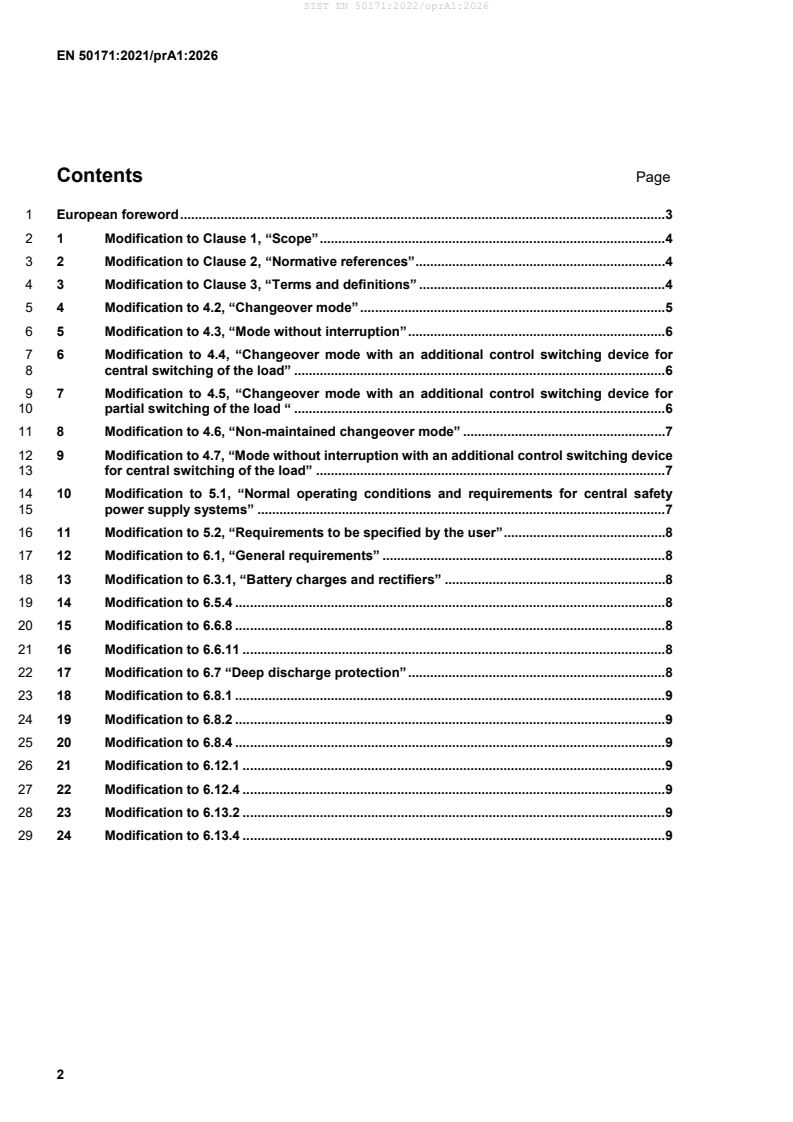
Contents Page
1 European foreword . 3
2 1 Modification to Clause 1, “Scope” . 4
3 2 Modification to Clause 2, “Normative references” . 4
4 3 Modification to Clause 3, “Terms and definitions” . 4
5 4 Modification to 4.2, “Changeover mode” . 5
6 5 Modification to 4.3, “Mode without interruption” . 6
7 6 Modification to 4.4, “Changeover mode with an additional control switching device for
8 central switching of the load” . 6
9 7 Modification to 4.5, “Changeover mode with an additional control switching device for
10 partial switching of the load “ . 6
11 8 Modification to 4.6, “Non-maintained changeover mode” . 7
12 9 Modification to 4.7, “Mode without interruption with an additional control switching device
13 for central switching of the load” . 7
14 10 Modification to 5.1, “Normal operating conditions and requirements for central safety
15 power supply systems” . 7
16 11 Modification to 5.2, “Requirements to be specified by the user” . 8
17 12 Modification to 6.1, “General requirements” . 8
18 13 Modification to 6.3.1, “Battery charges and rectifiers” . 8
19 14 Modification to 6.5.4 . 8
20 15 Modification to 6.6.8 . 8
21 16 Modification to 6.6.11 . 8
22 17 Modification to 6.7 “Deep discharge protection” . 8
23 18 Modification to 6.8.1 . 9
24 19 Modification to 6.8.2 . 9
25 20 Modification to 6.8.4 . 9
26 21 Modification to 6.12.1 . 9
27 22 Modification to 6.12.4 . 9
28 23 Modification to 6.13.2 . 9
29 24 Modification to 6.13.4 . 9
30 European foreword
31 This document (EN 50171:2021/prA1:2026) has been prepared by CLC/TC 22X “Power electronics”.
32 This document is currently submitted to the Enquiry.
33 The following dates are proposed:
• latest date by which the existence of this (doa) dav + 6 months
document has to be announced at national level
• latest date by which this document has to be (dop) dav + 12 months
implemented at national level by publication of
an identical national standard or by
endorsement
• latest date by which the national standards (dow) dav + 36 months
conflicting with this document have to be (to be confirmed or
withdrawn modified when voting)
35 1 Modification to Clause 1, “Scope”
nd
36 In the 4th paragraph, 2 sentence, replace “the interruption” with “a failure”.
37 2 Modification to Clause 2, “Normative references”
38 Replace the references to EN 62040-1, EN 61000-6-2, EN 61000-6-3 and EN 61000-6-4 with the following,
39 respectively:
40 EN IEC 62040-1, Uninterruptible power systems (UPS) - Part 1: Safety requirements (IEC 62040-1)
41 EN IEC 61000-6-2, Electromagnetic compatibility (EMC) - Part 6-2: Generic standards - Immunity standard for
42 industrial environments (IEC 61000-6-2)
43 EN IEC 61000-6-3, Electromagnetic compatibility (EMC) - Part 6-3: Generic standards - Emission standard for
44 equipment in residential locations (IEC 61000-6-3)
45 EN IEC 61000-6-4, Electromagnetic compatibility (EMC) - Part 6-4: Generic standards - Emission standard for
46 industrial environments (IEC 61000-6-4)
47 Add the following references:
48 EN IEC 61000-6-8:2020, Electromagnetic compatibility (EMC) - Part 6-8: Generic standards - Emission
49 standard for professional equipment in commercial and light-industrial locations
50 EN IEC 62040-2, Uninterruptible power systems (UPS) - Part 2: Electromagnetic compatibility (EMC)
51 requirements
52 3 Modification to Clause 3, “Terms and definitions”
53 Add the 3 following definitions:
54 3.24
55 residential location
56 area of land designated for domestic dwellings where the mains pow
...