


EN 62002-1:2006
(Main)Mobile and portable DVB-T/H radio access - Part 1: Interface specification
General Information
- Abstract
Superseded by EN 62002-1:2008
- Status
- Withdrawn
- Publication Date
- 08-Nov-2006
- Withdrawal Date
- 31-Oct-2009
- Technical Committee
- CLC/TC 206 - Consumer equipment for entertainment and information and related sub-systems
- Drafting Committee
- IEC/TC 100 - IEC_TC_100
- Parallel Committee
- IEC/TC 100 - IEC_TC_100
- Current Stage
- 9960 - Withdrawal effective - Withdrawal
- Start Date
- 01-Jun-2011
- Completion Date
- 01-Jun-2011

Relations
- Replaced By
EN 62002-1:2008 - Mobile and portable DVB-T/H radio access - Part 1: Interface specification - Effective Date
- 29-Jan-2023
- Effective Date
- 03-Feb-2026
- Effective Date
- 03-Feb-2026
- Effective Date
- 03-Feb-2026
- Referred By
EN 62002-2:2006 - Mobile and portable DVB-T/H radio access - Part 2: Interface conformance testing - Effective Date
- 03-Feb-2026
Get Certified
Connect with accredited certification bodies for this standard

ANCE
Mexican certification and testing association.

Intertek Slovenia
Intertek testing, inspection, and certification services in Slovenia.

LNE (Laboratoire National de Métrologie et d'Essais)
French national laboratory for metrology and testing.
Sponsored listings
Frequently Asked Questions
EN 62002-1:2006 is a standard published by CLC. Its full title is "Mobile and portable DVB-T/H radio access - Part 1: Interface specification". This standard covers: Superseded by EN 62002-1:2008
Superseded by EN 62002-1:2008
EN 62002-1:2006 is classified under the following ICS (International Classification for Standards) categories: 33.170 - Television and radio broadcasting. The ICS classification helps identify the subject area and facilitates finding related standards.
EN 62002-1:2006 has the following relationships with other standards: It is inter standard links to EN 62002-1:2008, EN 55020:2002, EN 55013:2001, HD 134.2 S2:1984, EN 62002-2:2006. Understanding these relationships helps ensure you are using the most current and applicable version of the standard.
EN 62002-1:2006 is available in PDF format for immediate download after purchase. The document can be added to your cart and obtained through the secure checkout process. Digital delivery ensures instant access to the complete standard document.
Standards Content (Sample)
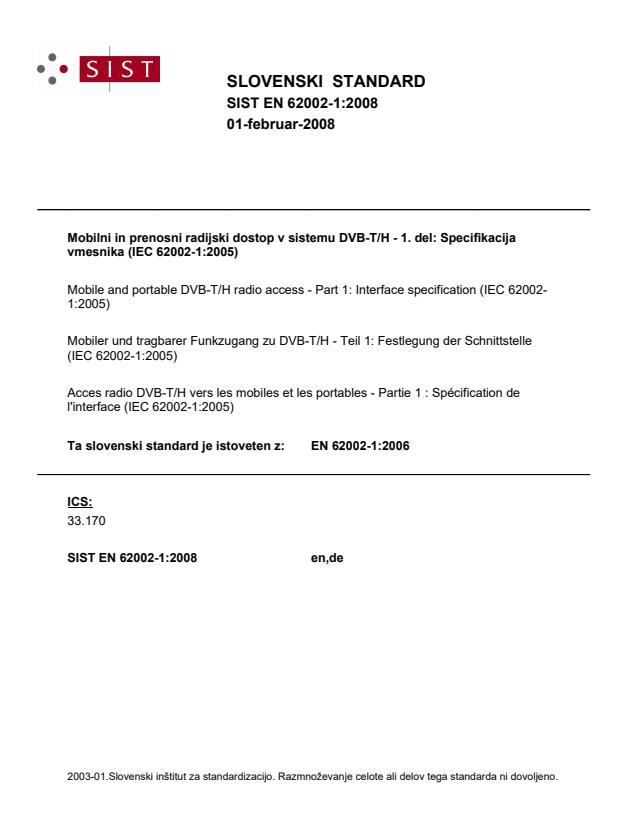
SLOVENSKI STANDARD
01-februar-2008
Mobilni in prenosni radijski dostop v sistemu DVB-T/H - 1. del: Specifikacija
vmesnika (IEC 62002-1:2005)
Mobile and portable DVB-T/H radio access - Part 1: Interface specification (IEC 62002-
1:2005)
Mobiler und tragbarer Funkzugang zu DVB-T/H - Teil 1: Festlegung der Schnittstelle
(IEC 62002-1:2005)
Acces radio DVB-T/H vers les mobiles et les portables - Partie 1 : Spécification de
l'interface (IEC 62002-1:2005)
Ta slovenski standard je istoveten z: EN 62002-1:2006
ICS:
33.170
2003-01.Slovenski inštitut za standardizacijo. Razmnoževanje celote ali delov tega standarda ni dovoljeno.
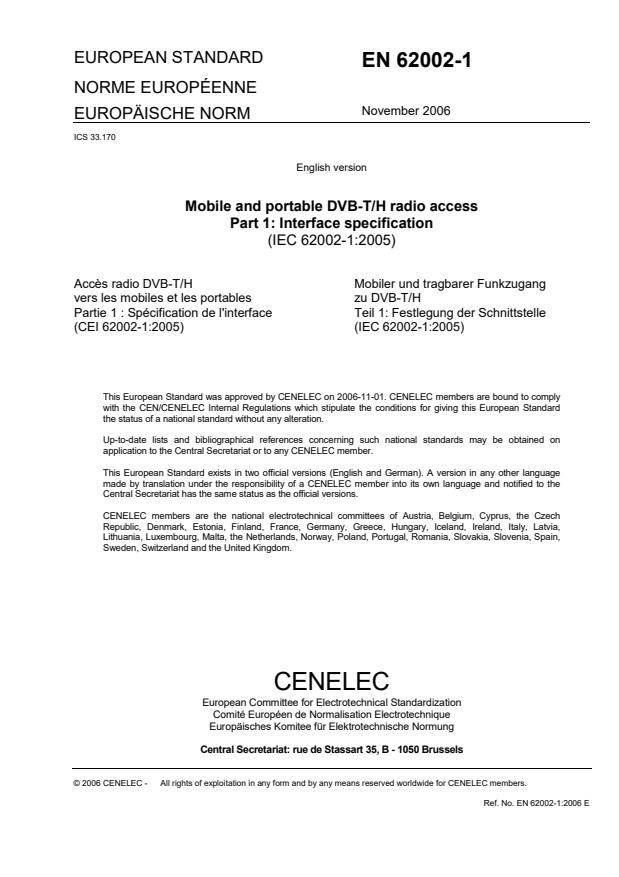
EUROPEAN STANDARD
EN 62002-1
NORME EUROPÉENNE
November 2006
EUROPÄISCHE NORM
ICS 33.170
English version
Mobile and portable DVB-T/H radio access
Part 1: Interface specification
(IEC 62002-1:2005)
Accès radio DVB-T/H Mobiler und tragbarer Funkzugang
vers les mobiles et les portables zu DVB-T/H
Partie 1 : Spécification de l'interface Teil 1: Festlegung der Schnittstelle
(CEI 62002-1:2005) (IEC 62002-1:2005)
This European Standard was approved by CENELEC on 2006-11-01. CENELEC members are bound to comply
with the CEN/CENELEC Internal Regulations which stipulate the conditions for giving this European Standard
the status of a national standard without any alteration.
Up-to-date lists and bibliographical references concerning such national standards may be obtained on
application to the Central Secretariat or to any CENELEC member.
This European Standard exists in two official versions (English and German). A version in any other language
made by translation under the responsibility of a CENELEC member into its own language and notified to the
Central Secretariat has the same status as the official versions.
CENELEC members are the national electrotechnical committees of Austria, Belgium, Cyprus, the Czech
Republic, Denmark, Estonia, Finland, France, Germany, Greece, Hungary, Iceland, Ireland, Italy, Latvia,
Lithuania, Luxembourg, Malta, the Netherlands, Norway, Poland, Portugal, Romania, Slovakia, Slovenia, Spain,
Sweden, Switzerland and the United Kingdom.
CENELEC
European Committee for Electrotechnical Standardization
Comité Européen de Normalisation Electrotechnique
Europäisches Komitee für Elektrotechnische Normung
Central Secretariat: rue de Stassart 35, B - 1050 Brussels
© 2006 CENELEC - All rights of exploitation in any form and by any means reserved worldwide for CENELEC members.
Ref. No. EN 62002-1:2006 E
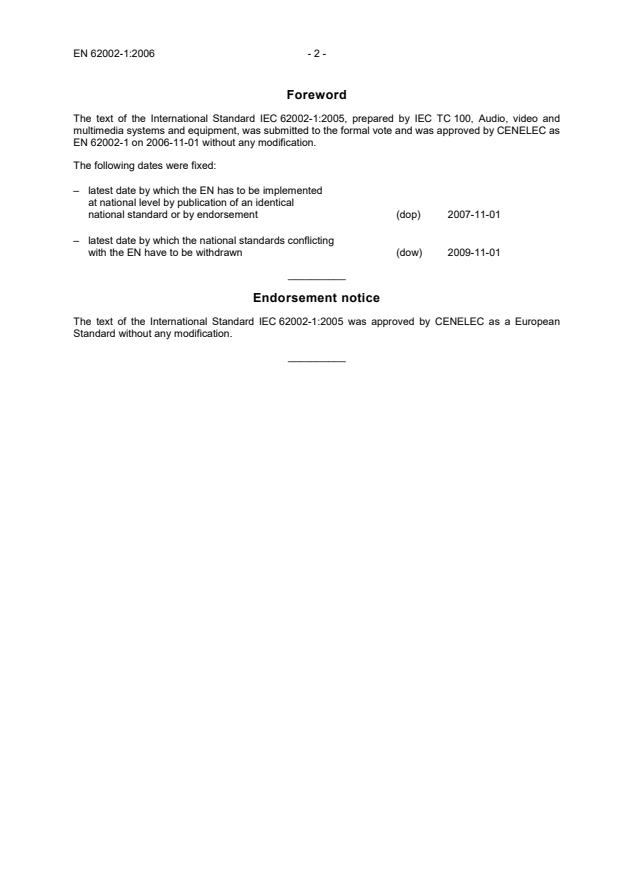
Foreword
The text of the International Standard IEC 62002-1:2005, prepared by IEC TC 100, Audio, video and
multimedia systems and equipment, was submitted to the formal vote and was approved by CENELEC as
EN 62002-1 on 2006-11-01 without any modification.
The following dates were fixed:
– latest date by which the EN has to be implemented
at national level by publication of an identical
national standard or by endorsement (dop) 2007-11-01
– latest date by which the national standards conflicting
with the EN have to be withdrawn (dow) 2009-11-01
__________
Endorsement notice
The text of the International Standard IEC 62002-1:2005 was approved by CENELEC as a European
Standard without any modification.
__________
- 3 - EN 62002-1:2006
Annex ZA
(normative)
Normative references to international publications
with their corresponding European publications
The following referenced documents are indispensable for the application of this document. For dated
references, only the edition cited applies. For undated references, the latest edition of the referenced
document (including any amendments) applies.
NOTE When an international publication has been modified by common modifications, indicated by (mod), the relevant EN/HD
applies.
Publication Year Title EN/HD Year
1) 2)
CISPR 13 EN 55013
- Sound and television broadcast receivers 2001
and associated equipment - Radio
disturbance characteristics - Limits and
methods of measurement
1) 2)
CISPR 20 EN 55020
- Sound and television broadcast receivers 2002
+ corr. September
and associated equipment - Immunity
characteristics - Limits and methods of
measurement
1) 2)
IEC 60169-2 HD 134.2 S2
- Radio-frequency connectors 1984
Part 2: Coaxial unmatched connector
- - Digital Video Broadcasting (DVB); Framing ETSI EN 300 744 2004
structure, channel coding and modulation
for digital terrestrial television V1.5.1
1)
ETSI ETS 300 342-1
- - Radio Equipment and Systems (RES); -
ElectroMagnetic Compatibility (EMC) for
European digital cellular telecommunications
system (GSM 900 MHz and DCS 1 800 MHz)
Part 1: Mobile and portable radio and
ancillary equipment
1)
ETSI EN 300 607-1
- - Digital cellular telecommunications system -
(Phase 2+) (GSM) - Mobile Station (MS)
conformance specification
Part 1: Conformance specification
ETSI EN 302 304 2004
- - Digital Video Broadcasting (DVB);
Transmission System for Handheld
Terminals (DVB-H) V1.1.1
1)
Undated reference.
2)
Valid edition at date of issue.
INTERNATIONAL IEC
STANDARD 62002-1
First edition
2005-10
Mobile and portable DVB-T/H radio access –
Part 1:
Interface specification
IEC 2005 Copyright - all rights reserved
No part of this publication may be reproduced or utilized in any form or by any means, electronic or
mechanical, including photocopying and microfilm, without permission in writing from the publisher.
International Electrotechnical Commission, 3, rue de Varembé, PO Box 131, CH-1211 Geneva 20, Switzerland
Telephone: +41 22 919 02 11 Telefax: +41 22 919 03 00 E-mail: inmail@iec.ch Web: www.iec.ch
PRICE CODE
Commission Electrotechnique Internationale XA
International Electrotechnical Commission
МеждународнаяЭлектротехническаяКомиссия
For price, see current catalogue
– 2 – 62002-1 IEC:2005(E)
CONTENTS
FOREWORD.5
1 Scope.7
2 Normative references .7
3 Abbreviations .8
4 Terminal categories .10
5 Definition of receiving conditions .11
5.1 Portable reception .11
5.2 Mobile reception.11
6 Frequencies and channel bandwidths .11
6.1 Channel frequencies .11
6.2 Supported frequency ranges.12
6.3 Supported bandwidths .13
7 DVB-T modes .13
7.1 Supported DVB-T modes.13
7.2 Change of modulation parameters .13
7.3 Tuning procedure .13
8 Transmitter performance .14
8.1 Transmitter noise-like impairments .14
8.2 Further transmitter impairments.15
8.3 Spectrum masks.16
9 Receiver antenna characteristics.17
9.1 Antennas for terminal category a .17
9.2 Antennas for terminal category b1 .17
9.3 Antennas for terminal category b2 and c .18
9.4 External antennas .19
10 Receiver performance .19
10.1 Reference model .19
10.2 Noise model .20
10.3 Degradation criteria.21
10.4 Diversity receivers.22
10.5 DVB-H receivers.23
10.6 Channel models .24
10.7 C/N performance .25
10.8 Receiver minimum and maximum signal input levels .28
10.9 Immunity to analogue and/or digital signals in other channels .29
10.10 Immunity to co-channel interference from analogue TV signals .35
10.11 Guard interval utilization.36
10.12 Tolerance to impulse interference.38
10.13 EMC characteristics .40
11 Interoperability with other radio systems.40
11.1 Cellular radios .40
11.2 DVB-RCT .44
62002-1 IEC:2005(E) – 3 –
Annex A (informative) Active external antennas .45
Annex B (informative) An example of C/N performance with a practical transmitter .48
Annex C (informative) Multi-path reception in a DVB-T system .49
Annex D (informative) C/N performance of DVB-H receivers .52
Bibliography.54
Figure 1 – Reference model.19
Figure 2 – Noise model.20
Figure 3 – Antenna diversity receiver.22
Figure 4 – Receiver behaviour in a mobile channel .25
Figure 5 – PAL interfering signals .30
Figure 6 – SECAM L interfering signal .30
Figure 7 – Pattern S1 in case of N + 1 or N – 1 .32
Figure 8 – Pattern S2 in case of N + 1 or N – 1 .33
Figure 9 – Pattern L1 .34
Figure 10 – Pattern L2 .34
Figure 11 – Pattern L3 .35
Figure 12 – Echo outside guard interval mask.37
Figure 13 – Mask for echo outside GI for GI = 1/4.38
Figure 14 – Definition of the impulse interference test pattern.39
Figure 15 – Terminal architectures.41
Figure 16 – Frequency bands .42
Figure 17 – GSM Tx block diagram .43
Figure 18 – Tx PA-noise mask in DVB-T/H receiver input.44
Figure C.1 – Theoretical limits of out-of-guard delay .49
Figure C.2 – DVB-T model – Splitting of the signal power into contributing and
interfering components .49
Figure C.3 – Theoretical echo power profile for 8k, 64QAM, 2/3.51
Figure D.1 – DVB-H reference receiver C/N behaviour in mobile channel .53
Table 1 – Supported frequency ranges .13
Table 2 – Conversion of MER to END .15
Table 3 – Typical antenna gain for terminal category b2 and c.18
Table 4 – Delta values between picture failure point and reference BER.21
Table 5 – Approximation of the DVB-T specified Rayleigh channel.24
Table 6 – Typical urban profile (TU6) constitution .24
Table 7 – C/N (dB) for reference BER in Gaussian channel .26
Table 8 – C/N (dB) for reference BER in portable channel .26
–4
Table 9 – C/N (dB) for PER = 10 in typical urban channel for single antenna receiver .27
–4
Table 10 – C/N (dB) for PER = 10 in typical urban channel for diversity receiver .27
Table 11 – Maximum input levels for terminal category a and b1.29
Table 12 – Maximum input levels for terminal category b2 and c.29
– 4 – 62002-1 IEC:2005(E)
Table 13 – Immunity to pattern S1 .32
Table 14 – Immunity to pattern S2 .33
Table 15 – Immunity to pattern L1.34
Table 16 – Immunity to pattern L2.35
Table 17 – Immunity to pattern L3.35
Table 18 – Immunity to co-channel interference from analogue signals.36
Table 19 – C/N for echo within guard interval .36
Table 20 – Timing of the corner point Tc .37
Table 21 – Definition of the value Δ .37
Table 22 – Definition of the inflection point .38
Table 23 – Impulse interference test patterns .40
Table 24 – GSM reject filter attenuation .43
Table B.1 – C/N (dB) for reference BER.48
Table D.1 – C/N (dB) for 5 % MFER in Gaussian channel .52
Table D.2 – C/N (dB) for QEFIP in portable channel.53
Table D.3 – C/N (dB) in mobile channel.53
62002-1 IEC:2005(E) – 5 –
INTERNATIONAL ELECTROTECHNICAL COMMISSION
____________
MOBILE AND PORTABLE DVB-T/H RADIO ACCESS –
Part 1: Interface specification
FOREWORD
1) The International Electrotechnical Commission (IEC) is a worldwide organization for standardization comprising
all national electrotechnical committees (IEC National Committees). The object of IEC is to promote
international co-operation on all questions concerning standardization in the electrical and electronic fields. To
this end and in addition to other activities, IEC publishes International Standards, Technical Specifications,
Technical Reports, Publicly Available Specifications (PAS) and Guides (hereafter referred to as “IEC
Publication(s)”). Their preparation is entrusted to technical committees; any IEC National Committee interested
in the subject dealt with may participate in this preparatory work. International, governmental and non-
governmental organizations liaising with the IEC also participate in this preparation. IEC collaborates closely
with the International Organization for Standardization (ISO) in accordance with conditions determined by
agreement between the two organizations.
2) The formal decisions or agreements of IEC on technical matters express, as nearly as possible, an international
consensus of opinion on the relevant subjects since each technical committee has representation from all
interested IEC National Committees.
3) IEC Publications have the form of recommendations for international use and are accepted by IEC National
Committees in that sense. While all reasonable efforts are made to ensure that the technical content of IEC
Publications is accurate, IEC cannot be held responsible for the way in which they are used or for any
misinterpretation by any end user.
4) In order to promote international uniformity, IEC National Committees undertake to apply IEC Publications
transparently to the maximum extent possible in their national and regional publications. Any divergence
between any IEC Publication and the corresponding national or regional publication shall be clearly indicated in
the latter.
5) IEC provides no marking procedure to indicate its approval and cannot be rendered responsible for any
equipment declared to be in conformity with an IEC Publication.
6) All users should ensure that they have the latest edition of this publication.
7) No liability shall attach to IEC or its directors, employees, servants or agents including individual experts and
members of its technical committees and IEC National Committees for any personal injury, property damage or
other damage of any nature whatsoever, whether direct or indirect, or for costs (including legal fees) and
expenses arising out of the publication, use of, or reliance upon, this IEC Publication or any other IEC
Publications.
8) Attention is drawn to the Normative references cited in this publication. Use of the referenced publications is
indispensable for the correct application of this publication.
9) Attention is drawn to the possibility that some of the elements of this IEC Publication may be the subject of
patent rights. IEC shall not be held responsible for identifying any or all such patent rights.
International Standard IEC 62002-1 has been prepared by Technical Area 1: Terminals for
audio, video and data services, of IEC technical committee 100: Audio, video and multimedia
systems and equipment.
The text of this standard is based on the following documents:
CDV Report on voting
100/920/CDV 100/1012/RVC
Full information on the voting for the approval of this standard can be found in the report on
voting indicated in the above table.
This publication has been drafted in accordance with the ISO/IEC Directives, Part 2.
– 6 – 62002-1 IEC:2005(E)
IEC 62002 consists of the following parts, under the general title Mobile and portable DVB-
T/H Radio access:
Part 1: Interface specification
Part 2: Interface conformance testing
The committee has decided that the contents of this publication will remain unchanged until
the maintenance result date indicated on the IEC web site under "http://webstore.iec.ch" in
the data related to the specific publication. At this date, the publication will be
• reconfirmed;
• withdrawn;
• replaced by a revised edition, or
• amended.
A bilingual version of this publication may be issued at a later date.
62002-1 IEC:2005(E) – 7 –
MOBILE AND PORTABLE DVB-T/H RADIO ACCESS –
Part 1: Interface specification
1 Scope
This part of IEC 62002 is a radio access specification for mobile, portable and hand-held
portable devices capable of receiving DVB-T/H services. It includes informative system
aspects as well as specifications for minimum RF performance. It covers terminals in three
main classes, namely integrated car terminals, portable digital TV sets and hand-held portable
convergence terminals. Interoperability with integrated cellular radios is also considered. The
specification covers the following areas.
• Frequency ranges
• Supported modes
• Definition of receiving conditions
• Definition of the receiver RF reference model
• Definition of QoS criteria
• Antenna characteristics
• Channel models
• C/ -performance with different channels
• Minimum and maximum input levels
• Immunity to interfering signals
• Definition of an ensemble of interference patterns
• Tolerance to impulse interference
• SFN performance
• Transmitter minimum performance
• Interoperability of cellular radios
• EMC aspects
2 Normative references
The following referenced documents are indispensable for the application of this document.
For dated references, only the edition cited applies. For undated references, the latest edition
of the referenced document (including any amendments) applies.
CISPR 13, Sound and television broadcast receivers and associated equipment – Radio
disturbance characteristics – Limits and methods of measurement
CISPR 20, Sound and television broadcast receivers and associated equipment – Immunity
characteristics – Limits and methods of measurement
IEC 60169-2, Radio-frequency connectors – Part 2: Coaxial unmatched connector
ETSI EN 300 744:2004, Digital Video Broadcasting (DVB); Framing structure, Channel coding
and modulation for digital terrestrial television, V1.5.1
– 8 – 62002-1 IEC:2005(E)
ETSI ETS 300 342-1, Radio Equipment and Systems (RES); ElectroMagnetic Compatibility
(EMC) for European digital cellular telecommunications system (GSM 900 MHz and DCS
1 800 MHz) – Part 1: Mobile and portable radio and ancillary equipment
ETSI EN 300 607-1, Digital cellular telecommunications system (Phase 2+) (GSM) – Mobile
Station (MS) conformance specification; Part 1: Conformance specification
ETSI EN 302 304:2004, Digital Video Broadcasting (DVB); Transmission System for Handheld
Terminals (DVB-H), V1.1.1
3 Abbreviations
For the purposes of this document, the following abbreviations apply.
λ Lambda, wavelength (λ = c/f)
A2 German analogue TV stereo system
A Coupling between antennas
A
AGC Automatic gain control
A Stop band attenuation of the GSM reject filter
GSM
B
Bandwidth
BER Bit error ratio
C
Carrier power (In band carrier power including any echoes)
C
Speed of light c = 3,0 × 10 m/s
Ci Power contribution from the i-th signal
Ct Total useful carrier power
C/N
Carrier-to-noise ratio
C/N Minimum C/N
min
CPE
Common phase error
CR Code rate
dB Decibel
dBc dB compared to carrier power C
dBd Antenna gain in dB compared to reference dipole (0 dBd = –2,14 dBi)
dBi Antenna gain in dB compared to isotropic antenna (0 dBi = 2,14 dBd)
dB(mW) Power in dB compared to 1 mW
DVB, DVB-T Digital video broadcasting, terrestrial digital video broadcasting
DVB-H Digital video broadcasting to hand held terminals
DVB-RCT DVB terrestrial return channel
E Field strength V/m
E(dBµV/m) Field strength in dB compared to 1 µV
EDGE Enhanced data rates for GSM/global evolution
EMC Electromagnetic compatibility
END Equivalent noise degradation
ENF Equivalent noise floor
ESR Erroneous second ratio
62002-1 IEC:2005(E) – 9 –
F Frequency in Hz
f (MHz) Frequency in MHz
fc Centre frequency
F Noise factor
fd, Fd Doppler frequency
Fd Doppler frequency with minimum C/N requirement raised by 3dB
3dB
FER Frame error rate
G Gain
Ga Antenna gain
GI Guard interval
GPRS General packet radio service
GSM Global system for mobile communications
I Interfering power
ICI Intercarrier interference
J joule
–26
K
Boltzmann’s constant k = 1,38 × 10 J/K
K kelvin
L1, L2, L3 Linearity patterns
L
Insertion loss of the GSM reject filter
GSM
LNA Low noise amplifier
MER
Modulation error ratio
MFER MPE-FEC frame error rate
MHz Megahertz
MPEG-2 Motion pictures expert group, video compression standard
N, m, N
Channel indexes
NF Noise figure in dB
NICAM Additional sound carrier for analogue TV, modulated with a near
instantaneous compended audio multiplex
PA Power amplifier
PAL, PAL B, PAL G, Phase alternation line, TV-systems using PAL
PAL I, PAL I1
PER Packet error ratio
P
Input power W
in
P (dB(mW)) Input power dB compared to 1 mW
in
P
Maximum power
max
P Minimum power
min
ppm Parts per million
PSI/SI Program specific information, service information
P
Transmission power
TX
Px Excess noise power dBc
QAM16, QAM64 Quadrature amplitude modulation, 16-level and 64-level versions
– 10 – 62002-1 IEC:2005(E)
QEF Quasi error free
QoS Quality of service
QPSK Quaternary phase shift keying
RF Radiofrequency
RS Reed solomon
Rx Receiver
S1,S2 Selectivity patterns
SECAM, SECAM L Sequential à mémoire, TV system using SECAM
SFN Single frequency network
SFP Subjective failure point
T Temperature in kelvins
Tc Corner point
Te Total duration of the gating pulses
ti Time of arrival for the i-th signal
TS Transport stream
Tg Guard interval duration
Tu Active symbol duration
Tx Transmitter
UHF Ultra high frequency
UMTS Universal mobile telecommunications system
VHF Very high frequency
W watt
WCDMA Wide-band code division multiple access
Wi Weighting coefficient for the i-th component
4 Terminal categories
In this specification three different terminal categories are considered. The requirements
cover all categories unless otherwise stated.
The terminal categories are:
a) Integrated car terminals
This category covers DVB-T terminals installed in a car and where the antenna is integral
with the car.
b) Portable digital TV sets
This category covers terminals, which are intended for receiving normal MPEG-2 based
digital TV services indoors and outdoors with terminal attached antennas. This category is
divided into two subcategories.
1) The receiver screen size is typically greater than 25 cm and the receiver may be
battery- or mains-powered. Typically, the terminal is stationary during the reception.
An example of the antenna construction may be an adjustable telescope or wide-
band design, either active or passive, attached to the receiver.
62002-1 IEC:2005(E) – 11 –
2) Pocketable digital TV-receiver. The terminal is battery operated and can be moved
during use. Usually the antenna is integral with the terminal.
c) Hand-held portable convergence terminals
This category covers small battery powered hand held convergence terminals with built in
cellular radio like GSM, GPRS or UMTS. The terminals have the functionality of a mobile
phone and can receive IP-based services using DVB-H over DVB-T physical layer. The
DVB-T antenna and the cellular antenna are both integral with the terminal.
5 Definition of receiving conditions
5.1 Portable reception
This is when a portable receiver (terminal category b1) with an attached or integral antenna is
used indoors or outdoors at a minimum height of 1,5 m above floor or ground level. It is
assumed that the receiving antenna is omni-directional. It is also assumed that the antenna
and any nearby large objects are stationary. Extreme cases, such as reception in completely
)
shielded rooms, are disregarded. [1]
As a special case of portable reception a small hand-held portable receiver (terminal category
b2 or c) is used indoors or outdoors at a minimum height of 1,0 m above floor or ground level.
It is assumed that the receiving antenna is omni-directional. It is also assumed that the
channel conditions can change due to slow movements (≤3 km/h) of the antenna and any
nearby large objects. Extreme cases, such as reception in completely shielded rooms, are
disregarded.
The main difference between portable and hand-held portable reception is the antenna gain of
the terminal.
5.2 Mobile reception
This applies to the use of integrated car terminals (terminal category a) with speeds higher
than 3 km/h. It is assumed that the receiving antenna is omni directional with a minimum
height above ground level of 1,5 m. Other vehicles such as buses or high-speed trains could
be considered as special cases.
A small hand-held portable receiver (terminal category b2 or c) used within a car or train
could also be considered as a case of mobile reception. [2]
6 Frequencies and channel bandwidths
6.1 Channel frequencies
The channel frequencies of bands III, IV and V are given below 6 MHz, 7 MHz and 8 MHz
channel rasters used in various countries. The centre frequencies fc of the incoming DVB-T
RF signals are as follows.
———————
)
Figures in square brackets refer to the Bibliography.
– 12 – 62002-1 IEC:2005(E)
VHF III
For countries using 8 MHz channel raster
fc = 178 MHz + (N – 6) x 8 MHz +f offset
N = {6, …,12} (VHF channel number)
For countries using 7 MHz channel raster
fc = 177,5 MHz + (N – 5) x 7 MHz +f offset
N =
{5, …,12} (VHF channel number)
For countries using 6 MHz channel raster
fc = 177,0 MHz + (N – 7) x 6 MHz +f offset
N = {7, …,13} (VHF channel number)
In some countries offsets may be used
Preferred offset is ± n x 1/6 MHz. n = { 1, 2,…}
UHF IV and V
For countries using 8 MHz channel raster
fc = 474 MHz + (N – 21) x 8 MHz +f offset
n = {21, …,69} (UHF channel number)
For countries using 7 MHz channel raster
fc = 529,5 MHz +(N – 28) x 7 MHz +f offset
n = {28, …,67} (UHF channel number)
For countries using 6 MHz channel raster
fc = 473,0 MHz +(N – 14) x 6 MHz +f offset
n = {14, …,83} (UHF channel number)
In some countries offsets may be used
Preferred offset is ± n x 1/6 MHz. n = { 1, 2,…}
In the UK n = 1
The error in the centre frequency (fc) of the transmitted RF signal should not exceed 500 Hz
in MFN. In SFN the error in the centre frequency (fc) of the transmitted RF signal should not
exceed 1 Hz.
6.2 Supported frequency ranges
The receivers in terminal categories a and b1 shall be able to receive all channels in the VHF
band III and UHF bands IV and V. VHF III can be left out in market areas, where it is not used.
The receivers in terminal category b2 shall be able to receive all channels in UHF bands IV
and V, VHF III is an option depending on the market area needs. The receivers in terminal
category c shall be able to receive all channels in UHF band IV and V, provided that the
terminal does not support GSM 900.
In the case where GSM 900 is used in a convergence terminal (category c), the usable
frequency range is limited to channel 49 (698 MHz) due to the interoperability considerations.
Supported frequency ranges are shown in Table 1.
62002-1 IEC:2005(E) – 13 –
Table 1 – Supported frequency ranges
Terminal category VHF III UHF IV UHF V
a Integrated car terminals Yes, in areas where VHF Yes Yes
is in use for DVB-T
b1 Portable digital TV sets Yes, in areas where VHF Yes Yes
is in use for DVB-T
b2 Pocketable TV sets Optional Yes Yes
c Convergence terminals No Yes Yes/up to ch 49
See text above
6.3 Supported bandwidths
The receiver should support the 6 MHz, 7 MHz and 8 MHz bandwidths according to the
market area needs. 5 MHz variant of DVB-H exists, but is not covered in this specification.
DVB-T modes
7 DVB-T modes
7.1 Supported DVB-T modes
The receiver shall be capable of correctly demodulating all modes specified in
ETSI EN 300 744, except the code rates 5/6 and 7/8. The front end shall therefore be able to
work with any combination of
• constellation (QPSK, 16-QAM, 64-QAM, hierarchical 16-QAM, hierarchical 64-QAM);
• code rate (1/2,2/3,3/4);
• guard interval (1/4,1/8,1/16 or 1/32);
• transmission mode (2k or 8k);
• where applicable, α (1, 2 or 4).
Receivers in terminal category c should be capable of correctly demodulating the modes
specified in EN 300 744, Annex F, additional features for DVB hand-held terminals (DVB-H).
The front end should therefore also be able to support
• 4k transmission mode;
• in-depth interleavers usable in 2k and 4k modes.
During channel search, the receiver shall automatically detect which mode is being used. The
receiver, when fed with one of the hierarchical modes (16-QAM or 64-QAM) specified in
ETSI EN 300 744, shall be capable of correctly demodulating whichever of the high or low
priority streams is selected by the user.
7.2 Change of modulation parameters
Dynamic change of modulation parameters during the transmission (signalled in the TPS data)
does not have to be supported by the receiver. If this happens, then a new channel search
may be required in order to detect which mode is being used.
7.3 Tuning procedure
The receiver shall be able to provide a channel search. It shall also be able to receive
information regarding tuning parameters found in PSI/SI.
– 14 – 62002-1 IEC:2005(E)
8 Transmitter performance
8.1 Transmitter noise-like impairments
8.1.1 Noise-like processes
Many of the impairments introduced by transmitters are said to be ’noise-like’, because their
effect is equivalent to the addition of white Gaussian noise. This equivalence enables the
overall ’noise’ power to be calculated by summing the ’noise’ powers introduced by the
individual impairments. It is then approximately true that the total END, as defined in the
following paragraph, equals the sum of the contributing ENDs.
The impairments considered to be noise-like are the following.
• Finite precision in the OFDM modulator and other digital processing stages.
• High-frequency phase noise introduced by local oscillators and timing references; that is,
those phase noise components occurring at offset frequencies greater than half the OFDM
carrier spacing.
• Thermal noise.
• Intermodulation products resulting from non-linearity in the transmitter chain.
• Amplitude errors (work carried out by the Digital Trade Group (DTG) has confirmed this to
be a noise-like impairment).
Impairments that cannot be considered as being equivalent to the addition of white Gaussian
noise are the following.
• Group delay errors.
• Low-frequency phase noise.
These “further transmitter impairments” are considered in 8.2.
A transmission chain should be designed such that its END does not exceed 0,5 dB.
A typical signal analyser makes a measurement of the noise remaining in the channel once
the OFDM signal has been stripped away. The result is expressed as an ENF or an MER.
(When measured in dB, ENF and MER are numerically identical but of opposite sign: ENF
equals the ratio of noise power to OFDM carrier power, whilst MER is effectively the ratio of
carrier power to noise power.) The MER is converted into END by means of the following
formula:
1/END = 1 – {(C/N) / MER}
ref
where (C/N) is the carrier-to-noise ratio at which the monitoring receiver gives the reference
ref
BER. The quantities here are all expressed in linear terms. Expressing them in more
convenient dB gives Table 2.
62002-1 IEC:2005(E) – 15 –
Table 2 – Conversion of MER to END
MER – (C/N) END
ref
dB dB
12 0,283
13 0,223
14 0,176
15 0,140
16 0,110
17 0,088
18 0,069
19 0,055
20 0,044
23 0,022
26 0,011
(C/N) also has to be determined: it is the carrier-to-noise ratio at which the monitoring
ref
receiver gives the reference BER. For the 64QAM 2/3 mode, this may be taken as 19 dB: the
theoretical figure is 16,5 dB, to which must be added the implementation margin for the
channel equalizer within the receiver. Slight errors (within 0,5 dB) are unimportant.
MER measurements do not take into account amplitude response errors: they look for ‘real’
noise appearing on the OFDM signal, not the ‘virtual’ noise introduced by response errors.
The ‘calibrated’ test transmitter is likely to be nearly ‘perfect’ in this respect, but an allowance
should be made. Reference [10] provides the following formula for the 64 QAM 2/3 mode:
END (dB) = 0,021 × (amplitude response ripple, dB pk-pk)
As an example, suppose the MER of the test transmitter is 39 dB, and it possesses an
amplitude response ripple of 0,5 dB peak-to-peak. The (C/N) of the receiver is 19 dB. The
ref
END of the test transmitter is made up of two contributions:
MER – (C/N) = 39 dB – 19 dB = 20 dB
ref
END = 0,044 dB (from Table 2)
The contribution from the amplitude response ripple is given by
END = 0,021 × (0,5) dB
= 0,005 dB
The total END (END + END ) of the test transmitter is therefore 0,049 dB.
1 2
8.2 Further transmitter impairments
8.2.1 Group delay errors
At the input to antenna feeder, the delay of any OFDM carrier relative to that of any other
should not exceed 500 ns.
This value may be measured by exciting the first analogue up-converter with a frequency
sweep waveform and examining the group delay response into the input to antenna feeder.
Note that most of the group delay errors are likely to be introduced by any high-power filters
and combiners.
– 16 – 62002-1 IEC:2005(E)
8.2.2 Phase noise in OFDM systems
Phase noise is introduced by local oscillators and timing references within the transmission
chain. If a noisy oscillator signal is viewed on a spectrum analyser, the phase noise appears
as sidebands symmetrically disposed about the oscillator centre frequency. Away from the
centre frequency, the sideband density generally falls off rapidly. Oscillator phase noise
degrades the signal because, in the frequency conversion process, the noise is transferred
from the oscillator to each of the carriers within the OFDM ensemble.
Phase noise is specified by quoting L(f), the single sideband phase noise power in a 1 Hz
bandwidth at a frequency f from the centre frequency. The unit of L(f) is dBc/Hz, the “c”
signifying that the reference is the total power of the oscillator. Oscillator manufacturers
normally provide plots of L(f) versus f.
At the receiver demodulator, the phase noise has two different effects. Low-frequency noise
gives rise to common phase error (CPE) – “common” because each of the OFDM carriers
suffers the same phase error. In principle, this error can be measured and removed by the
demodulator. High-frequency noise introduces ICI. The noise from one carrier becomes
superimposed upon the neighbouring carriers within the ensemble, and cannot be removed by
the demodulator. Because CPE and ICI are different in their effect, they must be specified
differently.
ICI may be calculated approximately by integrating L(f) for all values of f above half the
OFDM carrier spacing and for all carriers within the ensemble. (An accurate calculation makes
use of weighting functions; see, for instance, [11].) The result is a contribution to the system
noise floor, or ENF, which may be measured in the way described in 11.7.2 of [6]. As ICI is
genuinely “noise-like”, the END may be calculated by reference to Table 2.
An approximate value of CPE is given by integrating L(f) for all values of f below half the
OFDM carrier spacing and for a single carrier within the ensemble. (Again, an accurate
calculation makes use of weighting functions.) The result is expressed in dB relative to
2 2
1 radian or dB(rad ). The actual effect of CPE depends strongly on the receiver design.
In order for a transmission to be compliant with all possible receiver designs, it is
recommended that the total CPE for all values of f greater than 10 Hz should not exceed
-40 dB(rad ).
Where the phase noise spectrum is known, the ICI and CPE components may be calculated
by reference to [12].
8.2.3 OFDM clock frequency
−6
The error in the clock frequency of the transmitted OFDM signal should not exceed 3 × 10 .
8.3 Spectrum masks
The spectrum masks specified in this subclause are designed to prevent interference between
digital terrestrial TV transmissions, analogue terrestrial TV transmissions and other
transmissions. Transmissions conforming to these masks will not necessarily be acceptable in
other respects. For example, the amount of transmitter non-linearity implied by 8.3.1 could
give rise to an excessive END. Receiver manufacturers should note that transmissions outside
bands IV and V could cause interference if the receivers are not suitably designed; GSM
(900 MHz) and Tetra (380 MHz to 470 MHz) are such transmissions. The masks may be
changed in a future edition of this specification.
8.3.1 DVB-T signals (general)
All DVB-T emissions shall at least meet the spectrum mask requirements defined by
ETSI EN 300 744, chapter 4.8.2, for system B/G/I/K/L environments.
62002-1 IEC:2005(E) – 17 –
8.3.2 DVB-T signals (critical cases)
Where the DVB-T transmission is at the edge of the UHF band, or adjacent to sensitive non-
broadcast applications, a second spectrum mask with higher out-of-channel attenuation shall
be used. The requirements are given in ETSI EN 300 744 chapter 4.8.2.
8.3.3 DVB-T signals (DVB-T in adjacent channel)
At sites where a DVB-T transmission is present in the adjacent channel, additional restrictions
on the tr
...