

HD 60364-4-43:2023/A11:2026
(Amendment)Low-voltage electrical installations - Part 4-43: Protection for safety - Protection against overcurrent
- Abstract
IEC 60364-4-43:2023 provides requirements for: - protection of live conductors, PEN conductors, PEM conductors, and PEL conductors against the harmful effects caused by overcurrent; - coordination of measures for protection against overcurrent. This fourth edition cancels and replaces the third edition published in 2008. This edition constitutes a technical revision. This edition includes the following significant technical changes with respect to the previous edition: a) the standard has been restructured, see Table 1 (Correspondence between IEC 60364‑4‑43:2008 and this document) below; b) the measure "automatic disconnection of supply" has been designated as the preferred measure for protection against overcurrent; c) all measures except the measure "automatic disconnection of supply" have been transferred into new normative annexes to indicate that these measures are usable in certain applications and under certain restricted conditions only (see Annex A, Annex B and Annex E); d) a new clause "Terms and definitions" has been added; e) new requirements have been added for the protection of the neutral or mid-point conductor (with and without triplen harmonics).
- Status
- Not Published
- Publication Date
- 03-Jan-2027
- Technical Committee
- CLC/TC 64 - Electrical installations and protection against electric shock
- Current Stage
- 5060 - Voting results sent to TC, SR - Formal Approval
- Start Date
- 30-Oct-2026
- Due Date
- 15-Jul-2026
- Completion Date
- 30-Oct-2026

HD 60364-4-43:2023/A11:2026 is a CLC amendment to the European document for low-voltage electrical installations, Part 4-43. It updates the rules for protection against overcurrent in live conductors, PEN conductors, PEM conductors and PEL conductors, with a focus on where overcurrent protective devices are installed and when limited exceptions apply.
What does HD 60364-4-43:2023/A11:2026 specify?
HD 60364-4-43:2023/A11:2026 modifies HD 60364-4-43:2023. The underlying part sets requirements for protection against the harmful effects of overcurrent and for coordination of overcurrent protection measures in low-voltage electrical installations.
The amendment is organized around two modified subclauses and three annexes. It changes the overload and short-circuit subclauses, adds a normative annex on device positioning, and adds annexes for special national conditions and A-deviations.
| Annex | What it covers |
|---|---|
| Annex G (normative) | Position of overcurrent protection devices |
| Annex ZB (normative) | Special national conditions |
| Annex ZC (informative) | A-deviations |
What are the key requirements of HD 60364-4-43:2026/A11:2026?
HD 60364-4-43:2023/A11:2026 makes the position of overcurrent protective devices a defined part of the protection method. In practice, designers and installers need to check not only the device rating, but also where the device sits in relation to the conductor run.
Overload protection
- Subclause 431.4.1 requires the positioning of overcurrent protective devices for overload currents to follow Annex G. This means the device location must be checked against changes in conductor current-carrying capacity.
- Annex G.1 sets the general rule: devices for overload and/or short-circuit protection are installed at the origin of each circuit unless an exception applies. This gives a clear default position for circuit design.
- Annex G.2.1 requires overload protection where there is a reduction in current-carrying capacity, unless one of the listed exceptions applies. In practice, this matters when conductor size, material, insulation, installation method, external influence, or grouping changes.
- Annex G.2.2 allows a device to be placed within the run only under restricted conditions, including no branch circuit or socket-outlet in the unprotected part and either short-circuit protection in accordance with 431.5 or a short, carefully installed run. This limits how far a conductor can remain without local overload protection.
- Annex G.2.3 and G.2.4 set cases where overload protection may be omitted, including some conductors already protected on the supply side and one line conductor in certain IT systems without a neutral conductor when residual current protective devices are installed in each circuit.
Short-circuit protection
- Subclause 431.5.1 requires the positioning of overcurrent protective devices for short-circuit currents to follow Annex G. This makes the conductor’s short-circuit withstand capability part of the installation decision.
- Annex G.3.1 requires short-circuit protection at the point where the conductor’s let-through energy withstand capability decreases, using k2S2 as the basis. In practice, the protective device must match the downstream wiring’s ability to withstand fault energy.
- Annex G.3.2 and G.3.3 allow alternative positions only when the run is short, has no branch circuit or socket-outlet, is installed to reduce short-circuit risk, and is not near combustible material, or when the upstream device has the right operating characteristic. This is the exception path for special layouts.
- Annex G.3.4 allows omission at the origin where the distributor provides short-circuit protection and agrees that it protects the relevant part of the installation. This is relevant where the installation starts from an already protected supply point.
What terms does HD 60364-4-43:2023/A11:2026 define?
- Overcurrent - current above the intended value that can damage conductors or equipment.
- Overload current - an overcurrent condition addressed by the overload protection rules in 431.4.
- Short-circuit current - a fault current that requires the short-circuit protection rules in 431.5.
- Current-carrying capacity - the conductor capability used to judge where overload protection must be added.
- Let-through energy withstand capability (k2S2) - the conductor’s ability to withstand the thermal stress of a short-circuit.
- Automatic disconnection of supply - the preferred protection measure in the underlying document for overcurrent protection.
- Residual current protective device - a device used in Annex G.2.4 to support a specific overload-protection exception in IT systems.
- Special national conditions - national characteristics or practices that remain applicable for harmonization in Annex ZB.
Who uses HD 60364-4-43:2023/A11:2026?
HD 60364-4-43:2023/A11:2026 is used by electrical designers, installers, inspection bodies, utilities and distribution operators, and technical teams responsible for low-voltage electrical installations. They use it when selecting protective devices, deciding where to place them, checking conductor protection at changes in cable or wiring conditions, and applying national exceptions where they are relevant.
What changed in HD 60364-4-43:2023/A11:2026 from the previous edition?
HD 60364-4-43:2023 replaces the third edition published in 2008. The scope states that the revision restructures the document, identifies automatic disconnection of supply as the preferred measure for overcurrent protection, moves the other measures into new normative annexes for restricted use, adds a terms and definitions clause, and adds new requirements for the neutral or mid-point conductor with and without triplen harmonics.
Which standards are used with HD 60364-4-43:2023/A11:2026?
- IEC 60364-5-53:2019/AMD1:2020 - cited in the German special national condition linked to Clause 535.
- HD 60364-5-53:2015/A11:2017 - also cited in that German special national condition.
- CEI 0-21 - used in the Italian special national condition to provide maximum and minimum prospective short-circuit currents at a grid supply point.
- Annex A, Annex B and Annex E of HD 60364-4-43:2023 - the underlying document uses these annexes for overcurrent protection measures that are applicable only in certain applications and under restricted conditions.
What does the HD 60364-4-43:2023/A11:2026 document contain?
The amendment contains a European foreword, two text modifications to subclauses 431.4 and 431.5, and three annexes added to the base document. It also includes a correspondence table between IEC 60364-4-43:2008 and the revised document, which helps readers see how the structure changed.
Annex G gives the rules for positioning overcurrent protection devices for overload and short-circuit protection, including the general rule, permitted exceptions, and the special cases for IT systems and distributor-provided protection. Annex ZB lists special national conditions by country and clause, while Annex ZC gives A-deviations for national situations where different provisions apply.
Relations
- Effective Date
- 09-Apr-2024
Get Certified
Connect with accredited certification bodies for this standard

DIBt (Deutsches Institut für Bautechnik)
German Institute for Building Technology.

DIN CERTCO
DIN Group product certification.

IMQ S.p.A. (Certification)
Italian electrical product certification.
Sponsored listings
Frequently Asked Questions
HD 60364-4-43:2023/A11:2026 is a draft published by CLC. Its full title is "Low-voltage electrical installations - Part 4-43: Protection for safety - Protection against overcurrent". This standard covers: IEC 60364-4-43:2023 provides requirements for: - protection of live conductors, PEN conductors, PEM conductors, and PEL conductors against the harmful effects caused by overcurrent; - coordination of measures for protection against overcurrent. This fourth edition cancels and replaces the third edition published in 2008. This edition constitutes a technical revision. This edition includes the following significant technical changes with respect to the previous edition: a) the standard has been restructured, see Table 1 (Correspondence between IEC 60364‑4‑43:2008 and this document) below; b) the measure "automatic disconnection of supply" has been designated as the preferred measure for protection against overcurrent; c) all measures except the measure "automatic disconnection of supply" have been transferred into new normative annexes to indicate that these measures are usable in certain applications and under certain restricted conditions only (see Annex A, Annex B and Annex E); d) a new clause "Terms and definitions" has been added; e) new requirements have been added for the protection of the neutral or mid-point conductor (with and without triplen harmonics).
IEC 60364-4-43:2023 provides requirements for: - protection of live conductors, PEN conductors, PEM conductors, and PEL conductors against the harmful effects caused by overcurrent; - coordination of measures for protection against overcurrent. This fourth edition cancels and replaces the third edition published in 2008. This edition constitutes a technical revision. This edition includes the following significant technical changes with respect to the previous edition: a) the standard has been restructured, see Table 1 (Correspondence between IEC 60364‑4‑43:2008 and this document) below; b) the measure "automatic disconnection of supply" has been designated as the preferred measure for protection against overcurrent; c) all measures except the measure "automatic disconnection of supply" have been transferred into new normative annexes to indicate that these measures are usable in certain applications and under certain restricted conditions only (see Annex A, Annex B and Annex E); d) a new clause "Terms and definitions" has been added; e) new requirements have been added for the protection of the neutral or mid-point conductor (with and without triplen harmonics).
HD 60364-4-43:2023/A11:2026 is classified under the following ICS (International Classification for Standards) categories: 29.120.50 - Fuses and other overcurrent protection devices; 91.140.50 - Electricity supply systems. The ICS classification helps identify the subject area and facilitates finding related standards.
HD 60364-4-43:2023/A11:2026 has the following relationships with other standards: It is inter standard links to HD 60364-4-43:2023. Understanding these relationships helps ensure you are using the most current and applicable version of the standard.
HD 60364-4-43:2023/A11:2026 is available in PDF format for immediate download after purchase. The document can be added to your cart and obtained through the secure checkout process. Digital delivery ensures instant access to the complete standard document.
Standards Content (Sample)
SLOVENSKI STANDARD
SIST HD 60364-4-43:2023/oprAA:2025
01-julij-2025
Nizkonapetostne električne inštalacije - 4-43. del: Zaščitni ukrepi - Zaščita pred
nadtoki - Dopolnilo AA
Low-voltage electrical installations - Part 4-43: Protection for safety - Protection against
overcurrent
Errichten von Niederspannungsanlagen - Teil 4-43: Schutzmaßnahmen - Schutz bei
Überstrom
Installations électriques à basse tension - Partie 4-43: Protection pour assurer la sécurité
- Protection contre les surintensités
Ta slovenski standard je istoveten z: HD 60364-4-43:2023/prAA:2025
ICS:
29.120.50 Varovalke in druga Fuses and other overcurrent
nadtokovna zaščita protection devices
91.140.50 Sistemi za oskrbo z elektriko Electricity supply systems
SIST HD 60364-4-43:2023/oprAA:2025 en
2003-01.Slovenski inštitut za standardizacijo. Razmnoževanje celote ali delov tega standarda ni dovoljeno.
SIST HD 60364-4-43:2023/oprAA:2025
SIST HD 60364-4-43:2023/oprAA:2025
HARMONIZATION DOCUMENT DRAFT
HD 60364-4-43:2023
DOCUMENT D'HARMONISATION
HARMONISIERUNGSDOKUMENT
prAA
June 2025
ICS 91.140.50; 29.120.50 -
English Version
Low-voltage electrical installations - Part 4-43: Protection for
safety - Protection against overcurrent
Installations électriques à basse tension - Partie 4-43: Errichten von Niederspannungsanlagen - Teil 4-43:
Protection pour assurer la sécurité - Protection contre les Schutzmaßnahmen - Schutz bei Überstrom
surintensités
This draft amendment prAA, if approved, will modify the Harmonization Document HD 60364-4-43:2023; it is submitted to CENELEC
members for enquiry.
Deadline for CENELEC: 2025-08-29.
It has been drawn up by CLC/TC 64.
If this draft becomes an amendment, CENELEC members are bound to comply with the CEN/CENELEC Internal Regulations which
stipulate the conditions for implementation of this amendment on a national level.
This draft amendment, was established by CENELEC in three official versions (English, French, German).
CENELEC members are the national electrotechnical committees of Austria, Belgium, Bulgaria, Croatia, Cyprus, the Czech Republic,
Denmark, Estonia, Finland, France, Germany, Greece, Hungary, Iceland, Ireland, Italy, Latvia, Lithuania, Luxembourg, Malta, the
Netherlands, Norway, Poland, Portugal, Republic of North Macedonia, Romania, Serbia, Slovakia, Slovenia, Spain, Sweden, Switzerland,
Türkiye and the United Kingdom.
Recipients of this draft are invited to submit, with their comments, notification of any relevant patent rights of which they are aware and to
provide supporting documentation.
Warning : This document is not a Harmonization Document. It is distributed for review and comments. It is subject to change without notice
and shall not be referred to as a Harmonization Document.
European Committee for Electrotechnical Standardization
Comité Européen de Normalisation Electrotechnique
Europäisches Komitee für Elektrotechnische Normung
CEN-CENELEC Management Centre: Rue de la Science 23, B-1040 Brussels
© 2025 CENELEC All rights of exploitation in any form and by any means reserved worldwide for CENELEC Members.
Project: 79835 Ref. No. HD 60364-4-43:2023/prAA:2025 E
SIST HD 60364-4-43:2023/oprAA:2025
HD 60364-4-43:2023/prAA:2025 (E)
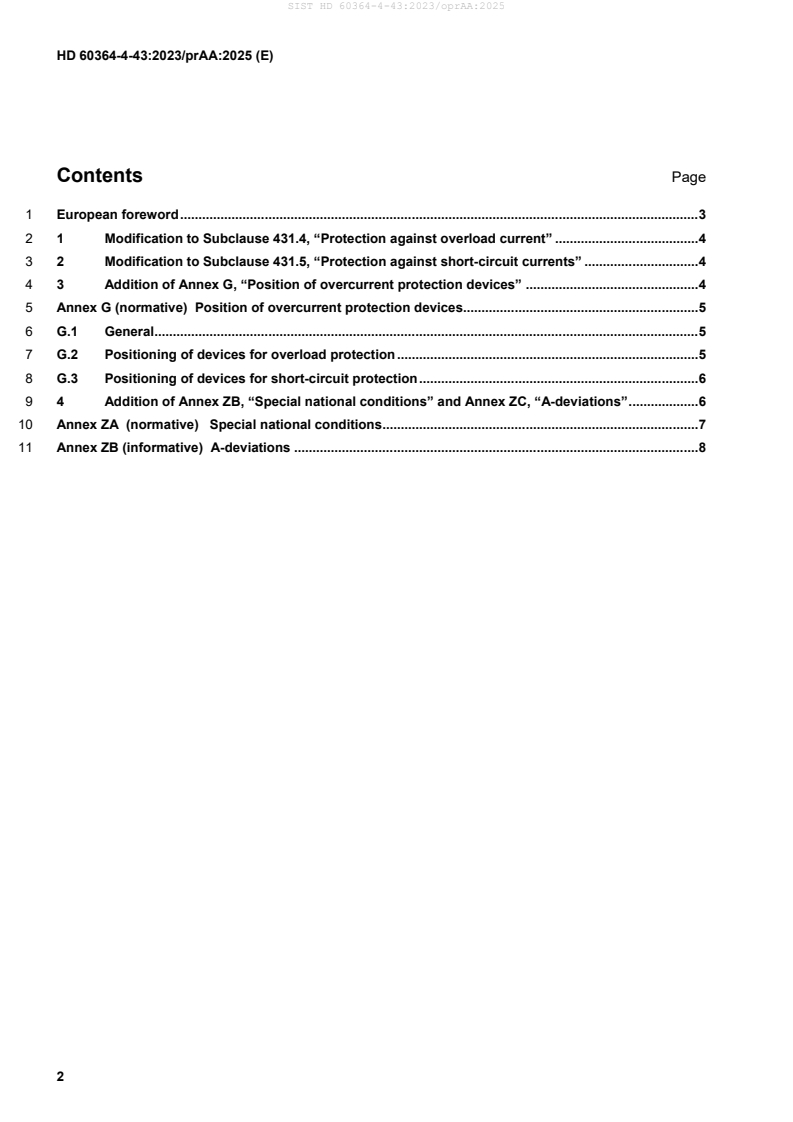
Contents Page
1 European foreword . 3
2 1 Modification to Subclause 431.4, “Protection against overload current” . 4
3 2 Modification to Subclause 431.5, “Protection against short-circuit currents” . 4
4 3 Addition of Annex G, “Position of overcurrent protection devices” . 4
5 Annex G (normative) Position of overcurrent protection devices. 5
6 G.1 General . 5
7 G.2 Positioning of devices for overload protection . 5
8 G.3 Positioning of devices for short-circuit protection . 6
9 4 Addition of Annex ZB, “Special national conditions” and Annex ZC, “A-deviations” . 6
10 Annex ZA (normative) Special national conditions. 7
11 Annex ZB (informative) A-deviations . 8
SIST HD 60364-4-43:2023/oprAA:2025
HD 60364-4-43:2023/prAA:2025 (E)
12 European foreword
13 This document (HD 60364-4-43:2023/prAA:2025) has been prepared by CLC/TC 64 “Electrical installations
14 and protection against electric shock”.
15 This document is currently submitted to the Enquiry.
16 The following dates are proposed:
• latest date by which the existence of this (doa) dav + 6 months
document has to be announced at national
level
• latest date by which this document has to be (dop) dav + 12 months
implemented at national level by publication of
an identical national standard or by
endorsement
• latest date by which the national standards (dow) dav + 36 months
conflicting with this document have to be (to be confirmed or
withdrawn modified when voting)
SIST HD 60364-4-43:2023/oprAA:2025
HD 60364-4-43:2023/prAA:2025 (E)
17 1 Modification to Subclause 431.4, “Protection against overload current”
18 In 431.4.1, add the following paragraph:
19 “The positioning of overcurrent protective devices for protection against overload currents shall meet the
20 requirements provided in Annex G.”
21 2 Modification to Subclause 431.5, “Protection against short-circuit currents”
22 In 431.5.1, replace Note 1 with the following paragraph:
23 “The positioning of overcurrent protective devices for protection against short-circuit currents shall meet the
24 requirements provided in Annex G.”
25 3 Addition of Annex G, “Position of overcurrent protection devices”
26 Add the following new normative Annex G:
27 “
SIST HD 60364-4-43:2023/oprAA:2025
HD 60364-4-43:2023/prAA:2025 (E)
28 Annex G
29 (normative)
31 Position of overcurrent protection devices
32 G.1 General
33 Devices for overload and/or short-circuit protection shall be installed at the origin of each circuit unless the
34 exceptions of G.2 and/or G.3 are applied.
35 G.2 Positioning of devices for overload protection
36 G.2.1 A device for protection against overload shall be placed at each point where there is a reduction in the
37 value of current-carrying capacity of the conductors except where A.2, G.2.2, G.2.3, or G.2.4 apply. The
38 requirements in G.2.2 to G.2.4 shall not be applied to installations situated in locations presenting a fire risk or
39 risk of explosion.
40 NOTE A reduc
...