

prEN 17020-2
(Main)Extended application of test results on durability of self-closing for fire resistance and/or smoke control doorsets and openable windows - Part 2: Durability of self-closing of steel rolling shutters
General Information
- Abstract
This European Standard covers steel rolling shutters as covered by EN 15269 10.
This document prescribes the methodology for extending the application of test results obtained from durability self-closing test(s) conducted in accordance with EN 1634 1.
Subject to the completion of the appropriate self-closing test or tests, the extended application may cover all or some of the following non-exhaustive list:
- Integrity only (E), radiation (EW) or insulated (EI1 or EI2) classifications;
- shutter curtain;
- wall/ceiling fixed elements (frame/suspension system);
- decorative finishes;
- intumescent, smoke, draught or acoustic seals;
- alternative supporting construction(s).
- Status
- Not Published
- Publication Date
- 04-Feb-2018
- Withdrawal Date
- 05-Aug-2018
- Technical Committee
- CEN/TC 127 - Fire safety in buildings
- Drafting Committee
- CEN/TC 33/WG 8 - Fire and smoke control
- Current Stage
- 4098 - Decision to abandon - Enquiry
- Start Date
- 18-Dec-2018
- Completion Date
- 30-Sep-2026

Overview
The prEN 17020-2:2016 European Standard, developed by CEN (European Committee for Standardization), defines a comprehensive methodology for the extended application of test results concerning the durability of self-closing steel rolling shutters. This standard complements existing European fire resistance and smoke control testing procedures and specifically addresses steel rolling shutters as covered under EN 15269-10.
Traditionally, durability testing for self-closing doors and shutters followed EN 1634-1, focusing on fire resistance and smoke control. prEN 17020-2 expands these results to cover a broader range of product variations while ensuring compliance with fire safety classifications. This document forms part of an essential framework supporting manufacturers and testing authorities to confidently extend test results to different shutter configurations without redundant testing.
Key Topics
- Durability of self-closing: Specifies evaluation criteria and extended application rules based on self-closing durability tests.
- Steel rolling shutters: Applies to rolling shutter assemblies including shutter curtains, frames, and suspension systems.
- Fire resistance classifications: Covers Integrity only (E), Radiation (EW), and Insulated (EI1, EI2) classifications according to EN 13501-2.
- Parameter variations: Addresses construction parameter variations such as shutter size, mounting position, seals, finishes, and supporting structures.
- Extended application process: Describes procedures to evaluate construction parameter changes that maintain fire classification and shutter durability without additional testing or indicate where further testing is necessary.
- Reports and classification: Defines requirements for producing extended application and classification reports aligned with EN 15269-1 and EN 13501-2.
Applications
- Manufacturers of steel rolling shutters can streamline product development by applying test results across multiple shutter configurations, reducing the need for repeated full-scale durability and fire resistance testing.
- Testing laboratories and certification bodies gain a standardized process to assess the feasibility of extending test results for different shutter variants while maintaining fire safety classifications.
- Building designers and specifiers benefit from harmonized classification reports confirming that variations in steel rolling shutter assemblies conform to European fire safety standards.
- Fire safety compliance: Supports fire safety engineers in ensuring rolling shutters’ integrity in fire and smoke control scenarios, contributing to safer building infrastructure.
- Quality assurance: Underpins durability guarantees for self-closing steel shutters across varied installation environments, finishes, and supporting constructions.
Related Standards
- EN 15269-10: Defines extended application of fire resistance test results specifically for steel rolling shutters.
- EN 1634-1: Fire resistance and smoke control tests for door and shutter assemblies, including durability self-closing testing.
- EN 13501-2: Provides criteria for fire classification of construction products, including doors and shutters.
- EN 12605: Specifies mechanical test methods for industrial, commercial, and garage doors and gates, including durability cycles.
- EN 1363-1 & EN 1363-2: General and alternative procedures for conducting fire resistance tests.
- EN 12433-1 & EN 12433-2: Terminology covering types and parts of industrial and commercial doors.
- EN ISO 13943: Fire safety vocabulary supporting clear and consistent terminology.
Keywords: prEN 17020-2, durability of self-closing, steel rolling shutters, fire resistance, smoke control doorsets, extended application, European Standard, EN 15269-10, EN 1634-1, fire door classification, self-closing test methodology, fire safety compliance, rolling shutter testing, shutter curtain durability, fire resistance classification.
Get Certified
Connect with accredited certification bodies for this standard

DIBt (Deutsches Institut für Bautechnik)
German Institute for Building Technology.
DIN CERTCO
DIN Group product certification.

Kiwa BDA Testing
Building and construction product certification.
Sponsored listings
Frequently Asked Questions
prEN 17020-2 is a draft published by the European Committee for Standardization (CEN). Its full title is "Extended application of test results on durability of self-closing for fire resistance and/or smoke control doorsets and openable windows - Part 2: Durability of self-closing of steel rolling shutters". This standard covers: This European Standard covers steel rolling shutters as covered by EN 15269 10. This document prescribes the methodology for extending the application of test results obtained from durability self-closing test(s) conducted in accordance with EN 1634 1. Subject to the completion of the appropriate self-closing test or tests, the extended application may cover all or some of the following non-exhaustive list: - Integrity only (E), radiation (EW) or insulated (EI1 or EI2) classifications; - shutter curtain; - wall/ceiling fixed elements (frame/suspension system); - decorative finishes; - intumescent, smoke, draught or acoustic seals; - alternative supporting construction(s).
This European Standard covers steel rolling shutters as covered by EN 15269 10. This document prescribes the methodology for extending the application of test results obtained from durability self-closing test(s) conducted in accordance with EN 1634 1. Subject to the completion of the appropriate self-closing test or tests, the extended application may cover all or some of the following non-exhaustive list: - Integrity only (E), radiation (EW) or insulated (EI1 or EI2) classifications; - shutter curtain; - wall/ceiling fixed elements (frame/suspension system); - decorative finishes; - intumescent, smoke, draught or acoustic seals; - alternative supporting construction(s).
prEN 17020-2 is classified under the following ICS (International Classification for Standards) categories: 13.220.50 - Fire-resistance of building materials and elements; 91.060.50 - Doors and windows. The ICS classification helps identify the subject area and facilitates finding related standards.
prEN 17020-2 is available in PDF format for immediate download after purchase. The document can be added to your cart and obtained through the secure checkout process. Digital delivery ensures instant access to the complete standard document.
Standards Content (Sample)
SLOVENSKI STANDARD
01-september-2016
Razširjena uporaba rezultatov preskusov trajnosti samozapiranja za požarno
odporna in/ali dimotesna vrata in okna, ki se odpirajo - 2. del: Trajnost
samozapiranja jeklenih valjanih zapiral
Extended application of test results on durability of self-closing for fire resistance and/or
smoke control doorsets and openable windows - Part 2: Durability of self-closing of steel
rolling shutters
Application étendue des résultats d’essais de durabilité de la fermeture automatique des
blocs-portes et fenêtres ouvrantes résistants au feu et/ou étanches à la fumée - Partie 2 :
Durabilité de la fermeture automatique des rideaux à enroulement en acier
Ta slovenski standard je istoveten z: prEN 17020-2
ICS:
13.220.50 Požarna odpornost Fire-resistance of building
gradbenih materialov in materials and elements
elementov
91.060.50 Vrata in okna Doors and windows
2003-01.Slovenski inštitut za standardizacijo. Razmnoževanje celote ali delov tega standarda ni dovoljeno.
DRAFT
EUROPEAN STANDARD
NORME EUROPÉENNE
EUROPÄISCHE NORM
June 2016
ICS 13.220.50; 91.060.50
English Version
Extended application of test results on durability of self-
closing for fire resistance and/or smoke control doorsets
and openable windows - Part 2: Durability of self-closing
of steel rolling shutters
This draft European Standard is submitted to CEN members for enquiry. It has been drawn up by the Technical Committee
CEN/TC 33.
If this draft becomes a European Standard, CEN members are bound to comply with the CEN/CENELEC Internal Regulations
which stipulate the conditions for giving this European Standard the status of a national standard without any alteration.
This draft European Standard was established by CEN in three official versions (English, French, German). A version in any other
language made by translation under the responsibility of a CEN member into its own language and notified to the CEN-CENELEC
Management Centre has the same status as the official versions.
CEN members are the national standards bodies of Austria, Belgium, Bulgaria, Croatia, Cyprus, Czech Republic, Denmark, Estonia,
Finland, Former Yugoslav Republic of Macedonia, France, Germany, Greece, Hungary, Iceland, Ireland, Italy, Latvia, Lithuania,
Luxembourg, Malta, Netherlands, Norway, Poland, Portugal, Romania, Slovakia, Slovenia, Spain, Sweden, Switzerland, Turkey and
United Kingdom.
Recipients of this draft are invited to submit, with their comments, notification of any relevant patent rights of which they are
aware and to provide supporting documentation.
Warning : This document is not a European Standard. It is distributed for review and comments. It is subject to change without
notice and shall not be referred to as a European Standard.
EUROPEAN COMMITTEE FOR STANDARDIZATION
COMITÉ EUROPÉEN DE NORMALISATION
EUROPÄISCHES KOMITEE FÜR NORMUNG
CEN-CENELEC Management Centre: Avenue Marnix 17, B-1000 Brussels
© 2016 CEN All rights of exploitation in any form and by any means reserved Ref. No. prEN 17020-2:2016 E
worldwide for CEN national Members.
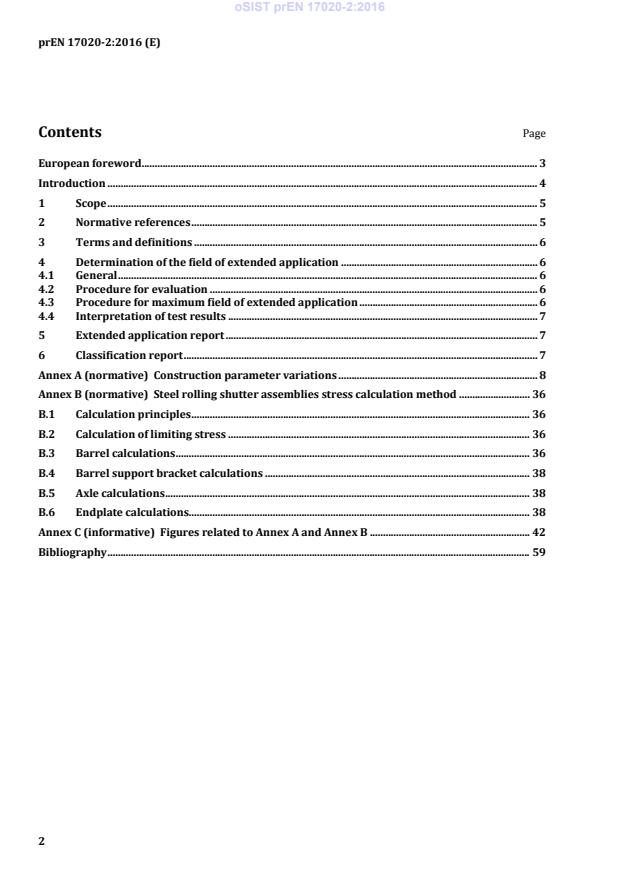
Contents Page
European foreword . 3
Introduction . 4
1 Scope . 5
2 Normative references . 5
3 Terms and definitions . 6
4 Determination of the field of extended application . 6
4.1 General . 6
4.2 Procedure for evaluation . 6
4.3 Procedure for maximum field of extended application . 6
4.4 Interpretation of test results . 7
5 Extended application report . 7
6 Classification report . 7
Annex A (normative) Construction parameter variations . 8
Annex B (normative) Steel rolling shutter assemblies stress calculation method . 36
B.1 Calculation principles . 36
B.2 Calculation of limiting stress . 36
B.3 Barrel calculations . 36
B.4 Barrel support bracket calculations . 38
B.5 Axle calculations . 38
B.6 Endplate calculations. 38
Annex C (informative) Figures related to Annex A and Annex B . 42
Bibliography . 59
European foreword
This document (prEN 17020-2:2016) has been prepared by Technical Committee CEN/TC 33 “Doors,
windows, shutters, building hardware and curtain walling”, the secretariat of which is held by AFNOR.
This document is currently submitted to the CEN Enquiry.
Introduction
The EN 15269 series of standards covering extended application of test results for fire resistance
and/or smoke control for door, shutter and openable window assemblies, including their elements of
building hardware, does not include the durability of self-closing of the doorsets following an extended
application process. This document is one of a series of standards intended to be used for the purpose
of producing an extended application report based on the evaluation of one or more durability self-
closing tests. These European Standards may also be used to identify the best selection of test
specimens required to cover a wide range of product variations.
Before there can be any consideration for extended application, the doorset will need to have been
tested in accordance with EN 1634-1 resp. EN 1634-3 and EN 12605 to achieve a test result which could
generate a classification in accordance with EN 13501-2 at least equal to the classification subsequently
required from extended application considerations.
1 Scope
This European Standard covers steel rolling shutters as covered by EN 15269-10.
This document prescribes the methodology for extending the application of test results obtained from
durability self-closing test(s) conducted in accordance with EN 1634-1.
Subject to the completion of the appropriate self-closing test or tests, the extended application may
cover all or some of the following non-exhaustive list:
— Integrity only (E), radiation (EW) or insulated (EI1 or EI2) classifications;
— shutter curtain;
— wall/ceiling fixed elements (frame/suspension system);
— decorative finishes;
— intumescent, smoke, draught or acoustic seals;
— alternative supporting construction(s).
2 Normative references
The following documents, in whole or in part, are normatively referenced in this document and are
indispensable for its application. For dated references, only the edition cited applies. For undated
references, the latest edition of the referenced document (including any amendments) applies.
EN 1363-1, Fire resistance tests - Part 1: General Requirements
EN 1363-2, Fire resistance tests - Part 2: Alternative and additional procedures
EN 1634-1, Fire resistance and smoke control tests for door and shutter assemblies, openable windows and
elements of building hardware - Part 1: Fire resistance test for door and shutter assemblies and openable
windows
EN 12433-1, Industrial, commercial and garage doors and gates - Terminology - Part 1: Types of doors
EN 12433-2, Industrial, commercial and garage doors and gates - Terminology - Part 2: Parts of doors
EN 12605, Industrial, commercial and garage doors and gates - Mechanical aspects - Test methods
EN 13501-2:2007+A1:2009, Fire classification of construction products and building elements — Part 2:
Classification using data from fire resistance tests, excluding ventilation services
EN 15269-1, Extended application of test results for fire resistance and/or smoke control for door, shutter
and openable window assemblies, including their elements of building hardware - Part 1: General
requirements
EN ISO 13943, Fire safety - Vocabulary (ISO 13943)
3 Terms and definitions
For the purposes of this document, the terms and definitions given in EN 1363-1, EN 1363-2,
EN 1634-1, EN 15269-1, EN 12433-1, EN 12433-2 and EN ISO 13943 and the following apply.
3.1
full scale test
test of a full size doorset or rolling shutter in accordance with EN 12605
4 Determination of the field of extended application
4.1 General
4.1.1 Before there can be any consideration for extended application the steel rolling shutter
assemblies shall have been tested and classified in accordance with EN 12605 and EN 13501-2
respectively in order to establish a classification for the doorset.
4.1.2 A review of the construction parameters can indicate that one or more characteristics may be
improved by a particular parameter variation. All evaluations shall be made on the basis of retaining the
classifications obtainable from testing to EN 12605, including those with a lower number of opening
and closing cycles. However, this shall never lead to an increased classification for any specific
parameter beyond that achieved during any one test unless specifically identified in the relevant
Construction Parameter Variation tables.
4.1.3 All evaluations shall be made on the basis of retaining the classification obtained from testing to
EN 1634-1 or EN 1634-3 and EN 12605.
4.1.4 If, by following the extended application procedure, any part of the classified product cannot be
achieved by extended application rules, that part shall be omitted from the subsequent extended
application report and classification report.
4.2 Procedure for evaluation
4.2.1 Identify the variations from the original test specimen(s) which are required to be covered by
an extended application report. Ensure that the variation(s) do(es) not prevent the shutter from self-
closing.
4.2.2 Locate the variations in the appropriate parameter variation by reference to columns (1) and
(2) of Table A.1.
4.2.3 Establish from the contents of column (4) of Table A.1 whether any extended application is
available without the need for further testing.
4.2.4 Where this is deemed to be possible this can be recorded in the extended application report
together with any appropriate restrictions and the stated rules from column (4) in Table A.1.
4.2.5 Where the variations required can only be achieved from additional testing according to
column (5), the additional test can be made on a similar specimen type to the original test against which
the extended application is sought. Alternatively, column (5) identifies an option for alternative testing
and relevant test parameters.
4.3 Procedure for maximum field of extended application
4.3.1 It is possible to provide a limited field of extended application from the results of a single test.
However, where a manufacturer intends to produce a range of steel rolling shutters assemblies
incorporating manual and power drives, insulated and uninsulated version, with alternative elements of
construction etc. it is recommended that careful consideration is given to the complete range of designs
and options in order to minimize the testing required before testing commences.
4.3.2 Establish all the parameter variations which are required to be part of the product range.
4.3.3 Determine which are the most important specification requirements and incorporate as many
as possible into the specimen(s) for the first tests in the series.
4.3.4 Conduct the first durability test or a series of tests and then establish which of the original
desired parameter variations have not been covered by this test(s).
4.3.5 Identify these parameter variations in Table A.1 and establish if any extended application is
possible without further testing.
4.3.6 Record this for the extended application report together with any restrictions and rules given in
column (4) in Table A.1.
4.3.7 Evaluate which, if any, of the desired parameter variations have not been covered by the initial
field of extended application derived from 4.3.6 above.
4.3.8 Select the required outstanding parameter variations from column (1) and column (2) of
Table A.1 and observe from column (5) of Table A.1 which are the most appropriate weakest specimen
options for further testing.
4.3.9 If the complete selection of required parameter variations has not been covered by the tests
completed in accordance with 4.3.8 and 4.3.9 above, then an appropriate test or tests may be repeated
with the additional product variations incorporated.
4.4 Interpretation of test results
4.4.1 In order to maximize the field of extended application, it is important that the test reports shall
record details of any failures throughout the test duration.
4.4.2 Where a series of tests have been conducted, the field of extended application shall be based on
the lowest performance achieved from the complete series of tests unless premature failure has been
attributed to one or more specific construction parameter variation.
4.4.3 Where it has been possible to identify specific parameter failures, the extended application for
all other construction parameter variations can be based on the performance achieved after isolating
the premature failure(s).
5 Extended application report
Prepare an extended application report in accordance with the requirements of EN 15269-1, based on
the results of evaluations in accordance with the above.
6 Classification report
The classification report shall be determined from the results of the extended application report and
shall be presented in accordance with EN 13501-2:2007+A1:2009, Annex A.
Annex A
(normative)
Construction parameter variations
Table A.1 below is designed to be used by experts competent in the field of fire resistance and self-
closing durability testing of steel rolling shutter assemblies.
The table shall only be used to assess a field of extended application when at least one positive self-
closing durability test to EN 12605 has generated a classification according to EN 13501-2.
The first two columns identify possible variations to the construction details of the specimen tested. It is
presupposed that the variation does not restrain the door closing.
Column (4) leads to the judgement of the possibility of extending the field of application.
Where additional tests are deemed to be necessary, the type of specimen approved for incorporation of
the changed parameter is defined in column (5). Where it is possible to use information from tests
performed on one configuration for evidence on a different configuration, this allowance has been made
in order to reduce the overall number of tests required for extended application evaluation.
Where an additional test is required in column (5), the test is a full scale test unless otherwise specified.
In order to maximize the possible field of application from a minimum number of tests, the parameter
changes have been spread over a series of test specimens. The recommended tests for each parameter
is depending upon the classification required and the preferred direction of testing as indicated in
column (5).
Where more than a single parameter variation is required, the influence on other variations shall also
be taken into account.
Table A.1 — Construction parameters
Influence of variation on Additional evidence
Construction parameter Variation Possibility of extension
performance characteristic required
(1) (2) (3) (4) (5)
A General (See Figure C.1 for an example of a General Arrangement of rolling shutter construction)
A.1 Size variations / construction
A.1.1 Width between vertical Possible providing tightness and clearances are not
Decrease ≥
guides (See Figure C.2) changed
Possible providing the static requirements to fixings,
A.1.2 Distance between
barrel and load-bearing constructions are fulfilled
vertical guides Increase =
and the requirements of Annex B are satisfied (at
(See Figure C.2)
room temperature)
A.1.3 Height from floor level
to centre line of barrel Decrease ≥ Possible
(See Figure C.3)
Possible providing the static requirements to fixings,
A.1.4 Height from floor level
barrel and load-bearing constructions are fulfilled
to centre line of barrel Increase =
and the requirements of Annex B are satisfied (at
(See Figure C.3)
room temperature)
Possible providing a minimum gap of 10 mm will
A.1.5 Expansion allowances
remain during opening/closing
between the end of the Decease > = <
lath and guide
Otherwise not possible without an additional test
A.1.6 Expansion allowances
between the end of the Increase = Possible
lath and guide
Face fixed on
A.1.7 Mounting furnace side to = Possible
within opening
Within opening
A.1.8 Mounting to face fixed on = Possible
furnace side
Influence of variation on Additional evidence
Construction parameter Variation
Possibility of extension
performance characteristic required
(1) (2) (3) (4) (5)
A.2 Materials and constructions
Possible providing no abrasion will occur (in general
this is given if no moving part touches the insulation
A.2.1 Insulation material
material during opening/closing)
whether intumescent Change > = <
or not Otherwise
Not possible without an additional test
Possible providing no moving part touches the
A.2.2 Density of insulation
insulation material during opening/closing)
Increase > = <
material
Otherwise not possible without an additional test
Possible providing no moving part touches the
A.2.3 Density of insulation
insulation material during opening/closing)
Decrease > = <
material
Otherwise not possible without an additional test
Possible but only for an identical composition or if no
Change of
moving part touches the insulation material during
A.2.4 Intumescent material supplier and/or > = <
opening/closing)
manufacturer
Otherwise not possible without an additional test
Possible providing no moving part touches the
Alternative
insulation material during opening/closing)
A.2.5 Intumescent material > = <
material
Otherwise not possible without an additional test
Possible providing no moving part touches the
A.2.6 Thickness of insulation
insulation material during opening/closing)
material other than Increase > = <
curtains
Otherwise not possible without an additional test
A.2.7 Thickness of insulation
material other than Decrease = Possible
curtains
B Curtain
B.1 Laths
Influence of variation on Additional evidence
Construction parameter Variation
Possibility of extension
performance characteristic required
(1) (2) (3) (4) (5)
Possible providing interlock remains the same and
the interaction with parts touching the curtain (e.g.
press rollers) remains the same
B.1.1 Size (height of lath)
Decrease > = <
(See Figure C.4) Or a test has been passed (with a similar type of
rolling shutter assembly) with this type of laths
Otherwise not possible without an additional test
Possible providing a test has been passed (with a
similar type of rolling shutter assembly) with this
B.1.2 Size (height of lath)
Increase ≥
type of laths with the same or lower barrel diameter
(See Figure C.5)
Otherwise not possible without an additional test
Possible providing a test has been passed (with
another type of rolling shutter assembly) with this
B.1.3 Thickness of steel Decrease > = <
type of laths with the same or lower barrel diameter
Otherwise not possible without an additional test
Possible providing a test has been passed (with
another type of rolling shutter assembly) with this
type of laths with the same or smaller barrel
B.1.4 Thickness of steel Increase > = <
diameter
Otherwise not possible without an additional test
Possible providing a test has been passed (with
another type of rolling shutter assembly) with this
B.1.5 Thickness of insulation
type of laths with the same or smaller barrel
material Decrease > = <
diameter
(See Figure C.6)
Otherwise not possible without an additional test
Influence of variation on Additional evidence
Construction parameter Variation
Possibility of extension
performance characteristic required
(1) (2) (3) (4) (5)
Possible providing a test has been passed (with
another type of rolling shutter assembly) with this
type of laths with the same or smaller barrel
B.1.6 Thickness of insulation
diameter and assuming that the gap between the
material Increase > = <
skins is full of insulating material and that the
(See Figure C.7)
thickness of lath creates a corresponding increase in
the width of the guides
Otherwise not possible without an additional test
Possible providing the material is not loaded
mechanically (e.g. fulled or bended) or a test has been
passed (with another type of rolling shutter
B.1.7 Density of insulation assembly) with this type of insulation material with
Increase > = <
material the same or smaller barrel diameter and the
requirements of Annex B are satisfied (at room
temperature) otherwise not possible without an
additional test
Possible providing the material is not loaded
mechanically (e.g. fulled or bended) or a test has been
passed (with another type of rolling shutter
B.1.8 Density of insulation
Decrease > = <
assembly) with this type of insulation material with
material
the same or smaller barrel diameter
Otherwise not possible without an additional test
Mild steel to
B.1.9 Material = Possible
stainless steel
Stainless steel to
B.1.10 Material = Possible
mild steel
Influence of variation on Additional evidence
Construction parameter Variation
Possibility of extension
performance characteristic required
(1) (2) (3) (4) (5)
Possible providing half the circumference of the
barrel is covered or a test has been passed (with
B.1.11 Number of laths on
another type of rolling shutter assembly) with this
barrel when door is in Decrease > = <
type of insulation material with the same or smaller
closed position
barrel diameter
Otherwise not possible without an additional test
B.1.12 Number of laths on
barrel when door is in Increase = Possible
closed position
Possible providing interlock remains the same and
the interaction with parts touching the curtain (e.g.
press rollers) remains the same
B.1.13 Shape (single skin)
Change > = <
(See Figure C.8) Or a test has been passed (with a similar type of
rolling shutter assembly) with this type of laths
Otherwise not possible without an additional test
Possible providing a test has been passed (with a
similar type of rolling shutter assembly) with this
B.1.14 Single skin to double
type of insulation material with the same or smaller
skin or double skin to
Change > = <
barrel diameter and the requirements of Annex B are
single skin
satisfied (at room temperature)
(See Figure C.9)
Otherwise not possible without an additional test
B.2 Endlocks (see Figure C.10 for example of endlock)
Possible providing the endlocks do not touch the
ground of the side guides during opening/closing
B.2.1 Size and shape Decrease > = <
Otherwise not possible without an additional test
Possible providing requirements in respect of
clearances and interlock remain unchanged
B.2.2 Size and shape Increase > = <
Otherwise not possible without an additional test
Influence of variation on Additional evidence
Construction parameter Variation
Possibility of extension
performance characteristic required
(1) (2) (3) (4) (5)
Possible providing the endlocks do not touch the
B.2.3 Thickness
ground of the side guides during opening/closing
Decrease > = <
(See Figure C.10)
Otherwise not possible without an additional test
Possible providing requirements in respect of
expansion clearances and interlock remain
B.2.4 Thickness
Increase > = <
unchanged
(See Figure C.10)
Otherwise not possible without an additional test
Steel to
B.2.5 Material = Possible
malleable iron
Malleable iron to
B.2.6 Material = Possible
steel
Possible providing the endlocks do not touch the
ground of the side guides during opening/closing
B.2.7 Material Steel to plastic ≤
Otherwise not possible without an additional test
Possible providing the endlocks do not touch the
ground of the side guides during opening/closing
B.2.8 Material Plastic to steel > = <
Otherwise not possible without an additional test
Possible providing the endlocks do not touch the
Steel to
ground of the side guides during opening/closing
B.2.9 Material > = <
aluminium
Otherwise not possible without an additional test
Possible providing the endlocks do not touch the
Aluminium to
ground of the side guides during opening/closing
B.2.10 Material > = <
steel
Otherwise not possible without an additional test
Influence of variation on Additional evidence
Construction parameter Variation
Possibility of extension
performance characteristic required
(1) (2) (3) (4) (5)
B.3 Endlock Fixings
Possible providing a test has been passed (with a
similar type of rolling shutter assembly) with this
diameter of endlock fixing with the same or smaller
B.3.1 Size (diameter) Decrease ≤
barrel diameter
Otherwise not possible without an additional test
B.3.2 Size (diameter) Increase ≥ Possible
Possible providing a test has been passed (with a
similar type of rolling shutter assembly) with this
type of endlock fixing with the same or smaller barrel
B.3.3 Type Change > = <
diameter
Otherwise not possible without an additional test
Possible providing a test has been passed (with a
similar type of rolling shutter assembly) with this
type of endlock fixing with the same or smaller barrel
B.3.4 Material Change > = <
diameter
Otherwise not possible without an additional test
Possible providing a test has been passed (with a
similar type of rolling shutter assembly) with the
required (or a lower) number of endlock fixings with
B.3.5 Number Decrease ≤
the same or smaller barrel diameter
Otherwise not possible without an additional test
B.3.6 Number Increase ≥ Possible
Influence of variation on Additional evidence
Construction parameter Variation
Possibility of extension
performance characteristic required
(1) (2) (3) (4) (5)
B.4 Bottom Rail
Possible providing a test has been passed (with a
similar type of rolling shutter assembly) with this
type of bottom rail with the same or smaller barrel
B.4.1 Size (See Figure C.11) Decrease > = <
diameter
Otherwise not possible without an additional test
Possible if requirements of Annex B are satisfied (at
B.4.2 Size (See Figure C.12) Increase ≥
room temperature)
Possible providing a test has been passed (with a
similar type of rolling shutter assembly) with this
type of bottom rail with the same or smaller barrel
B.4.3 Thickness of steel Decrease ≤
diameter
Otherwise not possible without an additional test
Possible if requirements of Annex B are satisfied (at
B.4.4 Thickness of steel Increase ≥
room temperature)
Stainless steel to
B.4.5 Material = Possible
mild steel
Mild steel to
B.4.6 Material = Possible
stainless steel
Possible providing a test has been passed (with a
similar type of rolling shutter assembly) with this
bottom rail material with the same or smaller barrel
B.4.7 Material of safety edge Change > = <
diameter
Otherwise not possible without an additional test
Influence of variation on Additional evidence
Construction parameter Variation
Possibility of extension
performance characteristic required
(1) (2) (3) (4) (5)
Possible providing a test has been passed (with a
similar type of rolling shutter assembly) with this
B.4.8 Construction Change from T-
type of bottom rail with the same or smaller barrel
> = <
(See Figure C.13) section to flat
diameter
Otherwise not possible without an additional test
Possible. If the weight of the T-section bottom bar is
B.4.9 Construction Change from flat
> = < higher the requirements of Annex B shall be satisfied
(See Figure C.14) to T-section
(at room temperature)
B.4.10 Expansion allowances
Possible providing a minimum gap of 10 mm will
between the end of
remain during opening/closing
Decrease ≤
the bottom rail and
Otherwise not possible without an additional test
guide
B.4.11 Expansion allowances
between the end of
Increase ≥ Possible
the bottom rail and
guide
Possible providing the bending stiffness and weight
Change from T-
will be the same or higher. In case of a higher weight
B.4.12 Construction
section to double > = <
the requirements of Annex B shall be satisfied.
(See Figure C.15)
angles
Otherwise not possible without an additional test
Possible providing the bending stiffness and weight
Change from
will be the same or higher. In case of a higher weight
B.4.13 Construction
double angles to > = <
the requirements of Annex B shall be satisfied.
(See Figure C.16)
T-section
Otherwise not possible without an additional test
Possible providing the bending stiffness and weight
Change from
will be the same or higher. In case of a higher weight
B.4.14 Construction
insulated to T- > = <
the requirements of Annex B shall be satisfied.
(See Figure C.17)
section
Otherwise not possible without an additional test
Influence of variation on Additional evidence
Construction parameter Variation
Possibility of extension
performance characteristic required
(1) (2) (3) (4) (5)
Possible providing the bending stiffness and weight
Change from T-
will be the same or higher. In case of a higher weight
B.4.15 Construction
section to > = <
the requirements of Annex B shall be satisfied.
(See Figure C.18)
insulated
Otherwise not possible without an additional test
B.5 Bottom rail fixings
Possible subject to total cross-section of fixings not
B.5.1 Size Decrease > = <
being reduced
B.5.2 Size Increase ≥ Possible
Possible subject to total cross-section of fixings not
B.5.3 Type Change > = <
being reduced
Possible providing the material has equal or better
B.5.4 Material Change > = < mechanical properties (yield stress, Young’s modulus,
creep behaviour)
B.5.5 Number Decrease ≤ Not possible
B.5.6 Number Increase ≥ Possible
C. Guides
C.1 Section
C.1.1 Shape from channel to
wind-lock type Change = Possible
(See Figure C.19)
C.1.2 Shape from wind-lock
type to channel Change = Possible providing no wind-locks are used
(See Figure C.20)
C.1.3 Depth
Decrease ≤ Not possible
(See Figure C.21)
Influence of variation on Additional evidence
Construction parameter Variation
Possibility of extension
performance characteristic required
(1) (2) (3) (4) (5)
C.1.4 Depth Possible providing tightness and clearances are not
Increase ≥
(See Figure C.22) reduced
C.1.5 Width Possible providing tightness and clearances are not
Decrease > = <
(See Figure C.23) reduced
C.1.6 Width
Increase ≥ Possible
(See Figure C.24)
C.1.7 Material thickness Decrease ≤ Not possible
C.1.8 Material thickness Increase ≥ Possible
Stainless steel to
C.1.9 Material = Possible
mild steel
Mild steel to
C.1.10 Material = Possible
stainless steel
Possible providing a minimum gap of 10 mm will
remain during opening/closing
C.1.11 Expansion allowances Decrease ≤
Otherwise not possible without an additional test
C.1.12 Expansion allowances Increase ≥ Possible
C.2 Guide fixing section
C.2.1 Size (See Figure C.25) Decrease ≤ Not possible
C.2.2 Size (See Figure C.26) Increase ≥ Possible
C.2.3 Thickness Decrease ≤ Not possible
C.2.4 Thickness Increase ≥ Possible
Stainless steel to
C.2.5 Material = Possible
mild steel
Mild steel to
C.2.6 Material = Possible
stainless steel
Influence of variation on Additional evidence
Construction parameter Variation
Possibility of extension
performance characteristic required
(1) (2) (3) (4) (5)
C.2.7 Expansion allowances Decrease = Possible
C.2.8 Expansion allowances Increase = Possible
Possible providing thickness and section modulus is
C.2.9 Shape
same or greater
Change > = <
(See Figure C.27)
Otherwise not possible without an additional test
C.2.10 Continuous section to
Change = Possible
short sections
C.2.11 Short sections to
Change = Possible
continuous sections
C.2.12 Flag type including
Possible providing clearances (between shutter and
endplate Separate =
guides) are not reduced
(See Figure C.28)
C.2.13 Separate Possible providing clearances (between shutter and
Flag type > = <
(See Figure C.29) guides) are not reduced
C.3 Fixings to supporting construction
Possible subject to more fixings being used so that
C.3.1 Size Decrease > = <
the total cross-section of the fixings is not decreased
C.3.2 Size Increase ≥ Possible
C.3.3 Spacing Decrease ≥ Possible
Possible by 10 % and providing that the position
C.3.4 Spacing Increase ≤
uppermost fixing (of each side) is not lowered
C.3.5 Number Decrease ≤ Not possible
C.3.6 Number Increase ≥ Possible
Influence of variation on Additional evidence
Construction parameter Variation
Possibility of extension
performance characteristic required
(1) (2) (3) (4) (5)
Possible providing the fixings have been shown by
Alternative
test to have an equal or better pullout strength (at
C.3.7 Material or Type material and/or > = < .
room temperature); see Annex B, otherwise not
type
possible without an additional test
D Barrel
D.1 Tube
Possible providing a test has been passed (with a
similar type of rolling shutter assembly) with the
D.1.1 Outside diameter
same or smaller tube diameter and the requirements
Decrease > = <
(See Figure C.30)
in Annex B are satisfied (at room temperature)
Otherwise not possible without an additional test
D.1.2 Outside diameter Possible providing requirements in Annex B are
Increase ≥
(See Figure C.31) satisfied (at room temperature)
D.1.3 Wall thickness Possible providing requirements in Annex B are
Decrease ≤
(See Figure C.32) satisfied (at room temperature)
D.1.4 Wall thickness Possible providing requirements in Annex B are
Increase ≥
(See Figure C.33) satisfied (at room temperature)
Possible requirements in Annex B are satisfied (at
room temperature) or a test has been passed (with a
Alternative
similar type of rolling shutter assembly) with the
D.1.5 Material material and/or > = <
same or smaller tube diameter
manufacturer
Otherwise not possible without an additional test
D.1.6 Expansion allowances Decrease = Possible
D.1.7 Expansion allowances Increase = Possible
Influence of variation on Additional evidence
Construction parameter Variation
Possibility of extension
performance characteristic required
(1) (2) (3) (4) (5)
Possible providing half the tube is minimum
octagonal and requirements in Annex B are satisfied
Change from
(at room temperature) or a test has been passed
D.1.8 Shape
circular to ≤
(with a similar type of rolling shutter assembly) with
(See Figure C.34)
angular
this type of tube with the same or smaller diameter,
Otherwise not possible without an additional test.
Change from
D.1.9 Shape Possible providing the requirements in Annex B are
angular to ≥
(See Figure C.34) satisfied (at room temperature).
circular
D.2 Shaft
D.2.1 Outside diameter Possible providing requirements in Annex B are
Decrease ≤
(See Figure C.35) satisfied (at room temperature).
D.2.2 Outside diameter Possible providing requirements in Annex B are
Increase ≥
(See Figure C.36) satisfied (at room temperature).
D.2.3 Type Possible providing requirements in Annex B are
Solid to hollow ≤
(See Figure C.37) satisfied (at room temperature).
D.2.4 Type
Hollow to solid ≥ Possible
(See Figure C.38)
Possible providing requirements in Annex B are
D.2.5 Material Alternative > = <
satisfied (at room temperature).
D.2.6 Expansion allowances
Decrease ≤ Not possible
(lateral)
D.2.7 Expansion allowances
Increase ≥ Possible
(lateral)
Possible providing requirements in Annex B are
D.2.8 Shape
Change = satisfied (at room temperature), otherwise not
(See Figure C.39)
possible without an additional test.
Influence of variation on Additional evidence
Construction parameter Variation
Possibility of extension
performance characteristic required
(1) (2) (3) (4) (5)
Possible providing a test has been passed (with a
similar type of rolling shutter assembly) with this
D.2.9 Stub shafts
Continuous axle ≤
type of shaft with the same or smaller diameter,
(See Figure C.40)
Otherwise not possible without an additional test.
D.2.10 Continuous axle
Stub shafts ≥ Possible
(See Figure C.41)
D.2.11 Shaft end retention Remove < Not possible
D.2.12 Shaft end retention Add ≥ Possible
D.3 Endcaps (Infill at end of tube usually mild steel or casting which sometimes carries a bearing if the shaft is fixed).
D.3.1 Thickness Decrease < Not possible
D.3.2 Thickness Increase ≥ Possible
Alternative Possible providing requirements in Annex B are
D.3.3 Material material and/or > = < satisfied (at room temperature). otherwise not
manufacturer possible without an additional test
D.4 Curtain to barrel fixings
Possible providing the fixings are positioned closer
together so that the total cross-section of the fixings
D.4.1 Size Decrease > = <
is not decreased, otherwise not possible without an
additional test
D.4.2 Size Increase ≥ Possible
D.4.3 Number Decrease < Not possible
D.4.4 Number Increase ≥ Possible
Possible providing the material has equal or better
Alternative
mechanical properties (yield stress, Young’s modulus,
D.4.5 Material material and/or > = <
creep behaviour), otherwise not possible without an
manufacturer
additional test
Influence of variation on Additional evidence
Construction parameter Variation
Possibility of extension
performance characteristic required
(1) (2) (3) (4) (5)
D.4.6 Spacing Decrease ≥ Possible
D.4.7 Spacing Increase ≤ Not possible
D.5 Springs either inside barrels or externally mounted
D.5.1 Delete > = < Possible providing closing speed will not increase
Possible providing requirements in Annex B are
D.5.2 Add > = <
satisfied (at room temperature)
D.5.3 Size Decrease > = < Possible providing closing speed will not increase
Possible providing requirements in Annex B are
D.5.4 Size Increase > = <
satisfied (at room temperature)
D.5.5 Number Decrease > = < Possible providing closing speed will not increase
Possible providing requirements in Annex B are
D.5.6 Number Increase > = <
satisfied (at room temperature)
Alternative Possible providing closing speed will not increase
D.5.7 Material material and/or > = < and the requirements in Annex B are satisfied (at
manufacturer room temperature)
E Barrel/shaft end supports
E.1 Support brackets/endplates
Possible providing requirements in
E.1.1 Size (See Figure C.42) Decrease > = <
Annex B are satisfied (at room temperature)
E.1.2 Size (See Figure C.43) Increase > Possible
Possible providing requirements in Annex B are
E.1.3 Material thickness Decrease > = <
satisfied (at room temperature)
E.1.4 Material thickness Increase > Possible
oSIST prEN 17
...