

EN 13684:2004+A3:2009
(Main + Amendment)Garden equipment - Pedestrian controlled lawn aerators and scarifiers - Safety
General Information
- Abstract
This European Standard specifies safety requirements and their verification for the design and construction of pedestrian controlled integrally powered lawn aerators and scarifiers which are designed for re-generating lawns by, for instance, combing out grass, thatch and moss or cutting vertically into the lawn face using tines which rotate about a horizontal axis. It describes methods of elimination or reduction of hazards arising from their use. In addition, it specifies the type of information to be provided by the manufacturer on safe working practices.
Throughout this standard, the term "machine" applies to those machines known as aerators, scarifiers, corers, lawn rakes or grass rakes.
This standard does not apply to aerators/scarifiers made from a machine falling within the scope of EN 709:1997 when fitted with an aerating/scarifying implement, non-powered aerators, vertical axis aerators or those aerators which cut into the soil by means of a reciprocating motion or by water pressure. The electrical aspects of mains operated machines are covered by EN 60335-1. The safety aspects of batteries other than batteries for starting the engine and the electrical safety aspects of battery powered lawn aerators and scarifiers are not covered by this standard.
This standard deals with all significant hazards, hazardous situations and events relevant to scarifiers and aerators, when they are used as intended and under the conditions foreseen by the manufacturer (see Clause 4).
Environmental hazards and EMC have not been considered in this standard.
This document is not applicable to aerators/scarifiers which are manufactured before the date of publication of this document by CEN.
- Status
- Withdrawn
- Publication Date
- 15-Dec-2009
- Withdrawal Date
- 29-Sep-2026
- Technical Committee
- CEN/TC 144 - Tractors and machinery for agriculture and forestry
- Drafting Committee
- CEN/TC 144/WG 7 - Garden equipment
- Current Stage
- 9960 - Withdrawal effective - Withdrawal
- Start Date
- 06-Jun-2018
- Completion Date
- 30-Sep-2026
- Directive
- 2006/42/EC - Directive 2006/42/EC of the European Parliament and of the Council of 17 May 2006 on machinery, and amending Directive 95/16/EC (recast)OJ Ref: C, C 136 OJ Date: 26-May-2010



Relations
- Effective Date
- 24-Oct-2009
- Replaced By
EN 13684:2018 - Garden equipment - Pedestrian controlled lawn aerators and scarifiers - Safety - Effective Date
- 18-Jun-2014
- Effective Date
- 25-Aug-2026
- Effective Date
- 25-Aug-2026
- Effective Date
- 25-Aug-2026
- Effective Date
- 09-Feb-2026
- Effective Date
- 09-Feb-2026
- Effective Date
- 09-Feb-2026
- Effective Date
- 28-Jan-2026
- Effective Date
- 28-Jan-2026
- Effective Date
- 28-Jan-2026
- Effective Date
- 28-Jan-2026
- Effective Date
- 28-Jan-2026
- Effective Date
- 28-Jan-2026
- Refers
EN ISO 354:2003 - Acoustics - Measurement of sound absorption in a reverberation room (ISO 354:2003) - Effective Date
- 28-Jan-2026
Get Certified
Connect with accredited certification bodies for this standard

Control Union Certifications
Global certification for agriculture and sustainability.

ECOCERT
Organic and sustainability certification.

FSC International
Forest Stewardship Council certification.
Sponsored listings
Frequently Asked Questions
EN 13684:2004+A3:2009 is a standard published by the European Committee for Standardization (CEN). Its full title is "Garden equipment - Pedestrian controlled lawn aerators and scarifiers - Safety". This standard covers: This European Standard specifies safety requirements and their verification for the design and construction of pedestrian controlled integrally powered lawn aerators and scarifiers which are designed for re-generating lawns by, for instance, combing out grass, thatch and moss or cutting vertically into the lawn face using tines which rotate about a horizontal axis. It describes methods of elimination or reduction of hazards arising from their use. In addition, it specifies the type of information to be provided by the manufacturer on safe working practices. Throughout this standard, the term "machine" applies to those machines known as aerators, scarifiers, corers, lawn rakes or grass rakes. This standard does not apply to aerators/scarifiers made from a machine falling within the scope of EN 709:1997 when fitted with an aerating/scarifying implement, non-powered aerators, vertical axis aerators or those aerators which cut into the soil by means of a reciprocating motion or by water pressure. The electrical aspects of mains operated machines are covered by EN 60335-1. The safety aspects of batteries other than batteries for starting the engine and the electrical safety aspects of battery powered lawn aerators and scarifiers are not covered by this standard. This standard deals with all significant hazards, hazardous situations and events relevant to scarifiers and aerators, when they are used as intended and under the conditions foreseen by the manufacturer (see Clause 4). Environmental hazards and EMC have not been considered in this standard. This document is not applicable to aerators/scarifiers which are manufactured before the date of publication of this document by CEN.
This European Standard specifies safety requirements and their verification for the design and construction of pedestrian controlled integrally powered lawn aerators and scarifiers which are designed for re-generating lawns by, for instance, combing out grass, thatch and moss or cutting vertically into the lawn face using tines which rotate about a horizontal axis. It describes methods of elimination or reduction of hazards arising from their use. In addition, it specifies the type of information to be provided by the manufacturer on safe working practices. Throughout this standard, the term "machine" applies to those machines known as aerators, scarifiers, corers, lawn rakes or grass rakes. This standard does not apply to aerators/scarifiers made from a machine falling within the scope of EN 709:1997 when fitted with an aerating/scarifying implement, non-powered aerators, vertical axis aerators or those aerators which cut into the soil by means of a reciprocating motion or by water pressure. The electrical aspects of mains operated machines are covered by EN 60335-1. The safety aspects of batteries other than batteries for starting the engine and the electrical safety aspects of battery powered lawn aerators and scarifiers are not covered by this standard. This standard deals with all significant hazards, hazardous situations and events relevant to scarifiers and aerators, when they are used as intended and under the conditions foreseen by the manufacturer (see Clause 4). Environmental hazards and EMC have not been considered in this standard. This document is not applicable to aerators/scarifiers which are manufactured before the date of publication of this document by CEN.
EN 13684:2004+A3:2009 is classified under the following ICS (International Classification for Standards) categories: 65.060.70 - Horticultural equipment. The ICS classification helps identify the subject area and facilitates finding related standards.
EN 13684:2004+A3:2009 has the following relationships with other standards: It is inter standard links to EN 13684:2004+A2:2009, EN 13684:2018, ISO 11684:1995, ISO 3767-3:1995, ISO 3767-4:1993, ISO 3864-1:2002, EN 60335-1:2002, ISO 3767-1:1998, EN 954-1:1996, EN ISO 11201:1995, EN ISO 11688-1:1998, EN 294:1992, EN ISO 3744:1995, EN 982:1996, EN ISO 354:2003. Understanding these relationships helps ensure you are using the most current and applicable version of the standard.
EN 13684:2004+A3:2009 is associated with the following European legislation: EU Directives/Regulations: 2006/42/EC, 98/37/EC; Standardization Mandates: M/079, M/396. When a standard is cited in the Official Journal of the European Union, products manufactured in conformity with it benefit from a presumption of conformity with the essential requirements of the corresponding EU directive or regulation.
EN 13684:2004+A3:2009 is available in PDF format for immediate download after purchase. The document can be added to your cart and obtained through the secure checkout process. Digital delivery ensures instant access to the complete standard document.
Standards Content (Sample)
2003-01.Slovenski inštitut za standardizacijo. Razmnoževanje celote ali delov tega standarda ni dovoljeno.Gartengeräte - Handgeführte Rasen-Bodenbelüfter und Vertikutierer - SicherheitMatériel de jardinage - Aérateurs et scarificateurs à conducteur à pied - SécuritéGarden equipment - Pedestrian controlled lawn aerators and scarifiers - Safety65.060.70Vrtnarska opremaHorticultural equipmentICS:Ta slovenski standard je istoveten z:EN 13684:2004+A3:2009SIST EN 13684:2004+A3:2010en,fr01-marec-2010SIST EN 13684:2004+A3:2010SLOVENSKI
STANDARD
EUROPEAN STANDARD NORME EUROPÉENNE EUROPÄISCHE NORM
EN 13684:2004+A3
December 2009 ICS 65.060.70 Supersedes EN 13684:2004+A2:2009English Version
Garden equipment - Pedestrian controlled lawn aerators and scarifiers - Safety
Matériel de jardinage - Aérateurs et scarificateurs à conducteur à pied - Sécurité
Gartengeräte - Handgeführte Rasen-Bodenbelüfter und Vertikutierer - Sicherheit This European Standard was approved by CEN on 1 April 2004 and includes Amendment 2 approved by CEN on 6 June 2009 and Amendment 3 approved by CEN on 20 November 2009.
CEN members are bound to comply with the CEN/CENELEC Internal Regulations which stipulate the conditions for giving this European Standard the status of a national standard without any alteration. Up-to-date lists and bibliographical references concerning such national standards may be obtained on application to the CEN Management Centre or to any CEN member.
This European Standard exists in three official versions (English, French, German). A version in any other language made by translation under the responsibility of a CEN member into its own language and notified to the CEN Management Centre has the same status as the official versions.
CEN members are the national standards bodies of Austria, Belgium, Bulgaria, Cyprus, Czech Republic, Denmark, Estonia, Finland, France, Germany, Greece, Hungary, Iceland, Ireland, Italy, Latvia, Lithuania, Luxembourg, Malta, Netherlands, Norway, Poland, Portugal, Romania, Slovakia, Slovenia, Spain, Sweden, Switzerland and United Kingdom.
EUROPEAN COMMITTEE FOR STANDARDIZATION
COMITÉ EUROPÉEN DE NORMALISATION EUROPÄISCHES KOMITEE FÜR NORMUNG
Management Centre:
Avenue Marnix 17,
B-1000 Brussels © 2009 CEN All rights of exploitation in any form and by any means reserved worldwide for CEN national Members. Ref. No. EN 13684:2004+A3:2009: ESIST EN 13684:2004+A3:2010
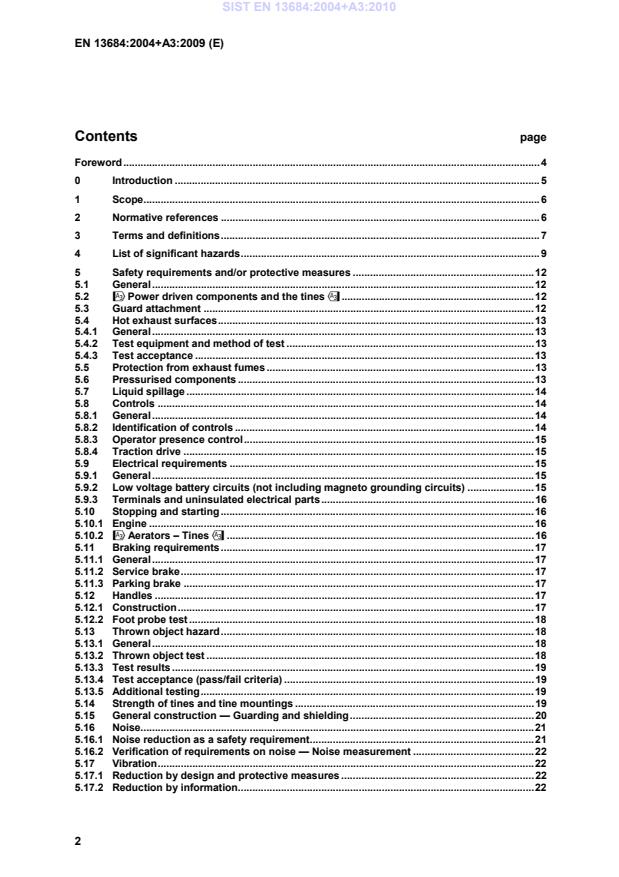
%Safety signs and symbols& . 34A.1General . 34A.2%Safety signs and symbols& . 34Annex B (informative)
Safety instructions . 36B.1General . 36B.2Safe operation practices. . 36B.2.1Training . 36B.2.2Preparation . 36B.2.3Operation . 37B.2.4Maintenance and storage . 38Annex C (normative)
Noise test code — Engineering method (grade 2) . 39C.1Scope. 39C.2A-weighted sound power level determination . 39C.3A-weighted emission sound pressure level measurement . 41C.4Requirements for test floor . 41C.4.1Artificial surface . 41C.4.2Natural grass . 42C.5Installation, mounting and operating conditions . 42C.6Measurement uncertainties and declaration of noise emission values . 43C.7Information to be recorded and reported . 43Annex D (informative)
Example of a material and construction fulfilling the requirements for an artificial surface. 44D.1Material . 44D.2Construction . 44Annex E (normative)
Vibration . 46E.1Quantities to be measured . 46E.2Instrumentation . 46E.2.1General . 46E.2.2Fastening of transducer . 46E.2.3Calibration . 46E.3Measurement direction and measurement location . 46E.3.1Measurement direction . 46E.3.2Measurement location . 47E.4Determination of working procedure . 47E.5Measurement procedure . 47E.6Determination of the measurement result . 48Annex ZA (informative)
#Relationship between this European Standard and the Essential Requirements of EU Directive 98/37/EC$ . 49Annex ZB (informative)
#Relationship between this European Standard and the Essential Requirements of EU Directive 2006/42/EC$ . 50Bibliography . 51 SIST EN 13684:2004+A3:2010
— machine parts or work pieces, e.g.:
e) inadequacy of mechanical strength; Tine failure/strength 5.14
— accumulation of energy inside the machinery e.g.:
g) liquids and gases under pressure; Hydraulic fluid leakage/burst 5.6, 6.1 1.2 Shearing hazard Contact with moving parts 5.2, 5.3, 5.10.2, 5.15, 6.1, 6.2 and annex A 1.3 Cutting or severing hazard Contact with moving parts 5.2, 5.3, 5.10.2, 5.15, 6.1, 6.2 and annex A 1.4 Entanglement hazard Contact with moving parts 5.2, 5.3, 5.10.2, 5.15, 6.1, 6.2 and annex A 1.5 Drawing-in or trapping hazard Contact with moving parts 5.2, 5.3, 5.10.2, 5.15, 6.1, 6.2 and annex A 1.6 Impact hazard Hit by thrown objects 5.3, 5.13 1.9 High pressure fluid injection or ejection hazard Penetration by high pressure fluid 5.6, 6.1 2 Electrical hazards due to: 2.1 Contact of persons with live parts (direct contact) Contact with live parts 5.9.3 2.3 Approach to live parts under high voltage Contact with HT ignition parts 5.9.3 2.5 Thermal radiation or other phenomena such as the projection of molten particles and chemical effects from short circuits, overloads, etc. Protection against circuit overload 5.9.2.3 3 Thermal hazards, resulting in: 3.1 Burns, scalds and other injuries by a possible contact of persons with objects or materials with an extreme high or low temperature, by flames or explosions and also by the radiation of heat sources Contact with hot parts 5.4 4 Hazards generated by noise, resulting in: 4.1 Hearing loss (deafness), other physiological disorders (e.g. loss of balance, loss of awareness) Hearing damage 5.16, 6.1, 6.2 and annex A, annex C 5 Hazards generated by vibration 5.1 Use of hand-held machines resulting in a variety of neurological and vascular disorders Vibration white finger 5.17, 6.1, annex E
(continued)
Over-speed of engine 5.8.1 Leaving unattended machine running 5.8.3 16 Break-up during operation Broken tines 5.14 17 Falling or ejected objects or fluids Thrown objects 5.3, 5.13
Additional hazards, hazardous situations and hazardous events due to mobility 20 Relating to the travelling function
20.1 Movement when starting the engine Movement of the machine 5.8.1, 5.8.3, 5.8.4 20.2 Movement without a driver at the driving position Operator presence control — tines Operator presence control — traction 5.8.3 5.8.4 20.6 Insufficient ability of machinery to be slowed down, stopped and immobilised Stopping from travelling Keeping stationary 5.11.1, 5.11.2 5.11.3 21 Linked to the work position (including driving station) on the machine 21.4 Mechanical hazards at the work position: c) fall of objects, penetration by objects e) contact of persons with machine parts or tools (pedestrian controlled machines)
Thrown objects Feet in contact with tines
5.3, 5.13 5.12
(continued) SIST EN 13684:2004+A3:2010
5.7 Liquid spillage When filled to the maximum according to the manufacturer's instructions liquid containers, batteries, fuel systems, oil reservoirs, and coolant systems shall be constructed to prevent spillage for 1 min whilst the machine is tilted at 20 ° lateral and 30 ° longitudinal. Weeping at vent systems shall not be considered as spillage. Compliance shall be checked by inspection. 5.8 Controls 5.8.1 General %Except as indicated in the following list, the following controls shall be located in such a way that they only require a range of movements within the anthropometric dimensions given for the operator zone in Figure 1: controls for setting the depth of penetration of the tines; catcher discharge arrangements; controls for engine starting with disengaged tines, or the tine enclosure shall, during normal operation, prevent the operator's feet coming into contact with the tines; compliance shall be verified by the test of 5.10.2. The operating range of controls that do not require sustained manual actuation may be extended by allowing the operator’s trunk, when standing with both feet on the ground, to articulate within the confines of the operator zone (e.g. lean forward until contacting the handle in any of the operating positions). The control for lifting the tines off the ground for transportation reasons is regarded to be such a control. If the control for lifting the tines off the ground for transportation is foot operated it shall be ≤ 450 mm in front of the handle measured horizontally from the rear most point of the handle. If the handle is adjustable the ≤ 450 mm dimension shall apply for all positions of the handle.& It shall not be possible to sustain an engine/motor speed greater than the maximum operating engine/motor speed by use of any control or by simple adjustments made by using standard tools. Compliance shall be checked by inspection. 5.8.2 Identification of controls Controls, whose purpose is not obvious to the user, shall have the function, direction and/or method of operation clearly identified by a durable label or mark. Operator control symbols shall comply with ISO 3767-1:1998, and ISO 3767-3:1995, and
ISO 3864-1:2002 for signs and colours. SIST EN 13684:2004+A3:2010
...