

EN 1628:2011
(Main)Pedestrian doorsets, windows, curtain walling, grilles and shutters - Burglar resistance - Test method for the determination of resistance under static loading
General Information
- Abstract
This European Standard specifies a test method for the determination of resistance to static loading in order to assess the burglar resistant properties of pedestrian door sets, windows, curtain walling, grilles and shutters. It is applicable to the following means of opening: Turning, tilting, folding, turn-tilting, top or bottom hung, sliding (horizontally and vertically) and rolling as well as fixed constructions.
This European Standard does not apply to doors, gates and barriers, intended for installation in areas in the reach of persons, and for which the main intended uses are giving safe access for goods and vehicles accompanied or driven by persons in industrial, commercial or residential premises, as covered by EN 13241-1.
- Status
- Withdrawn
- Publication Date
- 10-May-2011
- Withdrawal Date
- 29-Sep-2026
- Technical Committee
- CEN/TC 33 - Doors, windows, shutters and building hardware
- Drafting Committee
- CEN/TC 33 - Doors, windows, shutters and building hardware
- Current Stage
- 9960 - Withdrawal effective - Withdrawal
- Start Date
- 23-Dec-2015
- Completion Date
- 30-Sep-2026

Relations
- Effective Date
- 14-May-2011
- Effective Date
- 19-Jan-2023
- Effective Date
- 28-Jan-2026
- Effective Date
- 28-Jan-2026
- Effective Date
- 28-Jan-2026
- Effective Date
- 28-Jan-2026
- Effective Date
- 28-Jan-2026
- Refers
EN 1906:2010 - Building hardware - Lever handles and knob furniture - Requirements and test methods - Effective Date
- 28-Jan-2026
- Effective Date
- 28-Jan-2026
- Effective Date
- 28-Jan-2026
- Effective Date
- 21-May-2014
- Effective Date
- 06-May-2015
Get Certified
Connect with accredited certification bodies for this standard

DIBt (Deutsches Institut für Bautechnik)
German Institute for Building Technology.
DIN CERTCO
DIN Group product certification.

Kiwa BDA Testing
Building and construction product certification.
Sponsored listings
Frequently Asked Questions
EN 1628:2011 is a standard published by the European Committee for Standardization (CEN). Its full title is "Pedestrian doorsets, windows, curtain walling, grilles and shutters - Burglar resistance - Test method for the determination of resistance under static loading". This standard covers: This European Standard specifies a test method for the determination of resistance to static loading in order to assess the burglar resistant properties of pedestrian door sets, windows, curtain walling, grilles and shutters. It is applicable to the following means of opening: Turning, tilting, folding, turn-tilting, top or bottom hung, sliding (horizontally and vertically) and rolling as well as fixed constructions. This European Standard does not apply to doors, gates and barriers, intended for installation in areas in the reach of persons, and for which the main intended uses are giving safe access for goods and vehicles accompanied or driven by persons in industrial, commercial or residential premises, as covered by EN 13241-1.
This European Standard specifies a test method for the determination of resistance to static loading in order to assess the burglar resistant properties of pedestrian door sets, windows, curtain walling, grilles and shutters. It is applicable to the following means of opening: Turning, tilting, folding, turn-tilting, top or bottom hung, sliding (horizontally and vertically) and rolling as well as fixed constructions. This European Standard does not apply to doors, gates and barriers, intended for installation in areas in the reach of persons, and for which the main intended uses are giving safe access for goods and vehicles accompanied or driven by persons in industrial, commercial or residential premises, as covered by EN 13241-1.
EN 1628:2011 is classified under the following ICS (International Classification for Standards) categories: 13.310 - Protection against crime; 91.060.50 - Doors and windows. The ICS classification helps identify the subject area and facilitates finding related standards.
EN 1628:2011 has the following relationships with other standards: It is inter standard links to ENV 1628:1999, EN 1628:2011+A1:2015, EN 1630:2011, EN 1629:2011, EN 356:1999, EN 1303:2005, EN 12209:2003, EN 1906:2010, EN 12195-2:2000, EN 1627:2011, EN 1628:2011/FprA1, EN 1628:2021. Understanding these relationships helps ensure you are using the most current and applicable version of the standard.
EN 1628:2011 is associated with the following European legislation: EU Directives/Regulations: 305/2011, 89/106/EEC. When a standard is cited in the Official Journal of the European Union, products manufactured in conformity with it benefit from a presumption of conformity with the essential requirements of the corresponding EU directive or regulation.
EN 1628:2011 is available in PDF format for immediate download after purchase. The document can be added to your cart and obtained through the secure checkout process. Digital delivery ensures instant access to the complete standard document.
Standards Content (Sample)
2003-01.Slovenski inštitut za standardizacijo. Razmnoževanje celote ali delov tega standarda ni dovoljeno.Einbruchhemmende Bauprodukte (nicht für Betonfertigteile) - Prüfverfahren für die Ermittlung der Widerstandsfähigkeit unter statischer BelastungProduits de construction résistants à l'effraction (sauf éléments en béton préfabriqué) - Méthode d'essai pour la détermination de la résistance à la charge statiquePedestrian doorsets, windows, curtain walling, grilles and shutters - Burglar resistance - Test method for the determination of resistance under static loading91.060.50Vrata in oknaDoors and windows13.310Varstvo pred kriminalomProtection against crimeICS:Ta slovenski standard je istoveten z:EN 1628:2011SIST EN 1628:2012en,fr,de01-januar-2012SIST EN 1628:2012SLOVENSKI
STANDARDSIST ENV 1628:20001DGRPHãþD
EUROPEAN STANDARD NORME EUROPÉENNE EUROPÄISCHE NORM
EN 1628
May 2011 ICS 13.310; 91.060.50 Supersedes ENV 1628:1999English Version
Pedestrian doorsets, windows, curtain walling, grilles and shutters - Burglar resistance - Test method for the determination of resistance under static loading
Blocs-portes pour piétons, fenêtres, façades rideaux, grilles et fermetures - Résistance à l'effraction - Méthode d'essai pour la détermination de la résistance à la charge statique Türen, Fenster, Vorhangfassaden, Gitterelemente und Abschlüsse - Einbruchhemmung - Prüfverfahren für die Ermittlung der Widerstandsfähigkeit unter statischer Belastung This European Standard was approved by CEN on 2 December 2010.
CEN members are bound to comply with the CEN/CENELEC Internal Regulations which stipulate the conditions for giving this European Standard the status of a national standard without any alteration. Up-to-date lists and bibliographical references concerning such national standards may be obtained on application to the CEN-CENELEC Management Centre or to any CEN member.
This European Standard exists in three official versions (English, French, German). A version in any other language made by translation under the responsibility of a CEN member into its own language and notified to the CEN-CENELEC Management Centre has the same status as the official versions.
CEN members are the national standards bodies of Austria, Belgium, Bulgaria, Croatia, Cyprus, Czech Republic, Denmark, Estonia, Finland, France, Germany, Greece, Hungary, Iceland, Ireland, Italy, Latvia, Lithuania, Luxembourg, Malta, Netherlands, Norway, Poland, Portugal, Romania, Slovakia, Slovenia, Spain, Sweden, Switzerland and United Kingdom.
EUROPEAN COMMITTEE FOR STANDARDIZATION
COMITÉ EUROPÉEN DE NORMALISATION EUROPÄISCHES KOMITEE FÜR NORMUNG
Management Centre:
Avenue Marnix 17,
B-1000 Brussels © 2011 CEN All rights of exploitation in any form and by any means reserved worldwide for CEN national Members. Ref. No. EN 1628:2011: ESIST EN 1628:2012
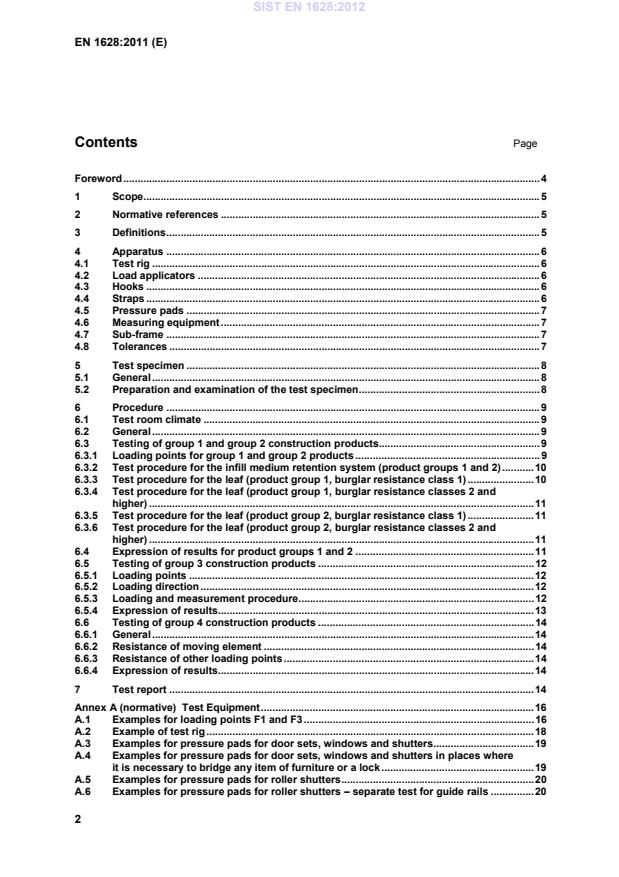
Test Equipment . 16A.1Examples for loading points F1 and F3 . 16A.2Example of test rig . 18A.3Examples for pressure pads for door sets, windows and shutters . 19A.4Examples for pressure pads for door sets, windows and shutters in places where it is necessary to bridge any item of furniture or a lock . 19A.5Examples for pressure pads for roller shutters . 20A.6Examples for pressure pads for roller shutters – separate test for guide rails . 20SIST EN 1628:2012
Test sequence for static loading test in resistance classes 1 to 6 . 63Annex C (normative)
Dislocation of window hardware against the locking direction . 65C.1General . 65C.2Test criteria . 65C.3Test method . 65Bibliography . 67 SIST EN 1628:2012
The test rig is consisting of a rigid steel frame with movable steel supports into which test specimens of various dimensions can be mounted, as shown in Figure A.5. The stiffness of the rig shall be such that a 15 kN force applied to any of the defined points and normal to the plane of the frame shall not cause a deflection of more than 5 mm. The test rig shall not impede the execution of the test. 4.2 Load applicators
The load applicators consisting of a hydraulic ram or similar loading device shall be capable of applying the required test forces progressively and without shock. 4.3 Hooks
Hooks are shown in Figure A.12. 4.4 Straps
Straps shall conform to EN 12195-2 or equivalent and have a minimum tensile strength of 5kN. These straps may be used to apply some of the loads. SIST EN 1628:2012
Pressure pads are shown in Figures A.6 to A.11. 4.6 Measuring equipment
The measurement equipment is consisting of the following: a) equipment to display and/or record the forces being applied; b) a chronometer with seconds display for measuring the loading times; c) equipment for determining temperature and relative humidity; d) calliper and/or depth gauge; e) angle measuring instrument; f) four gap gauges as shown in Figures A.13 and A.14: gap gauge A shall be 10 mm in diameter, gap gauge B shall be 25 mm in diameter, gap gauge C shall be 50 mm in diameter, gap gauge D shall have an elliptical form with a major diameter of 250 mm and a minor diameter of 150 mm. NOTE
The various gap gauges detailed in A.10 are used to evaluate the resistance to an applied load. They represent an acceptable level of deformation of the various products above which vulnerabilities may be exposed. They are not intended to represent any particular attack method but are used as a simple method to establishing failure. 4.7 Sub-frame The sub-frame shall simulate the support given to the product when installed into a building and shall be taken into consideration in the manufacturer´s installation instructions. It shall typically consist of the following: a) for group 1 to group 4 products, a rectangular metal tube 120 mm x 120 mm x 5 mm or a rectangular timber frame 100 mm x 50 mm; b) additionally for group 3 and group 4 products, a steel tube 40 mm x 40 mm x 3 mm; and a base plate of 8 mm steel, consisting of several segments which shall be removable for the purposes of loading if necessary. See Figures A.15 to A.32. 4.8 Tolerances Unless stated otherwise in this European Standard the following tolerances shall apply to the test equipment: Load
± 5 % Dimensions
< 20 mm
± 0,5 mm
≥ 20 to 500 mm
± 1,0 mm
≥ 500 to 2000 mm
± 2.0 mm
≥ 2000 mm
± 3,0 mm SIST EN 1628:2012
± 2° Time
± 1 % Temperature
± 2 °C Relative humidity
± 5 % 5 Test specimen 5.1 General Each test specimen shall be a functioning product complete with its frames, hardware, guide rails, curtain, tube, roller box and accessories, as appropriate. When testing roller shutters at least two test specimens consisting of separate sections of the guide rails shall be supplied for test. These sections shall be 1 m in length (see Figure A.56). The test specimen shall be fixed square and plumb and without twist or bend into a sub-frame. The installation shall be in accordance with the manufacturer's instructions as detailed in clause 10 of EN 1627:2011, including the method of fixing, packing supports, sealing requirements, etc. (see Figures A.15 to A.63). The sub-frame shall simulate the support given to the product when installed into a building. NOTE 1
The product may be installed directly into a building element as intended in practice. For the purposes of this standard, the test specimen shall be glazed according to the relevant glazing resistance class of EN 356:1999, corresponding to the resistance class of the construction product according to EN 1627:2011, as shown in Table 1. Security glazing, when used in an insulating glass unit, is normally positioned on the non-attack side. For the purpose of this test the glass pane offering the highest security level shall be positioned on the attack side of the sample. Table 1 — Test sample glazing requirements Resistance classResistance class of glazing according to EN 356 RC 1 N P4 A RC 2 N P4A RC 2 P4 A RC 3 P5 A RC 4 P6 B RC 5 P7 B RC 6 P8 B
NOTE 2
The test specimen used in this test may also be used for the dynamic test in accordance with EN 1629:2011 and the pre-test in accordance with EN 1630:2011, provided that any damage caused by these tests will not affect the result of the pre-test. 5.2 Preparation and examination of the test specimen The temperature of the test specimen shall be maintained between 15 °C and 30 °C for a period of not less than 8 hours prior to test. The test specimen and sub-frame mounted in the test rig shall be visually examined for damage, defects or other particular conditions of finish, etc. These shall be recorded. SIST EN 1628:2012
The parts removed during this preparation shall be recorded. 6 Procedure 6.1 Test room climate The test room temperature shall be maintained between 15 °C and 30 °C. The relative humidity in the test room shall be between 30 % and 70 %. 6.2 General The specified test loads detailed in EN 1627:2011 shall be applied in the order specified in 7.1 of EN 1627:2011 at the various loading points using the load applicator. The ability of the products to resist static loading shall be assessed by means of a gap gauge, as shown in Figures A.13 and A.14. The complete test procedure shall be carried out as shown in Annex B. Details of the hardware shall be recorded and their performance in terms of EN 1303:2005, EN 12209:2003 and EN 1906:2010 shall be identified, where relevant. 6.3 Testing of group 1 and group 2 construction products 6.3.1 Loading points for group 1 and group 2 products 6.3.1.1 Loading point F1: infilling corner The specified load shall be applied, in turn, to each corner of the infilling medium at a point as shown in Figure A.1, unless the infilling medium is circular, in which case four points shall be selected at approximately equidistant intervals around the edge. The load shall be applied in a direction to disassemble the infilling medium retention system and perpendicular to the plane of the test specimen. 6.3.1.2 Loading point F2: leaf corner The specified load shall be applied, in turn, to each corner of the leaf if the adjacent locking point has a greater distance A than 350 mm from the corner as shown in Figures A.33 to A.45. If no corner exists (e.g. circular product) apply the loads half way between locking points. It shall be applied in a direction to open the leaf and perpendicular to the plane of the test specimen. SIST EN 1628:2012
For the purpose of this test, the leaf of the test specimen shall be restrained to resist any deflection between leaf and frame due to the loads applied to the infilling medium. The restraint shall have a nominal contact area of 100 X 50 mm and offer restraint in the opposite directions to the applied load. The load F1 shall be applied progressively and without shock over a period of 10 s to 20 s and within 5° of perpendicular to plane to each corner of the infill medium. The load shall be maintained for a period of 8 s to 12 s. If the retention
...