

EN 14977:2006
(Main)Copper and copper alloys - Detection of tensile stress - 5 % ammonia test
General Information
- Abstract
This standard specifies a medium duration test using an ammonical atmosphere for the purpose of detecting the presence of tensile stress, residual or applied, in grades of copper or copper alloy products that might bring about failure of a component in service or storage through stress corrosion cracking.
The field of application of this standard is specified in the technical delivery specifications of semi finished or finished products in grades of copper and copper alloys, or by prior agreement between purchaser and supplier.
- Status
- Published
- Publication Date
- 20-Jun-2006
- Withdrawal Date
- 30-Dec-2006
- Technical Committee
- CEN/TC 133 - Copper and copper alloys
- Drafting Committee
- CEN/TC 133 - Copper and copper alloys
- Current Stage
- 9093 - Decision to confirm - Review Enquiry
- Start Date
- 18-Apr-2023
- Completion Date
- 30-Sep-2026

Overview
EN 14977:2006 is a European standard developed by the European Committee for Standardization (CEN) that specifies a method for detecting tensile stress in copper and copper alloys through a 5% ammonia test. This medium-duration test is designed to expose copper or copper alloy products to an ammoniacal atmosphere, providing a means to identify the presence of residual or applied tensile stresses. Such stresses are significant because they can cause stress corrosion cracking (SCC), potentially compromising the integrity of components during service or storage.
This standard is particularly valuable for the industrial quality control of semi-finished or finished copper and copper alloy products. It offers a procedure that avoids the health and environmental hazards associated with earlier mercury-based tests, such as those described in EN ISO 196, while delivering comparable sensitivity and faster results.
Key Topics
Detection of Tensile Stress:
EN 14977:2006 outlines procedures to determine if tensile stresses-either residual from manufacturing or externally applied-are present in copper products.5% Ammonia Test Method:
The standard describes immersing or exposing test pieces to an ammonia-rich atmosphere, simulating conditions that could lead to stress corrosion cracking.Stress Corrosion Cracking (SCC):
The test assesses the susceptibility of copper alloys to SCC, which is the cracking of metals due to the combined influence of tensile stress and corrosive environments.Health and Environmental Safety:
By utilizing ammonia instead of mercury compounds, the procedure reduces environmental risk and hazards for operators.Visual Inspection Guidelines:
After the test exposure, the appearance of the test piece is examined under low-magnification (×6 to ×10) to identify cracks.Reporting Requirements:
Guidance is provided for consistent test result documentation, including the identification of samples, environmental conditions, and test outcomes.
Applications
EN 14977:2006 is applied across various sectors where copper and copper alloy components are used and must maintain mechanical integrity, such as:
Manufacturing and Quality Assurance:
Used by suppliers and purchasers to verify that components are free of detrimental tensile stresses before deployment.Component Reliability:
Ensures the long-term durability of pipes, electrical wiring, connectors, and structural components that may be prone to stress corrosion.Product Specification Compliance:
Serves as a reference in technical delivery specifications for semi-finished or finished products, or by agreement between buyers and sellers.Failure Analysis:
Helps identify the root cause of in-service failures attributed to stress corrosion cracking, supporting safer and more reliable design choices.
Related Standards
Several international standards and reference documents are aligned with or complement EN 14977:2006:
EN ISO 196:
Wrought copper and copper alloys - Detection of residual stress - Mercury(I) nitrate test. An alternative test replaced for environmental considerations.ISO 6957:
Copper alloys - Ammonia test for stress corrosion resistance. Provides additional ammonia-based methods for SCC assessment.ASTM G 37:
Standard Practice for Use of Mattsson's Solution to Evaluate Stress-Corrosion Cracking Susceptibility in Copper-Zinc Alloys.Copper and Copper Alloy Standards (CEN/TC 133):
Additional specifications and product-related standards managed by the CEN Technical Committee for copper materials.
EN 14977:2006 represents a safe, effective method for detecting tensile stress in copper and copper alloy products, playing a crucial role in ensuring the reliability and safety of these materials in widespread industrial use. For organizations seeking to establish robust quality control measures, this standard forms a cornerstone in reducing product failures due to stress corrosion cracking.
Relations
- Effective Date
- 28-Jan-2026
- Effective Date
- 28-Jan-2026
- Effective Date
- 28-Jan-2026
- Effective Date
- 28-Jan-2026
- Effective Date
- 28-Jan-2026
- Effective Date
- 28-Jan-2026
- Effective Date
- 28-Jan-2026
- Effective Date
- 28-Jan-2026
- Effective Date
- 28-Jan-2026
- Effective Date
- 28-Jan-2026
- Effective Date
- 28-Jan-2026
- Effective Date
- 28-Jan-2026
- Effective Date
- 28-Jan-2026
- Effective Date
- 28-Jan-2026
Get Certified
Connect with accredited certification bodies for this standard

Element Materials Technology
Materials testing and product certification.

Inštitut za kovinske materiale in tehnologije
Institute of Metals and Technology. Materials testing, metallurgical analysis, NDT.
Sponsored listings
Frequently Asked Questions
EN 14977:2006 is a standard published by the European Committee for Standardization (CEN). Its full title is "Copper and copper alloys - Detection of tensile stress - 5 % ammonia test". This standard covers: This standard specifies a medium duration test using an ammonical atmosphere for the purpose of detecting the presence of tensile stress, residual or applied, in grades of copper or copper alloy products that might bring about failure of a component in service or storage through stress corrosion cracking. The field of application of this standard is specified in the technical delivery specifications of semi finished or finished products in grades of copper and copper alloys, or by prior agreement between purchaser and supplier.
This standard specifies a medium duration test using an ammonical atmosphere for the purpose of detecting the presence of tensile stress, residual or applied, in grades of copper or copper alloy products that might bring about failure of a component in service or storage through stress corrosion cracking. The field of application of this standard is specified in the technical delivery specifications of semi finished or finished products in grades of copper and copper alloys, or by prior agreement between purchaser and supplier.
EN 14977:2006 is classified under the following ICS (International Classification for Standards) categories: 77.150.30 - Copper products. The ICS classification helps identify the subject area and facilitates finding related standards.
EN 14977:2006 has the following relationships with other standards: It is inter standard links to EN 12168:2024, EN 12420:2024, EN 12163:2016, EN 12167:2024, EN 12167:2016, EN 12163:2011, EN 12164:2016, EN 12167:2011, EN 12164:2011, EN 12168:2011, EN 12168:2016, EN 12163:2024, EN 12420:2014, EN 12164:2024. Understanding these relationships helps ensure you are using the most current and applicable version of the standard.
EN 14977:2006 is available in PDF format for immediate download after purchase. The document can be added to your cart and obtained through the secure checkout process. Digital delivery ensures instant access to the complete standard document.
Standards Content (Sample)
2003-01.Slovenski inštitut za standardizacijo. Razmnoževanje celote ali delov tega standarda ni dovoljeno.Copper and copper alloys - Detection of tensile stress - 5 % ammonia testBaker in bakrove zlitine - Ugotavljanje natezne napetosti - Preskus s 5-odstotnim amoniakomCuivre et alliages de cuivre - Détection des contraintes de traction - Essai a l'ammoniaque a 5 %Kupfer und Kupferlegierungen - Auffinden von Zugspannungen - 5 % AmmoniakprüfungTa slovenski standard je istoveten z:EN 14977:2006SIST EN 14977:2006en77.120.30ICS:SLOVENSKI
STANDARDSIST EN 14977:200601-september-2006
EUROPEAN STANDARDNORME EUROPÉENNEEUROPÄISCHE NORMEN 14977June 2006ICS 77.150.30 English VersionCopper and copper alloys - Detection of tensile stress - 5 %ammonia testCuivre et alliages de cuivre - Détection des contraintes detraction - Essai à l'ammoniaque à 5 %Kupfer und Kupferlegierungen - Auffinden vonZugspannungen - 5 % AmmoniakprüfungThis European Standard was approved by CEN on 15 May 2006.CEN members are bound to comply with the CEN/CENELEC Internal Regulations which stipulate the conditions for giving this EuropeanStandard the status of a national standard without any alteration. Up-to-date lists and bibliographical references concerning such nationalstandards may be obtained on application to the Central Secretariat or to any CEN member.This European Standard exists in three official versions (English, French, German). A version in any other language made by translationunder the responsibility of a CEN member into its own language and notified to the Central Secretariat has the same status as the officialversions.CEN members are the national standards bodies of Austria, Belgium, Cyprus, Czech Republic, Denmark, Estonia, Finland, France,Germany, Greece, Hungary, Iceland, Ireland, Italy, Latvia, Lithuania, Luxembourg, Malta, Netherlands, Norway, Poland, Portugal, Romania,Slovakia, Slovenia, Spain, Sweden, Switzerland and United Kingdom.EUROPEAN COMMITTEE FOR STANDARDIZATIONCOMITÉ EUROPÉEN DE NORMALISATIONEUROPÄISCHES KOMITEE FÜR NORMUNGManagement Centre: rue de Stassart, 36
B-1050 Brussels© 2006 CENAll rights of exploitation in any form and by any means reservedworldwide for CEN national Members.Ref. No. EN 14977:2006: E
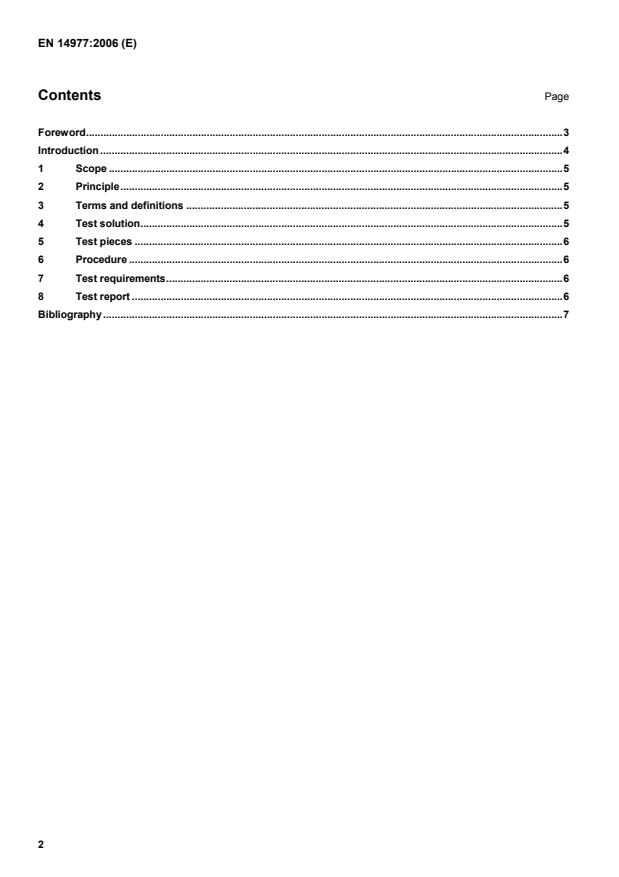
Contents Page Foreword.3 Introduction.4 1 Scope.5 2 Principle.5 3 Terms and definitions.5 4 Test solution.5 5 Test pieces.6 6 Procedure.6 7 Test requirements.6 8 Test report.6 Bibliography.7
Foreword This document (EN 14977:2006) has been prepared by Technical Committee CEN/TC 133 “Copper and copper alloys”, the secretariat of which is held by DIN. This European Standard shall be given the status of a national standard, either by publication of an identical text or by endorsement, at the latest by December 2006, and conflicting national standards shall be withdrawn at the latest by December 2006. According to the CEN/CENELEC Internal Regulations, the national standards organizations of the following countries are bound to implement this European Standard: Austria, Belgium, Cyprus, Czech Republic, Denmark, Estonia, Finland, France, Germany, Greece, Hungary, Iceland, Ireland, Italy, Latvia, Lithuania, Luxembourg, Malta, Netherlands, Norway, Poland, Portugal, Romania, Slovakia, Slovenia, Spain, Sweden, Switzerland and United Kingdom.
Introduction This test was developed to achieve three aims in particular: firstly to avoid health and environmental risks which are associated with the use of media other than ammonia, (e.g. with the use of compounds of mercury and recovery of mercury polluted test pieces), but with a similar sensitivity as the test according to EN ISO 196; secondly to combine a test on tensile stress with a test on stress corrosion cracking; thirdly to reduce the test duration from usually 24 h, as specified in ISO 6957, to 16 h. It is not intended to replace and withdraw EN ISO 196 in favour of this standard. In so far as a rapid result is required, the test according to EN ISO 196 can be used.
1 Scope This standard specifies a medium-duration test using
...