

EN 12163:2024
(Main)Copper and copper alloys - Rod for general purposes
General Information
- Abstract
This European Standard specifies the composition, property requirements and dimensional tolerances for copper alloy rod in the shape of circles, squares, hexagons or octagons, finally produced by drawing or extruding intended for general purposes.
The sampling procedures and the methods of test for verification of conformity to the requirements of this European Standard are also specified.
- Status
- Published
- Publication Date
- 15-Oct-2024
- Technical Committee
- CEN/TC 133 - Copper and copper alloys
- Drafting Committee
- CEN/TC 133/WG 4 - Extruded and drawn products, forgings and scrap
- Current Stage
- 6060 - Definitive text made available (DAV) - Publishing
- Start Date
- 16-Oct-2024
- Due Date
- 27-Nov-2023
- Completion Date
- 16-Oct-2024

Overview
EN 12163:2024 - published by CEN - is the European standard for copper and copper-alloy rod for general purposes. It specifies composition, property requirements and dimensional tolerances for rods in circular, square, hexagonal and octagonal cross-sections, finally produced by drawing or extrusion. The standard also defines sampling procedures and test methods to verify conformity, and replaces EN 12163:2016 (approved 30 June 2024, to be adopted by CEN members by April 2025).
Key Topics
- Material designation and numbering: Symbols (ISO 1190‑1) and numbers (EN 1412) for copper alloys and material-condition codes (EN 1173).
- Composition and alloy types: Chemical composition limits for specified copper alloys; recent additions include CuSi4Zn4MnP (CW245E), CuSi4Zn9MnP (CW246E) and CuSn5 (CW451K). Note: CW245E/CW246E may be subject to patent licensing (holder: Viega Technology GmbH).
- Mechanical property requirements: Tensile strength, hardness and residual stress level requirements with specified test locations and specimen forms.
- Corrosion resistance tests: Dezincification resistance and stress-corrosion resistance procedures (EN ISO 6509‑1; EN 14977 / ISO 6957).
- Dimensional tolerances and geometry: Diameter or width across flats, shape tolerances, straightness, length, corner radii and twist limits for polygonal rods.
- Surface and internal quality: Surface finish requirements and new clause on internal inclusion (introduced in 2024).
- Sampling and test methods: Analysis, tensile, hardness, conductivity, dezincification and stress‑corrosion tests, plus retest and rounding rules.
- Conformity documentation: Certificate of compliance, inspection documentation and marking/packaging requirements. Annex ZA relates the standard to Directive 2014/68/EU (Pressure Equipment Directive).
Applications
EN 12163 is used by:
- Producers of copper rod (foundries, continuous casting and extrusion plants) to specify product characteristics for general-purpose rod.
- Suppliers and distributors to certify composition, mechanical properties and tolerances.
- Machining and manufacturing operations that draw, machine, form or convert rod into components.
- Quality, testing and inspection laboratories for conformity testing and reporting.
- Procurement and design engineers writing specifications where consistent dimensional, chemical and corrosion-resistance performance is required.
Keywords: EN 12163, copper rod, copper alloys, dimensional tolerances, dezincification test, stress corrosion resistance, mechanical properties, CEN standard.
Related standards
- EN 12164 - Rod for free machining purposes
- EN 12165 - Wrought and unwrought forging stock
- EN 12166 - Wire for general purposes
- EN 12167 - Profiles and bars for general purposes
- EN ISO 6892‑1, EN ISO 6506‑1, EN ISO 6509‑1 and normative references listed in EN 12163 for test methods and inspection documentation.
Relations
- Effective Date
- 09-Oct-2019
- Effective Date
- 11-Mar-2026
- Refers
ISO 1190-1:1982 - Copper and copper alloys — Code of designation — Part 1: Designation of materials - Effective Date
- 09-Feb-2026
- Effective Date
- 28-Jan-2026
- Effective Date
- 28-Jan-2026
- Effective Date
- 28-Jan-2026
- Effective Date
- 28-Jan-2026
- Effective Date
- 28-Jan-2026
- Effective Date
- 28-Jan-2026
- Effective Date
- 28-Jan-2026
- Effective Date
- 28-Jan-2026
- Effective Date
- 28-Jan-2026
- Effective Date
- 28-Jan-2026
- Effective Date
- 28-Jan-2026
- Effective Date
- 28-Jan-2026
Get Certified
Connect with accredited certification bodies for this standard

Element Materials Technology
Materials testing and product certification.

Inštitut za kovinske materiale in tehnologije
Institute of Metals and Technology. Materials testing, metallurgical analysis, NDT.
Sponsored listings
Frequently Asked Questions
EN 12163:2024 is a standard published by the European Committee for Standardization (CEN). Its full title is "Copper and copper alloys - Rod for general purposes". This standard covers: This European Standard specifies the composition, property requirements and dimensional tolerances for copper alloy rod in the shape of circles, squares, hexagons or octagons, finally produced by drawing or extruding intended for general purposes. The sampling procedures and the methods of test for verification of conformity to the requirements of this European Standard are also specified.
This European Standard specifies the composition, property requirements and dimensional tolerances for copper alloy rod in the shape of circles, squares, hexagons or octagons, finally produced by drawing or extruding intended for general purposes. The sampling procedures and the methods of test for verification of conformity to the requirements of this European Standard are also specified.
EN 12163:2024 is classified under the following ICS (International Classification for Standards) categories: 77.150.30 - Copper products. The ICS classification helps identify the subject area and facilitates finding related standards.
EN 12163:2024 has the following relationships with other standards: It is inter standard links to EN 12163:2016, ISO 6957:1988, ISO 1190-1:1982, EN 10204:2004, EN ISO 6506-1:2014, EN 1173:2008, EN ISO 6892-1:2019, EN ISO 6509-1:2014, EN 14977:2006, EN 764-5:2014, EN ISO 15721:2001, EN 1412:2016, EN 1252-1:1998, EN 1503-4:2016, EN 331:2015. Understanding these relationships helps ensure you are using the most current and applicable version of the standard.
EN 12163:2024 is associated with the following European legislation: EU Directives/Regulations: 2014/68/EU; Standardization Mandates: M/017, M/601. When a standard is cited in the Official Journal of the European Union, products manufactured in conformity with it benefit from a presumption of conformity with the essential requirements of the corresponding EU directive or regulation.
EN 12163:2024 is available in PDF format for immediate download after purchase. The document can be added to your cart and obtained through the secure checkout process. Digital delivery ensures instant access to the complete standard document.
Standards Content (Sample)
SLOVENSKI STANDARD
01-december-2024
Baker in bakrove zlitine - Palice za splošno uporabo
Copper and copper alloys - Rod for general purposes
Kupfer und Kupferlegierungen - Stangen zur allgemeinen Verwendung
Cuivre et alliages de cuivre - Barres pour usages généraux
Ta slovenski standard je istoveten z: EN 12163:2024
ICS:
77.150.30 Bakreni izdelki Copper products
2003-01.Slovenski inštitut za standardizacijo. Razmnoževanje celote ali delov tega standarda ni dovoljeno.
EN 12163
EUROPEAN STANDARD
NORME EUROPÉENNE
October 2024
EUROPÄISCHE NORM
ICS 77.150.30 Supersedes EN 12163:2016
English Version
Copper and copper alloys - Rod for general purposes
Cuivre et alliages de cuivre - Barres pour usages Kupfer und Kupferlegierungen - Stangen zur
généraux allgemeinen Verwendung
This European Standard was approved by CEN on 30 June 2024.
CEN members are bound to comply with the CEN/CENELEC Internal Regulations which stipulate the conditions for giving this
European Standard the status of a national standard without any alteration. Up-to-date lists and bibliographical references
concerning such national standards may be obtained on application to the CEN-CENELEC Management Centre or to any CEN
member.
This European Standard exists in three official versions (English, French, German). A version in any other language made by
translation under the responsibility of a CEN member into its own language and notified to the CEN-CENELEC Management
Centre has the same status as the official versions.
CEN members are the national standards bodies of Austria, Belgium, Bulgaria, Croatia, Cyprus, Czech Republic, Denmark, Estonia,
Finland, France, Germany, Greece, Hungary, Iceland, Ireland, Italy, Latvia, Lithuania, Luxembourg, Malta, Netherlands, Norway,
Poland, Portugal, Republic of North Macedonia, Romania, Serbia, Slovakia, Slovenia, Spain, Sweden, Switzerland, Türkiye and
United Kingdom.
EUROPEAN COMMITTEE FOR STANDARDIZATION
COMITÉ EUROPÉEN DE NORMALISATION
EUROPÄISCHES KOMITEE FÜR NORMUNG
CEN-CENELEC Management Centre: Rue de la Science 23, B-1040 Brussels
© 2024 CEN All rights of exploitation in any form and by any means reserved Ref. No. EN 12163:2024 E
worldwide for CEN national Members.
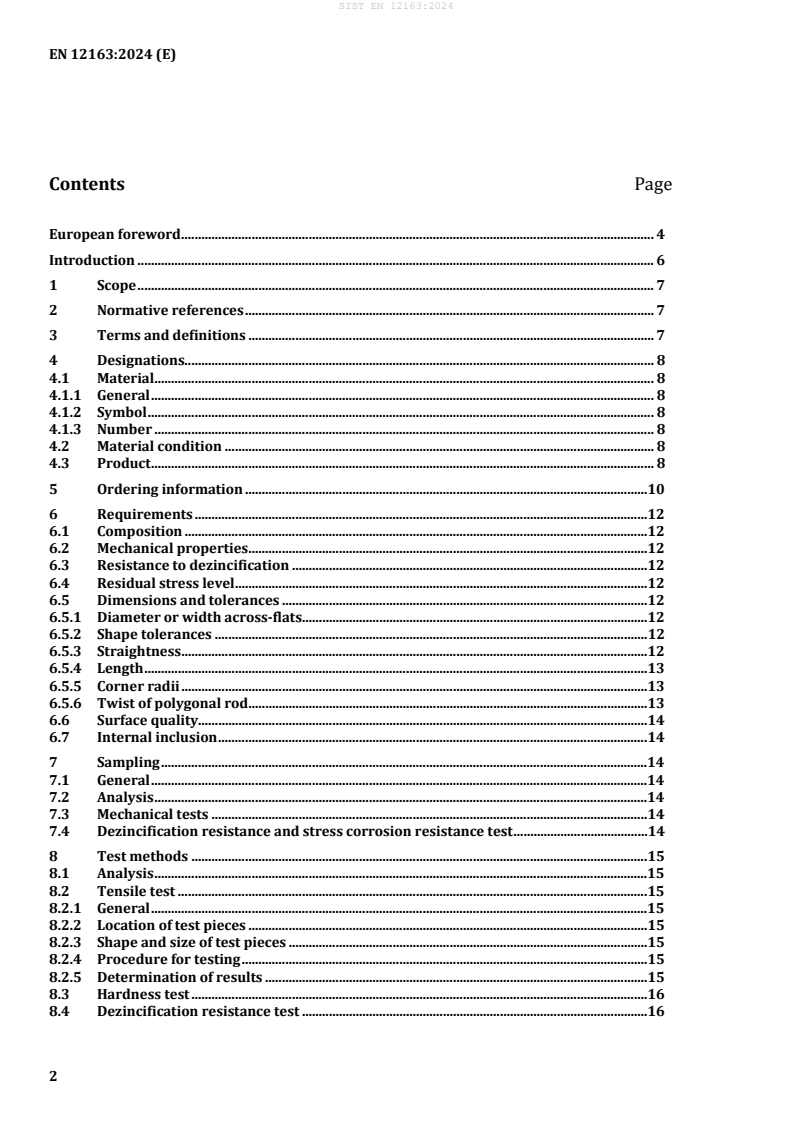
Contents Page
European foreword . 4
Introduction . 6
1 Scope . 7
2 Normative references . 7
3 Terms and definitions . 7
4 Designations. 8
4.1 Material . 8
4.1.1 General . 8
4.1.2 Symbol . 8
4.1.3 Number . 8
4.2 Material condition . 8
4.3 Product . 8
5 Ordering information .10
6 Requirements .12
6.1 Composition .12
6.2 Mechanical properties .12
6.3 Resistance to dezincification .12
6.4 Residual stress level .12
6.5 Dimensions and tolerances .12
6.5.1 Diameter or width across-flats .12
6.5.2 Shape tolerances .12
6.5.3 Straightness .12
6.5.4 Length .13
6.5.5 Corner radii .13
6.5.6 Twist of polygonal rod .13
6.6 Surface quality.14
6.7 Internal inclusion .14
7 Sampling .14
7.1 General .14
7.2 Analysis .14
7.3 Mechanical tests .14
7.4 Dezincification resistance and stress corrosion resistance test .14
8 Test methods .15
8.1 Analysis .15
8.2 Tensile test .15
8.2.1 General .15
8.2.2 Location of test pieces .15
8.2.3 Shape and size of test pieces .15
8.2.4 Procedure for testing .15
8.2.5 Determination of results .15
8.3 Hardness test .16
8.4 Dezincification resistance test .16
8.5 Stress corrosion resistance test . 16
8.6 Determination of the electrical conductivity . 16
8.7 Retests . 16
8.7.1 Analysis, tensile, hardness and dezincification resistance tests and determination of
the electrical conductivity . 16
8.7.2 Stress corrosion resistance test . 17
8.8 Rounding of results . 17
9 Certificate of compliance and inspection documentation . 17
9.1 Certificate of compliance . 17
9.2 Inspection documentation . 17
10 Marking, packaging, labelling . 17
Annex ZA (informative) Relationship between this European Standard and the essential
requirements of Directive 2014/68/EU (Pressure equipment Directive) aimed to be
covered . 43
Bibliography . 44
European foreword
This document (EN 12163:2024) has been prepared by Technical Committee CEN/TC 133 “Copper and
copper alloys”, the secretariat of which is held by DIN.
This European Standard shall be given the status of a national standard, either by publication of an
identical text or by endorsement, at the latest by April 2025, and conflicting national standards shall be
withdrawn at the latest by April 2025.
Attention is drawn to the possibility that some of the elements of this document may be the subject of
patent rights. CEN shall not be held responsible for identifying any or all such patent rights.
This document supersedes EN 12163:2016.
In comparison with EN 12163:2016, the following significant technical changes were made:
a) Introduction of 6.7 Internal inclusion;
b) Modified the definition of diameter or width across-flats at 6.5.1;
c) Added a new Figure for straightness at 6.5.3 and modified values in Table 18
d) CuSi4Zn4MnP (CW245E) and CuSi4Zn9MnP (CW246E) added in the new Table 2 and new Table 10
e) CuSn5 (CW451K) added in Table 6 and Table 14;
f) Introduction in the chemical composition Tables of a footnote to explain the meaning of elements for
which no upper and lower limits are specified;
g) Annex ZA added.
This document is one of a series of European Standards for the copper and copper alloy products rod,
wire, profile and forgings. Other products are specified as follows:
— EN 12164, Copper and copper alloys — Rod for free machining purposes;
— EN 12165, Copper and copper alloys — Wrought and unwrought forging stock;
— EN 12166, Copper and copper alloys — Wire for general purposes;
— EN 12167, Copper and copper alloys — Profiles and bars for general purposes;
— EN 12168, Copper and copper alloys — Hollow rod for free machining purposes;
— EN 13601, Copper and copper alloys — Copper rod, bar and wire for general electrical purposes;
— EN 13602, Copper and copper alloys — Drawn, round copper wire for the manufacture of electrical
conductors;
— EN 13605, Copper and copper alloys — Copper profiles and profiled wire for electrical purposes.
This document has been prepared under a standardization request addressed to CEN by the European
Commission. The Standing Committee of the EFTA States subsequently approves these requests for its
Member States.
For the relationship with EU Legislation, see informative Annex ZA, which is an integral part of this
document.
Any feedback and questions on this document should be directed to the users’ national standards body.
A complete listing of these bodies can be found on the CEN website.
According to the CEN-CENELEC Internal Regulations, the national standards organisations of the
following countries are bound to implement this European Standard: Austria, Belgium, Bulgaria, Croatia,
Cyprus, Czech Republic, Denmark, Estonia, Finland, France, Germany, Greece, Hungary, Iceland, Ireland,
Italy, Latvia, Lithuania, Luxembourg, Malta, Netherlands, Norway, Poland, Portugal, Republic of North
Macedonia, Romania, Serbia, Slovakia, Slovenia, Spain, Sweden, Switzerland, Türkiye and the United
Kingdom.
Introduction
The European Committee for Standardization (CEN) draws attention to the fact that it is claimed that
compliance with this document may involve the use of a patent concerning the alloys
CuSi4Zn4MnP (CW245E) and CuSi4Zn9MnP (CW246E) given in 6.1.
CEN takes no position concerning the evidence, validity and scope of this patent right.
The holder of this patent right has ensured the CEN that he is willing to negotiate licenses either free of
charge or under reasonable and non-discriminatory terms and conditions with applicants throughout the
world. In this respect, the statement of the holder of this patent right is registered with CEN. Information
may be obtained from:
Viega Technology GmbH and Co. KG
Viega Platz 1
57439 Attendorn
GERMANY
Attention is drawn to the possibility that some of the elements of this document may be the subject of
patent rights other than those identified above. CEN shall not be held responsible for identifying any or
all such patent rights.
CEN and CENELEC maintain online lists of patents relevant to their standards. Users are encouraged to
consult the lists for the most up to date information concerning patents
(https://www.cencenelec.eu/european-standardization/ipr-and-patents/patents/).
Due to developing legislation, the composition of a material may be restricted to the composition
specified in this European Standard with respect to individual uses (e.g. for the use in contact with
drinking water in some Member States of the European Union). These individual restrictions are not part
of this European Standard. Nevertheless, for materials for which traditional and major uses are affected,
these restrictions are indicated. The absence of an indication, however, does not imply that the material
can be used in any application without any legal restriction.
1 Scope
This document specifies the composition, property requirements and dimensional tolerances for copper
alloy rod in the shape of circles, squares, hexagons or octagons, finally produced by drawing or extruding
intended for general purposes.
The sampling procedures and the methods of test for verification of conformity to the requirements of
this document are also specified.
2 Normative references
The following documents are referred to in the text in such a way that some or all of their content
constitutes requirements of this document. For dated references, only the edition cited applies. For
undated references, the latest edition of the referenced document (including any amendments) applies.
EN 764-5:2014, Pressure equipment - Part 5: Inspection documentation of metallic materials and
compliance with the material specification
EN 1173:2008, Copper and copper alloys - Material condition designation
EN 1412:2016, Copper and copper alloys - European numbering system
EN 10204:2004, Metallic products - Types of inspection documents
EN 14977:2006, Copper and copper alloys - Detection of tensile stress - 5 % ammonia test
EN ISO 6506-1:2014, Metallic materials - Brinell hardness test - Part 1: Test method (ISO 6506-1:2014)
EN ISO 6509-1:2014, Corrosion of metals and alloys - Determination of dezincification resistance of copper
alloys with zinc - Part 1: Test method (ISO 6509-1:2014)
EN ISO 6892-1:2019, Metallic materials - Tensile testing - Part 1: Method of test at room temperature (ISO
6892-1:2019)
ISO 1190-1:1982, Copper and copper alloys — Code of designation — Part 1: Designation of materials
ISO 6957:1988, Copper alloys — Ammonia test for stress corrosion resistance
3 Terms and definitions
For the purposes of this document, the following terms and definitions apply.
ISO and IEC maintain terminology databases for use in standardization at the following addresses:
— IEC Electropedia: available at http://www.electropedia.org/
— ISO Online browsing platform: available at http://www.iso.org/obp
3.1
rod
straight product of uniform cross-section along its whole length
3.2
deviation from circular form
difference between the maximum and the minimum diameters measured at any one cross-section of a
round product
4 Designations
4.1 Material
4.1.1 General
The material is designated either by symbol or by number (see Tables 1 to 8).
4.1.2 Symbol
The material symbol designation shall be based on the designation system given in ISO 1190-1:1982.
NOTE Although material symbol designations used in this standard might be the same as those in other
standards using the designation system given in ISO 1190-1:1982, the detailed composition requirements are not
necessarily the same.
4.1.3 Number
The material number designation shall be in accordance with the system given in EN 1412:2016.
4.2 Material condition
For the purposes of this document, the following designations, which are in accordance with the system
given in EN 1173:2008, apply for the material condition:
M Material condition for the product as manufactured without specified mechanical
properties;
R. Material condition designated by the minimum value of tensile strength requirement for
the product with mandatory tensile property requirements;
Y. Material condition designated by the minimum value of yield strength requirement for the
product with mandatory tensile property requirements;
H. Material condition designated by the minimum value of hardness requirement for the
product with mandatory hardness requirements;
S (suffix) Material condition for a product which is stress relieved.
Products in the M, R. or H. material condition may be specially processed (i.e. mechanically or thermally
stress relieved) in order to lower the residual stress level to improve the resistance to stress corrosion
and the dimensional stability on machining [see Clause 5 list entry m), list entry n) and 8.4].
Exact conversion between material conditions designated R. and H. is not possible.
Except when the suffix S is used, material condition is designated by only one of the above designations.
4.3 Product
The product designation provides a standardized pattern of designation from which a rapid and
unequivocal description of a product is conveyed in communication. It provides mutual comprehension
at the international level with regard to products which meet the requirements of the relevant European
Standard.
The product designation is no substitute for the full content of the standard.
The product designation for products to this standard shall consist of:
— denomination (Rod);
— number of this document (EN 12163);
— material designation, either symbol or number (see Tables 1 to 8);
— DW for compliance in the chemical composition according to the 4 MS Common Composition List.
This information is mandatory in the case in which the product is used for drinking water
applications according to the 4 MS Common Composition List and not to be given in other cases (see
Bibliography [4]);
— material condition designation (see Tables 9 to 16);
— cross-sectional shape (the following designations shall be used, as appropriate: RND for round, SQR
for square, HEX for hexagonal, OCT for octagonal);
— nominal cross-sectional dimension (diameter or width across-flats);
— tolerance class (see Table 17);
— for polygonal rod, the corner shape (the following designations shall be used as appropriate: SH for
sharp, RD for rounded), (see Table 19).
The derivation of a product designation is shown in the following examples.
EXAMPLE 1 Rod for general purposes conforming to this standard, in material designated either CuZn40 or
CW509L, for standard applications, in material condition R410, hexagonal, nominal width across-flats 14 mm,
tolerance Class B, rounded corners, will be designated as follows:
EXAMPLE 2 Rod for general purposes conforming to this standard, in material designated either CuZn40 or
CW509L, for drinking water applications according to the 4 MS Common Composition List, in material condition
R410, hexagonal, nominal width across-flats 14 mm, tolerance Class B, rounded corners, will be designated as
follows:
5 Ordering information
In order to facilitate the enquiry, order and confirmation of order procedures the following information
shall be specified:
a) mass of product required;
b) denomination (Rod);
c) number of this document (EN 12163);
d) material designation (see Tables 1 to 8);
e) material condition designation (see 4.2 and Tables 9 to 16) if it is other than M;
f) DW for compliance in the chemical composition according to the 4 MS Common Composition List.
This information is mandatory in the case in which the product is used for drinking water
applications according to the 4 MS Common Composition List and not to be given in other cases;
g) cross-sectional shape;
h) nominal cross-sectional dimension (diameter or width across-flats);
i) whether other than class A tolerances are required (see Table 17);
j) for polygonal rod: whether “sharp” or “rounded” corners are required unless the corner radii shall
be left to the discretion of the supplier (see 6.5.5 and Table 19);
k) length and length tolerance (see 6.5.4).
It is recommended that the product designation, as described in 4.3, is used for items b) to k).
In addition, it shall also state on the enquiry and order any or the following, if required:
l) whether the products according to 6.3, are required to pass a dezincification resistance test (see 8.4)
m) whether the products are required to pass a stress corrosion resistance test. If so, which test method
shall be used (see 8.5) if the choice is not to be left to the discretion of the supplier;
n) whether the products shall be supplied in a thermally stress relieved material condition;
o) whether special surface quality is required (see 6.6);
p) whether a certificate of compliance is required (see 9.1);
q) whether an inspection document is required, and if so, which type (see 9.2);
r) whether there are any special requirements for marking, packaging or labelling (see Clause 10).
EXAMPLE Ordering details for 500 kg rod for general purposes conforming to EN 12163, in material
designated either CuZn40 or CW509L, for drinking water application according to the 4 MS Common Composition
List, in material condition R410, hexagonal, nominal width across-flats 14 mm, tolerance class B, rounded corners,
length 3 000 mm ± 100 mm:
500 kg Rod EN 12163 — CuZn40 — DW — R410 — HEX14B — RD
— length 3 000 mm ± 100 mm
or
500 kg Rod EN 12163 — CW509L — DW — R410 — HEX14B — RD
— length 3 000 mm ± 100 mm
6 Requirements
6.1 Composition
The composition shall conform to the requirements for the appropriate material given in Tables 1 to 8.
Due to developing legislation, specific applications (see 4.3) may require restrictions in the chemical
composition. In this case the limitations shall be specified in the ordering information [see Clause 5,
list entry f)].
6.2 Mechanical properties
The tensile or the hardness properties shall conform to the appropriate requirements given in Tables 9
to 16. The tests shall be carried out in accordance with 8.2 or 8.3.
6.3 Resistance to dezincification
This requirement only applies to materials that are declared resistant to dezincification.
The maximum depth of dezincification, in any direction, of CuZn38As (CW511L) and CuZn21Si3P
(CW724R)) products shall not exceed 100 µm.
The test shall be carried out in accordance with 8.4.
Shape and distribution of beta phase aggregates can influence the dezincification resistance of products.
Special requirements relating to shape and distribution of ß phase aggregates are subject to agreement
between the involved parties.
Products in alloy CuZn38As (CW511L) may be subjected to heat treatment in the range 500 °C to 550 °C
during manufacture. If the user needs to heat the material out of the range before specified (i.e. soldering,
brazing or welding operations) above then advice should be sought from the supplier.
6.4 Residual stress level
Products ordered and supplied in the stress relieved condition (see 4.2, 2nd paragraph) shall show no
evidence of cracking if tested. The tests shall be carried out in accordance with 8.5.
6.5 Dimensions and tolerances
6.5.1 Diameter or width across-flats
Diameter or width across-flats at any point shall conform to the tolerances given in Table 17.
6.5.2 Shape tolerances
6.5.2.1 Round rod
The deviation from circular form (see 3.2) shall not exceed half the range of the tolerance on diameter
given in Table 17.
6.5.2.2 Polygonal rod
The width across-flats, measured at the centre of the faces at any one cross-section, shall not differ by
more than half the range of the tolerance given for the size in Table 17.
6.5.3 Straightness
For rod of diameter, or width across-flats, from 10 mm up to and including 50 mm, and of length
1 000 mm or over, the deviation from straightness, defined as the curvature (depth of arc) against a
datum line when the product is lying flat in a horizontal plane (see Figure 1), shall conform to the
tolerances given in Table 18.
NOTE Outside this range, the deviation from straightness is subject to agreement between the involved parties.
Dimensions in millimetres
Key
h depht of arc in any lenght l of 1000
1 1
h2 depht of arc in any lenght l2 of 400
Figure 1 — Measurement of straightness
6.5.4 Length
The length and length tolerance shall conform to the requirements stated on the enquiry and order [see
Clause 5 list entry k)].
6.5.5 Corner radii
The corner radii of polygonal rod shall conform to Table 19 [see Clause 5 list entry j)].
Except in cases of dispute, the corners should be measured directly, either by use of a gauge or an optical
projector. In cases of dispute, the method by optical projector should be used.
6.5.6 Twist of polygonal rod
The maximum permitted twist V (see Figure 2) of polygonal rod, as measured between two cross-
sections along the rod, shall conform to Table 20.
Key
1 reference plane
V twist
W width across-flats
Figure 2 — Measurement of twist of polygonal rod
6.6 Surface quality
The surfaces shall be clean and smooth. The rods may have a superficial film of drawing lubricant or, if
annealed or thermally stress relieved, a superficial, dull, iridescent oxide film, securely adherent on the
surfaces.
Discontinuous irregularities on the surfaces of the rods are permitted if they are within the dimensional
tolerances.
Special requirements (e.g. pickling, degreasing, etc.) relating to the surface quality shall be agreed
between the involved parties [see Clause 5, list entry o)].
6.7 Internal inclusion
Freedom of internal inclusions cannot be ensured in any copper alloys.
7 Sampling
7.1 General
When required or for use in cases of dispute, an inspection lot shall be sampled in accordance with 7.2 to
7.4.
7.2 Analysis
The sampling rate shall be in accordance with Table 21. A test sample, depending on the analytical
technique to be employed, shall be prepared from each sampling unit and used for the determination of
the composition.
When preparing the test sample, care should be taken to avoid contaminating or overheating the test
sample. Carbide tipped tools are recommended; steel tools, if used, should be made of magnetic material
to assist in the subsequent removal of extraneous iron. If the test samples are in finely divided form (e.g.
drillings, millings), they should be treated carefully with a strong magnet to remove any particles of iron
introduced during preparation.
In cases of dispute concerning the results of analysis, the full procedure given in ISO 1811-2 should be
followed.
Results may be used from analyses carried out at an earlier stage of manufacturing the product, e.g. at the
casting stage, if the material identity is maintained and if the manufacturer can ensure the traceability of
the product.
7.3 Mechanical tests
The sampling rate shall be in accordance with Table 21. Sampling units shall be selected from the finished
products. The test samples shall be cut from the sampling units. Test samples, and test pieces prepared
from them, shall not be subjected to any further treatment, other than any machining operations
necessary in the preparation of the test pieces.
7.4 Dezincification resistance and stress corrosion resistance test
The sampling rate which shall be applied to finished products shall be:
— for products that have been heat treated: one sampling unit per heat treatment batch;
— for products that have not been heat treated: in accordance with Table 21.
The test samples shall be cut from the sampling units. Test samples, and test pieces prepared from them,
shall not be subjected to any further treatment, other than any machining operations necessary in the
preparation of the test pieces.
8 Test methods
8.1 Analysis
Analysis shall be carried out on the test pieces, or test portions, prepared from the test samples obtained
in accordance with 7.2. Except in cases of dispute, the analytical methods used shall be at the discretion
of the supplier. In cases of dispute the methods of analysis to be used shall be agreed between the
disputing parties. For expression of results, the rounding rules given in 8.8 shall be used.
8.2 Tensile test
8.2.1 General
Tensile test pieces shall be prepared in accordance with 8.2.2 and 8.2.3 and the test shall be carried out
in accordance with 8.2.4.
8.2.2 Location of test pieces
Test pieces shall be machined from one of the following locations in the test sample obtained in
accordance with 7.3:
a) for test samples from products up to and including 30 mm diameter, or width across-flats, the test
piece shall be coaxial with the product;
b) for test samples from products over 30 mm diameter, or width across-flats, the longitudinal axis of
the test piece shall be parallel to that of the product and shall be between 15 mm and 20 mm from
the surface of the product.
8.2.3 Shape and size of test pieces
Test pieces shall be in accordance with EN ISO 6892-1:2019, except that 200 mm gauge length is not
permitted.
Elongation requirements for rod of diameter or width across-flats:
a) less than 4 mm (A );
100 mm
b) 4 mm up to and including 8 mm (A );
11,3
c) greater than 8 mm (A);
are based on original gauge lengths of 100 mm, 11,3 mm and 5,65 mm respectively, where S
S S o
o o
is the original cross-sectional area of the test piece in square millimetres.
8.2.4 Procedure for testing
The tensile test shall be carried out in accordance with the method given in EN ISO 6892-1:2019.
8.2.5 Determination of results
The tensile strength and the elongation shall be determined from the tensile test results obtained in
accordance with 8.2.4. For expression of results, the rounding rules given in 8.8 shall be used.
8.3 Hardness test
Hardness shall be determined on test pieces cut from the test sample obtained in accordance with 7.3.
The test shall be carried out in accordance with EN ISO 6506-1:2014.
The position of the impression/indentation shall be:
a) for rod of diameter or width across-flats less than 5 mm upon agreement between the involved
parties;
b) for rod of diameter or width across-flats greater (equal) than 5 mm on the cross-section of the
product midway between the central axis and the outside surface.
8.4 Dezincification resistance test
The test method given in EN ISO 6509-1:2014 shall be used on the test samples obtained in accordance
with 7.4 [see Clause 5 list entry l)].
A test piece shall be taken from each test sample so as to expose a prepared cross-sectional surface to the
test solution.
At the completion of the test the maximum depth of dezincification in a longitudinal direction shall be
measured;
8.5 Stress corrosion resistance test
The test method given in either ISO 6957:1988 (using pH 10,0) or EN 14977:2006 shall be used on the
test pieces prepared from the test samples obtained in accordance with 7.4. The choice of which of these
tests is used shall be at the discretion of the supplier, unless a preference is agreed at the time of the order
[see Clause 5 list entry m)].
8.6 Determination of the electrical conductivity
If not otherwise specified the test method is left to the discretion of the supplier, e.g. eddy current method
or resistance bridge.
8.7 Retests
8.7.1 Analysis, tensile, hardness and dezincification resistance tests and determination of the
electrical conductivity
If there is a failure of one, or more than one, of the tests in 8.1, 8.2, 8.3 or 8.6, two test samples from the
same inspection lot shall be permitted to be selected for retesting the failed property (properties). One
of these test samples shall be taken from the same sampling unit as that from which the original failed
test piece was taken, unless that sampling unit is no longer available, or has been withdrawn by the
supplier.
If the test pieces from both test samples pass the appropriate test(s), then the inspection lot represented
shall be deemed to conform to the particular requirement(s) of this standard. If a test piece fails a test,
the inspection lot represented shall be deemed not to conform to this standard.
NOTE If an inspection lot of alloy CuZn38As (CW511L) fails the dezincification resistance test when tested or
retested, the supplier has the option to heat treat, or to further heat treat, the inspection lot and resubmit it for all
the tests called for on the order, except for analysis.
8.7.2 Stress corrosion resistance test
If a test piece fails the test in 8.5, the inspection lot represented by the failed test piece shall be permitted
to be subjected to a stress relieving treatment. A further test sample shall then be selected in accordance
with 7.4.
If a test piece from the further test sample passes the test, the stress relieved product shall be deemed to
conform to the requirements of this standard for residual stress level and shall then be subjected to all
the other tests called for on the order, except for analysis. If the test piece from the further test sample
fails the test, the stress relieved product shall be deemed not to conform to this standard.
8.8 Rounding of results
For the purpose of determining conformity to the limits specified in this standard an observed or a
calculated value obtained from a test shall be rounded in accordance with the following procedure, which
is based upon the guidance given in EN ISO 80000-1. It shall be rounded in one step to the same number
of figures used to express the specified limit in this European Standard. Except for tensile strength and
0,2 % proof strength the rounding interval shall be 10 N/mm and for elongation the value shall be
rounded to the nearest 1 %.
The following rules shall be used for rounding:
a) if the figure immediately after the last figure to be retained is less than 5, the last figure to be retained
shall be kept unchanged;
b) if the figure immediately after the last figure to be retained is equal to or greater than 5, the last figure
to be retained shall be increased by one.
9 Certificate of compliance and inspection documentation
9.1 Certificate of compliance
When requested and agreed at the time of the order [see Clause 5 list entry p)] the appropriate certificate
of compliance shall be issued for the products. The relevant information is available in
EN ISO/IEC 17050-1:2010 and EN ISO/IEC 17050-2:2004.
9.2 Inspection documentation
When requested and agreed at the time of the order [(see Clause 5 list entry q)] the appropriate
inspection document, in accordance with EN 10204:2004 shall be issued for the products.
For pressure equipment applications, the equipment manufacturer has the obligation to request the
appropriate inspection documentation according to the applicable product or application standard(s),
EN 764-5:2014 and EN 10204:2004.
10 Marking, packaging, labelling
Unless otherwise specified at the time of the order, the marking, packaging and labelling shall be left to
the discretion of the supplier [see Clause 5 list entry r)].
Table 1 — Composition of low alloyed copper alloys
a Electrical
Density
Composition
a,
Material designation
g/cm conductivity
% (mass fraction)
b
Others
MS/m % IACS
Symbol Number Element Cu Al Be Co Cr Fe Mn Ni P Pb Si Zn Zr
c
approx. approx.
total approx.
min. Rem. — 1,8 — — — — — — — — — — —
CuBe2 CW101C 8,3 15 26
max. — — 2,1 0,3 — 0,2 — 0,3 — — — — — 0,5
min. Rem. — 0,4 0,8 — — — 0,8 — — — — — —
CuCo1Ni1Be CW103C 8,8 28 48
max. — — 0,7 1,3 — 0,2 — 1,3 — — — — — 0,5
min. Rem. — 0,4 2,0 — — — — — — — — — —
CuCo2Be CW104C
8,8 25 43
max. — — 0,7 2,8 — 0,2 — 0,3 — — — — — 0,5
min. Rem. — — — 0,5 — — — — — — — 0,03 —
CuCr1Zr CW106C 8,9 46 79
max. — — — — 1,2 0,08 — — — — 0,1 — 0,3 0,2
min. Rem. — — — — — — 1,0 — — 0,4 — — —
CuNi1Si CW109C 8,8 22 38
max. — — — — — 0,2 0,1 1,6 — 0,02 0,7 — — 0,3
min. Rem. — 0,2 — — — — 1,4 — — — — — —
CuNi2Be CW110C 8,8 38 65
max. — — 0,6 0,3 — 0,2 — 2,4 — — — — — 0,5
min. Rem. — — — — — — 1,6 — — 0,4 — — —
CuNi2Si CW111C 8,8 20 34
max. — — — — — 0,2 0,1 2,5 — 0,02 0,8 — — 0,3
min. Rem. — — — — — — — — — — — 0,1 —
CuZr CW120C 8,9 50 86
max. — — — — — — — — — — — — 0,2 0,1
a
For information only.
b
Only for solution heat treated and precipitation hardened material conditions, where applicable.
c
Elements not reported and elements reported in the table for which no upper and lower limits are defined, are included in other totals.
Table 2 — Composition of Miscellaneous copper alloys
b a
Composition Density
Material designation
% (mass fraction) g/cm
Others
Symbol Number Element Cu Al As Fe Mn Ni P Pb Si Sn Zn
c
total approx.
min. Rem. — — — 0,01 — 0,05 — 2,5 — 1,0 —
CuSi4Zn4MnP CW245E 8,4
max. — 0,3 — 0,3 0,09 0,1 0,15 0,10 4,5 0,3 7,0 0,2
min. Rem. — — — 0,01 — 0,05 — 2,5 — 7,0 —
CuSi4Zn9MnP CW246E 8,4
max. — 0,3 — 0,3 0,09 0,1 0,15 0,10 4,5 0,3 11,0 0,2
a
For information only.
b
For drinking water applications, restrictions to the chemical composition of some materials listed in this table may apply
according to national regulations/laws, e.g. as specified in the 4 MS Common Composition List.
c
Elements not reported and elements reported in the table for which no upper and lower limits are defined, are included in
other totals.
Table 3 — Composition of copper-aluminium alloys
a
Composition
Density
Material designation
% (mass fraction)
g/cm
Others
Symbol Number Element Cu Al Fe Mn Ni Pb Si Sn Zn
b
total approx.
min. Rem. 9,0 0,5 — — — — — — —
CuAl10Fe1 CW305G 7,6
max. — 10,0 1,5 0,5 1,0 0,02 0,2 0,1 0,5 0,2
min. Rem. 8,5 3,0 — 4,0 — — — — —
CuAl10Ni5Fe4 CW307G 7,6
max. — 11,0 5,0 1,0 6,0 0,05 0,2 0,1 0,4 0,2
min. Rem. 10,5 5,0 — 5,0 — — — — —
CuAl11Fe6Ni6 CW308G 7,4
max. — 12,5 7,0 1,5 7,0 0,05 0,2 0,1 0,5 0,2
a
For information only.
b
Elements not reported and elements reported in the table for which no upper and lower limits are defined, are included in
other totals.
Table 4 — Composition of copper-nickel alloys
Composition a
Density
Material designation
% (mass fraction)
g/cm
Others
Symbol Number Element Cu C Co Fe Mg Mn Nb Ni P Pb S Sn Zn
c
total approx.
min. Rem. — — 1,0 0,5 9,0 — — — — — —
— —
CuNi10Fe1Mn CW352H 8,9
max. — 0,05 b 2,0 1,0 11,0 0,02 0,02 0,05 0,03 0,5 0,2
— —
0,1
min. Rem. — — 0,4 0,5 30,0 — — — — — —
— —
CuNi30Mn1Fe CW354H 8,9
max. — 0,05 b 1,0 1,5 32,0 0,02 0,02 0,05 0,05 0,5 0,2
— —
0,1
min. Rem. — — — — — — 14,5 — — — 7,5 — —
CuNi15Sn8 CW355H 8,9
max. — — — 0,5 0,15 0,3 0,10 15,5 — 0,02 — 8,5 0,5 0,3
a
For information only.
b
Co max. 0,1 % is counted as Ni.
c
Elements not reported and elements reported in the table for which no upper and lower limits are defined, are included in other totals.
Table 5 — Composition of copper-nickel-zinc alloys
a
Composition
Density
Material designation
% (mass fraction)
g/cm
Others
Symbol Number Element Cu Fe Mn Ni Pb Sn Zn
b
total approx.
min. 63,0 — — 11,0 — — Rem. —
CuNi12Zn24 CW403J 8,7
max. 66,0 0,3 0,5 13,0 0,03 0,03 — 0,2
min. 60,0 — — 17,0 — — Rem. —
CuNi18Zn20 CW409J 8,7
max. 63,0 0,3 0,5 19,0 0,03 0,03 — 0,2
a
For information only.
b
Elements not reported and elements reported in the table for which no upper and lower limits are defined, are included in
other totals.
Table 6 — Composition of copper-tin alloys
a
Composition
Density
Material designation
% (mass fraction)
g/cm
Others
Symbol Number Element Cu Fe Ni P Pb Sn Zn
b
total approx.
min. Rem. — — 0,01 — 4,5 — —
CuSn5 CW451K 8,8
max. — 0,1 0,2 0,4 0,02 5,5 0,2 0,2
min. Rem. — — 0,01 — 5,5 — —
CuSn6 CW452K 8,8
ma
...