

EN 15618:2022
(Main)Rubber- or plastic-coated fabrics - Upholstery fabrics - Classification and methods of test
General Information
- Abstract
This document specifies a set of properties relevant to the assessment of upholstery coated fabrics for indoor furniture and the appropriate test methods to determine these properties. It also describes a matrix system to express the material properties of an upholstery fabric.
This document applies to upholstery fabrics both in domestic and public use, except when used for the seats of road or railway vehicles, boats or aeroplanes.
This document applies to upholstery fabrics with a coating on the wear face.
This document does not apply to textile upholstery fabrics covered by EN 14465.
- Status
- Published
- Publication Date
- 20-Dec-2022
- Technical Committee
- CEN/TC 248 - Textiles and textile products
- Drafting Committee
- CEN/TC 248/WG 4 - Coated fabrics
- Current Stage
- 6060 - Definitive text made available (DAV) - Publishing
- Start Date
- 21-Dec-2022
- Due Date
- 07-May-2022
- Completion Date
- 21-Dec-2022



Overview
EN 15618:2022 is a European standard developed by CEN that specifies the essential properties and corresponding test methods for rubber- or plastic-coated fabrics intended for use in upholstery for indoor furniture. This standard provides a comprehensive framework for classifying and testing upholstery fabrics with coatings on their wear face, ensuring products meet defined levels of safety, durability, and functional performance. EN 15618:2022 is applicable to both domestic and public furniture upholstery, with exclusions for vehicles, boats, and aircraft seating, as well as textile fabrics covered under EN 14465.
By establishing clear performance levels and a practical test matrix, this standard helps manufacturers, testing laboratories, and procurement specialists accurately assess upholstery coated fabrics, leading to improved product quality and user satisfaction.
Key Topics
- Scope and Applicability: Focused on upholstery fabrics with wear-facing coatings made from rubber or plastic, intended for use in indoor furniture environments, both domestic and public.
- Property Assessment and Classification: Specifies measurable properties-such as fire behaviour, tensile strength, tear resistance, abrasion resistance, colour fastness, and dimensional stability-to enable clear product comparison and quality control.
- Test Methods: Outlines standardized laboratory tests, referencing recognized European and International methods (e.g., EN ISO standards) for each characteristic.
- Performance Levels: Introduces a matrix system of requirement levels, allowing selection of suitable grades for different end-use environments and user needs, such as high abrasion resistance for heavy use or high colour fastness for sunlight exposure.
- Reporting and Transparency: Details mandatory elements for test reporting, ensuring consistency and traceability across the supply chain.
Applications
EN 15618:2022 delivers substantial practical benefits for stakeholders in the furniture industry and related fields:
- Quality Assurance for Manufacturers: Provides a structured approach to product development and verification, supporting consistency and regulatory compliance for coated upholstery fabrics.
- Specification by Designers and Buyers: Enables informed material selection by architects, interior designers, and procurement managers, tailored to anticipated use (e.g., high-traffic public spaces vs. residential settings).
- Testing Laboratories: Standardizes testing processes, ensuring results are comparable across different labs and markets, which is critical for product certification and market entry.
- Consumer Protection: Ensures end-users receive furniture with verified safety (e.g., fire resistance), durability (e.g., abrasion and tear resistance), and cleanliness characteristics (e.g., soil resistance and cleanability).
- Sustainability and Lifecycle Planning: By specifying dimensional stability and cleanability, the standard assists in delivering longer-lasting, maintainable products that contribute to sustainability goals.
Related Standards
For comprehensive understanding and full compliance, EN 15618:2022 should be considered alongside related standards, including:
- EN 1021-1 and EN 1021-2: Fire testing methods for upholstered furniture.
- EN 15973:2011: Upholstery fabrics - Resistance to soiling.
- EN ISO 1421, EN ISO 2411, and EN ISO 3303-2: Methods for assessing mechanical and physical properties of coated fabrics, such as tensile and adhesion strength.
- EN ISO 5470-2: Abrasion resistance by Martindale method.
- EN ISO 105-Series: Colour fastness testing standards (to light, rubbing, water, and laundering).
- EN 14465: Specification and test methods for textile upholstery fabrics not covered by EN 15618.
- ISO 7617 Series: Related global specifications for PVC- and polyurethane-coated upholstery fabrics.
By integrating EN 15618:2022 and these referenced standards, professionals can ensure upholstery coated fabrics meet both mandatory safety requirements and the performance expectations of end users across Europe and beyond.
Keywords: EN 15618:2022, coated fabrics, upholstery fabrics, rubber-coated, plastic-coated, furniture standards, abrasion resistance, colour fastness, fire behaviour, test methods, CEN, indoor furniture upholstery.
Relations
- Effective Date
- 28-Dec-2022
- Effective Date
- 12-Aug-2026
- Effective Date
- 09-Feb-2026
- Effective Date
- 28-Jan-2026
- Effective Date
- 28-Jan-2026
- Effective Date
- 28-Jan-2026
- Effective Date
- 28-Jan-2026
- Effective Date
- 28-Jan-2026
- Effective Date
- 28-Jan-2026
- Refers
EN 15973:2011 - Rubber- or plastic-coated fabrics - Upholstery fabrics - Resistance to soiling - Effective Date
- 28-Jan-2026
- Effective Date
- 28-Jan-2026
- Effective Date
- 28-Jan-2026
- Effective Date
- 28-Jan-2026
- Effective Date
- 28-Jan-2026
- Effective Date
- 28-Jan-2026
Get Certified
Connect with accredited certification bodies for this standard

Control Union Certifications
Global certification for agriculture and sustainability.

Hohenstein Institut
Textile testing and certification.

Bureau Veritas Bangladesh
Bureau Veritas certification services in Bangladesh.
Sponsored listings
Frequently Asked Questions
EN 15618:2022 is a standard published by the European Committee for Standardization (CEN). Its full title is "Rubber- or plastic-coated fabrics - Upholstery fabrics - Classification and methods of test". This standard covers: This document specifies a set of properties relevant to the assessment of upholstery coated fabrics for indoor furniture and the appropriate test methods to determine these properties. It also describes a matrix system to express the material properties of an upholstery fabric. This document applies to upholstery fabrics both in domestic and public use, except when used for the seats of road or railway vehicles, boats or aeroplanes. This document applies to upholstery fabrics with a coating on the wear face. This document does not apply to textile upholstery fabrics covered by EN 14465.
This document specifies a set of properties relevant to the assessment of upholstery coated fabrics for indoor furniture and the appropriate test methods to determine these properties. It also describes a matrix system to express the material properties of an upholstery fabric. This document applies to upholstery fabrics both in domestic and public use, except when used for the seats of road or railway vehicles, boats or aeroplanes. This document applies to upholstery fabrics with a coating on the wear face. This document does not apply to textile upholstery fabrics covered by EN 14465.
EN 15618:2022 is classified under the following ICS (International Classification for Standards) categories: 59.080.40 - Coated fabrics; 97.140 - Furniture. The ICS classification helps identify the subject area and facilitates finding related standards.
EN 15618:2022 has the following relationships with other standards: It is inter standard links to EN 15618:2009+A1:2012, EN ISO 26082-1:2026, ISO 105-F09:2009, EN ISO 1421:2016, EN ISO 105-X12:2016, EN ISO 105-C06:2010, EN ISO 32100:2018, EN 1021-2:2014, EN ISO 105-B02:2014, EN 15973:2011, EN 1021-1:2014, EN ISO 5077:2008, EN ISO 3303-2:2020, EN ISO 5470-2:2021, EN ISO 4674-1:2016. Understanding these relationships helps ensure you are using the most current and applicable version of the standard.
EN 15618:2022 is available in PDF format for immediate download after purchase. The document can be added to your cart and obtained through the secure checkout process. Digital delivery ensures instant access to the complete standard document.
Standards Content (Sample)
SLOVENSKI STANDARD
01-marec-2023
Nadomešča:
SIST EN 15618:2009+A1:2012
Gumirane ali plastificirane tekstilije - Dekorativni in tapetniški materiali -
Klasifikacija in preskusne metode
Rubber- or plastic-coated fabrics - Upholstery fabrics - Classification and methods of test
Mit Kautschuk oder Kunststoff beschichtete Textilien - Möbelstoffe - Klassifizierung und
Prüfverfahren
Supports textiles revêtus de caoutchouc ou de plastique - Étoffes d’ameublement -
Classification et méthodes d’essai
Ta slovenski standard je istoveten z: EN 15618:2022
ICS:
59.080.40 Površinsko prevlečene Coated fabrics
tekstilije
2003-01.Slovenski inštitut za standardizacijo. Razmnoževanje celote ali delov tega standarda ni dovoljeno.
EN 15618
EUROPEAN STANDARD
NORME EUROPÉENNE
December 2022
EUROPÄISCHE NORM
ICS 59.080.40; 97.140 Supersedes EN 15618:2009+A1:2012
English Version
Rubber- or plastic-coated fabrics - Upholstery fabrics -
Classification and methods of test
Supports textiles revêtus de caoutchouc ou de Mit Kautschuk oder Kunststoff beschichtete Textilien -
plastique - Étoffes d'ameublement - Classification et Möbelstoffe - Klassifizierung und Prüfverfahren
méthodes d'essai
This European Standard was approved by CEN on 21 November 2022.
CEN members are bound to comply with the CEN/CENELEC Internal Regulations which stipulate the conditions for giving this
European Standard the status of a national standard without any alteration. Up-to-date lists and bibliographical references
concerning such national standards may be obtained on application to the CEN-CENELEC Management Centre or to any CEN
member.
This European Standard exists in three official versions (English, French, German). A version in any other language made by
translation under the responsibility of a CEN member into its own language and notified to the CEN-CENELEC Management
Centre has the same status as the official versions.
CEN members are the national standards bodies of Austria, Belgium, Bulgaria, Croatia, Cyprus, Czech Republic, Denmark, Estonia,
Finland, France, Germany, Greece, Hungary, Iceland, Ireland, Italy, Latvia, Lithuania, Luxembourg, Malta, Netherlands, Norway,
Poland, Portugal, Republic of North Macedonia, Romania, Serbia, Slovakia, Slovenia, Spain, Sweden, Switzerland, Türkiye and
United Kingdom.
EUROPEAN COMMITTEE FOR STANDARDIZATION
COMITÉ EUROPÉEN DE NORMALISATION
EUROPÄISCHES KOMITEE FÜR NORMUNG
CEN-CENELEC Management Centre: Rue de la Science 23, B-1040 Brussels
© 2022 CEN All rights of exploitation in any form and by any means reserved Ref. No. EN 15618:2022 E
worldwide for CEN national Members.
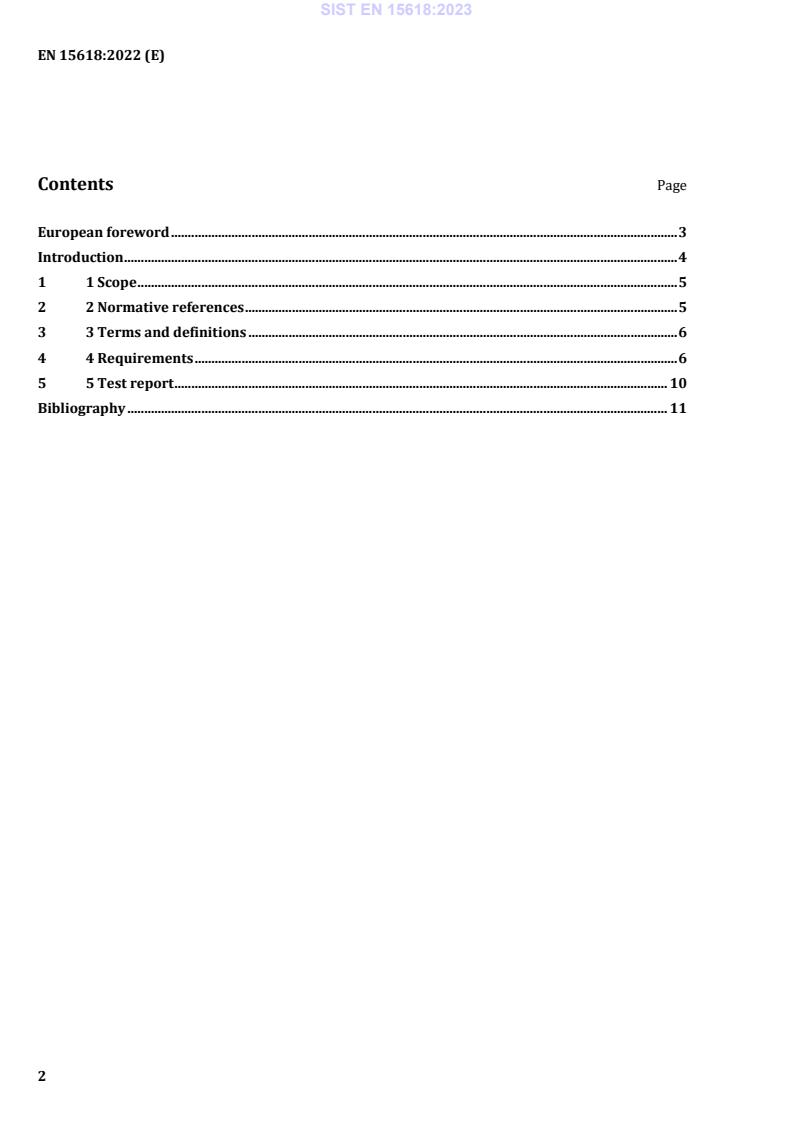
Contents Page
European foreword . 3
Introduction . 4
1 1 Scope . 5
2 2 Normative references . 5
3 3 Terms and definitions . 6
4 4 Requirements . 6
5 5 Test report . 10
Bibliography . 11
European foreword
This document (EN 15618:2022) has been prepared by Technical Committee CEN/TC 248 “Textiles and
textile products”, the secretariat of which is held by BSI.
This European Standard shall be given the status of a national standard, either by publication of an
identical text or by endorsement, at the latest by June 2023, and conflicting national standards shall be
withdrawn at the latest by June 2023.
Attention is drawn to the possibility that some of the elements of this document may be the subject of
patent rights. CEN shall not be held responsible for identifying any or all such patent rights.
This document supersedes EN 15618:2009+A1:2012.
The main changes compared to the previous edition are as follows:
— in the Introduction, the term “categories” has been changed to “requirement levels”;
— in Clause 2, the reference to ISO 5981 and prEN ISO 26081 have been deleted. Some references have
been replaced (ISO 3303 by EN ISO 3303-2, EN ISO 5402 by EN ISO 32100 and EN ISO 26082 by
EN ISO 26082-1). New references have been added (EN ISO 105-C06, EN ISO 105-E16, EN ISO 5077
and ISO 105-F09);
— in Clause 4, the former Table 1 has been split into separate Tables including a change to a new
requirement level format to avoid misunderstanding of product categories. Supplementary
properties have been added (colour fastness to water spotting, to domestic and commercial
laundering, determination of dimensional change in washing and drying) with their related
normative references. The requirements of resistance to soil detailed according to EN ISO 26082-1
are mandatory (the former Table 2 of optional properties has been deleted).
Any feedback and questions on this document should be directed to the users’ national standards body. A
complete listing of these bodies can be found on the CEN website.
According to the CEN-CENELEC Internal Regulations, the national standards organisations of the
following countries are bound to implement this European Standard: Austria, Belgium, Bulgaria, Croatia,
Cyprus, Czech Republic, Denmark, Estonia, Finland, France, Germany, Greece, Hungary, Iceland, Ireland,
Italy, Latvia, Lithuania, Luxembourg, Malta, Netherlands, Norway, Poland, Portugal, Republic of North
Macedonia, Romania, Serbia, Slovakia, Slovenia, Spain, Sweden, Switzerland, Türkiye and the United
Kingdom.
Introduction
This document introduces a system of performance levels. It is not possible to divide upholstery fabrics
into just a few performance categories, because of the enormous variety of conditions of use. In addition,
the type of upholstery (firm or soft) influences the abrasion of the upholstery fabric and hence the
requirements to the abrasion resistance. There is, for example, a tremendous difference between
furniture used in a room without windows and furniture which is directly exposed to sunlight, or
between furniture used by elder people and furniture used by a family with small children. These
differences in conditions and severity of use necessitate a flexible approach. This is done by defining a
performance level for each property. This allows to choose the appropriate level for each parameter and
so to compose a “product profile”, adapted to each specific type of use. This means that high resistance to
abrasion can be combined with, for example, low colour fastness. However, due to the interrelation of
some parameters, not all combinations will be possible.
1 Scope
This document specifies a set of properties relevant to the assessment of coated upholstery fabrics for
indoor furniture and the appropriate test methods to determine these properties. It also describes a
matrix system to express the material properties of an upholstery fabric.
This document is applicable to upholstery fabrics both in domestic and public use, except when used for
the seats of road or railway vehicles, boats or aeroplanes.
This document applies to upholstery fabrics with a coating on the wear face.
This document does not apply to textile upholstery fabrics covered by EN 14465.
2 Normative references
The following documents are referred to in the text in such a way that some or all of their content
constitutes requirements of this document. For dated references, only the edition cited applies. For
undated references, the latest edition of the referenced document (including any amendments) applies.
EN 1021-1, Furniture — Assessment of the ignitability of upholstered furniture — Part 1: Ignition source
smouldering cigarette
EN 1021-2, Furniture — Assessment of the ignitability of upholstered furniture — Part 2: Ignition source
match flame equivalent
EN 15973:2011, Rubber- or plastic-coated fabrics — Upholstery fabrics — Resistance to soiling
EN ISO 105-B02, Textiles — Tests for colour fastness — Part B02: Colour fastness to artificial light: Xenon
...