

EN 15500:2008
(Main)Control for heating, ventilating and air-conditioning applications - Electronic individual zone control equipment
General Information
- Abstract
The purpose of this standard is to specify the applications, functionality set and application performance for electronic individual zone control equipment. The applications are for cooling and hot water or electrical heating as described in Annex B.
This standard applies specifically to individual zone control equipment for maintaining temperature, humidity and air flow as a function of occupancy and demand operated with auxiliary electrical energy.
Information required for the operation of the equipment may be processed using either analogue or digital techniques or a combination of both. Safety requirements remain unaffected by this standard.
This standard refers to the input and output requirements of the controller and not of the input and output devices as e. g. sensors and actuators.
This standard covers fixed-function, configurable and programmable controllers.
The control equipment may or may not be connected to a data-network however communications aspects are not covered by this standard.
These devices could be applied for any kind of building, intermittent or non-intermittent occupation, residential or non residential (see Annex B).
- Status
- Withdrawn
- Publication Date
- 15-Jul-2008
- Withdrawal Date
- 29-Sep-2026
- Technical Committee
- CEN/TC 247 - Controls for mechanical building services
- Drafting Committee
- CEN/TC 247 - Controls for mechanical building services
- Current Stage
- 9960 - Withdrawal effective - Withdrawal
- Start Date
- 10-May-2017
- Completion Date
- 30-Sep-2026

Relations
- Effective Date
- 17-May-2017
- Effective Date
- 25-Aug-2026
- Effective Date
- 25-Aug-2026
- Effective Date
- 28-Jul-2026
- Effective Date
- 07-Jul-2026
- Effective Date
- 07-Jul-2026
- Effective Date
- 09-Jun-2026
- Effective Date
- 20-Feb-2026
- Effective Date
- 09-Feb-2026
- Effective Date
- 09-Feb-2026
- Effective Date
- 09-Feb-2026
- Effective Date
- 09-Feb-2026
- Effective Date
- 09-Feb-2026
- Effective Date
- 09-Feb-2026
- Effective Date
- 09-Feb-2026
Frequently Asked Questions
EN 15500:2008 is a standard published by the European Committee for Standardization (CEN). Its full title is "Control for heating, ventilating and air-conditioning applications - Electronic individual zone control equipment". This standard covers: The purpose of this standard is to specify the applications, functionality set and application performance for electronic individual zone control equipment. The applications are for cooling and hot water or electrical heating as described in Annex B. This standard applies specifically to individual zone control equipment for maintaining temperature, humidity and air flow as a function of occupancy and demand operated with auxiliary electrical energy. Information required for the operation of the equipment may be processed using either analogue or digital techniques or a combination of both. Safety requirements remain unaffected by this standard. This standard refers to the input and output requirements of the controller and not of the input and output devices as e. g. sensors and actuators. This standard covers fixed-function, configurable and programmable controllers. The control equipment may or may not be connected to a data-network however communications aspects are not covered by this standard. These devices could be applied for any kind of building, intermittent or non-intermittent occupation, residential or non residential (see Annex B).
The purpose of this standard is to specify the applications, functionality set and application performance for electronic individual zone control equipment. The applications are for cooling and hot water or electrical heating as described in Annex B. This standard applies specifically to individual zone control equipment for maintaining temperature, humidity and air flow as a function of occupancy and demand operated with auxiliary electrical energy. Information required for the operation of the equipment may be processed using either analogue or digital techniques or a combination of both. Safety requirements remain unaffected by this standard. This standard refers to the input and output requirements of the controller and not of the input and output devices as e. g. sensors and actuators. This standard covers fixed-function, configurable and programmable controllers. The control equipment may or may not be connected to a data-network however communications aspects are not covered by this standard. These devices could be applied for any kind of building, intermittent or non-intermittent occupation, residential or non residential (see Annex B).
EN 15500:2008 is classified under the following ICS (International Classification for Standards) categories: 97.120 - Automatic controls for household use. The ICS classification helps identify the subject area and facilitates finding related standards.
EN 15500:2008 has the following relationships with other standards: It is inter standard links to EN 15500-1:2017, ISO 8098:1989/Amd 1:1992, IEC 60038:1983, EN IEC 60730-2-24:2026, EN IEC 60730-2-15:2026, EN IEC 60730-2-9:2026, EN IEC 60730-2-5:2026, EN IEC 60730-2-12:2026, EN 60730-2-5:2015, EN 60529:1991, EN IEC 60730-2-12:2019, EN IEC 60730-2-9:2019/A2:2020, EN IEC 60730-2-8:2025, EN 60730-2-19:2002/A2:2008, EN IEC 60730-2-22:2020. Understanding these relationships helps ensure you are using the most current and applicable version of the standard.
EN 15500:2008 is available in PDF format for immediate download after purchase. The document can be added to your cart and obtained through the secure checkout process. Digital delivery ensures instant access to the complete standard document.
Standards Content (Sample)
2003-01.Slovenski inštitut za standardizacijo. Razmnoževanje celote ali delov tega standarda ni dovoljeno.Elektronske naprave za regulacijo posameznih conElektronische Regel- und Steuereinrichtungen für einzelne Räume oder ZonenRégulateur électronique de zone pour le chauffageElectronic individual zone control equipment97.120Avtomatske krmilne naprave za domAutomatic controls for household useICS:Ta slovenski standard je istoveten z:EN 15500:2008SIST EN 15500:2008en,fr,de01-december-2008SIST EN 15500:2008SLOVENSKI
STANDARD
EUROPEAN STANDARDNORME EUROPÉENNEEUROPÄISCHE NORMEN 15500July 2008ICS 97.120 English VersionControl for heating, ventilating and air-conditioning applications -Electronic individual zone control equipmentRégulation pour les applications CVC - Régulateursélectroniques de zone pour le chauffageAutomation von HLK-Anwendungen - Elektronische Regel-und Steuereinrichtungen für einzelne Räume oder ZonenThis European Standard was approved by CEN on 3 November 2007.CEN members are bound to comply with the CEN/CENELEC Internal Regulations which stipulate the conditions for giving this EuropeanStandard the status of a national standard without any alteration. Up-to-date lists and bibliographical references concerning such nationalstandards may be obtained on application to the CEN Management Centre or to any CEN member.This European Standard exists in three official versions (English, French, German). A version in any other language made by translationunder the responsibility of a CEN member into its own language and notified to the CEN Management Centre has the same status as theofficial versions.CEN members are the national standards bodies of Austria, Belgium, Bulgaria, Cyprus, Czech Republic, Denmark, Estonia, Finland,France, Germany, Greece, Hungary, Iceland, Ireland, Italy, Latvia, Lithuania, Luxembourg, Malta, Netherlands, Norway, Poland, Portugal,Romania, Slovakia, Slovenia, Spain, Sweden, Switzerland and United Kingdom.EUROPEAN COMMITTEE FOR STANDARDIZATIONCOMITÉ EUROPÉEN DE NORMALISATIONEUROPÄISCHES KOMITEE FÜR NORMUNGManagement Centre: rue de Stassart, 36
B-1050 Brussels© 2008 CENAll rights of exploitation in any form and by any means reservedworldwide for CEN national Members.Ref. No. EN 15500:2008: ESIST EN 15500:2008
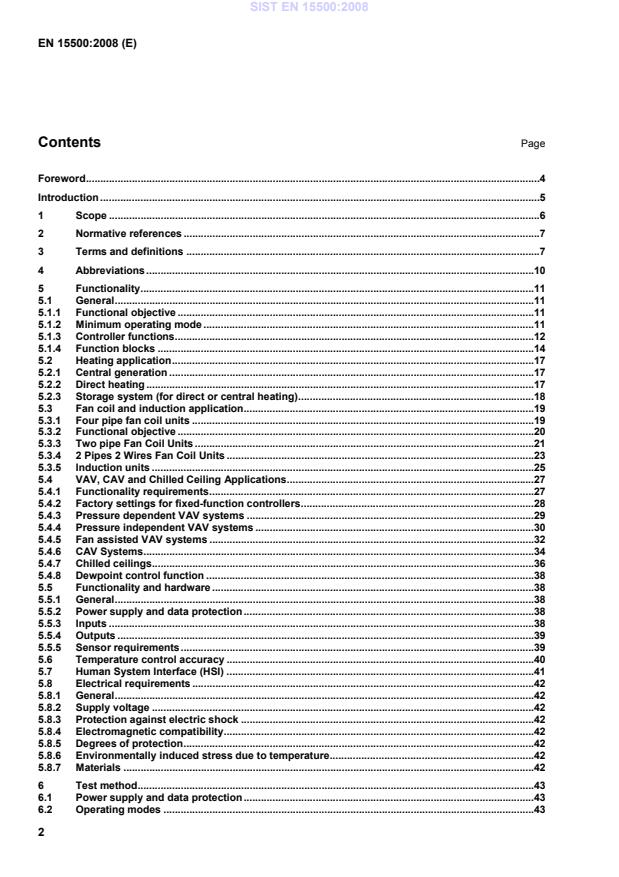
Functional and acceptance test.46 A.1 Objective.46 A.2 Testing procedures.46 A.2.1 Test principle.46 A.2.2 Test parameters.47 A.2.3 Product configuration.48 A.2.4 Definition of the Control Accuracy (CA).49 A.3 Test facility description.54 A.3.1 General layout.54 A.3.2 Sensor side interface.56 A.3.3 Actuator side interface.59 A.3.4 Interface between real and simulated environment.61 A.3.5 Simulated environment.62 A.3.6 Data acquisition system.62 Annex B (informative)
Data.63 B.1 Objective.63 B.2 Applications.63 B.3 Building and zone types.63 B.3.1 Building types.63 B.3.2 Zone types.64 B.4 Default time test parameters.64 Bibliography.66
1 Scope The purpose of this standard is to specify the applications, functionality set and application performance for electronic individual zone control equipment. The applications are for cooling and hot water or electrical heating as described in Annex B. This standard applies specifically to individual zone control equipment for maintaining temperature, humidity and air flow as a function of occupancy and demand operated with auxiliary electrical energy. Information required for the operation of the equipment may be processed using either analogue or digital techniques or a combination of both. Safety requirements remain unaffected by this standard. This standard refers to the input and output requirements of the controller and not of the input and output devices as e. g. sensors and actuators. This standard covers fixed-function, configurable and programmable controllers. The control equipment may or may not be connected to a data-network however communications aspects are not covered by this standard. These devices could be applied for any kind of building, intermittent or non-intermittent occupation, residential or non residential (see Annex B). SIST EN 15500:2008
2 Normative references The following referenced documents are indispensable for the application of this document. For dated references, only the edition cited applies. For undated references, the latest edition of the referenced document (including any amendments) applies. EN 12098-2, Controls for heating systems — Part 2: Optimum start-stop control equipment for hot water heating systems EN 12098-5, Controls for heating systems — Part 5: Start-stop schedulers for heating systems EN 60529, Degrees of protection provided by enclosures (IP code) (IEC 60529:1989) EN 60730 (all parts), Automatic electrical controls for household and similar use IEC 60038, IEC standard voltages 3 Terms and definitions For the purposes of this document, the following terms and definitions apply. 3.1 electronic individual zone control equipment equipment performing closed loop control functions of physical measured variable(s) (e.g. temperature, humidity, pressure) in a single room or in an area of a building 3.1.1
Fixed-function controller
application-specific controller where the manufacturer supplies one or more fixed control strategies for specific applications
NOTE see also EN ISO 16484-2
3.1.2
Configurable controller
Controller where the manufacturer supplies one or more configurable control strategies for specific applications
NOTE see also EN ISO 16484-2 3.1.3
Programmable controller
Controller where the control strategies can be programmed
NOTE 1 Programmable controllers also are named automation station.
NOTE 2 see also EN ISO 16484-2 3.2 operating mode mode that applies either to control equipment or to control functions NOTE Operating modes can be switched over by a scheduler program or manual. 3.2.1 manual mode of operation of equipment when significant control functions is overridden by the user SIST EN 15500:2008
NOTE 1 In the reduced operating mode, the control setpoint is lowered or raised with respect to the comfort setpoint. NOTE 2 Other terms for economy mode are e. g. unoccupied, night set-back, sleeping, holiday. 3.2.6 pre comfort reduced operating mode for the room to quickly reach the comfort range upon changing to a comfort operating mode 3.2.7 frost protection mode of operation to reach a minimum acceptable positive temperature preventing freezing 3.2.8 building protection mode of operation to protect the building from overheating or supercooling 3.2.9 off state where control and interlock functions are not operational 3.2.10 holiday function where a time programme is used to control a room temperature for a pre-determined period 3.2.11 tariff optimization function to control the room temperature according to the tariff rate signal from the electrical supplier 3.3 input and output devices 3.3.1 input device / sensor detector measures physical parameters such as temperature, humidity, air-quality, air-flow or occupancy. The sensor is incorporated into housing suitable for mounting and can be regarded as a functional unit which produces a signal that can be evaluated in correspondence with the quantity measured SIST EN 15500:2008
Control to setpoint
CV Control Variation EC Electric Convector ECH Electric Ceiling Heating EFH Electric Floor Heating EUBAC European Building Automation and Controls Association FCU-2P Fan Coil Unit system - 2 Pipes FCU-2P2W Fan Coil Unit system - 2 Pipes 2 Wires FCU-4P Fan Coil Unit system - 4 Pipes h Hours HVAC Heating Ventilating and Air Conditioning IEEE Institute of Electrical and Electronics Engineers IEP Index of Energy Price K Kelvin LIM
Limit NTC Negative Thermal Coefficient OM Operating Mode OP Other Parameters OS Output Signal P-Band Proportional Band PES Price energy Signal PI Proportional plus Integral PID Proportional plus Integral plus Derivative SIST EN 15500:2008
SP Setpoint SPA Setpoint Adjustment SPD Setpoint determination function
T1 Time 1 (End of the overshoot test period) T2 Time 2 (End of transient test period) TDP Dewpoint temperature TS Surface temperature TZ Zone temperature V Air (volume) flow VAV Variable Air Volume Vmax Maximum air (volume) flow limit Vmin Minimum air (volume) flow limit Vnom Nominal flow, i.e. the maximum air flow that a VAV box can handle as specified by the manufacturer Vs Volume supply air
Vx Volume exhaust air
WFH Water Floor Heating
5 Functionality 5.1 General 5.1.1 Functional objective The objective of electronic individual zone control equipment is to save energy and contribute to acceptable levels of hygiene, health and comfort, by performing the following primary functions: control the zone variables by influencing the energy supply source (e.g. hot/chilled fluid, electrical energy, air volume); minimise the energy supplied to the zone (e.g. operating modes: comfort, economy); minimise running cost according to the price of energy. 5.1.2 Minimum operating mode To minimise energy consumption, heating zone controllers shall at least include the following three operating modes, as defined in 5.1.3: comfort; reduced or economy; SIST EN 15500:2008
Name Description Save energy Air quality Temp comfort Hygiene/health Local function System function Control to setpoint of the zone temperature Algorithm to maintain the room temperature to a pre-determined level x
x
x
Setpoint determination Method by which the pre-determined room temperature is set
x x Setpoint limitation Upper and/or lower control limit for the room temperature setpoint x
x
x
Limitation monitoring Checking that the controlled output complies with pre-selected high or low limit parameters x
x
x
Time scheduling Method by which the temperature level is split into pre-determined periods x
x
x x
Table 1 — Controller functions (continued) Name Description Save energy Air quality Temp comfort Hygiene/health Local function System function Optimum start stop, Predictive control Algorithm to calculate advance level change period to achieve setpoint at a pre-determined time
x x Free cooling Cooling with external air
x Window open protection Monitoring the state of windows (open and closed). Signal sent to the zone controller to take action when the windows are open or closed x
Boost A heating operational mode providing maximal power (heating or cooling)
x
x x Summer/winter changeover Changing the action of the controller depending of the heating or cooling demand x
x
Summer/winter compensation Algorithm/selection to adjust temperature control for changes in load condition x
x
Operating time override Means of providing a pre-determined period of comfort level
x
Energy demand request Signal from the secondary controller with the greatest heating/cooling demand sent to the primary controller x
x
Status monitoring The monitoring of the status of Zone Controller devices, and any action which is taken to change the operation of the Zone Controller as a result of analysing the monitored values
Occupancy sensing Signal sent to the zone controller to take action when the zone is occupied/unoccupied x
x
x
Energy price optimizing Signal supplied by the utility to set the price level of electrical energy
x
Table 1 — Controller functions (concluded) Name Description Save energy Air quality Temp comfort Hygiene/health Local function System function Air flush Purging a zone with fresh air immediately prior to occupancy, to improve air quality
x x
Demand controlled ventilation The amount of air is controlled based on number of persons in the zone and/or air quality x x
Frost/building protection Special damage control function for switching all relevant parts of a plant into predicted state in order to avoid frost damage
x
Manual/auto operation Functional operating mode
Operating modes concerning the comfort level in the zone:
Comfort
x x x x
Pre comfort
x
Economy
x
Protection
x
Technical/functional operating modes:
Off
Holiday
Tariff optimisation
Manual
Automatic
Exclusions: this standard does not preclude other functions such as alarm signalling, lighting control or other integrated functions; the controller manufacturer is not necessarily responsible for the control of the process-side of the associated equipment; safety and related features of the associated equipment are the responsibility of the supplier of the associated equipment; the controller does not provide security or intrusion detection. 5.1.4 Function blocks A function block is a graphic representation of a function, which calculates one or several outputs as a function of a set of arguments. The arguments may either be inputs or parameters. Typical electronic individual zone control equipment for heating applications will include, as a minimum, a control function block and a setpoint determination block. SIST EN 15500:2008
Inputs Type CRLT Type Outputs
Real
Real Zone temperature --------- TZ
OS ------- Output signal
Parameters
Real
Actual Setpoint --------- ASP
Real
Control Parameter --------- CP
Real
Index of Energy Price -------- IEP
FB example abbreviations Name Type Description Unit/symbol Inputs TZ Real Zone temperature Phys. value °C Outputs OS Real
Output signal Phys. value Parameters ASP CP IEP Real Real Real Actual Setpoint low limiting value Control Parameter Index of Energy Price Phys. value °C Phys. value °C Cost value
€ NOTE
Explanation of the example: This control function block generates an output signal dependant upon the actual setpoint, the zone temperature and control parameters, e.g. hysteresis, P-band, integral action. A more complex function block with additional parameters and corresponding outputs can be used for graphical display.
Table 3 — Example "Setpoint Determination" Graphical FB representation
Inputs Type SPD Type Outputs
Real
Real Setpoint adjustments --------- SPA
ASP ------- Actual Setpoint
Real
Other parameters --------- OP
Real
Price energy Signal --------- PES
Parameters
Real
Other parameters --------- OP
Operating mode --------- OM
BOOL
FB example abbreviations
Price energy Signal Phys. value
Outputs ASP Real
Actual Setpoint Phys. value °C Parameters OP Real Other parameters Phys. value °C OM BOOL Operating mode
NOTE
Explanation of the example: The setpoint determination block generates the actual setpoint as a consequence of the inputs e.g. setpoint adjustment, operating modes, operating time override. A more complex function block with additional parameters and corresponding outputs can be used for graphical display.
Table 4 — Limitation Monitoring (LIM) Graphical FB representation
Inputs Type
LIM Type Outputs
Real
Real Variable Setpoint Value --------- VSV
ALS------- Actual limit Setpoint
Real
Low Limit Setpoint --------- LLS
Real
High Limit Setpoint --------- HLS
FB example abbreviations Name Type Description Unit/symbol Inputs VSV Real Variable Setpoint Value Phys. value °C LLS
Low Limit Setpoint
HLS
High Limit Setpoint
Outputs ALS Real
Actual limit Setpoint
Phys. value °C NOTE
Explanation of the example: The function limitation monitoring (LIM) is used to limit the setpoint or the positioning signal of a controller. This does not include safety function. This function block implements a high and a low limit to the setpoint value
5.2 Heating application 5.2.1 Central generation Central generation is defined as a single source with multiple emission units in one or several zones - see Figure 1.
Key a temperature sensor b zone controller c valve d emitter e heat source T temperature Z zone Figure 1 — Examples of a central generation 5.2.2 Direct heating Direct heating is defined as the combined generation and emission of heat. The heat source can be electric, gas, oil, or other fuel sources. The heat emitter can be a panel radiator, convector, under-floor or ceiling heating - see Figure 2.
Key a temperature sensor b zone controller c valve d emitter e heat generation f energy source T temperature Z zone Figure 2 — Example of a direct heating 5.2.3 Storage system (for direct or central heating) Storage heating is defined as a heat emission unit which stores energy produced during off-peak periods at a reduced price. The emitter (radiator, floor) has a large mass in order to store heat energy. The storage of the heat can be controlled by indoor temperature and/or by the precalculated demand according to the outdoor temperature – see Figure 3.
Key a temperature sensor b zone controller c valve d out door sensor e emitter f heat source T temperature Z zone Figure 3 — Example of a storage heating with outside sensor for charge control
5.3 Fan coil and induction application 5.3.1 Four pipe fan coil units The zone environmental conditions are controlled by the mean of heating and cooling coils and/or the fan. NOTE 1 The fan can be on/off or variable speed or not controlled by the zone controller. NOTE 2 The heating and/or cooling can be on/off, modulating or switched stages. SIST EN 15500:2008
Key a controller b temperature sensor c valve (2-3-4-port, modulating or On/Off) d Person Machine Interface e fan (On/Off or speed control) f battery for heating or cooling only or changeover between heating and cooling g fan coil T temperature Z zone
Figure 4 — Example of a 4 pipes fan coil unit
Figure 5 — Example block diagram of the 4 pipes fan coil unit 5.3.3 Two pipe Fan Coil Units 5.3.3.1 General The zone environmental conditions are controlled by the mean of one coil either for heating or cooling or both. When controlling both, then change-over function is required to change the medium from hot to cold water. 5.3.3.2 Functional objective An example of a schematic diagram of a 2 pipes Fan Coil system is shown in Figure 6. The objective of a 2 pipes Fan Coil Unit system is to maintain the required zone environmental conditions and to save energy by performing the following main functions: control and maintain the temperature by modulating the amount of energy supplied to the zone; minimise the amount of heating and/or cooling by various modes of operations.
Key a controller b temperature sensor c valve (2-3-4-port, modulating or On/Off) d Person Machine Interface e fan (On/Off or speed control) f battery for heating or cooling only or changeover between heating and cooling g fan coil T temperature Z zone Figure 6 — Example of a 2 pipes fan coil unit
5.3.3.3 Control equipment functionality An example of a typical simple control strategy for a 2 pipes fan coil unit is shown in Figure 7. The FCU-2P is either for heating or cooling. The description of the block diagram is similar to the FUC-4P. A change-over function can be effected locally by means of thermostats, or centrally derived signal. SIST EN 15500:2008
Figure 7 — Example block diagram of the 2 pipes fan coil unit
5.3.4 2 Pipes 2 Wires Fan Coil Units 5.3.4.1 General The zone environmental conditions are controlled by the mean of one coil either for heating or cooling or both, one electrical resistor and the fan. When controlling both heating and cooling with the coil, then change-over function is required to change the medium from hot to cold water. 5.3.4.2 Functional objective An example of schematic diagram of a 2 Pipes 2 Wires Fan Coil system is shown in Figure 8. The objective of a 2 Pipe 2 Wires Fan Coil Unit system is to maintain the required zone environmental conditions and to save energy by performing the following main functions: control and maintain the temperature by modulating the amount of energy supplied to the zone; minimise the amount of heating and/or cooling by various mode of operations.
Key a controller b temperature sensor c valve (2-3-4-port, modulating or On/Off) d Person Machine Interface e fan (On/Off or speed control) f fan coil T temperature Z zone Figure 8 — Example of a 2 pipes 2 wires fan coil unit
5.3.4.3 Control equipment functionality An example of a typical simple control strategy for a 2 pipes 2 wires fan coil unit is shown in Figure 9.
The FCU-2P2W is for electrical heating and water cooling.
The description of the block diagram is similar to the FUC-4P. SIST EN 15500:2008
Figure 9 — Example of a block diagram of the 2 pipes 2 wires fan coil unit 5.3.5 Induction units 5.3.5.1 General The zone environmental conditions are controlled by controlling the cooling or re-heating of the discharge air in a terminal unit in which a re-circulated air flow is induced by the energy of the primary air flow. 5.3.5.2 Functional objective An example of a schematic diagram of an induction unit is shown in Figure 10. The description of the block diagram is similar to a 2 Pipe Fan Coil Unit system, without a fan. The change-over function may be effected locally by means of thermostats, or centrally derived signal. SIST EN 15500:2008
Key a controller b temperature sensor c valve (2-3-4-port, modulating or On/Off) d Person Machine Interface e battery for heating or cooling only or changeover between heating and cooling f induction unit T temperature Figure 10 — Example of an induction unit system 5.3.5.3 Control equipment functionality An example of a typical simple control strategy for an induction unit is shown in Figure 11.
The description of the block diagram is similar to the FUC-4P. SIST EN 15500:2008
Figure 11 — Example of a block diagram of an induction unit 5.4 VAV, CAV and Chilled Ceiling Applications 5.4.1 Functionality requirements 5.4.1.1 General VAV/CAV and chilled ceiling zone control systems are used to maintain a desired zone temperature, and, in the case of VAV/CAV systems, a supply air flow within certain specified limits. 5.4.1.2 Air flow tolerances The air flow measurement and control tolerance requirements in a VAV zone control system depend on the relative flow, Vrel, which is defined as
100⋅=nomrelVVV&&&
where V is the air (volume) flow and Vnom is the nominal flow, i.e. the maximum air flow that the VAV box can handle as specified by the manufacturer (which is not necessarily equal to the maximum air flow limit, Vmax, of the zone to be controlled). %SIST EN 15500:2008
is the deviation of the air flow from setpoint; Vsp
is the setpoint of the air flow. The air flow tolerance for class 1 and class 2 VAV control should be less than the tolerances shown in Figure 12. Note that even in a properly designed VAV system, the minimum air flow limit should not correspond to relative flow less than 10 %.
Key a air flow tolerances b tolerance (%) c Vrel (%) d class 1 e class 2 f class 1 g class 1 sensor and pickup h class 2 i class 2 sensor and pickup Figure 12 — Diagram showing VAV zone control system air flow tolerances as a function of the
relative flow Vrel.
NOTE The control accuracy specifications in this table apply only under the test conditions specified in Clause 5. They may not actually apply within specific building installations because control accuracy is dependant upon actual system dimensioning. 5.4.2 Factory settings for fixed-function controllers The device shall be supplied with parameter settings already made. Factory settings shall be readily discernible in the manufacturer’s documentation. Factory settings shall not be lost during shipping. SIST EN 15500:2008
Key a primary air b VAV terminal unit c damper actuator d supply air e zone controller f sensor g zone Figure 13 — Example of a pressure dependent VAV system
5.4.3.2 Control equipment functionality An example of typical control functions of a pressure dependent VAV zone controller is shown in Figure 11. The block diagram shows the main control functions in a pressure dependent VAV system zone controller. An optional heating stage is indicated with dashed lines.
Figure 14 — Example of a block diagram of a pressure dependent VAV system 5.4.3.3 Functionality requirements for the minimum damper position In order to guarantee a sufficient fresh air supply to the zone, the supply air flow shall normally not fall below a certain minimum air flow limit. As the air flow is not measured in this application (as the actual air flow is dependent upon duct supply air pressure), a pressure dependent VAV controller shall provide a minimum damper position option, below which the damper will not be closed further. This position will not guarantee a minimum air flow. 5.4.4 Pressure independent VAV systems 5.4.4.1 Functional objective The objective of a pressure independent VAV system is to maintain the desired zone environmental conditions and to save energy by performing the following main functions: control the zone temperature by modulating the supply of air into the zone; ensure zone fresh air exchange by limiting the minimum air flow rate; minimise air flow noise by limiting the maximum air flow rate;
...