


prEN 19100-1
(Main)Eurocode 10 - Design of glass structures - Part 1: General rules
Eurocode 10 - Design of glass structures - Part 1: General rules
1.1 Scope of prEN 19100-1
(1) This document gives basic design rules for glass structures, assemblies and components. This document is concerned with the requirements for resistance, serviceability, fracture characteristics and glass component failure consequences in relation to human safety, robustness and redundancy of glass structures.
(2) This document covers the basis of design, structural design, materials, durability, and construction rules.
1.2 Assumptions
(1) The assumptions given in EN 1990 apply.
(2) This document is intended to be used in conjunction with EN 1990, EN 1991 (all parts), the parts of EN 1992 to EN 1999 where glass structures or glass components are referred to within those documents and EN 12488.
Eurocode 10 - Bemessung und Konstruktion von Bauteilen aus Glas - Teil 1: Grundlagen
1.1 Anwendungsbereich von prEN 19100 1
(1) Dieses Dokument enthält grundlegende Bemessungsregeln für Bauteile, Baugruppen und Komponenten aus Glas. Dieses Dokument behandelt die Anforderungen an Widerstand, Gebrauchstauglichkeit, Brucheigenschaften und Folgen des Versagens von Glaskomponenten hinsichtlich der Sicherheit von Personen, der Robustheit und der Redundanz von Tragwerken aus Glas.
(2) Dieses Dokument behandelt die Grundlagen der Bemessung, Tragwerksplanung, Werkstoffe, Dauerhaftigkeit und Konstruktionsregeln.
1.2 Voraussetzungen
(1) Es gelten die Voraussetzungen nach EN 1990.
(2) Dieses Dokument ist für die Anwendung in Zusammenhang mit EN 1990, EN 1991 (alle Teile), mit den Teilen von EN 1992 bis EN 1999, die innerhalb dieser Dokumente auf Bauteile oder Komponenten aus Glas Bezug nehmen, sowie mit EN 12488 vorgesehen.
Eurocode 10 - Calcul des structures en verre - Partie 1 : Règles générales
1.1 Domaine d'application du prEN 19100-1
(1) Le présent document énonce des règles de conception de base pour des structures, assemblages et composants en verre. Le présent document porte sur les exigences relatives à la résistance, à l'aptitude au service, aux caractéristiques de rupture et aux conséquences des défaillances des composants en verre en matière de sécurité humaine, robustesse et redondance des structures en verre.
(2) Le présent document couvre les bases de conception, de conception des structures, des matériaux, de la durabilité et des règles de construction.
1.2 Hypothèses
(1) Les hypothèses données dans l'EN 1990 s'appliquent.
(2) Le présent document est destiné à être utilisé en conjonction avec l'EN 1990, l'EN 1991 (toutes les parties), les parties de l'EN 1992 à l'EN 1999 où les structures en verre ou les composants en verre sont mentionnés dans ces documents et l'EN 12488.
Evrokod 10 - Projektiranje steklenih konstrukcij - 1. del: Splošna pravila
General Information
- Status
- Not Published
- Publication Date
- 01-Jul-2026
- Technical Committee
- CEN/TC 250 - Structural Eurocodes
- Drafting Committee
- CEN/TC 250/SC 11/WG 1 - Design of Glass Strcutures
- Current Stage
- 4599 - Dispatch of FV draft to CMC - Finalization for Vote
- Start Date
- 09-Dec-2025
- Due Date
- 20-Jun-2025
- Completion Date
- 09-Dec-2025
Relations
- Effective Date
- 18-Jan-2023
Overview
prEN 19100-1 (Eurocode 10 - Part 1) establishes the general rules for the structural design of mechanically supported glass components, assemblies and structures. The document sets out the basis of design, structural design principles, materials, durability and construction rules and addresses resistance, serviceability, fracture behaviour and consequences of glass component failure in relation to human safety, robustness and redundancy.
This part of EN 19100 is intended to be used together with EN 1990 (Basis of structural and geotechnical design), EN 1991 (Actions on structures), the relevant parts of EN 1992–EN 1999 where glass is referenced, and EN 12488. It forms part of the second generation of Eurocodes and will supersede CEN/TS 19100-1:2021 when finalized.
Key Topics
- Scope and purpose: Basic design rules for glass structures, components and assemblies, with emphasis on safety and serviceability.
- Limit states: Principles for Ultimate Limit State (ULS), Serviceability Limit State (SLS), Fracture Limit State (FLS) and Post-Fracture Limit State (PFLS) are provided to ensure consistent verification.
- Basis of design: Includes requirements, consequence classes, design working life and verification by the partial factor method in line with EN 1990 principles.
- Materials: Guidance on glass types, interlayers, insulating glass units (IGUs) and materials for further load transfer elements; considerations for durable performance prior to and after installation.
- Structural analysis: Basic assumptions for sectional forces, stresses, deformations and special provisions such as shear interaction in laminated glass and treatment of drill holes and recesses.
- Durability and construction rules: Practical coverage of long-term behaviour, exposure considerations and execution-related provisions.
- Annexes: Informative annexes cover design bending strength, thermally induced stresses and a framework for risk assessment.
Applications
This standard is relevant for:
- Structural designers and engineers specifying glass façades, canopies, balustrades, and load-bearing glazing.
- Manufacturers and fabricators developing glass products and assemblies to meet structural requirements.
- Authorities and clients setting project-specific safety, robustness and durability criteria.
- Software developers and educators applying Eurocode-compliant analysis and verification.
Practical benefits include a harmonised framework for assessing resistance and serviceability, clearer treatment of fracture behaviour and post-fracture consequences, and alignment with other Eurocodes for consistent safety verification across materials and construction types.
Related Standards
- EN 1990 - Basis of structural and geotechnical design (assumptions and limit state principles).
- EN 1991 - Actions on structures (all parts) for load definitions and combinations.
- EN 19100-2 / EN 19100-3 - Part 2 (out-of-plane loaded components) and Part 3 (in-plane loaded components) for application-specific design rules.
- EN 12488 and relevant execution, material and product standards referenced by the Eurocodes.
For project design follow national choices recorded in the National Annex where provided; when no national choices are made, default values in the standard apply.

Get Certified
Connect with accredited certification bodies for this standard

ICC Evaluation Service
Building products evaluation and certification.

QAI Laboratories
Building and construction product testing and certification.

Aboma Certification B.V.
Specialized in construction, metal, and transport sectors.
Sponsored listings
Frequently Asked Questions
prEN 19100-1 is a draft published by the European Committee for Standardization (CEN). Its full title is "Eurocode 10 - Design of glass structures - Part 1: General rules". This standard covers: 1.1 Scope of prEN 19100-1 (1) This document gives basic design rules for glass structures, assemblies and components. This document is concerned with the requirements for resistance, serviceability, fracture characteristics and glass component failure consequences in relation to human safety, robustness and redundancy of glass structures. (2) This document covers the basis of design, structural design, materials, durability, and construction rules. 1.2 Assumptions (1) The assumptions given in EN 1990 apply. (2) This document is intended to be used in conjunction with EN 1990, EN 1991 (all parts), the parts of EN 1992 to EN 1999 where glass structures or glass components are referred to within those documents and EN 12488.
1.1 Scope of prEN 19100-1 (1) This document gives basic design rules for glass structures, assemblies and components. This document is concerned with the requirements for resistance, serviceability, fracture characteristics and glass component failure consequences in relation to human safety, robustness and redundancy of glass structures. (2) This document covers the basis of design, structural design, materials, durability, and construction rules. 1.2 Assumptions (1) The assumptions given in EN 1990 apply. (2) This document is intended to be used in conjunction with EN 1990, EN 1991 (all parts), the parts of EN 1992 to EN 1999 where glass structures or glass components are referred to within those documents and EN 12488.
prEN 19100-1 is classified under the following ICS (International Classification for Standards) categories: 81.040.20 - Glass in building; 91.080.99 - Other structures. The ICS classification helps identify the subject area and facilitates finding related standards.
prEN 19100-1 has the following relationships with other standards: It is inter standard links to CEN/TS 19100-1:2021. Understanding these relationships helps ensure you are using the most current and applicable version of the standard.
prEN 19100-1 is associated with the following European legislation: Standardization Mandates: M/515. When a standard is cited in the Official Journal of the European Union, products manufactured in conformity with it benefit from a presumption of conformity with the essential requirements of the corresponding EU directive or regulation.
prEN 19100-1 is available in PDF format for immediate download after purchase. The document can be added to your cart and obtained through the secure checkout process. Digital delivery ensures instant access to the complete standard document.
Standards Content (Sample)
SLOVENSKI STANDARD
01-november-2024
Evrokod 10 - Projektiranje steklenih konstrukcij - 1. del: Splošna pravila
Eurocode 10 - Design of glass structures - Part 1: General rules
Eurocode 10 - Bemessung und Konstruktion von Bauteilen aus Glas - Teil 1: Grundlagen
Eurocode 10 - Calcul des structures en verre - Partie 1 : Règles générales
Ta slovenski standard je istoveten z: prEN 19100-1
ICS:
81.040.20 Steklo v gradbeništvu Glass in building
91.080.99 Druge konstrukcije Other structures
2003-01.Slovenski inštitut za standardizacijo. Razmnoževanje celote ali delov tega standarda ni dovoljeno.
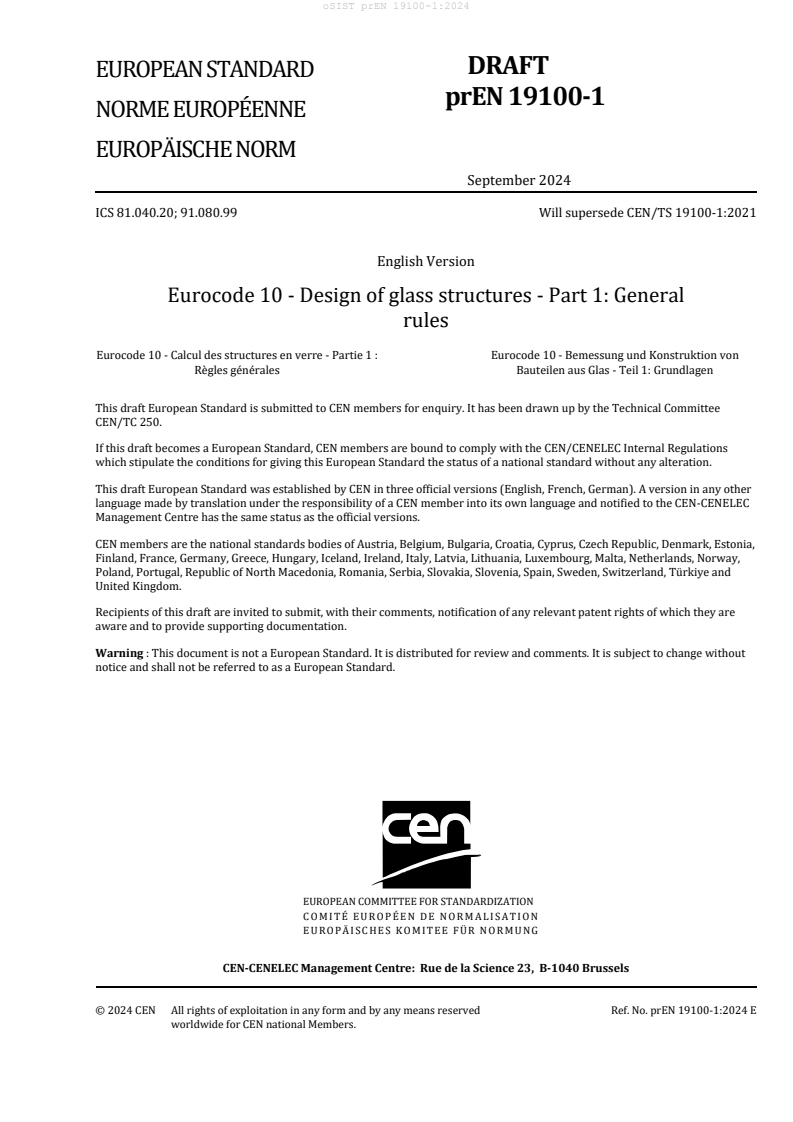
DRAFT
EUROPEAN STANDARD
NORME EUROPÉENNE
EUROPÄISCHE NORM
September 2024
ICS 81.040.20; 91.080.99 Will supersede CEN/TS 19100-1:2021
English Version
Eurocode 10 - Design of glass structures - Part 1: General
rules
Eurocode 10 - Calcul des structures en verre - Partie 1 : Eurocode 10 - Bemessung und Konstruktion von
Règles générales Bauteilen aus Glas - Teil 1: Grundlagen
This draft European Standard is submitted to CEN members for enquiry. It has been drawn up by the Technical Committee
CEN/TC 250.
If this draft becomes a European Standard, CEN members are bound to comply with the CEN/CENELEC Internal Regulations
which stipulate the conditions for giving this European Standard the status of a national standard without any alteration.
This draft European Standard was established by CEN in three official versions (English, French, German). A version in any other
language made by translation under the responsibility of a CEN member into its own language and notified to the CEN-CENELEC
Management Centre has the same status as the official versions.
CEN members are the national standards bodies of Austria, Belgium, Bulgaria, Croatia, Cyprus, Czech Republic, Denmark, Estonia,
Finland, France, Germany, Greece, Hungary, Iceland, Ireland, Italy, Latvia, Lithuania, Luxembourg, Malta, Netherlands, Norway,
Poland, Portugal, Republic of North Macedonia, Romania, Serbia, Slovakia, Slovenia, Spain, Sweden, Switzerland, Türkiye and
United Kingdom.
Recipients of this draft are invited to submit, with their comments, notification of any relevant patent rights of which they are
aware and to provide supporting documentation.
Warning : This document is not a European Standard. It is distributed for review and comments. It is subject to change without
notice and shall not be referred to as a European Standard.
EUROPEAN COMMITTEE FOR STANDARDIZATION
COMITÉ EUROPÉEN DE NORMALISATION
EUROPÄISCHES KOMITEE FÜR NORMUNG
CEN-CENELEC Management Centre: Rue de la Science 23, B-1040 Brussels
© 2024 CEN All rights of exploitation in any form and by any means reserved Ref. No. prEN 19100-1:2024 E
worldwide for CEN national Members.
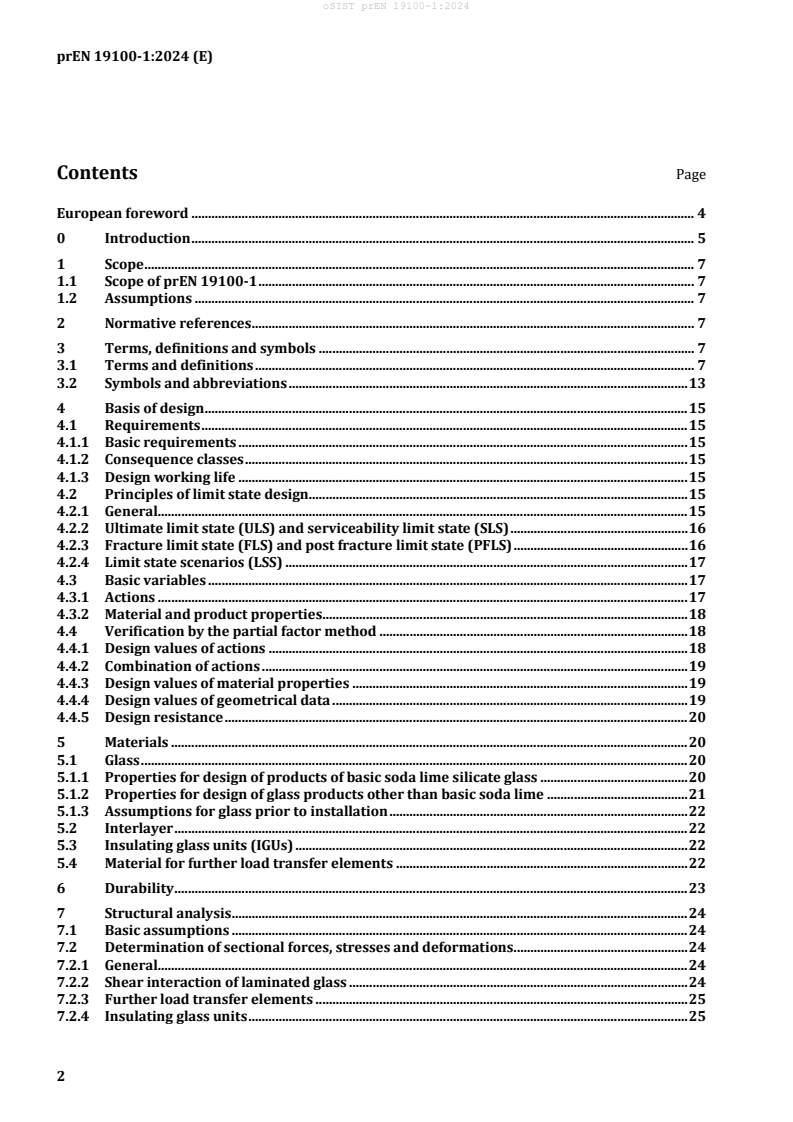
Contents Page
European foreword . 4
0 Introduction . 5
1 Scope . 7
1.1 Scope of prEN 19100-1 . 7
1.2 Assumptions . 7
2 Normative references . 7
3 Terms, definitions and symbols . 7
3.1 Terms and definitions . 7
3.2 Symbols and abbreviations . 13
4 Basis of design . 15
4.1 Requirements . 15
4.1.1 Basic requirements . 15
4.1.2 Consequence classes . 15
4.1.3 Design working life . 15
4.2 Principles of limit state design . 15
4.2.1 General. 15
4.2.2 Ultimate limit state (ULS) and serviceability limit state (SLS) . 16
4.2.3 Fracture limit state (FLS) and post fracture limit state (PFLS) . 16
4.2.4 Limit state scenarios (LSS) . 17
4.3 Basic variables . 17
4.3.1 Actions . 17
4.3.2 Material and product properties . 18
4.4 Verification by the partial factor method . 18
4.4.1 Design values of actions . 18
4.4.2 Combination of actions . 19
4.4.3 Design values of material properties . 19
4.4.4 Design values of geometrical data . 19
4.4.5 Design resistance . 20
5 Materials . 20
5.1 Glass . 20
5.1.1 Properties for design of products of basic soda lime silicate glass . 20
5.1.2 Properties for design of glass products other than basic soda lime . 21
5.1.3 Assumptions for glass prior to installation . 22
5.2 Interlayer . 22
5.3 Insulating glass units (IGUs) . 22
5.4 Material for further load transfer elements . 22
6 Durability . 23
7 Structural analysis . 24
7.1 Basic assumptions . 24
7.2 Determination of sectional forces, stresses and deformations . 24
7.2.1 General. 24
7.2.2 Shear interaction of laminated glass . 24
7.2.3 Further load transfer elements . 25
7.2.4 Insulating glass units . 25
7.3 General structural provisions . 26
7.3.1 Glass support . 26
7.3.2 Glass drill holes and recesses . 26
8 Ultimate limit state . 26
8.1 General . 26
8.2 Partial factors . 27
8.3 Resistance . 27
8.3.1 General . 27
8.3.2 Design bending strength . 28
8.3.3 Resistance of cross section and joints . 28
8.3.4 Static equilibrium: Assessment of safe position . 28
9 Serviceability limit states . 28
9.1 General . 28
9.2 Deformation classes . 28
Annex A (informative) Design bending strength . 30
A.1 Use of this annex . 30
A.2 Scope and field of application . 30
A.3 Design bending strength based on intrinsic glass strength and glass surface pre-stress . 30
Annex B (informative) In-plane thermally induced stress . 35
B.1 Use of this annex . 35
B.2 Scope and field of application . 35
B.3 Temperature distribution within the glass element . 35
B.4 Thermal stresses in glass . 37
Annex C (informative) Risk Assessment . 38
C.1 Use of this annex . 38
C.2 Scope and field of application . 38
C.3 Use of Risk Assessment . 38
Bibliography . 39
European foreword
This document (prEN 19100-1:2024) has been prepared by Technical Committee CEN/TC 250
“Structural Eurocodes”, the secretariat of which is held by BSI. CEN/TC 250 is responsible for all
Structural Eurocodes and has been assigned responsibility for structural and geotechnical design matters
by CEN.
This document is currently submitted to the CEN Enquiry.
This document will supersede CEN/TS 19100-1:2021.
In comparison with the previous edition, the following changes have been made:
— modified title and scope;
— updated references;
— improved provisions for action;
— improved provisions for coefficients and factor values;
— combined Annex A “Bending strength resistance” and Annex B “Bending strength resistance with
interference factor” into new Annex A “Design bending strength”.
The first generation of EN Eurocodes was published between 2002 and 2007. This document forms part
of the second generation of the Eurocodes, which have been prepared under Mandate M/515 issued to
CEN by the European Commission and the European Free Trade Association.
The Eurocodes have been drafted to be used in conjunction with relevant execution, material, product
and test standards, and to identify requirements for execution, materials, products and testing that are
relied upon by the Eurocodes.
The Eurocodes recognize the responsibility of each Member State and have safeguarded their right to
determine values related to regulatory safety matters at national level through the use of National
Annexes.
0 Introduction
0.1 Introduction to the Eurocodes
The Structural Eurocodes comprise the following standards generally consisting of a number of Parts:
— EN 1990 Eurocode — Basis of structural and geotechnical design
— EN 1991 Eurocode 1 — Actions on structures
— EN 1992 Eurocode 2 — Design of concrete structures
— EN 1993 Eurocode 3 — Design of steel structures
— EN 1994 Eurocode 4 — Design of composite steel and concrete structures
— EN 1995 Eurocode 5 — Design of timber structures
— EN 1996 Eurocode 6 — Design of masonry structures
— EN 1997 Eurocode 7 — Geotechnical design
— EN 1998 Eurocode 8 — Design of structures for earthquake resistance
— EN 1999 Eurocode 9 — Design of aluminium structures
— EN 19100 Eurocode 10 — Design of glass structures
The Eurocodes are intended for use by designers, clients, manufacturers, constructors, relevant
authorities (in exercising their duties in accordance with national or international regulations),
educators, software developers, and committees drafting standards for related product, testing and
execution standards.
NOTE Some aspects of design are most appropriately specified by relevant authorities or, where not specified,
can be agreed on a project-specific basis between relevant parties such as designers and clients. The Eurocodes
identify such aspects making explicit reference to relevant authorities and relevant parties.
0.2 Introduction to EN 19100 (all parts)
EN 19100 (all parts) applies to the structural design of mechanically supported glass components and
assemblies of glass components. It complies with the principles and requirements for the safety and
serviceability of structures, the basis of their design and verification that are given in EN 1990, Basis of
structural and geotechnical design.
EN 19100 is subdivided into three parts:
— EN 19100-1, Eurocode 10 — Design of glass structures — Part 1: General rules
— EN 19100-2, Eurocode 10 — Design of glass structures — Part 2: Out-of-plane loaded glass components
— EN 19100-3, Eurocode 10 — Design of glass structures — Part 3: In-plane loaded glass components
0.3 Introduction to EN 19100-1
EN 19100-1 applies to the structural design of mechanically supported glass components and assemblies
of glass components according to EN 19100-2 and EN 19100-3.
0.4 Verbal forms used in the Eurocodes
The verb “shall" expresses a requirement strictly to be followed and from which no deviation is permitted
in order to comply with the Eurocodes.
The verb “should” expresses a highly recommended choice or course of action. Subject to national
regulation and/or any relevant contractual provisions, alternative approaches could be used/adopted
where technically justified.
The verb “may" expresses a course of action permissible within the limits of the Eurocodes.
The verb “can" expresses possibility and capability; it is used for statements of fact and clarification of
concepts.
0.5 National Annex for EN 19100-1
National choice is allowed in this document where explicitly stated within notes. National choice includes
the selection of values for Nationally Determined Parameters (NDPs).
The national standard implementing EN 19100-1 can have a National Annex containing all national
choices to be used for the design of buildings and civil engineering works to be constructed in the relevant
country.
When no national choice is given, the default choice given in this document is to be used.
When no national choice is made and no default is given in this document, the choice can be specified by
a relevant authority or, where not specified, agreed for a specific project by appropriate parties.
National choice is allowed in EN 19100-1 through notes to the following clauses:
3.1.16 4.2.4(1) 4.3.1 (3) – 2 choices 4.3.1(8)
4.3.1(9) 4.3.1(10) 4.4.2(2) 4.4.2(3)
5.2(1) 7.2.2(2) 7.2.2(3) 7.2.2(4)
8.2(2) 8.3.2(1) 9.2(1)
National choice is allowed in EN 19100-1 on the application of the following informative annexes:
Annex A Annex B Annex C
The National Annex can contain, directly or by reference, non-contradictory complementary information
for ease of implementation, provided it does not alter any provisions of the Eurocodes.
1 Scope
1.1 Scope of prEN 19100-1
(1) This document gives basic design rules for glass structures, assemblies and components. This
document is concerned with the requirements for resistance, serviceability, fracture characteristics and
glass component failure consequences in relation to human safety, robustness and redundancy of glass
structures.
(2) This document covers the basis of design, structural design, materials, durability, and construction
rules.
1.2 Assumptions
(1) The assumptions given in EN 1990 apply.
(2) This document is intended to be used in conjunction with EN 1990, EN 1991 (all parts), the parts of
EN 1992 to EN 1999 where glass structures or glass components are referred to within those documents
and EN 12488.
2 Normative references
The following documents are referred to in the text in such a way that some or all of their content
constitutes requirements of this document. For dated references, only the edition cited applies. For
undated references, the latest edition of the referenced document (including any amendments) applies.
NOTE See the Bibliography for a list of other documents cited that are not normative references, including
those referenced as recommendations (i.e. through ‘should’ clauses) and permissions (i.e. through ‘may’ clauses).
EN 572 (all parts), Glass in building — Basic soda lime silicate glass products
EN 1279-5:2018, Glass in building — Insulating glass units — Part 5: Product standard
EN 1990:2023, Eurocode — Basis of structural and geotechnical design
EN 1991 (all parts), Eurocode 1 — Actions on structures
EN 12488, Glass in building — Glazing recommendations — Assembly principles for vertical and sloping
glazing
EN 13022-1, Glass in building — Structural sealant glazing — Part 1: Glass products for structural sealant
glazing systems for supported and unsupported monolithic and multiple glazing
EN 13022-2, Glass in building — Structural sealant glazing — Part 2: Assembly rules
EN 15434-1, Bonding sealants — Part 1: Bonded glazing sealants for direct light exposure
3 Terms, definitions and symbols
3.1 Terms and definitions
For the purposes of this document, the terms and definitions given in EN 1990 and the following apply.
As impacted by EN 1990:2023/prA1:2024.
Table 3.1— Glass component, glass member and system of glass members
Monolithic glass
Key
1 pane
2 single ply
Laminated glass
Key
1 pane
Glass
2 ply
component
3 interlayer
Insulated glass unit (IGU)
Key
1 pane
2 ply
3 interlayer
4 cavity
5 spacer
Glass Glass component +
member boundary conditions
System of Glass components + their
glass interconnections +
members boundary conditions
3.1.1
glass component
glass product being monolithic, laminated, and/or insulating glass unit, after installation
Note 1 to entry: See Table 3.1.
3.1.2
glass member
glass component with clear mechanical boundary conditions so that the effects (stresses or sectional
forces) of a defined action can be calculated
Note 1 to entry: See Table 3.1.
3.1.3
insulating glass unit
IGU
assembly consisting of at least two panes of glass, separated by one or more spacers, hermetically sealed
along the periphery, mechanically stable and durable
3.1.4
limit state scenario
LSS
set of limit states (SLS, ULS, FLS and PFLS) to be verified whilst designing a glass component
3.1.5
ultimate limit state
ULS
state associated with collapse or other forms of structural failure
Note 1 to entry: Generally, it corresponds to the maximum load-carrying resistance of a structure or structural
member.
[SOURCE: EN 1990:2023, 3.1.2.15]
3.1.6
serviceability limit state
SLS
state that correspond to conditions beyond which specified service requirements for a structure or
structural member are no longer met
[SOURCE: EN 1990:2023, 3.1.2.16]
3.1.7
failure
event where the total loss of structural resistance of the glass component or supports or bonding occurs
3.1.8
fracture
macroscopic physical disintegration due to crack propagation in glass
Note 1 to entry: For a monolithic glass pane, a glass fracture results into a failure of the component. For a laminated
glass pane, fracture of a ply or even of all plies does not necessarily result into a failure of the component. For an
IGU, fracture of one glass pane does not necessarily result into failure of the component.
3.1.9
fracture limit state
FLS
ultimate limit state beyond which, during accidental fracture of a glass component or part of glass
component, the following requirements are no longer satisfied
— the prevention of injuries by contact with glass fragments and/or,
— the prevention of body to pass through and/or,
— the ability to limit the failure to that glass component or part of glass component
Note 1 to entry: The requirements can usually be satisfied by choosing an appropriate mode of breakage of glass,
boundary conditions and other mechanical characteristics.
3.1.10
post fracture limit state
PFLS
ultimate limit state beyond which, in case of accidental failure of a glass component, the required residual
load bearing capacity provided by
— redundancy of the glass component,
— undamaged ply(ies) of that glass component,
— structure alternative load path(s)
during a defined period is no longer satisfied
3.1.11
redundancy
provision or existence of additional load paths or structural systems than strictly necessary to resist
design actions
3.1.12
robustness
ability of a structure to withstand unforeseen adverse events without being damaged to an extent
disproportionate to the original cause
[SOURCE: EN 1990:2023, 3.1.2.30]
Note 1 to entry: See EN 1990 and EN 1991-1-7.
3.1.13
ply
sheet of monolithic glass, cut to size and shape
3.1.14
in-plane loaded glass component
glass component subjected to a significant force component parallel to the glass surface
3.1.15
out-of-plane loaded glass component
glass component subjected to a significant force component perpendicular to the glass surface
3.1.16
vertical glass component
glass component which subtends an angle of no more than ± 15° to the vertical
Note 1 to entry: The value of the angle is given in EN 13830, unless the National Annex gives a different value.
3.1.17
interlayer
one or more layers of material acting as an adhesive between plies of glass and/or plastic glazing sheet
material
Note 1 to entry: The interlayer can also give additional performance to the finished product, for example impact
resistance, resistance to fire, solar control and acoustic insulation.
Note 2 to entry: The interlayer itself can also encapsulate non-adhesive films and plates, wires, grids, photovoltaic
cells, etc.
[SOURCE: EN ISO 12543-1:2021, 3.2.7, modified]
3.1.18
laminated glass
assembly consisting of one ply of glass with one or more plies of glass and/or plastic glazing sheet
material joined together with one or more interlayers
Note 1 to entry: The number of glass plies and the requirements on the interlayer depend on the application of the
glass component, required performance and processing capability, etc.
[SOURCE: EN ISO 12543-1:2021, 3.1.1, modified]
3.1.19
laminated safety glass
laminated glass classified in accordance with a soft body impact standard where in the case of breakage
the interlayer serves to retain the glass fragments, limits the size of opening, offers residual resistance
and reduces the risk of cutting or piercing injuries
[SOURCE: EN ISO 12543-1:2021, 3.1.2]
3.1.20
effective thickness
mechanically equivalent thickness used in structural calculation to represent the “as if monolithic
thickness” of laminated glass when calculating its resistance or stiffness
3.1.21
thermal stress
stress induced by thermal expansion, e.g. due to temperature differences in the glass
3.1.22
cavity pressure
pressure applied to the panes of insulating glass units due to the internal volume of the hermetically
sealed cavity or cavities being affected by variable cavity loading and permanent cavity loading
3.1.23
variable cavity loading
pressure acting on the panes of insulating glass unit resulting from the effect of sealed cavity volume
variations due to temperature and atmospheric changes
3.1.24
permanent cavity loading
pressure acting on the panes of insulating glass unit resulting solely from a difference in altitude between
the place of assembly (sealing) and the place of use
3.1.25
pre-stressed glass
glass within which a permanent surface compressive stress has been induced by a controlled process in
order to give it increased resistance to mechanical and thermal stress and/or prescribed fracture
characteristics
Note 1 to entry: Pre-stressed glasses can be thermally toughened glass, heat soaked thermally toughened glass,
heat strengthened glass or chemically strengthened glass.
3.1.26
mid plane of a hole
symmetry plane of a hole in a glass ply, which is parallel to the glass surfaces
3.1.27
glazing block
piece of suitable material, placed between the glass component and the frame preventing direct contact
between the two of them
Note 1 to entry: Glazing blocks include setting blocks, location blocks and distance pieces, see EN 12488.
3.1.28
annealed glass
glass as delivered directly from the fabrication cycle without subsequent treatment
[SOURCE: ISO 12216:2020, 3.7.1]
3.1.29
float glass
flat, transparent, clear or tinted soda-lime silicate glass having parallel and polished faces obtained by
continuous casting and flotation on a metal bath
[SOURCE: ISO 16293-1:2008, 3.1]
3.1.30
patterned glass
flat, translucent, clear or tinted soda-lime silicate glass obtained by continuous casting and rolling
[SOURCE: EN 572-1:2012+A1:2016, 3.3]
3.1.31
wired patterned glass
flat, translucent, clear or tinted soda-lime silicate glass obtained by continuous casting and rolling which
has a steel mesh welded at all intersections incorporated in the glass during its manufacturing process
Note 1 to entry: The surfaces can be either patterned or plain.
Note 2 to entry: In German, wired patterned glass with plain surfaces is called ‘Drahtglas’.
3.1.32
polished wired glass
flat, transparent, clear soda-lime silicate glass having parallel and polished faces obtained by grinding
and polishing the faces of wired patterned glass
Note 1 to entry: The surfaces can be either patterned or plain.
Note 2 to entry: In German, wired patterned glass with plain surfaces is called ‘Drahtglas’.
3.1.33
drawn sheet glass
flat, transparent, clear or tinted soda-lime silicate glass obtained by continuous drawing, initially
vertically, of a regular thickness and with the two surfaces fire polished
[SOURCE: EN 572-1:2012+A1:2016, 3.2]
3.1.34
surface pre-stress
permanent surface compression induced by pre-stressing technologies
3.1.35
European Technical Product Specification
European Standard (EN), European Technical Specification (TS) or a transparent and reproducible
assessment that complies with all the requirements of an EAD
3.2 Symbols and abbreviations
For the purposes of this document, the following symbols and abbreviations apply.
3.2.1 Latin upper-case letters
E Modulus of elasticity
E Design value of effect of actions
d
F Design value of an action
d
G Interlayer shear modulus or interlayer shear relaxation modulus
int
N Design value of normal forces in the relevant direction of the considered cross section or joint
Ed
N Design value of resisting normal forces in the direction of the corresponding effect
Rd
M Design value of moments in the relevant direction of the considered cross section or joint
Ed
M Design value of resisting moments in the direction of the corresponding effect
Rd
R Design values for resistance
d
R Characteristic value for resistance
k
T External air temperature
ext
T Maximum summer air temperature on the building site
max
T Minimum winter air temperature on the building site
min
V Design value of transverse forces in the relevant direction of the considered cross section or
Ed
joint
V Design value of resisting transverse forces in the direction of the corresponding effect
Rd
X Characteristic value of a material property
k
3.2.2 Latin lower-case letters
f Characteristic value of glass strength after a strengthening treatment
b,k
f Design value of bending strength of glass
g,d
f Characteristic value of bending strength of annealed glass
g,k
h Glass ply thickness
k Edge or hole finishing factor
e
k Edge or hole prestress factor
e,p
k Interference factor
i
k Modification factor depending on load duration
mod
k Coefficient accounting for the reduction of the process-induced prestress
p
k Surface treatment factor
sp
3.2.3 Greek upper-case letters
ΔT Temperature change
3.2.4 Greek lower-case letters
α Coefficient of linear thermal expansion
T
γ Material partial factor
M
Partial factor for prestress on the surface
γ
P
λA Size-effect factor area
λ Size-effect factor length (edge, hole)
l
ν Poisson’s ratio
ρ Density of glass
σ Design value of principal stresses on the surface of the glass in the relevant direction
prin,Ed
ψ Cavity pressure combination factors
cp,i
4 Basis of design
4.1 Requirements
4.1.1 Basic requirements
(1) Glass structures shall be designed in accordance with the general rules given in EN 1990.
(2) In conjunction with EN 1990, the specific provisions for resistance, serviceability, durability and
robustness given in this document should be used.
4.1.2 Consequence classes
(1) Considering the consequences of failure or malfunction, glass components shall be classified
according to the Consequence Classes given in EN 1990:2023, Table 4.1.
NOTE For glass components that are in class of consequence CC0, see EN 16612.
4.1.3 Design working life
(1) Glass components should be designed for a design working life category according to EN 1990.
NOTE The design working life refers to structural design only. Other performance requirements (e.g. thermal
insulation, weather tightness, etc.) or aesthetic requirements can lead to a different working life of a glass
component.
(2) It is recommended to establish a maintenance concept, explicitly describing inspection measures.
(3) Requirements for replaceability may be as specified by the relevant authority or, where not specified,
agreed for a specific project by the relevant parties.
(4) Glass components being part of the primary structural system should correspond to the design
working life of the rest of the global structure.
NOTE See also Clause 6 “Durability”.
4.2 Principles of limit state design
4.2.1 General
(1) The choice of glass is depending on the mode of breakage. Therefore, the required mode of breakage
and subsequently, the choice of glass type should be clarified prior to the verification in the limit states.
NOTE Further information on the choice of glass is provided in CEN/TS 19100-4.
(2) Glass components should be designed for the following limit states as relevant:
— the serviceability limit state (SLS) where glass is unfractured,
— the ultimate limit state (ULS) where glass is unfractured,
— the fracture limit state (FLS) during the event of fracture,
— the post fracture limit state (PFLS) where glass is fractured.
NOTE 1 For SLS, see EN 1990 as well as 4.2.2 and Clause 9 of this document.
NOTE 2 For ULS, see EN 1990 as well as 4.2.2 and Clause 8 of this document.
NOTE 3 For FLS and PFLS, see 4.2.3 and prEN 19100-2 and prEN 19100-3.
(3) FLS and PFLS verifications may be performed either by calculation (theoretical assessment) or by
testing.
(4) For glass structures, special attention should be paid to robustness and redundancy.
NOTE Design for the additional limit states FLS and PFLS provides means to achieve sufficient robustness and
redundancy.
(5) In situations where risk of breakage is critical, the design should start with consideration of FLS and
PFLS respectively.
4.2.2 Ultimate limit state (ULS) and serviceability limit state (SLS)
(1) The limit states that concern the safety verification and structural detailing of glass components shall
be classified as ultimate limit states (ULS), see EN 1990.
NOTE Design rules in the ULS are given in prEN 19100 (all parts).
(2) The limit states that concern the serviceability verification of unfractured (intact) glass components
shall be classified as serviceability limit states (SLS), see EN 1990.
NOTE Design rules for the SLS are given in Clause 9. Design limiting values are given in prEN 19100-2 and
prEN 19100-3.
4.2.3 Fracture limit state (FLS) and post fracture limit state (PFLS)
(1) Design of glass structures shall always consider situations where parts of or the entire glass
component fractures. This includes the situation during the event of fracture or the situation after
fracture.
NOTE Due to the brittleness of glass, the risk of breakage exists and can be critical if no further measures for
the situation during the event of fracture or for the situation after the event of fracture are taken.
(2) The limit states associated with these situations are the fracture limit state (FLS) and the post fracture
limit state (PFLS). In the fracture limit state (FLS) safety during the event of fracture shall be verified. In
the post fracture limit state (PFLS) safety after fracture shall be verified for a defined limited time period.
(3) Safety verification in the fracture limit state (FLS) shall consider dynamic impact, together with static
permanent and variable loadings likely to occur during impact. Safety verification in the post fracture
limit state (PFLS) shall consider static permanent and variable loading likely to occur for the considered
limited time period.
NOTE FLS and PFLS refer to accidental design situations in the ultimate limit state according to EN 1990:2023,
8.3.3.4. Because of the importance, limit states (FLS and PFLS) were created in prEN 19100 (all parts) for these
accidental design situations.
(4) Design rules for the FLS and for the PFLS are given in prEN 19100-2 and prEN 19100-3.
NOTE 1 The PFLS requires a suitable post fracture load bearing capacity for a defined time period.
NOTE 2 The fracture can refer to one or several plies or to the entire component.
NOTE 3 The time period usually comprises the expected times from fracture incidence to identification of the
fractured glass and further, the time required to secure or replace the fractured glass pane.
4.2.4 Limit state scenarios (LSS)
(1) In addition to the classification into CCs, glass components may be assigned to LSS. LSS describe
groups of limit state considerations, see Table 4.1.
NOTE 1 LSS are introduced to group different glass components with a common set of limit states.
NOTE 2 Generally, a glass component can be assigned to a LSS according to the National Annex. Countries are
encouraged to establish lists where typical glass applications (e.g. balustrade, roof, column, beam) are classified
according to LSS-0, LSS-1, LSS-2 or LSS-3.
(2) LSS 0 should be selected where verification in SLS and safety verification in ULS is required, but not
in FLS and PFLS.
(3) LSS 1 should be selected where, apart from SLS and ULS, safety verification in FLS is required but not
in PFLS.
(4) LSS 2 should be selected where, apart from SLS and ULS, safety verification in FLS is not required but
in PFLS.
(5) LSS 3 should be selected where, apart from SLS and ULS, safety verification in FLS and PFLS is
required.
Table 4.1 — Limit state scenarios (LSS) depending on limit or fracture state
Limit state scenario (LSS)
LSS-0 LSS-1 LSS-2 LSS-3
SLS SLS SLS SLS
Design for the unfractured glass state
ULS ULS ULS ULS
Design for the glass fracture state (safe glass fracture) FLS FLS
Design for the post-fractured state (residual load capacity) PFLS PFLS
4.3 Basic variables
4.3.1 Actions
(1) The characteristic values of actions for the design of glass structures, including any regional, climatic
and accidental situations, shall be obtained from the relevant parts of EN 1991.
(2) The climatic actions causing cavity pressure variations of the insulating glass unit such as gas
temperature variation, the difference of altitude between production and installation sites and change of
atmospheric pressure at the place of use shall be taken into account.
NOTE The cavity pressure due to the difference of altitude is a permanent action.
(3) The stresses resulting from cavity pressure variations shall be combined with other stresses.
Considering that temperature can play a significant role in the climatic effects, they may be treated
applying the partial factors in characteristic combination of loads (see EN 1990).
NOTE 1 See also 4.3.1(2) NOTE.
NOTE 2 The partial factor γ for the effect of change of altitude is 1,05 unless the National Annex gives a different
E
value.
NOTE 3 The combination of actions due to cavity pressure effects can be set by the National Annex.
(4) Settlements, changes in position, stiffness of constraints of the adjacent structure should be
considered in the design.
(5) If applicable, construction stages should be considered to derive actions during execution according
to EN 1991-1-6.
(6) In case of IGUs, besides the effect of the temperature on the cavity pressure of IGUs (see above),
occurring thermal stresses from temperature differences within the glass pane itself should be
considered in the stress verification. Such temperature differences can be caused by partial shading, large
edge cover, heat absorbing glass or coating, etc.
(7) Seismic design actions should be calculated in accordance with methods established under relevant
parts of EN 1998 or national standards. The following limit states shall be considered: Fully Operational
limit state (FO), Operational limit state (OP), Life Safety limit state (LS), Near Collapse limit state (NC).
(8) If for a vertical glazing a horizontal point load needs to be considered, it should be distributed over a
square area.
NOTE The size of the area is 100 mm x 100 mm for areas not susceptible to crowds and 300 mm x 300 mm for
areas susceptible to crowds, unless the National Annex gives a different value.
(9) If for a vertical glazing a horizontal line load needs to be considered, it should be distributed over a
strip like area with the corresponding length and a width of 100 mm.
NOTE The National Annex can give different values for the width of the line load.
(10) If for a horizontal glazing a vertical point load needs to be considered, it can be distributed over an
area of 100 mm x 100 mm.
NOTE 1 The areas given in 4.3.1(8), (9) and (10) refer to the actions as given in EN 1991-1-1.
NOTE 2 The National Annex can give a different value for the area.
4.3.2 Material and product properties
(1) The material properties for gla
...
Questions, Comments and Discussion
Ask us and Technical Secretary will try to provide an answer. You can facilitate discussion about the standard in here.
Loading comments...