

EN 13381-5:2014
(Main)Test methods for determining the contribution to the fire resistance of structural members - Part 5: Applied protection to concrete/profiled sheet steel composite member
General Information
- Abstract
This European Standard specifies a test method for determining the contribution of fire protection systems to the fire resistance of structural concrete/profiled sheet steel composite members or slabs. The concrete can be lightweight, normal-weight or heavy-weight concrete and of strength classes 20/25 (LC/C/HC) to 50/60 (LC/C/HC).
The test method and its assessment procedure are designed to permit direct application of the results to cover a range of thicknesses of the applied fire protection material.
The test method is applicable to all fire protection materials used for the protection of concrete/steel composite members or slab and includes sprayed materials, coatings, cladding protection systems and multi-layer or composite fire protection materials, with or without a cavity between the fire protection material and the concrete/steel composite members or slab.
This European Standard contains the fire test which specifies the tests which will be carried out to determine the ability of the fire protection system to remain coherent and fixed to the composite member and to provide data on the temperatures of the steel sheet, throughout the depth of the concrete (for extended application purposes) and the unexposed surface of the concrete, when exposed to the standard temperature/time curve according to the procedures defined herein.
In special circumstances, where specified in national building regulations, there can be a need to subject reactive protection material to a smouldering curve. The test for this and the special circumstances for its use are detailed in Annex A.
The fire test methodology makes provision for the collection and presentation of data which can be used as direct input to the calculation of fire resistance of concrete/steel composite members in accordance with the procedures given in EN 1994 1 2.
This European Standard also contains the assessment which prescribes how the analysis of the test data needs to be made and gives guidance to the procedures by which interpolation needs to be undertaken.
The limits of applicability of the results of the assessment arising from the fire test are defined, together with permitted direct application of the results to different steel/concrete composite structures, steel types and thicknesses, concrete densities, strengths, thicknesses and production techniques over the range of thicknesses of the applied fire protection system tested.
- Status
- Published
- Publication Date
- 11-Nov-2014
- Withdrawal Date
- 30-May-2015
- Technical Committee
- CEN/TC 127 - Fire safety in buildings
- Drafting Committee
- CEN/TC 127/WG 1 - Structural and separating elements
- Current Stage
- 9093 - Decision to confirm - Review Enquiry
- Start Date
- 28-Apr-2026
- Completion Date
- 30-Sep-2026

Overview
EN 13381-5:2014 (CEN) defines a laboratory test method to determine how applied fire protection systems contribute to the fire resistance of concrete/profiled sheet steel composite members (composite slabs). The standard covers protection for concrete of all densities (lightweight, normal-weight, heavy-weight) and strength classes from 20/25 to 50/60. It applies to a wide range of protection products - sprayed materials, coatings, cladding systems and multi-layer or composite protections - with or without an air cavity.
The test records the ability of the protection to remain coherent and fixed, and measures temperatures of the profiled steel sheet, temperatures through the concrete depth and the unexposed concrete surface when exposed to the standard time–temperature curve. Annex A addresses smouldering (slow heating) tests for reactive protection materials; Annex B covers measurement of protection properties.
Key topics and requirements
- Scope of application: Applied protection to concrete/profiled sheet steel composite members and slabs; enables direct application across tested protection thicknesses.
- Test objectives: Verify adhesion/fixity of the protection, measure temperature profiles (steel sheet, concrete depth, unexposed surface) and gather data for fire resistance calculations.
- Types of protection covered: Sprayed materials, coatings, cladding protection systems, multi-layer/composite systems; with/without cavity.
- Test setup elements: Use of standard furnace and time–temperature curve, instrumentation for furnace temperature and specimen temperatures, deformation and load measurement, and defined specimen construction and conditioning.
- Special procedures: Smouldering fire (Annex A) for reactive products when required by national regulations.
- Assessment & interpolation: Procedures to analyse test data, interpolate results for different protection thicknesses and provide inputs for structural fire design calculations.
- Limits of applicability: Defined limits for steel types/thicknesses, concrete densities/strengths/thicknesses and production techniques.
Applications
- Input for performance-based structural fire design of composite floors and slabs.
- Product development, type‑testing and certification of applied fire protection systems for composite members.
- Specification and procurement of fire protection thicknesses for renovation or new construction.
- Providing validated input data for calculations in EN 1994-1-2 (Eurocode 4 - structural fire design).
Who uses this standard
- Structural and fire engineers performing fire-resistance assessments.
- Manufacturers of passive fire protection (sprays, coatings, cladding).
- Fire-test laboratories and certification bodies.
- Regulators, building control authorities and consultants involved in compliance and product approval.
Related standards
- EN 1994-1-2 (Eurocode 4 - structural fire design)
- EN 1363-1 / EN 1363-2 (fire resistance test methods)
- Other parts of the EN 13381 series (Parts 1–4, 6–8) for different protection configurations and materials
Keywords: EN 13381-5, fire resistance, applied fire protection, concrete/profiled sheet steel composite, fire test method, smouldering curve, EN 1994-1-2.
Relations
- Effective Date
- 15-Oct-2011
- Effective Date
- 06-May-2026
- Effective Date
- 25-Mar-2026
- Effective Date
- 11-Mar-2026
- Effective Date
- 28-Jan-2026
- Effective Date
- 28-Jan-2026
- Effective Date
- 28-Jan-2026
- Effective Date
- 28-Jan-2026
- Effective Date
- 28-Jan-2026
- Effective Date
- 28-Jan-2026
- Effective Date
- 28-Jan-2026
- Effective Date
- 28-Jan-2026
- Effective Date
- 28-Jan-2026
- Effective Date
- 28-Jan-2026
- Effective Date
- 28-Jan-2026
Get Certified
Connect with accredited certification bodies for this standard

DIBt (Deutsches Institut für Bautechnik)
German Institute for Building Technology.
DIN CERTCO
DIN Group product certification.

Kiwa BDA Testing
Building and construction product certification.
Sponsored listings
Frequently Asked Questions
EN 13381-5:2014 is a standard published by the European Committee for Standardization (CEN). Its full title is "Test methods for determining the contribution to the fire resistance of structural members - Part 5: Applied protection to concrete/profiled sheet steel composite member". This standard covers: This European Standard specifies a test method for determining the contribution of fire protection systems to the fire resistance of structural concrete/profiled sheet steel composite members or slabs. The concrete can be lightweight, normal-weight or heavy-weight concrete and of strength classes 20/25 (LC/C/HC) to 50/60 (LC/C/HC). The test method and its assessment procedure are designed to permit direct application of the results to cover a range of thicknesses of the applied fire protection material. The test method is applicable to all fire protection materials used for the protection of concrete/steel composite members or slab and includes sprayed materials, coatings, cladding protection systems and multi-layer or composite fire protection materials, with or without a cavity between the fire protection material and the concrete/steel composite members or slab. This European Standard contains the fire test which specifies the tests which will be carried out to determine the ability of the fire protection system to remain coherent and fixed to the composite member and to provide data on the temperatures of the steel sheet, throughout the depth of the concrete (for extended application purposes) and the unexposed surface of the concrete, when exposed to the standard temperature/time curve according to the procedures defined herein. In special circumstances, where specified in national building regulations, there can be a need to subject reactive protection material to a smouldering curve. The test for this and the special circumstances for its use are detailed in Annex A. The fire test methodology makes provision for the collection and presentation of data which can be used as direct input to the calculation of fire resistance of concrete/steel composite members in accordance with the procedures given in EN 1994 1 2. This European Standard also contains the assessment which prescribes how the analysis of the test data needs to be made and gives guidance to the procedures by which interpolation needs to be undertaken. The limits of applicability of the results of the assessment arising from the fire test are defined, together with permitted direct application of the results to different steel/concrete composite structures, steel types and thicknesses, concrete densities, strengths, thicknesses and production techniques over the range of thicknesses of the applied fire protection system tested.
This European Standard specifies a test method for determining the contribution of fire protection systems to the fire resistance of structural concrete/profiled sheet steel composite members or slabs. The concrete can be lightweight, normal-weight or heavy-weight concrete and of strength classes 20/25 (LC/C/HC) to 50/60 (LC/C/HC). The test method and its assessment procedure are designed to permit direct application of the results to cover a range of thicknesses of the applied fire protection material. The test method is applicable to all fire protection materials used for the protection of concrete/steel composite members or slab and includes sprayed materials, coatings, cladding protection systems and multi-layer or composite fire protection materials, with or without a cavity between the fire protection material and the concrete/steel composite members or slab. This European Standard contains the fire test which specifies the tests which will be carried out to determine the ability of the fire protection system to remain coherent and fixed to the composite member and to provide data on the temperatures of the steel sheet, throughout the depth of the concrete (for extended application purposes) and the unexposed surface of the concrete, when exposed to the standard temperature/time curve according to the procedures defined herein. In special circumstances, where specified in national building regulations, there can be a need to subject reactive protection material to a smouldering curve. The test for this and the special circumstances for its use are detailed in Annex A. The fire test methodology makes provision for the collection and presentation of data which can be used as direct input to the calculation of fire resistance of concrete/steel composite members in accordance with the procedures given in EN 1994 1 2. This European Standard also contains the assessment which prescribes how the analysis of the test data needs to be made and gives guidance to the procedures by which interpolation needs to be undertaken. The limits of applicability of the results of the assessment arising from the fire test are defined, together with permitted direct application of the results to different steel/concrete composite structures, steel types and thicknesses, concrete densities, strengths, thicknesses and production techniques over the range of thicknesses of the applied fire protection system tested.
EN 13381-5:2014 is classified under the following ICS (International Classification for Standards) categories: 13.220.50 - Fire-resistance of building materials and elements; 91.080.01 - Structures of buildings in general. The ICS classification helps identify the subject area and facilitates finding related standards.
EN 13381-5:2014 has the following relationships with other standards: It is inter standard links to ENV 13381-5:2002, ISO 8421-2:1987, EN 1994-1-2:2026, EN 206-2:2026, EN 1992-1-1:2023, EN ISO 3251:2019, EN ISO 29466:2022, EN 1363-1:2020, EN 12467:2012+A2:2018, EN 206:2013+A2:2021, EN 12325-2:1999/AC:1999, EN ISO 13943:2023, EN 10346:2015, EN 1363-2:1999, EN 1994-1-2:2005. Understanding these relationships helps ensure you are using the most current and applicable version of the standard.
EN 13381-5:2014 is associated with the following European legislation: EU Directives/Regulations: 305/2011, 89/106/EEC; Standardization Mandates: M/117. When a standard is cited in the Official Journal of the European Union, products manufactured in conformity with it benefit from a presumption of conformity with the essential requirements of the corresponding EU directive or regulation.
EN 13381-5:2014 is available in PDF format for immediate download after purchase. The document can be added to your cart and obtained through the secure checkout process. Digital delivery ensures instant access to the complete standard document.
Standards Content (Sample)
2003-01.Slovenski inštitut za standardizacijo. Razmnoževanje celote ali delov tega standarda ni dovoljeno.RQVWUXNFLMVNLKSORþHYLQHPrüfverfahren zur Bestimmung des Beitrages zum Feuerwiderstand von tragenden Bauteilen - Teil 5: Brandschutzmaßnahmen für profilierte Stahlblech/Beton-VerbundkonstruktionenMéthodes d'essai pour déterminer la contribution à la résistance au feu des éléments de construction - Partie 5: Protection appliquée aux dalles mixtes béton/tôle d'acier profiléeTest methods for determining the contribution to the fire resistance of structural members - Part 5:
Applied protection to concrete/profiled sheet steel composite member91.080.01Gradbene konstrukcije na splošnoStructures of buildings in general13.220.50Požarna odpornost gradbenih materialov in elementovFire-resistance of building materials and elementsICS:Ta slovenski standard je istoveten z:EN 13381-5:2014SIST EN 13381-5:2014en,fr,de01-december-2014SIST EN 13381-5:2014SLOVENSKI
STANDARDSIST ENV 13381-5:20031DGRPHãþD
EUROPEAN STANDARD NORME EUROPÉENNE EUROPÄISCHE NORM
EN 13381-5
November 2014 ICS 13.220.50; 91.080.01 Supersedes ENV 13381-5:2002English Version
Test methods for determining the contribution to the fire resistance of structural members - Part 5:
Applied protection to concrete/profiled sheet steel composite member
Méthodes d'essai pour déterminer la contribution à la résistance au feu des éléments de construction - Partie 5 : Protection appliquée aux dalles mixtes béton/tôle d'acier profilée
Prüfverfahren zur Bestimmung des Beitrages zum Feuerwiderstand von tragenden Bauteilen - Teil 5: Brandschutzmaßnahmen für profilierte Stahlblech/Beton-Verbundkonstruktionen This European Standard was approved by CEN on 13 September 2014.
CEN members are bound to comply with the CEN/CENELEC Internal Regulations which stipulate the conditions for giving this European Standard the status of a national standard without any alteration. Up-to-date lists and bibliographical references concerning such national standards may be obtained on application to the CEN-CENELEC Management Centre or to any CEN member.
This European Standard exists in three official versions (English, French, German). A version in any other language made by translation under the responsibility of a CEN member into its own language and notified to the CEN-CENELEC Management Centre has the same status as the official versions.
CEN members are the national standards bodies of Austria, Belgium, Bulgaria, Croatia, Cyprus, Czech Republic, Denmark, Estonia, Finland, Former Yugoslav Republic of Macedonia, France, Germany, Greece, Hungary, Iceland, Ireland, Italy, Latvia, Lithuania, Luxembourg, Malta, Netherlands, Norway, Poland, Portugal, Romania, Slovakia, Slovenia, Spain, Sweden, Switzerland, Turkey and United Kingdom.
EUROPEAN COMMITTEE FOR STANDARDIZATION
COMITÉ EUROPÉEN DE NORMALISATION EUROPÄISCHES KOMITEE FÜR NORMUNG
CEN-CENELEC Management Centre:
Avenue Marnix 17,
B-1000 Brussels © 2014 CEN All rights of exploitation in any form and by any means reserved worldwide for CEN national Members. Ref. No. EN 13381-5:2014 ESIST EN 13381-5:2014
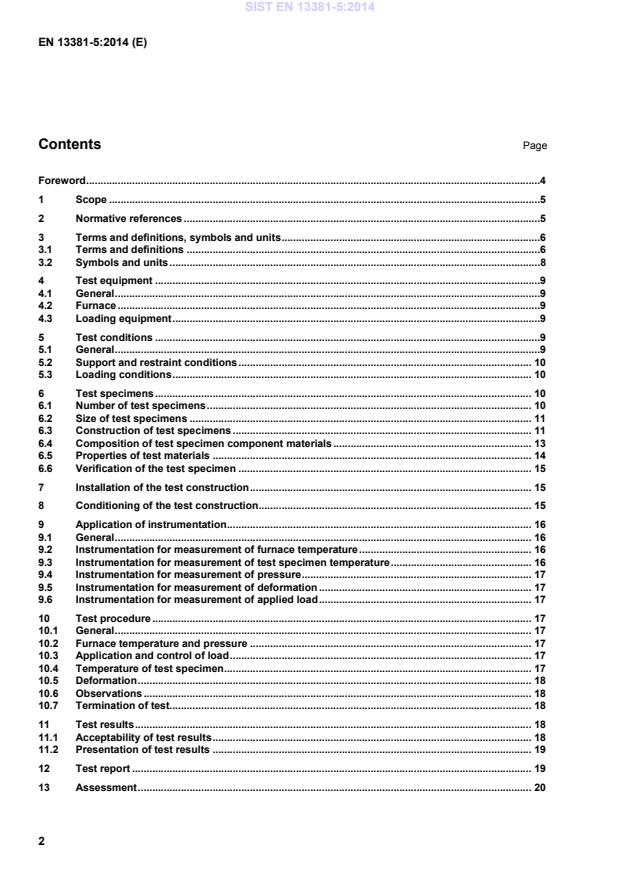
Test method to the smouldering fire or slow heating curve . 32 A.1 General . 32 A.2 Test conditions . 32 A.3 Termination of the test . 32 A.4 Evaluation of the results . 33 Annex B (normative)
Measurement of properties of fire protection materials . 35 B.1 General . 35 B.2 Thickness of fire protection materials . 35 B.3 Density of applied fire protection materials . 36 B.4 Moisture content of applied fire protection materials . 36 Bibliography . 38
°C characteristic temperature m,l (m,u) °C limiting temperature at the lower respectively upper part of the steel profile heff mm the effective thickness of the concrete/steel composite test slab he mm the equivalent effective thickness of the concrete/steel composite test slab heq mm the equivalent thickness of concrete corresponding to the particular thickness of the fire protection system tested tr min the time at which an increase of the characteristic temperature of all thermocouples on the unexposed concrete surface of 140 180
fy N/mm2 yield strength of steel dp mm thickness of fire protection material SIST EN 13381-5:2014
Small test specimen Large test specimen Exposed length (mm) Lexp ≥ 1 300 ≥ 3 000a Span (mm) Lsup ≥ 1 500
[(Lexp + 200) > Lsup < (Lexp + 400)]b ≥ 3 200a
[(Lexp + 200) > Lsup < (Lexp + 400)]b Length (mm) Lspec ≥ 1 700
[(Lexp + 400) > Lsup < (Lexp + 700)c] ≥ 3 400
[(Lexp + 400) > Lsup < (Lexp + 700)]c Exposed width (mm) Wexp ≥ 1 000 ≥ 2 000 Thickness h = [h1 + h2] (mm) [(h1 = 60 ± 5) + (h2 = height of ribs)] [(h1 = 60 ± 5) + (h2 = height of ribs)] Position of loading points from support points none Lsup/4 (symmetrically distributed) a
A span of 3 000 mm is mainly valid for trapezoidal decking with height of ribs of 50/60 mm and steel thickness of 1 mm. b The distance between the exposed part of the test specimen and the supports shall be kept as small as possible. For tests of short duration (less than 240 min) a distance of 100 mm at either end is recommended. For tests of longer duration, this can be increased to 200 mm at either end, to protect the test equipment from heat damage. c The additional length beyond the supports, required for installation purposes, shall be kept as small as it is practically possible. 6.3.2 Fabrication of concrete/steel composite slab test members Composite slab test members shall be prepared in a smooth surfaced framework made from steel or timber. To facilitate release of the edges of the slab from the framework, soluble oils or emulsions shall preferably be used, although wax, non-soluble oil or non-soluble emulsions may be used. The actual material used for this purpose shall be detailed in the test report. 6.3.3 Application of the fire protection system (except suspended ceiling) to the composite test slab The steel surface of the composite test element shall be prepared as in practice. The surface of the steel face of the concrete/steel composite test slab shall normally be dried prior to the application of the fire protection system. The fire protection system shall be uniformly applied to the test specimen, as in practice, including any required fixing aids and in the same manner for both maximum and minimum thickness. The fire protection material shall extend over the full exposed surface of the concrete/steel composite test slab and be applied prior to the application of the test load (if any). Where a fire protection system creates small cavities between the concrete/steel composite test element and the fire protection material, the ends shall be sealed with fire resistant material to prevent any flow of hot gases out of the cavities. Board type fire protection systems shall include joints in accordance with the following criteria: —
large size test specimen: at least one longitudinal joint shall be situated near the longitudinal mid-width axis under a void between two waves and at least one transverse joint positioned not further than 500 mm from the transverse mid-span axis; SIST EN 13381-5:2014
small size test specimen: at least one longitudinal joint shall be situated near the longitudinal mid-width axis under a void between two waves and at least one transverse joint positioned not further than 100 mm from the transverse axis. 6.3.4 Installation of the suspended ceiling onto the composite test slab The test specimen shall reproduce the conditions of use, including junctions between membrane and walls and edge panels, joints and jointing materials and be installed from below by the same method and procedures as given in the installation manual, or in written instructions, which shall be provided by the sponsor. It shall be fitted with all the components for hanging, expansion and abutting, plus any other fixtures which are to be defined by the sponsor, with a frequency representative of practice. For horizontal protective membranes which are suspended from the structural building member by hangers, the suspension system and the length of the hangers shall be representative of practice. The profiles bearing the various panels shall be installed against each other without any gap, unless a gap (or gaps) is required for design purposes. In this case the gap (or gaps) at the junctions of main runners shall be representative of that to be used in practice and shall be installed within the main runners and not at their ends. The profiles within the test specimen shall include a joint representative of joints to be used in practice in both longitudinal and transverse directions. The horizontal protective membrane shall be fixed according to normal practice on all four edges, either directly to the furnace walls or to a test frame. A test frame, where used, shall be fixed directly to the horizontal structural building member being protected, or to the furnace walls. If the construction or properties of the horizontal protective membrane are different in the longitudinal and transverse directions, the performance of the specimen may vary depending upon which components are aligned with the longitudinal axis. If known from experience, the specimen shall be installed so as to represent the most onerous condition by arranging the more critical components parallel to the longitudinal axis. If the more onerous condition cannot be identified, two separate tests shall be carried out with the components arranged both parallel and perpendicular to the longitudinal axis. 6.4 Composition of test specimen component materials 6.4.1 Profiled steel sheet The steel used shall be of grade between S280GD and S350GD as defined in EN 10346. 6.4.2 Concrete The concrete in the test specimen shall normally be of type 25/30 to 30/37 [LC/C/HC] (light-weight between 800 and 2 000 kg/m3, normal-weight between 2000 and 2600 kg/m3 or heavy-weight concrete greater than 2 600 kg/m3) according to EN 206 and EN 1992-1-1, although other grades within the strength range 20/25 to 50/60 may be used (see Clause 1). The concrete shall be prepared from silicious aggregates, of maximum aggregate size of 20 mm, and Portland cement. The composition and properties of the concrete used shall be appropriate to those defined in EN 206 and EN 1992-1-1. Other non-silicious and lower density aggregates may be permitted, but the applicability of the results of the assessment will be restricted according to 15.7. SIST EN 13381-5:2014
The thickness of a sprayed or coated passive type fire protection material shall not deviate by more than 20 % of the mean value over the whole of its surface. The mean value shall be used in the assessment of the results and the limits of applicability of the assessment. If it deviates by more than 20 %, the maximum thickness recorded shall be used in the assessment. The density of fire protection material applied to the composite steel/concrete slabs at minimum and maximum thickness shall be recorded. The average between mean values of the density of the fire protection material at minimum and maximum thickness shall be used in the assessment of the results of the test, unless the difference between this average value and the mean values at minimal and maximal thickness is greater than 15 % of the average value, in which case the maximum mean density value recorded shall be used. 6.6 Verification of the test specimen An examination and verification of the test specimen for conformity to specification shall be carried out as defined in EN 1363-1. The properties of the materials used in the preparation of the test specimen shall be measured using special samples, where necessary, as described in 6.5 using the methods defined in Annex B. The sponsor shall verify that the fire protection material has been applied correctly and in the case of sprayed or coating materials ensure, by methods appropriate to the material, that it is of the design composition and specification. 7 Installation of the test construction The test construction, comprising the concrete/steel composite test slab, any supporting construction or test frame and the fire protection system, shall be installed onto the furnace to allow freedom for longitudinal deflection and movement, according to 5.2.1, using at one side rolling support(s) and at the other side, hinge support(s). Special attention shall be given to the choice of size of the test specimen according to the expected duration of the test (see 6.2) and to insulation of the supports carrying the slab against the influence of heat. Care shall be taken to ensure during installation of the test specimens onto the furnace, or as a result of any movement occurring during the test, that the fire protection system is not subjected to any expansion or restraint stresses contrary to its use in practice. 8 Conditioning of the test construction The test construction and test samples taken for the determination of material properties (specified in 6.5) shall be conditioned according to EN 1363-1. Material properties shall be determined according to methods specified in 6.5, EN 1363-1 and Annex B. The minimum conditioning time for concrete/steel slabs shall be 90 d. SIST EN 13381-5:2014
...