

EN 13369:2013
(Main)Common rules for precast concrete products
General Information
- Abstract
This European Standard specifies the requirements, the basic performance criteria and the evaluation of conformity for unreinforced, reinforced and prestressed precast concrete products made of compact light-, normal- and heavyweight concrete according to EN 206-1 with no appreciable amount of entrapped air other than entrained air. Concrete containing fibres for other than mechanical properties steel, polymer or other fibres is also covered. It does not cover prefabricated reinforced components of lightweight aggregate concrete with open structure.
It may also be used to specify products for which there is no standard. Not all of the requirements (Clause 4) of this standard are relevant to all precast concrete products.
If a specific product standard exists, it takes precedence over this standard.
The precast concrete products dealt with in this standard are factory produced for building and civil engineering works. This standard may also be applied to products manufactured in temporary plants on site if the production is protected against adverse weather conditions and controlled following Clause 6 provisions.
The analysis and design of precast concrete products is not within the scope of this standard but it does offer, for non-seismic zones, information about:
- the choice of partial safety factors defined by the pertinent Eurocode;
- the definition of some requirements for prestressed concrete products.
- Status
- Withdrawn
- Publication Date
- 23-Apr-2013
- Withdrawal Date
- 29-Sep-2026
- Technical Committee
- CEN/TC 229 - Precast concrete products
- Current Stage
- 9960 - Withdrawal effective - Withdrawal
- Start Date
- 11-Apr-2018
- Completion Date
- 30-Sep-2026

Relations
- Effective Date
- 01-May-2013
- Effective Date
- 01-May-2013
- Effective Date
- 20-Jun-2009
- Effective Date
- 30-Sep-2016
- Refers
EN 10080:2005 - Steel for the reinforcement of concrete - Weldable reinforcing steel - General - Effective Date
- 28-Jan-2026
- Effective Date
- 28-Jan-2026
- Effective Date
- 28-Jan-2026
- Effective Date
- 28-Jan-2026
- Refers
EN 206-1:2000/A1:2004 - Concrete - Part 1: Specification performance, production and conformity - Effective Date
- 28-Jan-2026
- Effective Date
- 28-Jan-2026
- Effective Date
- 28-Jan-2026
- Refers
EN 12390-2:2019 - Testing hardened concrete - Part 2: Making and curing specimens for strength tests - Effective Date
- 28-Jan-2026
- Effective Date
- 28-Jan-2026
- Effective Date
- 28-Jan-2026
- Effective Date
- 28-Jan-2026
Get Certified
Connect with accredited certification bodies for this standard

DIBt (Deutsches Institut für Bautechnik)
German Institute for Building Technology.
DIN CERTCO
DIN Group product certification.

Aboma Certification B.V.
Specialized in construction, metal, and transport sectors.
Sponsored listings
Frequently Asked Questions
EN 13369:2013 is a standard published by the European Committee for Standardization (CEN). Its full title is "Common rules for precast concrete products". This standard covers: This European Standard specifies the requirements, the basic performance criteria and the evaluation of conformity for unreinforced, reinforced and prestressed precast concrete products made of compact light-, normal- and heavyweight concrete according to EN 206-1 with no appreciable amount of entrapped air other than entrained air. Concrete containing fibres for other than mechanical properties steel, polymer or other fibres is also covered. It does not cover prefabricated reinforced components of lightweight aggregate concrete with open structure. It may also be used to specify products for which there is no standard. Not all of the requirements (Clause 4) of this standard are relevant to all precast concrete products. If a specific product standard exists, it takes precedence over this standard. The precast concrete products dealt with in this standard are factory produced for building and civil engineering works. This standard may also be applied to products manufactured in temporary plants on site if the production is protected against adverse weather conditions and controlled following Clause 6 provisions. The analysis and design of precast concrete products is not within the scope of this standard but it does offer, for non-seismic zones, information about: - the choice of partial safety factors defined by the pertinent Eurocode; - the definition of some requirements for prestressed concrete products.
This European Standard specifies the requirements, the basic performance criteria and the evaluation of conformity for unreinforced, reinforced and prestressed precast concrete products made of compact light-, normal- and heavyweight concrete according to EN 206-1 with no appreciable amount of entrapped air other than entrained air. Concrete containing fibres for other than mechanical properties steel, polymer or other fibres is also covered. It does not cover prefabricated reinforced components of lightweight aggregate concrete with open structure. It may also be used to specify products for which there is no standard. Not all of the requirements (Clause 4) of this standard are relevant to all precast concrete products. If a specific product standard exists, it takes precedence over this standard. The precast concrete products dealt with in this standard are factory produced for building and civil engineering works. This standard may also be applied to products manufactured in temporary plants on site if the production is protected against adverse weather conditions and controlled following Clause 6 provisions. The analysis and design of precast concrete products is not within the scope of this standard but it does offer, for non-seismic zones, information about: - the choice of partial safety factors defined by the pertinent Eurocode; - the definition of some requirements for prestressed concrete products.
EN 13369:2013 is classified under the following ICS (International Classification for Standards) categories: 91.100.30 - Concrete and concrete products. The ICS classification helps identify the subject area and facilitates finding related standards.
EN 13369:2013 has the following relationships with other standards: It is inter standard links to EN 13369:2004/A1:2006, EN 13369:2004/AC:2007, EN 13369:2004, EN 13369:2018, EN 10080:2005, EN 1992-1-2:2004, EN 1097-6:2022, EN 12504-1:2019, EN 206-1:2000/A1:2004, EN ISO 717-1:2020, EN 206-1:2000, EN 12390-2:2019, EN 1008:2002, EN 12390-1:2021, EN 934-2:2009+A1:2012. Understanding these relationships helps ensure you are using the most current and applicable version of the standard.
EN 13369:2013 is available in PDF format for immediate download after purchase. The document can be added to your cart and obtained through the secure checkout process. Digital delivery ensures instant access to the complete standard document.
Standards Content (Sample)
2003-01.Slovenski inštitut za standardizacijo. Razmnoževanje celote ali delov tega standarda ni dovoljeno.Skupna pravila za montažne betonske izdelkeAllgemeine Regeln für BetonfertigteileRègles communes pour les produits préfabriqués en bétonCommon rules for precast concrete products91.100.30Beton in betonski izdelkiConcrete and concrete productsICS:Ta slovenski standard je istoveten z:EN 13369:2013SIST EN 13369:2013en,fr,de01-september-2013SIST EN 13369:2013SLOVENSKI
STANDARDSIST EN 13369:2004/AC:2008SIST EN 13369:2004/A1:2006SIST EN 13369:20041DGRPHãþD
EUROPEAN STANDARD NORME EUROPÉENNE EUROPÄISCHE NORM
EN 13369
April 2013 ICS 91.100.30 Supersedes EN 13369:2004English Version
Common rules for precast concrete products
Règles communes pour les produits préfabriqués en béton Allgemeine Regeln für Betonfertigteile This European Standard was approved by CEN on 21 January 2013.
CEN members are bound to comply with the CEN/CENELEC Internal Regulations which stipulate the conditions for giving this European Standard the status of a national standard without any alteration. Up-to-date lists and bibliographical references concerning such national standards may be obtained on application to the CEN-CENELEC Management Centre or to any CEN member.
This European Standard exists in three official versions (English, French, German). A version in any other language made by translation under the responsibility of a CEN member into its own language and notified to the CEN-CENELEC Management Centre has the same status as the official versions.
CEN members are the national standards bodies of Austria, Belgium, Bulgaria, Croatia, Cyprus, Czech Republic, Denmark, Estonia, Finland, Former Yugoslav Republic of Macedonia, France, Germany, Greece, Hungary, Iceland, Ireland, Italy, Latvia, Lithuania, Luxembourg, Malta, Netherlands, Norway, Poland, Portugal, Romania, Slovakia, Slovenia, Spain, Sweden, Switzerland, Turkey and United Kingdom.
EUROPEAN COMMITTEE FOR STANDARDIZATION
COMITÉ EUROPÉEN DE NORMALISATION EUROPÄISCHES KOMITEE FÜR NORMUNG
Management Centre:
Avenue Marnix 17,
B-1000 Brussels © 2013 CEN All rights of exploitation in any form and by any means reserved worldwide for CEN national Members. Ref. No. EN 13369:2013: ESIST EN 13369:2013
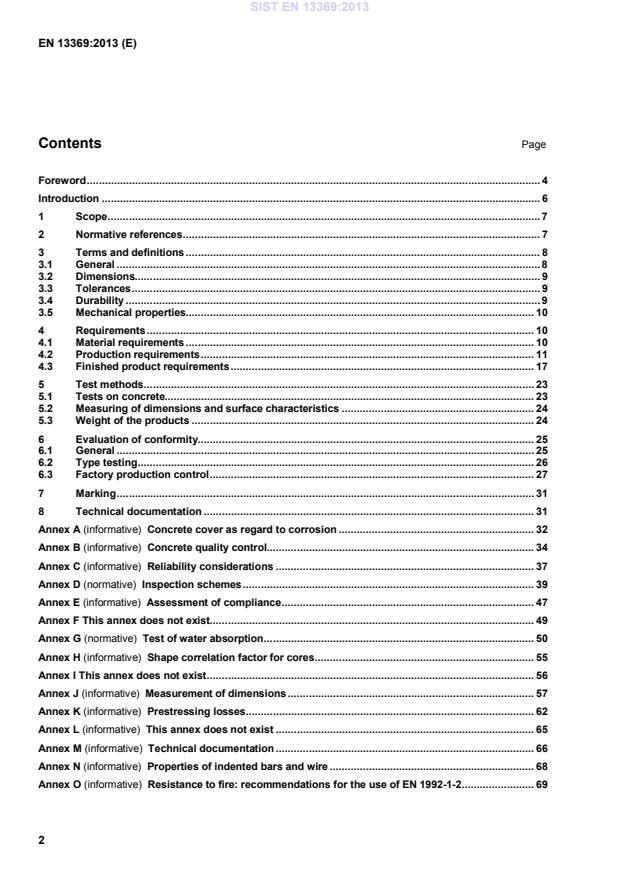
Concrete cover as regard to corrosion . 32 Annex B (informative)
Concrete quality control. 34 Annex C (informative)
Reliability considerations . 37 Annex D (normative)
Inspection schemes . 39 Annex E (informative)
Assessment of compliance . 47 Annex F This annex does not exist . 49 Annex G (normative)
Test of water absorption . 50 Annex H (informative)
Shape correlation factor for cores . 55 Annex I This annex does not exist . 56 Annex J (informative)
Measurement of dimensions . 57 Annex K (informative)
Prestressing losses . 62 Annex L (informative)
This annex does not exist . 65 Annex M (informative)
Technical documentation . 66 Annex N (informative)
Properties of indented bars and wire . 68 Annex O (informative)
Resistance to fire: recommendations for the use of EN 1992-1-2 . 69 SIST EN 13369:2013
Survey of type testing. 70 Annex Q (informative)
Use of reclaimed crushed and recycled coarse aggregates in concrete . 72 Bibliography . 74
As it is not a harmonised standard, it may not be used on its own for the purpose of CE marking of precast concrete products. The design of precast concrete products should be verified to ensure the fitness of their properties for the particular application, particular attention being paid to design co-ordination with other parts of the construction. SIST EN 13369:2013
It may also be used to specify products for which there is no standard. Not all of the requirements (Clause 4) of this standard are relevant to all precast concrete products. If a specific product standard exists, it takes precedence over this standard. The precast concrete products dealt with in this standard are factory produced for building and civil engineering works. This standard may also be applied to products manufactured in temporary plants on site if the production is protected against adverse weather conditions and controlled following Clause 6 provisions. The analysis and design of precast concrete products is not within the scope of this standard but it does offer, for non-seismic zones, information about: the choice of partial safety factors defined by the pertinent Eurocode; the definition of some requirements for prestressed concrete products. 2 Normative references The following documents, in whole or in part, are normatively referenced in this document and are indispensable for its application. For dated references, only the edition cited applies. For undated references, the latest edition of the referenced document (including any amendments) applies. EN 206-1:20001), Concrete — Part 1: Specification, performance, production and conformity EN 934-2, Admixtures for concrete, mortar and grout — Part 2: Concrete admixtures — Definitions, requirements, conformity, marking and labelling EN 1008, Mixing water for concrete — Specification for sampling, testing and assessing the suitability of water, including water recovered from processes in the concrete industry, as mixing water for concrete EN 1097-6, Tests for mechanical and physical properties of aggregates — Part 6: Determination of particle density and water absorption EN 1992-1-1:20042), Eurocode 2: Design of concrete structures — Part 1-1: General rules and rules for buildings EN 1992-1-2:20043), Eurocode 2: Design of concrete structures — Part 1-2: General rules — Structural fire design EN 10080:2005, Steel for the reinforcement of concrete — Weldable reinforcing steel — General
1) This document is impacted by the stand-alone amendments EN 206-1:2000/A1:2004 and EN 206-1:2000/A2:2005. 2) This document is impacted by the corrigendum EN 1992-1-1:2004/AC:2010. 3) This document is impacted by the corrigendum EN 1992-1-2:2004/AC:2008. SIST EN 13369:2013
3.1.6 normal weight concrete concrete with an oven-dry density of 2 000 kg/m3 to 2 600 kg/m³
3.1.7 heavyweight concrete
concrete with an oven-dry density of more than 2 600 kg/m³ 3.2 Dimensions 3.2.1 principal dimensions length, width, depth or thickness 3.2.2 nominal dimension dimension declared in the technical documentation and targeted at manufacture 3.3 Tolerances 3.3.1 tolerance sum of the absolute values of the upper and the lower permitted deviation 3.3.2 deviation difference between an actual measure and the corresponding nominal dimension 3.4 Durability 3.4.1 durability ability of a precast concrete product to satisfy, with anticipated maintenance, the design performance requirements during its design working life under the influence of the expected environmental actions 3.4.2 design working life assumed period for which a structure or part of it is to be used for its intended purpose with anticipated maintenance but without major repair being necessary 3.4.3 environmental conditions physical or chemical impacts to which the precast concrete product is exposed and which result in effects on the concrete or reinforcement or embedded metal that are not considered as loads in structural design SIST EN 13369:2013
compressive concrete strength derived from tests on cubes or cylinders moulded and cured in laboratory conditions in accordance with EN 12390-2 3.5.2 structural strength compressive concrete strength derived from tests on specimens (drilled cores or cut prisms) taken from the precast concrete product (direct structural strength) or derived from tests on moulded specimens cured in the same ambient conditions as the product itself (indirect structural strength) 3.5.3 characteristic strength value of strength below which 5 % of the population of all possible strength determinations of the volume of concrete under consideration are expected to fall 4 Requirements 4.1 Material requirements 4.1.1 General Only materials with established suitability shall be used. For a particular material, the establishment of suitability may be based on a European Standard which refers specifically to the use of this material in concrete or in precast concrete products; in absence of a European Standard, it may also result, under the same conditions, from an ISO Standard. Where this material is not covered by a European or ISO Standard, or if it deviates from the requirements of these standards, the establishment of suitability may be based on: the provisions valid in the place of use of the precast concrete product which refer specifically to the use of this material in concrete or in precast concrete products; or a European Technical Approval specifically for the use of this material in concrete or precast concrete products. 4.1.2 Constituent materials of concrete 4.1.2.1 General EN 206-1:2000, 5.1 shall apply. 4.1.2.2 Reclaimed crushed and recycled coarse aggregates Reclaimed crushed and recycled coarse aggregates, mixed in concrete with other aggregates, shall not adversely alter the rate of setting and hardening of concrete, nor shall it be detrimental to the durability of the precast concrete product in the end use conditions. SIST EN 13369:2013
Alternative provisions are under development in the upcoming version of EN 206-1 and should be considered. 4.1.3 Reinforcing steel Reinforcing steel (bars, coils and welded fabric) shall comply with EN 10080. Other types of reinforcing steel may be used according to provisions valid in the place of use of the product (e.g. EN 1992-1-1:2004, 3.2). NOTE Recommendations on indented bars and wires are given in Annex N. 4.1.4 Prestressing steel Prestressing steel (wire, bars and strand) shall comply with prEN 10138-1, prEN 10138-2, prEN 10138-3 and prEN 10138-4. Other types of prestressing steel may be used according to provisions valid in the place of use of the product (e.g. EN 1992-1-1:2004, 3.3). 4.1.5 Inserts and connectors Mechanical inserts and connectors shall: a) resist the design actions; b) have the necessary ductility. Permanent connecting parts and fasteners shall maintain these properties for the design working life of the precast concrete product. Provisions valid in the place of use of the product shall be taken into account. NOTE Recommendations for the design of some anchors can be found in CEN/TS 1992-4 (all parts); recommendations for the design of lifting and handling devices, can be found in CEN/TR 15728. 4.2 Production requirements 4.2.1 Concrete production 4.2.1.1 General For concrete composition, type of cement, use of aggregates, additions and admixtures, and for resistance to alkali-silica reaction, chloride content, air content and concrete temperature, EN 206-1:2000, 5.2 and 5.3 shall apply. For specification of concrete EN 206-1 shall apply. SIST EN 13369:2013
B - Keep the concrete moist by addition of water maintaining wet coverings on the concrete surface; keeping the concrete surface visibly wet by spraying with water C – Use of curing compounds Curing compounds used shall conform to provisions valid in the place of use
For methods A and B, the protection shall be maintained until the compressive strength of the sample at the end of curing (fc,cure) is equal to or greater than the smallest value of the parameters Dd.fck and fc,L (cylinders or cubes). The parameters Dd et fc,L are defined in Table 2. fc,cure ≥ MIN (Dd.fck ; fc,L) (1) NOTE fck is the characteristic compressive strength of the concrete at the age of 28 days targeted by the manufacturer. The measure of the mean compressive strength fc,cure shall be done on concrete samples that are submitted to the same protection against drying out as the product. For design working life of more than 50 years, or for specific local environmental conditions, other values may be given following the requirements valid in the place of use. The degree of hardening in Table 2 may either be measured by testing a concrete sample or estimated by calculation using a hardening law based on initial type testing or the maturity concept. The test result shall be obtained from an individual specimen or the average of the results when two or more specimens made from one sample are tested at the same age. SIST EN 13369:2013
% Cylinder/cube fc,L
MPa X0, XC1 only requirements on fc,L apply. 12/15 XC2, XC3, XC4, XD1, XD2, XF1 35 12/15a All other exposure conditions (wetting/drying cycles) 50 16/20b a This value has to be substituted by 0,25.fck if 0,25.fck ≥ N2 Mma (cylinder); 15 MPa (cube). b This value has to be substituted by 0,35.fck if 0,35.fck ≥ N6 Mma (cylinder); 20 MPa (cube).
Other means than those defined in Table 2 may be employed if the value of the water absorption of the concrete, measured according to the test procedure defined in Annex G, does not exceed 10 % (in relative proportion) of the value of water absorption of the concrete complying with the requirements in Table 1. The water absorption test is run on (30 ± 1) mm thick samples that include the surface exposed to the environment. 4.2.1.4 Accelerated hydration by heat treatment Where heat treatment at atmospheric pressure is applied to concrete during production in order to accelerate its hardening, it shall be demonstrated by initial testing that the required strength is achieved for each concrete family concerned. Depending on material and climatic conditions, more restricting requirements may apply to the heat treatment of outdoor products in certain areas according to provisions valid in the place of use. The following conditions shall be fulfilled when the maximum mean temperature Tmean within the concrete exceeds 40 °C during the curing process unless previous positive experience has shown that special measures are not necessary to avoid micro cracking and/or durability defects: a preheating period shall be applied during which Tmean does not exceeds 40 °C; the temperature difference between adjacent parts of the product during the heating and the cooling phases shall be limited to 20 °C. The duration and heating rate of the full heating and cooling period (if appropriate) shall be documented. During the full heating and cooling period Tmean shall be limited to the values of Table 3. However higher temperatures may be accepted provided the durability of concrete under the specified environment is demonstrated by long term positive experience. Table 3 — Conditions for accelerated hydration Product environments Maximum mean concrete temperature Tmeana Predominantly dry or moderate humidity
Tmean ≤ 85 °C b Wet and cyclic wet Tmean ≤ 65 °C a Individual values may be 5 °C higher. b When 70 °C < Tmean ≤ 85 °C initial tests shall have demonstrated that the structural strength at 90 d corresponds with normal evolution of hardening with respect to the structural strength obtained at 28 days.
4.2.2 Hardened concrete 4.2.2.1 Strength classes For compressive strength classes of concrete EN 206-1:2000, 4.3.1 applies. For design purposes, the properties of strength classes for normal and heavy weight concrete up to C90/105 are given in Table 3.1 of EN 1992-1-1:2004 and for lightweight concrete up to LC 80/88 in Table 11.3.1 of EN 1992-1-1:2004. The manufacturer may select intermediate classes, in 1,0 MPa steps of the characteristic strengths. In this case, other concrete properties are obtained by linear interpolation. For reinforced or prestressed precast concrete products, the minimum strength class of concrete shall be: C20/25 for reinforced precast concrete products; C30/37 for prestressed precast concrete products. When lightweight concrete is used, the minimum strength class shall be LC 16/18 both for reinforced and prestressed precast concrete products. 4.2.2.2 Compressive strength 4.2.2.2.1 General The compressive strength to verify the strength class of concrete is defined by the potential strength; the manufacturer may use direct structural strength or indirect structural strength to confirm it. 4.2.2.2.2 Potential strength The potential strength shall be tested at 28 days. Tests of potential strength may be performed before 28 days in order to evaluate the progression of potential strength or to estimate at early age the potential strength at 28 days by an appropriate hardening law. When relevant, tests may be performed at an age greater than 28 days. For determination of potential strength EN 206-1:2000, 5.5.1.1 and 5.5.1.2 shall apply. Additional requirements are given in 5.1.1. 4.2.2.2.3 Direct structural strength Compressive direct structural strength shall be determined from the finished product by drilling cores in accordance with EN 12504-1 or by cut prisms converted to cube or cylinder with the appropriate correction factor. Non-destructive tests on the finished product in accordance with EN 12504-2 may be used, but a correlation with tests as specified in 5.1.1 shall be established. SIST EN 13369:2013
EN 1992-1-1:2004, 11.3.3. 4.2.2.5 Dry density If required, dry density shall be determined in accordance with EN 206-1:2000, 5.5.2. 4.2.2.6 Water absorption If required for durability reasons or by provisions applicable in the place of use of the concrete product, water absorption shall be determined following Annex G. 4.2.3 Structural reinforcement 4.2.3.1 Processing of reinforcing steel Reinforcing steel for structural purposes that is straightened, bent or welded in the factory shall remain in conformity with 4.1.3 after this treatment. Welded connection of reinforcing bars may only be used when the weldability of the steel is fully documented. Indications on welding process may be found in EN 1992-1-1:2004, 3.2.5. 4.2.3.2 Tensioning and prestressing 4.2.3.2.1 Initial tensioning stresses The maximum prestressing force applied to a unit immediately after release of tendons shall satisfy the following conditions: SIST EN 13369:2013
± 7 %. 4.2.3.2.3 Minimum concrete strength at transfer At transfer of the prestressing force, the concrete shall have a minimum strength fcm,p of 1,5 times the maximum compressive stress in the concrete and not less than 20 MPa (cylinder strength). The requirements according to EN 1992-1-1:2004, 5.10.2.2 (5) shall be considered. In any case the strength shall be adequate for the anchorage of the strands. 4.2.3.2.4 Slippage of tendons Slippage, which is the shortening of the tendon at each end of the element after transfer of the prestress force, shall be limited to the following values: for individual tendons (strands or wires): 1,3 ∆L0; for the mean value of all tendons on one end of an element: ∆L0. For strands the average value of three circumferentially positioned wires shall be taken into account. The value of ∆L0, in millimetres, shall be calculated from: ppmopt204,0E1lL=∆ (4) where SIST EN 13369:2013
EN 1992-1-1:2004, 8.10.2.2; σpmo is the initial stress in the prestressing steel immediately after release, in MPa; Ep is the modulus of elasticity of the prestressing steel, in MPa. In general, slippage of tendons is measured except for one piece moulded products (see Table D.3). On sawn products, visual inspection alone may indicate no slippage and no further measurement is required. 4.3 Finished product requirements 4.3.1 Geometrical properties 4.3.1.1 Production tolerances Recommendations for maximum deviations of cross-sectional dimensions [width (∆b) and height (∆h)], and for maximum deviation of concrete cover (∆cdev) to bars, wires and strands are given in Table 4: Table 4 — Deviations Target dimension
mm Cross-section ∆b, ∆ha
mm Concrete cover a b ∆cdev mm L ≤ 150 + 10/− 5 ± 5 L = 400 +15/− 10 + 15/− 10 L ≥ 2 500 ± 30 +25/− 10 a Linear interpolation for intermediate values. b According to EN 1992-1-1:2004, 4.4.1.1: cnom = cmin+∆cdev (use the numerical value for −∆cdev). ∆cdev is a Nationally Determined Parameter; hence other values may be valid in the place of use. A manufacturer may achieve and declare smaller values for ∆cdev than given in the National Annex by taking the appropriate measures.
The structural design of the works shall take into account the tolerances on the supports as specified in the structural design for the works.
EN 1992-1-1:2004, 10.9.5.2 may be used as guidance to determine the assumed ineffective distances from the edge of the support and from the end of the precast concrete product. A combination of global tolerances may not be used to determine tolerances at the support, as in most cases they have to be stricter than tolerances achieved by such combinations. For slabs and beams, the average deviation of concrete cover may be determined as the mean deviation of the individual bars, wires or strands in a beam cross-section or over a maximum width of 1 m in a slab. No individual bar, wire or strand shall have a negative deviation numerically larger than the recommended negative deviation. NOTE Guidance on concrete cover can be found in Annex A. Production tolerances of geometrical properties may be determined by measurements according to J.1 to J.3 of Annex J. a) Recommendations for maximum deviations on length: SIST EN 13369:2013
EN 1992-1-1. Relevant information is also found in EN 1990:2002, Annex D. 4.3.3.4 Verification by testing In case of verification by testing, declared values shall be verified by direct load testing made on samples taken following proper statistical criteria. Relevant information is also found in EN 1990:2002, Annex D. 4.3.3.5 Safety factors Recommended values for partial safety factors can be found in EN 1990 and EN 1992-1-1. These standards also permit lower values under certain conditions. Annex C provides such information. 4.3.3.6 Transient situations The following transient situations shall be considered: demoulding; transport to the storage yards; storage (support and load conditions); transport to site; erection (lifting); construction (assembly). When relevant for the type of element, for transient situations a nominal transverse horizontal force to cover out of plane effects due to dynamic actions or verticality deviations shall be considered. This may be taken as 1,5 ›% of the self-weight of the element. SIST EN 13369:2013
...