

prEN ISO 20387
(Main)Biotechnology - Biobanking - General requirements for biobanks (ISO/DIS 20387:2025)
General Information
- Abstract
This document specifies general requirements for the competence, impartiality and consistent operation of biobanks including quality control requirements to ensure that collections of biological material and associated data are of appropriate quality.
This document is applicable to all organizations performing biobanking. This can include biobanking of biological material and associated data:
a) from multicellular organisms (e.g. human, animal, fungus and plant);
b) from microorganisms;
c) derived from sources such as environmental samples (e.g. soil, sediment, water, air).
Biobank users, regulatory authorities, organizations and schemes using peer-assessment, accreditation bodies, and others can also use this document in confirming or recognizing the competence of biobanks.
This document does not apply to biological material intended for therapeutic use.
NOTE 1 International, national or regional regulations or requirements can also apply to specific topics covered in this document.
NOTE 2 For entities handling human materials procured and used for diagnostic and treatment purposes, ISO 15189 and other clinical standards are intended to apply first and foremost.
- Status
- Not Published
- Publication Date
- 03-Mar-2027
- Technical Committee
- CEN/CLC/TC 1 - Criteria for conformity assessment bodies
- Current Stage
- 4599 - Dispatch of FV draft to CMC - Finalization for Vote
- Start Date
- 24-Jun-2026
- Completion Date
- 24-Jun-2026


Overview
prEN ISO 20387 / ISO/DIS 20387:2025 - Biotechnology - Biobanking - General requirements for biobanks - specifies requirements to ensure the competence, impartiality and consistent operation of biobanks. It covers quality control and management system expectations to maintain biological material and associated data at appropriate quality for research and development. The document applies to biobanking of multicellular organisms (human, animal, plant, fungus) and microorganisms, but does not apply to material intended for therapeutic use. For clinical diagnostic/treatment material, standards such as ISO 15189 are intended to take precedence.
Key topics and technical requirements
This standard addresses both technical and management aspects of biobanking, including:
- General requirements: impartiality, confidentiality, climate change awareness, and consistent operations.
- Structural requirements: governance, roles and responsibilities, collaborative activities.
- Resource requirements:
- Personnel competence, training and qualification
- Facilities, dedicated areas and environmental conditions
- Equipment, calibration and maintenance
- Outsourcing and control of externally provided processes and products
- Process requirements:
- Collection, acquisition, transport and reception of biological material and metadata
- Traceability and unique identifiers for samples and data
- Processing, testing, preservation, storage, retrieval, distribution and disposal
- Quality control (QC) for material, processes and data; validation and verification of methods
- Management of information systems, nonconforming outputs, reporting and complaints
- Management system:
- Documented information, records control, risk-based actions, internal audits, corrective actions and management review
The standard includes normative documentation annexes and guidance to support implementation and accreditation claims.
Practical applications and who uses it
ISO 20387 is used to:
- Demonstrate biobank competence and support accreditation or peer-recognition
- Implement robust sample and data quality assurance to improve reproducibility in research
- Standardize workflows for multi-site or collaborative biobanking networks
- Support regulatory compliance and transparent sample/data sharing
Primary users:
- Biobank operators and managers
- Research institutions and universities
- Accreditation bodies, peer-assessment schemes and regulatory authorities
- Biobank users (researchers, data scientists) and industry partners
Related standards
- ISO 15189 (clinical laboratories) - prioritized for diagnostic/treatment human material
- National/regional regulations and accreditation requirements (may apply alongside ISO 20387)
Keywords: ISO 20387, prEN ISO 20387, biobanking standard, biobanks, quality control, traceability, sample management, data management, biobank accreditation.
Relations
- Effective Date
- 20-Dec-2023
Frequently Asked Questions
prEN ISO 20387 is a draft published by the European Committee for Standardization (CEN). Its full title is "Biotechnology - Biobanking - General requirements for biobanks (ISO/DIS 20387:2025)". This standard covers: This document specifies general requirements for the competence, impartiality and consistent operation of biobanks including quality control requirements to ensure that collections of biological material and associated data are of appropriate quality. This document is applicable to all organizations performing biobanking. This can include biobanking of biological material and associated data: a) from multicellular organisms (e.g. human, animal, fungus and plant); b) from microorganisms; c) derived from sources such as environmental samples (e.g. soil, sediment, water, air). Biobank users, regulatory authorities, organizations and schemes using peer-assessment, accreditation bodies, and others can also use this document in confirming or recognizing the competence of biobanks. This document does not apply to biological material intended for therapeutic use. NOTE 1 International, national or regional regulations or requirements can also apply to specific topics covered in this document. NOTE 2 For entities handling human materials procured and used for diagnostic and treatment purposes, ISO 15189 and other clinical standards are intended to apply first and foremost.
This document specifies general requirements for the competence, impartiality and consistent operation of biobanks including quality control requirements to ensure that collections of biological material and associated data are of appropriate quality. This document is applicable to all organizations performing biobanking. This can include biobanking of biological material and associated data: a) from multicellular organisms (e.g. human, animal, fungus and plant); b) from microorganisms; c) derived from sources such as environmental samples (e.g. soil, sediment, water, air). Biobank users, regulatory authorities, organizations and schemes using peer-assessment, accreditation bodies, and others can also use this document in confirming or recognizing the competence of biobanks. This document does not apply to biological material intended for therapeutic use. NOTE 1 International, national or regional regulations or requirements can also apply to specific topics covered in this document. NOTE 2 For entities handling human materials procured and used for diagnostic and treatment purposes, ISO 15189 and other clinical standards are intended to apply first and foremost.
prEN ISO 20387 is classified under the following ICS (International Classification for Standards) categories: 07.080 - Biology. Botany. Zoology. The ICS classification helps identify the subject area and facilitates finding related standards.
prEN ISO 20387 has the following relationships with other standards: It is inter standard links to EN ISO 20387:2020. Understanding these relationships helps ensure you are using the most current and applicable version of the standard.
prEN ISO 20387 is associated with the following European legislation: EU Directives/Regulations: 765/2008; Standardization Mandates: M/580. When a standard is cited in the Official Journal of the European Union, products manufactured in conformity with it benefit from a presumption of conformity with the essential requirements of the corresponding EU directive or regulation.
prEN ISO 20387 is available in PDF format for immediate download after purchase. The document can be added to your cart and obtained through the secure checkout process. Digital delivery ensures instant access to the complete standard document.
Standards Content (Sample)
SLOVENSKI STANDARD
01-december-2025
Biotehnologija - Biobančništvo - Splošne zahteve za biobančništvo (ISO/DIS
20387:2025)
Biotechnology - Biobanking - General requirements for biobanks (ISO/DIS 20387:2025)
Biotechnologie - Biobanking - Allgemeine Anforderungen an Biobanken (ISO/DIS
20387:2025)
Biotechnologie - Mise en banque de matériel biologique - Exigences générales relatives
pour les biobanques (ISO/DIS 20387:2025)
Ta slovenski standard je istoveten z: prEN ISO 20387
ICS:
07.080 Biologija. Botanika. Zoologija Biology. Botany. Zoology
2003-01.Slovenski inštitut za standardizacijo. Razmnoževanje celote ali delov tega standarda ni dovoljeno.
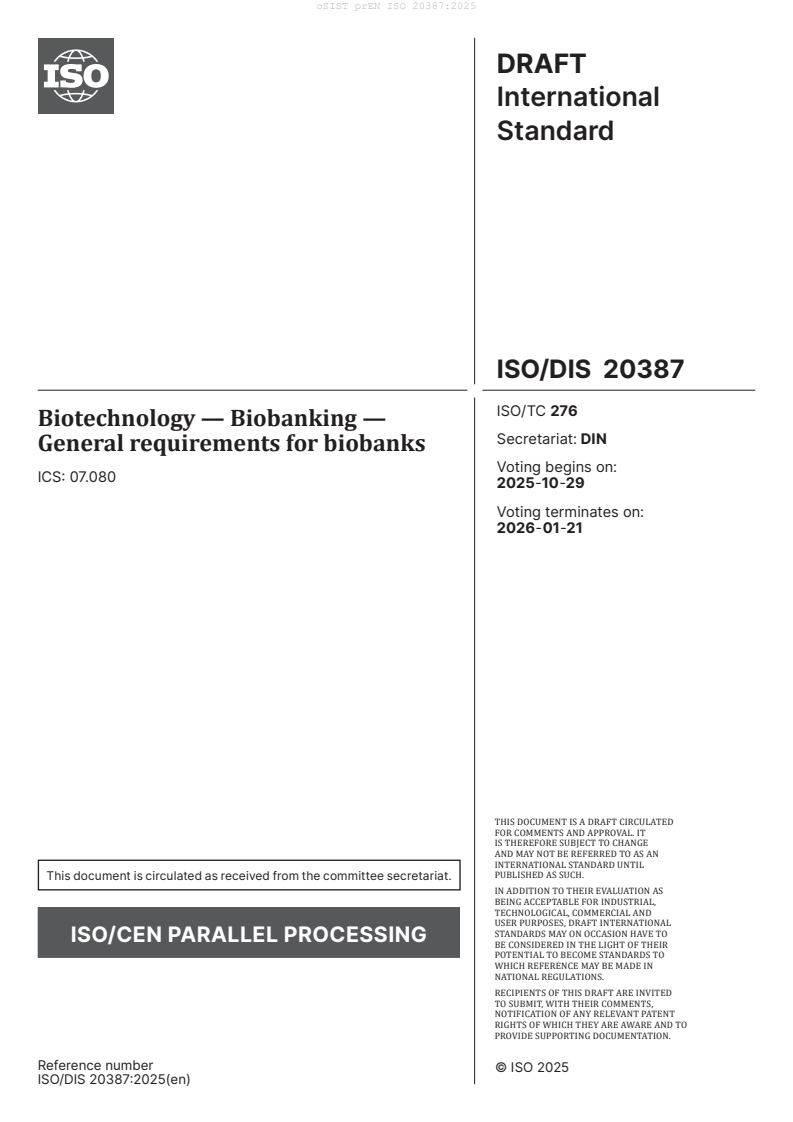
DRAFT
International
Standard
ISO/DIS 20387
ISO/TC 276
Biotechnology — Biobanking —
Secretariat: DIN
General requirements for biobanks
Voting begins on:
ICS: 07.080
2025-10-29
Voting terminates on:
2026-01-21
THIS DOCUMENT IS A DRAFT CIRCULATED
FOR COMMENTS AND APPROVAL. IT
IS THEREFORE SUBJECT TO CHANGE
AND MAY NOT BE REFERRED TO AS AN
INTERNATIONAL STANDARD UNTIL
PUBLISHED AS SUCH.
This document is circulated as received from the committee secretariat.
IN ADDITION TO THEIR EVALUATION AS
BEING ACCEPTABLE FOR INDUSTRIAL,
TECHNOLOGICAL, COMMERCIAL AND
USER PURPOSES, DRAFT INTERNATIONAL
STANDARDS MAY ON OCCASION HAVE TO
ISO/CEN PARALLEL PROCESSING
BE CONSIDERED IN THE LIGHT OF THEIR
POTENTIAL TO BECOME STANDARDS TO
WHICH REFERENCE MAY BE MADE IN
NATIONAL REGULATIONS.
RECIPIENTS OF THIS DRAFT ARE INVITED
TO SUBMIT, WITH THEIR COMMENTS,
NOTIFICATION OF ANY RELEVANT PATENT
RIGHTS OF WHICH THEY ARE AWARE AND TO
PROVIDE SUPPORTING DOCUMENTATION.
Reference number
ISO/DIS 20387:2025(en)
DRAFT
ISO/DIS 20387:2025(en)
International
Standard
ISO/DIS 20387
ISO/TC 276
Biotechnology — Biobanking —
Secretariat: DIN
General requirements for biobanks
Voting begins on:
ICS: 07.080
Voting terminates on:
THIS DOCUMENT IS A DRAFT CIRCULATED
FOR COMMENTS AND APPROVAL. IT
IS THEREFORE SUBJECT TO CHANGE
AND MAY NOT BE REFERRED TO AS AN
INTERNATIONAL STANDARD UNTIL
PUBLISHED AS SUCH.
This document has not been edited by the ISO Central Secretariat.
IN ADDITION TO THEIR EVALUATION AS
BEING ACCEPTABLE FOR INDUSTRIAL,
© ISO 2025
TECHNOLOGICAL, COMMERCIAL AND
USER PURPOSES, DRAFT INTERNATIONAL
All rights reserved. Unless otherwise specified, or required in the context of its implementation, no part of this publication may
STANDARDS MAY ON OCCASION HAVE TO
ISO/CEN PARALLEL PROCESSING
be reproduced or utilized otherwise in any form or by any means, electronic or mechanical, including photocopying, or posting on
BE CONSIDERED IN THE LIGHT OF THEIR
the internet or an intranet, without prior written permission. Permission can be requested from either ISO at the address below
POTENTIAL TO BECOME STANDARDS TO
WHICH REFERENCE MAY BE MADE IN
or ISO’s member body in the country of the requester.
NATIONAL REGULATIONS.
ISO copyright office
RECIPIENTS OF THIS DRAFT ARE INVITED
CP 401 • Ch. de Blandonnet 8
TO SUBMIT, WITH THEIR COMMENTS,
CH-1214 Vernier, Geneva
NOTIFICATION OF ANY RELEVANT PATENT
Phone: +41 22 749 01 11
RIGHTS OF WHICH THEY ARE AWARE AND TO
PROVIDE SUPPORTING DOCUMENTATION.
Email: copyright@iso.org
Website: www.iso.org
Published in Switzerland Reference number
ISO/DIS 20387:2025(en)
ii
ISO/DIS 20387:2025(en)
Contents Page
Foreword .v
Introduction .vii
1 Scope . 1
2 Normative references . 1
3 Terms and definitions . 1
4 General requirements . 10
4.1 General .10
4.2 Impartiality .11
4.3 Confidentiality .11
5 Structural requirements .12
6 Resource requirements .13
6.1 General . 13
6.2 Personnel . 13
6.2.1 General . 13
6.2.2 Competence and training . . .14
6.3 Facilities/dedicated areas and environmental conditions .14
6.4 Externally provided critical processes and services (Outsourcing) . 15
6.5 Externally provided products and services . 15
6.6 Equipment .16
7 Process requirements . 17
7.1 General .17
7.2 Collection of biological material and associated data .18
7.2.1 Documented information .18
7.2.2 Collection of biological material .18
7.3 Acquisition and reception of biological material and associated data .19
7.4 Transport of biological material and associated data .19
7.5 Traceability of biological material and associated data . 20
7.6 Processing, testing and preservation of biological material . 20
7.7 Storage of biological material and associated data.21
7.8 Retrieval of biological material and associated data .21
7.9 Distribution of biological material and associated data . 22
7.10 Disposal of biological material and associated data . 22
7.11 Quality control of biological material and associated data . 22
7.11.1 General . 22
7.11.2 Quality control of processes. 23
7.11.3 Quality control of biological material . 23
7.11.4 Quality assurance for biological material . 23
7.11.5 Quality control of data .24
7.12 Validation and verification of methods .24
7.12.1 General .24
7.12.2 Validation .24
7.12.3 Verification .24
7.13 Management of information and data . 25
7.14 Nonconforming output . 25
7.15 Report requirements. 26
7.15.1 General . 26
7.15.2 Content of the report . 26
7.15.3 Preparation of the report . 28
7.15.4 Amendments to reports . 29
7.16 Complaints. 30
8 Management system requirements .30
8.1 General . 30
iii
ISO/DIS 20387:2025(en)
8.2 Documented information for the management system .31
8.3 Control of management system documents .31
8.4 Control of records .32
8.5 Actions to address risks and opportunities .32
8.6 Improvement . 33
8.7 Corrective action for nonconforming output . 33
8.8 Internal audits. 34
8.9 Management reviews . 34
Annex A (normative) Documentation requirements .36
Annex B (informative) Implementation guidance for Annex A .39
Annex ZA (informative) Relationship between this European Standard and the requirements
of Regulation (EC) No 765/2008 of the European Parliament and of the Council of 9 July
2008 setting out the requirements for accreditation and market surveillance relating
to the marketing of products and repealing Regulation (EEC) No 339/93 aimed to be
covered .42
Bibliography .43
iv
ISO/DIS 20387:2025(en)
Foreword
ISO (the International Organization for Standardization) is a worldwide federation of national standards
bodies (ISO member bodies). The work of preparing International Standards is normally carried out through
ISO technical committees. Each member body interested in a subject for which a technical committee
has been established has the right to be represented on that committee. International organizations,
governmental and non-governmental, in liaison with ISO, also take part in the work. ISO collaborates closely
with the International Electrotechnical Commission (IEC) on all matters of electrotechnical standardization.
The procedures used to develop this document and those intended for its further maintenance are described
in the ISO/IEC Directives, Part 1. In particular, the different approval criteria needed for the different types
of ISO documents should be noted. This document was drafted in accordance with the editorial rules of the
ISO/IEC Directives, Part 2 (see www.iso.org/directives).
Attention is drawn to the possibility that some of the elements of this document may be the subject of patent
rights. ISO shall not be held responsible for identifying any or all such patent rights. Details of any patent
rights identified during the development of the document will be in the Introduction and/or on the ISO list of
patent declarations received (see www.iso.org/patents).
Any trade name used in this document is information given for the convenience of users and does not
constitute an endorsement.
For an explanation of the voluntary nature of standards, the meaning of ISO specific terms and expressions
related to conformity assessment, as well as information about ISO's adherence to the World Trade
Organization (WTO) principles in the Technical Barriers to Trade (TBT) see www.iso.org/iso/foreword.html.
This document was prepared by Technical Committee ISO/TC 276, Biotechnology.
This second edition cancels and replaces the first edition (ISO 20387:2018), which has been technically
revised.
The main changes are as follows:
— update and clarification of terminology;
— addition of 4.1.10 regarding climate change;
— addition of 5.14 on collaborative activities;
— together with the addition of 5.10 and 5.11 regarding the range of performed and outsourced activities
and the related conformity claim, 6.4 was updated to be more precise now about the obligatory biobanking
processes;
— 6.2.2 and 6.2.3 were merged;
— 6.4 was split into 6.4 and 6.5 to separate externally provided critical processes and services from non-
critical services and products;
— 7.2 and 7.3 were updated to include different cases of control over the collection, and putting acquisition
and reception requirements within the same chapter as clear differentiation is not always possible;
— testing requirements were added in 7.6 and ;
— new clauses on retrieval (7.8), distribution (7.9) and disposal (7.10) were added;
— the QC clause was restructured;
— in the report requirements clause, subchapters for the preparation of the report and amendments to
reports have been added;
— Clause 8 was updated based on the latest ISO requirements;
— editorial update and clarification of wording.
v
ISO/DIS 20387:2025(en)
Any feedback or questions on this document should be directed to the user’s national standards body. A
complete listing of these bodies can be found at www.iso.org/members.html.
vi
ISO/DIS 20387:2025(en)
Introduction
This document has been developed with the objective of promoting confidence in biobanking. It contains
requirements to enable biobanks to demonstrate competent biobank operation and the ability to provide
biological material and associated data of appropriate quality.
This is intended to be achieved by the planning and implementation of policies, processes and procedures
covering the life cycle of biological materials and their associated data. The use of this document facilitates
cooperation, fosters exchange, and assists in the harmonization of practices among biobanks, researchers
and other parties.
In this document, the following verbal forms are used:
— “shall” indicates a requirement;
— “should” indicates a recommendation;
— “may” indicates a permission;
— “can” indicates a possibility or a capability.
Further details can be found in the ISO/IEC Directives, Part 2.
vii
DRAFT International Standard ISO/DIS 20387:2025(en)
Biotechnology — Biobanking — General requirements for
biobanks
1 Scope
This document specifies general requirements for the competence, impartiality and consistent operation
of biobanks including quality control requirements to ensure that collections of biological material and
associated data are of appropriate quality.
This document is applicable to all organizations performing biobanking. This can include biobanking of
biological material:
a) from multicellular organisms (e.g. human, animal, fungus and plant);
b) from microorganisms;
c) derived from sources such as environmental samples (e.g. soil, sediment, water, air).
Biobank users, regulatory authorities, organizations and schemes using peer-assessment, accreditation
bodies, and others can also use this document in confirming or recognizing the competence of biobanks.
This document does not apply to biological material intended for therapeutic use.
NOTE 1 International, national or regional regulations or requirements can also apply to specific topics covered in
this document.
NOTE 2 For entities handling human materials procured and used for diagnostic and treatment purposes, ISO 15189
and other clinical standards are intended to apply first and foremost.
2 Normative references
The following documents are referred to in the text in such a way that some or all of their content constitutes
requirements of this document. For dated references, only the edition cited applies. For undated references,
the latest edition of the referenced document (including any amendments) applies.
ISO/IEC 17025, General requirements for the competence of testing and calibration laboratories
3 Terms and definitions
For the purposes of this document, the following terms and definitions apply.
ISO and IEC maintain terminological databases for use in standardization at the following addresses:
— ISO Online browsing platform: available at https:// www .iso .org/ obp
— IEC Electropedia: available at https:// www .electropedia .org/
3.1
acquisition
set of activities to obtain possession and/or custody of biological material (3.6) and associated data (3.2), that
includes some or all of the activities of collection (3.10) when the collection is performed by the biobank (3.4)
Note 1 to entry: Acquisition is also called procurement in some sectors.
ISO/DIS 20387:2025(en)
3.2
associated data
any information affiliated with biological material (3.6) including but not limited to research, phenotypic,
genotypic, clinical, epidemiologic, and procedural data
3.3
authentication
set of activities to characterize biological material (3.6) to a defined level of specification using appropriate
technology/documentation to establish a conclusive basis for accepting the material as genuine
3.4
biobank
legal entity (3.27) or part(s) of a legal entity that engage(s) in biobanking (3.5), which can include provision
of support services for biobanking
Note 1 to entry: Examples for ‘support services’ are administrative and IT support, legal counsel, procurement, facility
services etc.
3.5
biobanking
set of activities aiming for fit for purpose (3.22) biological material (3.6) and associated data (3.2) including
acquisition (3.1), storage (3.54) and retrieval (3.50) of defined biological material and associated data; with
the potential inclusion of one or more of the following: collection (3.10), processing (3.39), preservation (3.36),
testing (3.56), distribution (3.19), destruction (3.17), and disposal (3.18)
3.6
biological material
organic entity or any substance derived or part obtained from:
a) an organic entity, such as microorganism(s) (3.31) or multicellular organism(s) (e.g. human, animal,
fungus, brown seaweed, plant); or
b) an environmental sample (e.g. soil, sediment, water, air), that contains an organic entity of interest
3.7
biosafety
practices and controls that reduce the risk of unintentional exposure to or release of biological materials (3.6)
Note 1 to entry: Biological materials or parts thereof handled in biobanks (3.4) can contain biological agents or toxins
or biological agent vectors, such as arthropods, nematodes, and mites.
Note 2 to entry: For more details regarding biosafety, refer to ISO 35001.
[SOURCE: ISO 35001:2019, 3.22, modified — Two notes added; “to” added to definition.]
3.8
biosecurity
practices and controls that reduce the risk of loss, theft, misuse, diversion of, or intentional unauthorized
release of biological materials (3.6)
Note 1 to entry: Practices and controls can include but are not limited to institutional and personal security measures
and procedures (3.37).
[SOURCE: ISO 35001:2019, 3.23, modified — Note added.]
3.9
chain of custody
chronological record that tracks the control and responsibility for biological material (3.6) and associated
data (3.2) moving through each step of a process (3.38)
Note 1 to entry: The chain of custody can help assess the integrity of biological material and associated data.
ISO/DIS 20387:2025(en)
3.10
collection
set of activities to (physically) gather biological material (3.6) and associated data (3.2) from a source
Note 1 to entry: Collection can be part of the broader process (3.38) of acquisition (3.1).
3.11
competence
ability to apply knowledge, experience, and skills to achieve intended results
[SOURCE: ISO 17100:2015, 2.4.9]
3.12
complaint
expression of dissatisfaction other than appeal by any person or organization to a biobank (3.4), relating to
the activities, products or results of that biobank where a response is expected
Note 1 to entry: The wording “activities, products or results” includes biological material (3.6) or associated data (3.2)
or both.
Note 2 to entry: “Appeal” is defined in ISO/IEC 17000:2020, 8.6.
[SOURCE: ISO/IEC 17000:2020, 8.7 modified — “conformity assessment body or accreditation body” has
been replaced by “biobank”, the words “products or results” have been added, Note 1 to entry and Note 2 to
entry have been added]
3.13
confidentiality
property that information is not made available or disclosed to unauthorized individuals, entities, or
processes (3.38)
[SOURCE: ISO/IEC 27000:2018, 3.10]
3.14
conformity
fulfilment of a requirement
Note 1 to entry: This constitutes one of the common terms and core definitions for ISO management system standards
given in Annex SL of the Consolidated ISO Supplement to the ISO/IEC Directives, Part 1. The original definition has
been modified by adding Note 1 to entry.
[SOURCE: ISO 9000:2015, 3.6.11, modified – Note 1 was deleted.]
3.15
critical
having a potential impact on the fitness for the intended purpose (3.22) of biological material (3.6) or
associated data (3.2) or both
Note 1 to entry: Critical elements can vary depending on the intended purpose and the type of biological material
and associated data. Peer consensus, user (3.59) requests, and a risk assessment can assist with identifying critical
elements.
3.16
dedicated area
space containing the biological material (3.6) kept by the biobank (3.4) or where the biobank executes its
activities
3.17
destruction
set of activities to eliminate biological material (3.6) and/or delete associated data (3.2), beyond any possible
reconstruction
ISO/DIS 20387:2025(en)
3.18
disposal
set of activities to remove a retrieved biological material (3.6) or associated data (3.2) or both from the
biobank (3.4) if no longer useable or authorized for use; usually including discarding, destruction (3.17) or
returning to the provider (3.42) or donor (3.21)
3.19
distribution
set of activities to provide selected biological material (3.6) or associated data (3.2) or both to recipient(s)
(3.49)/user(s) (3.59)
3.20
documented information
information and the medium on which it is contained required to be controlled and maintained by an
organization
Note 1 to entry: Documented information can be in any format and media and from any source.
Note 2 to entry: Documented information can refer to:
— the management system (3.29), including related processes (3.38);
— information created in order for the organization to operate (documentation);
— evidence of results achieved.
Note 3 to entry: This constitutes one of the common terms and core definitions for ISO management system standards
given in Annex SL of the Consolidated ISO Supplement to the ISO/IEC Directives, Part 1.
[SOURCE: ISO 9000:2015, 3.8.6, modified – “required to be controlled and maintained by an organization”
put at the end of the definition.]
3.21
donor
organic source such as a human, animal, plant etc. from which the biological material (3.6) or associated data
(3.2) or both is collected for biobanking (3.5)
Note 1 to entry: A human donor can also be a provider (3.42).
3.22
fit for purpose
fitness for the intended purpose
aligned with prearranged requirements for an intended use
Note 1 to entry: The definition of such requirements can take place within the biobank (3.4) itself and/or in
collaboration with users (3.59) and include analytical and other relevant criteria.
Note 2 to entry: These requirements correspond to the feasibility of the downstream intended use and the satisfaction
of predefined performance criteria of the intended use.
Note 3 to entry: When the suitability for the intended purpose cannot be determined, the biobank indicates the range
of applications for which the biological material (3.6) can be used (see 4.1.2).
3.23
governance
principles, policies and framework by which a biobank (3.4) is overseen, directed and controlled
[SOURCE: ISO 21505:2017, 3.1, modified – added ‘overseen’, ‘an organization’ replaced by “a biobank)]
3.24
impartiality
objectivity, neutrality and fairness along with the awareness of bias and reduction of prejudice
Note 1 to entry: It is important for impartiality that possible conflicts of interest are declared, resolved or do not exist.
ISO/DIS 20387:2025(en)
Note 2 to entry: Other terms that are useful in conveying the element of impartiality include “independence”, “freedom
from conflict of interests”, “freedom from bias”, “lack of prejudice”, “neutrality”, “fairness”, “open-mindedness”, “even-
handedness”, “detachment”, “balance”.
[SOURCE: ISO 21043-1:2018, 3.17, modified – Note 2 added.]
3.25
interlaboratory comparison
organization, performance and evaluation of measurements or tests on the same or similar items by two or
more laboratories in accordance with predetermined conditions
[SOURCE: ISO 13528:2022, 3.1]
3.26
interoperability
interoperability (of information and data)
ability of two or more systems or applications to exchange information and to mutually use the information
that has been exchanged
[SOURCE: ISO/TR 14639-1:2012, 2.20, modified – additional term added]
3.27
legal entity
structure that is organized under the laws of any jurisdiction
[SOURCE: ISO 5009:2022, 3.2, modified - Deleted “Legal person”]
3.28
life cycle
consecutive and interlinked stages of biological material (3.6) and associated data (3.2) from start (e.g.
collection (3.10), acquisition (3.1) or reception (3.48)) to finish (e.g. distribution (3.19), disposal (3.18) or
destruction (3.17))
Note 1 to entry: This term refers to the biobanking (3.5) life cycle only.
3.29
management system
set of interrelated or interacting elements of an organization to establish policies and objectives, and
processes (3.38) to achieve those objectives
Note 1 to entry: A management system can address a single discipline or several disciplines, e.g. quality management
(3.45), financial management or environmental management.
Note 2 to entry: The management system elements establish the organization’s structure, roles and responsibilities,
planning, operation, policies, practices, rules, beliefs, objectives and processes to achieve those objectives.
Note 3 to entry: The scope of a management system can include the whole of the organization, specific and identified
functions of the organization, specific and identified sections of the organization, or one or more functions across a
group of organizations.
[SOURCE: ISO 9000:2015, 3.5.3, modified – Note 4 was deleted.]
3.30
metrological traceability
property of a measurement result whereby the result can be related to a reference through a documented
unbroken chain of calibrations, each contributing to the measurement uncertainty
[SOURCE: ISO/IEC Guide 99:2007, 2.41, modified — The notes were deleted.]
3.31
microorganism
microbiological entity, cellular or non-cellular, capable of replication or of transferring genetic material
[SOURCE: ISO 15190:2020, 3.15]
ISO/DIS 20387:2025(en)
3.32
nonconforming
deviating from a particular requirement
3.33
outsourcing
act of making an arrangement where an organization or entity external from the biobank (3.4) performs
part of the biobank’s service or process (3.38)
Note 1 to entry: An organization to which processes or services are outsourced to can be called process or service
provider.
Note 2 to entry: While an external organization operates outside of the biobank’s management system (3.29), any
outsourced service or process remains under the oversight (see 6.4) of the biobank.
Note 3 to entry: Entities external to the biobank can belong to the same legal entity (3.27) as the biobank and can be
or not be within the scope of the biobank’s management system. In any case, the oversight (3.34) of the outsourced
service or process remains within the scope of the biobank’s management system.
3.34
oversight
ongoing and structured monitoring of the implementation of organizational and governance (3.23) policies,
including monitoring of how associated tasks, services, and processes (3.38) are managed, to ensure they
remain appropriate and responsive to internal and external circumstances
3.35
personnel
person(s) employed by or working for the biobank (3.4)
Note 1 to entry: Personnel can be either internal or external.
3.36
preservation
set of activities to prevent or to slow biological or physical deterioration of biological material (3.6)
3.37
procedure
specified way to carry out an activity or a process (3.38)
[SOURCE: ISO 9000:2015, 3.4.5]
3.38
process
set of interrelated or interacting activities that use inputs to deliver an intended result
[SOURCE: ISO 9000:2015, 3.4.1, modified — Notes to entry 1, 2, 3, 4, 5 and 6 have been removed.]
3.39
processing
performing a set of activities on biological material (3.6) and associated data (3.2) to prepare them for
downstream life cycle (3.28) stages
Note 1 to entry: Processing activities for biological material can include, centrifuging, homogenizing, purifying, fixing,
stabilizing, replicating, filtering, sorting, culturing, cloning, vacuum drying, freeze drying, freezing and thawing,
tissue sectioning, fractionating, dispensing/aliquoting, and cryopreserving.
Note 2 to entry: Processing activities for associated data can include, cleansing, structuring, formatting, anonymizing,
[60][61]
filtering, sorting, aggregating, classifying, and statistical analysis .
ISO/DIS 20387:2025(en)
3.40
processing method
procedure (3.37), applied to biological material (3.6) or associated data (3.2) or both during processing
(3.39), with potential to impact the intrinsic properties of the biological material or associated data or both
produced as output
3.41
proficiency testing
evaluation of participant performance against pre-established criteria by means of interlaboratory
comparisons (3.25)
Note 1 to entry: For the purposes of this document, the term “proficiency testing” is taken in its widest sense and
includes, but is not limited to:
a) quantitative scheme — where the objective is to quantify one or more measurands of the proficiency test item;
b) qualitative scheme — where the objective is to identify or describe one or more characteristics of the proficiency
test item;
c) sequential scheme — where one or more proficiency test items are distributed sequentially for testing or
measurement and returned to the proficiency testing provider at intervals;
d) simultaneous scheme — where proficiency test items are distributed for concurrent testing or measurement
within a defined time period;
e) single occasion exercise — where proficiency test items are provided on a single occasion;
f) continuous scheme — where proficiency test items are provided at regular intervals;
g) sampling — where samples are taken for subsequent testing; and
h) data transformation and interpretation — where sets of data or other information are furnished and the
information is processed to provide an interpretation (or other outcome).
Note 2 to entry: Some providers of proficiency testing in the medical area use the term “External Quality Assessment
(EQA)” for their proficiency testing schemes, or for their broader programs, or both.
[SOURCE: ISO/IEC 17043:2023, 3.7, modified — Note 1 to entry has been deleted and a new Note 1 and Note
2 have been added.]
3.42
provider
depositor
person or entity from whom/which the biological material (3.6) or associated data (3.2) or both is received
or acquired for biobanking (3.5)
Note 1 to entry: Proficiency testing (3.41) providers and external providers are not included.
3.43
pseudonymization
processing (3.39) of data in such a manner that these data can no longer be attributed to a specific data
subject without the use of additional information
Note 1 to entry: Additional information is kept separately and is subject to technical and organizational measures to
ensure that the individual data are not attributed to an identified or identifiable subject.
Note 2 to entry: Pseudonymization is a particular type of de-identification.
3.44
quality control
part of quality management (3.45) focused on fulfilling quality requirements
[SOURCE: ISO 9000:2015, 3.3.7]
ISO/DIS 20387:2025(en)
3.45
quality management
management with regard to quality
Note 1 to entry: Quality management can include establishing quality policies and quality objectives, and processes
(3.38) to achieve these quality objectives through quality planning, quality assurance, quality control (3.44),
and quality improvement.
[SOURCE: ISO 9000:2015, 3.3.4]
3.46
quality management system
part of a management system (3.29) with regard to quality
[SOURCE: ISO 9000:2015, 3.5.4]
3.47
rare biological material
biological material (3.6) that is made precious by its scarcity
3.48
reception
set of activities to physically receive biological material (3.6) or associated data (3.2) or both
3.49
recipient
person or entity to whom/which the biological material (3.6) or associated data (3.2) or both is distributed
3.50
retrieval
set of activities to remove a biological material (3.6) or associated data (3.2) from their storage location for
the submission to processes (3.38) such as processing (3.39), testing (3.56), destruction (3.17), disposal (3.18)
and/or distribution (3.19)
3.51
safeguarding
deliberate and systematic application of measures aimed at protecting against potential harm, uncertainties,
and adverse events
3.52
sample
portion of or the entire whole
3.53
stability
characteristic of a biological material (3.6), when stored under specified conditions, to maintain a specified
property value within specified limits for a specified period of time
[SOURCE: ISO Guide 30:2015, 2.1.15, modified — The words “reference material” have been replaced by
“biological material” and Note 1 to entry has been deleted, "ability" was replaced by "characteristic".]
3.54
storage
set of activities to maintain biological material (3.6) under specified conditions for future use
3.55
tagging
act of labelling a biological material (3.6) for the purpose of identification, location or to give other
information
Note 1 to entry: An electronic device can be used for this purpose.
ISO/DIS 20387:2025(en)
3.56
testing
determination of one or more characteristics of an object of conformity (3.14) assessment , according to
a procedure (3.37)
Note 1 to entry: The procedure can address control of variables within testing to contribute to the accuracy or
reliability of results.
Note 2 to entry: The results of testing can be expressed in terms of specified units or objective comparison with
agreed references.
Note 3 to entry: The output of testing can include comments (e.g. opinions and interpretations) about the test results
and fulfilment of specified requirements.
[SOURCE: ISO/IEC 17000:2020, 6.2, modified — Note 4 was deleted, Note 1 was clarified.]
3.57
traceability
ability to trace the history, application or location of an object
Note 1 to entry: When considering a product or a service, traceability can relate to:
— the origin of materials and parts;
— the processing (3.39) history;
— the distribution and location of the product or service after delivery.
Note 2 to entry: In the field of metrology, the definition in ISO/IEC Guide 99 is the accepted definition.
Note 3 to entry: An “object” can also be data.
[SOURCE: ISO 9000:2015, 3.6.13, modified – Note 3 added.]
3.58
unique identifier
code that is associated with a single entity within a given system
Note 1 to entry: Such an identifier establishes an unambiguous relationship between each biological material (3.6) or
each individual unit derived from it and the associated data (3.2).
EXAMPLE Each of the ten aliquots derived from a cell culture are assigned a unique identifier.
3.59
user
individual or organization that receives or utilizes biobank (3.4) service(s)
3.60
validation
confirmation, through the provision of objective evidence, that the requirements for a specific intended use
or application have been fulfilled
Note 1 to entry: The objective evidence needed for a validation is the result of a test or other form of determination
such as performing alternative calculations or reviewing documents.
Note 2 to entry: The word “validated” is used to designate the corresponding status.
Note 3 to entry: The use conditions for validation can be real or simulated.
[SOURCE: ISO 9000:2015, 3.8.13]
ISO/DIS 20387:2025(en)
3.61
verification
confirmation, through the provision of objective evidence, that specified requirements have been fulfilled
Note 1
...