


prEN ISO 4531
(Main)Vitreous and porcelain enamels - Release from enamelled articles in contact with food - Methods of test and limits (ISO/DIS 4531:2025)
Vitreous and porcelain enamels - Release from enamelled articles in contact with food - Methods of test and limits (ISO/DIS 4531:2025)
This document specifies a simulating method of test for determination of the release of metal-ions from enamelled articles, which are intended to come into contact with food.
This document also specifies limits for the release of metal-ions from enamelled articles, which are intended to come into contact with food.
This document is applicable to enamelled articles, including tanks and vessels, which are intended to be used for the preparation, cooking, serving and storage of food.
Emails - Freisetzung aus emaillierten Gegenständen für den Kontakt mit Lebensmitteln - Prüfverfahren und zulässige Grenzwerte (ISO/DIS 4531:2025)
Émaux vitrifiés et fontes émaillées - Libération depuis les articles émaillés en contact avec les aliments - Méthode d'essai et limites(ISO/DIS 4531:2025)
Le présent document spécifie une méthode d’essai de simulation pour la détermination de la libération d’ions métalliques depuis les articles émaillés destinés à entrer en contact avec les denrées alimentaires.
Le présent document spécifie également les limites relatives à la libération d’ions métalliques depuis les articles émaillés destinés à entrer en contact avec les denrées alimentaires.
Le présent document est applicable aux articles émaillés, y compris réservoirs et récipients, destinés à la préparation, à la cuisson, au service et à la conservation des denrées alimentaires.
Steklasti in porcelanski emajli - Sproščanje iz emajliranih izdelkov v stiku z živili - Metode preskušanja in mejne vrednosti (ISO/DIS 4531:2025)
General Information
Relations
Standards Content (Sample)
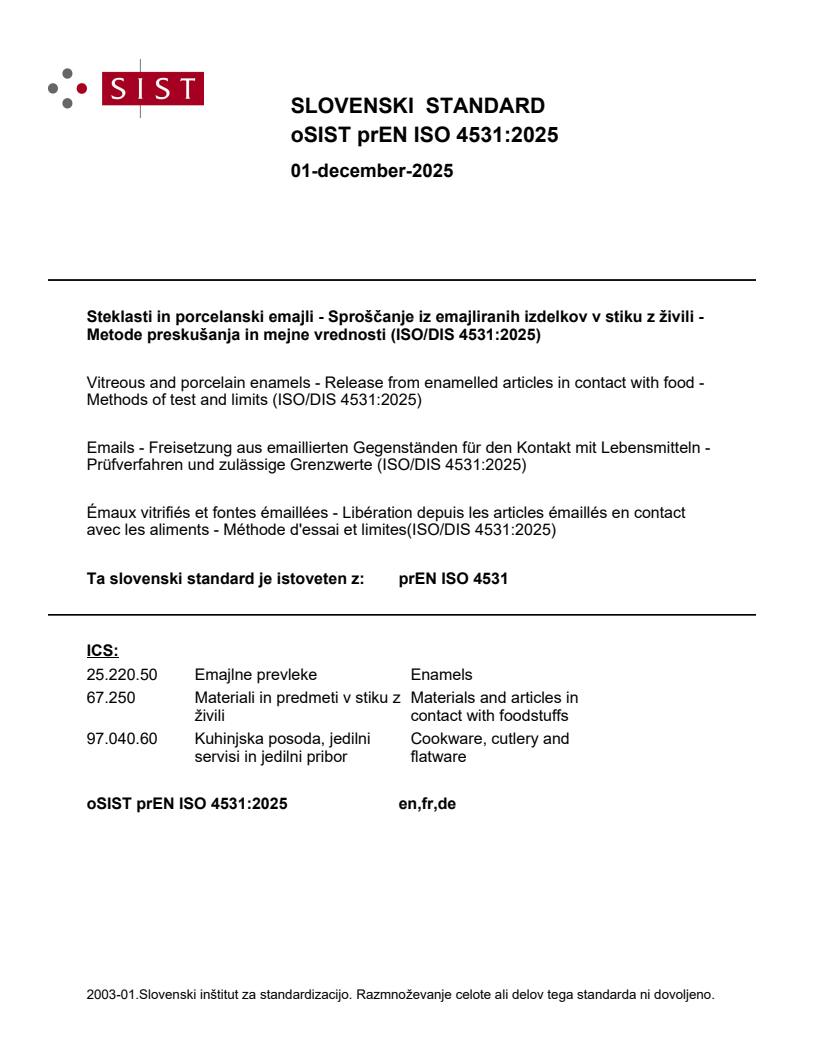
SLOVENSKI STANDARD
01-december-2025
Steklasti in porcelanski emajli - Sproščanje iz emajliranih izdelkov v stiku z živili -
Metode preskušanja in mejne vrednosti (ISO/DIS 4531:2025)
Vitreous and porcelain enamels - Release from enamelled articles in contact with food -
Methods of test and limits (ISO/DIS 4531:2025)
Emails - Freisetzung aus emaillierten Gegenständen für den Kontakt mit Lebensmitteln -
Prüfverfahren und zulässige Grenzwerte (ISO/DIS 4531:2025)
Émaux vitrifiés et fontes émaillées - Libération depuis les articles émaillés en contact
avec les aliments - Méthode d'essai et limites(ISO/DIS 4531:2025)
Ta slovenski standard je istoveten z: prEN ISO 4531
ICS:
25.220.50 Emajlne prevleke Enamels
67.250 Materiali in predmeti v stiku z Materials and articles in
živili contact with foodstuffs
97.040.60 Kuhinjska posoda, jedilni Cookware, cutlery and
servisi in jedilni pribor flatware
2003-01.Slovenski inštitut za standardizacijo. Razmnoževanje celote ali delov tega standarda ni dovoljeno.
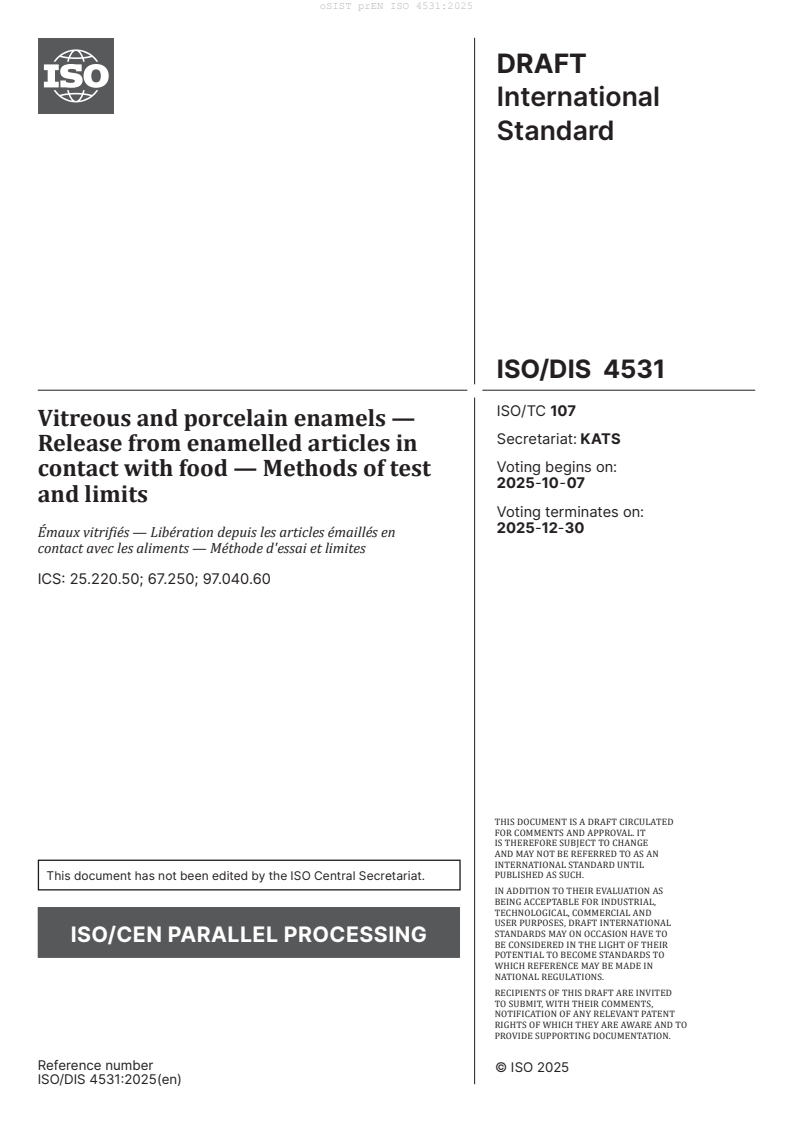
DRAFT
International
Standard
ISO/DIS 4531
ISO/TC 107
Vitreous and porcelain enamels —
Secretariat: KATS
Release from enamelled articles in
Voting begins on:
contact with food — Methods of test
2025-10-07
and limits
Voting terminates on:
2025-12-30
Émaux vitrifiés — Libération depuis les articles émaillés en
contact avec les aliments — Méthode d'essai et limites
ICS: 25.220.50; 67.250; 97.040.60
THIS DOCUMENT IS A DRAFT CIRCULATED
FOR COMMENTS AND APPROVAL. IT
IS THEREFORE SUBJECT TO CHANGE
AND MAY NOT BE REFERRED TO AS AN
INTERNATIONAL STANDARD UNTIL
PUBLISHED AS SUCH.
This document has not been edited by the ISO Central Secretariat.
IN ADDITION TO THEIR EVALUATION AS
BEING ACCEPTABLE FOR INDUSTRIAL,
TECHNOLOGICAL, COMMERCIAL AND
USER PURPOSES, DRAFT INTERNATIONAL
STANDARDS MAY ON OCCASION HAVE TO
ISO/CEN PARALLEL PROCESSING
BE CONSIDERED IN THE LIGHT OF THEIR
POTENTIAL TO BECOME STANDARDS TO
WHICH REFERENCE MAY BE MADE IN
NATIONAL REGULATIONS.
RECIPIENTS OF THIS DRAFT ARE INVITED
TO SUBMIT, WITH THEIR COMMENTS,
NOTIFICATION OF ANY RELEVANT PATENT
RIGHTS OF WHICH THEY ARE AWARE AND TO
PROVIDE SUPPORTING DOCUMENTATION.
Reference number
ISO/DIS 4531:2025(en)
DRAFT
ISO/DIS 4531:2025(en)
International
Standard
ISO/DIS 4531
ISO/TC 107
Vitreous and porcelain enamels —
Secretariat: KATS
Release from enamelled articles in
Voting begins on:
contact with food — Methods of test
and limits
Voting terminates on:
Émaux vitrifiés — Libération depuis les articles émaillés en
contact avec les aliments — Méthode d'essai et limites
ICS: 25.220.50; 67.250; 97.040.60
THIS DOCUMENT IS A DRAFT CIRCULATED
FOR COMMENTS AND APPROVAL. IT
IS THEREFORE SUBJECT TO CHANGE
AND MAY NOT BE REFERRED TO AS AN
INTERNATIONAL STANDARD UNTIL
PUBLISHED AS SUCH.
This document has not been edited by the ISO Central Secretariat.
IN ADDITION TO THEIR EVALUATION AS
BEING ACCEPTABLE FOR INDUSTRIAL,
© ISO 2025
TECHNOLOGICAL, COMMERCIAL AND
USER PURPOSES, DRAFT INTERNATIONAL
All rights reserved. Unless otherwise specified, or required in the context of its implementation, no part of this publication may
STANDARDS MAY ON OCCASION HAVE TO
ISO/CEN PARALLEL PROCESSING
be reproduced or utilized otherwise in any form or by any means, electronic or mechanical, including photocopying, or posting on
BE CONSIDERED IN THE LIGHT OF THEIR
the internet or an intranet, without prior written permission. Permission can be requested from either ISO at the address below
POTENTIAL TO BECOME STANDARDS TO
WHICH REFERENCE MAY BE MADE IN
or ISO’s member body in the country of the requester.
NATIONAL REGULATIONS.
ISO copyright office
RECIPIENTS OF THIS DRAFT ARE INVITED
CP 401 • Ch. de Blandonnet 8
TO SUBMIT, WITH THEIR COMMENTS,
CH-1214 Vernier, Geneva
NOTIFICATION OF ANY RELEVANT PATENT
Phone: +41 22 749 01 11
RIGHTS OF WHICH THEY ARE AWARE AND TO
PROVIDE SUPPORTING DOCUMENTATION.
Email: copyright@iso.org
Website: www.iso.org
Published in Switzerland Reference number
ISO/DIS 4531:2025(en)
ii
ISO/DIS 4531:2025(en)
Contents Page
Foreword .iv
Introduction .v
1 Scope . 1
2 Normative references . 1
3 Terms and definitions . 1
4 Principle . 1
5 Reagents . 2
6 Apparatus . 2
7 Samples . 3
8 Preparation of samples . 4
9 Test conditions . 4
10 Procedure . 4
10.1 Release test .4
10.2 Sampling the release test solution for analysis (sample measuring solution) . .7
11 Expression of results . 7
11.1 Reporting .7
11.2 Test report .8
Annex A (informative) Explanatory information on release limits .10
Bibliography .12
iii
ISO/DIS 4531:2025(en)
Foreword
ISO (the International Organization for Standardization) is a worldwide federation of national standards
bodies (ISO member bodies). The work of preparing International Standards is normally carried out through
ISO technical committees. Each member body interested in a subject for which a technical committee
has been established has the right to be represented on that committee. International organizations,
governmental and non-governmental, in liaison with ISO, also take part in the work. ISO collaborates closely
with the International Electrotechnical Commission (IEC) on all matters of electrotechnical standardization.
The procedures used to develop this document and those intended for its further maintenance are described
in the ISO/IEC Directives, Part 1. In particular, the different approval criteria needed for the different types
of ISO documents should be noted. This document was drafted in accordance with the editorial rules of the
ISO/IEC Directives, Part 2 (see www.iso.org/directives).
Attention is drawn to the possibility that some of the elements of this document may be the subject of patent
rights. ISO shall not be held responsible for identifying any or all such patent rights. Details of any patent
rights identified during the development of the document will be in the Introduction and/or on the ISO list of
patent declarations received (see www.iso.org/patents).
Any trade name used in this document is information given for the convenience of users and does not
constitute an endorsement.
For an explanation of the voluntary nature of standards, the meaning of ISO specific terms and expressions
related to conformity assessment, as well as information about ISO's adherence to the World Trade
Organization (WTO) principles in the Technical Barriers to Trade (TBT), see www.iso.org/iso/foreword.html.
This document was prepared by the European Committee for Standardization (CEN) Technical Committee
CEN/TC 262, Metallic and other inorganic coatings, including for corrosion protection and corrosion testing of
metals and alloys, in collaboration with ISO Technical Committee ISO/TC 107, Metallic and other inorganic
coatings, in accordance with the agreement on technical cooperation between ISO and CEN (Vienna
Agreement).
This third edition cancels and replaces the second edition (ISO 4531:2022), which has been technically
revised.
The main changes are as follows:
— a definition of a drinking rim has been added;
— a test procedure for a drinking rim has been added;
— aa test procedure for a lid has been added when a different enamel is used for the lid;
— two new reagents have been added;
Any feedback or questions on this document should be directed to the user’s national standards body. A
complete listing of these bodies can be found at www.iso.org/members.html.
iv
ISO/DIS 4531:2025(en)
Introduction
The release of metal-ions from enamelled articles requires effective means of control to ensure protection
against possible hazards arising from the use of improperly formulated, applied and fired enamels and/
or inorganic decorations on food contact surfaces of enamelled articles used for the preparation, cooking,
serving and storage of foodstuffs.
As a secondary consideration, different requirements from country to country for the control of the release
of ions from the surfaces of enamelled articles present non-tariff barriers to international trade in these
commodities. Accordingly, there is a need to establish internationally accepted methods of testing enamelled
articles for the release of metal-ions.
v
DRAFT International Standard ISO/DIS 4531:2025(en)
Vitreous and porcelain enamels — Release from enamelled
articles in contact with food — Methods of test and limits
1 Scope
This document specifies a simulating method of test for determination of the release of metal-ions from
enamelled articles, which are intended to come into contact with food.
This document also specifies limits for the release of metal-ions from enamelled articles, which are intended
to come into contact with food.
This document is applicable to enamelled articles, including tanks and vessels, which are intended to be
used for the preparation, cooking, serving and storage of food.
2 Normative references
The following documents are referred to in the text in such a way that some or all of their content constitutes
requirements of this document. For dated references, only the edition cited applies. For undated references,
the latest edition of the referenced document (including any amendments) applies.
ISO 648, Laboratory glassware — Single-volume pipettes
ISO 1042, Laboratory glassware — One-mark volumetric flasks
ISO 3585, Borosilicate glass 3.3 — Properties
ISO 3696, Water for analytical laboratory use — Specification and test methods
ISO 4788, Laboratory glassware — Graduated measuring cylinders
ISO 28764, Vitreous and porcelain enamels — Production of specimens for testing enamels on sheet steel, sheet
aluminium and cast iron
3 Terms and definitions
For the purposes of this document, the following terms and definitions apply.
ISO and IEC maintain terminological databases for use in standardization at the following addresses:
— ISO Online browsing platform: available at https:// www .iso .org/ obp
— IEC Electropedia: available at https:// www .electropedia .org/
3.1
drinking rim
20 mm wide section of the external surface of a drinking vessel, measured downwards from the upper edge
along the wall of the vessel
4 Principle
For the release of metal-ions, if present, from the surfaces of articles or test specimen, a mass fraction of
3 % (density) of an acetic acid solution shall be used. Three consecutive release tests shall be performed on
the same day using the same sample and a fresh test solution per test. The first two release test solutions
ISO/DIS 4531:2025(en)
(M1, M2) are discarded. Only the third release test solution (M3) shall be used for analysis. A blank test (B1,
B2, B3) is required for each release test, of which only the third release test solution (B3) shall be used for
analysis.
5 Reagents
During the determination, use only reagents of recognized analytical grade and only distilled water, or
water of equivalent purity, grade 3 water conforming to the requirements of ISO 3696.
It is permissible to prepare proportionately greater quantities of test solution and analytical solutions than
specified in 5.2.
5.1 Acetic acid, (CH COOH), concentrated, density ρ = 1,05 g/ml.
5.2 Test solution, acetic acid, a 3 % (density) solution.
By means of a graduated measuring cylinder (6.4) add, to 500 ml of water, (30 ± 1) g (28,6 ml) of concentrated
acetic acid (5.1) and make up to 1 l. Prepare the test solution freshly prior to use and in sufficient quantity to
enable the whole of any group of tests and analysis to be completed.
5.3 Analytical stock solutions, the standard stock solutions or multi-element solutions, used for ICP-
analysis shall be used.
5.4 Dishwashing agent, commercially available, non-acidic dishwashing detergent in common dilution.
5.5 Paraffin, with a high melting point.
5.6 Paraffin tape, e.g. made of 50 % paraffine and 50 % polyolefine
6 Apparatus
Use only laboratory glassware, conforming to the requirements of appropriate International Standards,
where they exist, and made of borosilicate glass as specified in ISO 3585.
6.1 ICP spectrometer, with a limit of detection at least six times lower than the release limits in Table 1.
Other analysis equipment that achieves the equivalent performance may also be used (e.g. AAS/GF).
6.2 One-mark volumetric flasks, capacities 100 ml and 1 000 ml, conforming to the requirements
specified for class B or better one-mark volumetric flasks in ISO 1042. Other sizes of one-mark volumetric
flasks may also be required.
6.3 One-mark pipettes, capacities 10 ml and 100 ml, conforming to the requirements specified for class B
or better one-mark pipettes in ISO 648. Other sizes of one-mark pipettes may also be required.
6.4 Graduated measuring cylinders, capacities 50 ml and 500 ml, conforming to the requirements
specified in ISO 4788. Other sizes of graduated measuring cylinders may also be required.
6.5 Vessels, containers, stoppers and connectors shall consist of a material, such as glass or
polytetrafluoroethylene (PTFE).
6.6 Vessels made of borosilicate glass, in accordance with ISO 3585, internal diameter 80 mm, external
diameter 90 mm, height 36 mm, 10 mm diameter of the filling hole.
The calculation of the surface/volume (S/V) ratio is reported below.
ISO/DIS 4531:2025(en)
Each chamber has an internal diameter of 80 mm. Therefore, the tested area, a, of one test plate is 5 025 mm
(a = π·r ) where r is the radius of the test plate.
The volume of the chamber, V, with a height, h, of 36 mm and a gasket thickness, e, of 2 mm is calculated from
Formula (1):
Vh=+ 2⋅ea⋅ (1)
()
2 3
V = (36 mm + 2·2 mm)·5 025 mm = 201 000 mm
The S/V ratio can be calculated from Formula (2):
S 5025mm
−1
==0,025mm (2)
V 201000mm³
−1
The S/V ratio for two plates that shall be used, therefore, is equal to 0,05 mm .
...
Questions, Comments and Discussion
Ask us and Technical Secretary will try to provide an answer. You can facilitate discussion about the standard in here.