

CWA 17935:2022
(Main)Sustainable Nanomanufacturing Framework
General Information
- Abstract
This document describes and specifies the requirements of a simplified Sustainability Nanomanufacturing Framework (SNF) for sustainability management in Nanomanufacturing Pilot Lines (NPLs), appropriate to their size, management capabilities and sustainability priorities.
The SNF sets up the basic requirements for a screening methodology to quicky assess the sustainability of a NPL. It provides guidance for diagnosis, implementation, and monitoring, to proactively improve nano-sustainability performances in NPLs, considering its sustainability management and results.
The model can be used by NPLs to achieve its intended outcomes in the field of nano-sustainability.
The SNF is intended to be applied to any NPL regardless of its size, type and activities. Similarly, the model could be scaled to manage the sustainability of a manufacturing area/plant that integrates multiple NPLs.
This document can be used in whole or in part to systematically improve the sustainability in NPLs.
- Status
- Published
- Publication Date
- 18-Oct-2022
- Technical Committee
- CEN/WS SNF - Sustainable Nanomanufacturing Framework
- Drafting Committee
- CEN/WS SNF - Sustainable Nanomanufacturing Framework
- Current Stage
- 9093 - Decision to confirm - Review Enquiry
- Start Date
- 12-Aug-2026
- Completion Date
- 30-Sep-2026

Overview
CWA 17935:2022 - Sustainable Nanomanufacturing Framework (SNF) - is a CEN Workshop Agreement published for Nanomanufacturing Pilot Lines (NPLs). The SNF defines a simplified, scalable sustainability management model and a rapid screening methodology to assess, monitor and improve nano‑sustainability performance. Designed for use regardless of NPL size, type or activity, the framework supports diagnosis, implementation, monitoring and continuous improvement of environmental, social and economic sustainability in nanomanufacturing.
Key technical topics and requirements
- Scope and applicability: SNF is applicable to any NPL and can be scaled to a manufacturing area or plant integrating multiple NPLs.
- Screening methodology: Basic requirements for a quick sustainability screening to identify priorities and risks in NPL operations.
- 10‑step operating procedure: A structured evaluation workflow (diagnosis → planning → implementation → monitoring) to build a sustainability dashboard and guide PDCA (Plan‑Do‑Check‑Act) cycles.
- Sustainability Management (SM) and Sustainability Results (SR): Guidance to assess both management practices and measurable sustainability outcomes.
- Customization guidance: Instructions for tailoring SNF to NPL size, management capabilities and priorities.
- Tools and examples: The OASIS‑SNF Excel tool automates the evaluation steps; Annexes provide practical use cases from OASIS and INNOMEM projects demonstrating real NPL applications.
- Continuous improvement: Procedures for implementing corrective actions and tracking improvements over time.
Practical applications
- Rapidly screen and prioritize sustainability actions in research and pilot production of nanomaterials and nano‑enabled products.
- Create a sustainability dashboard for management reporting, benchmarking and stakeholder communication.
- Integrate sustainability into early design and scale‑up stages to reduce environmental impact, conserve resources and address social/health concerns.
- Support grant projects, innovation testbeds and technology transfer by documenting sustainability improvements and compliance efforts.
Who should use this standard
- NPL managers, sustainability officers and engineers in nanotechnology R&D and pilot manufacturing.
- Project leads and coordinators in EU research projects or innovation ecosystems (e.g., OASIS, INNOMEM).
- Quality, EHS and sustainability consultants helping small to medium pilot facilities implement pragmatic sustainability systems.
- Standardization bodies and policy makers seeking harmonized, scalable approaches to nano‑sustainability.
Related standards and guidance
SNF complements existing management and sustainability standards (quality, environmental and safety management systems) and aligns with common sustainability assessment practices. It is intended as a practical, lightweight framework to sit alongside ISO and sectoral guidance for manufacturing sustainability.
Keywords: Sustainable Nanomanufacturing Framework, SNF, Nanomanufacturing Pilot Lines, NPL, sustainability screening, sustainability dashboard, nano‑sustainability, OASIS, INNOMEM, PDCA.
Get Certified
Connect with accredited certification bodies for this standard

BSI Group
BSI (British Standards Institution) is the business standards company that helps organizations make excellence a habit.

Bureau Veritas
Bureau Veritas is a world leader in laboratory testing, inspection and certification services.

DNV
DNV is an independent assurance and risk management provider.
Sponsored listings
Frequently Asked Questions
CWA 17935:2022 is a technical report published by the European Committee for Standardization (CEN). Its full title is "Sustainable Nanomanufacturing Framework". This standard covers: This document describes and specifies the requirements of a simplified Sustainability Nanomanufacturing Framework (SNF) for sustainability management in Nanomanufacturing Pilot Lines (NPLs), appropriate to their size, management capabilities and sustainability priorities. The SNF sets up the basic requirements for a screening methodology to quicky assess the sustainability of a NPL. It provides guidance for diagnosis, implementation, and monitoring, to proactively improve nano-sustainability performances in NPLs, considering its sustainability management and results. The model can be used by NPLs to achieve its intended outcomes in the field of nano-sustainability. The SNF is intended to be applied to any NPL regardless of its size, type and activities. Similarly, the model could be scaled to manage the sustainability of a manufacturing area/plant that integrates multiple NPLs. This document can be used in whole or in part to systematically improve the sustainability in NPLs.
This document describes and specifies the requirements of a simplified Sustainability Nanomanufacturing Framework (SNF) for sustainability management in Nanomanufacturing Pilot Lines (NPLs), appropriate to their size, management capabilities and sustainability priorities. The SNF sets up the basic requirements for a screening methodology to quicky assess the sustainability of a NPL. It provides guidance for diagnosis, implementation, and monitoring, to proactively improve nano-sustainability performances in NPLs, considering its sustainability management and results. The model can be used by NPLs to achieve its intended outcomes in the field of nano-sustainability. The SNF is intended to be applied to any NPL regardless of its size, type and activities. Similarly, the model could be scaled to manage the sustainability of a manufacturing area/plant that integrates multiple NPLs. This document can be used in whole or in part to systematically improve the sustainability in NPLs.
CWA 17935:2022 is classified under the following ICS (International Classification for Standards) categories: 07.120 - Nanotechnologies; 13.020.20 - Environmental economics. Sustainability. The ICS classification helps identify the subject area and facilitates finding related standards.
CWA 17935:2022 is available in PDF format for immediate download after purchase. The document can be added to your cart and obtained through the secure checkout process. Digital delivery ensures instant access to the complete standard document.
Standards Content (Sample)
SLOVENSKI STANDARD
01-december-2022
Okvir trajnostne nanoproizvodnje
Sustainable Nanomanufacturing Framework
Ta slovenski standard je istoveten z: CWA 17935:2022
ICS:
07.120 Nanotehnologije Nanotechnologies
13.020.20 Okoljska ekonomija. Environmental economics.
Trajnostnost Sustainability
2003-01.Slovenski inštitut za standardizacijo. Razmnoževanje celote ali delov tega standarda ni dovoljeno.
CEN
CWA 17935
WORKSHOP
October 2022
AGREEMENT
ICS 07.120; 13.020.20
English version
Sustainable Nanomanufacturing Framework
This CEN Workshop Agreement has been drafted and approved by a Workshop of representatives of interested parties, the
constitution of which is indicated in the foreword of this Workshop Agreement.
The formal process followed by the Workshop in the development of this Workshop Agreement has been endorsed by the
National Members of CEN but neither the National Members of CEN nor the CEN-CENELEC Management Centre can be held
accountable for the technical content of this CEN Workshop Agreement or possible conflicts with standards or legislation.
This CEN Workshop Agreement can in no way be held as being an official standard developed by CEN and its Members.
This CEN Workshop Agreement is publicly available as a reference document from the CEN Members National Standard Bodies.
CEN and CENELEC members are the national standards bodies and national electrotechnical committees of Austria, Belgium, Bulgaria, Croatia,
Cyprus, Czech Republic, Denmark, Estonia, Finland, France, Germany, Greece, Hungary, Iceland, Ireland, Italy, Latvia, Lithuania, Luxembourg,
Malta, Netherlands, Norway, Poland, Portugal, Republic of North Macedonia, Romania, Serbia, Slovakia, Slovenia, Spain, Sweden, Switzerland,
Türkiye and United Kingdom.
EUROPEAN COMMITTEE FOR STANDARDIZATION
COMITÉ EUROPÉEN DE NORMALISATION
EUROPÄISCHES KOMITEE FÜR NORMUNG
CEN-CENELEC Management Centre: Rue de la Science 23, B-1040 Brussels
© 2022 All rights of exploitation in any form and by any means reserved worldwide for CEN national Members and for
CEN/CENELE CENELEC Members.
C
Ref. No.:CWA 17935:2022 E
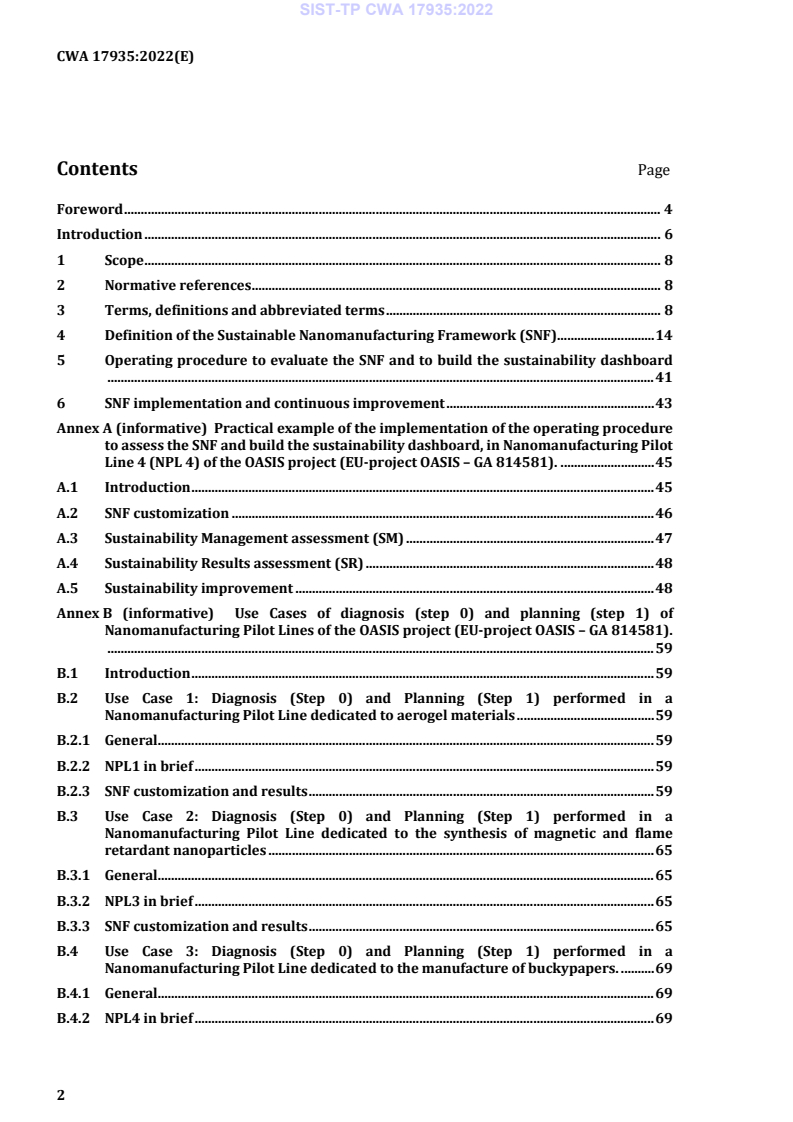
Contents Page
Foreword . 4
Introduction . 6
1 Scope . 8
2 Normative references . 8
3 Terms, definitions and abbreviated terms . 8
4 Definition of the Sustainable Nanomanufacturing Framework (SNF) . 14
5 Operating procedure to evaluate the SNF and to build the sustainability dashboard
................................................................................................................................................................... 41
6 SNF implementation and continuous improvement . 43
Annex A (informative) Practical example of the implementation of the operating procedure
to assess the SNF and build the sustainability dashboard, in Nanomanufacturing Pilot
Line 4 (NPL 4) of the OASIS project (EU-project OASIS – GA 814581). . 45
A.1 Introduction . 45
A.2 SNF customization . 46
A.3 Sustainability Management assessment (SM) . 47
A.4 Sustainability Results assessment (SR) . 48
A.5 Sustainability improvement . 48
Annex B (informative) Use Cases of diagnosis (step 0) and planning (step 1) of
Nanomanufacturing Pilot Lines of the OASIS project (EU-project OASIS – GA 814581).
................................................................................................................................................................... 59
B.1 Introduction . 59
B.2 Use Case 1: Diagnosis (Step 0) and Planning (Step 1) performed in a
Nanomanufacturing Pilot Line dedicated to aerogel materials . 59
B.2.1 General. 59
B.2.2 NPL1 in brief . 59
B.2.3 SNF customization and results . 59
B.3 Use Case 2: Diagnosis (Step 0) and Planning (Step 1) performed in a
Nanomanufacturing Pilot Line dedicated to the synthesis of magnetic and flame
retardant nanoparticles . 65
B.3.1 General. 65
B.3.2 NPL3 in brief . 65
B.3.3 SNF customization and results . 65
B.4 Use Case 3: Diagnosis (Step 0) and Planning (Step 1) performed in a
Nanomanufacturing Pilot Line dedicated to the manufacture of buckypapers. . 69
B.4.1 General. 69
B.4.2 NPL4 in brief . 69
B.4.3 SNF customization and results . 69
B.5 Use Case 4: Diagnosis (Step 0) and Planning (Step 1) performed in a
Nanomanufacturing Pilot Line dedicated to modular pultrusion. 74
B.5.1 General . 74
B.5.2 NPL12 in brief . 74
B.5.3 SNF customization and results . 74
Annex C (informative) Use Cases of diagnosis (step 0) and planning (step 1) of
Nanomanufacturing Pilot Lines of the INNOMEM project (EU-project INNOMEM– GA
862330). . 78
C.1 Introduction . 78
C.2 Use Case 1: Diagnosis (Step 0) and Planning (Step 1) performed in a
Nanomanufacturing Pilot Line dedicated to the Mixed Matrix Hollow Fiber
Membranes production . 78
C.2.1 General . 78
C.2.2 NPL1 in brief . 78
C.2.3 SNF customization and results . 78
C.3 Use Case 2: Diagnosis (Step 0) and Planning (Step 1) performed in a
Nanomanufacturing Pilot Line dedicated to Pd-based membranes production . 84
C.3.1 General . 84
C.3.2 NPL2 in brief . 84
C.3.3 SNF customization and results . 84
Bibliography . 91
Foreword
This CEN Workshop Agreement (CWA 17935:2022) has been developed in accordance with the CEN-
CENELEC Guide 29 “CEN/CENELEC Workshop Agreements – A rapid prototyping to standardization” and
with the relevant provisions of CEN/CENELEC Internal Regulations - Part 2. It was approved by a
Workshop of representatives of interested parties on 2022-09-20, the constitution of which was
supported by CEN following the public call for participation made on 2021-11-24. However, this CEN
Workshop Agreement does not necessarily include all relevant stakeholders.
The final text of this CEN Workshop Agreement was provided to CEN for publication on 2022-09-26.
Results incorporated in this CWA received funding from the European Union’s Horizon 2020 research
and innovation programme, under Grant Agreements No 814581 [OASIS] and No 862330 [INNOMEN].
The following organizations and individuals developed and approved this CEN Workshop Agreement:
• Chairperson: Eng. MSc. Jesús López de Ipiña, Jesús (Tecnalia).
• Vice-Chairperson: Ms. Joséphine Steck (CEA).
• AcumenIST: Dr. Steffi Friedrichs.
• Adamant Composites Ltd.: Ms. Despoina Batsouli, Mr. Grigorios Koutsoukis and Dr. Antonios
Vavouliotis.
• BioNanoNet Forschungsgesellschaft mbH: Mag. pharm., MSc. Susanne Resch and MSc. Clemens Wolf.
• CEA: Dr. Simon Clavaguera and Dr. Cécile Girardot.
• Fraunhofer-Gesellschaft zur Förderung der angewandten Forschung e.V.: Dr. Benedikt Schug.
• IPC: Mr. Maudez Le Dantec.
• ISQ: Mr. João Laranjeira and Ms. Cristina Matos
• Laboratoire National de Métrologie et d’Essais (LNE): PhD. Georges Favre.
• Pleione Energy SA: Dr. Athanasios Masouras and Mrs. Dorela Hoxha.
• Tecnalia: Dr. José Luis Viviente.
• TMBK Partners: Mr. Pawel Duralek and Mr. Przemyslaw Kosmider.
• UNE: Mr. Fernando Machicado and Ms. Raquel Martínez Egido.
• Universidad de Castilla-La Mancha: Dr. Rafael Orlando Klee Morán, Professor María Luz Sánchez,
Professor Paula Sánchez and MSc. Leticia Toledo Murcia.
• University of Patras: Dr. Stavros Tsantzalis and Professor Vassilis Kostopoulos.
• Sisteplant S.L.: Mr. Paul Gomendiourrutia.
Attention is drawn to the possibility that some elements of this document may be subject to patent rights.
CEN/CENELEC policy on patent rights is described in CEN-CENELEC Guide 8 “Guidelines for
Implementation of the Common IPR Policy on Patent”. CEN shall not be held responsible for identifying
any or all such patent rights.
Although the Workshop parties have made every effort to ensure the reliability and accuracy of technical
and nontechnical descriptions, the Workshop is not able to guarantee, explicitly or implicitly, the
correctness of this document. Anyone who applies this CEN Workshop Agreement shall be aware that
neither the Workshop, nor CEN, can be held liable for damages or losses of any kind whatsoever. The use
of this CEN Workshop Agreement does not relieve users of their responsibility for their own actions, and
they apply this document at their own risk. The CEN Workshop Agreement should not be construed as
legal advice authoritatively endorsed by CEN/CENELEC.
Introduction
European manufacturing is determined to provide by 2030 a robust foundation for the economic, social
and ecologically sustainable development of the European Union, which will contribute to increasing
sustainability in a global context. It is also expected that both nanotechnology and sustainability, will be
two important sources of differentiation and competitiveness for the European manufacturing industry
in the global market.
Although different definitions are used for the concept of sustainable manufacturing, there is no official
standardized one. The U.S. Department of Commerce [50] proposed in 2008 one of the first and most
widely used definitions of sustainable manufacturing: “the creation of manufactured products that use
processes that are non-polluting, conserve energy and natural resources, and are economically sound and
safe for employees, communities, and consumers”. This definition has supported other definitions such as
those produced by the US EPA [51] or ASTM [43].
Despite the fact that the concept of sustainability has been traditionally associated with an environmental
dimension, all these definitions highlight the three-dimensionality of sustainable manufacturing, that
encapsulates three basic dimensions: social, environment and economy.
In the literature review, different relevant initiatives on sustainable manufacturing can be found: the
European Commission (EC) [45] [46] [47] through the S3-Smart Specialization Platform [48], the US
Department of Commerce [49] [50], the US Environmental Protection Agency [51], the OECD through the
sustainable manufacturing toolkit [44], among others. Various methods, tools and metrics have been
applied for sustainability performance assessment in manufacturing. In the field of standardization,
several ISO standards, some of them adopted by CEN as European standards, address issues related to
sustainability such as quality [1] [2] [7], environment [3] [4], safety [35], responsibility, social,
governance, etc. Those can be applied to manufacturing processes to cover such sustainability items. In
this regard, standards developed by ASTM - Subcommittee E60.13 on Sustainable Manufacturing [43] are
of particular interest.
The sustainable manufacturing of nanotechnology supports the needs of the industry, contributes to the
industrial policies of the EU and promotes the technological leadership of Europe. At the same time, it
minimizes negative environmental impacts, conserves energy and natural resources, is safe for
employees, communities, and consumers, and is economically sound.
Pilot Lines (PLs) are strategic instruments of the European Commission to bridge the "valley of death",
and successfully introduce innovations based on Key Enabling Technologies (KETs) into the market. In
particular, in the field of nanotechnology, they are the embryo of tomorrow's nano-manufacturing
industry in Europe. Nanomanufacturing Pilot Lines (NPLs) are responsible for the potential impacts on
sustainability (social, environmental, economic) that their nanomanufacturing activities can produce.
The incorporation of sustainability requirements in these NPLs, from the first stages of design and
operation of the new processes, constitutes a proactive strategy to ensure equally sustainable future
commercial nanomanufacturing processes. Consequently, there is a need to define requirements to
guarantee the environmental, social and economic sustainability of these NPLs, considering at the same
time their embryonic and pre-commercial nature. This requires simple sustainability management
schemes easy to use and apply.
In this context, this document inserts the concept of sustainable manufacturing into the field of
nanotechnology, by proposing a new simplified conceptual framework to implement sustainability in
NPLs and evaluate their sustainable manufacturing performance. Our ambition is to contribute to the
deployment of more efficient and sustainable nano-manufacturing processes that enable the
manufacture of safer and more sustainable nanomaterials and nanoproducts, as the European
Commission recently pointed out.
The Sustainable Nanomanufacturing Framework (SNF) described in this document is based on the one
developed by the H2020 OASIS project OASIS “Open Access Single entry point for scale-up of Innovative
Smart lightweight composite materials and components”. The OASIS model is a simple and user-friendly
screening tool designed to carry out the initial diagnosis, define the improvement plans and evaluate the
sustainability and evolution of NPLs. This framework has been tested in 12 NPLs of the OASIS project (GA
814581) and 7 NPLs of the INNOMEM project (GA 862630).
Annex A shows, using an example based on the OASIS NPL4, the practical application of the 10-step SNF
evaluation procedure described in this document. Annex B of this document shows the results
corresponding to the diagnosis and planning stages of the Plan-Do-Check-Act (PDCA) cycle in four of the
12 NPLs of OASIS Subsequently, the H2020 INNOMEM project “Open Innovation Test Bed for nano-
enabled Membranes”, also used the model to assess the sustainability of the NPLs incorporated in its
manufacturing ecosystem. Annex C of this document shows the results corresponding to the initial
diagnosis and planning stages in two NPLs of this last project.
The OASIS project has developed a simple software based on MS Excel (OASIS-SNF Tool) to automate the
practical application of the 10-step SNF evaluation procedure. This tool has been used by the project to
diagnose, implement, monitor and re-evaluate management practices and sustainability results in NPLs,
in conformity with the requirements of the SNF model. It is envisaged that a new version of the OASIS-
SNF Tool will be publicly available at the website of OASIS (https://project-oasis.eu/ ) at the end of the
project (November 2022).
The SNF was initially conceived and designed as a resilient model to be used in the broad scope of
sustainable manufacturing (SM), for any manufacturing process. However, given the scope of the OASIS
project, the primary model was later customized to be used in the field of sustainable nanomanufacturing
(SN).
1 Scope
This document describes and specifies the requirements of a simplified Sustainability
Nanomanufacturing Framework (SNF) for sustainability management in Nanomanufacturing Pilot Lines
(NPLs), appropriate to their size, management capabilities and sustainability priorities.
The SNF sets up the basic requirements for a screening methodology to quicky assess the sustainability
of a NPL. It provides guidance for diagnosis, implementation, and monitoring, to proactively improve
nano-sustainability performances in NPLs, considering its sustainability management and results.
The model can be used by NPLs to achieve its intended outcomes in the field of nano-sustainability.
The SNF is intended to be applied to any NPL regardless of its size, type and activities. Similarly, the model
could be scaled to manage the sustainability of a manufacturing area/plant that integrates multiple NPLs.
This document can be used in whole or in part to systematically improve the sustainability in NPLs.
2 Normative references
There are no normative references in this document.
3 Terms, definitions and abbreviated terms
3.1 General
For the purposes of this document, the following terms and definitions apply.
ISO and IEC maintain terminological databases for use in standardization at the following addresses:
ISO Online browsing platform: available at https://www.iso.org/obp/
IEC Electropedia: available at https://www.electropedia.org/
3.2 Terms related to nanotechnology
3.2.1
nano-enabled product
product exhibiting function or performance only possible with nanotechnology.
Note 1 to entry: finished goods incorporating nanotechnology.
Note 2 to entry: term customized from ISO/TS 80004-1:2015 [36].
3.2.2
nano-intermediate
intermediate product with nanoscale features.
3.2.3
nanomanufacturing pilot line
pilot line conceived for the manufacture of nanomaterials, nano-intermediates or nano-enabled products.
3.2.4
nanomanufacturing process
ensemble of activities to intentionally synthesize, generate or control nanomaterials, or fabrication steps
in the nanoscale, for commercial purposes.
[SOURCE: ISO/TS 80004-1:2015, definition 2.12] [36]
3.2.5
nanomaterial
material with any external dimension in the nanoscale or having internal structure or surface structure
in the nanoscale.
Note 1 to entry: This generic term is inclusive of nano-object and nanostructured material.
Note 2 to entry has been deleted.
[SOURCE: ISO/TS 80004-1:2015, definition 2.11] [36]
3.2.6
NOAA
nano-objects, and their agglomerates and aggregates.
Note 1 to entry: NOAAs include structures with one, two or three external dimensions in the nanoscale, which might
be spheres, fibres, tubes and others as primary structures. NOAAs can consist of individual primary structures in
the nanoscale and aggregated or agglomerated structures, including those with sizes larger than 100 nm.
[SOURCE: ISO/DIS 80004-1, definition 2.11] [37]
3.3 Terms related to production and manufacturing
3.3.1
process
set of interrelated or interacting activities that use inputs to deliver an intended result.
[SOURCE: ISO 9000:2015, definition 3.4.1 (without notes)] [1]
3.3.2
manufacturing process
structured set of activities involving a flow and/or transformation of material, information, energy, or
any other element in a manufacturing area.
[SOURCE: ISO 20140-1:2019, 3.14] [17]
3.3.3
pilot line
the physical infrastructure and equipment needed to produce small series of pre-commercial products.
[SOURCE: Pilot Production in Key Enabling Technologies, EC 2017] [47]
3.4 Terms related to sustainability
3.4.1
economic aspect
element of an organization's activities or products or services that interacts or can interact with the
economy.
[SOURCE: ISO 23434-1:2021] [32]
3.4.2
economic sustainability
ability to provide sustainable, successful places in an economic context.
Note 1 to entry: Economic considerations include employment, competitiveness, wealth and distribution, welfare,
accounting and regulation.
[SOURCE: ISO 17889-1:2021] [15]
3.4.3
environmental aspect
element of an organization's activities or products or services that interacts or can interact with the
environment.
[SOURCE: EN ISO 14001:2015] [3]
3.4.4
environmental sustainability
state in which the ecosystem and its functions are maintained for the present and future generation.
[SOURCE: ISO 17889-1:2021] [15]
3.4.5
social aspect
element of an organization's activities or products or services that interacts or can interact with society
or quality of life.
[SOURCE: ISO 23434-1:2021] [32]
3.4.6
social sustainability
ability to provide sustainable, successful places in a social context.
Note 1 to entry: Social sustainability combines design of the physical realm with design of the world, infrastructure
to support social and cultural life, provides social amenities, systems for citizen engagement and spaces for people
and places to evolve.
[SOURCE: ISO 17889-1:2021] [15]
3.4.7
sustainability
state of the global system, including environmental, social and economic aspects, in which the needs of
the present are met without compromising the ability of future generations to meet their own needs.
Note 1 to entry: The environmental, social and economic aspects interact, are interdependent and are often referred
to as the three dimensions of sustainability.
Note 2 to entry: Sustainability is the goal of sustainable development (3.2).
[SOURCE: ISO Guide 82:2019, definition 3.1] [40]
3.4.8
sustainable development
development that meets the environmental, social and economic needs of the present without
compromising the ability of future generations to meet their own needs.
Note 1 to entry: Derived from the Brundtland Report [18].
[SOURCE: ISO Guide 82:2019, definition 3.2] [38]
3.4.9
sustainability aspect
aspect of an activity or goods or services that, during the life cycle of the activity, or goods or services, is
related to sustainability, positively or negatively.
[SOURCE: ISO 20400:2017] [18]
3.4.10
sustainability dimension
Each of the three pillars on which the concept of sustainability is based: environmental, economic and
social.
3.4.11
sustainability indicator
indicator related to economic, environmental or social impacts.
[SOURCE: ISO 21929-1:2011, 3.33] [22]
3.4.12
sustainability item
Each of the sustainability aspects that build the three sustainability dimensions.
3.4.13
sustainability KPI
key performance indicator that represents sustainability performance.
3.4.14
sustainability objective
intent to achieve global sustainability, resulting from the sustainability policy that an enterprise or
destination sets itself to achieve, being quantified whenever possible.
[SOURCE: ISO 23405:2022, 3.1.5] [31]
3.4.15
sustainability performance
combination of environmental performance, social performance and economic performance of an
organization.
Note 1 to entry: measurable results related to sustainability aspects.
[SOURCE: ISO 21931-2:2019(en), 3.30 modified – Note 1 adapted.] [25]
3.4.16
sustainability management
set of coordinated activities within an organization related to its sustainability aspects.
3.4.17
sustainability requirement
requirement related to sustainability.
3.5 Terms related to management
3.5.1
baseline
reference basis for comparison against which performance is monitored and controlled.
[SOURCE: ISO/TR 21506:2018, 3.5] [19]
3.5.2
continual improvement
recurring activity to enhance performance.
[SOURCE: EN ISO 9000:2015, without notes] [1]
3.5.3
indicator
quantitative, qualitative or binary variable that can be measured, calculated or described, representing
the status of operations, management, conditions or impacts.
[SOURCE: 14050:2020] [5]
3.5.4
key performance indicator
indicator of performance deemed by an organization to be significant and giving prominence and
attention to certain aspects of operations, management, conditions or impacts.
Note 1 to entry: The KPIs are derived directly from, or through an aggregation function of, physical measurements,
data and/or other KPIs.
[SOURCE: ISO 14050:2020; Note 1 to entry from ISO 22400-1:2014, 2.1.5] [5] [6] [27]
3.5.5
lagging indicator
metric that gives an indication of past performance.
[SOURCE: ISO 10014:2021] [7]
3.5.6
leading indicator
metric that gives an indication of expected performance.
[SOURCE: ISO 10014:2021] [7]
3.5.7
legal requirements and other requirements
legal requirements that an organization has to comply with and other requirements that an organization
has to or chooses to comply with.
[SOURCE: ISO 45001:2018, without notes] [35]
3.5.8
management
coordinated activities to direct and control an organization.
[SOURCE: EN ISO 9000:2015, without notes] [1]
3.5.9
management system
set of interrelated or interacting elements of an organization to establish policies and objectives, and
processes to achieve those objectives.
[SOURCE: EN ISO 9000:2015, without notes] [1]
3.5.10
nonconformity
non-fulfilment of a requirement.
[SOURCE: EN ISO 9000:2015, without notes] [1]
3.5.11
regulatory requirement
obligatory requirement specified by an authority mandated by a legislative body.
[SOURCE: EN ISO 9000:2015] [1]
3.5.12
requirement
need or expectation that is stated, generally implied or obligatory.
[SOURCE: EN ISO 9000:2015, without notes] [1]
3.5.13
strategy
plan to achieve a long-term or overall objective.
[SOURCE: EN ISO 9000:2015] [1]
3.6 Abbreviated terms
EHS Environment, Health and Safety
IP Improvement Plan
KPI Key Performance Indicator
NEP Nano-Enabled Product
NM Nanomaterial
NPL Nanomanufacturing Pilot Line
NQA Number of Question
OHS Occupational Health and Safety
PDCA Plan-Do-Check-Act (continuous improvement cycle)
PL Pilot Line
QES Quality, Environment and Safety
SBQ Score By question
SD Sustainability Dimension
SDG Sustainable Development Goal
SDW Sustainability Dimension Weight
SI/SA Sustainability Item/ Sustainability Aspect
SIW Sustainability Item Weight
SM Sustainability Management
SNF Sustainability Nanomanufacturing Framework
SNFI Sustainability Nanomanufacturing Index
SR Sustainability Results
TMS Total Model Score
TSDS Total Sustainability Dimension Score
TSDSW Total Sustainability Dimension Score (weighted)
TSIS Total Sustainability Item Score
TSISW Total Sustainability Item Score (weighted)
4 Definition of the Sustainable Nanomanufacturing Framework (SNF)
4.1 Introduction
The SNF is a simplified framework to manage and improve nano-sustainability for significant aspects in
the NPLs and other nanomanufacturing processes. The model deploys the three traditional Sustainability
Dimensions (SDs): Social, Environment and Economy. Each SD is divided into several Sustainability Items
(SIs), as shown in Table 1.
The SNF allows the assessment and diagnose of the starting position of a nanomanufacturing pilot line
with respect to the SNF model, at two levels:
1) Sustainability management practices; and
2) Sustainability results, by using Key Performance Indicators (KPIs) to measure results.
The result of the diagnose is used to elaborate the corresponding Sustainability Improvement Plan (SIP)
for the implementation/improvement of the SNF in the nanomanufacturing pilot line.
The SNF is used to monitor the progress of sustainability in the nanomanufacturing processes through a
customizable dashboard, that shows the two pillars (management practices and results) in two radar
diagrams, and a Sustainable Nanomanufacturing Index (SNFI). This dashboard allows intuitive
visualization of the starting values and the proposed improvement values for the period considered, as
well as of their evolution over time.
The SNF is nano-specific and applies to “nano” sustainability aspects. The model also includes some non-
nano specific SIs, such as energy, economic performance, quality and digitalization, which are especially
relevant for scaling NPLs, for the future commercial manufacture of nanomaterials and nanoproducts.
NPLs can customize the SNF according to the SDs and SIs selected as priorities. In addition, the SNF can
be expanded by adding new SIs in each of the three SDs.
The model considers compliance with regulatory requirements applicable to each nano-sustainability
issue. The simplicity of the model requires low dedication of resources for its diagnosis, implementation,
and continuous improvement. The framework is applicable to any NPL regardless of its size, type and
activities. The model can be used by NPLs to achieve its intended outcomes in the field of nano-
sustainability during successive stages of the innovation process (TRLs).
The adoption of the SNF is intended to enable NPLs to manufacture sustainably their products (NMs,
nano-intermediates, NEPs), manage properly their sustainability priorities, and improve continually
their sustainability performance.
The model meets the following basic design specifications:
a) Nano-oriented. The model focuses on the nano-sustainability aspects of nanoprocesses, and is
especially aimed at its implementation in NPLs.
b) Customizable. The model is customizable to monitor and manage those nano-sustainability aspects
identified as significant by NPLs.
c) Continuous improvement. The model has been designed to implement continuous improvement in
the field of nano-sustainability in NPLs.
d) Simple, easy to deploy and use. The model is easily implementable in NPLs and monitoring and
optimization is supported by KPIs.
e) Progressive. The model is based on progressive scores, KPIs and improvement baselines that allow
monitoring the continuous improvement of the sustainable behaviour of the NPL.
f) Involving regulatory compliance. The model considers compliance with regulatory requirements
(and other relevant requirements) applicable to SIs.
g) Aligned with sustainability standards. The design of the model is conceptually supported by the
existing standards on management, sustainability, sustainability in manufacturing and relevant
nanotechnological aspects. In particular, it is aligned with management practices deployed by
management systems standards for quality, environment, and safety and health at work (e.g. EN ISO
9001 [2], EN ISO 14001 [3], ISO 45001 [35]).
h) Cost effective. The simplicity of the model ensures the need of a low level of resources and dedication
of the NPL for its diagnosis, implementation and continuous improvement.
4.2 Pillars, basic architecture and customization
The SNF evaluates nano-sustainability in NPLs from two points of view:
1) Sustainability Management, which refers to the management practices implemented by the NPL to
manage its sustainability priorities (SDs and SIs).
2) Sustainability Results, which refers to the results obtained by the NPL with the implementation of
sustainability management practices, measured by Key Performance Indicators (KPIs).
The SNF model is based on the three traditional Sustainability Dimensions (SDs):
• SD1. Social,
• SD2. Environmental, and
• SD3. Economic
At the same time, each SD is divided into several Sustainability Items (SIs).
The Social dimension (SD1) deploys a single SI:
• SI 1.1 Nano-OHS
The Environmental dimension (SD2) deploys five SIs:
• SI 2.1 Nanomaterials and nanoproducts,
• SI 2.2 Nano-air emissions,
• SI 2.3 Nano-wastewaters,
• SI 2.4 Nano-wastes, and
• SI 2.5 Energy
Finally, the Economic dimension (SD3) deploys three SIs:
• SI 3.1 Economic performance,
• SI 3.2 Quality, and
• SI 3.3 Digitization.
Thus, the initial array of the model consists of three SDs and nine SIs (see Table 1). In the future, the model
can be expanded, incorporating new SIs in the three SDs considered.
Table 1 — General architecture of the SNF model showing the three Sustainability Dimensions
(SDs) and the corresponding Sustainability Items (SIs) considered by each of them
Sustainability Dimension (SD) Sustainability Item (SI)
1. SOCIAL 1.1 Nano-OHS
2. ENVIRONMENTAL 2.1 Nanomaterials and nanoproducts
2.2 Nano-air emissions
2.3 Nano-wastewaters
2.4 Nano-wastes
2.5 Energy
3. ECONOMIC 3.1 Economic performance
3.2 Quality
3.3 Digitization
The scope of the SNF can be customized according to the sustainability priorities of the NPL, by selecting
those SIs that are significant within each of the three sustainability dimensions considered. Therefore,
some SIs can be found relevant and others can be discarded (see example in Annex A).
4.3 Evaluation of the Sustainability Management of the NPL
4.3.1 Sustainability management diagnosis
Each of the SIs is evaluated by means of a customized questionnaire. Thus, nine specific questionnaires,
one per SI, have been included in the model. Each questionnaire contains 10 questions, and each question
can be scored from 0 to 10 points, according to the evaluator's criteria, in view of the available evidence
provided by the NPL. If the NPL has not implemented any practice related to any of the questions of the
set of 10 questions, the score of that question will be 0.
Each questionnaire can rate the current status of a selected SI and propose an improved expected future
punctuation. Using all these scores, the model displays two baselines: a) the Sustainability Management-
Current Baseline (the current situation of the NPL) and b) the Sustainability Management-Target Baseline
(the future expected situation of the NPL).
The total score of each SI (Current Baseline) is the summatory of all its questions. In the same way, the
Target Baseline, and the improvement percentage (the difference between the two baselines) is
calculated as the summatory of scores recorded in their respective questions.
The maximum score per questionnaire is 100 points. Thus, the nine SIs can be easily displayed on
percentage scales. The nine questionnaires and 10 questions per SI are shown in Tables 2 to 10, as well
as the way to register the sustainability management diagnosis described below.
Table 2 — Questionnaire to evaluate the Sustainability Item "Nano-OHS" (SI 1.1), within the SOCIAL Sustainability Dimension (SD1)
SD1.- Social
Item Question Current Baseline Target Baseline
Fully or Current Practices Practices to Target Impro-
partially score already be score vement
implemented? implemented implemented rate
to reach the
Yes/No
target
baseline
Basic managerial practices about the risks to the safety
and health of workers derived of the use/handling of
1.1.1 nanomaterials and nanoproducts (OHS nanorisks, such as
e.g. explosion, fire, exposure by inhalation, etc) have been
identified.
Hot spots connected with OHS-nanorisks have been
1.1.2
identified
Regulatory requirements on OHS-nanorisks have been
1.1.3
identified and are known
OHS-nanorisks have been evaluated, including potential
emergency situations. Risk assessment is permanently
1.1.4
updated with the evolution of working conditions and
new technologies.
Specific preventive and protective measures against
1.1 OHS risks
nanorisks have been implemented according to risk
assessment and following the hierarchical STOP approach
1.1.5
(Substitution, Technological, Organizational and PPEs),
and are properly maintained and periodically reviewed to
ensure maximum effectiveness.
In particular, PPEs (clothing, masks, gloves, etc) have
1.1.6 been appropriately selected, supplied to workers, used
and properly maintained.
Workers have been consulted, informed and
1.1.7
appropriately trained about nanorisks.
KPIs have been established to monitor the management
1.1.8
of OHS-nanorisks
A systematic management of OHS-nanorisks has been
1.1.9
deployed (objectives, organization, documentation)
SD1.- Social
Item Question Current Baseline Target Baseline
Fully or Current Practices Practices to Target Impro-
partially score already be score vement
implemented? implemented implemented rate
to reach the
Yes/No
target
baseline
Improvement objectives for the management of OHS-
1.1.10
nanorisks have been established.
TOTAL
Table 3 — Questionnaire to evaluate the Sustainability Item "Nanomaterials and nanoproducts" (SI 2.1), within the ENVIRONMENTAL
Sustainability Dimension (SD2)
SD2.- Environmental
Item Question Current Baseline Target Baseline
Fully or Current Practices Practices to be Target Impro-
partially score already implemented score vement
implemented? implemented to reach the rate
target baseline
Yes/No
Basic managerial practices with nanomaterials and
2.1.1
nanoproducts have been identified.
Nanomaterials and nanoproducts streams and hot
2.1.2
spots have been identified.
Nanomaterials and nanoproducts have been
2.1.3
classified by typologies.
Quantities of nanomaterials and nanoproducts
2.1.4
consumed/produced have been determined.
Regulatory requirements on nanomaterials and
2.1.5
nanoproducts have been identified and are known.
Safety Data Sheets (SDSs) on nanomaterials and
2.1.6
nanoproducts are available.
2.1 Materials
and products
Nanomaterials and nanoproducts are used/handled
2.1.7
according to instructions provided by SDSs.
KPIs have been established to monitor the
2.1.8
management of nanomaterials and nanoproducts
A systematic management of nanomaterials and
nanoproducts has been deployed (objectives,
2.1.9 organization, documentation), including the
efficiency of use and its substitution by others less
dangerous.
Improvement objectives for the management of
2.1.10 nanomaterials and nanoproducts have been
established
TOTAL
Table 4 — Questionnaire to evaluate the Sustainability Item "Nano-air emissions" (SI 2.2), within the ENVIRONMENTAL Sustainability
Dimension (SD2)
SD2.- Environmental
Item Question Current Baseline Target Baseline
Fully or partially Current Practices Practices to be Target Impro-
implemented? score already implemented to score vement
implemented reach the target rate
Yes/No
baseline
Basic managerial practices with nano-air
2.2.1
emissions have been identified.
Nano-air emissions streams and hot spots have
2.2.2
been identified.
Nano-air emissions have been classified by
2.2.3
typologies.
2.2.4 Nano-air emissions have been quantified
Regulatory requirements on nano-air emissions
2.2.5
have been identified and are known.
Equipment and systems for nano-air emissions
prevention and control, have been implemented
2.2.6
2.2 Air emissions and are properly maintained and periodically
reviewed, to ensure maximum effectiveness.
Periodic assessment and/or measurement of
2.2.7
nano-air emissions has been established
KPIs have been established to monitor the
2.2.8
management of nano-air emissions
A systematic management of nano-air emissions
2.2.9 has been deployed (objectives, organization,
documentation)
Improvement objectives for the management of
2.2.10
nano-air emissions have been established
TOTAL
Table 5 — Questionnaire to evaluate the Sustainability Item "Nano-wastewaters " (SI 2.3), within the ENVIRONMENTAL Sustainability
Dimension (SD2)
SD2.- Environmental
Item Question Current Baseline Target Baseline
Fully or partially Current Practices Practices to be Tar
...