

ASTM D6929-21
(Practice)Standard Practice for Evaluating the Effect of Freezing on Emulsified Asphalts
General Information
- Abstract
SIGNIFICANCE AND USE
3.1 Certain agencies who desire to use, store, or transport emulsified asphalt under less than ideal weather conditions may require that the product remain homogeneous (unbroken) after being subjected to a temperature of −18 °C.
Note 1: The quality of the results produced by this standard are dependent on the competence of the personnel performing the procedure and the capability, calibration, and maintenance of the equipment used. Agencies that meet the criteria of Specification D3666 are generally considered capable of competent and objective testing, sampling, inspection, etc. Users of this standard are cautioned that compliance with Specification D3666 alone does not completely ensure reliable results. Reliable results depend on many factors; following the suggestions of Specification D3666 or some similar acceptable guideline provides a means of evaluating and controlling some of those factors.
SCOPE
1.1 Emulsified asphalt is normally damaged by freezing temperatures, but specially formulated materials are expected to pass this practice.
1.2 The values stated in SI units are to be regarded as standard. No other units of measurement are included in this standard.
1.3 The text of this standard references notes and footnotes which provide explanatory material. These notes and footnotes (excluding those in tables and figures) shall not be considered as requirements of the standard.
1.4 This standard does not purport to address all of the safety concerns, if any, associated with its use. It is the responsibility of the user of this standard to establish appropriate safety, health, and environmental practices and determine the applicability of regulatory limitations prior to use.
1.5 This international standard was developed in accordance with internationally recognized principles on standardization established in the Decision on Principles for the Development of International Standards, Guides and Recommendations issued by the World Trade Organization Technical Barriers to Trade (TBT) Committee.
- Status
- Published
- Publication Date
- 30-Apr-2021
- Technical Committee
- D04 - Road and Paving Materials
- Drafting Committee
- D04.42 - Emulsified Asphalt Test
Buy Documents
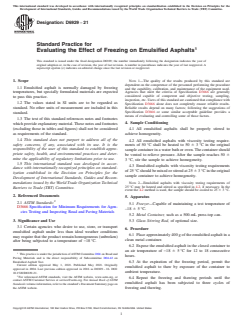


ASTM D6929-21 - Standard Practice for Evaluating the Effect of Freezing on Emulsified Asphalts
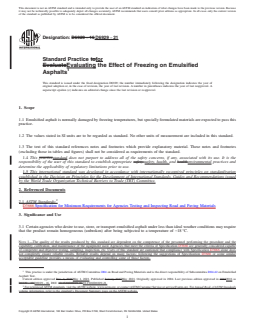
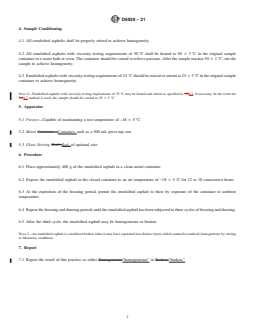


REDLINE ASTM D6929-21 - Standard Practice for Evaluating the Effect of Freezing on Emulsified Asphalts
Overview
ASTM D6929-21: Standard Practice for Evaluating the Effect of Freezing on Emulsified Asphalts is an internationally recognized guideline developed by ASTM International. This standard specifies procedures to assess whether emulsified asphalt remains stable and homogeneous after exposure to freezing temperatures, specifically at −18 °C. Emulsified asphalt, commonly used in road construction and paving, is typically sensitive to freezing; however, special formulations are expected to withstand such adverse conditions. The method outlined assists agencies and stakeholders in determining the suitability of emulsified asphalt for use, storage, or transport in cold weather environments.
Key Topics
- Emulsified Asphalt Stability: The standard focuses on the ability of emulsified asphalts to maintain homogeneity following repeated cycles of freezing and thawing.
- Freeze-Thaw Evaluation: The procedure involves subjecting asphalt samples to three cycles of freezing at −18 ± 5°C, followed by thawing at ambient temperature, simulating real-world handling and storage conditions in cold climates.
- Reporting Results: After testing, the product is reported as either “homogeneous” (stable) or “broken” (separated into layers that cannot be remixed).
- Quality Assurance: The reliability of results depends on competent laboratory practices, proper calibration of equipment, and adherence to related standards, such as ASTM D3666 for testing and inspection agencies.
- Safety and Environmental Considerations: Users are responsible for establishing safe practices and meeting regulatory requirements when implementing this standard.
Applications
- Transport and Storage: Ensures that emulsified asphalt can be reliably transported or stored in regions where sub-zero temperatures are likely, reducing risk of material waste and ensuring product performance.
- Procurement Specifications: Used by governmental agencies, contractors, and material suppliers to specify quality requirements for emulsified asphalt intended for cold-weather applications.
- Quality Control: Laboratories and quality control units use this standard to verify that particular asphalt formulations are resilient to freeze-thaw cycles prior to approval for field use.
- Research and Development: Provides a benchmark for developing new or improved emulsified asphalt products that need freeze-thaw resistance.
Related Standards
- ASTM D3666 - Specification for Minimum Requirements for Agencies Testing and Inspecting Road and Paving Materials: Establishes competence and procedural guidelines for laboratories performing tests under ASTM standards.
- ASTM Standards for Emulsified Asphalts: Various related ASTM standards set requirements for specific types of emulsified asphalts and testing methods.
- World Trade Organization TBT Principles: ASTM D6929-21 was developed adhering to globally recognized principles for international standards, facilitating fair trade and regulatory compatibility.
Keywords: ASTM D6929-21, emulsified asphalt, freezing, freeze-thaw stability, asphalt testing, road materials, cold-weather asphalt, homogeneity, ASTM standards, asphalt storage, asphalt transport, quality control
Relations
- Effective Date
- 01-Oct-2016
- Effective Date
- 01-Dec-2013
- Effective Date
- 01-Dec-2011
- Effective Date
- 01-Dec-2009
- Effective Date
- 01-Aug-2007
- Effective Date
- 01-Aug-2007
- Effective Date
- 15-Jan-2007
- Effective Date
- 15-Jan-2007
- Effective Date
- 15-Jan-2007
- Effective Date
- 01-Jun-2006
- Effective Date
- 01-Jun-2005
- Effective Date
- 01-Feb-2005
- Effective Date
- 01-Aug-2004
- Effective Date
- 01-Dec-2003
- Effective Date
- 10-Jul-2003
Buy Documents
ASTM D6929-21 - Standard Practice for Evaluating the Effect of Freezing on Emulsified Asphalts
REDLINE ASTM D6929-21 - Standard Practice for Evaluating the Effect of Freezing on Emulsified Asphalts
Get Certified
Connect with accredited certification bodies for this standard

Zavod za gradbeništvo Slovenije (ZAG) - Inšpekcija
ZAG inspection body for construction products, structures, and materials.
Sponsored listings
Frequently Asked Questions
ASTM D6929-21 is a standard published by ASTM International. Its full title is "Standard Practice for Evaluating the Effect of Freezing on Emulsified Asphalts". This standard covers: SIGNIFICANCE AND USE 3.1 Certain agencies who desire to use, store, or transport emulsified asphalt under less than ideal weather conditions may require that the product remain homogeneous (unbroken) after being subjected to a temperature of −18 °C. Note 1: The quality of the results produced by this standard are dependent on the competence of the personnel performing the procedure and the capability, calibration, and maintenance of the equipment used. Agencies that meet the criteria of Specification D3666 are generally considered capable of competent and objective testing, sampling, inspection, etc. Users of this standard are cautioned that compliance with Specification D3666 alone does not completely ensure reliable results. Reliable results depend on many factors; following the suggestions of Specification D3666 or some similar acceptable guideline provides a means of evaluating and controlling some of those factors. SCOPE 1.1 Emulsified asphalt is normally damaged by freezing temperatures, but specially formulated materials are expected to pass this practice. 1.2 The values stated in SI units are to be regarded as standard. No other units of measurement are included in this standard. 1.3 The text of this standard references notes and footnotes which provide explanatory material. These notes and footnotes (excluding those in tables and figures) shall not be considered as requirements of the standard. 1.4 This standard does not purport to address all of the safety concerns, if any, associated with its use. It is the responsibility of the user of this standard to establish appropriate safety, health, and environmental practices and determine the applicability of regulatory limitations prior to use. 1.5 This international standard was developed in accordance with internationally recognized principles on standardization established in the Decision on Principles for the Development of International Standards, Guides and Recommendations issued by the World Trade Organization Technical Barriers to Trade (TBT) Committee.
SIGNIFICANCE AND USE 3.1 Certain agencies who desire to use, store, or transport emulsified asphalt under less than ideal weather conditions may require that the product remain homogeneous (unbroken) after being subjected to a temperature of −18 °C. Note 1: The quality of the results produced by this standard are dependent on the competence of the personnel performing the procedure and the capability, calibration, and maintenance of the equipment used. Agencies that meet the criteria of Specification D3666 are generally considered capable of competent and objective testing, sampling, inspection, etc. Users of this standard are cautioned that compliance with Specification D3666 alone does not completely ensure reliable results. Reliable results depend on many factors; following the suggestions of Specification D3666 or some similar acceptable guideline provides a means of evaluating and controlling some of those factors. SCOPE 1.1 Emulsified asphalt is normally damaged by freezing temperatures, but specially formulated materials are expected to pass this practice. 1.2 The values stated in SI units are to be regarded as standard. No other units of measurement are included in this standard. 1.3 The text of this standard references notes and footnotes which provide explanatory material. These notes and footnotes (excluding those in tables and figures) shall not be considered as requirements of the standard. 1.4 This standard does not purport to address all of the safety concerns, if any, associated with its use. It is the responsibility of the user of this standard to establish appropriate safety, health, and environmental practices and determine the applicability of regulatory limitations prior to use. 1.5 This international standard was developed in accordance with internationally recognized principles on standardization established in the Decision on Principles for the Development of International Standards, Guides and Recommendations issued by the World Trade Organization Technical Barriers to Trade (TBT) Committee.
ASTM D6929-21 is classified under the following ICS (International Classification for Standards) categories: 93.080.20 - Road construction materials. The ICS classification helps identify the subject area and facilitates finding related standards.
ASTM D6929-21 has the following relationships with other standards: It is inter standard links to ASTM D3666-16, ASTM D3666-13, ASTM D3666-11, ASTM D3666-09a, ASTM D3666-07a, ASTM D3666-07ae1, ASTM D3666-07e2, ASTM D3666-07e1, ASTM D3666-07, ASTM D3666-06, ASTM D3666-05a, ASTM D3666-05, ASTM D3666-04, ASTM D3666-03a, ASTM D3666-03. Understanding these relationships helps ensure you are using the most current and applicable version of the standard.
ASTM D6929-21 is available in PDF format for immediate download after purchase. The document can be added to your cart and obtained through the secure checkout process. Digital delivery ensures instant access to the complete standard document.
Standards Content (Sample)
This international standard was developed in accordance with internationally recognized principles on standardization established in the Decision on Principles for the
Development of International Standards, Guides and Recommendations issued by the World Trade Organization Technical Barriers to Trade (TBT) Committee.
Designation: D6929 −21
Standard Practice for
Evaluating the Effect of Freezing on Emulsified Asphalts
This standard is issued under the fixed designation D6929; the number immediately following the designation indicates the year of
original adoption or, in the case of revision, the year of last revision. A number in parentheses indicates the year of last reapproval. A
superscript epsilon (´) indicates an editorial change since the last revision or reapproval.
NOTE 1—The quality of the results produced by this standard are
1. Scope
dependent on the competence of the personnel performing the procedure
1.1 Emulsified asphalt is normally damaged by freezing
and the capability, calibration, and maintenance of the equipment used.
temperatures, but specially formulated materials are expected Agencies that meet the criteria of Specification D3666 are generally
considered capable of competent and objective testing, sampling,
to pass this practice.
inspection, etc. Users of this standard are cautioned that compliance with
1.2 The values stated in SI units are to be regarded as
Specification D3666 alone does not completely ensure reliable results.
standard. No other units of measurement are included in this Reliable results depend on many factors; following the suggestions of
Specification D3666 or some similar acceptable guideline provides a
standard.
means of evaluating and controlling some of those factors.
1.3 The text of this standard references notes and footnotes
4. Sample Conditioning
which provide explanatory material.These notes and footnotes
(excluding those in tables and figures) shall not be considered
4.1 All emulsified asphalts shall be properly stirred to
as requirements of the standard.
achieve homogeneity.
1.4 This standard does not purport to address all of the
4.2 All emulsified asphalts with viscosity testing require-
safety concerns, if any, associated with its use. It is the
ments of 50 °C shall be heated to 50 6 3 °C in the original
responsibility of the user of this standard to establish appro-
sample container in a water bath or oven.The container should
priate safety, health, and environmental practices and deter-
be vented to relieve pressure. After the sample reaches 50 6
mine the applicability of regulatory limitations prior to use.
3 °C, stir the sample to achieve homogeneity.
1.5 This international standard was developed in accor-
4.3 Emulsified asphalts with viscosity testing requirements
dance with internationally recognized principles on standard-
of25 °Cshouldbemixedorstirredat25 63 °Cintheoriginal
ization established in the Decision on Principles for the
sample container to achieve homogeneity.
Development of International Standards, Guides and Recom-
NOTE 2—Emulsified asphalts with viscosity testing requirements of
mendations issued by the World Trade Organization Technical
25 °C may be heated and stirred as specified in 4.2, if necessary. In the
Barriers to Trade (TBT) Committee.
event the 4.2 method is used, the sample should be cooled to 25 6 3 °C.
2. Referenced Documents
5. Apparatus
2.1 ASTM Standards:
5.1 Freezer—Capable of maintaining a test temperature of
D3666 Specification for Minimum Requirements for Agen-
–18 6 5 °C.
cies Testing and Inspecting Road and Paving Materials
5.2 M
...
This document is not an ASTM standard and is intended only to provide the user of an ASTM standard an indication of what changes have been made to the previous version. Because
it may not be technically possible to adequately depict all changes accurately, ASTM recommends that users consult prior editions as appropriate. In all cases only the current version
of the standard as published by ASTM is to be considered the official document.
Designation: D6929 − 16 D6929 − 21
Standard Practice tofor
EvaluateEvaluating the Effect of Freezing on Emulsified
Asphalts
This standard is issued under the fixed designation D6929; the number immediately following the designation indicates the year of
original adoption or, in the case of revision, the year of last revision. A number in parentheses indicates the year of last reapproval. A
superscript epsilon (´) indicates an editorial change since the last revision or reapproval.
1. Scope
1.1 Emulsified asphalt is normally damaged by freezing temperatures, but specially formulated materials are expected to pass this
practice.
1.2 The values stated in SI units are to be regarded as standard. No other units of measurement are included in this standard.
1.3 The text of this standard references notes and footnotes which provide explanatory material. These notes and footnotes
(excluding those in tables and figures) shall not be considered as requirements of the standard.
1.4 This practicestandard does not purport to address all of the safety concerns, if any, associated with its use. It is the
responsibility of the user of this standard to establish appropriate safety safety, health, and healthenvironmental practices and
determine the applicability of regulatory limitations prior to use.
1.5 This international standard was developed in accordance with internationally recognized principles on standardization
established in the Decision on Principles for the Development of International Standards, Guides and Recommendations issued
by the World Trade Organization Technical Barriers to Trade (TBT) Committee.
2. Referenced Documents
2.1 ASTM Standards:
D3666 Specification for Minimum Requirements for Agencies Testing and Inspecting Road and Paving Materials
3. Significance and Use
3.1 Certain agencies who desire to use, store, or transport emulsified asphalt under less than ideal weather conditions may require
that the product remain homogeneous (unbroken) after being subjected to a temperature of −18 °C.
NOTE 1—The quality of the results produced by this standard are dependent on the competence of the personnel performing the procedure and the
capability, calibration, and maintenance of the equipment used. Agencies that meet the criteria of Specification D3666 are generally considered capable
of competent and objective testing, sampling, inspection, etc. Users of this standard are cautioned that compliance with Specification D3666 alone does
not completely ensure reliable results. Reliable results depend on many factors; following the suggestions of Specification D3666 or some similar
acceptable guideline provides a means of evaluating and controlling some of those factors.
This practice is under the jurisdiction of ASTM Committee D04 on Road and Paving Materials and is the direct responsibility of Subcommittee D04.42 on Emulsified
Asphalt Test.
Current edition approved Dec. 1, 2016May 1, 2021. Published January 2017May 2021. Originally approved in 2004. Last previous edition approved in 20102016 as
D6929 – 10.D6929 – 16. DOI: 10.1520/D6929-16.10.1520/D6929-21.
For referenced ASTM standards, visit the ASTM website, www.astm.org, or contact ASTM Customer Service at service@astm.org. For Annual Book of ASTM Standards
volume information, refer to the standard’s Document S
...