

ASTM F2236-16a
(Specification)Standard Consumer Safety Specification for Soft Infant and Toddler Carriers
General Information
- Abstract
SCOPE
1.1 This consumer safety specification establishes performance requirements, test methods and marking requirements to promote safe use of soft infant and toddler carriers.
1.2 This consumer safety specification is intended to minimize the risk of incidents to an infant from the normal use and reasonably foreseeable misuse of these products.
1.3 For purposes of definition, a soft infant and toddler carrier is a product, normally of sewn fabric construction, which is designed to contain a full term infant to a toddler, generally in an upright position, in close proximity to the caregiver. In general, the child will weigh between 7 and 45 lb (3.2 and 22 kg). The soft infant and toddler carrier is normally “worn” by the caregiver with a child positioned in the carrier and the weight of the child and carrier suspended from one or both shoulders of the caregiver. These products may be worn on the front, side, or back of the caregiver's body with the infant either facing towards or away from the caregiver. This consumer safety specification does not include products generally referred to as “slings.”
1.4 No soft infant and toddler carrier produced after the approval date of this consumer safety specification shall, either by label or other means, indicate compliance with the specification unless it complies with all of the requirements contained herein.
1.5 This consumer safety specification is not intended to address incidents and injuries resulting from the interaction of other persons or objects with the caregiver and infant while the soft carrier is in use.
1.6 The values stated in inch-pound units are to be regarded as standard. The values given in parentheses are mathematical conversions to SI units that are provided for information only and are not considered standard.
1.7 The following precautionary caveat pertains only to the test method portion, Section 7 of this consumer safety specification. This standard does not purport to address all of the safety concerns, if any, associated with its use. It is the responsibility of the user of this standard to establish appropriate safety and health practices and determine the applicability of regulatory requirements prior to use.
- Status
- Published
- Publication Date
- 31-Aug-2016
- Technical Committee
- F15 - Consumer Products
- Drafting Committee
- F15.21 - Infant Carriers, Bouncers and Baby Swings
Buy Documents
ASTM F2236-16a - Standard Consumer Safety Specification for Soft Infant and Toddler Carriers
REDLINE ASTM F2236-16a - Standard Consumer Safety Specification for Soft Infant and Toddler Carriers
Overview
ASTM F2236-16a – Standard Consumer Safety Specification for Soft Infant and Toddler Carriers establishes essential safety, performance, and labeling requirements for soft carriers designed to hold infants and toddlers. Developed by ASTM International, this standard aims to reduce potential hazards during typical use and foreseeable misuse, improve caregiver awareness, and ensure safer products enter the market. The specification is widely referenced by manufacturers, regulators, and consumer product safety organizations to support compliance, risk management, and promote safer child transportation solutions.
Key Topics
Scope and Definitions
The standard applies to soft infant and toddler carriers-typically sewn fabric products designed to support children weighing between 7 and 45 lb (3.2 to 22 kg). These carriers are worn by caregivers and can be used in various positions (front, side, or back), with the child facing towards or away from the caregiver. The standard excludes "sling" types.Performance Requirements
Addressing mechanical integrity, the standard specifies:- Structural tests for dynamic and static loads to ensure the carrier and its fasteners withstand repeated use
- Limits on leg opening sizes and fastener slippage to prevent falls
- Restrictions on hazardous sharp points, small parts, and flammable fabrics in accordance with related federal regulations
Warning Labeling and Marking
Carriers must feature clear, legible, and permanent warning labels. Essential statements must address fall and suffocation hazards, with instructional information on proper positioning and usage. The warning label format, font size, contrast, and content are strictly regulated.Instructional Literature
Assembly, usage, cleaning, and maintenance instructions must accompany each product. Warnings and critical safety information must be included, guiding users on proper carrier use, inspection, and limitations for occupant positioning.
Applications
Practical Uses for ASTM F2236-16a:
Product Design and Manufacturing:
Manufacturers utilize this standard to guide development, materials selection, and safety testing for soft infant and toddler carriers, ensuring products meet recognized safety benchmarks before reaching consumers.Compliance and Regulatory Review:
Regulatory agencies and third-party laboratories employ ASTM F2236-16a as a reference for product certification, market entry, and recall analysis. Adherence helps companies demonstrate compliance with both voluntary and mandatory safety programs.Retail and Procurement:
Retailers and purchasing agents reference this standard in their supplier criteria and quality assurance processes, supporting the selection of safe, market-ready infant carriers.Consumer Safety Education:
The specification’s labeling and instruction requirements contribute to improved consumer understanding of product risks, proper usage, and maintenance, reducing the likelihood of accidents and injuries.
Related Standards
ASTM F2236-16a frequently interacts with the following standards and regulations to ensure holistic safety:
- ASTM F963: Consumer Safety Specification for Toy Safety
- ASTM F977: Consumer Safety Specification for Infant Walkers
- 16 CFR 1303: Ban on Lead-Containing Paint in Consumer Products
- 16 CFR 1610: Standard for the Flammability of Clothing Textiles
- 16 CFR 1500 & 1501: Hazardous Substance, Flammable Solids, Sharp Points/Edges, and Small Parts Regulations
By referencing or integrating these related documents, manufacturers and safety professionals strengthen product risk management and regulatory alignment.
Keywords: ASTM F2236, soft infant carrier, toddler carrier, consumer safety, carrier labeling, load testing, product compliance, caregiver safety, baby carrier standard, child fall prevention.
Relations
- Effective Date
- 01-Sep-2016
- Effective Date
- 01-Aug-2023
- Effective Date
- 01-Aug-2016
- Effective Date
- 01-May-2012
- Effective Date
- 01-Dec-2011
- Effective Date
- 01-Dec-2011
- Effective Date
- 26-Sep-2011
- Effective Date
- 01-Nov-2009
- Effective Date
- 01-Jun-2009
- Effective Date
- 01-Dec-2008
- Effective Date
- 01-Nov-2007
- Effective Date
- 01-Apr-2007
- Effective Date
- 15-Mar-2007
- Effective Date
- 01-Oct-2003
- Effective Date
- 10-Mar-2003
Buy Documents
ASTM F2236-16a - Standard Consumer Safety Specification for Soft Infant and Toddler Carriers
REDLINE ASTM F2236-16a - Standard Consumer Safety Specification for Soft Infant and Toddler Carriers
Frequently Asked Questions
ASTM F2236-16a is a technical specification published by ASTM International. Its full title is "Standard Consumer Safety Specification for Soft Infant and Toddler Carriers". This standard covers: SCOPE 1.1 This consumer safety specification establishes performance requirements, test methods and marking requirements to promote safe use of soft infant and toddler carriers. 1.2 This consumer safety specification is intended to minimize the risk of incidents to an infant from the normal use and reasonably foreseeable misuse of these products. 1.3 For purposes of definition, a soft infant and toddler carrier is a product, normally of sewn fabric construction, which is designed to contain a full term infant to a toddler, generally in an upright position, in close proximity to the caregiver. In general, the child will weigh between 7 and 45 lb (3.2 and 22 kg). The soft infant and toddler carrier is normally “worn” by the caregiver with a child positioned in the carrier and the weight of the child and carrier suspended from one or both shoulders of the caregiver. These products may be worn on the front, side, or back of the caregiver's body with the infant either facing towards or away from the caregiver. This consumer safety specification does not include products generally referred to as “slings.” 1.4 No soft infant and toddler carrier produced after the approval date of this consumer safety specification shall, either by label or other means, indicate compliance with the specification unless it complies with all of the requirements contained herein. 1.5 This consumer safety specification is not intended to address incidents and injuries resulting from the interaction of other persons or objects with the caregiver and infant while the soft carrier is in use. 1.6 The values stated in inch-pound units are to be regarded as standard. The values given in parentheses are mathematical conversions to SI units that are provided for information only and are not considered standard. 1.7 The following precautionary caveat pertains only to the test method portion, Section 7 of this consumer safety specification. This standard does not purport to address all of the safety concerns, if any, associated with its use. It is the responsibility of the user of this standard to establish appropriate safety and health practices and determine the applicability of regulatory requirements prior to use.
SCOPE 1.1 This consumer safety specification establishes performance requirements, test methods and marking requirements to promote safe use of soft infant and toddler carriers. 1.2 This consumer safety specification is intended to minimize the risk of incidents to an infant from the normal use and reasonably foreseeable misuse of these products. 1.3 For purposes of definition, a soft infant and toddler carrier is a product, normally of sewn fabric construction, which is designed to contain a full term infant to a toddler, generally in an upright position, in close proximity to the caregiver. In general, the child will weigh between 7 and 45 lb (3.2 and 22 kg). The soft infant and toddler carrier is normally “worn” by the caregiver with a child positioned in the carrier and the weight of the child and carrier suspended from one or both shoulders of the caregiver. These products may be worn on the front, side, or back of the caregiver's body with the infant either facing towards or away from the caregiver. This consumer safety specification does not include products generally referred to as “slings.” 1.4 No soft infant and toddler carrier produced after the approval date of this consumer safety specification shall, either by label or other means, indicate compliance with the specification unless it complies with all of the requirements contained herein. 1.5 This consumer safety specification is not intended to address incidents and injuries resulting from the interaction of other persons or objects with the caregiver and infant while the soft carrier is in use. 1.6 The values stated in inch-pound units are to be regarded as standard. The values given in parentheses are mathematical conversions to SI units that are provided for information only and are not considered standard. 1.7 The following precautionary caveat pertains only to the test method portion, Section 7 of this consumer safety specification. This standard does not purport to address all of the safety concerns, if any, associated with its use. It is the responsibility of the user of this standard to establish appropriate safety and health practices and determine the applicability of regulatory requirements prior to use.
ASTM F2236-16a is classified under the following ICS (International Classification for Standards) categories: 97.190 - Equipment for children. The ICS classification helps identify the subject area and facilitates finding related standards.
ASTM F2236-16a has the following relationships with other standards: It is inter standard links to ASTM F2236-16, ASTM F963-23, ASTM F963-16, ASTM F977-12, ASTM F977-11b, ASTM F963-11, ASTM F977-11a, ASTM F977-09, ASTM D3359-09e1, ASTM F963-08, ASTM D3359-07, ASTM F977-07, ASTM F963-07e1, ASTM F963-03, ASTM F977-03. Understanding these relationships helps ensure you are using the most current and applicable version of the standard.
ASTM F2236-16a is available in PDF format for immediate download after purchase. The document can be added to your cart and obtained through the secure checkout process. Digital delivery ensures instant access to the complete standard document.
Standards Content (Sample)
This international standard was developed in accordance with internationally recognized principles on standardization established in the Decision on Principles for the
Development of International Standards, Guides and Recommendations issued by the World Trade Organization Technical Barriers to Trade (TBT) Committee.
Designation: F2236 −16a
Standard Consumer Safety Specification for
Soft Infant and Toddler Carriers
This standard is issued under the fixed designation F2236; the number immediately following the designation indicates the year of
original adoption or, in the case of revision, the year of last revision.Anumber in parentheses indicates the year of last reapproval.A
superscript epsilon (´) indicates an editorial change since the last revision or reapproval.
INTRODUCTION
This consumer safety specification is intended to address incidents reported by the U.S. Consumer
Product Safety Commission (CPSC) relating to soft infant carriers.
In response to the incident data compiled by the CPSC, this consumer safety specification attempts
tominimizethehazardsassociatedwiththeseproductsfromthefollowing:(1)occupantretention,(2)
structuralintegrity,(3)deficiencyofconsumereducationregardingproductuse.Thisconsumersafety
specification is intended to deal with reasonably foreseeable use and misuse of the products. This
consumer safety specification does not apply to products that are blatantly misused, nor does it apply
to products used by consumers in a careless manner that violate normal practice or disregard the
instructions or warnings provided with the product, or both.
1. Scope 1.5 This consumer safety specification is not intended to
address incidents and injuries resulting from the interaction of
1.1 This consumer safety specification establishes perfor-
otherpersonsorobjectswiththecaregiverandinfantwhilethe
mancerequirements,testmethodsandmarkingrequirementsto
soft carrier is in use.
promote safe use of soft infant and toddler carriers.
1.6 The values stated in inch-pound units are to be regarded
1.2 This consumer safety specification is intended to mini-
as standard. The values given in parentheses are mathematical
mize the risk of incidents to an infant from the normal use and
conversions to SI units that are provided for information only
reasonably foreseeable misuse of these products.
and are not considered standard.
1.3 For purposes of definition, a soft infant and toddler
1.7 The following precautionary caveat pertains only to the
carrier is a product, normally of sewn fabric construction,
test method portion, Section 7 of this consumer safety speci-
which is designed to contain a full term infant to a toddler,
fication. This standard does not purport to address all of the
generally in an upright position, in close proximity to the
safety concerns, if any, associated with its use. It is the
caregiver. In general, the child will weigh between 7 and 45 lb
responsibility of the user of this standard to establish appro-
(3.2 and 22 kg). The soft infant and toddler carrier is normally
priate safety and health practices and determine the applica-
“worn” by the caregiver with a child positioned in the carrier
bility of regulatory requirements prior to use.
and the weight of the child and carrier suspended from one or
both shoulders of the caregiver. These products may be worn
2. Referenced Documents
on the front, side, or back of the caregiver’s body with the
2.1 ASTM Standards:
infant either facing towards or away from the caregiver. This
D3359Test Methods for Measuring Adhesion by Tape Test
consumer safety specification does not include products gen-
F963Consumer Safety Specification for Toy Safety
erally referred to as “slings.”
F977Consumer Safety Specification for Infant Walkers
1.4 No soft infant and toddler carrier produced after the
2.2 Federal Regulations:
approvaldateofthisconsumersafetyspecificationshall,either
16 CFR 1303Ban of Lead-Containing Paint and Certain
by label or other means, indicate compliance with the specifi-
Consumer Products Bearing Lead-Containing Paint
cationunlessitcomplieswithalloftherequirementscontained
16 CFR 1500Hazardous Substance Act Regulations
herein.
1 2
This consumer safety specification is under the jurisdiction ofASTM Commit- For referenced ASTM standards, visit the ASTM website, www.astm.org, or
tee F15 on Consumer Products and is the direct responsibility of Subcommittee contact ASTM Customer Service at service@astm.org. For Annual Book of ASTM
F15.21 on Infant Carriers, Bouncers and Baby Swings. Standards volume information, refer to the standard’s Document Summary page on
Current edition approved Sept. 1, 2016. Published September 2016. Originally the ASTM website.
approved in 2003. Last previous edition approved in 2016 as F2236–16. DOI: Code of Federal Regulations, available from U.S. Government Printing Office,
10.1520/F2236-16A. Washington, DC 20402.
Copyright © ASTM International, 100 Barr Harbor Drive, PO Box C700, West Conshohocken, PA 19428-2959. United States
F2236 − 16a
16 CFR 1500.3(c)(6)(vi)Definition of “Flammable Solid” 3.1.11 paper label—any label material which tears without
16 CFR 1500.44Method for Determining Extremely Flam- the aid of tools and leaves a fibrous edge.
mable and Flammable Solids
3.1.12 primary load bearing fastener—any fastener which
16 CFR 1500.48Technical Requirements for Determining a
provides support for the child or is used to attach that support
SharpPointinToysorOtherArticlesIntendedforUseBy
ofthechildtothecaregiver,orboth,thatissubjecttothedirect
Children Under Eight Years of Age
forceoftheoccupantload,includingthosefastenersassociated
16 CFR 1500.49Technical Requirements for Determining a
with positioning or supporting the child’s torso within the
Sharp Metal or Glass Edge in Toys or Other Articles
carrier.
Intended for Use By Children Under Eight Years of Age
3.1.13 seam—means of joining fabric components, such as
16 CFR 1500.50-.51Test Methods for Simulating Use and
sewing, welding, heat sealing, or gluing.
Abuse of Toys and Other Articles for Use by Children
3.1.14 secondary load bearing fastener—any fastener
16 CFR 1501Method for Identifying Toys and Other Ar-
which provides aid to the wearer for positioning primary load
ticles Intended for Use by Children Under ThreeYears of
bearing components (for example, sternum strap fasteners).
Age Which Present Choking, Aspiration or Ingestion
Suchfastenersaresubjecttoforceslessthanthoseexhibitedby
Hazards Because of Small Parts
the direct occupant load in intended/foreseeable use.
16 CFR 1610Standard for the Flammability of Clothing
Textiles 3.1.15 static load—vertically downward force applied by a
calibrated force gage or by dead weights.
3. Terminology
3.1.16 unbounded leg opening—leg opening created by
3.1 Definitions:
placing the soft carrier on a caregiver’s torso and which has an
3.1.1 carrying position—the location on the caregiver’s
opening circumference composed solely of carrier materials
torso where the child is supported by the soft carrier.The most
and the caregiver’s torso.
common carrying positions are front, back, and side/hip.
4. Calibration and Standardization
3.1.2 conspicuous—label which is visible when the product
is in the manufacturer’s use position to a caregiver who is
4.1 The product shall be completely assembled in accor-
placing the occupant in the soft carrier or when the caregiver
dance with the manufacturer’s instructions.
places the product on his or her body.
4.2 No testing shall be conducted within 48 h of manufac-
3.1.3 cord—length of slender, flexible material including
ture.
monofilaments,rope,wovenandtwistedcord,plasticortextile
4.3 Theproducttobetestedshallbeatanambienttempera-
tapes, ribbons and those fibrous materials commonly called
ture of 73 6 9°F (23 6 5°C) for at least one hour before
string.
testing.Alltestingshallbeconductedinthistemperaturerange.
3.1.4 dynamic load—application of impulsive force through
4.4 All testing required by this consumer safety specifica-
free fall of a weight.
tion shall be conducted on the same unit in the order presented
3.1.5 fabric—any woven, knit, coated, laminated, extruded
in this specification unless otherwise specified (see 7.2).
or calendared flexible material that is intended to be sewn,
welded, heat sealed, or glued together as an assembly. 5. General Requirements
3.1.6 fastener—mechanical means of attachment that may
5.1 Hazardous Sharp Points or Edges—There shall be no
also allow for adjustments of the product fit to wearer and
sharp points or edges as defined by 16 CFR 1500.48 and 16
occupant including, but not limited to, buckles, snaps, rings,
CFR 1500.49 before and after testing.
D-rings, hook-and-loop, etc., and excluding fabric-only means
5.2 Small Parts—Thereshallbenosmallpartsasdefinedby
of attachment and fit adjustment such as, but not limited to,
16CFR1501beforetestingorliberatedasaresultoftestingto
consumer-tied knots.
this specification.
3.1.7 leg opening—opening in the soft carrier through
5.3 Lead in Paint—The paint or surface coating on the
which the occupant’s legs extend when the product is used in
product shall comply with 16 CFR 1303.
the manufacturer’s recommended use position.
5.4 Wood Parts—Prior to testing, any wooden parts shall be
3.1.8 manufacturer’s recommended use position(s)—any
smooth and free of splinters.
position that is presented as a normal, allowable, or acceptable
configurationforuseoftheproductbythemanufacturerinany
5.5 Locking and Latching—Any product designed with a
descriptive or instructional literature. This specifically ex-
locking and latching device must remain in the manufacturer’s
cludes positions that the manufacturer shows in a like manner
recommended use position before and after completion of all
initsliteraturetobeunacceptable,unsafeornotrecommended.
tests in this standard.
3.1.9 non-paper label—anylabelmaterial(suchasplasticor
5.6 Labeling—Warning labels (whether paper or non paper)
metal) that either will not tear without the aid of tools or tears,
shall be permanent when tested per 7.3 – 7.5.
leaving a sharply defined edge.
5.6.1 Warning statements applied directly onto the surface
3.1.10 occupant—thatindividualwhoisplacedorcarriedin of the product by hot stamping, heat transfer, printing, wood
the soft carrier product in one of the manufacturer’s recom- burning, and so forth shall be permanent when tested in
mended use positions. accordance with 7.4.
F2236 − 16a
FIG. 1 Truncated Test Cone
5.6.2 Non-paper labels shall not liberate small parts when bearing fastener, shall not break or disengage, and adjustable
tested in accordance with 7.5. elements in straps shall not slip, in a manner that loosens the
strap, more than 1 in. (2.5 cm) when tested in accordance with
5.7 Flammability of Textile Products:
7.7.1 and 7.7.3.
5.7.1 There shall be no Class 2 or 3 fabrics used in the
construction of a soft infant and toddler carrier when the
NOTE 1—The requirements in 6.4 only apply to load bearing fasteners
andlegopeningadjustmentfasteners.Non-loadbearingfastenersintended
product is evaluated against the requirements of 16 CFR 1610.
to retain accessory items such as, but not limited to, sleeping hoods, bibs,
5.7.2 Ifasoftinfantandtoddlercarrierisincapableofbeing
toy rings etc., or fasteners which do not provide support or securement of
evaluatedtotherequirementsof16CFR1610duetoconstruc-
the child’s torso within the carrier (for example, head adjustment
tion characteristics, the product shall not be flammable as
fasteners) are exempt from these requirements.
defined under 16 CFR 1500.3(c)(6)(vi) when tested in accor-
dance with Consumer Safety Specification F963, Annex 5.
7. Test Methods
5.8 Toys—Toy accessories attached to, removable from, or
7.1 Leg Openings:
sold with a soft infant carrier, as well as their means of
7.1.1 Fasten the soft carrier to a rigid fixture in a manner
attachment, must meet applicable requirements of Consumer
such that the leg opening of the carrier is horizontal. The
Safety Specification F963.
openingshallbeasclosetothecenterofthefixtureaspossible.
If the leg opening is adjustable in size to allow for growth, it
6. Performance Requirements
shallbetestedwiththelegopeningadjustedtoitssmallestsize
6.1 Leg Openings—Leg openings shall not permit the pas-
as described in the manufacturer’s literature or instructions.
sage of the Leg Opening Test Sphere when tested in accor-
7.1.2 Placethelegopeningtestsphere(seeFig.2)insidethe
dance with 7.1.
carrierandgraduallyallowthespheretorestinthelegopening
overaperiodof5s.Allowthespheretorestintheopeningfor
6.2 Dynamic and Static Load:
an additional 1 min.
6.2.1 Structural Integrity—Dynamic and static load testing
7.1.3 Repeat the test for the other leg opening.
shall not result in a hazardous condition as defined in Section
5 or result in a structural failure such as fasteners breaking or
7.2 Dynamic and Static Load Tests—Thedynamicandstatic
disengaging, or seams separating when tested in accordance
tests in 7.2.1 and 7.2.2, respectively, shall be performed on the
with 7.2.1 and 7.2.2, respectively.
same product sample in each carrying position with a new
6.2.2 Support/Shoulder Strap Slippage—Adjustable sec-
product sample being tested for each different carrying posi-
tions of support/shoulder straps shall not slip, in a manner that
tion.Forexample,aproductthatmaybewornonthefrontand
loosens the strap, more than 1 in. (25 mm) per strap from their
back has two carrying positions therefore a minimum of two
original adjusted position after dynamic and static load testing
samples must be tested. One product sample shall be used for
is performed in accordance with 7.2.1 and 7.2.2, respectively.
thefrontcarryingpositiondynamicandstatictests,andanother
for the back carrying position dynamic and static tests.
6.3 Unbounded Leg Opening—Leg opening shall not allow
7.2.1 Dynamic Load Test:
complete passage of the truncated test cone (see Fig. 1) when
7.2.1.1 Equipment: (1) Shot Bag—6 to 8 in. (152 to 203
tested according to 7.6.
mm) diameter shot bag with total mass of 25 lbm (11.3 kg) or
6.4 Fastener Strength and Strap Retention:
a mass equal to the manufacturer’s recommended maximum
6.4.1 Each unique primary load bearing fastener shall not
occupant weight for the specific carrying position of the
break or disengage, and adjustable elements in straps shall not
product,whicheverisgreater.Aproductwithmultiplecarrying
slip,inamannerthatloosensthestrap,morethan1in.(2.5cm)
positions may have different manufacturer’s recommended
when tested in accordance with 7.7.1 and 7.7.2.
maximum weights for each carrying position.
6.4.2 Each unique fastener whose primary purpose is to
adjust the size of the leg opening, or is a secondary load NOTE 2—Solid, cylindrical weights (Olympic-sized barbell weight
F2236 − 16a
NOTE 1—Sphere shall be fabricated from a smooth, rigid material weighted to 5 lb (2.3 kg).
NOTE 2—Sphere is machined to 14.75 in. (374.6 mm) circumference.
FIG. 2 Leg Opening Test Sphere
plates,forexample)maybesecuredontopofthe25lbm(6.9kg)shotbag
the height location of the product on the test torso changes,
when a greater total mass is required.
adjust the test torso or product to maintain the 1 in. (25 mm)
(2) Test Torso — See Fig. 3.
drop height.
7.2.1.2 Position, secure, and adjust the soft carrier onto the
7.2.2 Static Load Test:
test torso according to the manufacturer’s instructions pro-
7.2.2.1 Equipment:
vided with the product.
(1) Standard Weld Cap—6 in. (150-mm) (see Fig. 4).
7.2.1.3 Position the shot bag a distance of 1 in. (25 mm)
(2) Test Torso —See Fig. 3.
abovetheseatofthesoftcarrier.Allowtheshotbagtofreefall
7.2.2.2 Position, secure, and adjust the soft carrier onto the
onto the seat ten times with a cycle time of 4 6 1 s/cycle to
testtorsoaccordingtothemanufacturer’sinstructionsprovided
preset the adjustment(s) of the carrier on the test torso. By
with the product.
some appropriate means, mark the position of all adjustment
7.2.2.3 Center the standard weld cap in the seat area of the
hardware. This will be the reference point for measuring
soft carrier. Place a total weight of 75 lbm (34 kg) or three
adjustment slippage in the test. Drop the shot bag onto the seat
times the manufacturer recommended maximum occupant
an additional 990 times with a cycle time of 4 6 1 s/cycle. If
weight for the specific carrying position, whichever is greater,
onto the weld cap. (Include the weight of the weld cap in the
The sole source of supply of the test torso (called “Body Opponent Bag”)
total weight.) Gradually apply the weight within a 5-s period
known to the committee at this time is Century Sporting Goods. It is available from
and maintain for an additional 1 min.
various distributors on websites such as www.superfoots.com ⁄cenbodopbagb,
www.karate-mart.com, and karatedepot.com. If you are aware of alternative
7.3 Permanency of Labels and Warnings:
suppliers, please provide this information to ASTM International Headquarters.
7.3.1 A paper label (excluding labels attached by a seam)
Your comments will receive careful consideration at a meeting of the responsible
technical committee, which you may attend. shall be considered permanent if during an attempt to remove
F2236 − 16a
NOTE 1—This figure illustrates typical device that is acceptable.
FIG. 3 Test Torso
it without the aid of tools or solvents, it cannot be removed, it failure using a ⁄4-in. (19-mm) diameter clamp surface. Gradu-
tears into pieces upon removal or such action damages the ally apply the force over 5 s and maintain for an additional 10
surface to which it is attached.
s.
7.3.2 A non-paper label
...
This document is not an ASTM standard and is intended only to provide the user of an ASTM standard an indication of what changes have been made to the previous version. Because
it may not be technically possible to adequately depict all changes accurately, ASTM recommends that users consult prior editions as appropriate. In all cases only the current version
of the standard as published by ASTM is to be considered the official document.
Designation: F2236 − 16 F2236 − 16a
Standard Consumer Safety Specification for
Soft Infant and Toddler Carriers
This standard is issued under the fixed designation F2236; the number immediately following the designation indicates the year of
original adoption or, in the case of revision, the year of last revision. A number in parentheses indicates the year of last reapproval. A
superscript epsilon (´) indicates an editorial change since the last revision or reapproval.
INTRODUCTION
This consumer safety specification is intended to address incidents reported by the U.S. Consumer
Product Safety Commission (CPSC) relating to soft infant carriers.
In response to the incident data compiled by the CPSC, this consumer safety specification attempts
to minimize the hazards associated with these products from the following: (1) occupant retention, (2)
structural integrity, (3) deficiency of consumer education regarding product use. This consumer safety
specification is intended to deal with reasonably foreseeable use and misuse of the products. This
consumer safety specification does not apply to products that are blatantly misused, nor does it apply
to products used by consumers in a careless manner that violate normal practice or disregard the
instructions or warnings provided with the product, or both.
1. Scope
1.1 This consumer safety specification establishes performance requirements, test methods and marking requirements to
promote safe use of soft infant and toddler carriers.
1.2 This consumer safety specification is intended to minimize the risk of incidents to an infant from the normal use and
reasonably foreseeable misuse of these products.
1.3 For purposes of definition, a soft infant and toddler carrier is a product, normally of sewn fabric construction, which is
designed to contain a full term infant to a toddler, generally in an upright position, in close proximity to the caregiver. In general,
the child will weigh between 7 and 45 lb (3.2 and 22 kg). The soft infant and toddler carrier is normally “worn” by the caregiver
with a child positioned in the carrier and the weight of the child and carrier suspended from one or both shoulders of the caregiver.
These products may be worn on the front, side, or back of the caregiver’s body with the infant either facing towards or away from
the caregiver. This consumer safety specification does not include products generally referred to as “slings.”
1.4 No soft infant and toddler carrier produced after the approval date of this consumer safety specification shall, either by label
or other means, indicate compliance with the specification unless it complies with all of the requirements contained herein.
1.5 This consumer safety specification is not intended to address incidents and injuries resulting from the interaction of other
persons or objects with the caregiver and infant while the soft carrier is in use.
1.6 The values stated in inch-pound units are to be regarded as standard. The values given in parentheses are mathematical
conversions to SI units that are provided for information only and are not considered standard.
1.7 The following precautionary caveat pertains only to the test method portion, Section 7 of this consumer safety specification.
This standard does not purport to address all of the safety concerns, if any, associated with its use. It is the responsibility of the
user of this standard to establish appropriate safety and health practices and determine the applicability of regulatory
requirements prior to use.
2. Referenced Documents
2.1 ASTM Standards:
D3359 Test Methods for Measuring Adhesion by Tape Test
This consumer safety specification is under the jurisdiction of ASTM Committee F15 on Consumer Products and is the direct responsibility of Subcommittee F15.21
on Infant Carriers, Bouncers and Baby Swings.
Current edition approved May 1, 2016Sept. 1, 2016. Published May 2016September 2016. Originally approved in 2003. Last previous edition approved in 20142016 as
F2236 – 14.F2236 – 16. DOI: 10.1520/F2236-16.10.1520/F2236-16A.
For referenced ASTM standards, visit the ASTM website, www.astm.org, or contact ASTM Customer Service at service@astm.org. For Annual Book of ASTM Standards
volume information, refer to the standard’s Document Summary page on the ASTM website.
Copyright © ASTM International, 100 Barr Harbor Drive, PO Box C700, West Conshohocken, PA 19428-2959. United States
F2236 − 16a
F963 Consumer Safety Specification for Toy Safety
F977 Consumer Safety Specification for Infant Walkers
2.2 Federal Regulations:
16 CFR 1303 Ban of Lead-Containing Paint and Certain Consumer Products Bearing Lead-Containing Paint
16 CFR 1500 Hazardous Substance Act Regulations
16 CFR 1500.3(c)(6)(vi) Definition of “Flammable Solid”
16 CFR 1500.44 Method for Determining Extremely Flammable and Flammable Solids
16 CFR 1500.48 Technical Requirements for Determining a Sharp Point in Toys or Other Articles Intended for Use By Children
Under Eight Years of Age
16 CFR 1500.49 Technical Requirements for Determining a Sharp Metal or Glass Edge in Toys or Other Articles Intended for
Use By Children Under Eight Years of Age
16 CFR 1500.50-.51 Test Methods for Simulating Use and Abuse of Toys and Other Articles for Use by Children
16 CFR 1501 Method for Identifying Toys and Other Articles Intended for Use by Children Under Three Years of Age Which
Present Choking, Aspiration or Ingestion Hazards Because of Small Parts
16 CFR 1610 Standard for the Flammability of Clothing Textiles
3. Terminology
3.1 Definitions:
3.1.1 carrying position—the location on the caregiver’s torso where the child is supported by the soft carrier. The most common
carrying positions are front, back, and side/hip.
3.1.2 conspicuous—label which is visible when the product is in the manufacturer’s use position to a caregiver who is placing
the occupant in the soft carrier or when the caregiver places the product on his or her body.
3.1.3 cord—length of slender, flexible material including monofilaments, rope, woven and twisted cord, plastic or textile tapes,
ribbons and those fibrous materials commonly called string.
3.1.4 dynamic load—application of impulsive force through free fall of a weight.
3.1.5 fabric—any woven, knit, coated, laminated, extruded or calendared flexible material that is intended to be sewn, welded,
heat sealed, or glued together as an assembly.
3.1.6 fastener—mechanical means of attachment that may also allow for adjustments of the product fit to wearer and occupant
including, but not limited to, buckles, snaps, rings, D-rings, hook-and-loop, etc., and excluding fabric-only means of attachment
and fit adjustment such as, but not limited to, consumer-tied knots.
3.1.7 leg opening—opening in the soft carrier through which the occupant’s legs extend when the product is used in the
manufacturer’s recommended use position.
3.1.8 manufacturer’s recommended use position(s)—any position that is presented as a normal, allowable, or acceptable
configuration for use of the product by the manufacturer in any descriptive or instructional literature. This specifically excludes
positions that the manufacturer shows in a like manner in its literature to be unacceptable, unsafe or not recommended.
3.1.9 non-paper label—any label material (such as plastic or metal) that either will not tear without the aid of tools or tears,
leaving a sharply defined edge.
3.1.10 occupant—that individual who is placed or carried in the soft carrier product in one of the manufacturer’s recommended
use positions.
3.1.11 paper label—any label material which tears without the aid of tools and leaves a fibrous edge.
3.1.12 primary load bearing fastener—any fastener used in the attachment of the product to the caregiver which provides
support for the child or is used to attach that support of the child to the caregiver, or both, that is subject to the direct force of the
occupant load, including those fasteners associated with positioning or supporting the child’s torso within the carrier.
3.1.13 seam—means of joining fabric components, such as sewing, welding, heat sealing, or gluing.
3.1.14 secondary load bearing fastener—any fastener used in the attachment of the product to the caregiver which provides aid
to the wearer for positioning primary load bearing components (for example, sternum strap fasteners). Such fasteners are subject
to forces less than those exhibited by the direct occupant load in intended/foreseeable use.
3.1.15 static load—vertically downward force applied by a calibrated force gage or by dead weights.
3.1.16 unbounded leg opening—leg opening created by placing the soft carrier on a caregiver’s torso and which has an opening
circumference composed solely of carrier materials and the caregiver’s torso.
Code of Federal Regulations, available from U.S. Government Printing Office, Washington, DC 20402.
F2236 − 16a
4. Calibration and Standardization
4.1 The product shall be completely assembled in accordance with the manufacturer’s instructions.
4.2 No testing shall be conducted within 48 h of manufacture.
4.3 The product to be tested shall be at an ambient temperature of 73 6 9°F (23 6 5°C) for at least one hour before testing.
All testing shall be conducted in this temperature range.
4.4 All testing required by this consumer safety specification shall be conducted on the same unit in the order presented in this
specification unless otherwise specified (see 7.2).
5. General Requirements
5.1 Hazardous Sharp Points or Edges—There shall be no sharp points or edges as defined by 16 CFR 1500.48 and 16 CFR
1500.49 before and after testing.
5.2 Small Parts—There shall be no small parts as defined by 16 CFR 1501 before testing or liberated as a result of testing to
this specification.
5.3 Lead in Paint—The paint or surface coating on the product shall comply with 16 CFR 1303.
5.4 Wood Parts—Prior to testing, any wooden parts shall be smooth and free of splinters.
5.5 Locking and Latching—Any product designed with a locking and latching device must remain in the manufacturer’s
recommended use position before and after completion of all tests in this standard.
5.6 Labeling—Warning labels (whether paper or non paper) shall be permanent when tested per 7.3 – 7.5.
5.6.1 Warning statements applied directly onto the surface of the product by hot stamping, heat transfer, printing, wood burning,
and so forth shall be permanent when tested in accordance with 7.4.
5.6.2 Non-paper labels shall not liberate small parts when tested in accordance with 7.5.
5.7 Flammability of Textile Products:
5.7.1 There shall be no Class 2 or 3 fabrics used in the construction of a soft infant and toddler carrier when the product is
evaluated against the requirements of 16 CFR 1610.
5.7.2 If a soft infant and toddler carrier is incapable of being evaluated to the requirements of 16 CFR 1610 due to construction
characteristics, the product shall not be flammable as defined under 16 CFR 1500.3(c)(6)(vi) when tested in accordance with
Consumer Safety Specification F963, Annex 5.
5.8 Toys—Toy accessories attached to, removable from, or sold with a soft infant carrier, as well as their means of attachment,
must meet applicable requirements of Consumer Safety Specification F963.
6. Performance Requirements
6.1 Leg Openings—Leg openings shall not permit the passage of the Leg Opening Test Sphere when tested in accordance with
7.1.
6.2 Dynamic and Static Load:
6.2.1 Structural Integrity—Dynamic and static load testing shall not result in a hazardous condition as defined in Section 5 or
result in a structural failure such as fasteners breaking or disengaging, or seams separating when tested in accordance with 7.2.1
and 7.2.2, respectively.
6.2.2 Support/Shoulder Strap Slippage—Adjustable sections of support/shoulder straps shall not slip, in a manner that loosens
the strap, more than 1 in. (25 mm) per strap from their original adjusted position after dynamic and static load testing is performed
in accordance with 7.2.1 and 7.2.2, respectively.
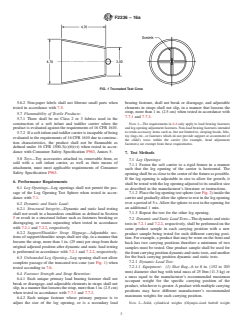
6.3 Unbounded Leg Opening—Leg opening shall not allow complete passage of the truncated test cone (see Fig. 1) when tested
according to 7.6.
6.4 Fastener Strength and Strap Retention:
6.4.1 Each unique primary load bearing fastener shall not break or disengage, and adjustable elements in straps shall not slip,
in a manner that loosens the strap, more than 1 in. (2.5 cm) when tested in accordance with 7.7.1 and 7.7.2.
6.4.2 Each unique fastener whose primary purpose is to adjust the size of the leg opening, or is a secondary load bearing
fastener, shall not break or disengage, and adjustable elements in straps shall not slip, in a manner that loosens the strap, more than
1 in. (2.5 cm) when tested in accordance with 7.7.1 and 7.7.3.
NOTE 1—The requirements in 6.4 only apply to load bearing fasteners and leg opening adjustment fasteners. Non-load bearing fasteners intended to
retain accessory items such as, but not limited to, sleeping hoods, bibs, toy rings etc., or fasteners which do not provide support or securement of the
child’s torso within the carrier (for example, head adjustment fasteners) are exempt from these requirements.
7. Test Methods
7.1 Leg Openings:
F2236 − 16a
FIG. 1 Truncated Test Cone
7.1.1 Fasten the soft carrier to a rigid fixture in a manner such that the leg opening of the carrier is horizontal. The opening shall
be as close to the center of the fixture as possible. If the leg opening is adjustable in size to allow for growth, it shall be tested
with the leg opening adjusted to its smallest size as described in the manufacturer’s literature or instructions.
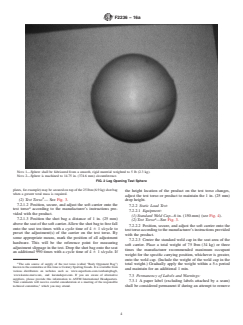
7.1.2 Place the leg opening test sphere (see Fig. 2) inside the carrier and gradually allow the sphere to rest in the leg opening
over a period of 5 s. Allow the sphere to rest in the opening for an additional 1 min.
7.1.3 Repeat the test for the other leg opening.
7.2 Dynamic and Static Load Tests—The dynamic and static tests in 7.2.1 and 7.2.2, respectively, shall be performed on the
same product sample in each carrying position with a new product sample being tested for each different carrying position. For
example, a product that may be worn on the front and back has two carrying positions therefore a minimum of two samples must
be tested. One product sample shall be used for the front carrying position dynamic and static tests, and another for the back
carrying position dynamic and static tests.
7.2.1 Dynamic Load Test:
7.2.1.1 Equipment: (1) Shot Bag—6 to 8 in. (152 to 203 mm) diameter shot bag with total mass of 25 lbm (11.3 kg) or a mass
equal to the manufacturer’s recommended maximum occupant weight for the specific carrying position of the product, whichever
is greater. A product with multiple carrying positions may have different manufacturer’s recommended maximum weights for each
carrying position.
NOTE 2—Solid, cylindrical weights (Olympic-sized barbell weight plates, for example) may be secured on top of the 25 lbm (6.9 kg) shot bag when
a greater total mass is required.
(2) Test Torso — See Fig. 3.
7.2.1.2 Position, secure, and adjust the soft carrier onto the test torso according to the manufacturer’s instructions provided with
the product.
7.2.1.3 Position the shot bag a distance of 1 in. (25 mm) above the seat of the soft carrier. Allow the shot bag to free fall onto
the seat ten times with a cycle time of 4 6 1 s/cycle to preset the adjustment(s) of the carrier on the test torso. By some appropriate
means, mark the position of all adjustment hardware. This will be the reference point for measuring adjustment slippage in the test.
Drop the shot bag onto the seat an additional 990 times with a cycle time of 4 6 1 s/cycle. If the height location of the product
on the test torso changes, adjust the test torso or product to maintain the 1 in. (25 mm) drop height.
7.2.2 Static Load Test:
7.2.2.1 Equipment:
(1) Standard Weld Cap—6 in. (150-mm) (see Fig. 4).
(2) Test Torso —See Fig. 3.
7.2.2.2 Position, secure, and adjust the soft carrier onto the test torso according to the manufacturer’s instructions provided with
the product.
7.2.2.3 Center the standard weld cap in the seat area of the soft carrier. Place a total weight of 75 lbm (34 kg) or three times
the manufacturer recommended maximum occupant weight for the specific carrying position, whichever is greater, onto the weld
cap. (Include the weight of the weld cap in the total weight.) Gradually apply the weight within a 5-s period and maintain for an
additional 1 min.
7.3 Permanency of Labels and Warnings:
The sole source of supply of the test torso (called “Body Opponent Bag”) known to the committee at this time is Century Sporting Goods. It is available from various
distributors on websites such as www.superfoots.com ⁄cenbodopbagb, www.karate-mart.com, and karatedepot.com. If you are aware of alternative suppliers, please provide
this information to ASTM International Headquarters. Your comments will receive careful consideration at a meeting of the responsible technical committee, which you may
attend.
F2236 − 16a
NOTE 1—Sphere shall be fabricated from a smooth, rigid material weighted to 5 lb (2.3 kg).
NOTE 2—Sphere is machined to 14.75 in. (374.6 mm) circumference.
FIG. 2 Leg Opening Test Sphere
7.3.1 A paper label (excluding labels attached by a seam) shall be considered permanent if during an attempt to remove it
without the aid of tools or solvents, it cannot be removed, it tears into pieces upon removal or such action damages the surface
to which it is attached.
7.3.2 A non-paper label (excluding labels attached by a seam) shall be considered permanent if, during an attempt to remove
it without the aid of tools or solv
...