

ASTM F736-17(2023)
(Test Method)Standard Test Method for Impact Resistance of Monolithic Polycarbonate Sheet by Means of a Falling Weight
General Information
- Abstract
SIGNIFICANCE AND USE
5.1 This test method is applicable for qualitatively evaluating coated and uncoated monolithic polycarbonate sheet material, for monitoring process control, for screening studies, and as an aid in the prediction of hardware performance when exposed to impact service conditions.
5.2 A limitation of Type A specimen testing is that a thick sheet may not fail since the available impact energy is limited by the maximum drop height and falling weight capacity of the test apparatus. Use Specimen Type A for material less than 12.7 mm (0.50 in.) thick.
5.3 Within the range of drop heights of this system, tests employing different velocities are not expected to produce different results. However, for a given series of tests, the drop height should be held constant so that velocity of impact (strain rate) will not be a variable.
5.4 As the polycarbonate specimen undergoes large plastic deformation under impact, the down (opposite impact) side is under tensile loading and most influential in initiating failure. For that reason, polycarbonate sheet coated on one side should be tested with the coated side down.
5.5 Direct comparison of specimen Type A and specimen Type B test results should not be attempted. For test programs that will require the comparison of interlaboratory test results the specimen type and the approximate drop height must be specified.
5.6 Monolithic polycarbonate sheet is notch sensitive. Data obtained from other test methods, particularly notched Izod/Charpy test results, and extremely high- or low-strain rate test results, should not be compared directly to data obtained from this method. It is noted that Type A specimens, free of flaws, have not experienced the characteristic ductile-to-brittle transition between thin, less than 3.18 mm (1/8 in.), and thick, greater than 7.94 mm (5/16 in.), sheet as reflected by other test methods.
SCOPE
1.1 This test method covers the determination of the energy required to initiate failure in monolithic polycarbonate sheet material under specified conditions of impact using a free falling weight.
1.2 Two specimen types are defined as follows:
1.2.1 Type A consists of a flat plate test specimen and employs a clamped ring support.
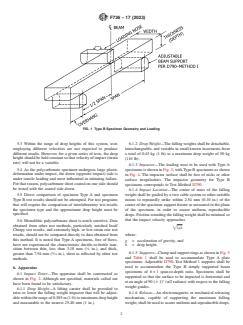
1.2.2 Type B consists of a simply supported three-point loaded beam specimen (Fig. 1) for use with material which can not be failed using the Type A specimen. For a maximum drop height of 6.096 m (20 ft) and a maximum drop weight of 22.68 kg (50 lb), virgin polycarbonate greater than 12.70 mm (1/2 in.) thick will require use of the Type B specimen.
Note 1: See also ASTM Methods: D1709, D2444 and D3029.
FIG. 1 Type B Specimen Geometry and Loading
1.3 The values stated in SI units are to be regarded as standard. No other units of measurement are included in this standard.
1.3.1 Exception—The inch-pound units in parentheses are provided for information only.
1.4 This standard does not purport to address all of the safety concerns, if any, associated with its use. It is the responsibility of the user of this standard to establish appropriate safety, health, and environmental practices and determine the applicability of regulatory limitations prior to use. For specific hazard statement, See Section 7.
1.5 This international standard was developed in accordance with internationally recognized principles on standardization established in the Decision on Principles for the Development of International Standards, Guides and Recommendations issued by the World Trade Organization Technical Barriers to Trade (TBT) Committee.
- Status
- Published
- Publication Date
- 31-Dec-2022
- Technical Committee
- F07 - Aerospace and Aircraft
- Drafting Committee
- F07.08 - Transparent Enclosures and Materials
Overview
ASTM F736-17(2023): Standard Test Method for Impact Resistance of Monolithic Polycarbonate Sheet by Means of a Falling Weight provides a systematic approach for determining the energy required to initiate failure in monolithic polycarbonate sheets under specified impact conditions. Developed by ASTM International, this standard is essential for evaluating both coated and uncoated polycarbonate materials, ensuring quality control, supporting product development, and predicting performance under impact service conditions. The method utilizes a falling weight apparatus to simulate real-life impact events, making it highly relevant for manufacturers, quality assurance professionals, and engineers working with polycarbonate products.
Key Topics
- Impact Resistance Evaluation: The standard specifies how to measure the energy needed to cause failure in polycarbonate sheets, using either flat plate (Type A) or beam (Type B) specimens.
- Specimen Types and Test Conditions:
- Type A Specimens: Suitable for polycarbonate less than 12.7 mm (0.50 in.) thick, using a clamped ring support.
- Type B Specimens: Used for thicker materials, especially when Type A cannot be failed, employing a three-point supportive beam configuration.
- Test Parameters: Critical variables such as drop height, drop weight, impact velocity, and specimen geometry are controlled to ensure consistent, repeatable results.
- Coating Considerations: When testing coated polycarbonate, the coated side should face downward, as it is under tension during impact-this minimizes premature failure due to coating properties.
- Limitations and Precautions: The test is not suitable for direct comparison with other impact test methods, such as notched Izod or Charpy, due to polycarbonate's notch sensitivity and differing failure mechanisms.
Applications
The ASTM F736-17(2023) standard is widely used in a variety of industrial and commercial applications, including:
- Product Development: Helps manufacturers evaluate new formulations and designs of polycarbonate sheets for enhanced impact resistance.
- Quality Control: Used for process monitoring and ensuring batch-to-batch consistency of impact performance in manufactured sheets.
- Screening and Material Selection: Enables quick screening of different polycarbonate grades or surface treatments to identify suitable candidates for specific impact environments.
- Predictive Performance Analysis: Provides valuable data to predict how polycarbonate hardware and products will behave under real-world conditions involving impacts, such as in glazing systems, protective barriers, and transportation components.
- Regulatory and Safety Compliance: Supports documentation required for compliance with safety standards in building, automotive, and aerospace industries.
Related Standards
ASTM F736-17(2023) is part of a broader suite of ASTM test methods relevant to plastic impact resistance:
- ASTM D1709: Standard Test Methods for Impact Resistance of Plastic Film by the Free-Falling Dart Method.
- ASTM D2444: Standard Test Method for Determination of the Impact Resistance of Thermoplastic Pipe and Fittings by Means of a Tup (Falling Weight).
- ASTM D3029: Standard Test Methods for Impact Resistance of Flat, Rigid Plastic Specimens by Means of a Tup (Falling Weight).
- ASTM D618: Practice for Conditioning Plastics for Testing, often used to prepare materials prior to performing impact resistance evaluations.
- ASTM D790: Test Methods for Flexural Properties of Unreinforced and Reinforced Plastics and Electrical Insulating Materials, related to beam specimen support.
Organizations seeking to ensure the durability and safety of polycarbonate sheet materials benefit from referencing ASTM F736-17(2023) in conjunction with these standards to achieve comprehensive impact resistance assessment and compliance.
Keywords: impact resistance, polycarbonate sheet, ASTM F736-17, falling weight test, material testing, coated polycarbonate, quality control, impact energy, plastics standards, product development.
Relations
- Effective Date
- 01-Jul-2017
- Effective Date
- 01-Dec-2015
- Effective Date
- 01-Dec-2015
- Effective Date
- 01-Nov-2008
- Effective Date
- 01-Sep-2007
- Effective Date
- 01-Sep-2007
- Effective Date
- 01-Nov-2005
- Effective Date
- 10-Mar-2003
- Effective Date
- 10-Apr-2002
- Effective Date
- 10-Apr-2002
- Effective Date
- 10-Nov-2000
Get Certified
Connect with accredited certification bodies for this standard

DIN CERTCO
DIN Group product certification.

Smithers Quality Assessments
US management systems and product certification.
Sponsored listings
Frequently Asked Questions
ASTM F736-17(2023) is a standard published by ASTM International. Its full title is "Standard Test Method for Impact Resistance of Monolithic Polycarbonate Sheet by Means of a Falling Weight". This standard covers: SIGNIFICANCE AND USE 5.1 This test method is applicable for qualitatively evaluating coated and uncoated monolithic polycarbonate sheet material, for monitoring process control, for screening studies, and as an aid in the prediction of hardware performance when exposed to impact service conditions. 5.2 A limitation of Type A specimen testing is that a thick sheet may not fail since the available impact energy is limited by the maximum drop height and falling weight capacity of the test apparatus. Use Specimen Type A for material less than 12.7 mm (0.50 in.) thick. 5.3 Within the range of drop heights of this system, tests employing different velocities are not expected to produce different results. However, for a given series of tests, the drop height should be held constant so that velocity of impact (strain rate) will not be a variable. 5.4 As the polycarbonate specimen undergoes large plastic deformation under impact, the down (opposite impact) side is under tensile loading and most influential in initiating failure. For that reason, polycarbonate sheet coated on one side should be tested with the coated side down. 5.5 Direct comparison of specimen Type A and specimen Type B test results should not be attempted. For test programs that will require the comparison of interlaboratory test results the specimen type and the approximate drop height must be specified. 5.6 Monolithic polycarbonate sheet is notch sensitive. Data obtained from other test methods, particularly notched Izod/Charpy test results, and extremely high- or low-strain rate test results, should not be compared directly to data obtained from this method. It is noted that Type A specimens, free of flaws, have not experienced the characteristic ductile-to-brittle transition between thin, less than 3.18 mm (1/8 in.), and thick, greater than 7.94 mm (5/16 in.), sheet as reflected by other test methods. SCOPE 1.1 This test method covers the determination of the energy required to initiate failure in monolithic polycarbonate sheet material under specified conditions of impact using a free falling weight. 1.2 Two specimen types are defined as follows: 1.2.1 Type A consists of a flat plate test specimen and employs a clamped ring support. 1.2.2 Type B consists of a simply supported three-point loaded beam specimen (Fig. 1) for use with material which can not be failed using the Type A specimen. For a maximum drop height of 6.096 m (20 ft) and a maximum drop weight of 22.68 kg (50 lb), virgin polycarbonate greater than 12.70 mm (1/2 in.) thick will require use of the Type B specimen. Note 1: See also ASTM Methods: D1709, D2444 and D3029. FIG. 1 Type B Specimen Geometry and Loading 1.3 The values stated in SI units are to be regarded as standard. No other units of measurement are included in this standard. 1.3.1 Exception—The inch-pound units in parentheses are provided for information only. 1.4 This standard does not purport to address all of the safety concerns, if any, associated with its use. It is the responsibility of the user of this standard to establish appropriate safety, health, and environmental practices and determine the applicability of regulatory limitations prior to use. For specific hazard statement, See Section 7. 1.5 This international standard was developed in accordance with internationally recognized principles on standardization established in the Decision on Principles for the Development of International Standards, Guides and Recommendations issued by the World Trade Organization Technical Barriers to Trade (TBT) Committee.
SIGNIFICANCE AND USE 5.1 This test method is applicable for qualitatively evaluating coated and uncoated monolithic polycarbonate sheet material, for monitoring process control, for screening studies, and as an aid in the prediction of hardware performance when exposed to impact service conditions. 5.2 A limitation of Type A specimen testing is that a thick sheet may not fail since the available impact energy is limited by the maximum drop height and falling weight capacity of the test apparatus. Use Specimen Type A for material less than 12.7 mm (0.50 in.) thick. 5.3 Within the range of drop heights of this system, tests employing different velocities are not expected to produce different results. However, for a given series of tests, the drop height should be held constant so that velocity of impact (strain rate) will not be a variable. 5.4 As the polycarbonate specimen undergoes large plastic deformation under impact, the down (opposite impact) side is under tensile loading and most influential in initiating failure. For that reason, polycarbonate sheet coated on one side should be tested with the coated side down. 5.5 Direct comparison of specimen Type A and specimen Type B test results should not be attempted. For test programs that will require the comparison of interlaboratory test results the specimen type and the approximate drop height must be specified. 5.6 Monolithic polycarbonate sheet is notch sensitive. Data obtained from other test methods, particularly notched Izod/Charpy test results, and extremely high- or low-strain rate test results, should not be compared directly to data obtained from this method. It is noted that Type A specimens, free of flaws, have not experienced the characteristic ductile-to-brittle transition between thin, less than 3.18 mm (1/8 in.), and thick, greater than 7.94 mm (5/16 in.), sheet as reflected by other test methods. SCOPE 1.1 This test method covers the determination of the energy required to initiate failure in monolithic polycarbonate sheet material under specified conditions of impact using a free falling weight. 1.2 Two specimen types are defined as follows: 1.2.1 Type A consists of a flat plate test specimen and employs a clamped ring support. 1.2.2 Type B consists of a simply supported three-point loaded beam specimen (Fig. 1) for use with material which can not be failed using the Type A specimen. For a maximum drop height of 6.096 m (20 ft) and a maximum drop weight of 22.68 kg (50 lb), virgin polycarbonate greater than 12.70 mm (1/2 in.) thick will require use of the Type B specimen. Note 1: See also ASTM Methods: D1709, D2444 and D3029. FIG. 1 Type B Specimen Geometry and Loading 1.3 The values stated in SI units are to be regarded as standard. No other units of measurement are included in this standard. 1.3.1 Exception—The inch-pound units in parentheses are provided for information only. 1.4 This standard does not purport to address all of the safety concerns, if any, associated with its use. It is the responsibility of the user of this standard to establish appropriate safety, health, and environmental practices and determine the applicability of regulatory limitations prior to use. For specific hazard statement, See Section 7. 1.5 This international standard was developed in accordance with internationally recognized principles on standardization established in the Decision on Principles for the Development of International Standards, Guides and Recommendations issued by the World Trade Organization Technical Barriers to Trade (TBT) Committee.
ASTM F736-17(2023) is classified under the following ICS (International Classification for Standards) categories: 83.140.10 - Films and sheets. The ICS classification helps identify the subject area and facilitates finding related standards.
ASTM F736-17(2023) has the following relationships with other standards: It is inter standard links to ASTM D790-17, ASTM D790-15e1, ASTM D790-15, ASTM D618-08, ASTM D790-07, ASTM D790-07e1, ASTM D618-05, ASTM D790-03, ASTM D790-00, ASTM D790-02, ASTM D618-00. Understanding these relationships helps ensure you are using the most current and applicable version of the standard.
ASTM F736-17(2023) is available in PDF format for immediate download after purchase. The document can be added to your cart and obtained through the secure checkout process. Digital delivery ensures instant access to the complete standard document.
Standards Content (Sample)
This international standard was developed in accordance with internationally recognized principles on standardization established in the Decision on Principles for the
Development of International Standards, Guides and Recommendations issued by the World Trade Organization Technical Barriers to Trade (TBT) Committee.
Designation: F736 − 17 (Reapproved 2023)
Standard Test Method for
Impact Resistance of Monolithic Polycarbonate Sheet by
Means of a Falling Weight
ThisstandardisissuedunderthefixeddesignationF736;thenumberimmediatelyfollowingthedesignationindicatestheyearoforiginal
adoption or, in the case of revision, the year of last revision.Anumber in parentheses indicates the year of last reapproval.Asuperscript
epsilon (´) indicates an editorial change since the last revision or reapproval.
1. Scope 2. Referenced Documents
2.1 ASTM Standards:
1.1 This test method covers the determination of the energy
D618 Practice for Conditioning Plastics for Testing
required to initiate failure in monolithic polycarbonate sheet
D790 Test Methods for Flexural Properties of Unreinforced
material under specified conditions of impact using a free
and Reinforced Plastics and Electrical Insulating Materi-
falling weight.
als
1.2 Two specimen types are defined as follows:
1.2.1 Type A consists of a flat plate test specimen and 3. Terminology
employs a clamped ring support.
3.1 Definitions of Terms Specific to This Standard:
1.2.2 Type B consists of a simply supported three-point
3.1.1 failure (of test specimen)—failure is signified by the
loaded beam specimen (Fig. 1) for use with material which can
presence of any crack or split in the impact-deformed area that
not be failed using the TypeAspecimen. For a maximum drop was created by the impact of the falling weight and that can be
height of 6.096 m (20 ft) and a maximum drop weight of
seen by the naked eye.
22.68 kg (50 lb), virgin polycarbonate greater than 12.70 mm
4. Summary of Test Method
( ⁄2 in.) thick will require use of the Type B specimen.
4.1 The test procedure to cause failure covers a range of
NOTE 1—See also ASTM Methods: D1709, D2444 and D3029.
impact energies and differs with respect to geometry and
1.3 The values stated in SI units are to be regarded as
support of test specimen Type A and test specimen Type B.
standard. No other units of measurement are included in this
Guidelines are established to control drop heights, impact
standard.
velocity, drop weights, impactor heads, impactor release,
1.3.1 Exception—The inch-pound units in parentheses are impactorrebound,impactlocation,andspecimenconfiguration
which are applicable to a falling weight impact tester designed
provided for information only.
to accommodate Type A or Type B test specimens, or both,
1.4 This standard does not purport to address all of the
fabricated from monolithic polycarbonate sheet material.
safety concerns, if any, associated with its use. It is the
responsibility of the user of this standard to establish appro-
5. Significance and Use
priate safety, health, and environmental practices and deter-
5.1 This test method is applicable for qualitatively evaluat-
mine the applicability of regulatory limitations prior to use.
ing coated and uncoated monolithic polycarbonate sheet
For specific hazard statement, See Section 7.
material, for monitoring process control, for screening studies,
1.5 This international standard was developed in accor-
and as an aid in the prediction of hardware performance when
dance with internationally recognized principles on standard-
exposed to impact service conditions.
ization established in the Decision on Principles for the
5.2 A limitation of Type A specimen testing is that a thick
Development of International Standards, Guides and Recom-
sheet may not fail since the available impact energy is limited
mendations issued by the World Trade Organization Technical
by the maximum drop height and falling weight capacity of the
Barriers to Trade (TBT) Committee.
test apparatus. Use Specimen Type A for material less than
12.7 mm (0.50 in.) thick.
This test method is under the jurisdiction of ASTM Committee F07 on
Aerospace and Aircraft and is the direct responsibility of Subcommittee F07.08 on
Transparent Enclosures and Materials. For referenced ASTM standards, visit the ASTM website, www.astm.org, or
Current edition approved Jan. 1, 2023. Published January 2023. Originally contact ASTM Customer Service at service@astm.org. For Annual Book of ASTM
approved in 1981. Last previous edition approved in 2017 as F736 – 17. DOI: Standards volume information, refer to the standard’s Document Summary page on
10.1520/F0736-17R23. theASTM website.
Copyright © ASTM International, 100 Barr Harbor Drive, PO Box C700, West Conshohocken, PA 19428-2959. United States
F736 − 17 (2023)
FIG. 1 Type B Specimen Geometry and Loading
5.3 Within the range of drop heights of this system, tests 6.1.2 Drop Weight—Thefallingweightsshallbedetachable,
employing different velocities are not expected to produce
interchangeable, and variable in small known increments from
different results. However, for a given series of tests, the drop a total of 0.45 kg (1 lb) to a maximum drop weight of 50 kg
heightshouldbeheldconstantsothatvelocityofimpact(strain
(110 lb).
rate) will not be a variable.
6.1.3 Impactor—The loading nose to be used with Type A
5.4 As the polycarbonate specimen undergoes large plastic specimens is shown inFig. 3; withType Bspecimens as shown
deformation under impact, the down (opposite impact) side is
in Fig. 4. The impactor surface shall be free of nicks or other
under tensile loading and most influential in initiating failure.
surface irregularities. The impactor geometry for Type B
For that reason, polycarbonate sheet coated on one side should
specimens corresponds to Test Method D790.
be tested with the coated side down.
6.1.4 Impact Location—The center of mass of the falling
5.5 Direct comparison of specimen Type A and specimen weight shall be guided by a two cable system or other suitable
Type B test results should not be attempted. For test programs means to repeatedly strike within 2.54 mm (0.10 in.) of the
that will require the comparison of interlaboratory test results
center of the specimen support fixture as measured in the plane
the specimen type and the approximate drop height must be
of the specimen, in order to assure uniform, reproducible
specified.
drops. Friction retarding the falling weight shall be minimal so
that the impact velocity approaches
5.6 Monolithic polycarbonate sheet is notch sensitive. Data
obtained from other test methods, particularly notched Izod/
=
2gh
Charpy test results, and extremely high- or low-strain rate test
results, should not be compared directly to data obtained from where:
this method. It is noted that Type A specimens, free of flaws,
g = acceleration of gravity, and
have not experienced the characteristic ductile-to-brittle tran-
h = drop height.
sition between thin, less than 3.18 mm ( ⁄8 in.), and thick,
6.1.5 Supports—Clamp and support rings as shown inFig. 5
greater than 7.94 mm ( ⁄16 in.), sheet as reflected by other test
and Table 1 shall be used to accommodate Type A plate
methods.
specimens. Adjustable D790–Test Method 1 supports shall be
used to accommodate the Type B simply supported beam
6. Apparatus
specimens of 6 + 1 span-to-depth ratio. Specimens shall be
6.1 Impact Tester—The apparatus shall be constructed as
supported so that the surface to be impacted is horizontal and
shown in Fig. 2. Although not specified, materials called out
at an angle of 90 (6 1)° (π/2 radians) with respect to the falling
have been found to be satisfactory.
weight guides.
6.1.1 Drop Height—A lifting carrier shall be provided to
6.1.6 Release—An electromagnetic or mechanical releasing
raise or lower the falling weight impactor that will be adjust-
mechanism, capable of supporting the maximum falling
ablewithintherangeof0.305m(1ft)tomaximumdropheight
and measurable to the nearest 25.40 mm (1 in.). weight,shallbeusedtoassureuniformandreproducibledrops.
F736 − 17 (2023)
FIG. 2 F
...