

ASTM F3414-20
(Test Method)Standard Test Method for Determining Ortho-Phthalate Concentration in Flooring Containing Polyvinyl Chloride
General Information
- Abstract
SIGNIFICANCE AND USE
4.1 This test method can be used to determine ortho-phthalate content in resilient flooring.
SCOPE
1.1 This test method covers determining the concentration of ortho-phthalate(s) in flooring containing polyvinyl chloride (PVC).
1.2 This test method does not purport to address or supersede any regulatory requirements.
1.3 The values stated in SI units are to be regarded as the standard. No other units of measurement are included in this standard
1.4 This standard does not purport to address all of the safety concerns, if any, associated with its use. It is the responsibility of the user of this standard to establish appropriate safety, health, and environmental practices and determine the applicability of regulatory limitations prior to use.
1.5 This international standard was developed in accordance with internationally recognized principles on standardization established in the Decision on Principles for the Development of International Standards, Guides and Recommendations issued by the World Trade Organization Technical Barriers to Trade (TBT) Committee.
- Status
- Published
- Publication Date
- 31-Jan-2020
- Technical Committee
- F06 - Resilient Floor Coverings
- Drafting Committee
- F06.20 - Test Methods
Overview
ASTM F3414-20: Standard Test Method for Determining Ortho-Phthalate Concentration in Flooring Containing Polyvinyl Chloride specifies a reliable procedure for quantifying the concentration of ortho-phthalates in resilient flooring products based on polyvinyl chloride (PVC). Ortho-phthalates are commonly used plasticizers in flooring materials, and their content can be critically important for quality control, regulatory compliance, and consumer safety. This standard provides guidance for laboratories and manufacturers to evaluate flooring products with consistency and scientific rigor.
Key Topics
Test Method Coverage: The standard details a method to determine ortho-phthalate concentrations in flooring that contains PVC, offering instructions for sample preparation, extraction, and analysis.
Terminology: Key terms include:
- Ortho-phthalate: A type of plasticizer frequently used to increase flexibility in PVC.
- Certified Reference Material (CRM): Solutions with known quantities of ortho-phthalates, crucial for instrument calibration.
- Resilient Flooring: Organic floor surfaces provided in sheet, tile, or seamless forms, encompassing materials such as vinyl and vinyl composition tiles.
Analytical Procedure:
- Sample is ground and dissolved in a suitable solvent, typically tetrahydrofuran (THF).
- Chromatographic methods such as GC-MS (Gas Chromatography-Mass Spectrometry) are used for detection and quantification.
- Inclusion of solvent and laboratory blanks to monitor contamination.
Quality Control: Requires the use of calibration standards, internal standards, and control samples for accurate quantification and validation of test results.
Safety Notice: Users are required to implement proper safety, health, and environmental practices when following this standard, and to consider any applicable regulatory limits.
Applications
ASTM F3414-20 is highly relevant for:
- Product Quality Assurance: Manufacturers can verify ortho-phthalate levels in PVC flooring during production and finished goods evaluation.
- Regulatory Compliance: Supports compliance with limits on phthalate concentrations in flooring products as required by regulatory bodies.
- Third-Party Verification: Testing laboratories use the standard for independent assessment and certification of resilient flooring.
- R&D and Material Selection: Assists researchers and developers in evaluating alternative plasticizers or new formulations to lower or eliminate restricted phthalates in flooring materials.
- Consumer Safety and Environmental Health: Helps ensure that flooring products meet safety standards and reduce potential exposure to harmful substances.
Related Standards
To optimize analytical accuracy and maintain industry best practices, ASTM F3414-20 references and aligns with several related standards:
- ASTM F141: Terminology Relating to Resilient Floor Coverings - Provides foundational definitions relevant to resilient flooring materials.
- Calibration and Reference Standards: Utilizes certified reference materials often supplied by organizations such as the National Institute of Standards and Technology (NIST).
- ISO and WTO TBT Principles: Developed following internationally accepted standardization principles as referenced by the World Trade Organization Technical Barriers to Trade (TBT) Committee.
Practical Value
Adhering to ASTM F3414-20 ensures uniformity in the assessment of ortho-phthalate content, supporting manufacturers, testing facilities, and regulatory agencies in the flooring industry. The standard’s procedures promote laboratory accuracy, improve product transparency, and help stakeholders demonstrate conformance with global chemical safety standards for resilient flooring products.
Keywords: ASTM F3414-20, ortho-phthalate, phthalate concentration, PVC flooring, resilient flooring, standard test method, chemical analysis, certified reference material, regulatory compliance, GC-MS.
Relations
- Effective Date
- 01-Aug-2023
- Effective Date
- 15-Jan-2020
- Effective Date
- 01-Mar-2012
- Effective Date
- 01-Dec-2011
- Effective Date
- 01-Dec-2008
- Effective Date
- 01-Nov-2008
- Effective Date
- 01-Nov-2004
- Effective Date
- 10-Jun-2003
- Effective Date
- 10-Aug-2001
- Effective Date
- 10-Aug-2001
- Effective Date
- 10-Aug-2001
- Effective Date
- 10-Aug-2001
Get Certified
Connect with accredited certification bodies for this standard

DIN CERTCO
DIN Group product certification.

Smithers Quality Assessments
US management systems and product certification.
Sponsored listings
Frequently Asked Questions
ASTM F3414-20 is a standard published by ASTM International. Its full title is "Standard Test Method for Determining Ortho-Phthalate Concentration in Flooring Containing Polyvinyl Chloride". This standard covers: SIGNIFICANCE AND USE 4.1 This test method can be used to determine ortho-phthalate content in resilient flooring. SCOPE 1.1 This test method covers determining the concentration of ortho-phthalate(s) in flooring containing polyvinyl chloride (PVC). 1.2 This test method does not purport to address or supersede any regulatory requirements. 1.3 The values stated in SI units are to be regarded as the standard. No other units of measurement are included in this standard 1.4 This standard does not purport to address all of the safety concerns, if any, associated with its use. It is the responsibility of the user of this standard to establish appropriate safety, health, and environmental practices and determine the applicability of regulatory limitations prior to use. 1.5 This international standard was developed in accordance with internationally recognized principles on standardization established in the Decision on Principles for the Development of International Standards, Guides and Recommendations issued by the World Trade Organization Technical Barriers to Trade (TBT) Committee.
SIGNIFICANCE AND USE 4.1 This test method can be used to determine ortho-phthalate content in resilient flooring. SCOPE 1.1 This test method covers determining the concentration of ortho-phthalate(s) in flooring containing polyvinyl chloride (PVC). 1.2 This test method does not purport to address or supersede any regulatory requirements. 1.3 The values stated in SI units are to be regarded as the standard. No other units of measurement are included in this standard 1.4 This standard does not purport to address all of the safety concerns, if any, associated with its use. It is the responsibility of the user of this standard to establish appropriate safety, health, and environmental practices and determine the applicability of regulatory limitations prior to use. 1.5 This international standard was developed in accordance with internationally recognized principles on standardization established in the Decision on Principles for the Development of International Standards, Guides and Recommendations issued by the World Trade Organization Technical Barriers to Trade (TBT) Committee.
ASTM F3414-20 is classified under the following ICS (International Classification for Standards) categories: 83.080.20 - Thermoplastic materials. The ICS classification helps identify the subject area and facilitates finding related standards.
ASTM F3414-20 has the following relationships with other standards: It is inter standard links to ASTM F141-23, ASTM F141-12(2020), ASTM F141-12, ASTM F141-11, ASTM F141-08a, ASTM F141-08, ASTM F141-04, ASTM F141-03, ASTM F141-01a, ASTM F141-00A, ASTM F141-01, ASTM F141-00B. Understanding these relationships helps ensure you are using the most current and applicable version of the standard.
ASTM F3414-20 is available in PDF format for immediate download after purchase. The document can be added to your cart and obtained through the secure checkout process. Digital delivery ensures instant access to the complete standard document.
Standards Content (Sample)
This international standard was developed in accordance with internationally recognized principles on standardization established in the Decision on Principles for the
Development of International Standards, Guides and Recommendations issued by the World Trade Organization Technical Barriers to Trade (TBT) Committee.
Designation: F3414 − 20
Standard Test Method for
Determining Ortho-Phthalate Concentration in Flooring
Containing Polyvinyl Chloride
This standard is issued under the fixed designation F3414; the number immediately following the designation indicates the year of
original adoption or, in the case of revision, the year of last revision. A number in parentheses indicates the year of last reapproval. A
superscript epsilon (´) indicates an editorial change since the last revision or reapproval.
1. Scope 3.1.2 certified reference material, CRM, n—solutions con-
taining known amounts of ortho-phthalate that are used to
1.1 This test method covers determining the concentration
evaluate the performance of the analytical instrument system.
of ortho-phthalate(s) in flooring containing polyvinyl chloride
3.1.2.1 Discussion—CRMs are obtained from a source ex-
(PVC).
ternal to the laboratory and are not made from the stock
1.2 This test method does not purport to address or super-
standard. For example, CRMs are available from the National
sede any regulatory requirements.
Institute of Standards and Technology (NIST).
1.3 The values stated in SI units are to be regarded as the
3.1.3 laboratory reagent blank, LRB, n—aliquot of solvents
standard. No other units of measurement are included in this
that is treated exactly as a sample including exposure to
standard
glassware, apparatus, and conditions used for a particular test
1.4 This standard does not purport to address all of the but with no added sample.
safety concerns, if any, associated with its use. It is the 3.1.3.1 Discussion—LRB data are used to assess contami-
responsibility of the user of this standard to establish appro-
nation from the laboratory environment.
priate safety, health, and environmental practices and deter-
3.1.4 ortho-phthalate, n—type of plasticizer used to make
mine the applicability of regulatory limitations prior to use.
solid resins such as polyvinyl chloride flexible
1.5 This international standard was developed in accor-
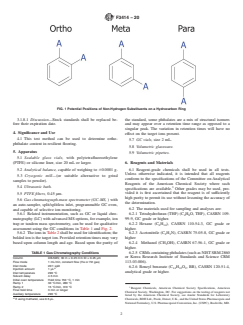
3.1.4.1 Discussion—The term ortho is a prefix used in
dance with internationally recognized principles on standard-
organic chemistry to indicate the position of non-hydrogen
ization established in the Decision on Principles for the
substituents on an aromatic ring. Ortho describes a molecule
Development of International Standards, Guides and Recom-
with substituents at the one and two positions on an aromatic
mendations issued by the World Trade Organization Technical
ring. See Fig. 1.
Barriers to Trade (TBT) Committee.
3.1.5 resilient flooring, n—organic floor surfacing material
made in sheet or tile form or formed in place as a seamless
2. Referenced Documents
material of which the wearing surface is non-textile.
2.1 ASTM Standard:
3.1.5.1 Discussion—The resilient floor covering classifica-
F141 Terminology Relating to Resilient Floor Coverings
tion by common usage includes, but is not limited to, asphalt,
cork, linoleum, rubber, vinyl, vinyl composition, and poly-
3. Terminology
meric poured seamless floors. Resilient in this sense is used as
3.1 Definitions:
a commonly accepted term but does not necessarily define a
3.1.1 calibration standard, n—stockstandardcontainingthe
physical property. F141
ortho-phthalate(s) of interest at a known concentration either
3.1.6 sample, n—individual consumer product or a group of
purchased from a certified reference material provider or
identical consumer products from a batch to be tested.
prepared in-house from materials of known purity and concen-
3.1.7 solvent blank, n—gas chromatograph (GC) or higher
tration and used to calibrate the measurement system.
grade solvent selected to run in between samples within a
sequencetopreventcrosscontaminationwithintheinstrument.
ThistestmethodisunderthejurisdictionofASTMCommitteeF06onResilient 3.1.7.1 Discussion—Solvent blanks can be selected based
Floor Coverings and is the direct responsibility of Subcommittee F06.20 on Test
on laboratory preference and instrument, for example, metha-
Methods.
nol or tetrahydrofuran (THF). Solvent blanks shall be replaced
Current edition approved Feb. 1, 2020. Published April 2020. DOI: 10.1520/
every 10 duplicates or 20 total samples.
F3414-20.
For referenced ASTM standards, visit the ASTM website, www.astm.org, or
3.1.8 stock standard, n—ortho-phthalate(s) purchased from
contact ASTM Customer Service at service@astm.org. For Annual Book of ASTM
commercial source at the highest available purity used to
Standards volume information, refer to the standard’s Document Summary page on
the ASTM website. prepare calibration standards.
Copyright © ASTM International, 100 Barr Harbor Drive, PO Box C700, West Conshohocken, PA 19428-2959. United States
F3414 − 20
FIG. 1 Potential Positions of Non-Hydrogen Substituents on a Hydrocarbon Ring
3.1.8.1 Discussion—Stock standards shall be replaced be- the standard, some phthalates are a mix of structural isomers
fore their expiration date. and may appear over a retention time range as opposed to a
singular peak. The variation in retention times will have no
4. Significance and Use
effect on the target ions present.
4.1 This test method can be used to determine ortho-
5.7 GC vials, size 2 mL.
phthalate content in resilient flooring.
5.8 Volumetric glassware.
5. Apparatus
5.9 Volumetric pipettes.
5.1 Sealable glass vials, with polytetrafluoroethylene
(PTFE) or silicone liner, size 20 mL or larger. 6. Reagents and Materials
5.2 Analytical balance, capable of weighing to 60.0001 g. 6.1 Reagent-grade chemicals shall be used in all tests.
Unless otherwise indicated, it is intended that all reagents
5.3 Cryogenic mill—(or suitable alternative to grind
conform to the specifications of the Committee on Analytical
samples to powder).
Reagents of the American Chemical Society where such
5.4 Ultrasonic bath.
specifications are available. Other grades may be used, pro-
vided it is first ascertained that the reagent is of sufficiently
5.5 PTFE filters, 0.45 µm.
high purity to permit its use without lessening the accuracy of
5.6 Gas chromatograph-mass spectrometer (GC-MS, ) with
the determination.
an auto-sampler, split/splitless inlet, programmable GC oven,
and capable of selective ion monitoring. 6.2 The materials used for sampling and analyses are:
5.6.1 Related instrumentation, such as GC or liquid chro- 6.2.1 Tetrahydrofuran (THF) (C H O, THF), CASRN 109-
4 8
matography (LC) with advanced MS options, for example, ion 99-9, GC grade or higher.
trap or tandem mass spectrometry, can be used for qualitative 6.2.2 Hexane (C H ), CASRN 110-54-3, GC grade or
6 14
assessment using the GC conditions in Table 1 and Fig. 2. higher.
5.6.2 The ions in Table 2 shall be used for identification; the 6.2.3 Acetonitrile (C H N), CASRN 75-05-8, GC grade or
2 3
bolded ion is the target ion. Provided retention times may vary higher
based upon column length and age. Based upon the purity of 6.2.4 Methanol (CH OH), CASRN 67-56-1, GC grade or
higher.
6.2.5 CRMscontainingphthalates(suchasNISTSRM2860
TABLE 1 Gas Chromatography Conditions
or Korea Research Institute of Standards and Science CRM
Column DB-5MS; 30m×0.25mmID×0.25µm
Flow mode 1 mL/min, constant flow (He or H2 gas) 113-03-006).
Inlet mode 20:1 split
6.2.6 Benzyl benzoate (C H O , BB), CASRN 120-51-4,
A 14 12 2
Injection amount 1 µL
analytical grade or higher.
Inlet temperature 290 °C
Solvent delay 4.5 min
Initial oven temperature Hold time 150 °C, 1 min
Ramp 1 30 °C/min, 280 °C
Ramp 2 15 °C/min, 310 °C
Reagent Chemicals, American Chemical Society Specifications, American
Final hold time 3 min or longer
Chemical Society, Washington, DC. For suggestions on the testing of reagents not
Auxiliary temperature 290 °C
listed by the American Chemical Society, see Analar Standards for Laboratory
A
Chemicals,BDHLtd.,Poole,Dorset,U.K.,andtheUnitedStatesPharmacopeiaand
If using methanol, use 0.5 µL.
National Formulary, U.S. Pharmacopeial Convention, Inc. (USPC), Rockville, MD.
F3414 − 20
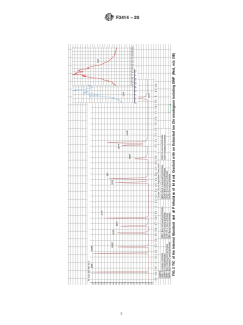
FIG. 2 TIC of the Internal Standard and all Phthalates of Interest Overlaid with an Extracted Ion Chromatogram Isolating DINP (Red, m/z 293)
F3414 − 20
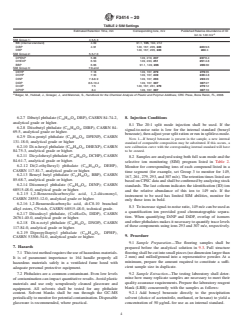
TABLE 2 SIM Settings
Estimated Retention Time, min Corresponding Ions, m/z Published Relative Abundance of ID
A
Ion to 149 m/z
SIM Group 1: 4.5-5.3
BB (internal standard) 4.69 91.1, 105, 194, 212
DiBP 4.91 149, 167, 205, 223 223:9.6
DBP 149, 167, 205, 223 224:4
SIM Group 2: 5.5-7.0
DPENP 5.88 149, 219, 237 237:6.4
DHEXP 6.53 149, 233, 251 251:4.8
BBP 6.66 91.1, 149, 206 206:30
SIM Group 3: 7.0-end
DEHP 7.18 149, 167, 279 279:35
DCHP 7.33 149, 167, 249 249:4.8
DINP 7.8-8.9 149, 167, 293 293:29
DIDP 8.6-10.4 149, 167, 307 307:27
DnOP 7.5 149, 167, 261, 279 279:12
DPHP 8.4 149, 167, 307 307:10
A
Bolgar, M., Hubball, J., Groeger, J., and Meronek, S., Handbook for the Chemical Analysis of Plastic and Polymer Additives, CRC Press, Boca Raton, FL, 2008.
6.2.7 Dibutylphthalate(C H O ,DBP),CASRN84-74-2, 8. Injection Conditions
16 22 4
analytical grade or higher.
8.1 The 20:1 split mode injection shall be used. If the
6.2.8 Diisobutyl phthalate (C H O , DIBP), CASRN 84-
16 22 4
signal-to-noise ratio is low for the internal standard (benzyl
69-5, analytical grade or higher.
benzoate), then adjust your split ration or run in splitless mode.
6.2.9 Di-n-pentyl phthalate (C H O , DPENP), CASRN
18 26 4
NOTE 1—If benzyl benzoate is present in the sample, a new internal
131-18-0, analytical grade or higher
standard of comparable composition may be substituted. If this occurs, a
6.2.10 Di-n-hexyl phthalate (C H O , DHEXP), CASRN
new calibration curve with the corresponding internal standard will have
20 30 4
to be created.
84-75-3, analytical grade or higher.
6.2.11 Dicyclohexyl phthalate (C H O , DCHP), CASRN
20 26 4
8.2 Samples are analyzed using both full scan mode and the
84-61-7, analytical grade or higher.
selective ion monitoring (SIM) program listed in Table 2.
6.2.12 Di(2-ethylhexyl) phthalate (C H O , DEHP),
24 38 4
Monitor for corresponding ions of each compound listed in a
CASRN 117-81-7, analytical grade or higher.
time segment (for example, set Group 3 to monitor for 149,
6.2.13 Benzyl butyl phthalate (C H O , BBP), CASRN
19 20 4
167,261,279,293,and307m/z).Theretentiontimeslistedare
85-68-7, analytical grade or higher.
based on CPSC data and shall be confirmed by analyzing stock
6.2.14 Diisononyl phthalate (C H O , DINP); CASRN
26 42 4
standards. The last column indicates the identification (ID) ion
68515-48-0, analytical grade or higher.
and the relative abundance of this ion to 149 m/z. If the
6.2.15 1,2-Benzenedicarboxylic acid, 1,2-diisononyl,
instrument to be used has limited SIM abilities, monitor for
CASRN 28553-12-0, analytical grade or higher.
only those ions in bold.
6.2.16 1,2-Benzenedicarboxylic acid, di-C8-10 branched
8.3 Toincreasesignal-to-noiseratio,149m/zcanbeusedas
alkyl esters, C9-rich, CASRN 68515-48-0, technical grade.
a quantification ion provided good chromatographic separa-
6.2.17 Diisodecyl phthalate, (C H O , DIDP), CASRN
28 46 4
tion. When quantifying DiNP and DiDP, overlap of isomers
26761-40-0, analytical grade or higher.
and other phthalates makes it necessary to quantify trace levels
6.2.18 Di-n-octyl phthalate (C H O , DNOP), CASRN
24 38 4
of these components using ions 293 and 307 m/z, respectively.
117-84-0, analytical grade or higher.
6.2.19 Dipropylheptyl phthalate (C H O , DPHP),
28 46 4
9. Procedure
CASRN 53306-54-0, analytical grade or higher.
9.1 Sample Preparation—The flooring samples shall be
7. Hazards
prepared before the analytical solution in 9.3. Full structure
flooringshallbecutintosmallpieces(nodimensionlargerthan
7.1 Thistestmethodrequirestheuseofhazardousmaterials.
2 mm) and milled/ground into a representative powder. At a
It is of paramount importance to 164 handle properly all
minimum, prepare the amount required to constitute a suffi-
hazardous materials safely in a ventilated fume hood with
cient sample size in duplicate.
adequate personal protective equipment.
9.2 Sample Extraction—The testing laboratory shall deter-
7.2 Phthalates are a common contaminant. Even low levels
mine how many replicate samples are necessary to meet their
of contamination can impact quantitative results.Avoid plastic
quality assurance requirements. Prepare the laboratory reagent
materials and use only scrupulously cleaned glassware and
blank (LRB) concurrently with the samples as follows:
equipment. All solvents shall be tested for any phthalate
content. Solvent blanks shall be run through the GC-MS 9.2.1 Add benzyl benzoate directly to the precipitation
periodicallytomonitorforpotentialcontamination.Disposable solvent (choice of acetonitrile, methanol, or hexane) to yield a
glassware is recommended, where practical. concentration of 50 µg/mL for use as an internal standard.
F3414 − 20
NOTE 6—If the sample phthalate concentration is greater than the
9.2.2 Weigh out a minimum of 0.05 6 0.005 g (not to
highest calibrant, an additional calibrant level may be created or the
exceed 0.6 g) of sample into a sealable glass vial (weighed to
sample may be diluted and rerun.
an accuracy of 60.5 % relative); if the sample is not uniform,
9.4 Steps for Preparing Solutions:
collect more to reduce the sample variance or mill mix the
9.4.1 Step1:PreparetheConcentratedCalibrationSolution
sample.
(Solution #1)—Prepare the phthalate concentrated calibration
9.2.3 Add 5 mL of THF to the sample. For samples larger
solution based upon the density of the phthalate. Phthalate
than 0.05 g, add 10 mL of THF
...