

ASTM D4216-22
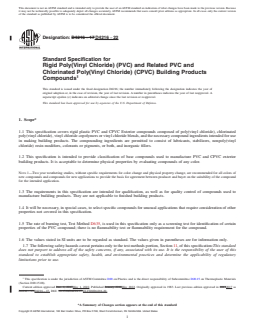
(Specification)Standard Specification for Rigid Poly(Vinyl Chloride) (PVC) and Related PVC and Chlorinated Poly(Vinyl Chloride) (CPVC) Building Products Compounds
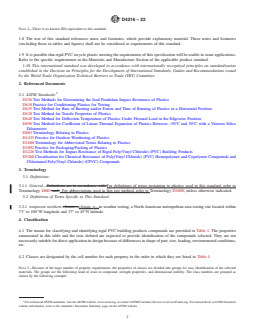
General Information
- Abstract
ABSTRACT
This specification covers rigid plastic PVC and CPVC exterior compounds composed of poly (vinyl chloride), chlorinated poly (vinyl chloride), vinyl chloride copolymers or vinyl chloride blends, and the necessary compound ingredients intended for use in making building products. The compounding ingredients may consist of lubricants, stabilizers, nonpoly-(vinyl chloride) resin modifiers, colorants or pigments, or both, and inorganic fillers. It is intended to provide classification of base compounds used to manufacture PVC and CPVC exterior building products. The means for classifying and identifying rigid PVC building products compounds are provided as follows: kind of resin in compound, impact resistance, tensile strength, modulus of elasticity in tension, deflection temperature under a specific load and coefficient of linear expansion. PVC compound shall be in the form of cubes, pellets, granules, free-flowing powder blends, or compacted powder blends. Materials shall be of uniform composition and size and shall be free of foreign matter to a level that is not expected to affect processability, serviceability, or finished product appearance adversely.
SCOPE
1.1 This specification covers rigid plastic PVC and CPVC Exterior compounds composed of poly(vinyl chloride), chlorinated poly(vinyl chloride), vinyl chloride copolymers or vinyl chloride blends, and the necessary compound ingredients intended for use in making building products. The compounding ingredients are permitted to consist of lubricants, stabilizers, nonpoly(vinyl chloride) resin modifiers, colorants or pigments, or both, and inorganic fillers.
1.2 This specification is intended to provide classification of base compounds used to manufacture PVC and CPVC exterior building products. It is acceptable to determine physical properties by evaluating compounds of any color.
Note 1: Two year weathering studies, without specific requirements for color change and physical property change, are recommended for all colors of new compounds and compounds for new applications to provide the basis for agreement between producer and buyer on the suitability of the compound for the intended application.
1.3 The requirements in this specification are intended for qualification, as well as for quality control of compounds used to manufacture building products. They are not applicable to finished building products.
1.4 It will be necessary, in special cases, to select specific compounds for unusual applications that require consideration of other properties not covered in this specification.
1.5 The rate of burning test, Test Method D635, is used in this specification only as a screening test for identification of certain properties of the PVC compound; there is no flammability test or flammability requirement for the compound.
1.6 The values stated in SI units are to be regarded as standard. The values given in parentheses are for information only.
1.7 The following safety hazards caveat pertains only to the test methods portion, Section 11, of this specification:This standard does not purport to address all of the safety concerns, if any, associated with its use. It is the responsibility of the user of this standard to establish appropriate safety, health, and environmental practices and determine the applicability of regulatory limitations prior to use.
Note 2: There is no known ISO equivalent to this standard.
1.8 The text of this standard references notes and footnotes, which provide explanatory material. These notes and footnotes (excluding those in tables and figures) shall not be considered as requirements of this standard.
1.9 It is possible that rigid PVC recycle plastic meeting the requirements of this specification will be usable in some applications. Refer to the specific requirements in the Materials and Manufacture Section of the applicable product standard.
1.10 This international standard was developed in accorda...
- Status
- Published
- Publication Date
- 30-Apr-2022
- Technical Committee
- D20 - Plastics
- Drafting Committee
- D20.15 - Thermoplastic Materials
Buy Documents
ASTM D4216-22 - Standard Specification for Rigid Poly(Vinyl Chloride) (PVC) and Related PVC and Chlorinated Poly(Vinyl Chloride) (CPVC) Building Products Compounds
REDLINE ASTM D4216-22 - Standard Specification for Rigid Poly(Vinyl Chloride) (PVC) and Related PVC and Chlorinated Poly(Vinyl Chloride) (CPVC) Building Products Compounds
Overview
ASTM D4216-22 is the internationally recognized standard specification for rigid Poly(Vinyl Chloride) (PVC) and Chlorinated Poly(Vinyl Chloride) (CPVC) building product compounds. Developed by ASTM International, this standard provides comprehensive guidelines for the classification and quality control of exterior PVC and CPVC compounds, which are key materials in numerous building and construction applications. This specification addresses the composition, physical property requirements, sampling, testing, packaging, and marking of rigid PVC and CPVC compounds, ensuring consistency and reliability for manufacturers and users in the building industry.
Key Topics
- Material Coverage: The standard specifies rigid PVC and CPVC compounds, including those made from vinyl chloride copolymers, blends, and essential compounding ingredients such as lubricants, stabilizers, resin modifiers, colorants, pigments, and inorganic fillers.
- Classification System: ASTM D4216-22 introduces a systematic method to classify rigid PVC and CPVC compounds based on characteristics such as:
- Type of resin
- Impact resistance
- Tensile strength
- Modulus of elasticity in tension
- Deflection temperature under specific load
- Coefficient of linear expansion
- Physical Forms: Compounds under this standard may be supplied as cubes, pellets, granules, or powder blends, all of which are required to be uniform in composition and free of contaminants that might affect performance or appearance.
- Testing and Conformance: The standard incorporates referenced ASTM test methods for evaluating physical properties, including impact resistance, tensile properties, deflection temperature, and weathering performance.
- Quality Control: Requirements in ASTM D4216-22 are intended for compound qualification and ongoing quality control during manufacturing but do not apply to finished building products.
Applications
Rigid PVC and CPVC compounds covered by ASTM D4216-22 are widely used in the building and construction sector for products that require durable, stable, and weather-resistant materials. Typical applications include:
- Exterior Building Products: Siding, soffit, fascia, trim, window and door profiles.
- Outdoor Construction Elements: Decking, fencing, handrails, and wall panels.
- Roofing and Cladding: Components that must withstand exposure to weather and UV radiation.
- Custom Architectural Components: Where specific mechanical and thermal properties are essential.
This standard is also relevant for compounders, extruders, and fabricators who need clear guidance to assure product consistency and compliance with market and regulatory demands. ASTM D4216-22 supports producer-buyer agreements on material suitability, especially for new compounds and applications, including recycled rigid PVC when specified.
Related Standards
When working with rigid PVC and CPVC compounds for building products, the following ASTM standards are frequently referenced in conjunction with ASTM D4216-22:
- ASTM D256 – Test Methods for Determining the Izod Pendulum Impact Resistance of Plastics
- ASTM D638 – Test Method for Tensile Properties of Plastics
- ASTM D648 – Test Method for Deflection Temperature of Plastics Under Flexural Load
- ASTM D696 – Test Method for Coefficient of Linear Thermal Expansion of Plastics
- ASTM D635 – Test Method for Rate of Burning and/or Extent and Time of Burning of Plastics
- ASTM D1435 – Practice for Outdoor Weathering of Plastics
- ASTM D4226 – Test Methods for Impact Resistance of Rigid PVC Building Products
- ASTM D5260 – Classification for Chemical Resistance of PVC and CPVC Compounds
- ASTM D3892 – Practice for Packaging/Packing of Plastics
ASTM D4216-22 ensures that rigid PVC and CPVC compounds meet consistent quality benchmarks, supporting robust and reliable building product manufacturing aligned with industry best practices.
Relations
- Effective Date
- 01-Feb-2024
- Effective Date
- 01-Nov-2023
- Effective Date
- 01-Jan-2020
- Effective Date
- 01-Nov-2019
- Effective Date
- 01-Nov-2019
- Effective Date
- 01-Aug-2019
- Effective Date
- 15-Apr-2019
- Effective Date
- 01-Feb-2019
- Effective Date
- 01-Dec-2018
- Effective Date
- 01-Nov-2018
- Effective Date
- 01-Apr-2018
- Refers
ASTM D1600-18 - Standard Terminology for Abbreviated Terms Relating to Plastics (Withdrawn 2024) - Effective Date
- 01-Jan-2018
- Effective Date
- 15-Aug-2017
- Effective Date
- 01-May-2016
- Effective Date
- 01-Apr-2016
Buy Documents
ASTM D4216-22 - Standard Specification for Rigid Poly(Vinyl Chloride) (PVC) and Related PVC and Chlorinated Poly(Vinyl Chloride) (CPVC) Building Products Compounds
REDLINE ASTM D4216-22 - Standard Specification for Rigid Poly(Vinyl Chloride) (PVC) and Related PVC and Chlorinated Poly(Vinyl Chloride) (CPVC) Building Products Compounds
Get Certified
Connect with accredited certification bodies for this standard

DIN CERTCO
DIN Group product certification.

Smithers Quality Assessments
US management systems and product certification.
Sponsored listings
Frequently Asked Questions
ASTM D4216-22 is a technical specification published by ASTM International. Its full title is "Standard Specification for Rigid Poly(Vinyl Chloride) (PVC) and Related PVC and Chlorinated Poly(Vinyl Chloride) (CPVC) Building Products Compounds". This standard covers: ABSTRACT This specification covers rigid plastic PVC and CPVC exterior compounds composed of poly (vinyl chloride), chlorinated poly (vinyl chloride), vinyl chloride copolymers or vinyl chloride blends, and the necessary compound ingredients intended for use in making building products. The compounding ingredients may consist of lubricants, stabilizers, nonpoly-(vinyl chloride) resin modifiers, colorants or pigments, or both, and inorganic fillers. It is intended to provide classification of base compounds used to manufacture PVC and CPVC exterior building products. The means for classifying and identifying rigid PVC building products compounds are provided as follows: kind of resin in compound, impact resistance, tensile strength, modulus of elasticity in tension, deflection temperature under a specific load and coefficient of linear expansion. PVC compound shall be in the form of cubes, pellets, granules, free-flowing powder blends, or compacted powder blends. Materials shall be of uniform composition and size and shall be free of foreign matter to a level that is not expected to affect processability, serviceability, or finished product appearance adversely. SCOPE 1.1 This specification covers rigid plastic PVC and CPVC Exterior compounds composed of poly(vinyl chloride), chlorinated poly(vinyl chloride), vinyl chloride copolymers or vinyl chloride blends, and the necessary compound ingredients intended for use in making building products. The compounding ingredients are permitted to consist of lubricants, stabilizers, nonpoly(vinyl chloride) resin modifiers, colorants or pigments, or both, and inorganic fillers. 1.2 This specification is intended to provide classification of base compounds used to manufacture PVC and CPVC exterior building products. It is acceptable to determine physical properties by evaluating compounds of any color. Note 1: Two year weathering studies, without specific requirements for color change and physical property change, are recommended for all colors of new compounds and compounds for new applications to provide the basis for agreement between producer and buyer on the suitability of the compound for the intended application. 1.3 The requirements in this specification are intended for qualification, as well as for quality control of compounds used to manufacture building products. They are not applicable to finished building products. 1.4 It will be necessary, in special cases, to select specific compounds for unusual applications that require consideration of other properties not covered in this specification. 1.5 The rate of burning test, Test Method D635, is used in this specification only as a screening test for identification of certain properties of the PVC compound; there is no flammability test or flammability requirement for the compound. 1.6 The values stated in SI units are to be regarded as standard. The values given in parentheses are for information only. 1.7 The following safety hazards caveat pertains only to the test methods portion, Section 11, of this specification:This standard does not purport to address all of the safety concerns, if any, associated with its use. It is the responsibility of the user of this standard to establish appropriate safety, health, and environmental practices and determine the applicability of regulatory limitations prior to use. Note 2: There is no known ISO equivalent to this standard. 1.8 The text of this standard references notes and footnotes, which provide explanatory material. These notes and footnotes (excluding those in tables and figures) shall not be considered as requirements of this standard. 1.9 It is possible that rigid PVC recycle plastic meeting the requirements of this specification will be usable in some applications. Refer to the specific requirements in the Materials and Manufacture Section of the applicable product standard. 1.10 This international standard was developed in accorda...
ABSTRACT This specification covers rigid plastic PVC and CPVC exterior compounds composed of poly (vinyl chloride), chlorinated poly (vinyl chloride), vinyl chloride copolymers or vinyl chloride blends, and the necessary compound ingredients intended for use in making building products. The compounding ingredients may consist of lubricants, stabilizers, nonpoly-(vinyl chloride) resin modifiers, colorants or pigments, or both, and inorganic fillers. It is intended to provide classification of base compounds used to manufacture PVC and CPVC exterior building products. The means for classifying and identifying rigid PVC building products compounds are provided as follows: kind of resin in compound, impact resistance, tensile strength, modulus of elasticity in tension, deflection temperature under a specific load and coefficient of linear expansion. PVC compound shall be in the form of cubes, pellets, granules, free-flowing powder blends, or compacted powder blends. Materials shall be of uniform composition and size and shall be free of foreign matter to a level that is not expected to affect processability, serviceability, or finished product appearance adversely. SCOPE 1.1 This specification covers rigid plastic PVC and CPVC Exterior compounds composed of poly(vinyl chloride), chlorinated poly(vinyl chloride), vinyl chloride copolymers or vinyl chloride blends, and the necessary compound ingredients intended for use in making building products. The compounding ingredients are permitted to consist of lubricants, stabilizers, nonpoly(vinyl chloride) resin modifiers, colorants or pigments, or both, and inorganic fillers. 1.2 This specification is intended to provide classification of base compounds used to manufacture PVC and CPVC exterior building products. It is acceptable to determine physical properties by evaluating compounds of any color. Note 1: Two year weathering studies, without specific requirements for color change and physical property change, are recommended for all colors of new compounds and compounds for new applications to provide the basis for agreement between producer and buyer on the suitability of the compound for the intended application. 1.3 The requirements in this specification are intended for qualification, as well as for quality control of compounds used to manufacture building products. They are not applicable to finished building products. 1.4 It will be necessary, in special cases, to select specific compounds for unusual applications that require consideration of other properties not covered in this specification. 1.5 The rate of burning test, Test Method D635, is used in this specification only as a screening test for identification of certain properties of the PVC compound; there is no flammability test or flammability requirement for the compound. 1.6 The values stated in SI units are to be regarded as standard. The values given in parentheses are for information only. 1.7 The following safety hazards caveat pertains only to the test methods portion, Section 11, of this specification:This standard does not purport to address all of the safety concerns, if any, associated with its use. It is the responsibility of the user of this standard to establish appropriate safety, health, and environmental practices and determine the applicability of regulatory limitations prior to use. Note 2: There is no known ISO equivalent to this standard. 1.8 The text of this standard references notes and footnotes, which provide explanatory material. These notes and footnotes (excluding those in tables and figures) shall not be considered as requirements of this standard. 1.9 It is possible that rigid PVC recycle plastic meeting the requirements of this specification will be usable in some applications. Refer to the specific requirements in the Materials and Manufacture Section of the applicable product standard. 1.10 This international standard was developed in accorda...
ASTM D4216-22 is classified under the following ICS (International Classification for Standards) categories: 83.080.20 - Thermoplastic materials. The ICS classification helps identify the subject area and facilitates finding related standards.
ASTM D4216-22 has the following relationships with other standards: It is inter standard links to ASTM D883-24, ASTM D883-23, ASTM D883-20, ASTM D4226-19, ASTM D4226-19e1, ASTM D883-19c, ASTM D883-19a, ASTM D883-19, ASTM D883-18a, ASTM D883-18, ASTM D648-18, ASTM D1600-18, ASTM D883-17, ASTM D4226-16, ASTM D696-16. Understanding these relationships helps ensure you are using the most current and applicable version of the standard.
ASTM D4216-22 is available in PDF format for immediate download after purchase. The document can be added to your cart and obtained through the secure checkout process. Digital delivery ensures instant access to the complete standard document.
Standards Content (Sample)
This international standard was developed in accordance with internationally recognized principles on standardization established in the Decision on Principles for the
Development of International Standards, Guides and Recommendations issued by the World Trade Organization Technical Barriers to Trade (TBT) Committee.
Designation:D4216 −22
Standard Specification for
Rigid Poly(Vinyl Chloride) (PVC) and Related PVC and
Chlorinated Poly(Vinyl Chloride) (CPVC) Building Products
Compounds
This standard is issued under the fixed designation D4216; the number immediately following the designation indicates the year of
original adoption or, in the case of revision, the year of last revision.Anumber in parentheses indicates the year of last reapproval.A
superscript epsilon (´) indicates an editorial change since the last revision or reapproval.
This standard has been approved for use by agencies of the U.S. Department of Defense.
1. Scope* 1.7 The following safety hazards caveat pertains only to the
test methods portion, Section 11, of this specification:This
1.1 This specification covers rigid plastic PVC and CPVC
standard does not purport to address all of the safety concerns,
Exterior compounds composed of poly(vinyl chloride), chlori-
if any, associated with its use. It is the responsibility of the user
nated poly(vinyl chloride), vinyl chloride copolymers or vinyl
of this standard to establish appropriate safety, health, and
chloride blends, and the necessary compound ingredients
environmental practices and determine the applicability of
intended for use in making building products. The compound-
regulatory limitations prior to use.
ing ingredients are permitted to consist of lubricants,
stabilizers, nonpoly(vinyl chloride) resin modifiers, colorants
NOTE 2—There is no known ISO equivalent to this standard.
or pigments, or both, and inorganic fillers.
1.8 The text of this standard references notes and footnotes,
1.2 Thisspecificationisintendedtoprovideclassificationof whichprovideexplanatorymaterial.Thesenotesandfootnotes
base compounds used to manufacture PVC and CPVC exterior (excluding those in tables and figures) shall not be considered
building products. It is acceptable to determine physical as requirements of this standard.
properties by evaluating compounds of any color.
1.9 It is possible that rigid PVC recycle plastic meeting the
requirements of this specification will be usable in some
NOTE 1—Two year weathering studies, without specific requirements
for color change and physical property change, are recommended for all
applications.RefertothespecificrequirementsintheMaterials
colorsofnewcompoundsandcompoundsfornewapplicationstoprovide
and Manufacture Section of the applicable product standard.
the basis for agreement between producer and buyer on the suitability of
1.10 This international standard was developed in accor-
the compound for the intended application.
dance with internationally recognized principles on standard-
1.3 The requirements in this specification are intended for
ization established in the Decision on Principles for the
qualification, as well as for quality control of compounds used
Development of International Standards, Guides and Recom-
to manufacture building products. They are not applicable to
mendations issued by the World Trade Organization Technical
finished building products.
Barriers to Trade (TBT) Committee.
1.4 It will be necessary, in special cases, to select specific
compounds for unusual applications that require consideration
2. Referenced Documents
of other properties not covered in this specification.
2.1 ASTM Standards:
1.5 The rate of burning test, Test Method D635, is used in
D256Test Methods for Determining the Izod Pendulum
this specification only as a screening test for identification of
Impact Resistance of Plastics
certain properties of the PVC compound; there is no flamma-
D618Practice for Conditioning Plastics for Testing
bility test or flammability requirement for the compound.
D635Test Method for Rate of Burning and/or Extent and
Time of Burning of Plastics in a Horizontal Position
1.6 The values stated in SI units are to be regarded as
D638Test Method for Tensile Properties of Plastics
standard. The values given in parentheses are for information
D648Test Method for Deflection Temperature of Plastics
only.
Under Flexural Load in the Edgewise Position
This specification is under the jurisdiction of ASTM Committee D20 on
Plastics and is the direct responsibility of Subcommittee D20.15 on Thermoplastic
Materials (Section D20.15.08). For referenced ASTM standards, visit the ASTM website, www.astm.org, or
Current edition approved May 1, 2022. Published May 2022. Originally contact ASTM Customer Service at service@astm.org. For Annual Book of ASTM
approved in 1983. Last previous edition approved in 2017 as D4216–17. DOI: Standards volume information, refer to the standard’s Document Summary page on
10.1520/D4216-22. the ASTM website.
*A Summary of Changes section appears at the end of this standard
Copyright © ASTM International, 100 Barr Harbor Drive, PO Box C700, West Conshohocken, PA 19428-2959. United States
D4216−22
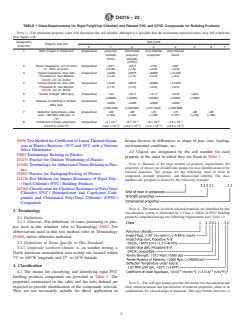
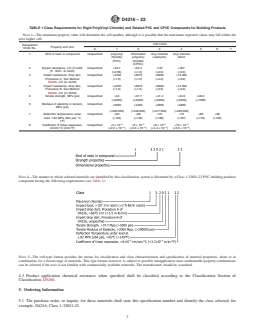
TABLE 1 Class Requirements for Rigid Poly(Vinyl Chloride) and Related PVC and CPVC Compounds for Building Products
NOTE 1—The minimum property value will determine the cell number, although it is possible that the maximum expected values may fall within the
next higher cell.
Cell Limits
Designation
Property and Unit
Order No.
0 123 4 5 6 7
1 Kind of resin in compound Unspecified poly(vinyl chlorinated vinyl chloride vinyl chloride
chloride) poly(vinyl copolymer blend
(PVC) chloride)
(CPVC)
2 Impact resistance, J/m of notch Unspecified >34.7 >53.4 >107 >267
(ft · lbf/in. of notch) (>0.65) (>1.0) (>2.0) (>5.0)
3 Impact resistance, drop dart, Unspecified >4450 >6675 >8900 >13 350
Procedure A, Test Method
(>1.0) (>1.5) (>2.0) (>3.0)
D4226, J/m (in.-lb/mil)
4 Impact resistance, drop dart, Unspecified >4450 >6675 >8900 >13 350
Procedure B, Test Method (>1.0) (>1.5) (>2.0) (>3.0)
D4226, J/m (in.-lb/mil)
5 Tensile strength, MPa (psi) Unspecified >34 >37.7 >41.4 >44.9 >48.3
(>5000) (>5500) (>6000) (>6500) (>7000)
6 Modulus of elasticity in tension, Unspecified
>2000 >2400 >2600 >2800
MPa (psi)
(>290 000) (>348 000) (>377 000) (>406 000)
7 Deflection temperature under Unspecified >60 >65 >70 >75 >80 >85
load, 1.82 MPa (264 psi) °C (>140) (>149) (>158) (>167) (>176) (>185)
(°F)
−5 −5 −5 −5
8 Coefficient of linear expansion, Unspecified <4 × 10 <6×10 <8×10 <10×10
−5 −5 −5 −5
cm/cm/°C (in/in/°F) (<2.2 × 10 ) (<3.3 × 10 ) (<4.4 × 10 ) (<5.5 × 10 )
D696TestMethodforCoefficientofLinearThermalExpan- design because of differences in shape of part, size, loading,
sion of Plastics Between −30°C and 30°C with a Vitreous environmental conditions, etc.
Silica Dilatometer
4.2 Classes are designated by the cell number for each
D883Terminology Relating to Plastics
property in the order in which they are listed in Table 1.
D1435Practice for Outdoor Weathering of Plastics
NOTE 3—Because of the large number of property requirements, the
D1600TerminologyforAbbreviatedTermsRelatingtoPlas-
properties of classes are divided into groups for easy identification of the
tics
selected materials. The groups are the following: kind of resin in
D3892Practice for Packaging/Packing of Plastics
compound, strength properties, and dimensional stability. The class
D4226Test Methods for Impact Resistance of Rigid Poly-
numbers are grouped as shown by the following example:
(Vinyl Chloride) (PVC) Building Products
D5260Classification for Chemical Resistance of Poly(Vinyl
Chloride) (PVC) Homopolymer and Copolymer Com-
pounds and Chlorinated Poly(Vinyl Chloride) (CPVC)
Compounds
NOTE 4—The manner in which selected materials are identified by this
3. Terminology
classification system is illustrated by a Class 1-32021-22 PVC building
products compound having the following requirements (see Table 1):
3.1 Definitions:
3.1.1 General—For definitions of terms pertaining to plas-
tics used in this standard, refer to Terminology D883. For
abbreviations used in this test method, refer to Terminology
D1600, unless otherwise indicated.
3.2 Definitions of Terms Specific to This Standard:
3.2.1 temperate northern climate, n—in weather testing, a
North American metropolitan area testing site located within
73° to 100°W longitude and 37° to 45°N latitude.
4. Classification
4.1 The means for classifying and identifying rigid PVC
building products compounds are provided in Table 1. The
properties enumerated in this table and the tests defined are
NOTE5—Thecell-typeformatprovidesthemeansforclassificationand
expected to provide identification of the compounds selected.
close characterization and specification of material properties, alone or in
They are not necessarily suitable for direct application in combination,forabroadrangeofmaterials.Thistypeformat,however,is
D4216−22
subject to possible misapplication since unobtainable property combina-
100 mm (4 in.) with an average time of burn not to exceed 10
tionscanbeselectediftheuserisnotfamiliarwithcommerciallyavailable
s. A sample thickness of 1 mm (0.040 in.) 610% is recom-
materials. The manufacturer should be consulted.
mended.
4.3 Product application chemical resistance when specified
8.3 Stability—The compound shall be adequately stabilized
shall be classified according to the Classification Section of
against thermal degradation without sacrificing weathering
Classification D5260.
performance.
5. Ordering Information
NOTE 6—The type and amount of stabilizer may vary with the
compound formulation, the equipment on which the compound is
5.1 The purchase order, or inquiry, for these materials shall
processed, the temperatures during processing steps, and the amount of
state this specification number and identify the class selected;
regrind (reworked) material or rigid PVC recycled plastic employed. To
for example, D4216, Class 1-32021-22.
date, no test procedure has been found that is suitable for use in
specificationsofthistype.Researchmethodsthatvaryamonglaboratories
5.2 Further definition, as potentially required for the
and that have not been amenable to standardization are used.
following, shall be on the basis of agreement between the
purchaser and the seller. 8.4 Weatherability—The compound shall be stabilized ad-
equately against changes in color, physical properties, and
5.2.1 Physical fo
...
This document is not an ASTM standard and is intended only to provide the user of an ASTM standard an indication of what changes have been made to the previous version. Because
it may not be technically possible to adequately depict all changes accurately, ASTM recommends that users consult prior editions as appropriate. In all cases only the current version
of the standard as published by ASTM is to be considered the official document.
Designation: D4216 − 17 D4216 − 22
Standard Specification for
Rigid Poly(Vinyl Chloride) (PVC) and Related PVC and
Chlorinated Poly(Vinyl Chloride) (CPVC) Building Products
Compounds
This standard is issued under the fixed designation D4216; the number immediately following the designation indicates the year of
original adoption or, in the case of revision, the year of last revision. A number in parentheses indicates the year of last reapproval. A
superscript epsilon (´) indicates an editorial change since the last revision or reapproval.
This standard has been approved for use by agencies of the U.S. Department of Defense.
1. Scope*
1.1 This specification covers rigid plastic PVC and CPVC Exterior compounds composed of poly(vinyl chloride), chlorinated
poly(vinyl chloride), vinyl chloride copolymers or vinyl chloride blends, and the necessary compound ingredients intended for use
in making building products. The compounding ingredients are permitted to consist of lubricants, stabilizers, nonpoly(vinyl
chloride) resin modifiers, colorants or pigments, or both, and inorganic fillers.
1.2 This specification is intended to provide classification of base compounds used to manufacture PVC and CPVC exterior
building products. It is acceptable to determine physical properties by evaluating compounds of any color.
NOTE 1—Two year weathering studies, without specific requirements for color change and physical property change, are recommended for all colors of
new compounds and compounds for new applications to provide the basis for agreement between producer and buyer on the suitability of the compound
for the intended application.
1.3 The requirements in this specification are intended for qualification, as well as for quality control of compounds used to
manufacture building products. They are not applicable to finished building products.
1.4 It will be necessary, in special cases, to select specific compounds for unusual applications that require consideration of other
properties not covered in this specification.
1.5 The rate of burning test, Test Method D635, is used in this specification only as a screening test for identification of certain
properties of the PVC compound; there is no flammability test or flammability requirement for the compound.
1.6 The values stated in SI units are to be regarded as standard. The values given in parentheses are for information only.
1.7 The following safety hazards caveat pertains only to the test methods portion, Section 11, of this specification:This standard
does not purport to address all of the safety concerns, if any, associated with its use. It is the responsibility of the user of this
standard to establish appropriate safety, health, and environmental practices and determine the applicability of regulatory
limitations prior to use.
This specification is under the jurisdiction of ASTM Committee D20 on Plastics and is the direct responsibility of Subcommittee D20.15 on Thermoplastic Materials
(Section D20.15.08).
Current edition approved Dec. 1, 2017May 1, 2022. Published January 2018May 2022. Originally approved in 1983. Last previous edition approved in 20132017 as
D4216 – 13.D4216 – 17. DOI: 10.1520/D4216-17.10.1520/D4216-22.
*A Summary of Changes section appears at the end of this standard
Copyright © ASTM International, 100 Barr Harbor Drive, PO Box C700, West Conshohocken, PA 19428-2959. United States
D4216 − 22
NOTE 2—There is no known ISO equivalent to this standard.
1.8 The text of this standard references notes and footnotes, which provide explanatory material. These notes and footnotes
(excluding those in tables and figures) shall not be considered as requirements of this standard.
1.9 It is possible that rigid PVC recycle plastic meeting the requirements of this specification will be usable in some applications.
Refer to the specific requirements in the Materials and Manufacture Section of the applicable product standard.
1.10 This international standard was developed in accordance with internationally recognized principles on standardization
established in the Decision on Principles for the Development of International Standards, Guides and Recommendations issued
by the World Trade Organization Technical Barriers to Trade (TBT) Committee.
2. Referenced Documents
2.1 ASTM Standards:
D256 Test Methods for Determining the Izod Pendulum Impact Resistance of Plastics
D618 Practice for Conditioning Plastics for Testing
D635 Test Method for Rate of Burning and/or Extent and Time of Burning of Plastics in a Horizontal Position
D638 Test Method for Tensile Properties of Plastics
D648 Test Method for Deflection Temperature of Plastics Under Flexural Load in the Edgewise Position
D696 Test Method for Coefficient of Linear Thermal Expansion of Plastics Between −30°C and 30°C with a Vitreous Silica
Dilatometer
D883 Terminology Relating to Plastics
D1435 Practice for Outdoor Weathering of Plastics
D1600 Terminology for Abbreviated Terms Relating to Plastics
D3892 Practice for Packaging/Packing of Plastics
D4226 Test Methods for Impact Resistance of Rigid Poly(Vinyl Chloride) (PVC) Building Products
D5260 Classification for Chemical Resistance of Poly(Vinyl Chloride) (PVC) Homopolymer and Copolymer Compounds and
Chlorinated Poly(Vinyl Chloride) (CPVC) Compounds
3. Terminology
3.1 Definitions:
3.1.1 General—Definitions are in accordance with For definitions of terms pertaining to plastics used in this standard, refer to
Terminology D883 and . For abbreviations used in this test method, refer to Terminology D1600, unless otherwise indicated.
3.2 Definitions of Terms Specific to This Standard:
3.2.1 temperate northern climate—climate, n—in weather testing, a North American metropolitan area testing site located within
73° to 100°W longitude and 37° to 45°N latitude.
4. Classification
4.1 The means for classifying and identifying rigid PVC building products compounds are provided in Table 1. The properties
enumerated in this table and the tests defined are expected to provide identification of the compounds selected. They are not
necessarily suitable for direct application in design because of differences in shape of part, size, loading, environmental conditions,
etc.
4.2 Classes are designated by the cell number for each property in the order in which they are listed in Table 1.
NOTE 3—Because of the large number of property requirements, the properties of classes are divided into groups for easy identification of the selected
materials. The groups are the following: kind of resin in compound, strength properties, and dimensional stability. The class numbers are grouped as
shown by the following example:
For referenced ASTM standards, visit the ASTM website, www.astm.org, or contact ASTM Customer Service at service@astm.org. For Annual Book of ASTM Standards
volume information, refer to the standard’s Document Summary page on the ASTM website.
D4216 − 22
TABLE 1 Class Requirements for Rigid Poly(Vinyl Chloride) and Related PVC and CPVC Compounds for Building Products
NOTE 1—The minimum property value will determine the cell number, although it is possible that the maximum expected values may fall within the
next higher cell.
Cell Limits
Designation
Property and Unit
Order No.
0 1 2 3 4 5 6 7
1 Kind of resin in compound Unspecified poly(vinyl chlorinated vinyl chloride vinyl chloride
chloride) poly(vinyl copolymer blend
(PVC) chloride)
(CPVC)
2 Impact resistance, J/m of notch Unspecified >34.7 >53.4 >107 >267
(ft · lbf/in. of notch)
(>0.65) (>1.0) (>2.0) (>5.0)
3 Impact resistance, drop dart, Unspecified >4450 >6675 >8900 >13 350
Procedure A, Test Method (>1.0) (>1.5) (>2.0) (>3.0)
D4226, J/m (in.-lb/mil)
4 Impact resistance, drop dart, Unspecified >4450 >6675 >8900 >13 350
Procedure B, Test Method (>1.0) (>1.5) (>2.0) (>3.0)
D4226, J/m (in.-lb/mil)
5 Tensile strength, MPa (psi) Unspecified >34 >37.7 >41.4 >44.9 >48.3
(>5000) (>5500) (>6000) (>6500) (>7000)
6 Modulus of elasticity in tension, Unspecified
>2000 >2400 >2600 >2800
MPa (psi)
(>290 000) (>348 000) (>377 000) (>406 000)
7 Deflection temperature under Unspecified >60 >65 >70 >75 >80 >85
load, 1.82 MPa (264 psi) °C (>140) (>149) (>158) (>167) (>176) (>185)
(°F)
−5 −5 −5 −5
8 Coefficient of linear expansion, Unspecified <4 × 10 <6 × 10 <8 × 10 <10 × 10
−5 −5 −5 −5
cm/cm/°C (in/in/°F) (<2.2 × 10 ) (<3.3 × 10 ) (<4.4 × 10 ) (<5.5 × 10 )
NOTE 4—The manner in which selected materials are identified by this classification system is illustrated by a Class 1-32021-22 PVC building products
compound having the following requirements (see Table 1):
NOTE 5—The cell-type format provides the means for classification and close characterization and specification of material properties, alone or in
combination, for a broad range of materials. This type format, however, is subject to possible misapplication since unobtainable property combinations
can be selected if the user is not familiar with commercially available materials. The manufacturer should be consulted.
4.3 Product application chemical resistance when specified shall be classified according to the Classification Section of
Classification D5260.
5. Ordering Information
5.1 The purchase order, or inquiry, for these materials shall state this specification number and identify the class selected; for
example, D4216, Class 1-32021-22.
D4216 − 22
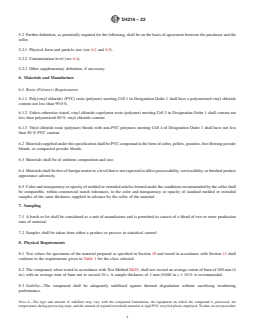
5.2 Further definition, as potentially required for the following, shall be on the basis of agreement between the purchaser and the
seller.
5.2.1 Physical form and particle size (see 6.2 and 6.3).
5.2.2 Contamination level (see 6.4).
5.2.3 Other supplementary definition, if necessary.
6. Materials and Manufacture
6.1 Resin (Polymer) Requirements:
6.1.1 Poly(vinyl chloride) (PVC) resin (polymer) meeting Cell 1 in Designation Order 1 shall have a polymerized vinyl chloride
content not less than 99.0 %.
6.1.2 Unless otherwise stated, vinyl chloride copolymer resin (polymer) meeting Cell 3 in Designation Order 1 shall contain not
less than polymerized 80 % vinyl chloride content.
6.1.3 Vinyl chloride resin (polymer) blends with non-PVC polymers meeting Cell 4 of Designation Order 1 shall have not less
than 50 % PVC content.
6.2 Materials supplied under this specification shall be PVC compound in the form of cubes, pellets, granules, free-flowing powder
blends, or compacted powder blends.
6.3 Materials shall be of uniform composition and size.
6.4 Materials shall be free of foreign matter to a level that is n
...