

ASTM D7133-21
(Test Method)Standard Test Method for Polyurethane Raw Materials: Instrumental Measurement of Tristimulus CIELAB Color and Yellowness Index of Liquids
General Information
- Abstract
SIGNIFICANCE AND USE
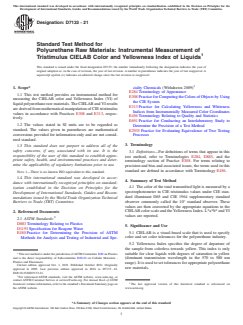
5.1 CIELAB is a visual-based scale that is used to specify color and set color tolerances for the polyurethane industry.
5.2 Yellowness Index specifies the degree of departure of the sample from colorless towards yellow. This index is only suitable for clear liquids with degrees of saturation in yellow (dominant transmission wavelength in the 570 to 580 nm range). It is used to set tolerances for appropriate polyurethane raw materials.
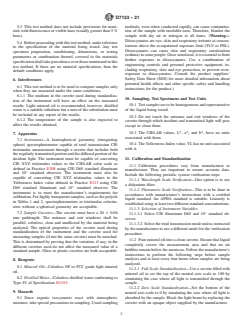
5.3 This test method does not include provisions for materials with fluorescence or visible haze (usually greater than 5 % haze).
5.4 Before proceeding with this test method, make reference to the specification of the material being tested. Any test specimen preparation, conditioning, dimensions, or testing parameters or combination thereof, covered in the materials specification shall take precedence over those mentioned in this test method. If there are no material specifications, then the default conditions apply.
SCOPE
1.1 This test method provides an instrumental method for measuring the CIELAB color and Yellowness Index (YI) of liquid polyurethane raw materials. The CIELAB and YI results are derived from mathematical manipulation of CIE tristimulus values in accordance with Practices E308 and E313, respectively.
1.2 The values stated in SI units are to be regarded as standard. The values given in parentheses are mathematical conversions provided for information only and are not considered standard.
1.3 This standard does not purport to address all of the safety concerns, if any, associated with its use. It is the responsibility of the user of this standard to establish appropriate safety, health, and environmental practices and determine the applicability of regulatory limitations prior to use.
Note 1: There is no known ISO equivalent to this standard.
1.4 This international standard was developed in accordance with internationally recognized principles on standardization established in the Decision on Principles for the Development of International Standards, Guides and Recommendations issued by the World Trade Organization Technical Barriers to Trade (TBT) Committee.
- Status
- Published
- Publication Date
- 30-Sep-2021
- Technical Committee
- D20 - Plastics
- Drafting Committee
- D20.22 - Cellular Materials - Plastics and Elastomers
Buy Documents
ASTM D7133-21 - Standard Test Method for Polyurethane Raw Materials: Instrumental Measurement of Tristimulus CIELAB Color and Yellowness Index of Liquids
REDLINE ASTM D7133-21 - Standard Test Method for Polyurethane Raw Materials: Instrumental Measurement of Tristimulus CIELAB Color and Yellowness Index of Liquids
Overview
ASTM D7133-21 is the Standard Test Method for Polyurethane Raw Materials: Instrumental Measurement of Tristimulus CIELAB Color and Yellowness Index of Liquids. Developed by ASTM International, this standard defines precise procedures for the instrumental evaluation of color (using the CIELAB scale) and yellowness index (YI) in liquid polyurethane raw materials. The method is essential for specifying and maintaining color tolerances in the polyurethane industry and is widely acknowledged as a key tool for quality control and product consistency.
Key Topics
CIELAB Color Measurement:
The CIELAB scale is a visually based, three-dimensional color model that enables accurate specification and comparison of color in liquids. It is widely used to set and verify color tolerances for polyurethane raw materials.Yellowness Index (YI):
YI quantifies the degree to which a clear liquid departs from colorless towards yellow, based on specific optical characteristics (dominant wavelength between 570 to 580 nm). This metric is crucial for quality assessment in clear polyurethane formulations.Applicability and Limitations:
- Suitable for clear liquids; not recommended for samples with significant fluorescence or visible haze (usually over 5% haze).
- Designed for consistent results when samples are prepared and measured under standardized conditions.
- Requires reference to specific material specifications prior to testing, as some conditions may override the test method defaults.
Instrumentation:
Utilizes spectrophotometric analysis under standardized illumination (CIE D65) and observer conditions (10° standard observer), as outlined in ASTM E308 and E313.Precision and Reproducibility:
The standard includes guidance for inter- and intra-laboratory precision, emphasizing the need for calibration and standardized procedures to ensure repeatability.
Applications
Quality Control in Polyurethane Production:
Manufacturers and suppliers of polyols, isocyanates, and other polyurethane precursors use ASTM D7133-21 to ensure raw material color consistency and to avoid undesirable yellowing in finished products.Material Acceptance and Specification:
Procurement and technical teams rely on this standard to define and verify allowable color and yellowness limits in supply contracts for polyurethane raw materials.Regulatory and Certification Testing:
Compliance testing for color properties is often required for certification or regulatory purposes in industries where appearance and transparency are critical.R&D and Formulation Optimization:
Laboratories utilize this method during product development to compare color performance between formulations and to identify factors that may impact appearance.
Related Standards
ASTM E308: Practice for Computing the Colors of Objects by Using the CIE System.
Provides the mathematical foundations for calculating CIE tristimulus values, upon which CIELAB and YI measurements are based.ASTM E313: Practice for Calculating Yellowness and Whiteness Indices from Instrumentally Measured Color Coordinates.
Specifies equations and protocols for calculating the yellowness index.ASTM D883: Terminology Relating to Plastics.
ASTM D1193: Specification for Reagent Water.
ASTM E284: Terminology of Appearance.
ASTM E691: Practice for Conducting an Interlaboratory Study to Determine the Precision of a Test Method.
There is currently no ISO equivalent to ASTM D7133-21, making this standard particularly significant for organizations seeking internationally recognized guidance on the instrumental color measurement and yellowness of liquid polyurethane raw materials.
Keywords: CIELAB, yellowness index, polyurethane raw materials, instrumental color measurement, spectrophotometry, polyols, isocyanates, ASTM D7133-21
Relations
- Effective Date
- 01-Feb-2024
- Effective Date
- 01-Nov-2023
- Effective Date
- 01-Apr-2022
- Effective Date
- 01-Jan-2020
- Effective Date
- 01-Aug-2019
- Effective Date
- 15-Apr-2019
- Effective Date
- 01-Feb-2019
- Effective Date
- 01-Dec-2018
- Effective Date
- 01-Nov-2018
- Effective Date
- 01-Oct-2017
- Effective Date
- 01-Oct-2017
- Refers
ASTM E2935-17 - Standard Practice for Conducting Equivalence Testing in Laboratory Applications - Effective Date
- 01-Oct-2017
- Effective Date
- 15-Aug-2017
- Effective Date
- 01-May-2017
- Refers
ASTM E2935-16 - Standard Practice for Conducting Equivalence Testing in Laboratory Applications - Effective Date
- 15-Nov-2016
Buy Documents
ASTM D7133-21 - Standard Test Method for Polyurethane Raw Materials: Instrumental Measurement of Tristimulus CIELAB Color and Yellowness Index of Liquids
REDLINE ASTM D7133-21 - Standard Test Method for Polyurethane Raw Materials: Instrumental Measurement of Tristimulus CIELAB Color and Yellowness Index of Liquids
Get Certified
Connect with accredited certification bodies for this standard

DIN CERTCO
DIN Group product certification.

Smithers Quality Assessments
US management systems and product certification.
Sponsored listings
Frequently Asked Questions
ASTM D7133-21 is a standard published by ASTM International. Its full title is "Standard Test Method for Polyurethane Raw Materials: Instrumental Measurement of Tristimulus CIELAB Color and Yellowness Index of Liquids". This standard covers: SIGNIFICANCE AND USE 5.1 CIELAB is a visual-based scale that is used to specify color and set color tolerances for the polyurethane industry. 5.2 Yellowness Index specifies the degree of departure of the sample from colorless towards yellow. This index is only suitable for clear liquids with degrees of saturation in yellow (dominant transmission wavelength in the 570 to 580 nm range). It is used to set tolerances for appropriate polyurethane raw materials. 5.3 This test method does not include provisions for materials with fluorescence or visible haze (usually greater than 5 % haze). 5.4 Before proceeding with this test method, make reference to the specification of the material being tested. Any test specimen preparation, conditioning, dimensions, or testing parameters or combination thereof, covered in the materials specification shall take precedence over those mentioned in this test method. If there are no material specifications, then the default conditions apply. SCOPE 1.1 This test method provides an instrumental method for measuring the CIELAB color and Yellowness Index (YI) of liquid polyurethane raw materials. The CIELAB and YI results are derived from mathematical manipulation of CIE tristimulus values in accordance with Practices E308 and E313, respectively. 1.2 The values stated in SI units are to be regarded as standard. The values given in parentheses are mathematical conversions provided for information only and are not considered standard. 1.3 This standard does not purport to address all of the safety concerns, if any, associated with its use. It is the responsibility of the user of this standard to establish appropriate safety, health, and environmental practices and determine the applicability of regulatory limitations prior to use. Note 1: There is no known ISO equivalent to this standard. 1.4 This international standard was developed in accordance with internationally recognized principles on standardization established in the Decision on Principles for the Development of International Standards, Guides and Recommendations issued by the World Trade Organization Technical Barriers to Trade (TBT) Committee.
SIGNIFICANCE AND USE 5.1 CIELAB is a visual-based scale that is used to specify color and set color tolerances for the polyurethane industry. 5.2 Yellowness Index specifies the degree of departure of the sample from colorless towards yellow. This index is only suitable for clear liquids with degrees of saturation in yellow (dominant transmission wavelength in the 570 to 580 nm range). It is used to set tolerances for appropriate polyurethane raw materials. 5.3 This test method does not include provisions for materials with fluorescence or visible haze (usually greater than 5 % haze). 5.4 Before proceeding with this test method, make reference to the specification of the material being tested. Any test specimen preparation, conditioning, dimensions, or testing parameters or combination thereof, covered in the materials specification shall take precedence over those mentioned in this test method. If there are no material specifications, then the default conditions apply. SCOPE 1.1 This test method provides an instrumental method for measuring the CIELAB color and Yellowness Index (YI) of liquid polyurethane raw materials. The CIELAB and YI results are derived from mathematical manipulation of CIE tristimulus values in accordance with Practices E308 and E313, respectively. 1.2 The values stated in SI units are to be regarded as standard. The values given in parentheses are mathematical conversions provided for information only and are not considered standard. 1.3 This standard does not purport to address all of the safety concerns, if any, associated with its use. It is the responsibility of the user of this standard to establish appropriate safety, health, and environmental practices and determine the applicability of regulatory limitations prior to use. Note 1: There is no known ISO equivalent to this standard. 1.4 This international standard was developed in accordance with internationally recognized principles on standardization established in the Decision on Principles for the Development of International Standards, Guides and Recommendations issued by the World Trade Organization Technical Barriers to Trade (TBT) Committee.
ASTM D7133-21 is classified under the following ICS (International Classification for Standards) categories: 83.080.20 - Thermoplastic materials. The ICS classification helps identify the subject area and facilitates finding related standards.
ASTM D7133-21 has the following relationships with other standards: It is inter standard links to ASTM D883-24, ASTM D883-23, ASTM E456-13a(2022)e1, ASTM D883-20, ASTM D883-19c, ASTM D883-19a, ASTM D883-19, ASTM D883-18a, ASTM D883-18, ASTM E456-13A(2017)e1, ASTM E456-13A(2017)e3, ASTM E2935-17, ASTM D883-17, ASTM E308-17, ASTM E2935-16. Understanding these relationships helps ensure you are using the most current and applicable version of the standard.
ASTM D7133-21 is available in PDF format for immediate download after purchase. The document can be added to your cart and obtained through the secure checkout process. Digital delivery ensures instant access to the complete standard document.
Standards Content (Sample)
This international standard was developed in accordance with internationally recognized principles on standardization established in the Decision on Principles for the
Development of International Standards, Guides and Recommendations issued by the World Trade Organization Technical Barriers to Trade (TBT) Committee.
Designation: D7133 − 21
Standard Test Method for
Polyurethane Raw Materials: Instrumental Measurement of
Tristimulus CIELAB Color and Yellowness Index of Liquids
This standard is issued under the fixed designation D7133; the number immediately following the designation indicates the year of
original adoption or, in the case of revision, the year of last revision. A number in parentheses indicates the year of last reapproval. A
superscript epsilon (´) indicates an editorial change since the last revision or reapproval.
1. Scope* cialty Chemicals (Withdrawn 2009)
E284 Terminology of Appearance
1.1 This test method provides an instrumental method for
E308 PracticeforComputingtheColorsofObjectsbyUsing
measuring the CIELAB color and Yellowness Index (YI) of
the CIE System
liquid polyurethane raw materials.The CIELAB andYI results
E313 Practice for Calculating Yellowness and Whiteness
arederivedfrommathematicalmanipulationofCIEtristimulus
Indices from Instrumentally Measured Color Coordinates
values in accordance with Practices E308 and E313, respec-
E456 Terminology Relating to Quality and Statistics
tively.
E691 Practice for Conducting an Interlaboratory Study to
1.2 The values stated in SI units are to be regarded as
Determine the Precision of a Test Method
standard. The values given in parentheses are mathematical
E2935 Practice for Evaluating Equivalence of Two Testing
conversions provided for information only and are not consid-
Processes
ered standard.
3. Terminology
1.3 This standard does not purport to address all of the
safety concerns, if any, associated with its use. It is the
3.1 Definitions—For definitions of terms that appear in this
responsibility of the user of this standard to establish appro-
test method, refer to Terminologies E284, D883, and the
priate safety, health, and environmental practices and deter-
terminology section of Practice E308. For terms relating to
mine the applicability of regulatory limitations prior to use.
precision and bias and associated issues, the terms used in this
standard are defined in accordance with Terminology E456.
NOTE 1—There is no known ISO equivalent to this standard.
1.4 This international standard was developed in accor-
4. Summary of Test Method
dance with internationally recognized principles on standard-
4.1 The color of the total transmitted light is measured by a
ization established in the Decision on Principles for the
spectrophotometer in CIE tristimulus values under CIE stan-
Development of International Standards, Guides and Recom-
dard illuminant D65 and CIE 1964 supplementary standard
mendations issued by the World Trade Organization Technical
observer commonly called the 10° standard observer. These
Barriers to Trade (TBT) Committee.
values are then converted by the appropriate equations to the
CIELAB color scale and theYellowness Index. L*a*b* andYI
2. Referenced Documents
values are reported.
2.1 ASTM Standards:
D883 Terminology Relating to Plastics
5. Significance and Use
D1193 Specification for Reagent Water
5.1 CIELAB is a visual-based scale that is used to specify
E180 Practice for Determining the Precision of ASTM
color and set color tolerances for the polyurethane industry.
Methods for Analysis and Testing of Industrial and Spe-
5.2 Yellowness Index specifies the degree of departure of
the sample from colorless towards yellow. This index is only
suitable for clear liquids with degrees of saturation in yellow
This test method is under the jurisdiction ofASTM Committee D20 on Plastics
and is the direct responsibility of Subcommittee D20.22 on Cellular Materials -
(dominant transmission wavelength in the 570 to 580 nm
Plastics and Elastomers.
range). It is used to set tolerances for appropriate polyurethane
Current edition approved Oct. 1, 2021. Published October 2021. Originally
raw materials.
approved in 2005. Last previous edition approved in 2016 as D7133 - 16.
DOI:10.1520/D7133-21.
For referenced ASTM standards, visit the ASTM website, www.astm.org, or
contact ASTM Customer Service at service@astm.org. For Annual Book of ASTM
Standards volume information, refer to the standard’s Document Summary page on The last approved version of this historical standard is referenced on
the ASTM website. www.astm.org.
*A Summary of Changes section appears at the end of this standard
Copyright © ASTM International, 100 Barr Harbor Drive, PO Box C700, West Conshohocken, PA 19428-2959. United States
D7133 − 21
5.3 This test method does not include provisions for mate- methods, even when conducted rapidly, can cause contamina-
rialswithfluorescenceorvisiblehaze(usuallygreaterthan5 % tion of the sample with insoluble urea. Therefore, blanket the
haze). sample with dry air or nitrogen at all times. (Warning—
Diisocyanates are eye, skin and respiratory irritants at concen-
5.4 Beforeproceedingwiththistestmethod,makereference
trations above the occupational exposure limit (TLV or PEL).
to the specification of the material being tested. Any test
Diisocyanates can cause skin and respiratory sensitization
specimen preparation, conditioning, dimensions, or testing
(asthma)insomepeople.Oncesensitized,itisessentialtolimit
parameters or combination thereof, covered in the materials
further exposure to diisocyanates. Use a combination of
specificationshalltakeprecedenceoverthosementionedinthis
engineering controls and personal protective equipment, in-
test method. If there are no material specifications, then the
cluding respiratory, skin and eye protection, to prevent over-
default conditions apply.
exposure to diisocyanates. Consult the product suppliers’
Safety Data Sheet (SDS) for more detailed information about
6. Interferences
potential health effects and other specific safety and handling
6.1 This test method is to be used to compare samples only
instructions for the product.)
when they are measured under the same conditions.
6.1.1 The medium in the cuvette used during standardiza-
10. Sampling, Test Specimens and Test Units
tion of the instrument will have an effect on the measured
10.1 Testsamplesaretobehomogeneousandrepresentative
results. Light mineral oil is recommended, however, distilled
of the liquid being tested.
water is a suitable substitute but a note of the substitution must
be included in any report of the results.
10.2 Do not touch the entrance and exit windows of the
6.1.2 The temperature of the sample is also expected to
cuvette through which incident and transmitted light will pass
affect the results obtained.
except to clean them.
10.3 The CIELAB values, L*, a*, and b*, have no units
7. Apparatus
associated with them.
7.1 Instrument—A hemispherical geometry (integrating
10.4 TheYellowness Index value,YI, has no unit associated
sphere) spectrophotometer capable of total transmission CIE
with it.
tristimulus measurement through a cuvette that includes both
theregularlytransmittedportionandthediffusedportionofthe
11. Calibration and Standardization
incident light. The instrument must be capable of converting
CIE XYZ tristimulus values to the CIELAB color scale as
11.1 Calibration procedures vary from manufacturer to
defined in Practice E308 using CIE D65 standard illuminant
manufacturer. They are important to ensure accurate data.
and 10° standard observer. The instrument must also be
Include the following periodic system verification steps:
capable of converting CIE XYZ tristimulus values to the
11.1.1 Wavelength Scale Verification—One option is to use
Yellowness Index value defined in Practice E313 using CIE
a didymium filter.
D65 standard illuminant and 10° standard observer. The
11.1.2 Photomeric Scale Verification—This is to be done in
instrument is to meet the manufacturer’s requirements for
accordance with manufacturer’s instructions with a certified
calibration. For highly transparent samples, such as the polyols
liquid standard. An APHA standard is suitable. Linearity is
in Tables 1 and 2, spectrophotometers or tristimulus colorim-
establishedusingatleasttwodifferentstandardconcentrations.
eters without a spherical geometry are acceptable.
11.1.3 Selection of Instrument Variables
7.2 Sample Cuvettes—The cuvette must have a 20 6 0.06
11.1.3.1 Select CIE illuminant D65 and 10° standard ob-
mm pathlength. The entrance and exit windows shall be
server.
parallel, colorless, clear and unaffected by the material being
11.1.3.2 Selectthetotaltransmissionmodeunlessinstructed
analyzed. The optical properties of the cuvette used during
by the manufacturer to use a different mode for the verification
standardization of the instrument and the cuvette used for
procedure.
measuring samples (if not the same cuvette) must be matched.
11.2 Pourmineraloilintoacleancuvette.Ensurethatliquid
This is determined by proving that the variation, if any, in the
completely covers the measurement area and that no air
different cuvettes used do not affect the measured value of a
bubblesremainbelowthemeniscus.Followthemanufacturer’s
standard sample. Glass or plastic cuvettes are both acceptable.
instructions to perform the following steps before sample
analyses and at least every four hours when samples are being
8. Reagents
analyzed.
8.1 Mineral Oil—Colorless NF or FCC grade light mineral
11.2.1 Full-Scale Standardization—Useacuvettefilledwith
oil.
mineral oil to set the top of the neutral axis scale to 100 by
8.2 Distilled Water—Colorlessdistilledwaterconformingto
simulating the case where all light is tra
...
This document is not an ASTM standard and is intended only to provide the user of an ASTM standard an indication of what changes have been made to the previous version. Because
it may not be technically possible to adequately depict all changes accurately, ASTM recommends that users consult prior editions as appropriate. In all cases only the current version
of the standard as published by ASTM is to be considered the official document.
Designation: D7133 − 16 D7133 − 21
Standard Test Method for
Polyurethane Raw Materials: Instrumental Measurement of
Tristimulus CIELAB Color and Yellowness Index of Liquids
This standard is issued under the fixed designation D7133; the number immediately following the designation indicates the year of
original adoption or, in the case of revision, the year of last revision. A number in parentheses indicates the year of last reapproval. A
superscript epsilon (´) indicates an editorial change since the last revision or reapproval.
1. Scope*
1.1 This test method provides an instrumental method for measuring the CIELAB color and Yellowness Index (YI) of liquid
polyurethane raw materials. The CIELAB and YI results are derived from mathematical manipulation of CIE tristimulus values
in accordance with Practices E308 and E313, respectively.
1.2 The values stated in SI units are to be regarded as standard. The values given in parentheses are mathematical conversions to
inch-pound units that are provided for information only and are not considered standard.
1.3 This standard does not purport to address all of the safety concerns, if any, associated with its use. It is the responsibility
of the user of this standard to establish appropriate safety safety, health, and healthenvironmental practices and determine the
applicability of regulatory limitations prior to use.
NOTE 1—There is no known ISO equivalent to this standard.
1.4 This international standard was developed in accordance with internationally recognized principles on standardization
established in the Decision on Principles for the Development of International Standards, Guides and Recommendations issued
by the World Trade Organization Technical Barriers to Trade (TBT) Committee.
2. Referenced Documents
2.1 ASTM Standards:
D883 Terminology Relating to Plastics
D1193 Specification for Reagent Water
E180 Practice for Determining the Precision of ASTM Methods for Analysis and Testing of Industrial and Specialty Chemicals
(Withdrawn 2009)
E284 Terminology of Appearance
E308 Practice for Computing the Colors of Objects by Using the CIE System
E313 Practice for Calculating Yellowness and Whiteness Indices from Instrumentally Measured Color Coordinates
E456 Terminology Relating to Quality and Statistics
E691 Practice for Conducting an Interlaboratory Study to Determine the Precision of a Test Method
E2935 Practice for Evaluating Equivalence of Two Testing Processes
This test method is under the jurisdiction of ASTM Committee D20 on Plastics and is the direct responsibility of Subcommittee D20.22 on Cellular Materials - Plastics
and Elastomers.
Current edition approved Sept. 1, 2016Oct. 1, 2021. Published September 2016October 2021. Originally approved in 2005. Last previous edition approved in 20112016
as D7133 - 11.D7133 - 16. DOI:10.1520/D7133-16.DOI:10.1520/D7133-21.
For referenced ASTM standards, visit the ASTM website, www.astm.org, or contact ASTM Customer Service at service@astm.org. For Annual Book of ASTM Standards
volume information, refer to the standard’s Document Summary page on the ASTM website.
The last approved version of this historical standard is referenced on www.astm.org.
*A Summary of Changes section appears at the end of this standard
Copyright © ASTM International, 100 Barr Harbor Drive, PO Box C700, West Conshohocken, PA 19428-2959. United States
D7133 − 21
3. Terminology
3.1 Definitions—For definitions of terms that appear in this test method, refer to Terminologies E284, D883, and the terminology
section of Practice E308. For terms relating to precision and bias and associated issues, the terms used in this standard are defined
in accordance with Terminology E456.
4. Summary of Test Method
4.1 The color of the total transmitted light is measured by a spectrophotometer in CIE tristimulus values under CIE standard
illuminant D65 and CIE 1964 supplementary standard observer commonly called the 10° standard observer. These values are then
converted by the appropriate equations to the CIELAB color scale and the Yellowness Index. L*a*b* and YI values are reported.
5. Significance and Use
5.1 CIELAB is a visual-based scale that is used to specify color and set color tolerances for the polyurethane industry.
5.2 Yellowness Index specifies the degree of departure of the sample from colorless towards yellow. This index is only suitable
for clear liquids with degrees of saturation in yellow (dominant transmission wavelength in the 570 to 580 nm range). It is used
to set tolerances for appropriate polyurethane raw materials.
5.3 This test method does not include provisions for materials with fluorescence or visible haze (usually greater than 5 % haze).
5.4 Before proceeding with this test method, make reference to the specification of the material being tested. Any test specimen
preparation, conditioning, dimensions, or testing parameters or combination thereof, covered in the materials specification shall
take precedence over those mentioned in this test method. If there are no material specifications, then the default conditions apply.
6. Interferences
6.1 This test method is to be used to compare samples only when they are measured under the same conditions.
6.1.1 The medium in the cuvette used during standardization of the instrument will have an effect on the measured results. Light
mineral oil is recommended, however, distilled water is a suitable substitute but a note of the substitution must be included in any
report of the results.
6.1.2 The temperature of the sample is also expected to affect the results obtained.
7. Apparatus
7.1 Instrument—A hemispherical geometry (integrating sphere) spectrophotometer capable of total transmission (TTRAN) CIE
tristimulus measurement through a cuvette. TTRANcuvette that includes both the regularly transmitted portion and the diffused
portion of the incident light. The instrument must be capable of converting CIE XYZ tristimulus values to the CIELAB color scale
as defined in Practice E308 using CIE D65 standard illuminant and 10° standard observer. The instrument must also be capable
of converting CIE XYZ tristimulus values to the Yellowness Index value defined in Practice E313 using CIE D65 standard
illuminant and 10° standard observer. The instrument is to meet the manufacturer’s requirements for calibration. For highly
transparent samples, such as the polyols in Tables 1 and 2, Tables 1 and 2, spectrophotometers or tristimulus colorimeters without
a spherical geometry are acceptable for use with equivalent results.acceptable.
7.2 Sample Cuvettes—The cuvette must have a 20 6 0.06 mm pathlength. The entrance and exit windows shall be parallel,
colorless, clear and unaffected by the material being analyzed. The optical properties of the cuvette used during standardization
of the instrument and the cuvette used for measuring samples (if not the same cuvette) must be matched. This is determined by
proving that the variation, if any, in the different cuvettes used do not affect the measured value of a standard sample. Glass or
plastic cuvettes are both acceptable.
8. Reagents
8.1 Mineral Oil—Colorless NF or FCC grade light mineral oil.
D7133 − 21
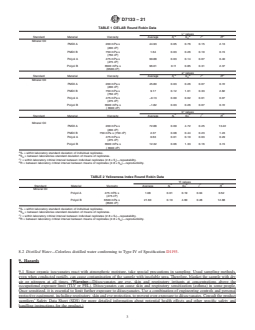
TABLE 1 CIELAB Round Robin Data
L* values
A B C D
Standard Material Viscosity Average S S r R
r R
Mineral Oil
PMDI A 200 mPa s 44.93 0.05 0.76 0.15 2.13
(200 cP)
PMDI B 750 mPa s 1.64 0.03 0.26 0.10 0.74
(750 cP)
Polyol A 475 mPa s 99.88 0.03 0.14 0.07 0.40
(475 cP)
Polyol B 6500 mPa s 96.01 0.11 0.85 0.31 2.37
(6500 cP)
a* values
A B C D
Standard Material Viscosity Average S S r R
r R
Mineral Oil
PMDI A 200 mPa s 45.80 0.03 0.26 0.07 0.72
(200 cP)
PMDI B 750 mPa s 9.17 0.12 1.01 0.33 2.82
(750 cP)
Polyol A 475 mPa s –0.13 0.00 0.02 0.01 0.07
(475 cP)
Polyol B 6500 mPa s –1.82 0.03 0.26 0.07 0.72
( 6500 cP)
b* values
A B C D
Standard Material Viscosity Average S S r R
r R
Mineral Oil
PMDI A 200 mPa s 72.88 0.09 4.72 0.25 13.22
(200 cP)
PMDI B 750 mPa s (750 cP) 2.37 0.08 0.44 0.23 1.23
Polyol A 475 mPa s 0.63 0.01 0.10 0.03 0.29
(475 cP)
Polyol B 6500 mPa s 12.32 0.06 1.33 0.16 3.74
( 6500 cP)
A
S = within laboratory standard deviation of individual replicates.
r
B
S = between laboratories standard deviation of means of replicates.
R
C
r = within laboratory critical interval between individual replicates (2.8 × S )—repeatability.
r
D
R = between laboratory critical interval between means of replicates (2.8 × S )—reproducibility.
R
TABLE 2 Yellowness Index Round Robin Data
YI values
A B C D
Standard Material Viscosity Average S S r R
r R
Mineral Oil
Polyol A 475 mPA s 1.08 0.01 0.19 0.04 0.52
(475 cP)
Polyol B 6500 mPa s 21.60 0.10 4.60 0.28 12.88
(6500 cP)
A
S = within laboratory standard deviation of individual replicates.
r
B
S = between laboratories standard deviation of means of replicates.
R
C
r = within laboratory critical interval between individual replicates (2.8 × S )—repeatability.
r
D
R = between laboratory critical interval between means of replicates (2.8 × S )—reproducibility.
R
8.2 Distilled Water—Colorless distilled water conforming to Type IV of Specification D1193.
9. Hazards
9.1 Since organic isocyanates react with atmospheric moisture, take special precautions in sampling. Usual sampling methods,
even when conducted rapidly, can cause contamination of the sample with insoluble urea. Therefore, blanket the sample with dry
air or nitrogen at all times. (Warning—Diisocyanates are eye, skin and respiratory irritants at concentrations above the
occupational exposure limit (TLV or PEL). Diisocyanates can cause skin and respiratory sensitization (asthma) in some people.
Once sensitized, it is essential to limit further exposure to diisocyanates. Use a combination of engineering controls and personal
protective equipment, including respiratory, skin and eye protection, to prevent over-exposure to diisocyanates. Consult the product
suppliers’ Safety Data Sheet (SDS) for more detailed information about potential health effects and other specific safety and
handling instructions for the product.)
D7133 − 21
10. Sampling Sampling, Test Specimens and Test Specs and Units
10.1 Test samples are to be homogeneous and representative of the liquid being tested.
10.2 Do not touch the entrance and exit windows of the cuvette through which incident and transmitted light will pass except to
clean them.
10.3 The CIELAB values, L*, a*, and b*, have no units associated with them.
10.4 The Yellowness Index value, YI, has no unit associated with it.
9.5 Since organic isocyanates react with atmospheric moisture, take special precautions in sampling. Usual sampling methods,
even
...