

ASTM D6607-21
(Practice)Standard Practice for Inclusion of Precision Statement Variation in Specification Limits
General Information
- Abstract
SIGNIFICANCE AND USE
4.1 Each test method has a limited precision. Even if a test is performed as carefully and as correctly as possible on a material which is as homogeneous as can be obtained, the test will still vary from one to another. A widely used measure of the variation of the test results from a test method is the standard deviation (σ). In an ASTM standard test method, the standard deviation of the test method can be found in the Precision and Bias statement for the test. The “Blue Book,” Form and Style for ASTM Standards, requires that all test methods include Precision and Bias statements. Practices C670 and C802 provide guidance for determination of these values.
4.2 If the precision of a test method is low and the precision of the test has not been properly considered in a material specification, a uniform material with the right quality may still be rejected most of the time because of the wide variation of the test results. In order to have rational specification limits, the precision of the test used should be properly included in a specification.
4.3 This practice provides a guideline for proper inclusion of precision of the test method in a rational specification.
SCOPE
1.1 This practice covers a method of determining rational specification limits by inclusion of the precision of the test method used in the specification.
1.2 The values stated in SI units are to be regarded as standard. No other units of measurement are included in this standard.
1.3 The text of this standard references notes and footnotes which provide explanatory material. These notes and footnotes (excluding those in tables and figures) shall not be considered as requirements of the standard.
1.4 This standard does not purport to address all of the safety concerns, if any, associated with its use. It is the responsibility of the user of this standard to establish appropriate safety, health, and environmental practices and determine the applicability of regulatory limitations prior to use.
1.5 This international standard was developed in accordance with internationally recognized principles on standardization established in the Decision on Principles for the Development of International Standards, Guides and Recommendations issued by the World Trade Organization Technical Barriers to Trade (TBT) Committee.
- Status
- Published
- Publication Date
- 31-Oct-2021
- Technical Committee
- D04 - Road and Paving Materials
- Drafting Committee
- D04.94 - Statistical Procedures and Evaluation of Data
Buy Documents


ASTM D6607-21 - Standard Practice for Inclusion of Precision Statement Variation in Specification Limits
REDLINE ASTM D6607-21 - Standard Practice for Inclusion of Precision Statement Variation in Specification Limits
Overview
ASTM D6607-21: Standard Practice for Inclusion of Precision Statement Variation in Specification Limits is a vital international standard developed by ASTM International. This standard outlines procedures for incorporating the precision of test methods-specifically their measured variability-when establishing rational specification limits for materials. By formally considering test method precision, ASTM D6607-21 ensures that materials are not unjustly rejected due to normal statistical variation, thereby supporting more accurate, repeatable, and fair quality assessments in laboratory settings or construction project evaluations.
Key Topics
- Test Method Precision: Recognizes that every test method exhibits some degree of inherent variation, typically described by the standard deviation (σ) as found in a method's Precision and Bias statements.
- Rational Specification Limits: Provides guidelines for setting acceptance criteria that reflect both the actual material variability and the measurement precision, thereby minimizing the risk of erroneously rejecting compliant materials.
- Statistical Calculations: Offers methods to calculate combined standard deviations, considering both material and test method variability, and guidance in determining specification limits for one-ended and two-ended (bilateral) requirements.
- Confidence Intervals: Recommends use of Z-values to set specification boundaries at established confidence levels, improving the reliability of quality assurance programs.
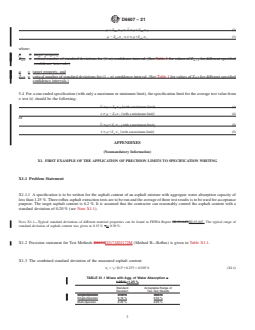
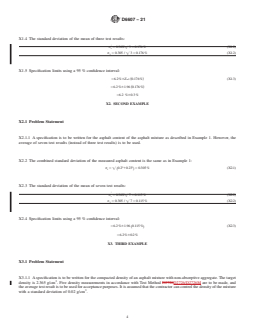
- Practical Examples: Includes nonmandatory appendices with sample calculations for common scenarios such as asphalt content in mixtures and compacted density measurements, showing step-by-step applications of the standard.
- SI Units Compliance: Specifies SI units as the standard, promoting consistency and clarity in international contexts.
Applications
ASTM D6607-21 plays a critical role in industries where material specification and conformance testing are vital, including construction materials engineering, asphalt production, and laboratory quality control. Typical applications include:
- Laboratory Test Methods: Assists test developers and laboratory technicians in integrating test precision into quality acceptance criteria, preventing undue rejection of well-manufactured products.
- Materials Specification Writing: Guides engineers and specification writers in formulating rational, statistically grounded specification limits for material properties, including but not limited to asphalt binder content and bulk density of compacted mixtures.
- Quality Assurance Programs: Enhances the integrity of quality control processes by establishing clear acceptance thresholds that account for both product variability and measurement uncertainty, as required under many regulatory and contractual frameworks.
- Interlaboratory Comparisons: Supports the harmonization of test methods and acceptance criteria across laboratories, ensuring comparable and repeatable results in multi-site projects.
- Risk Mitigation: Decreases the likelihood that inherent test imprecision will lead to costly disputes or waste due to unnecessary rejection of compliant materials.
Related Standards
Several other ASTM and industry standards are directly referenced or aligned with ASTM D6607-21 for comprehensive quality management:
- ASTM C670 - Practice for Preparing Precision and Bias Statements for Test Methods for Construction Materials
- ASTM C802 - Practice for Conducting an Interlaboratory Test Program to Determine the Precision of Test Methods for Construction Materials
- ASTM E177 - Practice for Use of the Terms Precision and Bias in ASTM Test Methods
- ASTM D2172 / D2172M - Test Methods for Quantitative Extraction of Asphalt Binder from Asphalt Mixtures
- ASTM D2726 / D2726M - Test Method for Bulk Specific Gravity and Density of Non-Absorptive Compacted Asphalt Mixtures
- FHWA Report HI-93-047 - Materials Control and Acceptance–Quality Assurance
Adherence to ASTM D6607-21 ensures scientifically sound and internationally recognized practices for establishing specification limits, strongly supporting organizations' quality assurance and compliance objectives.
Relations
- Effective Date
- 01-Feb-2024
- Effective Date
- 01-Jan-2024
- Effective Date
- 01-Jun-2017
- Effective Date
- 01-Apr-2017
- Effective Date
- 01-Apr-2017
- Effective Date
- 01-May-2014
- Effective Date
- 01-Jul-2013
- Effective Date
- 01-Jul-2013
- Effective Date
- 01-May-2013
- Effective Date
- 01-Feb-2011
- Effective Date
- 01-Oct-2010
- Effective Date
- 01-Oct-2010
- Effective Date
- 15-Dec-2009
- Effective Date
- 01-Nov-2009
- Effective Date
- 01-Dec-2008
Buy Documents
ASTM D6607-21 - Standard Practice for Inclusion of Precision Statement Variation in Specification Limits
REDLINE ASTM D6607-21 - Standard Practice for Inclusion of Precision Statement Variation in Specification Limits
Get Certified
Connect with accredited certification bodies for this standard

IMP NDT d.o.o.
Non-destructive testing services. Radiography, ultrasonic, magnetic particle, penetrant, visual inspection.
Inštitut za kovinske materiale in tehnologije
Institute of Metals and Technology. Materials testing, metallurgical analysis, NDT.
Q Techna d.o.o.
NDT and quality assurance specialist. 30+ years experience. NDT personnel certification per ISO 9712, nuclear and thermal power plant inspections, QA/
Sponsored listings
Frequently Asked Questions
ASTM D6607-21 is a standard published by ASTM International. Its full title is "Standard Practice for Inclusion of Precision Statement Variation in Specification Limits". This standard covers: SIGNIFICANCE AND USE 4.1 Each test method has a limited precision. Even if a test is performed as carefully and as correctly as possible on a material which is as homogeneous as can be obtained, the test will still vary from one to another. A widely used measure of the variation of the test results from a test method is the standard deviation (σ). In an ASTM standard test method, the standard deviation of the test method can be found in the Precision and Bias statement for the test. The “Blue Book,” Form and Style for ASTM Standards, requires that all test methods include Precision and Bias statements. Practices C670 and C802 provide guidance for determination of these values. 4.2 If the precision of a test method is low and the precision of the test has not been properly considered in a material specification, a uniform material with the right quality may still be rejected most of the time because of the wide variation of the test results. In order to have rational specification limits, the precision of the test used should be properly included in a specification. 4.3 This practice provides a guideline for proper inclusion of precision of the test method in a rational specification. SCOPE 1.1 This practice covers a method of determining rational specification limits by inclusion of the precision of the test method used in the specification. 1.2 The values stated in SI units are to be regarded as standard. No other units of measurement are included in this standard. 1.3 The text of this standard references notes and footnotes which provide explanatory material. These notes and footnotes (excluding those in tables and figures) shall not be considered as requirements of the standard. 1.4 This standard does not purport to address all of the safety concerns, if any, associated with its use. It is the responsibility of the user of this standard to establish appropriate safety, health, and environmental practices and determine the applicability of regulatory limitations prior to use. 1.5 This international standard was developed in accordance with internationally recognized principles on standardization established in the Decision on Principles for the Development of International Standards, Guides and Recommendations issued by the World Trade Organization Technical Barriers to Trade (TBT) Committee.
SIGNIFICANCE AND USE 4.1 Each test method has a limited precision. Even if a test is performed as carefully and as correctly as possible on a material which is as homogeneous as can be obtained, the test will still vary from one to another. A widely used measure of the variation of the test results from a test method is the standard deviation (σ). In an ASTM standard test method, the standard deviation of the test method can be found in the Precision and Bias statement for the test. The “Blue Book,” Form and Style for ASTM Standards, requires that all test methods include Precision and Bias statements. Practices C670 and C802 provide guidance for determination of these values. 4.2 If the precision of a test method is low and the precision of the test has not been properly considered in a material specification, a uniform material with the right quality may still be rejected most of the time because of the wide variation of the test results. In order to have rational specification limits, the precision of the test used should be properly included in a specification. 4.3 This practice provides a guideline for proper inclusion of precision of the test method in a rational specification. SCOPE 1.1 This practice covers a method of determining rational specification limits by inclusion of the precision of the test method used in the specification. 1.2 The values stated in SI units are to be regarded as standard. No other units of measurement are included in this standard. 1.3 The text of this standard references notes and footnotes which provide explanatory material. These notes and footnotes (excluding those in tables and figures) shall not be considered as requirements of the standard. 1.4 This standard does not purport to address all of the safety concerns, if any, associated with its use. It is the responsibility of the user of this standard to establish appropriate safety, health, and environmental practices and determine the applicability of regulatory limitations prior to use. 1.5 This international standard was developed in accordance with internationally recognized principles on standardization established in the Decision on Principles for the Development of International Standards, Guides and Recommendations issued by the World Trade Organization Technical Barriers to Trade (TBT) Committee.
ASTM D6607-21 is classified under the following ICS (International Classification for Standards) categories: 19.020 - Test conditions and procedures in general. The ICS classification helps identify the subject area and facilitates finding related standards.
ASTM D6607-21 has the following relationships with other standards: It is inter standard links to ASTM C670-24a, ASTM C670-24, ASTM D2726/D2726M-17, ASTM D2172/D2172M-17e1, ASTM D2172/D2172M-17, ASTM E177-14, ASTM C670-13, ASTM D2726/D2726M-13, ASTM E177-13, ASTM D2172/D2172M-11, ASTM C670-10, ASTM E177-10, ASTM C802-09a, ASTM C802-09, ASTM C802-96(2008)e1. Understanding these relationships helps ensure you are using the most current and applicable version of the standard.
ASTM D6607-21 is available in PDF format for immediate download after purchase. The document can be added to your cart and obtained through the secure checkout process. Digital delivery ensures instant access to the complete standard document.
Standards Content (Sample)
This international standard was developed in accordance with internationally recognized principles on standardization established in the Decision on Principles for the
Development of International Standards, Guides and Recommendations issued by the World Trade Organization Technical Barriers to Trade (TBT) Committee.
Designation:D6607 −21
Standard Practice for
Inclusion of Precision Statement Variation in Specification
Limits
This standard is issued under the fixed designation D6607; the number immediately following the designation indicates the year of
original adoption or, in the case of revision, the year of last revision. A number in parentheses indicates the year of last reapproval. A
superscript epsilon (´) indicates an editorial change since the last revision or reapproval.
1. Scope D2726/D2726M Test Method for Bulk Specific Gravity and
Density of Non-Absorptive Compacted Asphalt Mixtures
1.1 This practice covers a method of determining rational
E177 Practice for Use of the Terms Precision and Bias in
specification limits by inclusion of the precision of the test
ASTM Test Methods
method used in the specification.
2.2 Federal Highway Administration Report:
1.2 The values stated in SI units are to be regarded as
FHWA Report HI-93-047 Materials Control and
standard. No other units of measurement are included in this
Acceptance—Quality Assurance, Federal Highway
standard.
Administration, May 1993
1.3 The text of this standard references notes and footnotes
3. Terminology
which provide explanatory material. These notes and footnotes
(excluding those in tables and figures) shall not be considered 3.1 For definitions of terms used in this practice, consult
as requirements of the standard. Practice E177.
1.4 This standard does not purport to address all of the
4. Significance and Use
safety concerns, if any, associated with its use. It is the
4.1 Each test method has a limited precision. Even if a test
responsibility of the user of this standard to establish appro-
is performed as carefully and as correctly as possible on a
priate safety, health, and environmental practices and deter-
material which is as homogeneous as can be obtained, the test
mine the applicability of regulatory limitations prior to use.
will still vary from one to another. A widely used measure of
1.5 This international standard was developed in accor-
the variation of the test results from a test method is the
dance with internationally recognized principles on standard-
standard deviation (σ). In an ASTM standard test method, the
ization established in the Decision on Principles for the
standard deviation of the test method can be found in the
Development of International Standards, Guides and Recom-
Precision and Bias statement for the test. The “Blue Book,”
mendations issued by the World Trade Organization Technical
Form and Style for ASTM Standards, requires that all test
Barriers to Trade (TBT) Committee.
methods include Precision and Bias statements. PracticesC670
2. Referenced Documents and C802 provide guidance for determination of these values.
2.1 ASTM Standards:
4.2 If the precision of a test method is low and the precision
C670 Practice for Preparing Precision and Bias Statements of the test has not been properly considered in a material
for Test Methods for Construction Materials
specification,auniformmaterialwiththerightqualitymaystill
C802 Practice for Conducting an Interlaboratory Test Pro- be rejected most of the time because of the wide variation of
gram to Determine the Precision of Test Methods for
thetestresults.Inordertohaverationalspecificationlimits,the
Construction Materials precision of the test used should be properly included in a
D2172/D2172M TestMethodsforQuantitativeExtractionof
specification.
Asphalt Binder from Asphalt Mixtures
4.3 This practice provides a guideline for proper inclusion
of precision of the test method in a rational specification.
This practice is under the jurisdiction of Committee D04 on Road and Paving
5. Procedure
Materials and is the direct responsibility of Subcommittee D04.94 on Statistical
Procedures and Evaluation of Data.
5.1 Determine the effective standard deviation (σ)ofthe
x
Current edition approved Nov. 1, 2021. Published November 2021. Originally
test results due to the combined effects of materials variation
approved in 2000. Last previous edition approved in 2015 as D6607 – 00 (2015).
DOI: 10.1520/D6607-21.
and test variation using Eq 1:
For referenced ASTM standards, visit the ASTM website, www.astm.org, or
contact ASTM Customer Service at service@astm.org. For Annual Book of ASTM
Standards volume information, refer to the standard’s Document Summary page on Available from National Technical Information Service (NTIS), U.S. Depart-
the ASTM website. ment of Commerce, 5285 Port Royal Rd., Springfield, VA 22161.
Copyright © ASTM International, 100 Barr Harbor Drive, PO Box C700, West Conshohocken, PA 19428-2959. United States
D6607−21
TABLE 1 Z-Values for Different Confidence Levels
2 2
σ 5 = σ 1 σ (1)
~ !
x M T
Confidence
90 % 95 % 97.5 % 99.0 %
Level (1 – α):
where:
Z (Two-End 1.645 1.960 2.243 2.575
α/2
σ = standard deviation of test property due to material
M Specification)
variation (see Note 1), and Z (One-End 1.282 1.645 1.960 2.327
α
Specification)
σ = standard deviation of test property due to test method
T
(see Note 2).
NOTE 1—σ is the expected standard deviation of the material property
M
when the material is produced in a properly controlled process.Astandard
deviation which is representative of the acceptable variation of the
material can be used. It can be calculated from the data obtained from
where:
properly produced
...
This document is not an ASTM standard and is intended only to provide the user of an ASTM standard an indication of what changes have been made to the previous version. Because
it may not be technically possible to adequately depict all changes accurately, ASTM recommends that users consult prior editions as appropriate. In all cases only the current version
of the standard as published by ASTM is to be considered the official document.
Designation: D6607 − 00 (Reapproved 2015) D6607 − 21
Standard Practice for
Inclusion of Precision Statement Variation in Specification
Limits
This standard is issued under the fixed designation D6607; the number immediately following the designation indicates the year of
original adoption or, in the case of revision, the year of last revision. A number in parentheses indicates the year of last reapproval. A
superscript epsilon (´) indicates an editorial change since the last revision or reapproval.
1. Scope
1.1 This practice covers a method of determining rational specification limits by inclusion of the precision of the test method used
in the specification.
1.2 The values stated in SI units are to be regarded as standard. No other units of measurement are included in this standard.
1.3 This standard does not purport to address all of the safety concerns, if any, associated with its use. It is the responsibility of
the user of this standard to establish appropriate safety and health practices and determine the applicability of regulatory limitations
prior to use.The text of this standard references notes and footnotes which provide explanatory material. These notes and footnotes
(excluding those in tables and figures) shall not be considered as requirements of the standard.
1.4 This standard does not purport to address all of the safety concerns, if any, associated with its use. It is the responsibility
of the user of this standard to establish appropriate safety, health, and environmental practices and determine the applicability of
regulatory limitations prior to use.
1.5 This international standard was developed in accordance with internationally recognized principles on standardization
established in the Decision on Principles for the Development of International Standards, Guides and Recommendations issued
by the World Trade Organization Technical Barriers to Trade (TBT) Committee.
2. Referenced Documents
2.1 ASTM Standards:
C670 Practice for Preparing Precision and Bias Statements for Test Methods for Construction Materials
C802 Practice for Conducting an Interlaboratory Test Program to Determine the Precision of Test Methods for Construction
Materials
D2172D2172/D2172M Test Methods for Quantitative Extraction of Asphalt Binder from Asphalt Mixtures
D2726D2726/D2726M Test Method for Bulk Specific Gravity and Density of Non-Absorptive Compacted Asphalt Mixtures
E177 Practice for Use of the Terms Precision and Bias in ASTM Test Methods
2.2 Federal Highway Administration Report:
FHWA Report HI-93–047HI-93-047 Materials Control and Acceptance—Quality Assurance, Federal Highway Administration,
May 1993
This practice is under the jurisdiction of Committee D04 on Road and Paving Materials and is the direct responsibility of Subcommittee D04.94 on Statistical Procedures
and Evaluation of Data.
Current edition approved Jan. 1, 2015Nov. 1, 2021. Published February 2015November 2021. Originally approved in 2000. Last previous edition approved in 20092015
as D6607 – 00 (2009).(2015). DOI: 10.1520/D6607-00R15.10.1520/D6607-21.
For referenced ASTM standards, visit the ASTM website, www.astm.org, or contact ASTM Customer Service at service@astm.org. For Annual Book of ASTM Standards
volume information, refer to the standard’s Document Summary page on the ASTM website.
Available from National Technical Information Service (NTIS), U.S. Department of Commerce, 5285 Port Royal Rd., Springfield, VA 22161.
Copyright © ASTM International, 100 Barr Harbor Drive, PO Box C700, West Conshohocken, PA 19428-2959. United States
D6607 − 21
3. Terminology
3.1 For definitions of terms used in this practice, consult Practice E177.
4. Significance and Use
4.1 Each test method has a limited precision. Even if a test is performed as carefully and as correctly as possible on a material
which is as homogeneous as can be obtained, the test will still vary from one to another. A widely used measure of the variation
of the test results from a test method is the standard deviation (σ). In an ASTM standard test, test method, the standard deviation
of the test method can be found in the Precision and Bias statement for the test. The “Blue Book,” Form and Style for ASTM
Standards, requires that all test methods include Precision and Bias statements. PracticePractices C670 and Practice C802 provide
guidance for determination of these values.
4.2 If the precision of a test method is low and the precision of the test has not been properly considered in a material specification,
a uniform material with the right quality may still be rejected most of the time because of the wide variation of the test results.
In order to have rational specification limits, the precision of the test used should be properly included in a specification.
4.3 This practice provides a guideline for proper inclusion of precision of the test method in a rational specification.
5. Procedure
5.1 Determine the effective standard deviation (σ ) of the test results due to the combined effects of materials variation and test
Xx
variation using Eq 1:
2 2
σ 5=~σ 1 σ ! (1)
X M T
2 2
σ 5=~σ 1 σ ! (1)
x M T
where:
σ = standard deviation of test property due to material variation (see Note 1), and
M
σ = standard deviation of test property due to test method (see Note 2).
T
NOTE 1—σ is the expected standard deviation of the material property when the material is produced in a properly controlled process. A standard
M
deviation which is representative of the acceptable variation of the material can be used. It can be calculated from the data obtained from properly
produced materials.
NOTE 2—σ is the standard deviation as given in the precision statement for the test method used to measure the test property.
T
¯
5.2 Determine the standard deviation of the mean of the test results σ σ using Eq 2:
~ !~ !
3 x¯
¯
σ 5 σ /=n (2)
3 3
σ 5 σ /=n (2)
x¯ x
where:
n = number of tests performed.
5.3 For a two-ended specification (with both a minimum and maximum limits), the specifica
...