

ASTM D7253-22
(Test Method)Standard Test Method for Polyurethane Raw Materials: Determination of Acidity as Acid Number for Polyether Polyols
General Information
- Abstract
SIGNIFICANCE AND USE
5.1 This test method is suitable for quality control, as a specification test, and for research. Acid numbers indicate the extent of any neutralization reaction of the polyol with acids. The results of this method measure batch-to-batch uniformity and are used as correction factors in calculating true hydroxyl numbers.
SCOPE
1.1 This test method measures the acidic constituents in polyether polyols and reports the results as acid number. The typical acid number range is 0-0.1 mg KOH/g sample. (See Note 1.)
1.2 The values stated in SI units are to be regarded as standard.
1.3 This standard does not purport to address all of the safety concerns, if any, associated with its use. It is the responsibility of the user of this standard to establish appropriate safety, health, and environmental practices and determine the applicability of regulatory limitations prior to use.
Note 1: There is no known ISO equivalent to this standard.
1.4 This international standard was developed in accordance with internationally recognized principles on standardization established in the Decision on Principles for the Development of International Standards, Guides and Recommendations issued by the World Trade Organization Technical Barriers to Trade (TBT) Committee.
- Status
- Published
- Publication Date
- 14-Mar-2022
- Technical Committee
- D20 - Plastics
- Drafting Committee
- D20.22 - Cellular Materials - Plastics and Elastomers
Buy Documents
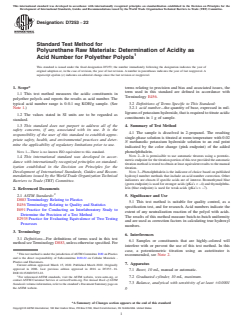


ASTM D7253-22 - Standard Test Method for Polyurethane Raw Materials: Determination of Acidity as Acid Number for Polyether Polyols
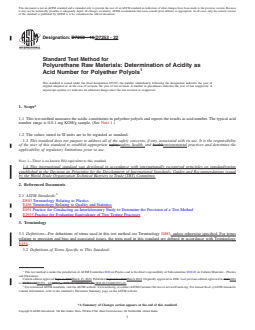
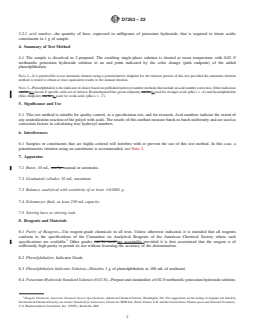

REDLINE ASTM D7253-22 - Standard Test Method for Polyurethane Raw Materials: Determination of Acidity as Acid Number for Polyether Polyols
Overview
ASTM D7253-22: Standard Test Method for Polyurethane Raw Materials: Determination of Acidity as Acid Number for Polyether Polyols provides a widely recognized method for measuring acidic constituents in polyether polyols. This standard reports results as the acid number, expressed as milligrams of potassium hydroxide (mg KOH) required to neutralize acidic components in one gram of sample.
The method is essential for quality control, specification testing, and research within the polyurethane industry. Acid number determination supports the verification of batch-to-batch uniformity and provides data necessary for correcting hydroxyl number measurements, ensuring accurate formulation and product consistency in polyether polyols.
Key Topics
- Acid Number Determination: Identifies and quantifies the acidic constituents within polyether polyols, facilitating the assessment of neutralization reactions between polyols and acids.
- Test Method Description: Samples are dissolved in 2-propanol, then titrated with methanolic KOH using phenolphthalein to signal the endpoint. Alternative indicators or automatic titration may be used for certain sample characteristics.
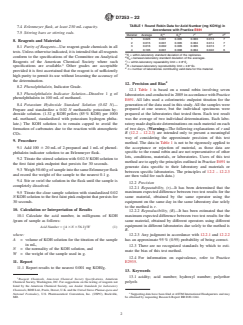
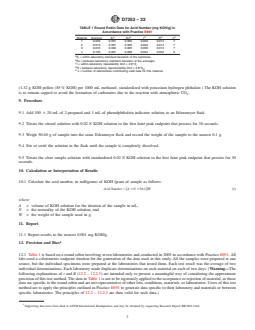
- Repeatability and Reproducibility: The test exhibits well-documented levels of precision for both intra-laboratory (repeatability) and inter-laboratory (reproducibility) scenarios, based on round-robin data generated by multiple laboratories using standardized procedures.
- Scope and Limitations: Targets an acid number range of 0-0.1 mg KOH/g sample. The method is not suitable for highly colored samples without adaptation, such as potentiometric titration.
- Reporting and Results Interpretation: Requires reporting results to the nearest 0.001 mg KOH/g, facilitating sensitive and precise analysis for quality management purposes.
Applications
- Quality Control in Polyurethane Manufacturing: Accurate measurement of the acid number is critical for maintaining product specifications and ensuring batch-to-batch consistency in polyether polyols used for polyurethane production.
- Specification Verification: Enables manufacturers and suppliers to verify raw material quality, meet contractual specifications, and comply with industry requirements.
- Research and Development: Allows researchers to characterize and optimize polyether polyol formulations by understanding the material's acid content and its effect on subsequent chemical reactions.
- Correction in Hydroxyl Number Calculations: Acid number results serve as correction factors when calculating true hydroxyl numbers, essential for the accurate stoichiometry of polyurethane systems.
The standardized measurement plays a vital role in effective process control in the plastics and elastomers industry, helping stakeholders avoid unwanted side reactions and achieve desired physical properties in end products.
Related Standards
- ASTM D883: Terminology Relating to Plastics
- ASTM E456: Terminology Relating to Quality and Statistics
- ASTM E691: Practice for Conducting an Interlaboratory Study to Determine the Precision of a Test Method
- ASTM E2935: Practice for Evaluating Equivalence of Two Testing Processes
It should be noted that there is no known ISO equivalent to ASTM D7253-22. The standard was developed following the internationally recognized principles outlined by the World Trade Organization Technical Barriers to Trade (TBT) Committee.
Keywords: ASTM D7253-22, acid number, polyether polyols, polyurethane raw materials, acidity determination, quality control, hydroxyl number correction, titration method, plastics standards, polyurethane industry.
Relations
- Effective Date
- 01-Feb-2024
- Effective Date
- 01-Nov-2023
- Effective Date
- 01-Apr-2022
- Effective Date
- 01-Jan-2020
- Effective Date
- 01-Aug-2019
- Effective Date
- 15-Apr-2019
- Effective Date
- 01-Feb-2019
- Effective Date
- 01-Dec-2018
- Effective Date
- 01-Nov-2018
- Effective Date
- 01-Oct-2017
- Refers
ASTM E2935-17 - Standard Practice for Conducting Equivalence Testing in Laboratory Applications - Effective Date
- 01-Oct-2017
- Effective Date
- 01-Oct-2017
- Effective Date
- 15-Aug-2017
- Refers
ASTM E2935-16 - Standard Practice for Conducting Equivalence Testing in Laboratory Applications - Effective Date
- 15-Nov-2016
- Refers
ASTM E2935-15 - Standard Practice for Conducting Equivalence Testing in Laboratory Applications - Effective Date
- 01-Oct-2015
Buy Documents
ASTM D7253-22 - Standard Test Method for Polyurethane Raw Materials: Determination of Acidity as Acid Number for Polyether Polyols
REDLINE ASTM D7253-22 - Standard Test Method for Polyurethane Raw Materials: Determination of Acidity as Acid Number for Polyether Polyols
Get Certified
Connect with accredited certification bodies for this standard

DIN CERTCO
DIN Group product certification.

Smithers Quality Assessments
US management systems and product certification.
Sponsored listings
Frequently Asked Questions
ASTM D7253-22 is a standard published by ASTM International. Its full title is "Standard Test Method for Polyurethane Raw Materials: Determination of Acidity as Acid Number for Polyether Polyols". This standard covers: SIGNIFICANCE AND USE 5.1 This test method is suitable for quality control, as a specification test, and for research. Acid numbers indicate the extent of any neutralization reaction of the polyol with acids. The results of this method measure batch-to-batch uniformity and are used as correction factors in calculating true hydroxyl numbers. SCOPE 1.1 This test method measures the acidic constituents in polyether polyols and reports the results as acid number. The typical acid number range is 0-0.1 mg KOH/g sample. (See Note 1.) 1.2 The values stated in SI units are to be regarded as standard. 1.3 This standard does not purport to address all of the safety concerns, if any, associated with its use. It is the responsibility of the user of this standard to establish appropriate safety, health, and environmental practices and determine the applicability of regulatory limitations prior to use. Note 1: There is no known ISO equivalent to this standard. 1.4 This international standard was developed in accordance with internationally recognized principles on standardization established in the Decision on Principles for the Development of International Standards, Guides and Recommendations issued by the World Trade Organization Technical Barriers to Trade (TBT) Committee.
SIGNIFICANCE AND USE 5.1 This test method is suitable for quality control, as a specification test, and for research. Acid numbers indicate the extent of any neutralization reaction of the polyol with acids. The results of this method measure batch-to-batch uniformity and are used as correction factors in calculating true hydroxyl numbers. SCOPE 1.1 This test method measures the acidic constituents in polyether polyols and reports the results as acid number. The typical acid number range is 0-0.1 mg KOH/g sample. (See Note 1.) 1.2 The values stated in SI units are to be regarded as standard. 1.3 This standard does not purport to address all of the safety concerns, if any, associated with its use. It is the responsibility of the user of this standard to establish appropriate safety, health, and environmental practices and determine the applicability of regulatory limitations prior to use. Note 1: There is no known ISO equivalent to this standard. 1.4 This international standard was developed in accordance with internationally recognized principles on standardization established in the Decision on Principles for the Development of International Standards, Guides and Recommendations issued by the World Trade Organization Technical Barriers to Trade (TBT) Committee.
ASTM D7253-22 is classified under the following ICS (International Classification for Standards) categories: 83.080.20 - Thermoplastic materials. The ICS classification helps identify the subject area and facilitates finding related standards.
ASTM D7253-22 has the following relationships with other standards: It is inter standard links to ASTM D883-24, ASTM D883-23, ASTM E456-13a(2022)e1, ASTM D883-20, ASTM D883-19c, ASTM D883-19a, ASTM D883-19, ASTM D883-18a, ASTM D883-18, ASTM E456-13A(2017)e1, ASTM E2935-17, ASTM E456-13A(2017)e3, ASTM D883-17, ASTM E2935-16, ASTM E2935-15. Understanding these relationships helps ensure you are using the most current and applicable version of the standard.
ASTM D7253-22 is available in PDF format for immediate download after purchase. The document can be added to your cart and obtained through the secure checkout process. Digital delivery ensures instant access to the complete standard document.
Standards Content (Sample)
This international standard was developed in accordance with internationally recognized principles on standardization established in the Decision on Principles for the
Development of International Standards, Guides and Recommendations issued by the World Trade Organization Technical Barriers to Trade (TBT) Committee.
Designation: D7253 − 22
Standard Test Method for
Polyurethane Raw Materials: Determination of Acidity as
Acid Number for Polyether Polyols
This standard is issued under the fixed designation D7253; the number immediately following the designation indicates the year of
original adoption or, in the case of revision, the year of last revision. A number in parentheses indicates the year of last reapproval. A
superscript epsilon (´) indicates an editorial change since the last revision or reapproval.
1. Scope* terms relating to precision and bias and associated issues, the
term used in this standard are defined in accordance with
1.1 This test method measures the acidic constituents in
Terminology E456.
polyether polyols and reports the results as acid number. The
typical acid number range is 0-0.1 mg KOH/g sample. (See 3.2 Definitions of Terms Specific to This Standard:
Note 1.) 3.2.1 acid number—the quantity of base, expressed in mil-
ligramsofpotassiumhydroxide,thatisrequiredtotitrateacidic
1.2 The values stated in SI units are to be regarded as
constituents in1gof sample.
standard.
1.3 This standard does not purport to address all of the
4. Summary of Test Method
safety concerns, if any, associated with its use. It is the
4.1 The sample is dissolved in 2-propanol. The resulting
responsibility of the user of this standard to establish appro-
single-phase solution is titrated at room temperature with 0.02
priate safety, health, and environmental practices and deter-
N methanolic potassium hydroxide solution to an end point
mine the applicability of regulatory limitations prior to use.
indicated by the color change (pink endpoint) of the added
NOTE 1—There is no known ISO equivalent to this standard. phenolphthalein.
NOTE 2—It is permissible to use automatic titrators using a potentio-
1.4 This international standard was developed in accor-
metric endpoint for the titration portion of this test provided the automatic
dance with internationally recognized principles on standard-
titration method is tested to obtain at least equivalent results to the manual
ization established in the Decision on Principles for the
titration.
Development of International Standards, Guides and Recom-
NOTE 3—Phenolphthalein is the indicator of choice based on published
hydroxyl number methods that include an acid number correction. Other
mendations issued by the World Trade Organization Technical
indicators are chosen if specific acids are of interest. Bromothymol blue
Barriers to Trade (TBT) Committee.
(green endpoint) is used for stronger acids (pKa’s < ~4) and thymolphtha-
lein (blue endpoint) is used for weak acids (pKa’s > ~7).
2. Referenced Documents
2.1 ASTM Standards:
5. Significance and Use
D883 Terminology Relating to Plastics
5.1 This test method is suitable for quality control, as a
E456 Terminology Relating to Quality and Statistics
specification test, and for research. Acid numbers indicate the
E691 Practice for Conducting an Interlaboratory Study to
extent of any neutralization reaction of the polyol with acids.
Determine the Precision of a Test Method
The results of this method measure batch-to-batch uniformity
E2935 Practice for Evaluating Equivalence of Two Testing
and are used as correction factors in calculating true hydroxyl
Processes
numbers.
3. Terminology
6. Interferences
3.1 Definitions—For definitions of terms used in this test
6.1 Samples or constituents that are highly-colored will
method seeTerminology D883, unless otherwise specified. For
interfere with or prevent the use of this test method. In this
case, a potentiometric titration using an autotitrator is
This test method is under the jurisdiction ofASTM Committee D20 on Plastics
recommended, see Note 2.
and is the direct responsibility of Subcommittee D20.22 on Cellular Materials -
Plastics and Elastomers.
7. Apparatus
Current edition approved March 15, 2022. Published March 2022. Originally
approved in 2006. Last previous edition approved in 2016 as D7253 - 16.
7.1 Buret, 10 mL, manual or automatic.
DOI:10.1520/D7253-22.
For referenced ASTM standards, visit the ASTM website, www.astm.org, or 7.2 Graduated cylinder, 10 mL, maximum.
contact ASTM Customer Service at service@astm.org. For Annual Book of ASTM
7.3 Balance, analytical with sensitivity of at least 60.0001
Standards volume information, refer to the standard’s Document Summary page on
the ASTM website. g.
*A Summary of Changes section appears at the end of this standard
Copyright © ASTM International, 100 Barr Harbor Drive, PO Box C700, West Conshohocken, PA 19428-2959. United States
D7253 − 22
TABLE 1 Round Robin Data for Acid Number (mg KOH/g) in
7.4 Erlenmeyer flask, at least 250 mL capacity.
Accordance with Practice E691
7.5 Stirring bars or stirring rods.
A B C D E
Material Average S S r R n
r R
1 0.026 0.001 0.005 0.003 0.013 7
8. Reagents and Materials
2 0.015 0.001 0.005 0.004 0.014 7
3 0.016 0.002 0.005 0.005 0.013 7
8.1 Purity of Reagents—Use reagent-grade chemicals in all
4 0.105 0.001 0.008 0.004 0.022 6
tests.Unlessotherwiseindicated,itisintendedthatallreagents
A
S = within-laboratory standard deviation of the replicates.
r
conform to the specifications of the Committee on Analytical
B
S = between-laboratory standard deviation of the averages.
R
C
Reagents of the American Chemical Society where such
r = within-laboratory repeatability limit = 2.8*S .
r
D
R = between-laboratory reproducibility limit = 2.8*S .
R
specifications are available. Other grades are acceptable
E
n = number of laboratories contributing valid data for this material.
provided it is first ascertained that the reagent is of sufficiently
high purity to permit its use without lessening the acc
...
This document is not an ASTM standard and is intended only to provide the user of an ASTM standard an indication of what changes have been made to the previous version. Because
it may not be technically possible to adequately depict all changes accurately, ASTM recommends that users consult prior editions as appropriate. In all cases only the current version
of the standard as published by ASTM is to be considered the official document.
Designation: D7253 − 16 D7253 − 22
Standard Test Method for
Polyurethane Raw Materials: Determination of Acidity as
Acid Number for Polyether Polyols
This standard is issued under the fixed designation D7253; the number immediately following the designation indicates the year of
original adoption or, in the case of revision, the year of last revision. A number in parentheses indicates the year of last reapproval. A
superscript epsilon (´) indicates an editorial change since the last revision or reapproval.
1. Scope*
1.1 This test method measures the acidic constituents in polyether polyols and reports the results as acid number. The typical acid
number range is 0-0.1 mg KOH/g sample. (See Note 1.)
1.2 The values stated in SI units are to be regarded as standard.
1.3 This standard does not purport to address all of the safety concerns, if any, associated with its use. It is the responsibility
of the user of this standard to establish appropriate safety safety, health, and healthenvironmental practices and determine the
applicability of regulatory limitations prior to use.
NOTE 1—There is no known ISO equivalent to this standard.
1.4 This international standard was developed in accordance with internationally recognized principles on standardization
established in the Decision on Principles for the Development of International Standards, Guides and Recommendations issued
by the World Trade Organization Technical Barriers to Trade (TBT) Committee.
2. Referenced Documents
2.1 ASTM Standards:
D883 Terminology Relating to Plastics
E456 Terminology Relating to Quality and Statistics
E691 Practice for Conducting an Interlaboratory Study to Determine the Precision of a Test Method
E2935 Practice for Evaluating Equivalence of Two Testing Processes
3. Terminology
3.1 Definitions—For definitions of terms used in this test method see Terminology D883, unless otherwise specified. For terms
relating to precision and bias and associated issues, the term used in this standard are defined in accordance with Terminology
E456.
3.2 Definitions of Terms Specific to This Standard:
This test method is under the jurisdiction of ASTM Committee D20 on Plastics and is the direct responsibility of Subcommittee D20.22 on Cellular Materials - Plastics
and Elastomers.
Current edition approved Sept. 1, 2016March 15, 2022. Published September 2016March 2022. Originally approved in 2006. Last previous edition approved in 20112016
ɛ1
as D7253 - 11D7253 - 16.(2011) . DOI:10.1520/D7253-16. DOI:10.1520/D7253-22.
For referenced ASTM standards, visit the ASTM website, www.astm.org, or contact ASTM Customer Service at service@astm.org. For Annual Book of ASTM Standards
volume information, refer to the standard’s Document Summary page on the ASTM website.
*A Summary of Changes section appears at the end of this standard
Copyright © ASTM International, 100 Barr Harbor Drive, PO Box C700, West Conshohocken, PA 19428-2959. United States
D7253 − 22
3.2.1 acid number—the quantity of base, expressed in milligrams of potassium hydroxide, that is required to titrate acidic
constituents in 1 g of sample.
4. Summary of Test Method
4.1 The sample is dissolved in 2-propanol. The resulting single-phase solution is titrated at room temperature with 0.02 N
methanolic potassium hydroxide solution to an end point indicated by the color change (pink endpoint) of the added
phenolphthalein.
NOTE 2—It is permissible to use automatic titrators using a potentiometric endpoint for the titration portion of this test provided the automatic titration
method is tested to obtain at least equivalent results to the manual titration.
NOTE 3—Phenolphthalein is the indicator of choice based on published hydroxyl number methods that include an acid number correction. Other indicators
can be are chosen if specific acids are of interest. Bromothymol blue (green endpoint) can be is used for stronger acids (pKa’s < ~4) and thymolphthalein
(blue endpoint) can be is used for weak acids (pKa’s > ~7).
5. Significance and Use
5.1 This test method is suitable for quality control, as a specification test, and for research. Acid numbers indicate the extent of
any neutralization reaction of the polyol with acids. The results of this method measure batch-to-batch uniformity and are used as
correction factors in calculating true hydroxyl numbers.
6. Interferences
6.1 Samples or constituents that are highly-colored will interfere with or prevent the use of this test method. In this case, a
potentiometric titration using an autotitrator is recommended, see Note 2.
7. Apparatus
7.1 Buret, 10 mL, can be manual or automatic.
7.2 Graduated cylinder, 10 mL, maximum.
7.3 Balance, analytical with sensitivity of at least 60.0001 g.
7.4 Erlenmeyer flask, at least 250 mL capacity.
7.5 Stirring bars or stirring rods.
8. Reagents and Materials
8.1 Purity of Reagents—Use reagent-grade chemicals in all tests. Unless otherwise indicated, it is intended that all reagents
conform to the specifications of the Committee on Analytical Reagents of the American Chemical Society where such
specifications are available. Other grades can be used are acceptable provided it is first ascertained that the reagent is of
sufficiently high purity to permit its use without lessening the accuracy of the determination.
8.2 Phenolphthalein, Indicator Grade.
8.3 Phenolphthalein Indicator Solution—Dissolve 1 g of phenolphthalein in 100 mL of methanol.
8.4 Potassium Hydroxide Standard Solution (0.02 N)—Prepare and standardize a 0.02 N methanolic potassium hydroxide solution.
Reagent Chemicals, American Chemical Society Specifications, American Chemical Society, Washington, DC. For suggestions on the testing of reagents not listed by
the American Chemical Society, see Analar Standards for Laboratory Chemicals, BDH Ltd., Poole, Dorset, U.K. and the United States Phamacopeia and National Formulary,
U.S. Pharmaceutical Convention, Inc. (USPC), Rockville, MD.
D7253 − 22
TABLE 1 Round Robin Data for Acid Number (mg KOH/g) in
Accordance with Practice E691
A B C D E
Material Average S S r
...