

ASTM D4711-89(2017)
(Test Method)Standard Test Method for Sulfonic and Sulfuric Acids in Alkylbenzene Sulfonic Acids
General Information
- Abstract
SIGNIFICANCE AND USE
4.1 Alkylbenzene sulfonic acids are important intermediates in the synthetic detergent industry and are defined under “alkyl benzene sulfonate” in Terminology D459. This test method is suitable for the rapid monitoring of the sulfonic and sulfuric acid levels, both of which have a vital bearing on final product performance and appearance.
SCOPE
1.1 This test method is applicable to the determination of sulfonic and sulfuric acids in branched and linear alkylbenzene sulfonic acids used as intermediates in synthetic detergents.
1.2 The values stated in SI units are to be regarded as standard. No other units of measurement are included in this standard.
1.3 This standard does not purport to address all of the safety concerns, if any, associated with its use. It is the responsibility of the user of this standard to establish appropriate safety and health practices and determine the applicability of regulatory limitations prior to use. Material Safety Data Sheets are available for reagents and materials. Review them for hazards prior to usage.
- Status
- Published
- Publication Date
- 31-Dec-2016
- Technical Committee
- D12 - Soaps and Other Detergents


Overview
ASTM D4711-89(2017): Standard Test Method for Sulfonic and Sulfuric Acids in Alkylbenzene Sulfonic Acids establishes procedures for the determination of sulfonic and sulfuric acids in both branched and linear alkylbenzene sulfonic acids. These chemicals are critical intermediates in the synthetic detergent industry, directly affecting the performance and appearance of finished detergent products. The method supports rapid, reliable quantitative analysis to maintain product quality.
This ASTM standard is developed in line with internationally recognized principles, supporting global consistency and compliance in the analysis of detergent intermediates.
Key Topics
- Scope of Application: This test method is applicable to branched and linear forms of alkylbenzene sulfonic acids used in the production of synthetic detergents.
- Testing Principle: The method involves potentiometric titration of a methanolic solution of the sample with cyclohexylamine, detecting sulfonic and sulfuric acid content through measurement of inflection points on the titration curve.
- Importance: Determining the correct levels of sulfonic and sulfuric acids ensures optimal cleaning performance and acceptable appearance in synthetic detergents.
- Precision and Repeatability: The procedure includes recommendations for achieving reliable results within and between laboratories, with detailed criteria for repeatability, reproducibility, and checking limits for duplicate testing.
- Interferences: The method is sensitive to the presence of certain strong and weak acids (such as nitric, hydrochloric, or carboxylic acids), but small amounts of water do not significantly interfere unless in excess.
Applications
- Synthetic Detergent Manufacturing: Used by quality control laboratories in the detergent industry to ensure intermediate chemicals meet specified acid levels, which are vital for detergent effectiveness.
- Technical Research & Development: Enables researchers to assess and refine synthetic processes for detergent intermediates.
- Compliance & Quality Assurance: Supports regulatory requirements and internal specifications for the composition of cleaning product intermediates.
- Routine Monitoring: Allows rapid detection of variations in acid content, facilitating timely adjustments in manufacturing processes to prevent off-spec product batches.
- International Trade: Provides a common, internationally recognized test method, enabling consistent quality benchmarking for suppliers and buyers in global detergent markets.
Related Standards
- ASTM D459 - Terminology Relating to Soaps and Other Detergents: Provides the definitions relevant to this standard.
- ASTM E180 - Practice for Determining the Precision of ASTM Methods for Analysis and Testing of Industrial and Specialty Chemicals (Withdrawn 2009): Forms the basis for precision data and inter-laboratory analysis.
- Material Safety Data Sheets (MSDS): Reference for safety and handling of test reagents and chemicals.
By adopting ASTM D4711-89(2017), laboratories and manufacturers ensure accurate monitoring of sulfonic and sulfuric acid content in alkylbenzene sulfonic acids, supporting high standards for detergent performance and industry compliance. For further alignment, organizations are encouraged to consider related ASTM standards and to regularly review and update testing protocols in response to technological and regulatory developments.
Relations
- Effective Date
- 01-Jan-2017
- Effective Date
- 01-Jul-2016
- Refers
ASTM D459-09 - Standard Terminology Relating to Soaps and Other Detergents <a href="#fn00002"></a> - Effective Date
- 01-Oct-2009
- Refers
ASTM D459-08a - Standard Terminology Relating to Soaps and Other Detergents <a href="#fn00002"></a> - Effective Date
- 15-Oct-2008
- Refers
ASTM D459-08 - Standard Terminology Relating to Soaps and Other Detergents <a href="#fn00002"></a> - Effective Date
- 15-Jul-2008
- Effective Date
- 01-Oct-2007
- Effective Date
- 10-Jun-2000
Get Certified
Connect with accredited certification bodies for this standard

ECOCERT
Organic and sustainability certification.

Eurofins Food Testing Global
Global leader in food, environment, and pharmaceutical product testing.

Intertek Bangladesh
Intertek certification and testing services in Bangladesh.
Sponsored listings
Frequently Asked Questions
ASTM D4711-89(2017) is a standard published by ASTM International. Its full title is "Standard Test Method for Sulfonic and Sulfuric Acids in Alkylbenzene Sulfonic Acids". This standard covers: SIGNIFICANCE AND USE 4.1 Alkylbenzene sulfonic acids are important intermediates in the synthetic detergent industry and are defined under “alkyl benzene sulfonate” in Terminology D459. This test method is suitable for the rapid monitoring of the sulfonic and sulfuric acid levels, both of which have a vital bearing on final product performance and appearance. SCOPE 1.1 This test method is applicable to the determination of sulfonic and sulfuric acids in branched and linear alkylbenzene sulfonic acids used as intermediates in synthetic detergents. 1.2 The values stated in SI units are to be regarded as standard. No other units of measurement are included in this standard. 1.3 This standard does not purport to address all of the safety concerns, if any, associated with its use. It is the responsibility of the user of this standard to establish appropriate safety and health practices and determine the applicability of regulatory limitations prior to use. Material Safety Data Sheets are available for reagents and materials. Review them for hazards prior to usage.
SIGNIFICANCE AND USE 4.1 Alkylbenzene sulfonic acids are important intermediates in the synthetic detergent industry and are defined under “alkyl benzene sulfonate” in Terminology D459. This test method is suitable for the rapid monitoring of the sulfonic and sulfuric acid levels, both of which have a vital bearing on final product performance and appearance. SCOPE 1.1 This test method is applicable to the determination of sulfonic and sulfuric acids in branched and linear alkylbenzene sulfonic acids used as intermediates in synthetic detergents. 1.2 The values stated in SI units are to be regarded as standard. No other units of measurement are included in this standard. 1.3 This standard does not purport to address all of the safety concerns, if any, associated with its use. It is the responsibility of the user of this standard to establish appropriate safety and health practices and determine the applicability of regulatory limitations prior to use. Material Safety Data Sheets are available for reagents and materials. Review them for hazards prior to usage.
ASTM D4711-89(2017) is classified under the following ICS (International Classification for Standards) categories: 71.080.40 - Organic acids. The ICS classification helps identify the subject area and facilitates finding related standards.
ASTM D4711-89(2017) has the following relationships with other standards: It is inter standard links to ASTM D4711-89(2009), ASTM D459-16, ASTM D459-09, ASTM D459-08a, ASTM D459-08, ASTM D459-00(2007), ASTM D459-00. Understanding these relationships helps ensure you are using the most current and applicable version of the standard.
ASTM D4711-89(2017) is available in PDF format for immediate download after purchase. The document can be added to your cart and obtained through the secure checkout process. Digital delivery ensures instant access to the complete standard document.
Standards Content (Sample)
This international standard was developed in accordance with internationally recognized principles on standardization established in the Decision on Principles for the
Development of International Standards, Guides and Recommendations issued by the World Trade Organization Technical Barriers to Trade (TBT) Committee.
Designation: D4711 − 89 (Reapproved 2017)
Standard Test Method for
Sulfonic and Sulfuric Acids in Alkylbenzene Sulfonic Acids
This standard is issued under the fixed designation D4711; the number immediately following the designation indicates the year of
original adoption or, in the case of revision, the year of last revision. A number in parentheses indicates the year of last reapproval. A
superscript epsilon (´) indicates an editorial change since the last revision or reapproval.
1. Scope lated from the titrant volume between the two inflections,
which is equivalent to the amount of base required for
1.1 This test method is applicable to the determination of
neutralization of the bisulfate anion.
sulfonic and sulfuric acids in branched and linear alkylbenzene
sulfonic acids used as intermediates in synthetic detergents.
4. Significance and Use
1.2 The values stated in SI units are to be regarded as
4.1 Alkylbenzenesulfonicacidsareimportantintermediates
standard. No other units of measurement are included in this
in the synthetic detergent industry and are defined under “alkyl
standard.
benzene sulfonate” in Terminology D459. This test method is
1.3 This standard does not purport to address all of the
suitable for the rapid monitoring of the sulfonic and sulfuric
safety concerns, if any, associated with its use. It is the
acid levels, both of which have a vital bearing on final product
responsibility of the user of this standard to establish appro-
performance and appearance.
priate safety and health practices and determine the applica-
bility of regulatory limitations prior to use. Material Safety
5. Interferences
Data Sheets are available for reagents and materials. Review
5.1 Strong acids, like nitric and hydrochloric, interfere, as
them for hazards prior to usage.
do weak acids, such as carboxylic acids. Small amounts of
2. Referenced Documents
water originally present in the sample do not interfere in the
determination. However, if as much as 5 % of water is present
2.1 ASTM Standards:
in the total solution (solvent plus sample), the end point
D459 Terminology Relating to Soaps and Other Detergents
becomes less sharp.
E180 Practice for Determining the Precision of ASTM
Methods for Analysis and Testing of Industrial and Spe-
6. Apparatus
cialty Chemicals (Withdrawn 2009)
6.1 Potentiometric Titrator, and combination calomel ref-
3. Summary of Test Method
erence electrode.
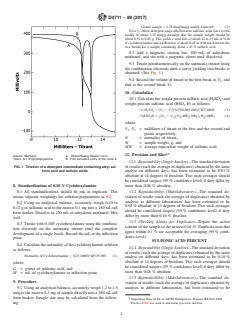
3.1 A methanolic solution of the sample is titrated with
6.2 Buret Assembly, having a 20 mL buret.
cyclohexylamine in methanol to yield a potentiometric curve.
6.3 Beaker, 180 mL tall form.
(See Fig. 1.)The first inflection represents the neutralization of
strong acids, such as sulfonics and alkylsulfurics, and the first
6.4 Volumetric Flask, Class A, 500 mL.
hydrogen of sulfuric acid. The second inflection represents the
6.5 Magnetic Stirrer, and stirring bar.
neutralization of the second hydrogen of sulfuric acid. The
amount of sulfonic acid is calculated based on the titrant
7. Reagents and Materials
volume of the first inflection minus that between the two
7.1 Methanol, anhydrous,
inflections. The amount of sulfuric acid meanwhile is calcu-
7.2 Cyclohexylamine (0.10 N)—Dissolve 10 g of reagent
cyclohexylamine in 1000 mL of anhydrous methanol. Stan-
This test method is under the jurisdiction of ASTM Committee D12 on Soaps
and Other Detergents and is the direct responsibility of Subcommittee D12.12 on dardize against sulfamic acid as described in Section 8.
Analysis and Specifications of Soaps, Synthetics, Detergents and their Components.
7.3 Sulfamic Acid, acidimetric standard.
Current edition approved Jan. 1, 2017. Published February 2017. Originally
approvedin1987.Lastpreviouseditionapprovedin2009asD4711-89(2009).DOI:
10.1520/D4711-89R17.
For referenced ASTM standards, visit the ASTM website, www.astm.org, or
contact ASTM Customer Service at service@astm.org. For Annual Book of ASTM Metrohm A436, or its equivalent, has been found suitable for this purpose.
Standards volume information, refer to the standard’s Document Summary page on Available from Brinkman Instruments.
the ASTM website. J.T. Baker No. 4898, or its equivalent, has been found suitable for this purpose.
The last approved version of this historical standard is referenced on Available from Sargent-Welch Scientific Co., 7300 Linder Ave., PO Box 1026,
www.astm.org. Skokie, IL 60077.
Copyright © ASTM International, 100 Barr Harbor Drive, PO Box C700, West Conshohocken, PA 19428-2959. United States
D4711 − 89 (2017)
Grams sample 5 1.35 meq/meq/g acidity expected (2)
NOTE 1—Most detergent range alkylbenzene sulfonic acids have a total
acidity of about 3.35 meq/g meaning that the sample weight should be
about 0.35 to 0.45 g. This yields a total titer of about 12 to 15 mL of 0.10
N cyclohexylamine and a difference of about 0.45 to 0.68 mLbetween the
two breaks for a sample containing about 1.25 % sulfuric acid.
9.2 Add a magnetic stirring bar, 100 mL of anhydrous
methanol, and stir with a magnetic stirrer until dissolved.
9.3 Titrate potentiometrically on the automatic titrator using
the combination electrode until a curve yielding two breaks is
obtained. (See Fig. 1.)
9.4 Record the vol
...