

ASTM F2050-19
(Specification)Standard Consumer Safety Specification for Hand-Held Infant Carriers
General Information
- Abstract
SCOPE
1.1 This consumer safety specification establishes performance requirements, test methods, and marking requirements to promote safe use of a hand-held infant carrier by an occupant and caregiver.
1.2 This consumer safety specification is intended to minimize the risk of incidents to an occupant resulting from normal use and reasonably foreseeable misuse or abuse of a hand-held infant carrier.
1.3 No hand-held infant carrier produced after the approval date of this consumer safety specification, either by label or other means, shall indicate compliance with this specification, unless it conforms to all requirements contained herein.
1.4 This consumer safety specification is not intended to address accidents and injuries resulting from the interaction of other persons with the child occupant in a hand-held infant carrier or the accidents resulting from abuse and misuse by children able to walk.
1.5 This consumer safety specification is not intended to address incidents or injuries resulting from use of the product in a motor vehicle, nor is it intended to address any issues that may arise from the manufacturer meeting the certification requirements of 49 CFR 571.213 or other applicable add-on child restraint standards.
1.6 The values stated in inch-pound units are to be regarded as standard. The values given in parentheses are mathematical conversions to SI units that are provided for information only and are not considered standard.
1.7 The following precautionary caveat pertains only to the test method portion, Section 7, of this consumer safety specification: This standard does not purport to address all of the safety concerns, if any, associated with its use. It is the responsibility of the user of this standard to establish appropriate safety, health, and environmental practices and determine the applicability of regulatory limitations prior to use.
1.8 This international standard was developed in accordance with internationally recognized principles on standardization established in the Decision on Principles for the Development of International Standards, Guides and Recommendations issued by the World Trade Organization Technical Barriers to Trade (TBT) Committee.
- Status
- Published
- Publication Date
- 14-Dec-2019
- Technical Committee
- F15 - Consumer Products
- Drafting Committee
- F15.21 - Infant Carriers, Bouncers and Baby Swings
Buy Documents
ASTM F2050-19 - Standard Consumer Safety Specification for Hand-Held Infant Carriers
REDLINE ASTM F2050-19 - Standard Consumer Safety Specification for Hand-Held Infant Carriers
Overview
ASTM F2050-19, titled Standard Consumer Safety Specification for Hand-Held Infant Carriers, is an internationally recognized standard developed by ASTM International. It sets forth performance, testing, and labeling requirements for hand-held infant carriers to enhance consumer safety and minimize incidents during normal and foreseeable use. The intent of this standard is to ensure that manufacturers, suppliers, and consumers have clear guidelines for safe design, use, and marking of hand-held infant carriers.
By adhering to these requirements, manufacturers help to reduce the risk of injury or death caused by hazards such as handle failure, tip-overs, falls, and restraint system malfunctions. This standard does not address hazards in motor vehicle use, interactions with other children, or certain forms of product misuse.
Key Topics
- Performance Requirements: Addresses how a hand-held infant carrier must perform under various typical and abusive use conditions, including handle strength, slip resistance, and restraint systems.
- Test Methods: Provides standardized methods for testing key aspects of the carrier, including handle integrity, slip resistance, and permanence of labeling.
- Marking and Labeling: Specifies requirements for product and shipping container labels, manufacturer identification, warning statements, and label permanence.
- Instructional Literature: Outlines the need for clear, accessible user manuals covering assembly, use, maintenance, and proper restraint operation.
- Hazard Mitigation: Focuses on preventing hazards such as sharp points/edges, small part choking risks, scissoring or pinching points, and fall or suffocation hazards.
- Applicable Definitions: Clarifies types of carriers covered, including hand-held infant carrier seats and bassinets/cradles.
Applications
ASTM F2050-19 is widely used by:
- Manufacturers: To design and produce compliant, market-ready hand-held infant carriers meeting rigorous safety standards.
- Quality Assurance Teams: For product testing and validation, ensuring each unit meets specified performance and labeling criteria.
- Retailers: To verify product compliance before offering carriers to consumers.
- Regulatory Agencies: As a reference for marketplace surveillance and consumer safety enforcement.
- Product Safety Professionals: To educate caregivers on proper use and to develop safety-oriented instructional materials.
This standard applies to all hand-held infant carriers intended for carrying infants outside of vehicles, and excludes requirements for in-car restraint systems, which are covered by other regulations such as FMVSS 213.
Related Standards
- ASTM F963: Consumer Safety Specification for Toy Safety, referenced for toy accessories included with infant carriers.
- ASTM D3359: Test Methods for Rating Adhesion by Tape Test, used for label permanence testing.
- 16 CFR 1303: Ban of Lead-Containing Paint and Certain Consumer Products Bearing Lead-Containing Paint.
- 16 CFR 1500: Hazardous Substances Act Regulations, covering requirements for sharp points, sharp edges, small parts, and hazard simulation.
- 49 CFR 571.213: Federal Motor Vehicle Safety Standard for Child Restraint Systems, which governs in-vehicle use of restraint systems.
- CAMI Infant Dummies: Reference test devices for performance testing.
Practical Value
Compliance with ASTM F2050-19 helps ensure:
- Reduced Risk of Injury: By addressing hazards such as tip-overs, falls, suffocation, and strangulation.
- Consumer Confidence: Through clear labeling, warnings, and product identification.
- Streamlined Market Access: Via internationally accepted safety benchmarks for product design and manufacturing.
- Clear Guidance: For manufacturers and consumers on the intended use and limitations of hand-held infant carriers.
Keywords: ASTM F2050-19, hand-held infant carriers, infant safety standards, product labeling, carrier handle strength, child restraint systems, product testing, warning label requirements.
Relations
- Effective Date
- 01-Aug-2023
- Effective Date
- 01-Aug-2016
- Effective Date
- 01-Dec-2011
- Effective Date
- 01-Jun-2009
- Effective Date
- 01-Dec-2008
- Effective Date
- 01-Nov-2007
- Effective Date
- 15-Mar-2007
- Effective Date
- 01-Oct-2003
- Effective Date
- 10-Aug-2002
- Effective Date
- 10-Nov-1996
- Effective Date
- 10-Nov-1996
- Effective Date
- 10-Nov-1996
Buy Documents
ASTM F2050-19 - Standard Consumer Safety Specification for Hand-Held Infant Carriers
REDLINE ASTM F2050-19 - Standard Consumer Safety Specification for Hand-Held Infant Carriers
Frequently Asked Questions
ASTM F2050-19 is a technical specification published by ASTM International. Its full title is "Standard Consumer Safety Specification for Hand-Held Infant Carriers". This standard covers: SCOPE 1.1 This consumer safety specification establishes performance requirements, test methods, and marking requirements to promote safe use of a hand-held infant carrier by an occupant and caregiver. 1.2 This consumer safety specification is intended to minimize the risk of incidents to an occupant resulting from normal use and reasonably foreseeable misuse or abuse of a hand-held infant carrier. 1.3 No hand-held infant carrier produced after the approval date of this consumer safety specification, either by label or other means, shall indicate compliance with this specification, unless it conforms to all requirements contained herein. 1.4 This consumer safety specification is not intended to address accidents and injuries resulting from the interaction of other persons with the child occupant in a hand-held infant carrier or the accidents resulting from abuse and misuse by children able to walk. 1.5 This consumer safety specification is not intended to address incidents or injuries resulting from use of the product in a motor vehicle, nor is it intended to address any issues that may arise from the manufacturer meeting the certification requirements of 49 CFR 571.213 or other applicable add-on child restraint standards. 1.6 The values stated in inch-pound units are to be regarded as standard. The values given in parentheses are mathematical conversions to SI units that are provided for information only and are not considered standard. 1.7 The following precautionary caveat pertains only to the test method portion, Section 7, of this consumer safety specification: This standard does not purport to address all of the safety concerns, if any, associated with its use. It is the responsibility of the user of this standard to establish appropriate safety, health, and environmental practices and determine the applicability of regulatory limitations prior to use. 1.8 This international standard was developed in accordance with internationally recognized principles on standardization established in the Decision on Principles for the Development of International Standards, Guides and Recommendations issued by the World Trade Organization Technical Barriers to Trade (TBT) Committee.
SCOPE 1.1 This consumer safety specification establishes performance requirements, test methods, and marking requirements to promote safe use of a hand-held infant carrier by an occupant and caregiver. 1.2 This consumer safety specification is intended to minimize the risk of incidents to an occupant resulting from normal use and reasonably foreseeable misuse or abuse of a hand-held infant carrier. 1.3 No hand-held infant carrier produced after the approval date of this consumer safety specification, either by label or other means, shall indicate compliance with this specification, unless it conforms to all requirements contained herein. 1.4 This consumer safety specification is not intended to address accidents and injuries resulting from the interaction of other persons with the child occupant in a hand-held infant carrier or the accidents resulting from abuse and misuse by children able to walk. 1.5 This consumer safety specification is not intended to address incidents or injuries resulting from use of the product in a motor vehicle, nor is it intended to address any issues that may arise from the manufacturer meeting the certification requirements of 49 CFR 571.213 or other applicable add-on child restraint standards. 1.6 The values stated in inch-pound units are to be regarded as standard. The values given in parentheses are mathematical conversions to SI units that are provided for information only and are not considered standard. 1.7 The following precautionary caveat pertains only to the test method portion, Section 7, of this consumer safety specification: This standard does not purport to address all of the safety concerns, if any, associated with its use. It is the responsibility of the user of this standard to establish appropriate safety, health, and environmental practices and determine the applicability of regulatory limitations prior to use. 1.8 This international standard was developed in accordance with internationally recognized principles on standardization established in the Decision on Principles for the Development of International Standards, Guides and Recommendations issued by the World Trade Organization Technical Barriers to Trade (TBT) Committee.
ASTM F2050-19 is classified under the following ICS (International Classification for Standards) categories: 97.190 - Equipment for children. The ICS classification helps identify the subject area and facilitates finding related standards.
ASTM F2050-19 has the following relationships with other standards: It is inter standard links to ASTM F963-23, ASTM F963-16, ASTM F963-11, ASTM D3359-09e1, ASTM F963-08, ASTM D3359-07, ASTM F963-07e1, ASTM F963-03, ASTM D3359-02, ASTM F963-96ae2, ASTM F963-96ae1, ASTM F963-96a. Understanding these relationships helps ensure you are using the most current and applicable version of the standard.
ASTM F2050-19 is available in PDF format for immediate download after purchase. The document can be added to your cart and obtained through the secure checkout process. Digital delivery ensures instant access to the complete standard document.
Standards Content (Sample)
This international standard was developed in accordance with internationally recognized principles on standardization established in the Decision on Principles for the
Development of International Standards, Guides and Recommendations issued by the World Trade Organization Technical Barriers to Trade (TBT) Committee.
Designation:F2050 −19
Standard Consumer Safety Specification for
Hand-Held Infant Carriers
This standard is issued under the fixed designation F2050; the number immediately following the designation indicates the year of
original adoption or, in the case of revision, the year of last revision. A number in parentheses indicates the year of last reapproval. A
superscript epsilon (´) indicates an editorial change since the last revision or reapproval.
INTRODUCTION
This consumer safety specification is intended to mitigate potential safety hazards associated with
achild’suseofahand-heldinfantcarrierandtherebyminimizetheriskofinjuryordeath.Thespecific
hazardsaddressedbythisstandardarecarrierhandlestrengthtosupporttheoccupant,producttipover,
and falls from elevated surfaces.
1. Scope 1.7 The following precautionary caveat pertains only to the
test method portion, Section 7, of this consumer safety speci-
1.1 This consumer safety specification establishes perfor-
fication: This standard does not purport to address all of the
mance requirements, test methods, and marking requirements
safety concerns, if any, associated with its use. It is the
to promote safe use of a hand-held infant carrier by an
responsibility of the user of this standard to establish appro-
occupant and caregiver.
priate safety, health, and environmental practices and deter-
1.2 This consumer safety specification is intended to mini-
mine the applicability of regulatory limitations prior to use.
mize the risk of incidents to an occupant resulting from normal
1.8 This international standard was developed in accor-
use and reasonably foreseeable misuse or abuse of a hand-held
dance with internationally recognized principles on standard-
infant carrier.
ization established in the Decision on Principles for the
Development of International Standards, Guides and Recom-
1.3 No hand-held infant carrier produced after the approval
date of this consumer safety specification, either by label or mendations issued by the World Trade Organization Technical
Barriers to Trade (TBT) Committee.
other means, shall indicate compliance with this specification,
unless it conforms to all requirements contained herein.
2. Referenced Documents
1.4 This consumer safety specification is not intended to
2.1 ASTM Standards:
address accidents and injuries resulting from the interaction of
D3359 Test Methods for Rating Adhesion by Tape Test
other persons with the child occupant in a hand-held infant
F963 Consumer Safety Specification for Toy Safety
carrier or the accidents resulting from abuse and misuse by
children able to walk.
2.2 Federal Regulations:
16 CFR 1303 Ban of Lead-Containing Paint and Certain
1.5 This consumer safety specification is not intended to
Consumer Products Bearing Lead-Containing Paint
address incidents or injuries resulting from use of the product
16CFR1500 HazardousSubstancesActRegulationsinclud-
in a motor vehicle, nor is it intended to address any issues that
ing sections:
may arise from the manufacturer meeting the certification
16 CFR 1500.48 Technical Requirements for Determining a
requirements of 49 CFR 571.213 or other applicable add-on
Sharp Point in Toys or OtherArticles Intended for Use by
child restraint standards.
Children Under Eight Years of Age
1.6 The values stated in inch-pound units are to be regarded
16 CFR 1500.49 Technical Requirements for Determining a
as standard. The values given in parentheses are mathematical
Sharp Metal or Glass Edge in Toys or Other Articles
conversions to SI units that are provided for information only
Intended for Use by Children Under Eight Years of Age
and are not considered standard.
16 CFR 1500.50–51 Test Methods for Simulating Use and
1 2
This consumer safety performance specification is under the jurisdiction of For referenced ASTM standards, visit the ASTM website, www.astm.org, or
ASTM Committee F15 on Consumer Products and is the direct responsibility of contact ASTM Customer Service at service@astm.org. For Annual Book of ASTM
Subcommittee F15.21 on Infant Carriers, Bouncers and Baby Swings. Standards volume information, refer to the standard’s Document Summary page on
Current edition approved Dec. 15, 2019. Published January 2020. Originally the ASTM website.
approved in 2000. Last previous edition approved in 2016 as F2050 – 16. DOI: Code of Federal Regulations, available from U.S. Government Printing Office,
10.1520/F2050-19. Washington, DC 20402.
Copyright © ASTM International, 100 Barr Harbor Drive, PO Box C700, West Conshohocken, PA 19428-2959. United States
F2050−19
Abuse of Toys and Other Articles Intended for Use by
Children
16 CFR 1501 Method for Identifying Toys and Other Ar-
ticles Intended for Use by Children Under Three Years of
Age Which Present Choking, Aspiration or Ingestion
Hazards Because of Small Parts
49 CFR 571.213 Federal Motor Vehicle Safety Standard
(FMVSS) No. 213
2.3 Other References:
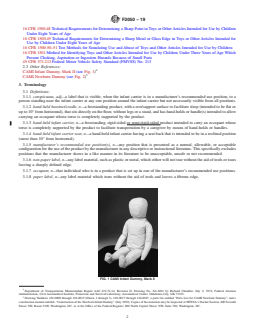
CAMI Infant Dummy, Mark II (see Fig. 1)
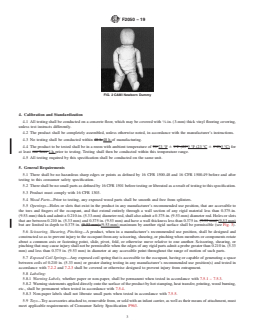
CAMI Newborn Dummy (see Fig. 2)
3. Terminology
3.1 Definitions:
FIG. 2CAMI Newborn Dummy
3.1.1 conspicuous, adj—a label that is visible, when the
infantcarrierisinamanufacturer’srecommendeduseposition,
to a person standing near the infant carrier at any one position
3.1.3 hand-held infant carrier, n—a freestanding, rigid-
around the infant carrier but not necessarily visible from all
sidedorsemi-rigid-sidedproductintendedtocarryanoccupant
positions.
whosetorsoiscompletelysupportedbytheproducttofacilitate
3.1.2 hand-held bassinet/cradle, n—a freestanding product, transportation by a caregiver by means of hand-holds or
witharest/supportsurfacetofacilitatesleep(intendedtobeflat
handles.
or up to 10° from horizontal), that sits directly on the floor,
3.1.4 hand-held infant carrier seat, n—a hand-held infant
without legs or a stand, and has hand-holds or handle(s)
carrier having a seat back that is intended to be in a reclined
intended to allow carrying an occupant whose torso is com-
position (more than 10° from horizontal).
pletely supported by the product.
3.1.5 manufacturer’s recommended use position(s), n—any
position that is presented as a normal, allowable, or acceptable
configuration for the use of the product by the manufacturer in
any descriptive or instructional literature. This specifically
excludes positions that the manufacturer shows in a like
Department of Transportation Memorandum ReportAAC-119-74-14, Revision
manner in its literature to be unacceptable, unsafe or not
II, Drawing No. SA-1001 by Richard Chandler, July 2, 1974, Federal Aviation
recommended.
Administration, Civil Aeromedical Institute, Protection and Survival Laboratory,
Aeromedical Center, Oklahoma City, OK 73125.
3.1.6 non-paper label, n—any label material, such as plastic
Drawing Numbers 126-0000 through 126-0015 (Sheets 1 through 3), 126-0017
or metal, which either will not tear without the aid of tools or
through 126-0027, a parts list entitled “Parts List for CAMI Newborn Dummy”, and
a construction manual entitled, “Construction of the Newborn Infant Dummy” (July
tears leaving a sharply defined edge.
1992). Copies of the materials may be inspected at NHTSA’s Docket Section, 400
3.1.7 occupant, n—thatindividualwhoisinaproductthatis
Seventh Street, SW, Room 5109, Washington, DC, or at the Office of the Federal
Register, 800 North Capitol Street, NW, Suite 700, Washington, DC. set up in one of the manufacturer’s recommended use posi-
tions.
3.1.8 paper label, n—any label material which tears without
the aid of tools and leaves a fibrous edge.
4. Calibration and Standardization
4.1 All testing shall be conducted on a concrete floor, which
may be covered with ⁄8-in. (3-mm) thick vinyl flooring
covering, unless test instructs differently.
4.2 The product shall be completely assembled, unless
otherwise noted, in accordance with the manufacturer’s in-
structions.
4.3 No testing shall be conducted within 48 h of manufac-
turing.
4.4 The product to be tested shall be in a room with ambient
temperature of 73 °F 6 9 °F (23 °C 6 5 °C) for at least 1 h
prior to testing. Testing shall then be conducted within this
temperature range.
4.5 All testing required by this specification shall be con-
FIG. 1CAMI Infant Dummy, Mark II ducted on the same unit.
F2050−19
5. General Requirements (9.53 mm) but are limited in depth to 0.375 in. (9.53 mm)
maximum by another rigid surface shall be permissible (see
5.1 There shall be no hazardous sharp edges or points as
Fig. 3).
defined by 16 CFR 1500.48 and 16 CFR 1500.49 before and
after testing to this consumer safety specification.
5.6 Scissoring, Shearing, Pinching—A product, when in a
5.2 Thereshallbenosmallpartsasdefinedby16CFR1501 manufacturer’s recommended use position, shall be designed
before testing or liberated as a result of testing to this
and constructed so as to prevent injury to the occupant from
specification.
any scissoring, shearing, or pinching when members or com-
ponents rotate about a common axis or fastening point, slide,
5.3 Product must comply with 16 CFR 1303.
pivot, fold, or otherwise move relative to one another.
5.4 Wood Parts—Prior to testing, any exposed wood parts
Scissoring, shearing, or pinching that may cause injury shall
shall be smooth and free from splinters.
not be permissible when the edges of any rigid parts admit a
5.5 Openings—Holesorslotsthatexistintheproductinany
probe greater than 0.210 in. (5.33 mm) and less than 0.375 in.
manufacturer’s recommended use position, that are accessible
(9.53 mm) in diameter at any accessible point throughout the
to the toes and fingers of the occupant, and that extend entirely
range of motion of such parts.
through a wall section of any rigid material less than 0.375-in.
5.7 Exposed Coil Springs—Any exposed coil spring that is
(9.53-mm) thick and admit a 0.210-in. (5.33-mm) diameter
accessible to the occupant, having or capable of generating a
rod,shallalsoadmita0.375-in.(9.53-mm)diameterrod.Holes
or slots that are between 0.210 in. (5.33 mm) and 0.375 in. space between coils of 0.210 in. (5.33 mm) or greater during
(9.53 mm) and have a wall thickness less than 0.375 in. testinginanymanufacturer’srecommendeduseposition(s)and
FIG. 3Opening Example
F2050−19
tested in accordance with 7.2.2 and 7.2.3 shall be covered or requirement applies only to products having a rigid carry
otherwise designed to prevent injury from entrapment. handle that rotates in head-to-foot and foot-to-head directions,
and is capable of being adjusted from the manufacturer’s
5.8 Labeling:
recommended carry position to any additional adjustment
5.8.1 Warning Labels, whether paper or non-paper, shall be
position.
permanent when tested in accordance with 7.5.1 – 7.5.3.
5.8.2 Warning statements applied directly onto the surface 6.3 Restraint System—A restraint system shall be provided
of the product by hot stamping, heat transfer, printing, wood
to secure a child in the seated positions in any of the
burning, etc., shall be permanent when tested in accordance manufacturer’s recommended use positions except as outlined
with 7.5.4.
in 6.3.3.
5.8.3 Non-paper labels shall not liberate small parts when
6.3.1 For infant carriers that are not for use in motor
tested in accordance with 7.5.5.
vehicles, the restraint system shall include a waist restraint and
crotch restraint. The crotch restraint’s use shall be mandatory
5.9 Toys—Toy accessories attached to, removable from, or
when the waist restraint is in use.
soldwithaninfantcarrier,aswellastheirmeansofattachment,
6.3.2 The system and its closing means shall not slip more
must meet applicable requirements of Consumer Safety Speci-
than 1 in. (25 mm), break, separate, or permit the removal of
fication F963.
the test dummy when tested in accordance with 7.6.
5.10 Protective Components—If a child can grasp compo-
6.3.3 Hand held bassinets/cradles that are not for use in
nents between the thumb and forefinger, or teeth, such as caps,
motor vehicles shall meet either 6.3.3.1 or 6.3.3.2.
sleeves or plugs used for protection from sharp edges, points,
6.3.3.1 Hand-held bassinets/cradles shall not contain a re-
or entrapment of fingers or toes or if there is at least a 0.040-in.
straint system.
(1.00-mm) gap between the component and its adjacent parent
6.3.3.2 Hand-held infant carrier seats that can be converted
component, such component shall not be removed when tested
to a hand-held bassinet/cradle shall not be capable of being
in accordance with 7.4.
converted to a hand-held bassinet/cradle without the harness
6. Performance Requirements
first being made inaccessible to the occupant when in the
NOTE 1—The forces that are to be applied to the sample in the tests
bassinet/cradle mode.
described in Section 7 of this specification are readily applied by means of
6.3.3.3 Rationale for 6.3.3—Hand-held bassinets/cradles as
a calibrated force gauge.
defined in 3.1.2 have been added to this standard because
6.1 Carry Handle Auto-locking—This requirement applies
bassinet/cradle products that do not have legs and sit directly
only to products having a rigid, adjustable carry handle that
on the floor are excluded from the ASTM bassinet/cradle
rotates about a singular axis and locks in the manufacturer’s
standard. The restraint system requirements were added to
designated carry position. The carry handle shall comply with
extend the nonallowance of restraints from the bassinet/cradle
6.1.1, 6.1.2,or 6.1.3 when tested in accordance with 7.1.
standard to hand-held bassinet/cradles, while at the same time
6.1.1 The carry handle shall move unaided and lock into the
allowing restraints for hand-held bassinet/cradle products that
manufacturer’s designated carry position or move unaided into
also have adjustment positions to hand-held infant carrier seats
a position that is obvious to the caregiver that the carry handle
as defined in 3.1.4 that have a semi-reclined seating position.
is not in the manufacturer’s designated carry position. The
The subcommittee determined that the risk associated with
unaided movement shall occur within 5 s of the carry handle
strangulation in products configured for use in a bassinet mode
being placed into an unlocked position in 7.1.2 and 7.1.4,
(where the occupant is horizontal) far exceeded the potential
beforeattemptingtoliftthecarrierin7.1.3.Themanufacturer’s
for children falling out of the product during transportation.
designated carry position shall be clearly depicted in the
6.4 Slip Resistance—An infant carrier shall not slip more
instructional literature.Aposition obvious to the caregiver that
than 0.12 in. (3.0 mm) within 1 min when tested in accordance
isnotthemanufacturer’sdesignatedcarrypositionisdefinedas
with 7.3.
any position that is not suitable for carrying the occupant. For
example,thecarryhandlecomestorestatthepositionadjacent
7. Test Methods
to the top of the occupants head.
6.1.2 The carry handle shall lock in the manufacturer’s
7.1 Carry Handle Auto-Locking Test:
designated carry position when tested in accordance with 7.1.2
7.1.1 Without a dummy in the carrier, secure the harness
– 7.1.4.
and adjust the soft goods to accommodate an infant weighing
6.1.3 The carry handle shall lock or be prevented from
17 lb (development stage corresponding to the CAMI infant
further movement by means of a mechanical stop in a position
dummy Mark II) according to the manufacturer’s instructions.
forward or rearward of the manufacturer’s designated carry
Adjust the harness such that it contacts the seating surface
position such that an unrestrained dummy does not fall out of
along its entire exposed length. Place the CAMI Infant dummy
the carrier when tested in accordance with 7.1.2 – 7.1.4.
MarkIIinthecarrierontopofthebuckledharness.Ensurethat
6.2 Carrying Handle Integrity—All tests of 7.2 are to be the dummy is firmly seated in the carrier against the harness
performed on the same product, sequentially and without with the rump in the seat bight and body fully seated against
refurbishing or repositioning of adjustment. The carrier handle the seat back and bottom. Position the hands of the CAMI
shall not break or unlatch on either one or both sides of the Infant dummy Mark II in front of the dummy at the head-to-toe
carrier when tested in accordance to 7.2.2 and 7.2.3. This centerline and attach the dummy’s hands together using duct
F2050−19
tape or a similar means, such that the dummy’s arms are matic cylinder shall be capable of producing a gradual lifting
prevented from interfering with the carrier soft goods during speed within the range of 1.5 s to 2.0 s over 12 in. (30.5 cm).
the test.
7.1.3.2 The vertical lifting force shall be applied using an
18 in. 6 0.25 in. (46 cm 6 0.6 cm) length of child restraint
NOTE 2—Positioning of the CAMI Infant dummy in the carrier is
webbing having a width of 1.5 in. 6 0.06 in. (38 mm 6
critical to ensure testing consistency and to eliminate test result variability
1.5 mm) (Fig. 5). The fixture shall be fitted with a suitable
that might be associated with the age/stiffness of the dummy. The
dummy’s crotch should be pressed back against the buckled harness. The
clamping device that will prevent slippage of the webbing
dummy’s taped hands should rest on its lap. The carrier padding should
during the lift test. The webbing length shall allow a 4 in. to
not prevent the dummy from movement during rotation of the seat during
6 in. distance between the top of the carrier handle and the
the test.
clamping device when the webbing is in contact with the
7.1.2 Starting with the carry handle locked in the manufac-
underside of the handle grip surface (Fig. 4).
turer’s designated carry position, unlock the carry handle, and
7.1.3.3 Alignthelengthwisecenterlineofthewebbingatthe
rotatethecarryhandleslightlyrearward(towardtheoccupant’s
horizontal mid-point of the carrier hand grip. Clamp the ends
head end of the carrier) into a position that is as close to the
of the webbing in the fixture.
designated carry position as possible without the carry handle
7.1.3.4 Raise the sliding support until the webbing contacts
being locked in the designated carry position.
the underside of the grip surface and is taut. Apply a vertical
7.1.3 If the carry handle remains in the unlocked position,
force gradually over 1.5 s to 2 s to lift the carrier 12 in.
conduct the test in this section.
(30.5 cm) from the at rest position. If the carry handle remains
7.1.3.1 A test fixture having a vertically sliding, rigidly
in the unlocked position after completion of lifting process,
mounted support (Fig. 4) shall be used to apply the vertical
gradually apply a downward force to the occupant’s feet end of
lifting force in this test. The vertical lifting force shall be
the carrier at the side-to-side midpoint. The force shall be
applied using a pneumatically powered cylinder. The pneu-
manually applied and shall be the minimum amou
...
This document is not an ASTM standard and is intended only to provide the user of an ASTM standard an indication of what changes have been made to the previous version. Because
it may not be technically possible to adequately depict all changes accurately, ASTM recommends that users consult prior editions as appropriate. In all cases only the current version
of the standard as published by ASTM is to be considered the official document.
Designation: F2050 − 16 F2050 − 19
Standard Consumer Safety Specification for
Hand-Held Infant Carriers
This standard is issued under the fixed designation F2050; the number immediately following the designation indicates the year of
original adoption or, in the case of revision, the year of last revision. A number in parentheses indicates the year of last reapproval. A
superscript epsilon (´) indicates an editorial change since the last revision or reapproval.
INTRODUCTION
This consumer safety specification is intended to mitigate potential safety hazards associated with
a child’s use of a hand-held infant carrier and thereby minimize the risk of injury or death. The specific
hazards addressed by this standard are carrier handle strength to support the occupant, product tip over,
and falls from elevated surfaces.
1. Scope
1.1 This consumer safety specification establishes performance requirements, test methods, and marking requirements to
promote safe use of a hand-held infant carrier by an occupant and caregiver.
1.2 This consumer safety specification is intended to minimize the risk of incidents to an occupant resulting from normal use
and reasonably foreseeable misuse or abuse of a hand-held infant carrier.
1.3 No hand-held infant carrier produced after the approval date of this consumer safety specification, either by label or other
means, shall indicate compliance with this specification, unless it conforms to all requirements contained herein.
1.4 This consumer safety specification is not intended to address accidents and injuries resulting from the interaction of other
persons with the child occupant in a hand-held infant carrier or the accidents resulting from abuse and misuse by children able to
walk.
1.5 This consumer safety specification is not intended to address incidents or injuries resulting from use of the product in a
motor vehicle, nor is it intended to address any issues that may arise from the manufacturer meeting the certification requirements
of 49 CFR 571.213 or other applicable add-on child restraint standards.
1.6 The values stated in inch-pound units are to be regarded as standard. The values given in parentheses are mathematical
conversions to SI units that are provided for information only and are not considered standard.
1.7 The following precautionary caveat pertains only to the test method portion, Section 7, of this consumer safety specification:
This standard does not purport to address all of the safety concerns, if any, associated with its use. It is the responsibility of the
user of this standard to establish appropriate safety safety, health, and healthenvironmental practices and determine the
applicability of regulatory limitations prior to use.
1.8 This international standard was developed in accordance with internationally recognized principles on standardization
established in the Decision on Principles for the Development of International Standards, Guides and Recommendations issued
by the World Trade Organization Technical Barriers to Trade (TBT) Committee.
2. Referenced Documents
2.1 ASTM Standards:
D3359 Test Methods for Rating Adhesion by Tape Test
F963 Consumer Safety Specification for Toy Safety
2.2 Federal Regulations:
16 CFR 1303 Ban of Lead-Containing Paint and Certain Consumer Products Bearing Lead-Containing Paint
16 CFR 1500 Hazardous Substances Act Regulations including sections:
This consumer safety performance specification is under the jurisdiction of ASTM Committee F15 on Consumer Products and is the direct responsibility of Subcommittee
F15.21 on Infant Carriers, Bouncers and Baby Swings.
Current edition approved Feb. 1, 2016Dec. 15, 2019. Published February 2016January 2020. Originally approved in 2000. Last previous edition approved in 20132016
as F2050 – 13a.F2050 – 16. DOI: 10.1520/F2050-16.10.1520/F2050-19.
For referenced ASTM standards, visit the ASTM website, www.astm.org, or contact ASTM Customer Service at service@astm.org. For Annual Book of ASTM Standards
volume information, refer to the standard’s Document Summary page on the ASTM website.
Code of Federal Regulations, available from U.S. Government Printing Office, Washington, DC 20402.
Copyright © ASTM International, 100 Barr Harbor Drive, PO Box C700, West Conshohocken, PA 19428-2959. United States
F2050 − 19
16 CFR 1500.48 Technical Requirements for Determining a Sharp Point in Toys or Other Articles Intended for Use by Children
Under Eight Years of Age
16 CFR 1500.49 Technical Requirements for Determining a Sharp Metal or Glass Edge in Toys or Other Articles Intended for
Use by Children Under Eight Years of Age
16 CFR 1500.50–51 Test Methods for Simulating Use and Abuse of Toys and Other Articles Intended for Use by Children
16 CFR 1501 Method for Identifying Toys and Other Articles Intended for Use by Children Under Three Years of Age Which
Present Choking, Aspiration or Ingestion Hazards Because of Small Parts
49 CFR 571.213 Federal Motor Vehicle Safety Standard (FMVSS) No. 213
2.3 Other References:
CAMI Infant Dummy, Mark II (see Fig. 1)
CAMI Newborn Dummy (see Fig. 2)
3. Terminology
3.1 Definitions:
3.1.1 conspicuous, adj—a label that is visible, when the infant carrier is in a manufacturer’s recommended use position, to a
person standing near the infant carrier at any one position around the infant carrier but not necessarily visible from all positions.
3.1.2 hand-held bassinet/cradle, n—a freestanding product, with a rest/support surface to facilitate sleep (intended to be flat or
up to 10° from horizontal), that sits directly on the floor, without legs or a stand, and has hand-holds or handle(s) intended to allow
carrying an occupant whose torso is completely supported by the product.
3.1.3 hand-held infant carrier, n—a freestanding, rigid-sided or semi-rigid-sided product intended to carry an occupant whose
torso is completely supported by the product to facilitate transportation by a caregiver by means of hand-holds or handles.
3.1.4 hand-held infant carrier seat, n—a hand-held infant carrier having a seat back that is intended to be in a reclined position
(more than 10° from horizontal).
3.1.5 manufacturer’s recommended use position(s), n—any position that is presented as a normal, allowable, or acceptable
configuration for the use of the product by the manufacturer in any descriptive or instructional literature. This specifically excludes
positions that the manufacturer shows in a like manner in its literature to be unacceptable, unsafe or not recommended.
3.1.6 non-paper label, n—any label material, such as plastic or metal, which either will not tear without the aid of tools or tears
leaving a sharply defined edge.
3.1.7 occupant, n—that individual who is in a product that is set up in one of the manufacturer’s recommended use positions.
3.1.8 paper label, n—any label material which tears without the aid of tools and leaves a fibrous edge.
FIG. 1 CAMI Infant Dummy, Mark II
Department of Transportation Memorandum Report AAC-119-74-14, Revision II, Drawing No. SA-1001 by Richard Chandler, July 2, 1974, Federal Aviation
Administration, Civil Aeromedical Institute, Protection and Survival Laboratory, Aeromedical Center, Oklahoma City, OK 73125.
Drawing Numbers 126-0000 through 126-0015 (Sheets 1 through 3), 126-0017 through 126-0027, a parts list entitled “Parts List for CAMI Newborn Dummy”, and a
construction manual entitled, “Construction of the Newborn Infant Dummy” (July 1992). Copies of the materials may be inspected at NHTSA’s Docket Section, 400 Seventh
Street, SW, Room 5109, Washington, DC, or at the Office of the Federal Register, 800 North Capitol Street, NW, Suite 700, Washington, DC.
F2050 − 19
FIG. 2 CAMI Newborn Dummy
4. Calibration and Standardization
4.1 All testing shall be conducted on a concrete floor, which may be covered with ⁄8-in. (3-mm) thick vinyl flooring covering,
unless test instructs differently.
4.2 The product shall be completely assembled, unless otherwise noted, in accordance with the manufacturer’s instructions.
4.3 No testing shall be conducted within 48 h 48 h of manufacturing.
4.4 The product to be tested shall be in a room with ambient temperature of 73°73 °F 6 9°F (23°9 °F (23 °C 6 5°C)5 °C) for
at least one hour 1 h prior to testing. Testing shall then be conducted within this temperature range.
4.5 All testing required by this specification shall be conducted on the same unit.
5. General Requirements
5.1 There shall be no hazardous sharp edges or points as defined by 16 CFR 1500.48 and 16 CFR 1500.49 before and after
testing to this consumer safety specification.
5.2 There shall be no small parts as defined by 16 CFR 1501 before testing or liberated as a result of testing to this specification.
5.3 Product must comply with 16 CFR 1303.
5.4 Wood Parts—Prior to testing, any exposed wood parts shall be smooth and free from splinters.
5.5 Openings—Holes or slots that exist in the product in any manufacturer’s recommended use position, that are accessible to
the toes and fingers of the occupant, and that extend entirely through a wall section of any rigid material less than 0.375-in.
(9.53-mm) thick and admit a 0.210-in. (5.33-mm) diameter rod, shall also admit a 0.375-in. (9.53-mm) diameter rod. Holes or slots
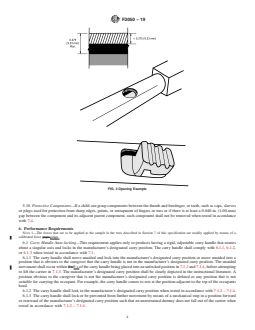
that are between 0.210 in. (5.33 mm) and 0.375 in. (9.53 mm) and have a wall thickness less than 0.375 in. (9.53 mm) (9.53 mm)
but are limited in depth to 0.375 in. (9.53 mm) (9.53 mm) maximum by another rigid surface shall be permissible (see Fig. 3).
5.6 Scissoring, Shearing, Pinching—A product, when in a manufacturer’s recommended use position, shall be designed and
constructed so as to prevent injury to the occupant from any scissoring, shearing, or pinching when members or components rotate
about a common axis or fastening point, slide, pivot, fold, or otherwise move relative to one another. Scissoring, shearing, or
pinching that may cause injury shall not be permissible when the edges of any rigid parts admit a probe greater than 0.210 in. (5.33
mm) and less than 0.375 in. (9.53 mm) in diameter at any accessible point throughout the range of motion of such parts.
5.7 Exposed Coil Springs—Any exposed coil spring that is accessible to the occupant, having or capable of generating a space
between coils of 0.210 in. (5.33 mm) or greater during testing in any manufacturer’s recommended use position(s) and tested in
accordance with 7.2.2 and 7.2.3 shall be covered or otherwise designed to prevent injury from entrapment.
5.8 Labeling:
5.8.1 Warning Labels, whether paper or non-paper, shall be permanent when tested in accordance with 7.5.1 – 7.5.3.
5.8.2 Warning statements applied directly onto the surface of the product by hot stamping, heat transfer, printing, wood burning,
etc., shall be permanent when tested in accordance with 7.5.4.
5.8.3 Non-paper labels shall not liberate small parts when tested in accordance with 7.5.5.
5.9 Toys—Toy accessories attached to, removable from, or sold with an infant carrier, as well as their means of attachment, must
meet applicable requirements of Consumer Safety Specification F963.
F2050 − 19
FIG. 3 Opening Example
5.10 Protective Components—If a child can grasp components between the thumb and forefinger, or teeth, such as caps, sleeves
or plugs used for protection from sharp edges, points, or entrapment of fingers or toes or if there is at least a 0.040-in. (1.00-mm)
gap between the component and its adjacent parent component, such component shall not be removed when tested in accordance
with 7.4.
6. Performance Requirements
NOTE 1—The forces that are to be applied to the sample in the tests described in Section 7 of this specification are readily applied by means of a
calibrated force gage.gauge.
6.1 Carry Handle Auto-locking—This requirement applies only to products having a rigid, adjustable carry handle that rotates
about a singular axis and locks in the manufacturer’s designated carry position. The carry handle shall comply with 6.1.1, 6.1.2,
or 6.1.3 when tested in accordance with 7.1.
6.1.1 The carry handle shall move unaided and lock into the manufacturer’s designated carry position or move unaided into a
position that is obvious to the caregiver that the carry handle is not in the manufacturer’s designated carry position. The unaided
movement shall occur within 5 s 5 s of the carry handle being placed into an unlocked position in 7.1.2 and 7.1.4, before attempting
to lift the carrier in 7.1.3. The manufacturer’s designated carry position shall be clearly depicted in the instructional literature. A
position obvious to the caregiver that is not the manufacturer’s designated carry position is defined as any position that is not
suitable for carrying the occupant. For example, the carry handle comes to rest at the position adjacent to the top of the occupants
head.
6.1.2 The carry handle shall lock in the manufacturer’s designated carry position when tested in accordance with 7.1.2 – 7.1.4.
6.1.3 The carry handle shall lock or be prevented from further movement by means of a mechanical stop in a position forward
or rearward of the manufacturer’s designated carry position such that an unrestrained dummy does not fall out of the carrier when
tested in accordance with 7.1.2 – 7.1.4.
F2050 − 19
6.2 Carrying Handle Integrity—All tests of 7.2 are to be performed on the same product, sequentially and without refurbishing
or repositioning of adjustment. The carrier handle shall not break or unlatch on either one or both sides of the carrier when tested
in accordance to 7.2.2 and 7.2.3. This requirement applies only to products having a rigid carry handle that rotates in head-to-foot
and foot-to-head directions, and is capable of being adjusted from the manufacturer’s recommended carry position to any
additional adjustment position.
6.3 Restraint System—A restraint system shall be provided to secure a child in the seated positions in any of the manufacturer’s
recommended use positions except as outlined in 6.3.3.
6.3.1 For infant carriers that are not for use in motor vehicles, the restraint system shall include a waist restraint and crotch
restraint. The crotch restraint’s use shall be mandatory when the waist restraint is in use.
6.3.2 The system and its closing means shall not slip more than 1 in. (25 mm), 1 in. (25 mm), break, separate, or permit the
removal of the test dummy when tested in accordance with 7.6.
6.3.3 Hand held bassinets/cradles that are not for use in motor vehicles shall meet either 6.3.3.1 or 6.3.3.2.
6.3.3.1 Hand-held bassinets/cradles shall not contain a restraint system.
6.3.3.2 Hand-held infant carrier seats that can be converted to a hand-held bassinet/cradle shall not be capable of being
converted to a hand-held bassinet/cradle without the harness first being made inaccessible to the occupant when in the
bassinet/cradle mode.
6.3.3.3 Rationale for 6.3.3—Hand-held bassinets/cradles as defined in 3.1.2 have been added to this standard because
bassinet/cradle products that do not have legs and sit directly on the floor are excluded from the ASTM bassinet/cradle standard.
The restraint system requirements were added to extend the nonallowance of restraints from the bassinet/cradle standard to
hand-held bassinet/cradles, while at the same time allowing restraints for hand-held bassinet/cradle products that also have
adjustment positions to hand-held infant carrier seats as defined in 3.1.4 that have a semi-reclined seating position. The
subcommittee determined that the risk associated with strangulation in products configured for use in a bassinet mode (where the
occupant is horizontal) far exceeded the potential for children falling out of the product during transportation.
6.4 Slip Resistance—An infant carrier shall not slip more than 0.12 in. (3.0 mm) within one minute 0.12 in. (3.0 mm) within
1 min when tested in accordance with 7.3.
7. Test Methods
7.1 Carry Handle Auto-Locking Test:
7.1.1 Without a dummy in the carrier, secure the harness and adjust the soft goods to accommodate an infant weighing 17 lb
17 lb (development stage corresponding to the CAMI infant dummy Mark II) according to the manufacturer’s instructions. Adjust
the harness such that it contacts the seating surface along its entire exposed length. Place the CAMI Infant dummy Mark II in the
carrier on top of the buckled harness. Ensure that the dummy is firmly seated in the carrier against the harness with the rump in
the seat bight and body fully seated against the seat back and bottom. Position the hands of the CAMI Infant dummy Mark II in
front of the dummy at the head-to-toe centerline and attach the dummy’s hands together using duct tape or a similar means, such
that the dummy’s arms are prevented from interfering with the carrier soft goods during the test.
NOTE 2—Positioning of the CAMI Infant dummy in the carrier is critical to ensure testing consistency and to eliminate test result variability that might
be associated with the age/stiffness of the dummy. The dummy’s crotch should be pressed back against the buckled harness. The dummy’s taped hands
should rest on its lap. The carrier padding should not prevent the dummy from movement during rotation of the seat during the test.
7.1.2 Starting with the carry handle locked in the manufacturer’s designated carry position, unlock the carry handle, and rotate
the carry handle slightly rearward (toward the occupant’s head end of the carrier) into a position that is as close to the designated
carry position as possible without the carry handle being locked in the designated carry position.
7.1.3 If the carry handle remains in the unlocked position, conduct the test in this section.
7.1.3.1 A test fixture having a vertically sliding, rigidly mounted support (Fig. 4) shall be used to apply the vertical lifting force
in this test. The vertical lifting force shall be applied using a pneumatically powered cylinder. The pneumatic cylinder shall be
capable of producing a gradual lifting speed within the range of 1.51.5 s to 2.0 s over 12 in. (30.5 cm).2.0 s over 12 in. (30.5 cm).
7.1.3.2 The vertical lifting force shall be applied using an 18 6 0.25 in. (46 6 0.6 cm) 18 in. 6 0.25 in. (46 cm 6 0.6 cm) length
of child restraint webbing having a width of 1.5 6 0.06 in. (38 6 1.5 mm) 1.5 in. 6 0.06 in. (38 mm 6 1.5 mm) (Fig. 5). The
fixture shall be fitted with a suitable clamping device that will prevent slippage of the webbing during the lift test. The webbing
length shall allow a 44 in. to 6 in. 6 in. distance between the top of the carrier handle and the clamping device when the webbing
is in contact with the underside of the handle grip surface (Fig. 4).
7.1.3.3 Align the lengthwise centerline of the webbing at the horizontal mid-point of the carrier hand grip. Clamp the ends of
the webbing in the fixture.
7.1.3.4 Raise the sliding support until the webbing contacts the underside of the grip surface and is taut. Apply a vertical force
gradually over 1.51.5 s to 2 s 2 s to lift the carrier 12 in. (30.5 cm) (30.5 cm) from the at rest position. If the carry handle remains
in the unlocked position after completion of lifting process, gradually apply a downward force to the occupant’s feet end of the
carrier at the side-to-side midpoint. The force shall be manually applied and
...