

ASTM F2926-18(2022)
(Guide)Standard Guide for Selection and Operation of Vessel-mounted Camera Systems
General Information
- Abstract
SIGNIFICANCE AND USE
3.1 The contributions of an effective vessel-mounted camera system:
3.1.1 Provide a tactical image of the portion of spill in the vicinity of the vessel upon which the system is mounted,
3.1.2 Assist in detection of slicks when they are not observable by persons operating at, or near, the water’s surface or at night,
3.1.3 Provide assistance identifying the area of heaviest oil concentration,
3.1.4 Provide input for the operational deployment of equipment,
3.1.5 Extend the hours of clean-up operations to include darkness and poor visibility,
3.1.6 Locate reported oil-on-water, and
3.1.7 Guidance for operational crews to the slick(s).
SCOPE
1.1 This guide provides information and criteria for the selection of camera remote sensing systems that are vessel-mounted for the detection of oil on water.
1.2 This guide applies to the detection of oil-on-water involving cameras of IR, visible, ultra-violet, or night vision types.
1.3 The context of camera use is addressed to the extent it has a bearing on their selection and utility for certain missions or objectives.
1.4 This guide is generally applicable to all types of crude oils and most petroleum products, under a variety of marine or fresh water situations.
1.5 Many camera technologies exhibit limitations with respect to discriminating between the target substances under certain states of weathering, lighting, wind and sea, or various camera settings.
1.6 In general remote sensing systems are used to detect and delineate the overall slick. Vessel-mounted systems are used only to provide a tactical image in the vicinity of the recovery vessel.
1.7 The values stated in SI units are to be regarded as standard. No other units of measurement are included in this standard.
1.8 This standard does not purport to address all of the safety concerns, if any, associated with its use. It is the responsibility of the user of this standard to establish appropriate safety, health, and environmental practices and determine the applicability of regulatory limitations prior to use.
1.9 This international standard was developed in accordance with internationally recognized principles on standardization established in the Decision on Principles for the Development of International Standards, Guides and Recommendations issued by the World Trade Organization Technical Barriers to Trade (TBT) Committee.
- Status
- Published
- Publication Date
- 28-Feb-2022
- Technical Committee
- F20 - Hazardous Substances and Oil Spill Response
- Drafting Committee
- F20.16 - Surveillance and Tracking
Overview
ASTM F2926-18(2022), titled Standard Guide for Selection and Operation of Vessel-mounted Camera Systems, provides comprehensive guidance for selecting and operating camera-based remote sensing systems installed on vessels for the detection of oil on water. Developed by ASTM International, this standard is a key resource for emergency response teams, oil spill recovery operators, and marine safety professionals engaged in oil spill response and environmental monitoring.
The standard covers criteria for the selection of remote sensing camera systems, recommendations for their deployment, and considerations for varying types of oil and water environments. It addresses the use of different camera technologies-including infrared (IR), visible spectrum, ultraviolet (UV), and night vision-and discusses their advantages and limitations for specific applications.
Key Topics
Purpose of Vessel-mounted Camera Systems
- Tactical imaging of oil spills around the vessel
- Enhanced detection of oil slicks, especially in low-visibility conditions and at night
- Identification of areas with the highest oil concentration
- Operational support for deploying skimmers, booms, and other response equipment
- Extending the duration of response operations to include darkness and adverse weather
- Improved guidance for operational crews to locate and track slicks
Types of Camera Technologies
- Visual Cameras: Effective under daylight with familiar operation, but limited by low-light and sometimes challenged to distinguish oil from background water surfaces.
- Infrared Cameras: Useful in differentiating oil thicknesses via thermal contrast, particularly effective for fresh or thick oils, with certain limitations relating to weather and lighting conditions.
- Ultraviolet Cameras: Capable of detecting very thin oil sheens; performance requires sufficient ambient light and may be susceptible to interference from sun glint and biological materials.
- Night Vision Cameras: Enhance visibility in complete darkness, providing situational awareness but lacking a unique oil signature.
Operational Considerations
- Proper mounting height and angle (often near Brewster’s angle, approx. 53° from vertical) for optimal field of view and avoidance of water surface reflection
- Importance of camera stabilization in rough seas
- Use of pan, tilt, and zoom capabilities for maximizing coverage and targeting slicks
- Combining multiple camera types for improved detection and situational awareness
Limitations and Challenges
- Inability of current sensors to provide quantitative data on oil thickness
- Variability in detection capabilities due to oil weathering, lighting, wind, and background interference
- Necessity for pre-spill planning and reporting to guide camera system deployment and selection
Applications
- Oil Spill Detection and Response: Supporting tactical decisions during marine and freshwater oil spill incidents by providing real-time visual data to operational crews.
- Environmental Monitoring: Routine surveillance in harbors, shipping lanes, and sensitive environmental zones for early detection of oil-on-water threats.
- Extended Operation Conditions: Enabling clean-up and monitoring activities during night and periods of low visibility, thus minimizing environmental impact and optimizing resource deployment.
- Training and Preparedness: Assisting organizations in developing effective oil spill response strategies and ensuring their personnel are equipped to utilize vessel-mounted camera systems optimally.
Related Standards
For further guidance on remote sensing and oil spill detection, these related ASTM standards may be referenced:
- ASTM F2327: Guide for Selection of Airborne Remote Sensing Systems for Detection and Monitoring of Oil on Water
- Standards on hazardous substances and oil spill response under ASTM Committee F20
Keywords: vessel-mounted camera systems, oil spill detection, remote sensing, infrared camera, ultraviolet camera, night vision, environmental monitoring, spill response, marine safety, ASTM F2926-18
Relations
- Effective Date
- 15-Sep-2008
- Effective Date
- 01-Nov-2003
Get Certified
Connect with accredited certification bodies for this standard

BSI Group
BSI (British Standards Institution) is the business standards company that helps organizations make excellence a habit.

Bureau Veritas
Bureau Veritas is a world leader in laboratory testing, inspection and certification services.

DNV
DNV is an independent assurance and risk management provider.
Sponsored listings
Frequently Asked Questions
ASTM F2926-18(2022) is a guide published by ASTM International. Its full title is "Standard Guide for Selection and Operation of Vessel-mounted Camera Systems". This standard covers: SIGNIFICANCE AND USE 3.1 The contributions of an effective vessel-mounted camera system: 3.1.1 Provide a tactical image of the portion of spill in the vicinity of the vessel upon which the system is mounted, 3.1.2 Assist in detection of slicks when they are not observable by persons operating at, or near, the water’s surface or at night, 3.1.3 Provide assistance identifying the area of heaviest oil concentration, 3.1.4 Provide input for the operational deployment of equipment, 3.1.5 Extend the hours of clean-up operations to include darkness and poor visibility, 3.1.6 Locate reported oil-on-water, and 3.1.7 Guidance for operational crews to the slick(s). SCOPE 1.1 This guide provides information and criteria for the selection of camera remote sensing systems that are vessel-mounted for the detection of oil on water. 1.2 This guide applies to the detection of oil-on-water involving cameras of IR, visible, ultra-violet, or night vision types. 1.3 The context of camera use is addressed to the extent it has a bearing on their selection and utility for certain missions or objectives. 1.4 This guide is generally applicable to all types of crude oils and most petroleum products, under a variety of marine or fresh water situations. 1.5 Many camera technologies exhibit limitations with respect to discriminating between the target substances under certain states of weathering, lighting, wind and sea, or various camera settings. 1.6 In general remote sensing systems are used to detect and delineate the overall slick. Vessel-mounted systems are used only to provide a tactical image in the vicinity of the recovery vessel. 1.7 The values stated in SI units are to be regarded as standard. No other units of measurement are included in this standard. 1.8 This standard does not purport to address all of the safety concerns, if any, associated with its use. It is the responsibility of the user of this standard to establish appropriate safety, health, and environmental practices and determine the applicability of regulatory limitations prior to use. 1.9 This international standard was developed in accordance with internationally recognized principles on standardization established in the Decision on Principles for the Development of International Standards, Guides and Recommendations issued by the World Trade Organization Technical Barriers to Trade (TBT) Committee.
SIGNIFICANCE AND USE 3.1 The contributions of an effective vessel-mounted camera system: 3.1.1 Provide a tactical image of the portion of spill in the vicinity of the vessel upon which the system is mounted, 3.1.2 Assist in detection of slicks when they are not observable by persons operating at, or near, the water’s surface or at night, 3.1.3 Provide assistance identifying the area of heaviest oil concentration, 3.1.4 Provide input for the operational deployment of equipment, 3.1.5 Extend the hours of clean-up operations to include darkness and poor visibility, 3.1.6 Locate reported oil-on-water, and 3.1.7 Guidance for operational crews to the slick(s). SCOPE 1.1 This guide provides information and criteria for the selection of camera remote sensing systems that are vessel-mounted for the detection of oil on water. 1.2 This guide applies to the detection of oil-on-water involving cameras of IR, visible, ultra-violet, or night vision types. 1.3 The context of camera use is addressed to the extent it has a bearing on their selection and utility for certain missions or objectives. 1.4 This guide is generally applicable to all types of crude oils and most petroleum products, under a variety of marine or fresh water situations. 1.5 Many camera technologies exhibit limitations with respect to discriminating between the target substances under certain states of weathering, lighting, wind and sea, or various camera settings. 1.6 In general remote sensing systems are used to detect and delineate the overall slick. Vessel-mounted systems are used only to provide a tactical image in the vicinity of the recovery vessel. 1.7 The values stated in SI units are to be regarded as standard. No other units of measurement are included in this standard. 1.8 This standard does not purport to address all of the safety concerns, if any, associated with its use. It is the responsibility of the user of this standard to establish appropriate safety, health, and environmental practices and determine the applicability of regulatory limitations prior to use. 1.9 This international standard was developed in accordance with internationally recognized principles on standardization established in the Decision on Principles for the Development of International Standards, Guides and Recommendations issued by the World Trade Organization Technical Barriers to Trade (TBT) Committee.
ASTM F2926-18(2022) is classified under the following ICS (International Classification for Standards) categories: 13.020.40 - Pollution, pollution control and conservation; 33.160.40 - Video systems. The ICS classification helps identify the subject area and facilitates finding related standards.
ASTM F2926-18(2022) has the following relationships with other standards: It is inter standard links to ASTM F2327-08, ASTM F2327-03. Understanding these relationships helps ensure you are using the most current and applicable version of the standard.
ASTM F2926-18(2022) is available in PDF format for immediate download after purchase. The document can be added to your cart and obtained through the secure checkout process. Digital delivery ensures instant access to the complete standard document.
Standards Content (Sample)
This international standard was developed in accordance with internationally recognized principles on standardization established in the Decision on Principles for the
Development of International Standards, Guides and Recommendations issued by the World Trade Organization Technical Barriers to Trade (TBT) Committee.
Designation: F2926 − 18 (Reapproved 2022)
Standard Guide for
Selection and Operation of Vessel-mounted Camera
Systems
This standard is issued under the fixed designation F2926; the number immediately following the designation indicates the year of
original adoption or, in the case of revision, the year of last revision. A number in parentheses indicates the year of last reapproval. A
superscript epsilon (´) indicates an editorial change since the last revision or reapproval.
1. Scope mendations issued by the World Trade Organization Technical
Barriers to Trade (TBT) Committee.
1.1 This guide provides information and criteria for the
selection of camera remote sensing systems that are vessel-
2. Referenced Documents
mounted for the detection of oil on water.
2.1 ASTM Standards:
1.2 This guide applies to the detection of oil-on-water
F2327 Guide for Selection of Airborne Remote Sensing
involving cameras of IR, visible, ultra-violet, or night vision
Systems for Detection and Monitoring of Oil on Water
types.
1.3 The context of camera use is addressed to the extent it 3. Significance and Use
has a bearing on their selection and utility for certain missions
3.1 The contributions of an effective vessel-mounted cam-
or objectives.
era system:
3.1.1 Provide a tactical image of the portion of spill in the
1.4 This guide is generally applicable to all types of crude
vicinity of the vessel upon which the system is mounted,
oils and most petroleum products, under a variety of marine or
3.1.2 Assist in detection of slicks when they are not observ-
fresh water situations.
able by persons operating at, or near, the water’s surface or at
1.5 Many camera technologies exhibit limitations with re-
night,
spect to discriminating between the target substances under
3.1.3 Provide assistance identifying the area of heaviest oil
certain states of weathering, lighting, wind and sea, or various
concentration,
camera settings.
3.1.4 Provide input for the operational deployment of
1.6 In general remote sensing systems are used to detect and
equipment,
delineate the overall slick. Vessel-mounted systems are used
3.1.5 Extend the hours of clean-up operations to include
only to provide a tactical image in the vicinity of the recovery
darkness and poor visibility,
vessel.
3.1.6 Locate reported oil-on-water, and
3.1.7 Guidance for operational crews to the slick(s).
1.7 The values stated in SI units are to be regarded as
standard. No other units of measurement are included in this
4. Overview of Remote Sensing Equipment Capabilities
standard.
and Limitations
1.8 This standard does not purport to address all of the
4.1 The capability of camera equipment is determined by
safety concerns, if any, associated with its use. It is the
the physical and chemical properties of the atmosphere, the
responsibility of the user of this standard to establish appro-
water, and the target oil. There may be variations in the degree
priate safety, health, and environmental practices and deter-
of sophistication, sensitivity and spatial resolution of sensors
mine the applicability of regulatory limitations prior to use.
using the same portion of the electromagnetic spectrum and
1.9 This international standard was developed in accor-
detector technology. Sensors within a given class tend to have
dance with internationally recognized principles on standard-
thesamegeneralcapabilitiesandtypicallysufferfromthesame
ization established in the Decision on Principles for the
limitations (see Guide F2327).
Development of International Standards, Guides and Recom-
4.2 Combinations of camera types may offer broader spec-
tral coverage that permit better probability of detection, better
This guide is under the jurisdiction of ASTM Committee F20 on Hazardous
Substances and Oil Spill Response and is the direct responsibility of Subcommittee
F20.16 on Surveillance and Tracking. For referenced ASTM standards, visit the ASTM website, www.astm.org, or
Current edition approved March 1, 2022. Published March 2022. Originally contact ASTM Customer Service at service@astm.org. For Annual Book of ASTM
approved in 2012. Last previous edition approved in 2018 as D2926–18. DOI: Standards volume information, refer to the standard’s Document Summary page on
10.1520/F2926–18R22. the ASTM website.
Copyright © ASTM International, 100 Barr Harbor Drive, PO Box C700, West Conshohocken, PA 19428-2959. United States
F2926 − 18 (2022)
discrimination, and effective operation over a broader range of spill vessel applications as they are available with remote angle
weather and lighting conditions. Certain combinations, or and pan controls as well as narrow fields of view (vertical and
sensor suites, are well documented, and their use is particularly horizontal view angles). Fig. 1 shows the essential cross
suited to oil spill response missions. section of a camera mount.
5.2.1 It is important then to purchase a camera with the
4.3 Camera performance can be enhanced by a variety of
vertical and horizontal view angles that will permit the vessel
real time or post processing techniques applied to the acquired
to look forward sufficiently to enable steering into the slick. It
data or imagery. Furthermore, image or data fusion can greatly
is important that the camera have a good view of the slick and
enhance the utility of the camera output or product.
of the boom, if used, where the skimmer is positioned.
4.4 Inadeploymentofcamerasystems,generallocationand
Calculations were made on optimal angles, etc. and are
type of oil would have been reported in advance of the launch
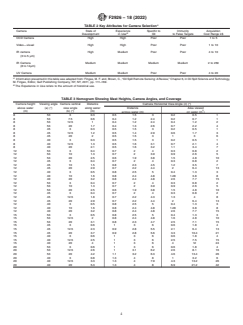
presented in Table 3.
of the vessel upon which the camera system is mounted. The
5.3 Setting the Camera Angle—The camera is best set at
planning for spills in different situation influences the selection
Brewster’s angle, which is about 53° from the vertical. At
of cameras.
Brewster’s angle, reflection from the water surface is mini-
4.5 Vessel-mounted cameras can provide tactical imagery,
mized. This angle however may not permit sufficient forward
such as to determine the response vessel maneuvers to enhance
view for some applications. Thus an adjustable camera is
the oil encounter rates during daytime and nighttime.
desirable. See Fig. 2.
4.6 In rough sea conditions, some form of camera stabili-
6. Conclusions
zation may be needed to produce a useful image.
6.1 Vessel mounted cameras can provide useful imagery to
4.7 No sensor is currently available to give information on
assist in maneuvering the vessel during oil recovery to enhance
actual oil thickness. Only relative thickness information, thick
oil encounter rate.
or thin, can be derived from an infrared camera.
6.2 Four types of cameras are used, infrared, visible,
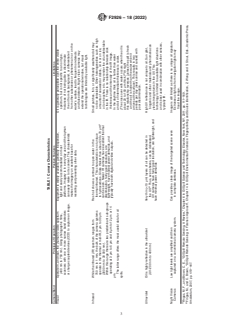
4.8 Table 1 lists cameras based upon their mode of opera-
ultraviolet and night vision. Infrared is common and can
tion. Summary information on their positive features and
provideimagerydiscriminatingbetweensheensandthickeroil.
limitations is presented.
Infrared cameras are often used together with visible cameras.
4.9 Table 2 presents a summary of key attributes which
Ultraviolet cameras may be less useful as they highlight
generally influence the selection of cameras.
sunlight and other glare. Night vision cameras may enhance
night recovery operations.
5. Summary
6.3 The height and angle mounting of the camera are
5.1 The information presented in this guide should be
important both to provide a useful image as well as to provide
considered a starting point for camera selection. In addition to
desired coverage of sea surface. Cameras should be mounted at
the context of use and the attributes of the various types of
or near Brewster’s angle (about 53° from the vertical).
sensors. Both camera technology, and image and data analysis
capabilities are evolving rapidly. Some equipment is not
6.4 Cameras with pan, tilt, zoom capability are best for
commercially-available.
vessel-mount
...