

ASTM D1986-14(2021)
(Test Method)Standard Test Method for Determining the Apparent Viscosity of Polyethylene Wax
General Information
- Abstract
SIGNIFICANCE AND USE
4.1 This test method is used to determine a physical property of a wax and may determine the utility of the wax, as well as being a significant quality control test.
SCOPE
1.1 This test method describes the determination of the viscosity of polyethylene wax using small-volume, concentric cylinder, rotational viscometer and a temperature bath at 140 °C.
1.2 The values stated in SI units are to be regarded as standard. The units in parentheses are provided for user convenience and are not standard.
1.3 This standard does not purport to address all of the safety concerns, if any, associated with its use. It is the responsibility of the user of this standard to establish appropriate safety, health, and environmental practices and determine the applicability of regulatory limitations prior to use.
1.4 This international standard was developed in accordance with internationally recognized principles on standardization established in the Decision on Principles for the Development of International Standards, Guides and Recommendations issued by the World Trade Organization Technical Barriers to Trade (TBT) Committee.
- Status
- Published
- Publication Date
- 28-Feb-2021
- Technical Committee
- D21 - Polishes
- Drafting Committee
- D21.02 - Raw Materials


Overview
ASTM D1986-14(2021) is the internationally recognized standard for determining the apparent viscosity of polyethylene wax. Developed by ASTM International, this test method provides a reliable procedure for measuring the viscosity-an important physical property-of polyethylene wax using a small-volume, concentric cylinder rotational viscometer at a controlled temperature of 140 °C. The standard specifies the equipment, sample preparation, calibration, and test protocol, ensuring consistent and reproducible results, which are essential for quality control and product performance evaluation in industrial applications.
Key Topics
- Apparatus and Equipment: The method employs a small-volume coaxial rotational viscometer capable of providing rotational speeds from 0.05 to 6.0 rad/s and measuring torque up to 0.6 mN·m. Essential supporting items include a temperature sensor, controlled temperature bath, data collection devices, and appropriate sample containers.
- Test Temperature: The standard specifies testing at 140 °C, with provisions for specimens with higher melt points to be tested at 150 °C if necessary.
- Sample Preparation: Approximately 8 grams of polyethylene wax are required, carefully melted and maintained at the test temperature to avoid thermal and oxidative decomposition.
- Measurement Procedure: Viscosity readings are taken once the sample temperature equilibrates. The procedure involves repetitive measurements to ensure accuracy, with the average of three consistent readings reported as the test result.
- Calibration and Precision: The viscometer is calibrated using Newtonian reference fluids, and test repeatability is specified as not to differ by more than 1% for duplicate results by the same operator using the same equipment.
- Safety and Compliance: Users are responsible for implementing suitable safety and environmental practices and for complying with local regulatory requirements.
Applications
- Quality Control: This standard is widely used in manufacturing environments to verify the consistency and processability of polyethylene wax. Ensuring correct viscosity is crucial for maintaining product performance, especially in industries such as plastics, coatings, and polish formulations.
- Product Development: By characterizing the apparent viscosity, formulators can optimize polyethylene wax blends to achieve desired properties in various end-use applications.
- Regulatory Compliance: Using this ASTM standard helps organizations align with internationally recognized testing protocols, supporting product certification, market entry, and compliance with technical barriers to trade as referenced by the WTO TBT Committee.
- Research and Development: Laboratories utilize ASTM D1986-14(2021) to compare different grades of polyethylene wax, assess batch-to-batch consistency, and support innovation in wax technology.
Related Standards
- ASTM E1970: Practice for Statistical Treatment of Thermoanalytical Data, which is often referenced for processing and interpreting viscosity data.
- General ASTM Standards on Viscometry: Other test methods may cover viscosity measurement for different materials or conditions, offering complementary procedures.
- International Standards: This method aligns with the principles for developing international standards, guides, and recommendations, supporting global harmonization in laboratory testing and quality assurance.
Keywords: ASTM D1986-14, polyethylene wax, apparent viscosity, rotational viscometer, quality control, wax testing, viscosity measurement, industrial standards, laboratory methods, temperature-controlled testing.
Relations
- Effective Date
- 01-Aug-2011
- Effective Date
- 01-Mar-2006
- Effective Date
- 10-Aug-2001
- Effective Date
- 10-Aug-2001
Get Certified
Connect with accredited certification bodies for this standard

DIN CERTCO
DIN Group product certification.

Smithers Quality Assessments
US management systems and product certification.
Sponsored listings
Frequently Asked Questions
ASTM D1986-14(2021) is a standard published by ASTM International. Its full title is "Standard Test Method for Determining the Apparent Viscosity of Polyethylene Wax". This standard covers: SIGNIFICANCE AND USE 4.1 This test method is used to determine a physical property of a wax and may determine the utility of the wax, as well as being a significant quality control test. SCOPE 1.1 This test method describes the determination of the viscosity of polyethylene wax using small-volume, concentric cylinder, rotational viscometer and a temperature bath at 140 °C. 1.2 The values stated in SI units are to be regarded as standard. The units in parentheses are provided for user convenience and are not standard. 1.3 This standard does not purport to address all of the safety concerns, if any, associated with its use. It is the responsibility of the user of this standard to establish appropriate safety, health, and environmental practices and determine the applicability of regulatory limitations prior to use. 1.4 This international standard was developed in accordance with internationally recognized principles on standardization established in the Decision on Principles for the Development of International Standards, Guides and Recommendations issued by the World Trade Organization Technical Barriers to Trade (TBT) Committee.
SIGNIFICANCE AND USE 4.1 This test method is used to determine a physical property of a wax and may determine the utility of the wax, as well as being a significant quality control test. SCOPE 1.1 This test method describes the determination of the viscosity of polyethylene wax using small-volume, concentric cylinder, rotational viscometer and a temperature bath at 140 °C. 1.2 The values stated in SI units are to be regarded as standard. The units in parentheses are provided for user convenience and are not standard. 1.3 This standard does not purport to address all of the safety concerns, if any, associated with its use. It is the responsibility of the user of this standard to establish appropriate safety, health, and environmental practices and determine the applicability of regulatory limitations prior to use. 1.4 This international standard was developed in accordance with internationally recognized principles on standardization established in the Decision on Principles for the Development of International Standards, Guides and Recommendations issued by the World Trade Organization Technical Barriers to Trade (TBT) Committee.
ASTM D1986-14(2021) is classified under the following ICS (International Classification for Standards) categories: 83.080.20 - Thermoplastic materials. The ICS classification helps identify the subject area and facilitates finding related standards.
ASTM D1986-14(2021) has the following relationships with other standards: It is inter standard links to ASTM E1970-11, ASTM E1970-06, ASTM E1970-00, ASTM E1970-01. Understanding these relationships helps ensure you are using the most current and applicable version of the standard.
ASTM D1986-14(2021) is available in PDF format for immediate download after purchase. The document can be added to your cart and obtained through the secure checkout process. Digital delivery ensures instant access to the complete standard document.
Standards Content (Sample)
This international standard was developed in accordance with internationally recognized principles on standardization established in the Decision on Principles for the
Development of International Standards, Guides and Recommendations issued by the World Trade Organization Technical Barriers to Trade (TBT) Committee.
Designation: D1986 − 14 (Reapproved 2021)
Standard Test Method for
Determining the Apparent Viscosity of Polyethylene Wax
This standard is issued under the fixed designation D1986; the number immediately following the designation indicates the year of
original adoption or, in the case of revision, the year of last revision. A number in parentheses indicates the year of last reapproval. A
superscript epsilon (´) indicates an editorial change since the last revision or reapproval.
1. Scope 3.1.2.1 Discussion—The unit of viscosity is the pascal
second (Pa·s). For a Newtonian liquid, the viscosity is constant
1.1 This test method describes the determination of the
at all shear rates. For a non-Newtonian liquid, viscosity will
viscosity of polyethylene wax using small-volume, concentric
vary depending on shear rate.
cylinder, rotational viscometer and a temperature bath at 140
3.1.3 apparent viscosity—the viscosity determined by this
°C.
test method and expressed in millipascal seconds (mPa·s or
1.2 The values stated in SI units are to be regarded as
centipoises (cP)). (1 cP=1 mPa·s). Its value may vary with the
standard. The units in parentheses are provided for user
spindle and rotational speed selected because many waxes are
convenience and are not standard.
non-Newtonian.
1.3 This standard does not purport to address all of the
safety concerns, if any, associated with its use. It is the
4. Significance and Use
responsibility of the user of this standard to establish appro-
4.1 This test method is used to determine a physical
priate safety, health, and environmental practices and deter-
property of a wax and may determine the utility of the wax, as
mine the applicability of regulatory limitations prior to use.
well as being a significant quality control test.
1.4 This international standard was developed in accor-
dance with internationally recognized principles on standard-
5. Apparatus
ization established in the Decision on Principles for the
5.1 Small-volume, Coaxial Rotational Viscometer —The
Development of International Standards, Guides and Recom-
essential instrumentation required providing the minimal rota-
mendations issued by the World Trade Organization Technical
tional viscometer analytical capabilities for this method in-
Barriers to Trade (TBT) Committee.
clude:
2. Referenced Documents
5.1.1 Drive Motor, to apply an unidirectional rotational
displacement to the specimen at a rate of 0.05 to 6.0 rad/s (0.5
2.1 ASTM Standards:
to 60 r/min) constant to 61%.
E1970 PracticeforStatisticalTreatmentofThermoanalytical
5.1.2 Force Sensor, to measure the torque up to 0.6 mN·m
Data
developed by the specimen to the rotational displacement of
3. Terminology the rotational element.
5.1.3 Coupling Shaft, or other means to transmit the rota-
3.1 Definitions:
tional displacement from the motor to the specimen.
3.1.1 polyethylene wax—polymerized ethylene with a mo-
5.1.4 Rotational Element, Spindle or Tool, to fix the speci-
lecular weight 2,000 to 10,000 g/mol and a density of 0.9 to 1.0
men between the drive shaft and a stationary position. A
g/cm . These polymers may be oxidized or copolymerized but
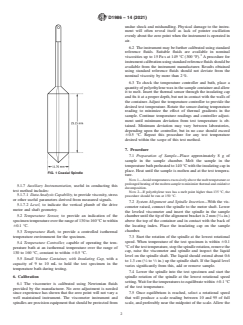
coaxial spindle with the dimensions shown in Fig. 1 is suitable
should have a melt point lower than 140 °C.
for this test method.
3.1.2 viscosity—the ratio of shear stress to shear rate. The
5.1.5 Data Collection Device, to acquire and display mea-
viscosity of a liquid is a measure of the internal friction of the
sured or calculated signals from the test. The minimum output
liquid in motion.
signals required for apparent viscosity are torque, rotational
speed, temperature and time.
1 5.1.6 Stand, to support, level and adjust the height of the
This test method is under the jurisdiction ofASTM Committee D21 on Polishes
and is the direct responsibility of Subcommittee D21.02 on Raw Materials. drive motor, shaft and rotational element.
Current edition approved March 1, 2021. Published March 2021. Originally
approved in 1991. Last previous edition approved in 2014 as D1986-14. DOI:
10.1520/D1986-14R21.
2 3
For referenced ASTM standards, visit the ASTM website, www.astm.org, or Available from most manufacturers of precision laboratory instruments. Many
contact ASTM Customer Service at service@astm.org. For Annual Book of ASTM versions have an integral controlled temperature bath and other specified apparatus.
Standards volume information, refer to the standard’s Document Summary page on The product literature or sales information usually specifies that the instrument is
the ASTM website. suitable for use in ASTM D1986.
Copyright © ASTM International, 100 Barr Harbor Drive, PO Box C700, West Conshohocken, PA 19428-2959. United States
D1986 − 14 (2021)
undue shock and mishandling. Physical damage to the instru-
ment will often reveal itself as lack of pointer oscillation
evenly about the zero point when the instrument is operated in
air.
6.2 The instrument may be further calibrated using standard
reference fluids. Suitable fluids are available in nominal
viscosities up to 15 Pa·s at 149 °C (300 °F). A procedure for
instrumentcalibrationusingstandardreferencefluidsshouldbe
available from the instrument manufacturer. Results obtained
using standard reference fluids should not deviate from the
nominal viscosity by more than 2 %.
6.3 To check the temperature controller and bath, place a
quantityofpolyethylenewaxinthesamplecontainerandallow
it to melt. Insert the thermal sensor through the insulating cap
and fix it at a proper depth, but not in contact with the walls of
the container. Adjust the temperature controller to provide the
desired test temperature. Rotate the sensor during temperature
reading to minimize the effect of thermal gradients in the
sample. Continue temperature readings and controller adjust-
ment until minimum deviation from test temperature is ob-
tained.
...