

ASTM D3851-17(2022)
(Specification)Standard Specification for Microcellular Polyurethane Shoe Soling Materials
General Information
- Abstract
ABSTRACT
This specification covers the standard physical property requirements and test methods for urethane microcellular materials intended for shoe soling applications. It covers three grades of polyurethane materials that may be selected for use according to abrasion resistance, cut-growth resistance, and other physical properties. Materials shall be subjected to physical tests and shall conform to the requirements for physical properties such as density, tensile strength, ultimate elongation, tear, hardness, cut-growth resistance, and taper abrasion or wear index.
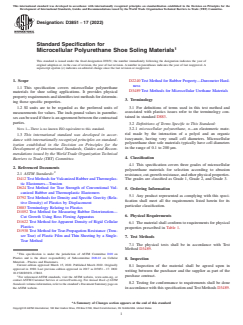
SCOPE
1.1 This specification covers microcellular polyurethane materials for shoe soling applications. It provides physical property requirements and identifies test methods for determining those specific properties.
1.2 SI units are to be regarded as the preferred units of measurements for values. The inch-pound values in parentheses can be used if there is an agreement between the contractual parties.
Note 1: There is no known ISO equivalent to this standard.
1.3 This international standard was developed in accordance with internationally recognized principles on standardization established in the Decision on Principles for the Development of International Standards, Guides and Recommendations issued by the World Trade Organization Technical Barriers to Trade (TBT) Committee.
- Status
- Published
- Publication Date
- 14-Mar-2022
- Technical Committee
- D20 - Plastics
- Drafting Committee
- D20.22 - Cellular Materials - Plastics and Elastomers


Overview
ASTM D3851-17(2022) is the internationally recognized standard specification for microcellular polyurethane shoe soling materials, as developed by ASTM International. This standard establishes comprehensive physical property requirements and test methods for urethane microcellular materials intended for use in footwear outsoles. Its guidelines ensure consistent quality, performance, and safety in the production of polyurethane solings, benefiting footwear manufacturers, suppliers, and end users globally.
The scope of ASTM D3851-17(2022) includes requirements for material grades based on attributes like abrasion resistance, cut-growth resistance, tensile strength, and density. It also describes procedures for inspection, packaging, labeling, and identifying compliance, contributing to uniformity and reliability in the footwear industry.
Key Topics
- Material Grades: The standard identifies three grades of microcellular polyurethane materials, each suitable for various shoe soling applications based on their physical performance.
- Physical Properties: Requirements cover crucial attributes such as density, tensile strength, ultimate elongation, tear strength, durometer hardness, cut-growth resistance, and abrasion resistance. Compliance with these properties is verified using referenced ASTM test methods.
- Test Methods: ASTM D3851-17(2022) calls upon several established ASTM test methods to assess the material's performance, including:
- D412 (Tensile strength and elongation)
- D624 (Tear strength)
- D2240 (Durometer hardness)
- D792, D1622 (Density)
- D3489 (Wear and abrasion)
- D1052 (Cut-growth resistance)
- Inspection and Retest: Clear procedures for inspection and retesting ensure that both manufacturers and purchasers agree on quality and conformance before the materials are used.
- Packaging and Labeling: The specification requires correct packaging, shipping marks, and labeling to support traceability and compliance, with options for manufacturers to denote products meeting this ASTM standard.
Applications
ASTM D3851-17(2022) is essential for:
- Footwear Manufacturers: Ensures the soling materials provide the required durability, comfort, and safety in shoes, boots, and other footwear items. The standard supports quality assurance in production and procurement, resulting in longer-lasting, higher-performing footwear.
- Material Suppliers and Converters: Offers a clear benchmark for testing, classifying, and marketing polyurethane soling materials to footwear brands and OEMs.
- Quality Assurance and Testing Laboratories: Provides a detailed framework for evaluating materials prior to integration in footwear manufacturing, enhancing product reliability and reducing defects.
- Contract Negotiations: The standard's use of both SI and inch-pound units, as agreed by parties, simplifies international trade and contracts for global footwear supply chains.
Microcellular polyurethane soling materials specified under this standard are widely used in athletic, casual, work, and safety footwear due to their balance of flexibility, cushioning, abrasion resistance, and lightweight properties.
Related Standards
Key related ASTM standards referenced within ASTM D3851-17(2022) include:
- ASTM D412: Test Methods for Vulcanized Rubber and Thermoplastic Elastomers - Tension
- ASTM D624: Test Method for Tear Strength of Conventional Vulcanized Rubber and Thermoplastic Elastomers
- ASTM D2240: Test Method for Rubber Property-Durometer Hardness
- ASTM D792: Test Methods for Density and Specific Gravity of Plastics by Displacement
- ASTM D1622: Test Method for Apparent Density of Rigid Cellular Plastics
- ASTM D3489: Test Methods for Microcellular Urethane Materials
- ASTM D1052: Test Method for Measuring Rubber Deterioration-Cut Growth Using Ross Flexing Apparatus
- ASTM D1938: Test Method for Tear-Propagation Resistance of Plastic Film and Thin Sheeting
- ASTM D883: Terminology Relating to Plastics
Note: There is no known ISO equivalent to ASTM D3851-17(2022), making it a unique and authoritative reference for microcellular polyurethane shoe soling materials in the global market.
Keywords: polyurethane shoe soling, microcellular urethane, ASTM D3851-17, shoe outsole materials, abrasion resistance, footwear standards, physical property testing, soling material specification.
Relations
- Effective Date
- 01-Feb-2024
- Effective Date
- 01-Nov-2023
- Effective Date
- 15-Jul-2020
- Effective Date
- 01-Jan-2020
- Effective Date
- 01-Aug-2019
- Effective Date
- 15-Apr-2019
- Effective Date
- 01-Apr-2019
- Effective Date
- 01-Feb-2019
- Effective Date
- 01-Dec-2018
- Effective Date
- 01-Nov-2018
- Effective Date
- 15-Aug-2017
- Effective Date
- 01-Dec-2014
- Effective Date
- 15-Nov-2012
- Effective Date
- 01-Dec-2011
- Effective Date
- 15-May-2011
Get Certified
Connect with accredited certification bodies for this standard

DIN CERTCO
DIN Group product certification.

Smithers Quality Assessments
US management systems and product certification.
Sponsored listings
Frequently Asked Questions
ASTM D3851-17(2022) is a technical specification published by ASTM International. Its full title is "Standard Specification for Microcellular Polyurethane Shoe Soling Materials". This standard covers: ABSTRACT This specification covers the standard physical property requirements and test methods for urethane microcellular materials intended for shoe soling applications. It covers three grades of polyurethane materials that may be selected for use according to abrasion resistance, cut-growth resistance, and other physical properties. Materials shall be subjected to physical tests and shall conform to the requirements for physical properties such as density, tensile strength, ultimate elongation, tear, hardness, cut-growth resistance, and taper abrasion or wear index. SCOPE 1.1 This specification covers microcellular polyurethane materials for shoe soling applications. It provides physical property requirements and identifies test methods for determining those specific properties. 1.2 SI units are to be regarded as the preferred units of measurements for values. The inch-pound values in parentheses can be used if there is an agreement between the contractual parties. Note 1: There is no known ISO equivalent to this standard. 1.3 This international standard was developed in accordance with internationally recognized principles on standardization established in the Decision on Principles for the Development of International Standards, Guides and Recommendations issued by the World Trade Organization Technical Barriers to Trade (TBT) Committee.
ABSTRACT This specification covers the standard physical property requirements and test methods for urethane microcellular materials intended for shoe soling applications. It covers three grades of polyurethane materials that may be selected for use according to abrasion resistance, cut-growth resistance, and other physical properties. Materials shall be subjected to physical tests and shall conform to the requirements for physical properties such as density, tensile strength, ultimate elongation, tear, hardness, cut-growth resistance, and taper abrasion or wear index. SCOPE 1.1 This specification covers microcellular polyurethane materials for shoe soling applications. It provides physical property requirements and identifies test methods for determining those specific properties. 1.2 SI units are to be regarded as the preferred units of measurements for values. The inch-pound values in parentheses can be used if there is an agreement between the contractual parties. Note 1: There is no known ISO equivalent to this standard. 1.3 This international standard was developed in accordance with internationally recognized principles on standardization established in the Decision on Principles for the Development of International Standards, Guides and Recommendations issued by the World Trade Organization Technical Barriers to Trade (TBT) Committee.
ASTM D3851-17(2022) is classified under the following ICS (International Classification for Standards) categories: 61.060 - Footwear; 83.100 - Cellular materials. The ICS classification helps identify the subject area and facilitates finding related standards.
ASTM D3851-17(2022) has the following relationships with other standards: It is inter standard links to ASTM D883-24, ASTM D883-23, ASTM D1622-20, ASTM D883-20, ASTM D883-19c, ASTM D883-19a, ASTM D1938-19, ASTM D883-19, ASTM D883-18a, ASTM D883-18, ASTM D883-17, ASTM D1938-14, ASTM D883-12e1, ASTM D3489-11, ASTM D883-11. Understanding these relationships helps ensure you are using the most current and applicable version of the standard.
ASTM D3851-17(2022) is available in PDF format for immediate download after purchase. The document can be added to your cart and obtained through the secure checkout process. Digital delivery ensures instant access to the complete standard document.
Standards Content (Sample)
This international standard was developed in accordance with internationally recognized principles on standardization established in the Decision on Principles for the
Development of International Standards, Guides and Recommendations issued by the World Trade Organization Technical Barriers to Trade (TBT) Committee.
Designation:D3851 −17 (2022)
Standard Specification for
Microcellular Polyurethane Shoe Soling Materials
This standard is issued under the fixed designation D3851; the number immediately following the designation indicates the year of
original adoption or, in the case of revision, the year of last revision. A number in parentheses indicates the year of last reapproval. A
superscript epsilon (´) indicates an editorial change since the last revision or reapproval.
1. Scope D2240 Test Method for Rubber Property—Durometer Hard-
ness
1.1 This specification covers microcellular polyurethane
D3489 Test Methods for Microcellular Urethane Materials
materials for shoe soling applications. It provides physical
propertyrequirementsandidentifiestestmethodsfordetermin-
3. Terminology
ing those specific properties.
3.1 For definitions of terms used in this test method and
1.2 SI units are to be regarded as the preferred units of
associated with plastics issues refer to the terminology con-
measurements for values. The inch-pound values in parenthe-
tained in standard D883.
sescanbeusedifthereisanagreementbetweenthecontractual
parties.
3.2 Definitions of Terms Specific to This Standard:
3.2.1 microcellular polyurethane, n—an elastomeric mate-
NOTE 1—There is no known ISO equivalent to this standard.
rial made by the interaction of a polyol and an organic
1.3 This international standard was developed in accor-
isocyanate, having very small cell diameters. Microcellular
dance with internationally recognized principles on standard-
polyurethane shoe sole materials typically have cell diameters
ization established in the Decision on Principles for the
in the range of 0.1 to 200 µm.
Development of International Standards, Guides and Recom-
mendations issued by the World Trade Organization Technical
4. Classification
Barriers to Trade (TBT) Committee.
4.1 This specification covers three grades of microcellular
2. Referenced Documents
polyurethane materials for selection according to abrasion
2.1 ASTM Standards:
resistance,cut-growthresistance,andotherphysicalproperties.
D412 Test Methods forVulcanized Rubber andThermoplas-
The grades are classified as Grade 1, Grade 2, and Grade 3.
tic Elastomers—Tension
D624 Test Method for Tear Strength of Conventional Vul-
5. Ordering Information
canized Rubber and Thermoplastic Elastomers
5.1 Any product represented as complying with this speci-
D792 Test Methods for Density and Specific Gravity (Rela-
fication shall meet all the requirements listed herein for its
tive Density) of Plastics by Displacement
particular classification.
D883 Terminology Relating to Plastics
D1052 Test Method for Measuring Rubber Deterioration—
6. Physical Requirements
Cut Growth Using Ross Flexing Apparatus
D1622 Test Method for Apparent Density of Rigid Cellular
6.1 The material shall conform to requirements for physical
Plastics
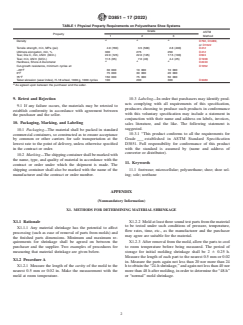
properties prescribed in Table 1.
D1938 Test Method for Tear-Propagation Resistance (Trou-
ser Tear) of Plastic Film and Thin Sheeting by a Single-
7. Test Methods
Tear Method
7.1 The physical tests shall be in accordance with Test
Method D3489.
This specification is under the jurisdiction of ASTM Committee D20 on
Plastics and is the direct responsibility of Subcommittee D20.22 on Cellular
8. Inspection
Materials - Plastics and Elastomers.
Current edition approved March 15, 2022. Published March 2022. Originally
8.1 Inspection of the material shall be agreed upon in
approved in 1980. Last previous edition approved in 2017 as D3851 – 17. DOI:
writing between the purchaser and the supplier as part of the
10.1520/D3851-17R22.
2 purchase contract.
For referenced ASTM standards, visit the ASTM website, www.astm.org, or
contact ASTM Customer Service at service@astm.org. For Annual Book of ASTM
8.2 Testing for conformance to requirements shall be done
Standards volume information, refer to the standard’s Document Summary page on
the ASTM website. in accordance with this specification and Test Methods D3489.
*A Summary of Changes section appears at the end of this standard
Copyright © ASTM International, 100 Barr Harbor Drive, PO Box C700, West Conshohocken, PA 19428-2959. United States
D3851−17 (2022)
TABLE 1 Physical Property Requirements on Polyurethane Shoe Systems
Grade
ASTM
Property
Method
AAA
Density D792, D3489,
or D1622
Tensile strength, min, MPa (psi) 4.9 (700) 3.5 (500) 2.8 (400) D412
Ultimate elongation, min, % 300 275 250 D412
Tear, Die C, min, kN/m (lbf/in.) 22.0 (125) 22.0 (125) 17.5 (100) D624
Tear, min, kN/m (lbf/in.) 11.5 (65) 7.0 (40) 4.4 (25) D1938
AAA
Hardness, Shore A Durometer D2240
Cut-growth resistance, minimum cycles at: D1052
−20°F 30 000 10 000 10 000
0°F 75 000 30 000 20 000
75°F 150 000 75 000 50 000
Taber abrasion (wear index), H-18 wheel, 1000 g, 1000 cycles 100 200 300 D3489
A
As agreed upon between the purchaser and the seller.
9. Retest and Rejection
...