

ASTM D1838-21
(Test Method)Standard Test Method for Copper Strip Corrosion by Liquefied Petroleum (LP) Gases
General Information
- Abstract
SIGNIFICANCE AND USE
5.1 Copper corrosion limits provide assurance that difficulties will not be experienced in deterioration of the copper and copper-alloy fittings and connections that are commonly used in many types of utilization, storage, and transportation equipment.
SCOPE
1.1 This test method covers the detection of the presence of components in liquefied petroleum gases which can be corrosive to copper.
Note 1: For an equivalent copper strip test applicable to less volatile petroleum products, see Test Method D130.
1.2 The values stated in SI units are to be regarded as standard.
1.2.1 Exception—The values given in parentheses are for information only.
1.3 This standard does not purport to address all of the safety concerns, if any, associated with its use. It is the responsibility of the user of this standard to establish appropriate safety, health, and environmental practices and determine the applicability of regulatory limitations prior to use. For specific warning statements, see 7.1, 10.3.1, and Annex A1.
1.4 This international standard was developed in accordance with internationally recognized principles on standardization established in the Decision on Principles for the Development of International Standards, Guides and Recommendations issued by the World Trade Organization Technical Barriers to Trade (TBT) Committee.
- Status
- Published
- Publication Date
- 30-Jun-2021
- Technical Committee
- D02 - Petroleum Products, Liquid Fuels, and Lubricants
- Drafting Committee
- D02.H0 - Liquefied Petroleum Gas
Buy Documents
ASTM D1838-21 - Standard Test Method for Copper Strip Corrosion by Liquefied Petroleum (LP) Gases
REDLINE ASTM D1838-21 - Standard Test Method for Copper Strip Corrosion by Liquefied Petroleum (LP) Gases
Overview
ASTM D1838-21, Standard Test Method for Copper Strip Corrosion by Liquefied Petroleum (LP) Gases, is an internationally recognized method published by ASTM International. The standard specifies the procedures for detecting the presence of corrosive components in liquefied petroleum gases that may damage copper and copper alloy fittings commonly used in storage, transport, and utilization systems. By identifying corrosion potential, this test method helps ensure the longevity and safety of LP gas infrastructure and equipment.
Copper corrosion testing provides critical assurance against the deterioration of system components, safeguarding both operational reliability and safety in various LP gas applications.
Key Topics
- Test Principle: The method uses a polished copper strip, which is immersed in an LP gas sample and exposed at a controlled temperature (37.8°C) for a fixed duration (1 hour). After exposure, the copper strip is visually inspected and classified according to the degree of tarnish using the ASTM Copper Strip Corrosion Standard.
- Corrosive Components Detection: Identifies the presence of substances in LP gases that may corrode copper, such as sulfur compounds.
- Classification System: Results are rated in four numerical classes, reflecting the degree of observable corrosion, from slight tarnish (Class 1) to severe corrosion (Class 4).
- Sampling Requirements: Stresses the importance of proper sampling techniques to obtain representative gas samples and prevent contamination.
- Safety and Compliance: Highlights the need for users to adopt appropriate safety, health, and environmental practices and to adhere to regulatory limitations when performing the test.
Applications
ASTM D1838-21 is applied across the LP gas industry to:
- Quality Assurance: Manufacturers, distributors, and users apply this standard to verify that LP gases meet required copper corrosion limits, ensuring compatibility with copper and copper alloy equipment.
- Equipment Longevity: Reduces the risk of premature failures, leaks, or hazardous conditions arising from corrosion in valves, fittings, pipelines, and storage vessels.
- Regulatory Compliance: Supports conformance with industry and governmental specifications, such as ASTM D1835 for LP gases, which mandate copper strip corrosion results not exceeding Class 1.
- Supply Chain Confidence: Offers confidence to system operators, transporters, and end-users that the LP gas in use will not contribute to corrosive damage in the infrastructure.
Related Standards
The ASTM D1838-21 standard references and aligns with several related documents, including:
- ASTM D130: Standard Test Method for Corrosiveness to Copper from Petroleum Products by Copper Strip Test (applies to less volatile products).
- ASTM D1265: Practice for Sampling Liquefied Petroleum (LP) Gases, Manual Method.
- ASTM D1835: Specification for Liquefied Petroleum (LP) Gases.
- ASTM D3700: Practice for Obtaining LPG Samples Using a Floating Piston Cylinder.
- ADJD0130: ASTM Copper Strip Corrosion Standard for Petroleum (adjunct for classification).
These related standards support comprehensive quality and safety evaluation for the handling and testing of LP gases.
Keywords: ASTM D1838, copper strip corrosion test, LP gas, liquefied petroleum gas, copper corrosion, gas quality assurance, ASTM standards, corrosive components detection, metal compatibility, LPG safety.
Relations
- Effective Date
- 01-Dec-2023
- Effective Date
- 01-May-2013
- Effective Date
- 01-Dec-2012
- Effective Date
- 01-Nov-2012
- Effective Date
- 01-May-2011
- Effective Date
- 01-Nov-2010
- Effective Date
- 15-Feb-2007
- Effective Date
- 01-Apr-2005
- Refers
ASTM D1265-04a - Standard Practice for Sampling Liquefied Petroleum (LP) Gases (Manual Method) - Effective Date
- 01-Nov-2004
- Effective Date
- 01-May-2004
- Effective Date
- 01-May-2004
- Effective Date
- 01-May-2004
- Effective Date
- 01-Nov-2003
- Effective Date
- 10-May-2003
- Effective Date
- 10-Dec-2001
Buy Documents
ASTM D1838-21 - Standard Test Method for Copper Strip Corrosion by Liquefied Petroleum (LP) Gases
REDLINE ASTM D1838-21 - Standard Test Method for Copper Strip Corrosion by Liquefied Petroleum (LP) Gases
Get Certified
Connect with accredited certification bodies for this standard

Element Materials Technology
Materials testing and product certification.

Inštitut za kovinske materiale in tehnologije
Institute of Metals and Technology. Materials testing, metallurgical analysis, NDT.
Sponsored listings
Frequently Asked Questions
ASTM D1838-21 is a standard published by ASTM International. Its full title is "Standard Test Method for Copper Strip Corrosion by Liquefied Petroleum (LP) Gases". This standard covers: SIGNIFICANCE AND USE 5.1 Copper corrosion limits provide assurance that difficulties will not be experienced in deterioration of the copper and copper-alloy fittings and connections that are commonly used in many types of utilization, storage, and transportation equipment. SCOPE 1.1 This test method covers the detection of the presence of components in liquefied petroleum gases which can be corrosive to copper. Note 1: For an equivalent copper strip test applicable to less volatile petroleum products, see Test Method D130. 1.2 The values stated in SI units are to be regarded as standard. 1.2.1 Exception—The values given in parentheses are for information only. 1.3 This standard does not purport to address all of the safety concerns, if any, associated with its use. It is the responsibility of the user of this standard to establish appropriate safety, health, and environmental practices and determine the applicability of regulatory limitations prior to use. For specific warning statements, see 7.1, 10.3.1, and Annex A1. 1.4 This international standard was developed in accordance with internationally recognized principles on standardization established in the Decision on Principles for the Development of International Standards, Guides and Recommendations issued by the World Trade Organization Technical Barriers to Trade (TBT) Committee.
SIGNIFICANCE AND USE 5.1 Copper corrosion limits provide assurance that difficulties will not be experienced in deterioration of the copper and copper-alloy fittings and connections that are commonly used in many types of utilization, storage, and transportation equipment. SCOPE 1.1 This test method covers the detection of the presence of components in liquefied petroleum gases which can be corrosive to copper. Note 1: For an equivalent copper strip test applicable to less volatile petroleum products, see Test Method D130. 1.2 The values stated in SI units are to be regarded as standard. 1.2.1 Exception—The values given in parentheses are for information only. 1.3 This standard does not purport to address all of the safety concerns, if any, associated with its use. It is the responsibility of the user of this standard to establish appropriate safety, health, and environmental practices and determine the applicability of regulatory limitations prior to use. For specific warning statements, see 7.1, 10.3.1, and Annex A1. 1.4 This international standard was developed in accordance with internationally recognized principles on standardization established in the Decision on Principles for the Development of International Standards, Guides and Recommendations issued by the World Trade Organization Technical Barriers to Trade (TBT) Committee.
ASTM D1838-21 is classified under the following ICS (International Classification for Standards) categories: 77.060 - Corrosion of metals. The ICS classification helps identify the subject area and facilitates finding related standards.
ASTM D1838-21 has the following relationships with other standards: It is inter standard links to ASTM D1265-23a, ASTM D1835-13, ASTM D1835-12, ASTM D3700-12, ASTM D1835-11, ASTM D130-10, ASTM D3700-07, ASTM D1835-05, ASTM D1265-04a, ASTM D1265-04, ASTM D130-04, ASTM D130-04e1, ASTM D1835-03a, ASTM D1835-03, ASTM D3700-01. Understanding these relationships helps ensure you are using the most current and applicable version of the standard.
ASTM D1838-21 is available in PDF format for immediate download after purchase. The document can be added to your cart and obtained through the secure checkout process. Digital delivery ensures instant access to the complete standard document.
Standards Content (Sample)
This international standard was developed in accordance with internationally recognized principles on standardization established in the Decision on Principles for the
Development of International Standards, Guides and Recommendations issued by the World Trade Organization Technical Barriers to Trade (TBT) Committee.
Designation: D1838 −21
Standard Test Method for
Copper Strip Corrosion by Liquefied Petroleum (LP) Gases
This standard is issued under the fixed designation D1838; the number immediately following the designation indicates the year of
original adoption or, in the case of revision, the year of last revision. A number in parentheses indicates the year of last reapproval. A
superscript epsilon (´) indicates an editorial change since the last revision or reapproval.
1. Scope* 2.2 ASTM Adjuncts:
ADJD0130, ASTM Copper Strip Corrosion Standard for
1.1 This test method covers the detection of the presence of
Petroleum
components in liquefied petroleum gases which can be corro-
sive to copper.
3. Terminology
NOTE 1—For an equivalent copper strip test applicable to less volatile
3.1 Abbreviations:
petroleum products, see Test Method D130.
3.1.1 CAMI—Coated Abrasives Manufacturers Institute
1.2 The values stated in SI units are to be regarded as
3.1.2 FEPA—FederationofEuropeanProducersAssociation
standard.
1.2.1 Exception—The values given in parentheses are for
4. Summary of Test Method
information only.
4.1 A polished copper strip is immersed in approximately
1.3 This standard does not purport to address all of the
100 mLof the sample and exposed at a temperature of 37.8 °C
safety concerns, if any, associated with its use. It is the
(100 °F) for1hina cylinder of suitable working pressure. At
responsibility of the user of this standard to establish appro-
the end of this period, the copper strip is removed and rated as
priate safety, health, and environmental practices and deter-
one of the four classifications of the ASTM Copper Strip
mine the applicability of regulatory limitations prior to use.
Corrosion Standard (ADJD0130).
For specific warning statements, see 7.1, 10.3.1, and Annex
A1.
5. Significance and Use
1.4 This international standard was developed in accor-
dance with internationally recognized principles on standard- 5.1 Copper corrosion limits provide assurance that difficul-
ization established in the Decision on Principles for the ties will not be experienced in deterioration of the copper and
Development of International Standards, Guides and Recom- copper-alloy fittings and connections that are commonly used
mendations issued by the World Trade Organization Technical in many types of utilization, storage, and transportation equip-
Barriers to Trade (TBT) Committee.
ment.
2. Referenced Documents
6. Apparatus
2.1 ASTM Standards: 6.1 Corrosion Test Cylinder, constructed of stainless steel
D130 Test Method for Corrosiveness to Copper from Petro-
with an O-ring removable top closure according to the dimen-
leum Products by Copper Strip Test sions given in Fig. 1. Provide a flexible inert hose, such as one
D1265 Practice for Sampling Liquefied Petroleum (LP)
composed of aluminum or stainless steel, which permits
Gases, Manual Method
inverting the test cylinder as required in the procedure (see
D1835 Specification for Liquefied Petroleum (LP) Gases
6.1.1). The whole assembly, including the corrosion test
D3700 Practice for Obtaining LPG Samples Using a Float-
cylinder, shall be constructed to withstand a minimum hydro-
ing Piston Cylinder
static test pressure of 6900 kPa (1000 psig). No leak shall be
discernible when tested at 3450 kPa (500 psig) with gas.
6.1.1 Swivel connections with an adapter to fit a 6.4 mm
This test method is under the jurisdiction of ASTM Committee D02 on 1
( ⁄4 in.) pipe may be used.
Petroleum Products, Liquid Fuels, and Lubricants and is the direct responsibility of
6.1.2 The assembly shall be tested for compliance with the
Subcommittee D02.H0 on Liquefied Petroleum Gas.
minimum pressure rating of 6900 kPa (1000 psig) by hydro-
Current edition approved July 1, 2021. Published July 2021. Originally approved
in 1961. Last previous edition approved in 2020 as D1838 – 20. DOI: 10.1520/
static testing, or alternative testing protocol acceptable to the
D1838-21.
For referenced ASTM standards, visit the ASTM website, www.astm.org, or
contact ASTM Customer Service at service@astm.org. For Annual Book of ASTM
Standards volume information, refer to the standard’s Document Summary page on Available from ASTM International Headquarters. Order Adjunct No.
the ASTM website. ADJD0130.
*A Summary of Changes section appears at the end of this standard
Copyright © ASTM International, 100 Barr Harbor Drive, PO Box C700, West Conshohocken, PA 19428-2959. United States
D1838 − 21
7. Materials
7.1 Wash Solvent—Any volatile, less than 5 mg/kg sulfur,
hydrocarbon solvent may be used provided that it shows no
tarnish at all when tested for3hat50°C (122 °F). 2,2,4-
trimethylpentane (isooctane) of minimum 99.75 % purity is the
referee solvent and should be used in case of dispute.
(Warning—Extremely flammable, see Annex A1.)
7.2 Copper Strip Specification—Use strips that are 12.5 mm
1 1 1
62mm( ⁄2 in.) wide, 1.5 mm to 3.2 mm ( ⁄16 to ⁄8 in.) thick,
and cut 75 mm 6 5 mm (3 in.) long from smooth-surfaced,
hard-temper, cold-finished copper of 99.9+ % purity; electrical
bus bar stock is generally suitable. Drill a 3.2 mm ( ⁄8 in.) hole
approximately3.2mm( ⁄8in.)fromoneendinthecenterofthe
strip. The strips may be used repeatedly but shall be discarded
when the strip’s surface shows pitting or deep scratches that
cannot be removed by the specified polishing procedure, or
when the surface becomes deformed, or the dimensions for the
copper strip fall outside the specified limits.
7.3 Surface Preparation/Polishing Materials—00 grade or
finer steel wool; silicon carbide grit paper or cloth of varying
degrees of fineness including 65 µm grade (220-grit CAMI-
grade or P220 FEPA-grade); also a supply of 105 µm (120-grit
to 150-grit CAMI-grade or P120 to P150 FEPA-grade) size
Metric Equivalents silicon carbide grain or powder and absorbent cotton. A
in. mm in. mm
commercial grade is suitable, but pharmaceutical grade cotton
⁄8 3.2 3 76
wool is most commonly available and is acceptable.
⁄4 6.4 6 152
1 ⁄2 38.1
7.4 ASTM Copper Strip Corrosion Standard (ADJD0130),
Plaques are available. Their care and inspection for stability
FIG. 1 Copper Strip Corrosion Test Cylinder
are described in detail in Test Method D130.
7.5 Reagent Grade LPG—Propane, butane, or mixture of
propane and butane that has less than 1 mg⁄kg sulfur and
local authority having jurisdiction, prior to first use.Additional
passes this copper corrosion test with a No. 1 rating.
testing can be required by the local authority having jurisdic-
tion.
8. Preparation of Strips
6.1.3 The assembly shall be verified for gas tightness by
8.1 Surface Preparation—Remove all surface blemishes
leaktestingataminimumof3450kPa(500psig)withinertgas
fromallsixsidesofthestripobtainedfromapreviousanalysis.
prior to first use, whenever pressure-containing components of
One way to accomplish this is to use 00 grade or finer steel
the assembly are replaced, or otherwise on an annual basis.
wool or silicon carbide paper or cloth of such degrees of
6.1.4 Note the presence and length (about 60 mm) of the
fineness as are needed to accomplish the desired results
outage tube shown in Fig. 1, to provide adequate ullage for
efficiently. Finish with 65 µm grade (220-grit CAMI-grade or
safety.Asafety pressure relief device may also be incorporated
P220 FEPA-grade) silicon carbide paper or cloth, removing all
into the design of the corrosion test cylinder, if desired. If a
marksthatcouldhavebeenmadebyothergradesofpaperused
pressure relief device is incorporated, ensure that the materials
previously. Ensure the prepared copper strip is protected from
of its construction will not affect the test results.
oxidation prior to final preparation, such as by immersing the
strip in wash solvent from which it can be withdrawn imme-
6.2 Water Bath, capable of being maintained at 37.8 °C 6
diately for final preparation (polishing) or in which it can be
0.5 °C (100 °F 6 1 °F). Incorporate suitable supports to hold
stored for future use.
the test cylinder in an upright position. Make the bath deep
8.1.1 As a practical manual procedure for surface
enough so that the entire cylinder and valves will be covered
during the test. preparation, place a sheet of silicon carbide paper or cloth on
a flat surface and moisten it with wash solvent. Rub the strip
6.3 Temperature Sensing Device (TSD)—Capable of moni-
against the silicon carbide paper or cloth with a circular
toring the desired test temperature in the bath to within an
motion, protecting the strip from contact with the fingers by
accuracy of 60.5 °C (1 °F) or better.
using ashless filter paper or wearing disposable gloves.
6.4 Strip Polishing Vise, to hold the copper strip firmly Alternatively, the surface of the strip may be prepared by use
without marring the edges. For convenient vises see Test of motor-driven machines using appropriate grades of dry
Method D130. paper or cloth.
D1838 − 21
NOTE 2—Some internal coatings are porous and can adsorb or release
8.1.2 Only final preparation (8.2) is necessary for commer-
contaminantsthatcanaffecttestresults.Also,freshsteelsurfacescanreact
cially purchased pre-polished strips.
with some corrosive sulfur species and potentially remove them, which
could result in a “false pass” in the copper strip corrosion test.
8.2 Final Preparation—For strips prepared in 8.1 or new
strips being used for the first time, remove a strip from its
9.3 Flushing a prepared (wetted) test cylinder with LPG as
protected location, such as by removing it from the wash
is the practice at a flowthrough sampling station can invalidate
solvent.To prevent possible surface contamination during final
the test by drying the cylinder walls. While a flow-through
preparation, do not allow fingers to come in direct contact with
samplingstationcanhelpensurethatarepresentativesampleis
the copper strips, such as by wearing disposable gloves or
collected, care shall be taken that the procedure for collecting
holding the strips in the fingers protected with ashless filter
a sample for this test method is followed to remove air but not
paper. Polish first the ends and then the sides with the 105 µm
flow liquid LPG through the cylinder excessively which could
(120-grit to 150-grit CAMI-grade or P120 to P150 FEPA-
dry the wetted surfaces (10.3).
grade) silicon carbide grains picked up with a pad of absorbent
9.4 The time between when the sample is collected and
cotton moistened with wash solvent. Wipe vigorously with
whenthetestisbegunshouldbeheldtoaminimum(preferably
freshpadsofabsorbentcottonandsubsequentlyhandlewithout
only a few minutes) (see Note 3).
touching the surface of the strip with the fingers. Padded
9.5 In case of dispute, a sample shall be collected directly
forceps (to prevent the scratching of the surface) have been
into a corrosion test cylinder.
found suitable to use. Secure the copper strip in a vise or
suitable holder and polish the main surfaces with silicon-
10. Procedure
carbide grains on absorbent cotton. Do not polish in a circular
motion. Rub in the direction of the long axis of the strip, 10.1 WithValve B (Fig. 1), open, place approximately 1 mL
carrying the stroke beyond the end of the strip before reversing
of distilled water into a clean test cylinder and swirl to moisten
the direction. Clean all metal dust from the strip by rubbing the walls; allow the remainder to drain from the cylinder, insert
vigorouslywithcleanpadsofabsorbentcottonuntilafreshpad the freshly polished copper strip suspended from the hook on
remains unsoiled. When the strip is clean, with minimal delay, the dip tube making sure that the bottom of the strip is at least
attach to the dip tube and lower into the prepared corrosion test 6.4 mm ( ⁄4 in.) from the bottom of the cylinder when
cylinder (see Fig. 1). assembled.After assembly of the apparatus, close bothValve A
(Fig. 1), on closure assembly with outage tube, and Valve B.
8.2.1 It is important to polish the whole surface of the strip
uniformlytoobtainauniformlystainedstrip.Iftheedgesshow
10.2 Prior to collecting a test sample, air shall be purged
wear (surface elliptical) they will likely show more corrosion
from the test cylinder with the sample to be measured in a
than the center. The use of a vise will facilitate uniform
manner that does not dry the cylinder walls.
polishing.
10.2.1 Procedure A:
8.2.2 It is important to follow the order of preparation with
10.2.1.1 Holding the test cylinder upright so as not to wet
the correctly sized silicon carbide material as described in 8.1
the copper strip with water, attach the sample source to the test
and 8.2. The final preparation is with 105 µm (120-grit to
cylinder Valve A (Fig. 1) by means of a short length of flexib
...
This document is not an ASTM standard and is intended only to provide the user of an ASTM standard an indication of what changes have been made to the previous version. Because
it may not be technically possible to adequately depict all changes accurately, ASTM recommends that users consult prior editions as appropriate. In all cases only the current version
of the standard as published by ASTM is to be considered the official document.
Designation: D1838 − 20 D1838 − 21
Standard Test Method for
Copper Strip Corrosion by Liquefied Petroleum (LP) Gases
This standard is issued under the fixed designation D1838; the number immediately following the designation indicates the year of
original adoption or, in the case of revision, the year of last revision. A number in parentheses indicates the year of last reapproval. A
superscript epsilon (´) indicates an editorial change since the last revision or reapproval.
1. Scope*
1.1 This test method covers the detection of the presence of components in liquefied petroleum gases which can be corrosive to
copper.
NOTE 1—For an equivalent copper strip test applicable to less volatile petroleum products, see Test Method D130.
1.2 The values stated in SI units are to be regarded as standard.
1.2.1 Exception—The values given in parentheses are for information only.
1.3 This standard does not purport to address all of the safety concerns, if any, associated with its use. It is the responsibility
of the user of this standard to establish appropriate safety, health, and environmental practices and determine the applicability of
regulatory limitations prior to use. For specific warning statements, see 7.1, 10.3.1, and Annex A1.
1.4 This international standard was developed in accordance with internationally recognized principles on standardization
established in the Decision on Principles for the Development of International Standards, Guides and Recommendations issued
by the World Trade Organization Technical Barriers to Trade (TBT) Committee.
2. Referenced Documents
2.1 ASTM Standards:
D130 Test Method for Corrosiveness to Copper from Petroleum Products by Copper Strip Test
D1265 Practice for Sampling Liquefied Petroleum (LP) Gases, Manual Method
D1835 Specification for Liquefied Petroleum (LP) Gases
D3700 Practice for Obtaining LPG Samples Using a Floating Piston Cylinder
2.2 ASTM Adjuncts:
ADJD0130, ASTM Copper Strip Corrosion Standard for Petroleum
3. Terminology
3.1 Abbreviations:
3.1.1 CAMI—Coated Abrasives Manufacturers Institute
This test method is under the jurisdiction of ASTM Committee D02 on Petroleum Products, Liquid Fuels, and Lubricants and is the direct responsibility of Subcommittee
D02.H0 on Liquefied Petroleum Gas.
Current edition approved July 1, 2020July 1, 2021. Published July 2020July 2021. Originally approved in 1961. Last previous edition approved in 20162020 as
D1838 – 16.D1838 – 20. DOI: 10.1520/D1838-20.10.1520/D1838-21.
For referenced ASTM standards, visit the ASTM website, www.astm.org, or contact ASTM Customer Service at service@astm.org. For Annual Book of ASTM Standards
volume information, refer to the standard’s Document Summary page on the ASTM website.
Available from ASTM International Headquarters. Order Adjunct No. ADJD0130.
*A Summary of Changes section appears at the end of this standard
Copyright © ASTM International, 100 Barr Harbor Drive, PO Box C700, West Conshohocken, PA 19428-2959. United States
D1838 − 21
3.1.2 FEPA—Federation of European Producers Association
4. Summary of Test Method
4.1 A polished copper strip is immersed in approximately 100 mL of the sample and exposed at a temperature of 37.8 °C (100 °F)
for 1 h in a cylinder of suitable working pressure. At the end of this period, the copper strip is removed and rated as one of the
four classifications of the ASTM Copper Strip Corrosion Standard (ADJD0130).
5. Significance and Use
5.1 Copper corrosion limits provide assurance that difficulties will not be experienced in deterioration of the copper and
copper-alloy fittings and connections that are commonly used in many types of utilization, storage, and transportation equipment.
6. Apparatus
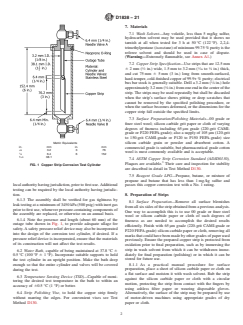
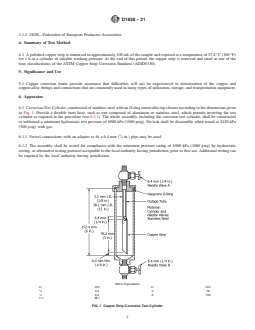
6.1 Corrosion Test Cylinder, constructed of stainless steel with an O-ring removable top closure according to the dimensions given
in Fig. 1. Provide a flexible inert hose, such as one composed of aluminum or stainless steel, which permits inverting the test
cylinder as required in the procedure (see 6.1.1). The whole assembly, including the corrosion test cylinder, shall be constructed
to withstand a minimum hydrostatic test pressure of 6900 kPa (1000 psig). No leak shall be discernible when tested at 3450 kPa
(500 psig) with gas.
6.1.1 Swivel connections with an adapter to fit a 6.4 mm ( ⁄4 in.) pipe may be used.
6.1.2 The assembly shall be tested for compliance with the minimum pressure rating of 6900 kPa (1000 psig) by hydrostatic
testing, or alternative testing protocol acceptable to the local authority having jurisdiction, prior to first use. Additional testing can
be required by the local authority having jurisdiction.
Metric Equivalents
in. mm in. mm
⁄8 3.2 3 76
⁄4 6.4 6 152
1 ⁄2 38.1
FIG. 1 Copper Strip Corrosion Test Cylinder
D1838 − 21
6.1.3 The assembly shall be verified for gas tightness by leak testing at a minimum of 3450 kPa (500 psig) with inert gas prior
to first use, whenever pressure-containing components of the assembly are replaced, or otherwise on an annual basis.
6.1.4 Note the presence and length (about 60 mm) of the outage tube shown in Fig. 1, to provide adequate ullage for safety. A
safety pressure relief device may also be incorporated into the design of the corrosion test cylinder, if desired. If a pressure relief
device is incorporated, ensure that the materials of its construction will not affect the test results.
6.2 Water Bath, capable of being maintained at 37.8 °C 6 0.5 °C (100 °F 6 1 °F). Incorporate suitable supports to hold the test
cylinder in an upright position. Make the bath deep enough so that the entire cylinder and valves will be covered during the test.
6.3 Temperature Sensing Device (TSD)—Capable of monitoring the desired test temperature in the bath to within an accuracy of
60.5 °C (1 °F) or better.
6.4 Strip Polishing Vise, to hold the copper strip firmly without marring the edges. For convenient vises see Test Method D130.
7. Materials
7.1 Wash Solvent—Any volatile, less than 5 mg/kg sulfur, hydrocarbon solvent may be used provided that it shows no tarnish at
all when tested for 3 h at 50 °C (122 °F). 2,2,4- trimethylpentane (isooctane)(isooctane) of minimum 99.75 % purity is the referee
solvent and should be used in case of dispute. (Warning—Extremely flammable, see Annex A1.)
1 1 1
7.2 Copper Strip Specification—Use strips that are 12.5 mm 6 2 mm ( ⁄2 in.) wide, 1.5 mm to 3.2 mm ( ⁄16 to ⁄8 in.) thick, and
cut 75 mm 6 5 mm (3 in.) long from smooth-surfaced, hard-temper, cold-finished copper of 99.9+ % purity; electrical bus bar
1 1
stock is generally suitable. Drill a 3.2 mm ( ⁄8 in.) hole approximately 3.2 mm ( ⁄8 in.) from one end in the center of the strip. The
strips may be used repeatedly but shall be discarded when the strip’s surface shows pitting or deep scratches that cannot be
removed by the specified polishing procedure, or when the surface becomes deformed, or the dimensions for the copper strip fall
outside the specified limits.
7.3 Surface Preparation/Polishing Materials—00 grade or finer steel wool; silicon carbide grit paper or cloth of varying degrees
of fineness including 65 μm grade (220-grit CAMI-grade or P220 FEPA-grade); also a supply of 105 μm (120-grit to 150-grit
CAMI-grade or P120 to P150 FEPA-grade) size silicon carbide grain or powder and absorbent cotton. A commercial grade is
suitable, but pharmaceutical grade cotton wool is most commonly available and is acceptable.
7.4 ASTM Copper Strip Corrosion Standard (ADJD0130), Plaques are available. Their care and inspection for stability are
described in detail in Test Method D130.
7.5 Reagent Grade LPG—Propane, butane, or mixture of propane and butane that has less than 1 mg ⁄kg sulfur and passes this
copper corrosion test with a No. 1 rating.
8. Preparation of Strips
8.1 Surface Preparation—Remove all surface blemishes from all six sides of the strip obtained from a previous analysis. One way
to accomplish this is to use 00 grade or finer steel wool or silicon carbide paper or cloth of such degrees of fineness as are needed
to accomplish the desired results efficiently. Finish with 65 μm grade (220-grit CAMI-grade or P220 FEPA-grade) silicon carbide
paper or cloth, removing all marks that could have been made by other grades of paper used previously. Ensure the prepared copper
strip is protected from oxidation prior to final preparation, such as by immersing the strip in wash solvent from which it can be
withdrawn immediately for final preparation (polishing) or in which it can be stored for future use.
8.1.1 Only final preparation (8.2) is necessary for commercially purchased pre-polished strips.
8.1.1 As a practical manual procedure for surface preparation, place a sheet of silicon carbide paper or cloth on a flat surface and
moisten it with wash solvent. Rub the strip against the silicon carbide paper or cloth with a circular motion, protecting the strip
from contact with the fingers by using ashless filter paper or wearing disposable gloves. Alternatively, the surface of the strip may
be prepared by use of motor-driven machines using appropriate grades of dry paper or cloth.
D1838 − 21
8.1.2 Only final preparation (8.2) is necessary for commercially purchased pre-polished strips.
8.2 Final Preparation—For strips prepared in 8.1 or new strips being used for the first time, remove a strip from its protected
location, such as by removing it from the wash solvent. To prevent possible surface contamination during final preparation, do not
allow fingers to come in direct contact with the copper strips, such as by wearing disposable gloves or holding the strips in the
fingers protected with ashless filter paper. Polish first the ends and then the sides with the 105 μm (120-grit to 150-grit CAMI-grade
or P120 to P150 FEPA-grade) silicon carbide grains picked up with a pad of absorbent cotton moistened with wash solvent. Wipe
vigorously with fresh pads of absorbent cotton and subsequently handle without touching the surface of the strip with the fingers.
Padded forceps (to prevent the scratching of the surface) have been found suitable to use. Secure the copper strip in a vise or
suitable holder and polish the main surfaces with silicon-carbide grains on absorbent cotton. Do not polish in a circular motion.
Rub in the direction of the long axis of the strip, carrying the stroke beyond the end of the strip before reversing the direction. Clean
all metal dust from the strip by rubbing vigorously with clean pads of absorbent cotton until a fresh pad remains unsoiled. When
the strip is clean, with minimal delay, attach to the dip tube and lower into the prepared corrosion test cylinder (see Fig. 1).
8.2.1 It is important to polish the whole surface of the strip uniformly to obtain a uniformly stained strip. If the edges show wear
(surface elliptical) they will likely show more corrosion than the center. The use of a vise will facilitate uniform polishing.
8.2.2 It is important to follow the order of preparation with the correctly sized silicon carbide material as described in 8.1 and 8.2.
The final preparation is with 105 μm (120-grit to 150-grit CAMI-grade or P120 to P150 FEPA-grade) silicon carbide grains. This
is a larger grain size than the 65 μm grade (220-grit CAMI-grade or P220 FEPA-grade) paper used in the surface preparation stage.
The reason for this use of larger silicon carbide grains in the final preparation is to produce asperities (controlled roughness) on
the surface of the copper which act as sites for the initiation of corrosion reactions.
9. Sampling
9.1 Obtain a sample from a point in the LPG system that will give a representative sample of the volume being tested, such as
from a dynamic flowing stream or from a well mixed container, as appropriate. Preferably, collect the sample directly into the
corrosion test cylinder (6.1) after it has been prepared for testing (10.1). Pay particular attention to safety and warning notes in
Practices D1265 and D3700.
9.2 Alternatively, collect a sample in accordance with Practices D1265 and D3700.
9.2.1 If a sample is first collected in a sampling cylinder, ensure that the interior surfaces are inert and will not react with corrosive
species. Sampling cylinders with protective (inert) internal coatings or surface treatments (such as fused glass) may be used.
NOTE 2—Some internal coatings are porous and can adsorb or release contaminants that can affect test results. Also, fresh steel surfaces can react with
some corrosive sulfur species and potentially remove them, which could result in a “false pass” in the copper strip corrosion test.
9.3 Flushing a prepared (wetted) test cylinder with LPG as is the practice at a flowthrough sampling station can invalidate the test
by drying the cylinder walls. While a flow-through sampling station can help ensure that a representative sample is collected, care
...