

ASTM D130-19
(Test Method)Standard Test Method for Corrosiveness to Copper from Petroleum Products by Copper Strip Test
General Information
- Abstract
SIGNIFICANCE AND USE
5.1 Crude petroleum contains sulfur compounds, most of which are removed during refining. However, of the sulfur compounds remaining in the petroleum product, some can have a corroding action on various metals and this corrosivity is not necessarily related directly to the total sulfur content. The effect can vary according to the chemical types of sulfur compounds present. The copper strip corrosion test is designed to assess the relative degree of corrosivity of a petroleum product.
SCOPE
1.1 This test method covers the determination of the corrosiveness to copper of aviation gasoline, aviation turbine fuel, automotive gasoline, cleaners (Stoddard) solvent, kerosine, diesel fuel, distillate fuel oil, lubricating oil, and natural gasoline or other hydrocarbons having a vapor pressure no greater than 124 kPa (18 psi) at 37.8 °C. (Warning—Some products, particularly natural gasoline, may have a much higher vapor pressure than would normally be characteristic of automotive or aviation gasolines. For this reason, exercise extreme caution to ensure that the pressure vessel used in this test method and containing natural gasoline or other products of high vapor pressure is not placed in the 100 °C (212 °F) bath. Samples having vapor pressures in excess of 124 kPa (18 psi) may develop sufficient pressures at 100 °C to rupture the pressure vessel. For any sample having a vapor pressure above 124 kPa (18 psi), use Test Method D1838.)
1.2 The values stated in SI units are to be regarded as standard. The values given in parentheses after SI units are provided for information only and are not considered standard.
1.3 This standard does not purport to address all of the safety concerns, if any, associated with its use. It is the responsibility of the user of this standard to establish appropriate safety, health, and environmental practices and determine the applicability of regulatory limitations prior to use. For specific warning statements, see 1.1, 7.1, and Annex A2.
1.4 This international standard was developed in accordance with internationally recognized principles on standardization established in the Decision on Principles for the Development of International Standards, Guides and Recommendations issued by the World Trade Organization Technical Barriers to Trade (TBT) Committee.
- Status
- Published
- Publication Date
- 30-Apr-2019
- Technical Committee
- D02 - Petroleum Products, Liquid Fuels, and Lubricants
- Drafting Committee
- D02.05 - Properties of Fuels, Petroleum Coke and Carbon Material
Buy Documents
ASTM D130-19 - Standard Test Method for Corrosiveness to Copper from Petroleum Products by Copper Strip Test
REDLINE ASTM D130-19 - Standard Test Method for Corrosiveness to Copper from Petroleum Products by Copper Strip Test
Overview
ASTM D130-19: Standard Test Method for Corrosiveness to Copper from Petroleum Products by Copper Strip Test is an internationally recognized standard developed by ASTM. This method is used to determine the corrosive properties of various petroleum products, including aviation gasoline, aviation turbine fuel, automotive gasoline, kerosine, diesel fuel, lubricating oil, and natural gasoline, with respect to copper. The test evaluates how sulfur compounds remaining after refining may affect metals, regardless of total sulfur content, by measuring the degree of tarnish or corrosion a copper strip experiences when immersed in the sample under controlled conditions.
Key Topics
- Purpose: Evaluates the corrosiveness to copper from residual sulfur compounds in petroleum products, which are not always directly related to total sulfur content.
- Test Samples: Suitable for petroleum products with a vapor pressure not exceeding 124 kPa (18 psi) at 37.8 °C.
- Test Method: Involves immersing a polished copper strip in the sample and heating it under specific conditions. After exposure, the strip is examined and rated according to the ASTM Copper Strip Corrosion Standard.
- Copper Strip Classification: The method assigns classifications ranging from slight tarnish to severe corrosion based on color changes and surface appearance.
- Safety Considerations: Highlights potential hazards when working with highly volatile products, recommending strict adherence to safety, health, and environmental practices.
Applications
The copper strip corrosion test described in ASTM D130-19 is widely used across the petroleum industry and related sectors:
- Product Quality Control: Ensures fuels like gasoline, diesel, and aviation fuel meet corrosion standards to protect engine and fuel system components.
- Specification Compliance: Supports regulatory and contractual requirements, with results often stipulated in product specifications and referenced in commercial agreements.
- Material Compatibility Assessment: Provides insights into potential corrosive effects of fuels and lubricants on copper and copper-containing alloys, aiding in the selection of compatible downstream equipment and additives.
- Research and Development: Assists in formulation and evaluation of new petroleum products, especially regarding their sulfur chemistry and additives.
- International Trade: Accepted by governmental agencies and fuel suppliers globally to verify fuel quality during transfers, particularly at refineries, blending terminals, and airports.
Related Standards
- ASTM D396: Specification for Fuel Oils.
- ASTM D975: Specification for Diesel Fuel Oils.
- ASTM D1655: Specification for Aviation Turbine Fuels.
- ASTM D1838: Test Method for Copper Strip Corrosion by Liquefied Petroleum (LP) Gases – used for products with higher vapor pressure.
- ASTM D4057 & D4177: Practices for Manual and Automatic Sampling of Petroleum and Petroleum Products.
- ASTM D6300: Practice for Determination of Precision and Bias Data for Test Methods for Petroleum Products and Lubricants.
- ASTM E1: Specification for ASTM Liquid-in-Glass Thermometers.
Practical Value
Employing ASTM D130-19 enhances quality assurance and safety by:
- Detecting potentially damaging sulfur compounds that can cause corrosion, even in refined products.
- Helping to avoid equipment failure and operational disruptions caused by corrosive fuels and lubricants.
- Supporting compliance with both national and international fuel standards, facilitating smoother trade and regulatory acceptance.
Keywords: ASTM D130, copper strip corrosion test, corrosiveness to copper, petroleum product testing, fuel quality, sulfur compounds, fuel standards, copper corrosion, ASTM test methods, petroleum product specification.
Relations
- Effective Date
- 15-Mar-2024
- Effective Date
- 01-Mar-2024
- Effective Date
- 15-Dec-2023
- Effective Date
- 01-Dec-2023
- Effective Date
- 01-Oct-2023
- Effective Date
- 15-Dec-2019
- Effective Date
- 01-Dec-2019
- Effective Date
- 01-May-2019
- Effective Date
- 01-Feb-2019
- Effective Date
- 01-Dec-2018
- Effective Date
- 01-Oct-2018
- Effective Date
- 01-May-2018
- Effective Date
- 01-Jan-2018
- Effective Date
- 15-Dec-2017
- Effective Date
- 01-Dec-2017
Buy Documents
ASTM D130-19 - Standard Test Method for Corrosiveness to Copper from Petroleum Products by Copper Strip Test
REDLINE ASTM D130-19 - Standard Test Method for Corrosiveness to Copper from Petroleum Products by Copper Strip Test
Get Certified
Connect with accredited certification bodies for this standard

Element Materials Technology
Materials testing and product certification.

Inštitut za kovinske materiale in tehnologije
Institute of Metals and Technology. Materials testing, metallurgical analysis, NDT.
Sponsored listings
Frequently Asked Questions
ASTM D130-19 is a standard published by ASTM International. Its full title is "Standard Test Method for Corrosiveness to Copper from Petroleum Products by Copper Strip Test". This standard covers: SIGNIFICANCE AND USE 5.1 Crude petroleum contains sulfur compounds, most of which are removed during refining. However, of the sulfur compounds remaining in the petroleum product, some can have a corroding action on various metals and this corrosivity is not necessarily related directly to the total sulfur content. The effect can vary according to the chemical types of sulfur compounds present. The copper strip corrosion test is designed to assess the relative degree of corrosivity of a petroleum product. SCOPE 1.1 This test method covers the determination of the corrosiveness to copper of aviation gasoline, aviation turbine fuel, automotive gasoline, cleaners (Stoddard) solvent, kerosine, diesel fuel, distillate fuel oil, lubricating oil, and natural gasoline or other hydrocarbons having a vapor pressure no greater than 124 kPa (18 psi) at 37.8 °C. (Warning—Some products, particularly natural gasoline, may have a much higher vapor pressure than would normally be characteristic of automotive or aviation gasolines. For this reason, exercise extreme caution to ensure that the pressure vessel used in this test method and containing natural gasoline or other products of high vapor pressure is not placed in the 100 °C (212 °F) bath. Samples having vapor pressures in excess of 124 kPa (18 psi) may develop sufficient pressures at 100 °C to rupture the pressure vessel. For any sample having a vapor pressure above 124 kPa (18 psi), use Test Method D1838.) 1.2 The values stated in SI units are to be regarded as standard. The values given in parentheses after SI units are provided for information only and are not considered standard. 1.3 This standard does not purport to address all of the safety concerns, if any, associated with its use. It is the responsibility of the user of this standard to establish appropriate safety, health, and environmental practices and determine the applicability of regulatory limitations prior to use. For specific warning statements, see 1.1, 7.1, and Annex A2. 1.4 This international standard was developed in accordance with internationally recognized principles on standardization established in the Decision on Principles for the Development of International Standards, Guides and Recommendations issued by the World Trade Organization Technical Barriers to Trade (TBT) Committee.
SIGNIFICANCE AND USE 5.1 Crude petroleum contains sulfur compounds, most of which are removed during refining. However, of the sulfur compounds remaining in the petroleum product, some can have a corroding action on various metals and this corrosivity is not necessarily related directly to the total sulfur content. The effect can vary according to the chemical types of sulfur compounds present. The copper strip corrosion test is designed to assess the relative degree of corrosivity of a petroleum product. SCOPE 1.1 This test method covers the determination of the corrosiveness to copper of aviation gasoline, aviation turbine fuel, automotive gasoline, cleaners (Stoddard) solvent, kerosine, diesel fuel, distillate fuel oil, lubricating oil, and natural gasoline or other hydrocarbons having a vapor pressure no greater than 124 kPa (18 psi) at 37.8 °C. (Warning—Some products, particularly natural gasoline, may have a much higher vapor pressure than would normally be characteristic of automotive or aviation gasolines. For this reason, exercise extreme caution to ensure that the pressure vessel used in this test method and containing natural gasoline or other products of high vapor pressure is not placed in the 100 °C (212 °F) bath. Samples having vapor pressures in excess of 124 kPa (18 psi) may develop sufficient pressures at 100 °C to rupture the pressure vessel. For any sample having a vapor pressure above 124 kPa (18 psi), use Test Method D1838.) 1.2 The values stated in SI units are to be regarded as standard. The values given in parentheses after SI units are provided for information only and are not considered standard. 1.3 This standard does not purport to address all of the safety concerns, if any, associated with its use. It is the responsibility of the user of this standard to establish appropriate safety, health, and environmental practices and determine the applicability of regulatory limitations prior to use. For specific warning statements, see 1.1, 7.1, and Annex A2. 1.4 This international standard was developed in accordance with internationally recognized principles on standardization established in the Decision on Principles for the Development of International Standards, Guides and Recommendations issued by the World Trade Organization Technical Barriers to Trade (TBT) Committee.
ASTM D130-19 is classified under the following ICS (International Classification for Standards) categories: 77.060 - Corrosion of metals. The ICS classification helps identify the subject area and facilitates finding related standards.
ASTM D130-19 has the following relationships with other standards: It is inter standard links to ASTM D1655-24, ASTM D6300-24, ASTM D975-23a, ASTM D6300-23a, ASTM D1655-23a, ASTM D396-19a, ASTM D6300-19a, ASTM D396-19, ASTM D975-19, ASTM D975-18a, ASTM D396-18a, ASTM D396-18, ASTM D1655-18, ASTM D975-17a, ASTM D1655-17a. Understanding these relationships helps ensure you are using the most current and applicable version of the standard.
ASTM D130-19 is available in PDF format for immediate download after purchase. The document can be added to your cart and obtained through the secure checkout process. Digital delivery ensures instant access to the complete standard document.
Standards Content (Sample)
This international standard was developed in accordance with internationally recognized principles on standardization established in the Decision on Principles for the
Development of International Standards, Guides and Recommendations issued by the World Trade Organization Technical Barriers to Trade (TBT) Committee.
Designation: D130 − 19 Federation of Societies for
Paint Technology Standard No. Dt-28-65
British Standard 4351
Standard Test Method for
Corrosiveness to Copper from Petroleum Products by
Copper Strip Test
This standard is issued under the fixed designation D130; the number immediately following the designation indicates the year of
original adoption or, in the case of revision, the year of last revision. A number in parentheses indicates the year of last reapproval. A
superscript epsilon (´) indicates an editorial change since the last revision or reapproval.
This standard has been approved for use by agencies of the U.S. Department of Defense.
1. Scope* 2. Referenced Documents
2.1 ASTM Standards:
1.1 This test method covers the determination of the corro-
siveness to copper of aviation gasoline, aviation turbine fuel, D396 Specification for Fuel Oils
D975 Specification for Diesel Fuel Oils
automotive gasoline, cleaners (Stoddard) solvent, kerosine,
diesel fuel, distillate fuel oil, lubricating oil, and natural D1655 Specification for Aviation Turbine Fuels
D1838 TestMethodforCopperStripCorrosionbyLiquefied
gasoline or other hydrocarbons having a vapor pressure no
greater than 124 kPa (18 psi) at 37.8 °C. (Warning—Some Petroleum (LP) Gases
products, particularly natural gasoline, may have a much D4057 Practice for Manual Sampling of Petroleum and
higher vapor pressure than would normally be characteristic of Petroleum Products
automotive or aviation gasolines. For this reason, exercise D4177 Practice for Automatic Sampling of Petroleum and
extreme caution to ensure that the pressure vessel used in this Petroleum Products
test method and containing natural gasoline or other products D6300 Practice for Determination of Precision and Bias
of high vapor pressure is not placed in the 100 °C (212 °F) Data for Use in Test Methods for Petroleum Products and
bath. Samples having vapor pressures in excess of 124 kPa Lubricants
(18 psi) may develop sufficient pressures at 100 °C to rupture E1 Specification for ASTM Liquid-in-Glass Thermometers
the pressure vessel. For any sample having a vapor pressure
2.2 ASTM Adjuncts:
above 124 kPa (18 psi), use Test Method D1838.)
ASTM Copper Strip Corrosion Standard
1.2 The values stated in SI units are to be regarded as
3. Terminology
standard. The values given in parentheses after SI units are
provided for information only and are not considered standard.
3.1 Acronyms:
1.3 This standard does not purport to address all of the 3.1.1 CAMI—Coated Abrasives Manufacturers Institute
safety concerns, if any, associated with its use. It is the
3.1.2 FEPA—FederationofEuropeanProducersAssociation
responsibility of the user of this standard to establish appro-
priate safety, health, and environmental practices and deter-
4. Summary of Test Method
mine the applicability of regulatory limitations prior to use.
4.1 Apolishedcopperstripisimmersedinaspecificvolume
For specific warning statements, see 1.1, 7.1, and Annex A2.
of the sample being tested and heated under conditions of
1.4 This international standard was developed in accor-
temperature and time that are specific to the class of material
dance with internationally recognized principles on standard-
being tested. At the end of the heating period, the copper strip
ization established in the Decision on Principles for the
is removed, washed and the color and tarnish level assessed
Development of International Standards, Guides and Recom-
against the ASTM Copper Strip Corrosion Standard.
mendations issued by the World Trade Organization Technical
Barriers to Trade (TBT) Committee.
For referenced ASTM standards, visit the ASTM website, www.astm.org, or
contact ASTM Customer Service at service@astm.org. For Annual Book of ASTM
This test method is under the jurisdiction of ASTM Committee D02 on Standards volume information, refer to the standard’s Document Summary page on
Petroleum Products, Liquid Fuels, and Lubricants and is the direct responsibility of the ASTM website.
SubcommitteeD02.05onPropertiesofFuels,PetroleumCokeandCarbonMaterial. Available from ASTM International Headquarters. Order Adjunct No.
Current edition approved May 1, 2019. Published June 2019. Originally ADJD0130. Names of suppliers in the United Kingdom can be obtained from
approved in 1922, replacing former D89. Last previous edition approved in 2018 as Energy Institute, 61 New Cavendish St., London, WIG 7AR, U.K. Two master
D130 – 18. DOI: 10.1520/D0130-19. standards are held by the IP for reference.
*A Summary of Changes section appears at the end of this standard
Copyright © ASTM International, 100 Barr Harbor Drive, PO Box C700, West Conshohocken, PA 19428-2959. United States
D130 − 19
5. Significance and Use
5.1 Crude petroleum contains sulfur compounds, most of
which are removed during refining. However, of the sulfur
compoundsremaininginthepetroleumproduct,somecanhave
a corroding action on various metals and this corrosivity is not
necessarily related directly to the total sulfur content. The
effect can vary according to the chemical types of sulfur
compounds present.The copper strip corrosion test is designed
to assess the relative degree of corrosivity of a petroleum
product.
6. Apparatus
6.1 Copper Strip Corrosion Pressure Vessel, constructed
from stainless steel according to the dimensions as given in
Fig. 1. The vessel shall be capable of withstanding a test
pressure of 700 kPa gage (100 psi).Alternative designs for the
vessel’s cap and synthetic rubber gasket may be used provided
that the internal dimensions of the vessel are the same as those
shown in Fig. 1.The internal dimensions of the pressure vessel
are such that a nominal 25 mm by 150 mm test tube can be
placed inside the pressure vessel.
6.2 Test Tubes, of borosilicate glass of nominal 25 mm by
150 mm dimensions. The internal dimensions shall be checked
as acceptable by use of a copper strip (see 7.3). When 30 mL
of liquid is added to the test tube with the copper strip in it, a
minimum of 5 mm of liquid shall be above the top surface of
the strip.
6.3 Test Baths:
6.3.1 General—All test baths shall be able to maintain the
test temperature to within 61 °C (2 °F) of the required test
temperature.
6.3.2 Liquid Bath Used for Submerging Pressure Vessel(s)—
The bath shall be deep enough to submerge one or more
pressure vessels (see 6.1) completely during the test. As the
bath medium, use water or any liquid that can be satisfactorily
controlled to the sample test temperature. The bath shall be
fitted with suitable supports to hold each pressure vessel in a
vertical position when submerged.
6.3.3 Bath(s) Used for Test Tubes—Liquid baths shall be
fitted with suitable supports to hold each test tube (see 6.2)in
a vertical position to a depth of about 100 mm (4 in.) as
measured from the bottom of the test tube to the bath surface.
Key:
As a liquid bath medium, water and oil have been found
1 Lifting eye
satisfactory and controllable at the specified test temperature.
2 Wide groove for pressure relief
Solid block baths shall meet the same temperature control and 3 Knurled cap
4 Twelve threads per inch NF thread or equivalent
immersion conditions and shall be checked for temperature
5 Camber inside cap to protect “O” ring when closing pressure vessel
measurement (heat transfer) for each product class by running
6 Synthetic rubber “O” ring without free sulfur
7 Seamless tube
tests on tubes filled with 30 mLof product plus a metal strip of
the nominal dimensions given, plus a temperature sensor.
Material: stainless steel
Welded construction
6.4 Temperature Sensing Device (TSD), capable of monitor-
Maximum test gage pressure: 700 kPa
ing the desired test temperature in the bath to within an
NOTE 1—Dimensions in millimetres.
accuracy of 61 °C or better. The ASTM 12C (12F) (see
NOTE 2—All dimensions without tolerance limits are nominal values.
Specification E1) or IP 64C (64F) total immersion thermom-
FIG. 1 Pressure Vessel for Copper Strip Corrosion Test
eters have been found suitable to use in the test. If used, no
more than 10 mm (0.4 in.) of the mercury should extend above 6.5 Polishing Vise, for holding the copper strip firmly
the surface of the bath at the test temperature. without marring the edges while polishing. Any convenient
D130 − 19
type of holder (see Appendix X1) may be used provided that an angle of 45°. If any evidence of fading is observed,
the strip is held tightly and that the surface of the strip being particularly at the left-hand end of the plaque, it is suggested
polished is supported above the surface of the holder. that the one that is the more faded with respect to the other be
discarded.
6.6 Viewing Test Tubes, flat glass test tubes, are convenient
8.1.1.1 Alternatively,placeasuitablysizedopaquestrip(for
for protecting corroded copper strips for close inspection or
example, 20 mm ( ⁄4 in.) black electrical tape) across the top of
storage (see Appendix X1 for the description of a flat-glass
the colored portion of the plaque when initially purchased. At
viewing tube). The viewing test tube shall be of such dimen-
intervals remove the opaque strip and observe. When there is
sionsastoallowtheintroductionofacopperstrip(see7.3)and
any evidence of fading of the exposed portion, the standards
made of glass free of striae or similar defects.
shall be replaced.
6.7 Forceps, with either stainless steel or polytetrafluoro-
8.1.1.2 These plaques are full-color reproductions of typical
ethylene (PTFE) tips, for use in handling the copper strips,
strips. They have been printed on photo lithographed strips
have been found suitable to use.
encased in plastic and made up in the form of a plaque for
6.8 Timing Device, electronic or manual, capable of accu-
protection.Directionsfortheirusearegivenonthereverseside
rately measuring the test duration within the allowable toler-
of each plaque.
ance.
8.1.2 If the surface of the plastic cover shows excessive
scratching, it is suggested that the plaque be replaced.
7. Reagents and Materials
7.1 Wash Solvent—Any volatile, less than 5 mg⁄kg sulfur
9. Samples
hydrocarbon solvent may be used provided that it shows no
9.1 In accordance with D4057 or D4177, or both, it is
tarnish at all when tested for 3 h at 50 °C (122 °F). 2,2,4-
particularly important that all types of fuel samples, that pass a
trimethylpentane(isooctane)ofminimum99.75 %purityisthe
low-tarnish strip classification, be collected in clean, dark glass
referee solvent and should be used in case of dispute.
bottles, plastic bottles, or other suitable containers that will not
(Warning—extremely flammable, see A2.1.)
affect the corrosive properties of the fuel. Avoid the use of tin
7.2 Surface Preparation/Polishing Materials, 00 grade or
plate containers for collection of samples, since experience has
finer steel wool or silicon carbide grit paper or cloth of varying
shown that they may contribute to the corrosiveness of the
degrees of fineness including 65 µm grade (220 grit CAMI-
sample.
grade or P220 FEPA-grade); also a supply of 105 µm (120 grit
9.2 Fill the containers as completely as possible and close
to 150 grit CAMI-grade or P120 to P150 FEPA-grade) size
themimmediatelyaftertakingthesample.Adequateheadspace
silicon carbide grain or powder and absorbent cotton (cotton
in the container is necessary to provide room for possible
wool). A commercial grade is suitable, but pharmaceutical
thermal expansion during transport. It is recommended that
grade is most commonly available and is acceptable.
volatile samples be filled between 70 % and 80 % of the
7.3 Copper Strips Specification—Use strips that are
container’s capacity. Take care during sampling to protect the
1 1
12.5 mm 62mm( ⁄2 in.) wide, 1.5 mm to 3.2 mm ( ⁄16 in. to
samples from exposure to direct sunlight or even diffused
⁄8 in.) thick, and cut 75 mm 6 5 mm (3 in.) long from
daylight. Carry out the test as soon as possible after receipt in
smooth-surfaced, hard-temper, cold-finished copper of 99.9
the laboratory and immediately after opening the container.
+ % purity; electrical bus bar stock is generally suitable (see
Annex A1). The strips may be used repeatedly but shall be 9.3 If suspended water (that is, haze) is observed in the
discarded when the strip’s surface shows pitting or deep sample, dry by filtering a sufficient volume of sample through
scratches that cannot be removed by the specified polishing a medium rapid qualitative filter, into the prescribed clean, dry
procedure, or when the surface becomes deformed, or the test tube. Carry out this operation in a darkened room or under
a light-protected shield.
dimensions for the copper strip fall outside the specified limits.
9.3.1 Contact of the copper strip with water before, during
7.4 Ashless Filter Paper or Disposable Gloves, for use in
or after completion of the test run will cause staining, making
protecting the copper strip from coming in contact with the
it difficult to evaluate the strips.
individual during final polishing.
10. Preparation of Test Strips
8. ASTM Copper Strip Corrosion Standards
8.1 These consist of reproductions in color of typical test 10.1 Surface Preparation—Remove all surface blemishes
strips representing increasing degrees of tarnish and corrosion, from all six sides of the strip obtained from a previous analysis
the reproductions being encased for protection in plastic and (see Note 1). One way to accomplish this is to use 00 grade or
made up in the form of a plaque. finer steel wool or silicon carbide paper or cloth of such
8.1.1 Keep the plastic-encased ASTM Copper Strip Corro- degrees of fineness as are needed to accomplish the desired
sion Standards protected from light to avoid the possibility of results efficiently. Finish with 65 µm (220 grit CAMI-grade or
fading. Inspect for fading by comparing two different plaques, P220 FEPA-grade) silicon carbide paper or cloth, removing all
one of which has been carefully protected from light (for marks that may have been made by other grades of paper used
example, new plaque). Observe both sets in diffused daylight previously. Ensure the prepared copper strip is protected from
(or equivalent) first from a point directly above and then from oxidation prior to final preparation, such as by immersing the
D130 − 19
strip in wash solvent from which it can be withdrawn imme- 11. Procedure
diately for final preparation (polishing) or in which it can be
11.1 General—There are a variety of test conditions, which
stored for future use.
are broadly specific to given classes of product but, within
NOTE 1—Only final preparation (10.2) is necessary for commercially certain classes, more than one set of test conditions of time or
purchased pre-polished strips, although if gasoline samples are being
temperature, or both, may apply. In general, aviation gasoline
analyzed, pre-polished strips may be used “as is” (that is, without going
and aviation turbine fuel shall be tested in a pressure vessel at
through the final polishing procedure), based on the results of a 2008
4 100 °C and other high vapor pressure fuels, like natural
interlaboratory study versus manually prepared copper strips. No statis-
gasoline,at40 °C.Otherliquidproductsshallbetestedinatest
tical evaluation involving pre-polished copper strips has been performed
using sample types other than gasoline at this time. See Section 14 for tube at 50 °C, 100 °C or even higher temperatures. The
more details.
conditions of time and temperature given below are commonly
used and are quoted in the ASTM specifications for these
10.1.1 As a practical manual procedure for surface
preparation, place a sheet of silicon carbide paper or cloth on products where such specifications exist. They are, however,
guides only. Other conditions can also be used when required
aflatsurfaceandmoistenitwithkerosineorwashsolvent.Rub
the strip against the silicon carbide paper or cloth with a by specifications or by agreement between parties. The test
circular motion, protecting the strip from contact with the conditions of time and temperature shall be recorded as part of
fingers by using ashless filter paper or wearing disposable the result (see 13.1).
gloves. Alternatively, the surface of the strip can be prepared
11.2 Pressure Vessel Procedure—For use with aviation
by use of motor-driven machines using appropriate grades of
gasoline, aviation turbine fuel, and higher vapor pressure
dry paper or cloth.
samples.
10.2 Final Preparation—For strips prepared in 10.1 or new
11.2.1 For Aviation Gasoline and Aviation Turbine Fuel—
strips being used for the first time, remove a strip from its
Place 30 mL of sample, completely clear and free of any
protected location, such as by removing it from the wash
suspended or entrained water (see 9.3) into a chemically clean
solvent.To prevent possible surface contamination during final
and dry 25 mm by 150 mm test tube. Within 1 m
...
This document is not an ASTM standard and is intended only to provide the user of an ASTM standard an indication of what changes have been made to the previous version. Because
it may not be technically possible to adequately depict all changes accurately, ASTM recommends that users consult prior editions as appropriate. In all cases only the current version
of the standard as published by ASTM is to be considered the official document.
Designation: D130 − 18 D130 − 19 Federation of Societies for
Paint Technology Standard No. Dt-28-65
British Standard 4351
Standard Test Method for
Corrosiveness to Copper from Petroleum Products by
Copper Strip Test
This standard is issued under the fixed designation D130; the number immediately following the designation indicates the year of
original adoption or, in the case of revision, the year of last revision. A number in parentheses indicates the year of last reapproval. A
superscript epsilon (´) indicates an editorial change since the last revision or reapproval.
This standard has been approved for use by agencies of the U.S. Department of Defense.
1. Scope*
1.1 This test method covers the determination of the corrosiveness to copper of aviation gasoline, aviation turbine fuel,
automotive gasoline, cleaners (Stoddard) solvent, kerosine, diesel fuel, distillate fuel oil, lubricating oil, and natural gasoline or
other hydrocarbons having a vapor pressure no greater than 124 kPa (18 psi) at 37.8 °C. (Warning—Some products, particularly
natural gasoline, may have a much higher vapor pressure than would normally be characteristic of automotive or aviation
gasolines. For this reason, exercise extreme caution to ensure that the pressure vessel used in this test method and containing
natural gasoline or other products of high vapor pressure is not placed in the 100 °C (212 °F) bath. Samples having vapor pressures
in excess of 124 kPa (18 psi) may develop sufficient pressures at 100 °C to rupture the pressure vessel. For any sample having a
vapor pressure above 124 kPa (18 psi), use Test Method D1838.)
1.2 The values stated in SI units are to be regarded as standard. The values given in parentheses after SI units are provided for
information only and are not considered standard.
1.3 This standard does not purport to address all of the safety concerns, if any, associated with its use. It is the responsibility
of the user of this standard to establish appropriate safety, health, and environmental practices and determine the applicability of
regulatory limitations prior to use. For specific warning statements, see 1.1, 7.1, and Annex A2.
1.4 This international standard was developed in accordance with internationally recognized principles on standardization
established in the Decision on Principles for the Development of International Standards, Guides and Recommendations issued
by the World Trade Organization Technical Barriers to Trade (TBT) Committee.
2. Referenced Documents
2.1 ASTM Standards:
D396 Specification for Fuel Oils
D975 Specification for Diesel Fuel Oils
D1655 Specification for Aviation Turbine Fuels
D1838 Test Method for Copper Strip Corrosion by Liquefied Petroleum (LP) Gases
D4057 Practice for Manual Sampling of Petroleum and Petroleum Products
D4177 Practice for Automatic Sampling of Petroleum and Petroleum Products
D6300 Practice for Determination of Precision and Bias Data for Use in Test Methods for Petroleum Products and Lubricants
E1 Specification for ASTM Liquid-in-Glass Thermometers
2.2 ASTM Adjuncts:
ASTM Copper Strip Corrosion Standard
This test method is under the jurisdiction of ASTM Committee D02 on Petroleum Products, Liquid Fuels, and Lubricants and is the direct responsibility of Subcommittee
D02.05 on Properties of Fuels, Petroleum Coke and Carbon Material.
Current edition approved April 1, 2018May 1, 2019. Published April 2018June 2019. Originally approved in 1922, replacing former D89. Last previous edition approved
in 20122018 as D130 – 12.D130 – 18. DOI: 10.1520/D0130-18.10.1520/D0130-19.
For referenced ASTM standards, visit the ASTM website, www.astm.org, or contact ASTM Customer Service at service@astm.org. For Annual Book of ASTM Standards
volume information, refer to the standard’s Document Summary page on the ASTM website.
Available from ASTM International Headquarters. Order Adjunct No. ADJD0130. Names of suppliers in the United Kingdom can be obtained from Energy Institute,
61 New Cavendish St., London, WIG 7AR, U.K. Two master standards are held by the IP for reference.
*A Summary of Changes section appears at the end of this standard
Copyright © ASTM International, 100 Barr Harbor Drive, PO Box C700, West Conshohocken, PA 19428-2959. United States
D130 − 19
3. Terminology
3.1 Acronyms:
3.1.1 CAMI—Coated Abrasives Manufacturers Institute
3.1.2 FEPA—Federation of European Producers Association
4. Summary of Test Method
4.1 A polished copper strip is immersed in a specific volume of the sample being tested and heated under conditions of
temperature and time that are specific to the class of material being tested. At the end of the heating period, the copper strip is
removed, washed and the color and tarnish level assessed against the ASTM Copper Strip Corrosion Standard.
5. Significance and Use
5.1 Crude petroleum contains sulfur compounds, most of which are removed during refining. However, of the sulfur compounds
remaining in the petroleum product, some can have a corroding action on various metals and this corrosivity is not necessarily
related directly to the total sulfur content. The effect can vary according to the chemical types of sulfur compounds present. The
copper strip corrosion test is designed to assess the relative degree of corrosivity of a petroleum product.
6. Apparatus
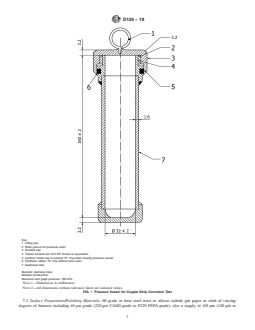
6.1 Copper Strip Corrosion Pressure Vessel, constructed from stainless steel according to the dimensions as given in Fig. 1. The
vessel shall be capable of withstanding a test pressure of 700 kPa gage (100 psi). Alternative designs for the vessel’s cap and
synthetic rubber gasket may be used provided that the internal dimensions of the vessel are the same as those shown in Fig. 1. The
internal dimensions of the pressure vessel are such that a nominal 25 mm by 150 mm test tube can be placed inside the pressure
vessel.
6.2 Test Tubes, of borosilicate glass of nominal 25 mm by 150 mm dimensions. The internal dimensions shall be checked as
acceptable by use of a copper strip (see 7.3). When 30 mL of liquid is added to the test tube with the copper strip in it, a minimum
of 5 mm of liquid shall be above the top surface of the strip.
6.3 Test Baths:
6.3.1 General—All test baths shall be able to maintain the test temperature to within 61 °C (2 °F) of the required test
temperature.
6.3.2 Liquid Bath Used for Submerging Pressure Vessel(s)—The bath shall be deep enough to submerge one or more pressure
vessels (see 6.1) completely during the test. As the bath medium, use water or any liquid that can be satisfactorily controlled to
the sample test temperature. The bath shall be fitted with suitable supports to hold each pressure vessel in a vertical position when
submerged.
6.3.3 Bath(s) Used for Test Tubes—Liquid baths shall be fitted with suitable supports to hold each test tube (see 6.2) in a vertical
position to a depth of about 100 mm (4 in.) as measured from the bottom of the test tube to the bath surface. As a liquid bath
medium, water and oil have been found satisfactory and controllable at the specified test temperature. Solid block baths shall meet
the same temperature control and immersion conditions and shall be checked for temperature measurement (heat transfer) for each
product class by running tests on tubes filled with 30 mL of product plus a metal strip of the nominal dimensions given, plus a
temperature sensor.
6.4 Temperature Sensing Device (TSD), capable of monitoring the desired test temperature in the bath to within an accuracy of
61 °C or better. The ASTM 12C (12F) (see Specification E1) or IP 64C (64F) total immersion thermometers have been found
suitable to use in the test. If used, no more than 10 mm (0.4 in.) of the mercury should extend above the surface of the bath at the
test temperature.
6.5 Polishing Vise, for holding the copper strip firmly without marring the edges while polishing. Any convenient type of holder
(see Appendix X1) may be used provided that the strip is held tightly and that the surface of the strip being polished is supported
above the surface of the holder.
6.6 Viewing Test Tubes, flat glass test tubes, are convenient for protecting corroded copper strips for close inspection or storage
(see Appendix X1 for the description of a flat-glass viewing tube). The viewing test tube shall be of such dimensions as to allow
the introduction of a copper strip (see 7.3) and made of glass free of striae or similar defects.
6.7 Forceps, with either stainless steel or polytetrafluoroethylene (PTFE) tips, for use in handling the copper strips, have been
found suitable to use.
6.8 Timing Device, electronic or manual, capable of accurately measuring the test duration within the allowable tolerance.
7. Reagents and Materials
7.1 Wash Solvent—Any volatile, less than 5 mg ⁄kg sulfur hydrocarbon solvent may be used provided that it shows no tarnish
at all when tested for 3 h at 50 °C (122 °F). 2,2,4-trimethylpentane (isooctane) of minimum 99.75 % purity is the referee solvent
and should be used in case of dispute. (Warning—extremely flammable, see A2.1.)
D130 − 19
Key:
1 Lifting eye
2 Wide groove for pressure relief
3 Knurled cap
4 Twelve threads per inch NF thread or equivalent
5 Camber inside cap to protect “O” ring when closing pressure vessel
6 Synthetic rubber “O” ring without free sulfur
7 Seamless tube
Material: stainless steel
Welded construction
Maximum test gage pressure: 700 kPa
NOTE 1—Dimensions in millimetres.
NOTE 2—All dimensions without tolerance limits are nominal values.
FIG. 1 Pressure Vessel for Copper Strip Corrosion Test
7.2 Surface Preparation/Polishing Materials, 00 grade or finer steel wool or silicon carbide grit paper or cloth of varying
degrees of fineness including 65 μm grade (220 grit CAMI-grade or P220 FEPA-grade); also a supply of 105 μm (120 grit to
D130 − 19
150 grit CAMI-grade or P120 to P150 FEPA-grade) size silicon carbide grain or powder and absorbent cotton (cotton wool). A
commercial grade is suitable, but pharmaceutical grade is most commonly available and is acceptable.
1 1 1
7.3 Copper Strips Specification—Use strips that are 12.5 mm 6 2 mm ( ⁄2 in.) wide, 1.5 mm to 3.2 mm ( ⁄16 in. to ⁄8 in.) thick,
and cut 75 mm 6 5 mm (3 in.) long from smooth-surfaced, hard-temper, cold-finished copper of 99.9 + % purity; electrical bus
bar stock is generally suitable (see Annex A1). The strips may be used repeatedly but shall be discarded when the strip’s surface
shows pitting or deep scratches that cannot be removed by the specified polishing procedure, or when the surface becomes
deformed, or the dimensions for the copper strip fall outside the specified limits.
7.4 Ashless Filter Paper or Disposable Gloves, for use in protecting the copper strip from coming in contact with the individual
during final polishing.
8. ASTM Copper Strip Corrosion Standards
8.1 These consist of reproductions in color of typical test strips representing increasing degrees of tarnish and corrosion, the
reproductions being encased for protection in plastic and made up in the form of a plaque.
8.1.1 Keep the plastic-encased ASTM Copper Strip Corrosion Standards protected from light to avoid the possibility of fading.
Inspect for fading by comparing two different plaques, one of which has been carefully protected from light (for example, new
plaque). Observe both sets in diffused daylight (or equivalent) first from a point directly above and then from an angle of 45°. If
any evidence of fading is observed, particularly at the left-hand end of the plaque, it is suggested that the one that is the more faded
with respect to the other be discarded.
8.1.1.1 Alternatively, place a suitably sized opaque strip (for example, 20 mm ( ⁄4 in.) black electrical tape) across the top of the
colored portion of the plaque when initially purchased. At intervals remove the opaque strip and observe. When there is any
evidence of fading of the exposed portion, the standards shall be replaced.
8.1.1.2 These plaques are full-color reproductions of typical strips. They have been printed on photo lithographed strips encased
in plastic and made up in the form of a plaque for protection. Directions for their use are given on the reverse side of each plaque.
8.1.2 If the surface of the plastic cover shows excessive scratching, it is suggested that the plaque be replaced.
9. Samples
9.1 In accordance with D4057 or D4177, or both, it is particularly important that all types of fuel samples, that pass a
low-tarnish strip classification, be collected in clean, dark glass bottles, plastic bottles, or other suitable containers that will not
affect the corrosive properties of the fuel. Avoid the use of tin plate containers for collection of samples, since experience has
shown that they may contribute to the corrosiveness of the sample.
9.2 Fill the containers as completely as possible and close them immediately after taking the sample. Adequate headspace in
the container is necessary to provide room for possible thermal expansion during transport. It is recommended that volatile samples
be filled between 70 % and 80 % of the container’s capacity. Take care during sampling to protect the samples from exposure to
direct sunlight or even diffused daylight. Carry out the test as soon as possible after receipt in the laboratory and immediately after
opening the container.
9.3 If suspended water (that is, haze) is observed in the sample, dry by filtering a sufficient volume of sample through a medium
rapid qualitative filter, into the prescribed clean, dry test tube. Carry out this operation in a darkened room or under a light-protected
shield.
9.3.1 Contact of the copper strip with water before, during or after completion of the test run will cause staining, making it
difficult to evaluate the strips.
10. Preparation of Test Strips
10.1 Surface Preparation—Remove all surface blemishes from all six sides of the strip obtained from a previous analysis (see
Note 1). One way to accomplish this is to use 00 grade or finer steel wool or silicon carbide paper or cloth of such degrees of
fineness as are needed to accomplish the desired results efficiently. Finish with 65 μm (220 grit CAMI-grade or P220 FEPA-grade)
silicon carbide paper or cloth, removing all marks that may have been made by other grades of paper used previously. Ensure the
prepared copper strip is protected from oxidation prior to final preparation, such as by immersing the strip in wash solvent from
which it can be withdrawn immediately for final preparation (polishing) or in which it can be stored for future use.
NOTE 1—Only final preparation (10.2) is necessary for commercially purchased pre-polished strips, although if gasoline samples are being analyzed,
pre-polished strips may be used “as is” (that is, without going through the final polishing procedure), based on the results of a 2008 interlaboratory study
versus manually prepared copper strips. No statistical evaluation involving pre-polished copper strips has been performed using sample types other than
gasoline at this time. See Section 14 for more details.
10.1.1 As a practical manual procedure for surface preparation, place a sheet of silicon carbide paper or cloth on a flat surface
and moisten it with kerosine or wash solvent. Rub the strip against the silicon carbide paper or cloth with a circular motion,
Supporting data have been filed at ASTM International Headquarters and may be obtained by requesting Research Report RR:D02-1703. Contact ASTM Customer
Service at service@astm.org.
D130 − 19
protecting the strip from contact with the fingers by using ashless filter paper or wearing disposable gloves. Alternatively, the
surface of the strip can be prepared by use of motor-driven machines using appropriate grades of dry paper or cloth.
10.2 Final Preparation—For strips prepared in 10.1 or new strips being used for the first time, remove a strip from its protected
location, such as by removing it from the wash solvent. To prevent possible surface contamination during final preparation, do not
allow fingers to come in direct contact with the copper strips, such as by wearing disposable gloves or holding the strips in the
fingers protected with ashless filter paper. Polish first the ends and then the sides with the 105 μm (120 grit to 150 grit CAMI-grade
or P120 to P150 FEPA-grade) silicon carbide grains picked up with a pad of cotton (cotton wool) moistened with wash solvent.
Wipe vigorously with fresh pads of cotton (cotton wool) and subsequently handle without touching the surface of the strip with
the fingers. Forceps have been found suitable to use. Clamp in a vise and polish the main surfaces with silicon-carbide grains on
absorbent cotton. Do not polish in a circular motion. Rub in the direction of the long axis of the strip, carrying the stroke beyond
the end of the strip before reversing the direction. Clean all metal dust from the strip by rubbing vigorously with clean pads of
absorbent cotton until a fresh pad remains unsoiled. When t
...