

ASTM D5404/D5404M-21
(Practice)Standard Practice for Recovery of Asphalt Binder from Solution Using the Rotary Evaporator
General Information
- Abstract
SIGNIFICANCE AND USE
4.1 In order to determine the characteristics of the asphalt in an asphalt paving mixture, it is necessary to extract the asphalt from the aggregate by means of a suitable solvent and then to recover the asphalt from the solvent without significantly changing the asphalt's properties. The asphalt recovered from the solvent by this practice can be tested using the same methods as for the original asphalt cement, and comparisons between the properties of the original and recovered asphalt can be made.
Note 1: The quality of the results produced by this standard are dependent on the competence of the personnel performing the procedure and the capability, calibration, and maintenance of the equipment used. Agencies that meet the criteria of Specification D3666 are generally considered capable of competent and objective testing, sampling, inspection, etc. Users of this standard are cautioned that compliance with Specification D3666 alone does not completely ensure reliable results. Reliable results depend on many factors; following the suggestions of Specification D3666 or some similar acceptable guideline provides a means of evaluating and controlling some of those factors.
SCOPE
1.1 This practice is intended to recover asphalt from a solvent using the rotary evaporator to ensure that changes in the asphalt properties during the recovery process are minimized.
1.2 The values stated in either SI units or inch-pound units are to be regarded separately as standard. The values stated in each system may not be exact equivalents; therefore, each system shall be used independently of the other. Combining values from the two systems may result in nonconformance with the standard.
1.2.1 Residual pressure measurements are shown in both the SI unit of kPa and the commonly used non-standard equivalent unit of “mm of Hg.”
1.2.2 Measurements of volume and mass are only given in SI units because they are the only units typically used in practice when performing this standard practice.
1.3 The text of this standard references notes and footnotes which provide explanatory material. These notes and footnotes (excluding those in tables and figures) shall not be considered as requirements of the standard.
1.4 This standard does not purport to address all of the safety concerns, if any, associated with its use. It is the responsibility of the user of this standard to establish appropriate safety, health, and environmental practices and determine the applicability of regulatory limitations prior to use.
1.5 This international standard was developed in accordance with internationally recognized principles on standardization established in the Decision on Principles for the Development of International Standards, Guides and Recommendations issued by the World Trade Organization Technical Barriers to Trade (TBT) Committee.
- Status
- Published
- Publication Date
- 31-Oct-2021
- Technical Committee
- D04 - Road and Paving Materials
- Drafting Committee
- D04.25 - Analysis of Asphalt Mixtures
Buy Documents

ASTM D5404/D5404M-21 - Standard Practice for Recovery of Asphalt Binder from Solution Using the Rotary Evaporator
REDLINE ASTM D5404/D5404M-21 - Standard Practice for Recovery of Asphalt Binder from Solution Using the Rotary Evaporator
Overview
ASTM D5404/D5404M-21 is the standard practice for recovering asphalt binder from solution using a rotary evaporator. Developed by ASTM International, this standard is vital for professionals involved in testing and assessing asphalt paving mixtures. The main objective is to extract asphalt from aggregates with a suitable solvent and then recover the asphalt using a rotary evaporator with minimal change to its properties. This ensures the recovered asphalt binder can be accurately tested and compared to the original material, supporting quality control and research in pavement engineering.
This practice is widely utilized by laboratories, agencies, and organizations that need reliable test results for bituminous paving mixtures. Adherence to this standard is essential for generating comparable results and upholding international best practices within the infrastructure and road construction industries.
Key Topics
- Purpose of the Standard: To enable the recovery of asphalt binder from solvent solutions while maintaining its original properties as much as possible.
- Equipment and Apparatus: Includes a rotary evaporator, distillation and solvent recovery flasks, temperature measurement devices, manometer or vacuum gauge, gas flow meter, sample container, and vacuum system.
- Operational Precautions:
- Proper ventilation due to solvent toxicity.
- Monitoring for solvent decomposition, which could impact asphalt test results and laboratory safety.
- Regular calibration and maintenance of equipment to ensure reliable results.
- Measurement Units: Provides values in both SI and inch-pound units, but requires that measurement systems not be mixed within the same application.
- Standardization and Verification: Regular checks and calibrations must be conducted annually to assure accuracy in vacuum, gas flow rate, and temperature measurements.
Applications
The recovery of asphalt binder using ASTM D5404/D5404M-21 is crucial for:
- Testing Asphalt Properties: Allows asphalt recovered from paving mixtures to be subjected to standard tests-such as penetration, softening point, ductility, and viscosity-to monitor quality and performance.
- Research and Development: Supports analysis and comparison of asphalt properties before and after mixing with aggregates, which is vital for pavement technology improvements and life-cycle assessments.
- Quality Assurance: Produces comparable data for project specifications, material approval, and regulatory compliance.
- Comparison with Original Binder: Enables accurate comparison between the characteristics of the original and recovered asphalt, which is necessary for identifying potential changes during mixing or extraction.
This standard is widely used in construction materials testing laboratories, highway agencies, and research institutions working on road and pavement materials.
Related Standards
ASTM D5404/D5404M-21 references and complements several other standards, including:
- ASTM D92: Test Method for Flash and Fire Points by Cleveland Open Cup Tester
- ASTM D1856: Recovery of Asphalt from Solution by Abson Method
- ASTM D3666: Minimum Requirements for Agencies Testing and Inspecting Road and Paving Materials
- ASTM D6368: Specification for Vapor-Degreasing Solvents Based on normal-Propyl Bromide
- ASTM E1, E1137/E1137M, E2251: Specifications for temperature measurement devices and thermometers
Using ASTM D5404/D5404M-21 in conjunction with these standards ensures a robust, consistent approach to asphalt binder recovery and analysis, promoting accuracy, repeatability, and international compliance in pavement research and practice.
Keywords: asphalt binder recovery, rotary evaporator, ASTM D5404, asphalt testing, paving mixtures, solvent extraction, quality control, pavement materials, bituminous mixtures, laboratory standards
Relations
- Effective Date
- 01-Oct-2016
- Effective Date
- 01-Dec-2013
- Effective Date
- 01-May-2013
- Effective Date
- 01-Nov-2012
- Effective Date
- 01-Mar-2012
- Effective Date
- 01-Dec-2011
- Effective Date
- 01-May-2011
- Effective Date
- 01-Nov-2010
- Effective Date
- 01-Dec-2009
- Effective Date
- 01-Jul-2009
- Effective Date
- 01-Nov-2008
- Effective Date
- 01-Nov-2007
- Effective Date
- 01-Nov-2007
- Effective Date
- 01-Aug-2007
- Effective Date
- 01-Aug-2007
Buy Documents
ASTM D5404/D5404M-21 - Standard Practice for Recovery of Asphalt Binder from Solution Using the Rotary Evaporator
REDLINE ASTM D5404/D5404M-21 - Standard Practice for Recovery of Asphalt Binder from Solution Using the Rotary Evaporator
Get Certified
Connect with accredited certification bodies for this standard

DIBt (Deutsches Institut für Bautechnik)
German Institute for Building Technology.
DIN CERTCO
DIN Group product certification.
Zavod za gradbeništvo Slovenije (ZAG) - Inšpekcija
ZAG inspection body for construction products, structures, and materials.
Sponsored listings
Frequently Asked Questions
ASTM D5404/D5404M-21 is a standard published by ASTM International. Its full title is "Standard Practice for Recovery of Asphalt Binder from Solution Using the Rotary Evaporator". This standard covers: SIGNIFICANCE AND USE 4.1 In order to determine the characteristics of the asphalt in an asphalt paving mixture, it is necessary to extract the asphalt from the aggregate by means of a suitable solvent and then to recover the asphalt from the solvent without significantly changing the asphalt's properties. The asphalt recovered from the solvent by this practice can be tested using the same methods as for the original asphalt cement, and comparisons between the properties of the original and recovered asphalt can be made. Note 1: The quality of the results produced by this standard are dependent on the competence of the personnel performing the procedure and the capability, calibration, and maintenance of the equipment used. Agencies that meet the criteria of Specification D3666 are generally considered capable of competent and objective testing, sampling, inspection, etc. Users of this standard are cautioned that compliance with Specification D3666 alone does not completely ensure reliable results. Reliable results depend on many factors; following the suggestions of Specification D3666 or some similar acceptable guideline provides a means of evaluating and controlling some of those factors. SCOPE 1.1 This practice is intended to recover asphalt from a solvent using the rotary evaporator to ensure that changes in the asphalt properties during the recovery process are minimized. 1.2 The values stated in either SI units or inch-pound units are to be regarded separately as standard. The values stated in each system may not be exact equivalents; therefore, each system shall be used independently of the other. Combining values from the two systems may result in nonconformance with the standard. 1.2.1 Residual pressure measurements are shown in both the SI unit of kPa and the commonly used non-standard equivalent unit of “mm of Hg.” 1.2.2 Measurements of volume and mass are only given in SI units because they are the only units typically used in practice when performing this standard practice. 1.3 The text of this standard references notes and footnotes which provide explanatory material. These notes and footnotes (excluding those in tables and figures) shall not be considered as requirements of the standard. 1.4 This standard does not purport to address all of the safety concerns, if any, associated with its use. It is the responsibility of the user of this standard to establish appropriate safety, health, and environmental practices and determine the applicability of regulatory limitations prior to use. 1.5 This international standard was developed in accordance with internationally recognized principles on standardization established in the Decision on Principles for the Development of International Standards, Guides and Recommendations issued by the World Trade Organization Technical Barriers to Trade (TBT) Committee.
SIGNIFICANCE AND USE 4.1 In order to determine the characteristics of the asphalt in an asphalt paving mixture, it is necessary to extract the asphalt from the aggregate by means of a suitable solvent and then to recover the asphalt from the solvent without significantly changing the asphalt's properties. The asphalt recovered from the solvent by this practice can be tested using the same methods as for the original asphalt cement, and comparisons between the properties of the original and recovered asphalt can be made. Note 1: The quality of the results produced by this standard are dependent on the competence of the personnel performing the procedure and the capability, calibration, and maintenance of the equipment used. Agencies that meet the criteria of Specification D3666 are generally considered capable of competent and objective testing, sampling, inspection, etc. Users of this standard are cautioned that compliance with Specification D3666 alone does not completely ensure reliable results. Reliable results depend on many factors; following the suggestions of Specification D3666 or some similar acceptable guideline provides a means of evaluating and controlling some of those factors. SCOPE 1.1 This practice is intended to recover asphalt from a solvent using the rotary evaporator to ensure that changes in the asphalt properties during the recovery process are minimized. 1.2 The values stated in either SI units or inch-pound units are to be regarded separately as standard. The values stated in each system may not be exact equivalents; therefore, each system shall be used independently of the other. Combining values from the two systems may result in nonconformance with the standard. 1.2.1 Residual pressure measurements are shown in both the SI unit of kPa and the commonly used non-standard equivalent unit of “mm of Hg.” 1.2.2 Measurements of volume and mass are only given in SI units because they are the only units typically used in practice when performing this standard practice. 1.3 The text of this standard references notes and footnotes which provide explanatory material. These notes and footnotes (excluding those in tables and figures) shall not be considered as requirements of the standard. 1.4 This standard does not purport to address all of the safety concerns, if any, associated with its use. It is the responsibility of the user of this standard to establish appropriate safety, health, and environmental practices and determine the applicability of regulatory limitations prior to use. 1.5 This international standard was developed in accordance with internationally recognized principles on standardization established in the Decision on Principles for the Development of International Standards, Guides and Recommendations issued by the World Trade Organization Technical Barriers to Trade (TBT) Committee.
ASTM D5404/D5404M-21 is classified under the following ICS (International Classification for Standards) categories: 91.100.50 - Binders. Sealing materials; 93.080.20 - Road construction materials. The ICS classification helps identify the subject area and facilitates finding related standards.
ASTM D5404/D5404M-21 has the following relationships with other standards: It is inter standard links to ASTM D3666-16, ASTM D3666-13, ASTM E1-13, ASTM D92-12a, ASTM D6368-06(2012), ASTM D3666-11, ASTM E2251-11, ASTM E2251-10, ASTM D3666-09a, ASTM D1856-09, ASTM E1137/E1137M-08, ASTM E2251-07, ASTM E1-07, ASTM D3666-07ae1, ASTM D3666-07a. Understanding these relationships helps ensure you are using the most current and applicable version of the standard.
ASTM D5404/D5404M-21 is available in PDF format for immediate download after purchase. The document can be added to your cart and obtained through the secure checkout process. Digital delivery ensures instant access to the complete standard document.
Standards Content (Sample)
This international standard was developed in accordance with internationally recognized principles on standardization established in the Decision on Principles for the
Development of International Standards, Guides and Recommendations issued by the World Trade Organization Technical Barriers to Trade (TBT) Committee.
Designation: D5404/D5404M − 21
Standard Practice for
Recovery of Asphalt Binder from Solution Using the Rotary
Evaporator
This standard is issued under the fixed designation D5404/D5404M; the number immediately following the designation indicates the
year of original adoption or, in the case of revision, the year of last revision. A number in parentheses indicates the year of last
reapproval. A superscript epsilon (´) indicates an editorial change since the last revision or reapproval.
1. Scope 2. Referenced Documents
2.1 ASTM Standards:
1.1 This practice is intended to recover asphalt from a
D92 Test Method for Flash and Fire Points by Cleveland
solvent using the rotary evaporator to ensure that changes in
Open Cup Tester
the asphalt properties during the recovery process are mini-
D1856 Test Method for Recovery of Asphalt from Solution
mized.
by Abson Method
1.2 The values stated in either SI units or inch-pound units
D2939 Test Methods for Emulsified Bitumens Used as
are to be regarded separately as standard. The values stated in
Protective Coatings (Withdrawn 2012)
each system may not be exact equivalents; therefore, each
D3666 Specification for Minimum Requirements for Agen-
system shall be used independently of the other. Combining
cies Testing and Inspecting Road and Paving Materials
values from the two systems may result in nonconformance
D6368 Specification for Vapor-Degreasing Solvents Based
with the standard.
on normal-Propyl Bromide and Technical Grade normal-
Propyl Bromide
1.2.1 Residualpressuremeasurementsareshowninboththe
E1 Specification for ASTM Liquid-in-Glass Thermometers
SI unit of kPa and the commonly used non-standard equivalent
E1137/E1137M Specification for Industrial Platinum Resis-
unit of “mm of Hg.”
tance Thermometers
1.2.2 Measurements of volume and mass are only given in
E2251 Specification for Liquid-in-Glass ASTM Thermom-
SI units because they are the only units typically used in
eters with Low-Hazard Precision Liquids
practice when performing this standard practice.
1.3 The text of this standard references notes and footnotes 3. Summary of Practice
which provide explanatory material. These notes and footnotes
3.1 The solution of solvent and asphalt from a prior extrac-
(excluding those in tables and figures) shall not be considered
tion is distilled by partially immersing the rotating distillation
as requirements of the standard.
flask of the rotary evaporator in a heated oil bath while the
solution is subjected to a partial vacuum and a flow of nitrogen
1.4 This standard does not purport to address all of the
gas or carbon dioxide gas. The recovered asphalt can then be
safety concerns, if any, associated with its use. It is the
subjected to testing as required.
responsibility of the user of this standard to establish appro-
priate safety, health, and environmental practices and deter-
4. Significance and Use
mine the applicability of regulatory limitations prior to use.
1.5 This international standard was developed in accor-
4.1 In order to determine the characteristics of the asphalt in
dance with internationally recognized principles on standard-
an asphalt paving mixture, it is necessary to extract the asphalt
ization established in the Decision on Principles for the
from the aggregate by means of a suitable solvent and then to
Development of International Standards, Guides and Recom- recover the asphalt from the solvent without significantly
mendations issued by the World Trade Organization Technical changing the asphalt’s properties. The asphalt recovered from
Barriers to Trade (TBT) Committee. the solvent by this practice can be tested using the same
1 2
This practice is under the jurisdiction of ASTM Committee D04 on Road and For referenced ASTM standards, visit the ASTM website, www.astm.org, or
Paving Materials and is the direct responsibility of Subcommittee D04.25 on contact ASTM Customer Service at service@astm.org. For Annual Book of ASTM
Analysis of Asphalt Mixtures. Standards volume information, refer to the standard’s Document Summary page on
Current edition approved Nov. 1, 2021. Published November 2021. Originally the ASTM website.
approved in 1993. Last previous edition approved in 2017 as D5404/D5404M – 12 The last approved version of this historical standard is referenced on
(2017). DOI: 10.1520/D5404_D5404M-21. www.astm.org.
Copyright © ASTM International, 100 Barr Harbor Drive, PO Box C700, West Conshohocken, PA 19428-2959. United States
D5404/D5404M − 21
methods as for the original asphalt cement, and comparisons stainlesssteelsheaththathasalengthofatleast150mm[6in.]
between the properties of the original and recovered asphalt and a minimum immersion depth of not more than 40 mm
can be made. [1.6 in.].
5.2.3 AClassAPt-100 RTD (Specification E1137/E1137M)
NOTE 1—The quality of the results produced by this standard are
sensor with a three- or four-wire configuration at the connec-
dependent on the competence of the personnel performing the procedure
tion terminal and paired with an appropriate meter capable of
and the capability, calibration, and maintenance of the equipment used.
Agencies that meet the criteria of Specification D3666 are generally
displaying the temperature to the nearest 0.1 °C [0.2 °F]. The
considered capable of competent and objective testing, sampling,
sensor shall be encased in a stainless steel sheath that has a
inspection, etc. Users of this standard are cautioned that compliance with
length of at least 150 mm [6 in.] and a minimum immersion
Specification D3666 alone does not completely ensure reliable results.
depth of not more than 40 mm [1.6 in.].
Reliable results depend on many factors; following the suggestions of
Specification D3666 or some similar acceptable guideline provides a
5.3 Manometer or Vacuum Gauge, suitable for measuring
means of evaluating and controlling some of those factors.
the specified vacuum.
5. Apparatus
5.4 Gas Flow Meter, capable of indicating a gas flow of up
to 1000 mL/min.
5.1 Rotary Evaporator (see Fig. 1), equipped with a distil-
lation flask, a variable speed motor capable of rotating the
5.5 Sample Container, having adequate volume to hold the
distillation flask at a rate of at least 50 rpm, condenser, solvent
sample and added solvent.
recovery flask, and heated oil bath.The angle of the distillation
5.6 Vacuum System, capable of maintaining a vacuum to
flaskfromthehorizontaltothebathissetatapproximately15°.
within 60.7 kPa [65 mm of Hg] of the desired level up to and
The distillation flask (Note 2), when fully immersed, should be
including 80 kPa [600 mm of Hg].
at a depth of approximately 40 mm [1.5 in.].
5.7 Oven, capable of maintain a temperature of 165 65°C
NOTE 2—A flask having a 2000-mL capacity is recommended.
[329 6 10 °F].
5.2 Thermometer, used for verifying the temperature of the
oil bath, with a range of at least 135 to 145 °C [275 to 298 °F]
6. Reagents and Materials
and an accuracy of 61.5 °C [62.5 °F]. The thermometer shall
6.1 Nitrogen Gas or Carbon Dioxide Gas—A pressurized
be one of the following:
tank with pressure-reducing valve, or other convenient source.
5.2.1 A liquid-in-glass thermometer conforming to the re-
NOTE 3—Different flow rates may be required depending on whether
quirements of Specification E1 or E2251, readable to 0.1 °C
nitrogen gas or carbon dioxide gas is used.
[0.2 °F].
5.2.2 Adigitalmetalstemthermometerwithathermocouple 6.2 Oil—The oil for the heated oil bath should be USP
sensor and a stem length of at least 150 mm [6 in.] paired with White Oil or Silicone Fluid SWS-101 with flash point above
an appropriate meter capable of displaying temperature to the 215 °C [420 °F] or an equivalent.The flash point is determined
nearest 0.1 °C [0.2 °F]. The sensor shall be encased in a in accordance with Test Method D92.
It is important that the needle valve is located as shown instead of being placed ahead of the flow meter.
FIG. 1 Rotary Evaporator and Recovery System
D5404/D5404M − 21
6.3 Solvents: 10. Procedure
6.3.1 Trichloroethylene and Methylene Chloride—The sol-
10.1 Heat the oil bath to a temperature of 140 6 3 °C [285
vent for extracting the asphalt from mixtures should be
6 5 °F] (Note 4). Using the thermometer, verify the tempera-
reagent-grade trichloroethylene or methylene chloride.Atech-
ture of the oil bath near the location where the distillation flask
nical grade of trichloroethylene may be used, but it is recom-
will be immersed. Circulate cold water
...
This document is not an ASTM standard and is intended only to provide the user of an ASTM standard an indication of what changes have been made to the previous version. Because
it may not be technically possible to adequately depict all changes accurately, ASTM recommends that users consult prior editions as appropriate. In all cases only the current version
of the standard as published by ASTM is to be considered the official document.
Designation: D5404/D5404M − 12 (Reapproved 2017) D5404/D5404M − 21
Standard Practice for
Recovery of Asphalt Binder from Solution Using the Rotary
Evaporator
This standard is issued under the fixed designation D5404/D5404M; the number immediately following the designation indicates the
year of original adoption or, in the case of revision, the year of last revision. A number in parentheses indicates the year of last
reapproval. A superscript epsilon (´) indicates an editorial change since the last revision or reapproval.
1. Scope
1.1 This practice is intended to recover asphalt from a solvent using the rotary evaporator to ensure that changes in the asphalt
properties during the recovery process are minimized.
1.2 The values stated in either SI units or inch-pound units are to be regarded separately as standard. The values stated in each
system may not be exact equivalents; therefore, each system shall be used independently of the other. Combining values from the
two systems may result in nonconformance with the standard.
1.2.1 Residual pressure measurements are shown in both the SI unit of kPa and the commonly used non-standard equivalent unit
of “mm of Hg.”
1.2.2 Measurements of volume and mass are only given in SI units because they are the only units typically used in practice when
performing this standard practice.
1.3 The text of this standard references notes and footnotes which provide explanatory material. These notes and footnotes
(excluding those in tables and figures) shall not be considered as requirements of the standard.
1.4 This standard does not purport to address all of the safety concerns, if any, associated with its use. It is the responsibility
of the user of this standard to establish appropriate safety, health, and environmental practices and determine the applicability of
regulatory limitations prior to use.
1.5 This international standard was developed in accordance with internationally recognized principles on standardization
established in the Decision on Principles for the Development of International Standards, Guides and Recommendations issued
by the World Trade Organization Technical Barriers to Trade (TBT) Committee.
2. Referenced Documents
2.1 ASTM Standards:
D92 Test Method for Flash and Fire Points by Cleveland Open Cup Tester
D1856 Test Method for Recovery of Asphalt from Solution by Abson Method
D2939 Test Methods for Emulsified Bitumens Used as Protective Coatings (Withdrawn 2012)
This practice is under the jurisdiction of ASTM Committee D04 on Road and Paving Materials and is the direct responsibility of Subcommittee D04.25 on Analysis of
Asphalt Mixtures.
Current edition approved Oct. 1, 2017Nov. 1, 2021. Published October 2017November 2021. Originally approved in 1993. Last previous edition approved in 20122017
as D5404/D5404M – 12. 12 (2017). DOI: 10.1520/D5404_D5404M-12R17.10.1520/D5404_D5404M-21.
For referenced ASTM standards, visit the ASTM website, www.astm.org, or contact ASTM Customer Service at service@astm.org. For Annual Book of ASTM Standards
volume information, refer to the standard’s Document Summary page on the ASTM website.
The last approved version of this historical standard is referenced on www.astm.org.
Copyright © ASTM International, 100 Barr Harbor Drive, PO Box C700, West Conshohocken, PA 19428-2959. United States
D5404/D5404M − 21
D3666 Specification for Minimum Requirements for Agencies Testing and Inspecting Road and Paving Materials
D6368 Specification for Vapor-Degreasing Solvents Based on normal-Propyl Bromide and Technical Grade normal-Propyl
Bromide
E1 Specification for ASTM Liquid-in-Glass Thermometers
E1137/E1137M Specification for Industrial Platinum Resistance Thermometers
E2251 Specification for Liquid-in-Glass ASTM Thermometers with Low-Hazard Precision Liquids
3. Summary of Practice
3.1 The solution of solvent and asphalt from a prior extraction is distilled by partially immersing the rotating distillation flask of
the rotary evaporator in a heated oil bath while the solution is subjected to a partial vacuum and a flow of nitrogen gas or carbon
dioxide gas. The recovered asphalt can then be subjected to testing as required.
4. Significance and Use
4.1 In order to determine the characteristics of the asphalt in an asphalt paving mixture, it is necessary to extract the asphalt from
the aggregate by means of a suitable solvent and then to recover the asphalt from the solvent without significantly changing the
asphalt’s properties. The asphalt recovered from the solvent by this practice can be tested using the same methods as for the
original asphalt cement, and comparisons between the properties of the original and recovered asphalt can be made.
NOTE 1—The quality of the results produced by this standard are dependent on the competence of the personnel performing the procedure and the
capability, calibration, and maintenance of the equipment used. Agencies that meet the criteria of Specification D3666 are generally considered capable
of competent and objective testing, sampling, inspection, etc. Users of this standard are cautioned that compliance with Specification D3666 alone does
not completely ensure reliable results. Reliable results depend on many factors; following the suggestions of Specification D3666 or some similar
acceptable guideline provides a means of evaluating and controlling some of those factors.
5. Apparatus
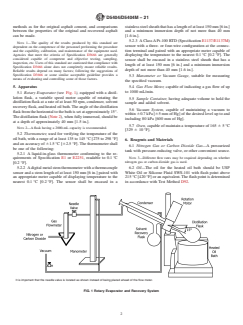
5.1 Rotary Evaporator (see Fig. 1), equipped with a distillation flask, a variable speed motor capable of rotating the distillation
flask at a rate of at least 50 rpm, condenser, solvent recovery flask, and heated oil bath. The angle of the distillation flask from the
horizontal to the bath is set at approximately 15°. The distillation flask (Note 2), when fully immersed, should be at a depth of
approximately 40 mm [1.5 in.].
NOTE 2—A flask having a 2000-mL capacity is recommended.
NOTE 1—It is important that the needle valve is located as shown instead of being placed ahead of the flowmeter.
It is important that the needle valve is located as shown instead of being placed ahead of the flow meter.
FIG. 1 Rotary Evaporator and Recovery System
D5404/D5404M − 21
5.1.1 Thermometric Device—A built-in temperature measurement device capable of displaying the oil temperatures to the nearest
1 °C [2 °F].
5.2 Thermometer, used for verifying the temperature of the oil bath, with a range of at least 135 to 145 °C [275 to 298 °F] and
an accuracy of 61.5 °C [62.5 °F]. The thermometer shall be one of the following:
5.2.1 A liquid-in-glass thermometer conforming to the requirements of Specification E1 or E2251, readable to 0.1 °C [0.2 °F].
5.2.2 A digital metal stem thermometer with a thermocouple sensor and a stem length of at least 150 mm [6 in.] paired with an
appropriate meter capable of displaying temperature to the nearest 0.1 °C [0.2 °F]. The sensor shall be encased in a stainless steel
sheath that has a length of at least 150 mm [6 in.] and a minimum immersion depth of not more than 40 mm [1.6 in.].
5.2.3 A Class A Pt-100 RTD (Specification E1137/E1137M) sensor with a three- or four-wire configuration at the connection
terminal and paired with an appropriate meter capable of displaying the temperature to the nearest 0.1 °C [0.2 °F]. The sensor shall
be encased in a stainless steel sheath that has a length of at least 150 mm [6 in.] and a minimum immersion depth of not more
than 40 mm [1.6 in.].
5.3 Manometer or Vacuum Gage,Gauge, suitable for measuring the specified vacuum.
5.4 Gas Flowmeter, Flow Meter, capable of indicating a gas flow of up to 1000 mL/min.
5.5 Sample Container, having adequate volume to hold the sample and added solvent.
5.6 Vacuum System, capable of maintaining a vacuum to within 60.7 kPa [65 mm of Hg] of the desired level up to and including
80 kPa [600 mm of Hg].
5.7 Oven, capable of maintain a temperature of 165 6 5 °C [329 6 10 °F].
6. Reagents and Materials
6.1 Nitrogen Gas or Carbon Dioxide Gas—A pressurized tank with pressure-reducing valve, or other convenient source.
NOTE 3—Different flow rates may be required depending on whether nitrogen gas or carbon dioxide gas is used.
6.2 Oil—The oil for the heated oil bath should be USP White Oil or Silicone Fluid SWS-101 with flash point above 215 °C
[420 °F] or an equivalent. The flash point is determined in accordance with Test Method D92.
6.3 Solvents:
6.3.1 Trichloroethylene and Methylene Chloride—The solvent for extracting the asphalt from mixtures should be reagent-grade
trichloroethylene or methylene chloride. A technical grade of trichloroethylene may be used, but it is recommended that for each
new supply of solvent, a blank should be run on an asphalt with known properties.
6.3.2 No
...