

ASTM F1524-22
(Guide)Standard Guide for Use of Advanced Oxidation Process for the Mitigation of Chemical Spills
General Information
- Abstract
SIGNIFICANCE AND USE
4.1 General—This guide contains information regarding the use of AOPs to oxidize and eventually mineralize hazardous materials that have entered surface and groundwater as the result of a spill. These guidelines will only refer to those units that are currently applied at a field scale level. The user should review applicable state regulations and guidance on the applicability of AOP (see California DTSC 2010, New Jersey DEP 2017, Oklahoma DEQ 2017).
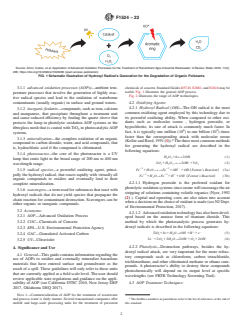
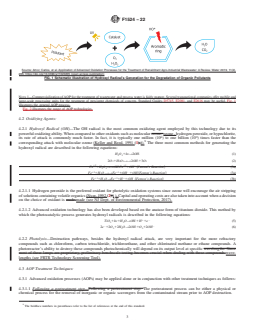
Note 1: Commercialization of AOP for the treatment of wastewater and process water is fairly mature. Several transnational companies offer mobile and large-scale processing units for the treatment of persistent chemicals of concern. Standard Guides D5745, E2081, and E2616 may be useful. Fig. 1 illustrates the general AOP process.
FIG. 1 Schematic Illustration of Hydroxyl Radical's Generation for the Degradation of Organic Pollutants
Source: Amor, Carlos, et al. Application of Advanced Oxidation Processes for the Treatment of Recalcitrant Agro-Industrial Wastewater: A Review. Water 2019, 11(2), 205; https://doi.org/10.3390/w11020205 (open access publication)
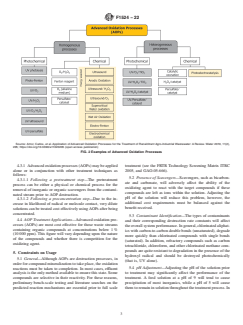
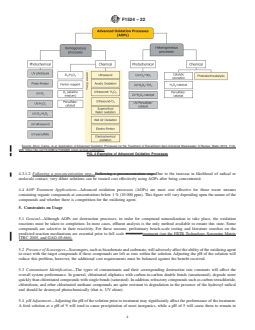
Fig. 2 illustrates the range of AOP technologies.
FIG. 2 Examples of Advanced Oxidation Processes
Source: Amor, Carlos, et al. Application of Advanced Oxidation Processes for the Treatment of Recalcitrant Agro-Industrial Wastewater: A Review. Water 2019, 11(2), 205; https://doi.org/10.3390/w11020205 (open access publication)
4.2 Oxidizing Agents:
4.2.1 Hydroxyl Radical (OH)—The OH radical is the most common oxidizing agent employed by this technology due to its powerful oxidizing ability. When compared to other oxidants such as molecular ozone , hydrogen peroxide, or hypochlorite, its rate of attack is commonly much faster. In fact, it is typically one million (106) to one billion (109) times faster than the corresponding attack with molecular ozone (Keller and Reed, 1991 (1)).9 The three most common methods for generating the hydroxyl radical ar...
SCOPE
1.1 This guide covers the considerations for advanced oxidation processes (AOPs) in the mitigation of spilled chemicals and hydrocarbons dissolved into ground and surface waters.
1.2 This guide addresses the application of advanced oxidation alone or in conjunction with other technologies.
1.3 The values stated in SI units are to be regarded as standard. No other units of measurement are included in this standard.
1.4 This standard does not purport to address all of the safety concerns, if any, associated with its use. It is the responsibility of the user of this standard to establish appropriate safety, health, and environmental practices and determine the applicability of regulatory limitations prior to use.
In addition, it is the responsibility of the user to ensure that such activity takes place under the control and direction of a qualified person with full knowledge of any potential safety and health protocols.
1.5 This international standard was developed in accordance with internationally recognized principles on standardization established in the Decision on Principles for the Development of International Standards, Guides and Recommendations issued by the World Trade Organization Technical Barriers to Trade (TBT) Committee.
- Status
- Published
- Publication Date
- 31-Dec-2021
- Technical Committee
- F20 - Hazardous Substances and Oil Spill Response
- Drafting Committee
- F20.22 - Mitigation Actions
Buy Documents
ASTM F1524-22 - Standard Guide for Use of Advanced Oxidation Process for the Mitigation of Chemical Spills
REDLINE ASTM F1524-22 - Standard Guide for Use of Advanced Oxidation Process for the Mitigation of Chemical Spills
Overview
ASTM F1524-22: Standard Guide for Use of Advanced Oxidation Process for the Mitigation of Chemical Spills provides guidance on employing advanced oxidation processes (AOPs) to remediate hazardous chemical and hydrocarbon spills impacting surface water and groundwater. Developed by ASTM International, this standard focuses on practical, field-scale applications and encourages users to review applicable regulations before implementation.
The document outlines key considerations, including methods for generating oxidizing agents, treatment process design, system limitations, and essential safety and regulatory requirements. It emphasizes both emergency and non-emergency situations where AOPs can contribute significantly to environmental protection and remediation efforts.
Key Topics
- Advanced Oxidation Processes (AOPs): Defined as ambient temperature methods involving highly reactive radical species that oxidize and mineralize organic contaminants in water.
- Oxidizing Agents: Hydroxyl radicals (OH·) are emphasized for their powerful and fast-acting oxidative properties, vastly surpassing oxidants like ozone or hydrogen peroxide alone.
- AOP Techniques: Includes photolytic (UV) oxidation, ozonation with hydrogen peroxide, and photocatalysis (commonly using the anatase form of titanium dioxide).
- Treatment Integration: AOPs may be used as standalone solutions or integrated with other technologies, such as preconcentration, physical/chemical pretreatment, or post-treatment steps.
- System Design and Monitoring: Provides guidelines for system setup, monitoring inflow and outflow streams, pH adjustment, off-gas management, and addressing fouling by inorganic compounds.
- Performance Factors: Critical aspects such as scavenger presence (e.g., bicarbonate), contaminant identification, reaction rate constants, and field-scale testing are discussed.
Applications
ASTM F1524-22 serves as a reference for industries, environmental consultants, spill response teams, and regulatory agencies involved in chemical spill response and groundwater remediation. Practical applications include:
- Emergency Spill Response: Rapid deployment of AOP units following containment and recovery operations to treat dissolved hazardous substances before discharge or further migration.
- Groundwater and Surface Water Remediation: Field-scale treatment systems designed to mineralize persistent organic pollutants, including chlorinated solvents, hydrocarbons, and industrial chemicals.
- Pretreatment or Post-Treatment Steps: Used in remediation trains where AOPs improve the effectiveness of traditional treatment processes, especially for compounds resistant to standard methods.
- Mobile and Large-Scale Solutions: Commercially available units capable of addressing large sites or remote locations, often using advanced monitoring and automation for process optimization.
When implementing AOP technologies, users are responsible for ensuring compliance with all relevant safety, health, and environmental regulations and for consulting qualified professionals.
Related Standards
For a holistic approach to spill mitigation and site remediation, consider referencing these related ASTM standards and guidance documents:
- ASTM D5745 - Guide for Developing and Implementing Short-Term Measures or Early Actions for Site Remediation
- ASTM E2081 - Guide for Risk-Based Corrective Action
- ASTM E2616 - Guide for Remedy Selection Integrating Risk-Based Corrective Action and Non-Risk Considerations
Additional state and federal guidance documents from organizations such as the California Department of Toxic Substances Control, New Jersey Department of Environmental Protection, and U.S. EPA provide region-specific recommendations on the application of AOPs.
Keywords: advanced oxidation process, AOP, hazardous chemical spill remediation, groundwater treatment, hydroxyl radical, hydrogen peroxide, ozone, photolysis, titanium dioxide, UV oxidation, ASTM F1524-22, environmental remediation, site mitigation.
Adhering to ASTM F1524-22 ensures that advanced oxidation technologies are applied safely, effectively, and in conformity with recognized best practices.
Relations
- Effective Date
- 01-Sep-2010
- Effective Date
- 01-Sep-2009
- Effective Date
- 01-Apr-2005
- Effective Date
- 01-Oct-2004
- Effective Date
- 10-Apr-2000
- Effective Date
- 10-Sep-1999
Buy Documents
ASTM F1524-22 - Standard Guide for Use of Advanced Oxidation Process for the Mitigation of Chemical Spills
REDLINE ASTM F1524-22 - Standard Guide for Use of Advanced Oxidation Process for the Mitigation of Chemical Spills
Get Certified
Connect with accredited certification bodies for this standard

ECOCERT
Organic and sustainability certification.

Eurofins Food Testing Global
Global leader in food, environment, and pharmaceutical product testing.

Intertek Bangladesh
Intertek certification and testing services in Bangladesh.
Sponsored listings
Frequently Asked Questions
ASTM F1524-22 is a guide published by ASTM International. Its full title is "Standard Guide for Use of Advanced Oxidation Process for the Mitigation of Chemical Spills". This standard covers: SIGNIFICANCE AND USE 4.1 General—This guide contains information regarding the use of AOPs to oxidize and eventually mineralize hazardous materials that have entered surface and groundwater as the result of a spill. These guidelines will only refer to those units that are currently applied at a field scale level. The user should review applicable state regulations and guidance on the applicability of AOP (see California DTSC 2010, New Jersey DEP 2017, Oklahoma DEQ 2017). Note 1: Commercialization of AOP for the treatment of wastewater and process water is fairly mature. Several transnational companies offer mobile and large-scale processing units for the treatment of persistent chemicals of concern. Standard Guides D5745, E2081, and E2616 may be useful. Fig. 1 illustrates the general AOP process. FIG. 1 Schematic Illustration of Hydroxyl Radical's Generation for the Degradation of Organic Pollutants Source: Amor, Carlos, et al. Application of Advanced Oxidation Processes for the Treatment of Recalcitrant Agro-Industrial Wastewater: A Review. Water 2019, 11(2), 205; https://doi.org/10.3390/w11020205 (open access publication) Fig. 2 illustrates the range of AOP technologies. FIG. 2 Examples of Advanced Oxidation Processes Source: Amor, Carlos, et al. Application of Advanced Oxidation Processes for the Treatment of Recalcitrant Agro-Industrial Wastewater: A Review. Water 2019, 11(2), 205; https://doi.org/10.3390/w11020205 (open access publication) 4.2 Oxidizing Agents: 4.2.1 Hydroxyl Radical (OH)—The OH radical is the most common oxidizing agent employed by this technology due to its powerful oxidizing ability. When compared to other oxidants such as molecular ozone , hydrogen peroxide, or hypochlorite, its rate of attack is commonly much faster. In fact, it is typically one million (106) to one billion (109) times faster than the corresponding attack with molecular ozone (Keller and Reed, 1991 (1)).9 The three most common methods for generating the hydroxyl radical ar... SCOPE 1.1 This guide covers the considerations for advanced oxidation processes (AOPs) in the mitigation of spilled chemicals and hydrocarbons dissolved into ground and surface waters. 1.2 This guide addresses the application of advanced oxidation alone or in conjunction with other technologies. 1.3 The values stated in SI units are to be regarded as standard. No other units of measurement are included in this standard. 1.4 This standard does not purport to address all of the safety concerns, if any, associated with its use. It is the responsibility of the user of this standard to establish appropriate safety, health, and environmental practices and determine the applicability of regulatory limitations prior to use. In addition, it is the responsibility of the user to ensure that such activity takes place under the control and direction of a qualified person with full knowledge of any potential safety and health protocols. 1.5 This international standard was developed in accordance with internationally recognized principles on standardization established in the Decision on Principles for the Development of International Standards, Guides and Recommendations issued by the World Trade Organization Technical Barriers to Trade (TBT) Committee.
SIGNIFICANCE AND USE 4.1 General—This guide contains information regarding the use of AOPs to oxidize and eventually mineralize hazardous materials that have entered surface and groundwater as the result of a spill. These guidelines will only refer to those units that are currently applied at a field scale level. The user should review applicable state regulations and guidance on the applicability of AOP (see California DTSC 2010, New Jersey DEP 2017, Oklahoma DEQ 2017). Note 1: Commercialization of AOP for the treatment of wastewater and process water is fairly mature. Several transnational companies offer mobile and large-scale processing units for the treatment of persistent chemicals of concern. Standard Guides D5745, E2081, and E2616 may be useful. Fig. 1 illustrates the general AOP process. FIG. 1 Schematic Illustration of Hydroxyl Radical's Generation for the Degradation of Organic Pollutants Source: Amor, Carlos, et al. Application of Advanced Oxidation Processes for the Treatment of Recalcitrant Agro-Industrial Wastewater: A Review. Water 2019, 11(2), 205; https://doi.org/10.3390/w11020205 (open access publication) Fig. 2 illustrates the range of AOP technologies. FIG. 2 Examples of Advanced Oxidation Processes Source: Amor, Carlos, et al. Application of Advanced Oxidation Processes for the Treatment of Recalcitrant Agro-Industrial Wastewater: A Review. Water 2019, 11(2), 205; https://doi.org/10.3390/w11020205 (open access publication) 4.2 Oxidizing Agents: 4.2.1 Hydroxyl Radical (OH)—The OH radical is the most common oxidizing agent employed by this technology due to its powerful oxidizing ability. When compared to other oxidants such as molecular ozone , hydrogen peroxide, or hypochlorite, its rate of attack is commonly much faster. In fact, it is typically one million (106) to one billion (109) times faster than the corresponding attack with molecular ozone (Keller and Reed, 1991 (1)).9 The three most common methods for generating the hydroxyl radical ar... SCOPE 1.1 This guide covers the considerations for advanced oxidation processes (AOPs) in the mitigation of spilled chemicals and hydrocarbons dissolved into ground and surface waters. 1.2 This guide addresses the application of advanced oxidation alone or in conjunction with other technologies. 1.3 The values stated in SI units are to be regarded as standard. No other units of measurement are included in this standard. 1.4 This standard does not purport to address all of the safety concerns, if any, associated with its use. It is the responsibility of the user of this standard to establish appropriate safety, health, and environmental practices and determine the applicability of regulatory limitations prior to use. In addition, it is the responsibility of the user to ensure that such activity takes place under the control and direction of a qualified person with full knowledge of any potential safety and health protocols. 1.5 This international standard was developed in accordance with internationally recognized principles on standardization established in the Decision on Principles for the Development of International Standards, Guides and Recommendations issued by the World Trade Organization Technical Barriers to Trade (TBT) Committee.
ASTM F1524-22 is classified under the following ICS (International Classification for Standards) categories: 71.060.20 - Oxides. The ICS classification helps identify the subject area and facilitates finding related standards.
ASTM F1524-22 has the following relationships with other standards: It is inter standard links to ASTM E2081-00(2010)e1, ASTM D5745-09, ASTM D5745-95(2005), ASTM E2081-00(2004)e1, ASTM E2081-00, ASTM D5745-95(1999). Understanding these relationships helps ensure you are using the most current and applicable version of the standard.
ASTM F1524-22 is available in PDF format for immediate download after purchase. The document can be added to your cart and obtained through the secure checkout process. Digital delivery ensures instant access to the complete standard document.
Standards Content (Sample)
This international standard was developed in accordance with internationally recognized principles on standardization established in the Decision on Principles for the
Development of International Standards, Guides and Recommendations issued by the World Trade Organization Technical Barriers to Trade (TBT) Committee.
Designation: F1524 − 22
Standard Guide for
Use of Advanced Oxidation Process for the Mitigation of
Chemical Spills
This standard is issued under the fixed designation F1524; the number immediately following the designation indicates the year of
original adoption or, in the case of revision, the year of last revision. A number in parentheses indicates the year of last reapproval. A
superscript epsilon (´) indicates an editorial change since the last revision or reapproval.
1. Scope E2616 Guide for Remedy Selection Integrating Risk-Based
Corrective Action and Non-Risk Considerations
1.1 This guide covers the considerations for advanced
2.2 Federal and State Guidance Documents:
oxidation processes (AOPs) in the mitigation of spilled chemi-
Guidance WQD-004 Advanced Oxidation Process (AOP)
cals and hydrocarbons dissolved into ground and surface
for the Oxidation of Microcontaminants. August 2017
waters.
Proven TechnologiesAnd Remedies Guidance Remediation
1.2 This guide addresses the application of advanced oxi-
Of Chlorinated Volatile Organic Compounds In Vadose
dation alone or in conjunction with other technologies.
Zone Soil. California Department of Toxic Substances
1.3 The values stated in SI units are to be regarded as
Control. 2010
standard. No other units of measurement are included in this ERDC-TR-19-3. 2019 U.S. Army Corps of Engineers.
standard.
Cross-Comparison of Advanced Oxidation Processes for
Remediation of Organic Pollutants in Water Treatment
1.4 This standard does not purport to address all of the
Systems
safety concerns, if any, associated with its use. It is the
In Situ Remediation: Design Considerations and Perfor-
responsibility of the user of this standard to establish appro-
mance Monitoring, Technical Guidance Document. New
priate safety, health, and environmental practices and deter-
Jersey Department of Environmental Protection. October
mine the applicability of regulatory limitations prior to use.In
addition, it is the responsibility of the user to ensure that such
Advanced Oxidation Processes (AOPs) For Destruction Of
activity takes place under the control and direction of a
Methyl Tertiary Butyl Ether (MtBE -An Unregulated
qualified person with full knowledge of any potential safety
Contaminant) In Drinking Water. U.S. EPA. September
and health protocols.
1.5 This international standard was developed in accor-
GAO-05-666 GeneralAccountingOffice.GroundwaterCon-
dance with internationally recognized principles on standard-
tamination: DOD Uses and Develops a Range of Reme-
ization established in the Decision on Principles for the
diation Technologies to Clean Up Military Sites. June
Development of International Standards, Guides and Recom-
mendations issued by the World Trade Organization Technical
Technology Screening Matrix, Federal Remediation Tech-
Barriers to Trade (TBT) Committee.
nologies Roundtable. https://frtr.gov/matrix/default.cfm
2. Referenced Documents
3. Terminology
2.1 ASTM Standards:
3.1 Definitions of Terms Specific to This Standard:
D5745 Guide for Developing and Implementing Short-Term
Measures or Early Actions for Site Remediation
E2081 Guide for Risk-Based Corrective Action
AvailablefromOklahomaDepartmentofEnvironmentalQualityDepartmentof
Environmental Quality 707 N Robinson Oklahoma City, OK, 73102 https://
www.deq.ok.gov/
Available from California Department of Toxic Substances Control 1001 I
This guide is under the jurisdiction of ASTM Committee F20 on Hazardous Street, Sacramento, CA 95814-2828 https://dtsc.ca.gov/
Substances and Oil Spill Response and is the direct responsibility of Subcommittee Available from U.S. Army Corps of Engineers 441 G Street NW Washington,
F20.22 on Mitigation Actions. DC 20314-1000 https://www.usace.army.mil/
CurrenteditionapprovedJan.1,2022.PublishedMay2022.Originallyapproved Available from New Jersey Department of Environmental Protection 401 East
in 1994. Last previous edition approved in 2013 as F1524 – 95(2013) . DOI: State Street, Trenton NJ, 08625. https://www.nj.gov/dep/
10.1520/F1524-22. AvailablefromUnitedStatesEnvironmentalProtectionAgency(EPA),William
For referenced ASTM standards, visit the ASTM website, www.astm.org, or Jefferson Clinton Bldg., 1200 Pennsylvania Ave., NW, Washington, DC 20460,
contact ASTM Customer Service at service@astm.org. For Annual Book of ASTM http://www.epa.gov.
Standards volume information, refer to the standard’s Document Summary page on Available from U.S. Government Publishing Office (GPO), 732 N. Capitol St.,
the ASTM website. NW, Washington, DC 20401, http://www.gpo.gov.
Copyright © ASTM International, 100 Barr Harbor Drive, PO Box C700, West Conshohocken, PA 19428-2959. United States
F1524 − 22
Source: Amor, Carlos, et al. Application of Advanced Oxidation Processes for the Treatment of Recalcitrant Agro-Industrial Wastewater: A Review. Water 2019, 11(2),
205; https://doi.org/10.3390/w11020205 (open access publication)
FIG. 1 Schematic Illustration of Hydroxyl Radical’s Generation for the Degradation of Organic Pollutants
chemicals of concern. Standard Guides D5745, E2081, and E2616 may be
3.1.1 advanced oxidation processes (AOPs)—ambient tem-
useful. Fig. 1 illustrates the general AOP process.
perature processes that involve the generation of highly reac-
Fig. 2 illustrates the range of AOP technologies.
tive radical species and lead to the oxidation of waterborne
contaminants (usually organic) in surface and ground waters. 4.2 Oxidizing Agents:
4.2.1 Hydroxyl Radical (OH)—The OH radical is the most
3.1.2 inorganic foulants—compounds, such as iron, calcium
common oxidizing agent employed by this technology due to
and manganese, that precipitate throughout a treatment unit
its powerful oxidizing ability. When compared to other oxi-
and cause reduced efficiency by fouling the quartz sleeve that
dants such as molecular ozone , hydrogen peroxide, or
protects the lamp in photolytic oxidation AOP systems or the
hypochlorite, its rate of attack is commonly much faster. In
fibreglass mesh that is coated with TiO in photocatalyticAOP
6 9
fact, it is typically one million (10 ) to one billion (10 ) times
systems.
faster than the corresponding attack with molecular ozone
3.1.3 mineralization—the complete oxidation of an organic
(KellerandReed,1991 (1)). Thethreemostcommonmethods
compound to carbon dioxide, water, and acid compounds, that
for generating the hydroxyl radical are described in the
is, hydrochloric acid if the compound is chlorinated.
following equations:
3.1.4 photoreactor—the core of the photoreactor is a UV
H O 1hv→2OH· (1)
2 2
lamp that emits light in the broad range of 200 nm to 400 nm
2O 1H O→→2OH·13O (2)
wavelength range.
3 2 2 2
12 13 2
3.1.5 radical species—a powerful oxidizing agent, princi- Fe 1H O→→Fe 1OH 1OH·~Fenton’s Reaction! (3a)
2 2
13 12 1
pally the hydroxyl radical, that reacts rapidly with virtually all
Fe 1H O→Fe 1H 1OH · Fenton’s Reaction (3b)
~ !
organic compounds to oxidize and eventually lead to their
4.2.1.1 Hydrogen peroxide is the preferred oxidant for
complete mineralization.
photolyticoxidationsystemssinceozonewillencouragetheair
3.1.6 scavengers—atermusedforsubstancesthatreactwith
stripping of solutions containing volatile organics (Nyer, 1992
hydroxyl radicals that do not yield species that propagate the
(2) ). Capital and operating costs are also taken into account
chain reaction for contaminant destruction. Scavengers can be
whenadecisiononthechoiceofoxidantismade(seeNJDept.
either organic or inorganic compounds.
of Environmental Protection, 2017).
3.2 Acronyms:
4.2.1.2 Advancedoxidationtechnologyhasalsobeendevel-
3.2.1 AOP—Advanced Oxidation Process
oped based on the anatase form of titanium dioxide. This
3.2.2 COC—Chemicals of Concern
method by which the photocatalytic process generates hy-
droxyl radicals is described in the following equations:
3.2.3 EPA—U.S. Environmental Protection Agency
1 2
TiO 1hv1H O→OH·1H 1e (5)
3.2.4 GAC—Granulated Activated Carbon
2 2
2 2
3.2.5 UV—Ultraviolet 2e 12O 12H O→2OH·1O 12OH (6)
2 2 2
4.2.2 Photolysis—Destruction pathways, besides the hy-
4. Significance and Use
droxyl radical attack, are very important for the more refrac-
4.1 General—This guide contains information regarding the
tory compounds such as chloroform, carbon tetrachloride,
use of AOPs to oxidize and eventually mineralize hazardous
trichloroethane, and other chlorinated methane or ethane com-
materials that have entered surface and groundwater as the
pounds. A photoreactor’s ability to destroy these compounds
result of a spill. These guidelines will only refer to those units
photochemically will depend on its output level at specific
that are currently applied at a field scale level. The user should
wavelengths (see FRTR Technol
...
This document is not an ASTM standard and is intended only to provide the user of an ASTM standard an indication of what changes have been made to the previous version. Because
it may not be technically possible to adequately depict all changes accurately, ASTM recommends that users consult prior editions as appropriate. In all cases only the current version
of the standard as published by ASTM is to be considered the official document.
Designation: F1524 − 95 (Reapproved 2013) F1524 − 22
Standard Guide for
Use of Advanced Oxidation Process for the Mitigation of
Chemical Spills
This standard is issued under the fixed designation F1524; the number immediately following the designation indicates the year of
original adoption or, in the case of revision, the year of last revision. A number in parentheses indicates the year of last reapproval. A
superscript epsilon (´) indicates an editorial change since the last revision or reapproval.
1. Scope
1.1 This guide covers the considerations for advanced oxidation processes (AOPs) in the mitigation of spilled chemicals and
hydrocarbons dissolved into ground and surface waters.
1.2 This guide addresses the application of advanced oxidation alone or in conjunction with other technologies.
1.3 The values stated in SI units are to be regarded as standard. No other units of measurement are included in this standard.
1.4 This standard does not purport to address all of the safety concerns, if any, associated with its use. It is the responsibility
of the user of this standard to establish appropriate safety safety, health, and healthenvironmental practices and determine the
applicability of regulatory limitations prior to use.In addition, it is the responsibility of the user to ensure that such activity takes
place under the control and direction of a qualified person with full knowledge of any potential safety and health protocols.In
addition, it is the responsibility of the user to ensure that such activity takes place under the control and direction of a qualified
person with full knowledge of any potential safety and health protocols.
1.5 This international standard was developed in accordance with internationally recognized principles on standardization
established in the Decision on Principles for the Development of International Standards, Guides and Recommendations issued
by the World Trade Organization Technical Barriers to Trade (TBT) Committee.
2. Referenced Documents
2.1 ASTM Standards:
D5745 Guide for Developing and Implementing Short-Term Measures or Early Actions for Site Remediation
E2081 Guide for Risk-Based Corrective Action
E2616 Guide for Remedy Selection Integrating Risk-Based Corrective Action and Non-Risk Considerations
2.2 Federal and State Guidance Documents:
Guidance WQD-004 Advanced Oxidation Process (AOP) for the Oxidation of Microcontaminants. August 2017
Proven Technologies And Remedies Guidance Remediation Of Chlorinated Volatile Organic Compounds In Vadose Zone Soil.
California Department of Toxic Substances Control. 2010
This guide is under the jurisdiction of ASTM Committee F20 on Hazardous Substances and Oil Spill Response and is the direct responsibility of Subcommittee F20.22
on Mitigation Actions.
Current edition approved April 1, 2013Jan. 1, 2022. Published April 2013May 2022. Originally approved in 1994. Last previous edition approved in 20072013 as
F1524 – 95 (2007).(2013) . DOI: 10.1520/F1524-95R13.10.1520/F1524-22.
For referenced ASTM standards, visit the ASTM website, www.astm.org, or contact ASTM Customer Service at service@astm.org. For Annual Book of ASTM Standards
volume information, refer to the standard’s Document Summary page on the ASTM website.
Available from Oklahoma Department of Environmental Quality Department of Environmental Quality 707 N Robinson Oklahoma City, OK, 73102 https://
www.deq.ok.gov/
Available from California Department of Toxic Substances Control 1001 I Street, Sacramento, CA 95814-2828 https://dtsc.ca.gov/
Copyright © ASTM International, 100 Barr Harbor Drive, PO Box C700, West Conshohocken, PA 19428-2959. United States
F1524 − 22
ERDC-TR-19-3. 2019 U.S. Army Corps of Engineers. Cross-Comparison of Advanced Oxidation Processes for Remediation of
Organic Pollutants in Water Treatment Systems
In Situ Remediation: Design Considerations and Performance Monitoring, Technical Guidance Document. New Jersey
Department of Environmental Protection. October 2017
Advanced Oxidation Processes (AOPs) For Destruction Of Methyl Tertiary Butyl Ether (MtBE -An Unregulated Contaminant)
In Drinking Water. U.S. EPA. September 2004
GAO-05-666 General Accounting Office. Groundwater Contamination: DOD Uses and Develops a Range of Remediation
Technologies to Clean Up Military Sites. June 2006
Technology Screening Matrix, Federal Remediation Technologies Roundtable. https://frtr.gov/matrix/default.cfm
3. Terminology
3.1 Definitions of Terms Specific to This Standard:
3.1.1 advanced oxidation processes (AOPs)—ambient temperature processes that involve the generation of highly reactive radical
species and lead to the oxidation of waterborne contaminants (usually organic) in surface and ground waters.
3.1.2 inorganic foulants—compounds, such as iron, calcium and manganese, that precipitate throughout a treatment unit and cause
reduced efficiency by fouling the quartz sleeve that protects the lamp in photolytic oxidation AOP systems or the fibreglass mesh
that is coated with TiO in photocatalytic AOP systems.
3.1.3 mineralization—the complete oxidation of an organic compound to carbon dioxide, water, and acid compounds, that is,
hydrochloric acid if the compound is chlorinated.
3.1.4 photoreactor—the core of the photoreactor is a UV lamp that emits light in the broad range of 200200 nm to 400 nm
wavelength range.
3.1.5 radical species—a powerful oxidizing agent, principally the hydroxyl radical, that reacts rapidly with virtually all organic
compounds to oxidize and eventually lead to their complete mineralization.
3.1.6 scavengers—a term used for substances that react with hydroxyl radicals that do not yield species that propagate the chain
reaction for contaminant destruction. Scavengers can be either organic or inorganic compounds.
3.2 Acronyms:
3.2.1 AOP—Advanced Oxidation Process
3.2.2 COC—Chemicals of Concern
3.2.3 EPA—U.S. Environmental Protection Agency
3.2.4 GAC—Granulated Activated Carbon
3.2.5 UV—Ultraviolet
4. Significance and Use
4.1 General—This guide contains information regarding the use of AOPs to oxidize and eventually mineralize hazardous materials
that have entered surface and groundwater as the result of a spill. Since much of this technology development is still at the
benchscale level, these These guidelines will only refer to those units that are currently applied at a field scale level. The user
should review applicable state regulations and guidance on the applicability of AOP (see California DTSC 2010, New Jersey DEP
2017, Oklahoma DEQ 2017).
Available from U.S. Army Corps of Engineers 441 G Street NW Washington, DC 20314-1000 https://www.usace.army.mil/
Available from New Jersey Department of Environmental Protection 401 East State Street, Trenton NJ, 08625. https://www.nj.gov/dep/
Available from United States Environmental Protection Agency (EPA), William Jefferson Clinton Bldg., 1200 Pennsylvania Ave., NW, Washington, DC 20460,
http://www.epa.gov.
Available from U.S. Government Publishing Office (GPO), 732 N. Capitol St., NW, Washington, DC 20401, http://www.gpo.gov.
F1524 − 22
Source: Amor, Carlos, et al. Application of Advanced Oxidation Processes for the Treatment of Recalcitrant Agro-Industrial Wastewater: A Review. Water 2019, 11(2),
205; https://doi.org/10.3390/w11020205 (open access publication)
FIG. 1 Schematic Illustration of Hydroxyl Radical’s Generation for the Degradation of Organic Pollutants
NOTE 1—Commercialization of AOP for the treatment of wastewater and process water is fairly mature. Several transnational companies offer mobile and
large-scale processing units for the treatment of persistent chemicals of concern. Standard Guides D5745, E2081, and E2616 may be useful. Fig. 1
illustrates the general AOP process.
Fig. 2 illustrates the range of AOP technologies.
4.2 Oxidizing Agents:
4.2.1 Hydroxyl Radical (OH)—The OH radical is the most common oxidizing agent employed by this technology due to its
powerful oxidizing ability. When compared to other oxidants such as molecular ozone, ozone , hydrogen peroxide, or hypochlorite,
6 9
its rate of attack is commonly much faster. In fact, it is typically one million (10 ) to one billion (10 ) times faster than the
corresponding attack with molecular ozone (Keller and Reed, 1991 (1).)). The three most common methods for generating the
hydroxyl radical are described in the following equations:
H O 1hv→2OH· (1)
2 2
2O 1H O →→2OH·13O (2)
3 2 2 2
12 13 2
Fe 1H O →→OH·Fe 1OH ~Fenton’s Reaction! (3a)
2 2
12 13 2
Fe 1H O →→Fe 1OH 1OH·~Fenton’s Reaction! (3a)
2 2
13 12 1
Fe 1H O→Fe 1H 1OH · Fenton’s Reaction (3b)
~ !
4.2.1.1 Hydrogen peroxide is the preferred oxidant for photolytic oxidation systems since ozone will encourage the air stripping
of solutions containing volatile organics (Nyer, 1992 (2).) ). Capital and operating costs are also taken into account when a decision
on the choice of oxidant is made.made (see NJ Dept. of Environmental Protection, 2017).
4.2.1.2 Advanced oxidation technology has also been developed based on the anatase form of titanium dioxide. This method by
which the photocatalytic process generates hydroxyl radicals is described in the following equations:
1 2
TiO 1hv1H O→OH·1H 1e (5)
2 2
2 2
2e 12O 12H O→2OH·1O 12OH (6)
2 2 2
4.2.2 Photolysis—Destruction pathways, besides the hydroxyl radical attack, are very important for the more refractory
compounds such as chloroform, carbon tetrachloride, trichloroethane, and other chlorinated methane or ethane compounds. A
photoreactor’s ability to destroy these compounds photochemically will depend on its output level at specific wavelengths. Since
most of these lamps are proprietary, preliminary benchscale testing becomes crucial when dealing with these compounds.wave-
lengths (see FRTR Technology Screening Tool).
4.3 AOP Treatment Techniques:
4.3.1 Advanced oxidation processes (AOPs) may be applied alone or in conjunction with other treatment techniques as follows:
4.3.1.1 Following a pretreatment step—Following a pretreatment step. The pretreatment process can be either a physical or
chemical process for the removal of inorganic or organic scavengers from the contaminated stream prior to AOP destruction.
The boldface numbers in parentheses refer to the list of references at the end of this standard.
F1524 − 22
Source: Amor, Carlos, et al. Application of Advanced Oxidation Processes for the Treatment of Recalcitrant Agro-Industrial Wastew
...