

ASTM B1019-21
(Test Method)Standard Test Method for Determination of Surface Oxides on Copper Rod(for Electrical Purposes)
General Information
- Abstract
SIGNIFICANCE AND USE
5.1 The copper oxides layer present on the surface of the copper rod has a detrimental effect on both final surface quality of the copper wire produced by cold drawing of the rod, and on the drawing process itself leading to wire breaks and excessive wear of the drawing dies. Thus, it is critical to use adequate cleaning techniques during the copper rod manufacturing process in order to limit the depth of the residual copper oxide layer on the finished rod, and it is necessary to have a method to accurately measure the copper oxide depth.
5.2 This test method is the most common test method used by continuous casting and rolling mills to measure the depth of residual surface oxides after the copper rod has been cleaned.
5.3 Applicability of the test method for any other purpose or product has not been evaluated. Suitability beyond the stated scope shall be evaluated before use.
SCOPE
1.1 This specification established a quantitative, laboratory conducted, electrolytic reduction method to determine the thickness of surface copper oxide films on copper rod produced to Specification B49 for further fabrication into electrical conductors.
1.2 The values stated in SI units are to be regarded as standard. No other units of measurement are included in this standard.
1.3 This standard does not purport to address all of the safety concerns, if any, associated with its use. It is the responsibility of the user of this standard to establish appropriate safety, health, and environmental practices and determine the applicability of regulatory limitations prior to use.
1.4 This international standard was developed in accordance with internationally recognized principles on standardization established in the Decision on Principles for the Development of International Standards, Guides and Recommendations issued by the World Trade Organization Technical Barriers to Trade (TBT) Committee.
- Status
- Published
- Publication Date
- 30-Sep-2021
- Technical Committee
- B05 - Copper and Copper Alloys
- Drafting Committee
- B05.06 - Methods of Test
Overview
ASTM B1019-21 is the internationally recognized standard test method for determining surface oxides on copper rod, specifically those produced for electrical applications. Developed by ASTM International, this standard outlines a quantitative laboratory method based on electrolytic reduction to accurately measure the thickness of copper oxide films present on copper rod surfaces after cleaning. The presence of surface oxides, such as cuprous (Cu₂O) and cupric (CuO) oxides, significantly affects the final surface quality of copper wire and the efficiency of the drawing process, making reliable surface oxide measurement essential for quality control in copper rod manufacturing.
Key Topics
Purpose and Significance
- Surface oxides on copper rod can cause wire breaks, excessive die wear, and reduce the quality of finished copper wire in cold drawing processes.
- Accurate measurement of the oxide layer depth enables manufacturers to monitor and optimize cleaning techniques, minimizing detrimental effects.
Test Method Overview
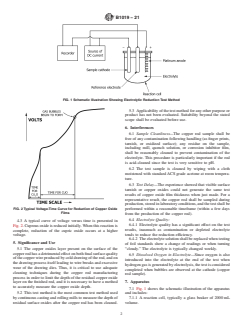
- The method utilizes electrolytic reduction to sequentially reduce surface oxides to copper, capturing reduction potentials and times for quantitative analysis.
- The test sample (copper rod) acts as a cathode in an electrolytic cell with an inert anode (e.g., platinum wire), using a controlled DC current.
- Typical measurements are reported in Angstrom units, providing precise data on oxide thickness for process control.
Standardization and Compliance
- The procedure is performed in SI units as per international standardization principles.
- Safety, health, and environmental guidelines must be followed by users, with laboratory best practices in place.
Applications
ASTM B1019-21 is widely used by:
- Continuous casting and rolling mills producing copper rods for electrical conductors, where residual surface oxide control is crucial for downstream processing.
- Quality assurance laboratories in the copper industry, seeking to validate and maintain the cleanliness of copper rod surfaces in accordance with Specification ASTM B49 for electrical purposes.
- Research and process development teams developing or optimizing copper rod cleaning and fabrication techniques to achieve superior electrical conductor performance.
Practical benefits of applying this standard include:
- Reducing frequency of wire breaks and prolonging the lifespan of drawing dies by maintaining minimal oxide layers.
- Enabling reliable productivity and higher yield in copper wire production.
- Helping manufacturers demonstrate compliance with international electrical conductor quality requirements.
Related Standards
The following ASTM standards are referenced and closely related to ASTM B1019-21:
- ASTM B49 – Specification for Copper Rod for Electrical Purposes
- ASTM B846 – Terminology for Copper and Copper Alloys
- ASTM D1193 – Specification for Reagent Water
- ASTM E177 – Practice for Use of the Terms Precision and Bias in ASTM Test Methods
- ASTM E1601, E691, E2480, E2653 – Practices for conducting interlaboratory studies to determine test method performance (precision, reproducibility, reliability)
Summary
By setting a clear, repeatable protocol for measuring surface oxide films on copper rod, ASTM B1019-21 helps manufacturers maintain control over key quality parameters in copper wire production. Following this standard ensures the durability and performance of electrical conductors, supporting both safety and economic efficiency within the copper industry. For best results, users should ensure proper sample preparation, adhere to the SI measurement system, and maintain current best laboratory safety practices during testing.
Relations
- Effective Date
- 15-Apr-2020
- Effective Date
- 01-Nov-2019
- Effective Date
- 01-Aug-2019
- Effective Date
- 01-Jan-2019
- Effective Date
- 01-Apr-2017
- Effective Date
- 01-Apr-2016
- Effective Date
- 15-Sep-2015
- Effective Date
- 01-May-2015
- Effective Date
- 01-Dec-2014
- Effective Date
- 01-May-2014
- Effective Date
- 01-May-2013
- Effective Date
- 01-May-2013
- Effective Date
- 15-Dec-2012
- Effective Date
- 01-Jul-2012
- Effective Date
- 01-Nov-2011
Get Certified
Connect with accredited certification bodies for this standard

ECOCERT
Organic and sustainability certification.

Eurofins Food Testing Global
Global leader in food, environment, and pharmaceutical product testing.

Intertek Bangladesh
Intertek certification and testing services in Bangladesh.
Sponsored listings
Frequently Asked Questions
ASTM B1019-21 is a standard published by ASTM International. Its full title is "Standard Test Method for Determination of Surface Oxides on Copper Rod<brk/>(for Electrical Purposes)". This standard covers: SIGNIFICANCE AND USE 5.1 The copper oxides layer present on the surface of the copper rod has a detrimental effect on both final surface quality of the copper wire produced by cold drawing of the rod, and on the drawing process itself leading to wire breaks and excessive wear of the drawing dies. Thus, it is critical to use adequate cleaning techniques during the copper rod manufacturing process in order to limit the depth of the residual copper oxide layer on the finished rod, and it is necessary to have a method to accurately measure the copper oxide depth. 5.2 This test method is the most common test method used by continuous casting and rolling mills to measure the depth of residual surface oxides after the copper rod has been cleaned. 5.3 Applicability of the test method for any other purpose or product has not been evaluated. Suitability beyond the stated scope shall be evaluated before use. SCOPE 1.1 This specification established a quantitative, laboratory conducted, electrolytic reduction method to determine the thickness of surface copper oxide films on copper rod produced to Specification B49 for further fabrication into electrical conductors. 1.2 The values stated in SI units are to be regarded as standard. No other units of measurement are included in this standard. 1.3 This standard does not purport to address all of the safety concerns, if any, associated with its use. It is the responsibility of the user of this standard to establish appropriate safety, health, and environmental practices and determine the applicability of regulatory limitations prior to use. 1.4 This international standard was developed in accordance with internationally recognized principles on standardization established in the Decision on Principles for the Development of International Standards, Guides and Recommendations issued by the World Trade Organization Technical Barriers to Trade (TBT) Committee.
SIGNIFICANCE AND USE 5.1 The copper oxides layer present on the surface of the copper rod has a detrimental effect on both final surface quality of the copper wire produced by cold drawing of the rod, and on the drawing process itself leading to wire breaks and excessive wear of the drawing dies. Thus, it is critical to use adequate cleaning techniques during the copper rod manufacturing process in order to limit the depth of the residual copper oxide layer on the finished rod, and it is necessary to have a method to accurately measure the copper oxide depth. 5.2 This test method is the most common test method used by continuous casting and rolling mills to measure the depth of residual surface oxides after the copper rod has been cleaned. 5.3 Applicability of the test method for any other purpose or product has not been evaluated. Suitability beyond the stated scope shall be evaluated before use. SCOPE 1.1 This specification established a quantitative, laboratory conducted, electrolytic reduction method to determine the thickness of surface copper oxide films on copper rod produced to Specification B49 for further fabrication into electrical conductors. 1.2 The values stated in SI units are to be regarded as standard. No other units of measurement are included in this standard. 1.3 This standard does not purport to address all of the safety concerns, if any, associated with its use. It is the responsibility of the user of this standard to establish appropriate safety, health, and environmental practices and determine the applicability of regulatory limitations prior to use. 1.4 This international standard was developed in accordance with internationally recognized principles on standardization established in the Decision on Principles for the Development of International Standards, Guides and Recommendations issued by the World Trade Organization Technical Barriers to Trade (TBT) Committee.
ASTM B1019-21 is classified under the following ICS (International Classification for Standards) categories: 71.060.20 - Oxides. The ICS classification helps identify the subject area and facilitates finding related standards.
ASTM B1019-21 has the following relationships with other standards: It is inter standard links to ASTM B49-20, ASTM E1601-19, ASTM B846-19a, ASTM B846-19, ASTM B49-17, ASTM B49-16, ASTM B49-15a, ASTM B49-15, ASTM E2653-14, ASTM E177-14, ASTM E177-13, ASTM E691-13, ASTM E1601-12, ASTM E2480-12, ASTM E691-11. Understanding these relationships helps ensure you are using the most current and applicable version of the standard.
ASTM B1019-21 is available in PDF format for immediate download after purchase. The document can be added to your cart and obtained through the secure checkout process. Digital delivery ensures instant access to the complete standard document.
Standards Content (Sample)
This international standard was developed in accordance with internationally recognized principles on standardization established in the Decision on Principles for the
Development of International Standards, Guides and Recommendations issued by the World Trade Organization Technical Barriers to Trade (TBT) Committee.
Designation: B1019 − 21
Standard Test Method for
Determination of Surface Oxides on Copper Rod
(for Electrical Purposes)
This standard is issued under the fixed designation B1019; the number immediately following the designation indicates the year of
original adoption or, in the case of revision, the year of last revision.Anumber in parentheses indicates the year of last reapproval.A
superscript epsilon (´) indicates an editorial change since the last revision or reapproval.
1. Scope E691Practice for Conducting an Interlaboratory Study to
Determine the Precision of a Test Method
1.1 This specification established a quantitative, laboratory
E1601Practice for Conducting an Interlaboratory Study to
conducted, electrolytic reduction method to determine the
Evaluate the Performance of an Analytical Method
thicknessofsurfacecopperoxidefilmsoncopperrodproduced
E2480Practice for Conducting an Interlaboratory Study to
to Specification B49 for further fabrication into electrical
Determine the Precision of a Test Method with Multi-
conductors.
Valued Measurands
1.2 The values stated in SI units are to be regarded as
E2653Practice for Conducting an Interlaboratory Study to
standard. No other units of measurement are included in this
Determine Precision Estimates for a Fire Test Method
standard.
with Fewer Than Six Participating Laboratories
1.3 This standard does not purport to address all of the
safety concerns, if any, associated with its use. It is the
3. Terminology
responsibility of the user of this standard to establish appro-
3.1 For definitions of related terms to copper and copper
priate safety, health, and environmental practices and deter-
alloys, refer to Terminology B846.
mine the applicability of regulatory limitations prior to use.
1.4 This international standard was developed in accor-
4. Summary of Test Method
dance with internationally recognized principles on standard-
ization established in the Decision on Principles for the
4.1 The thickness and type of unreduced oxide films re-
Development of International Standards, Guides and Recom-
maining on the surface of copper rod after cleaning shall be
mendations issued by the World Trade Organization Technical
determined by an electrolytic reduction method.This test shall
Barriers to Trade (TBT) Committee.
beperformedbyreducingthesurfacecopperoxide(s)tocopper
in an electrolytic cell. For a description of a similar, yet
2. Referenced Documents
alternative standard procedure to determine tarnish films on
coupons exposed to environmental tests, see Refs. (1-5). As
2.1 The following documents in the current issue of the
shown by the schematic diagram in Fig. 1, the test sample
Annual Book of ASTM Standardsform a part of this specifica-
being tested acts as cathode with respect to an anode, which
tion to the extent referenced herein and define materials
shall be made from a platinum wire or an equivalent inert
suitable for use in rod manufacture.
2 electrode.CurrentshallbesuppliedfromaDCpowersupplyor
2.2 ASTM Standards:
a coulometer.Adiscussion on means to help improve accuracy
B49Specification for Copper Rod for Electrical Purposes
and repeatability of this test method will be found in Note
B846Terminology for Copper and Copper Alloys
X1.1.
D1193Specification for Reagent Water
E177Practice for Use of the Terms Precision and Bias in
4.2 Each of the copper oxides found on copper, namely
ASTM Test Methods
cuprous and cupric, are reduced sequentially to copper at
different reduction potentials, and the voltages are to be
recorded against time during the entire test. When the indi-
This test method is under the jurisdiction ofASTM Committee B05 on Copper
vidual reactions between the oxides and hydrogen ions are
and Copper Alloys and is the direct responsibility of Subcommittee B05.06 on
complete, gaseous hydrogen is generated and may be seen as
Methods of Test.
little bubbles at the surface of the copper rod sample.
Current edition approved Oct. 1, 2021. Published December 2021. DOI:
10.1520/B1019-21.
For referenced ASTM standards, visit the ASTM website, www.astm.org, or
contact ASTM Customer Service at service@astm.org. For Annual Book of ASTM
Standards volume information, refer to the standard’s Document Summary page on The boldface numbers in parentheses refer to a list of references at the end of
the ASTM website. this standard.
Copyright © ASTM International, 100 Barr Harbor Drive, PO Box C700, West Conshohocken, PA 19428-2959. United States
B1019 − 21
FIG. 1 Schematic Illustration Showing Electrolytic Reduction Test Method
5.3 Applicabilityofthetestmethodforanyotherpurposeor
product has not been evaluated. Suitability beyond the stated
scope shall be evaluated before use.
6. Interferences
6.1 Sample Cleanliness—The copper rod sample shall be
free of any contamination following handling (as finger prints,
tarnish, or oxidized surface); any residue on the sample,
including mill, quench solution, or corrosion inhibitor film,
shall be reasonably cleaned to prevent contamination of the
electrolyte. This procedure is particularly important if the rod
is acid-cleaned since the test is very sensitive to pH.
6.2 The test sample is cleaned by wiping with a cloth
moistened with standardACS grade acetone at room tempera-
ture.
6.3 Test Delay—The experience showed that visible surface
tarnish or copper oxides could not generate the same test
results of copper oxide film thickness when just made. For a
representative result, the copper rod shall be sampled during
production,storedinlaboratoryconditions,andthetestshallbe
FIG. 2 Typical Voltage-Time Curve for Reduction of Copper Oxide
performed within a reasonable timeframe (within a few days
Films
from the production of the copper rod).
6.4 Electrolyte Quality:
4.3 A typical curve of voltage versus time is presented in
6.4.1 Electrolyte quality has a significant effect on the test
Fig.2.Cuprousoxideisreducedinitially.Whenthisreactionis
results, inasmuch as contamination or depleted electrolyte
complete, reduction of the cupric oxide occurs at a higher
tends to reduce the reduction efficiency.
voltage.
6.4.2 Theelectrolytesolutionshallbereplacedwhentesting
5. Significance and Use
of foil standards show a change of readings or when turning
5.1 The copper oxides layer present on the surface of the “cloudy.” The electrolyte is typically changed weekly.
copperrodhasadetrimentaleffectonbothfinalsurfacequality
6.5 Dissolved Oxygen in Electrolyte—Since oxygen is also
ofthecopperwireproducedbycolddrawingoftherod,andon
introduced into the electrolyte at the end of the test when
thedrawingprocessitselfleadingtowirebreaksandexcessive
hydrogengasisgeneratedbyelectrolysis,thetestisconsidered
wear of the drawing dies. Thus, it is critical to use adequate
completed when bubbles are observed at the cathode (copper
cleaning techniques during the copper rod manufacturing
rod sample).
process in order to limit the depth of the residual copper oxide
7. Apparatus
layer on the finished rod, and it is necessary to have a method
to accurately measure the copper oxide depth.
7.1 Fig. 1 shows the schematic illustration of the apparatus
5.2 This test method is the most common test method used and includes:
bycontinuouscastingandrollingmillstomeasurethedepthof 7.1.1 A reaction cell, typically a glass beaker of 2000mL
residual surface oxides after the copper rod has been cleaned. volume.
B1019 − 21
7.1.2 A source of DC current, or a coulometer operating in 10. Sampling, Test Specimens, and Test Units
the range of 1 mA to 20mA.
10.1 Any rod diameter (or wire diameter) can be used.
7.1.2.1 Current Density—This property is calculated by
However, for consistent results, the minimum wire diameter
taking the constant test current and dividing it by the surface
shall be around 2mm. Oxide thicknesses are reported in
area of the sample exposed to the electrolyte. The test takes
“Angstrom” units.
more time to complete as the current density is decreased, but
at the same time accuracy and repeatability are improved.As a
11. Preparation of Apparatus
compromise between attaining practical (short) laboratory test
times while not losing extreme accuracy, a current density in 11.1 Apparatus is arranged and connected as shown in Fig.
2 2
the range between 0.15mA⁄cm and 0.55mA⁄cm is used in 1.
the rod industry.
7.1.3 A Platinum anode, or an equivalent inert electrode. 12. Calibration and Standardization
7.1.4 A reference electrode:
12.1 No specific standards exist for this test method.
7.1.4.1 Either saturated calomel, or a silver/silver-chloride
12.2 DC source and voltage recorder shall be checked and
configurationcanbeusedtodeterminevoltage.However,ifthe
calibrated periodically.
current density is maintained fairly low, a simple copper wire
can be used as an electrode with no effect on accuracy of the
13. Conditioning
oxide thickness determination.
7.1.5 Arecorder measuring the voltage between the sample
13.1 No conditioning is required.
(cathode) and the reference electrode. Range covering 0V to
2V.
14. Procedure
7.1.6 A sample cathode consisting of a straight length of
14.1 The following is the method to be used:
copper rod cut to a suitable length and suspended such that a
14.1.1 A30cm length of rod is cut from a rod coil.The rod
known surface area of the rod is immersed in the electrolyte.
is straightened, cleaned with acetone, and marked to indicate
7.1.7 Connectors and wires to connect the DC current
the area to be submerged in the electrolyte.
source and the recorder to the cathode, anode, and reference
14.1.2 For 8mm diameter rod, the depth of submersion is
electrode.
10cm.
8. Reagents and Materials
14.1.3 The sample is immersed in the electrolyte up to the
mark and connected as in Fig. 1.
8.1 Purity of Reagents—Reagent grade chemicals shall be
14.1.4 The tester is initiated until the voltage asymptote is
used in all tests. Unless otherwise indicated, it is intended that
reached, then the test is stopped.
all reagents conform to the specifications of the Committee on
Analytical Reagents of theAmerican Chemical Society where 14.1.5 The time taken to complete each reaction is mea-
such specifications are available. Other grades may be used, sured.
provided it is first ascertained that the reagent is of sufficiently
14.1.6 The thickness of each oxide is calculated from Eq 1.
high purity to permit its use without lessening the accuracy of
14.1.7 The test is conducted at room temperature.
the determination.
14.1.8 The current of the DC source is set at 10mAfor the
8.2 Purity of Water—Unless otherwise indicated, references
duration of the test.
to water shall be understood to mean reagent water as defined
by Type grade III of Specification D1193.
15. Calculation or Interpretation of Results
8.3 Electrolyte Solution—A 0.1 molar solution of sodium
15.1 Each of the copper oxides found on copper, namely
carbonate has generally been adopted, although potassium
cuprous and cupric, are reduced sequentially to copper at
chloride solutions are also acceptable.
different reduction potentials, and the voltages are to be
recorded against time during the entire test. When the indi-
9. Hazards
vidual reactions between the oxide
...