

ASTM D6263-23
(Specification)Standard Specification for Extruded Rods and Bars Made From Rigid Poly(Vinyl Chloride) (PVC) and Chlorinated Poly(Vinyl Chloride) (CPVC)
General Information
- Abstract
ABSTRACT
This specification covers requirements and test methods for the material, dimensions, and workmanship, and the properties of extruded shapes of rods and bars made from poly(vinyl chloride) (PVC), and chlorinated poly(vinyl chloride) (CPVC). The type of poly(vinyl chloride), and chlorinated poly(vinyl chloride) shape product may be categorized by type, grade, and class depending on resin composition: Types 01 and 02; Classes 0 and 1; Grades 0 and 1. The type, class and grade is further differentiated based on dimensional stability. The following test methods shall be performed: tensile stress at break; elongation at break; tensile modulus; dimensional stability; lengthwise chamber; flexural modulus; izod impact; and degree of fusion of extruded PVC and CPVC by solvent immersion.
SCOPE
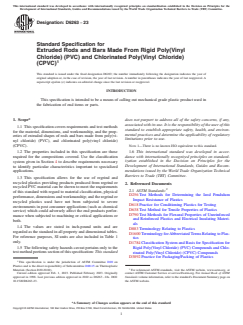
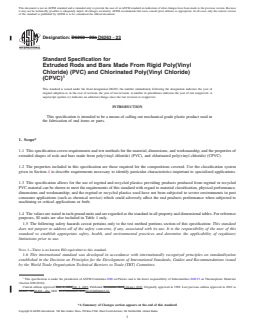
1.1 This specification covers requirements and test methods for the material, dimensions, and workmanship, and the properties of extruded shapes of rods and bars made from poly(vinyl chloride) (PVC), and chlorinated poly(vinyl chloride) (CPVC).
1.2 The properties included in this specification are those required for the compositions covered. Use the classification system given in Section 4 to describe requirements necessary to identify particular characteristics important to specialized applications.
1.3 This specification allows for the use of regrind and recycled plastics providing products produced from regrind or recycled PVC material can be shown to meet the requirements of this standard with regard to material classification, physical performance, dimensions and workmanship; and the regrind or recycled plastics used have not been subjected to severe environments in post consumer applications (such as chemical service) which could adversely affect the end products performance when subjected to machining or critical applications or both.
1.4 The values are stated in inch-pound units and are regarded as the standard in all property and dimensional tables. For reference purposes, SI units are also included in Table 1 only.
1.5 The following safety hazards caveat pertains only to the test method portions section of this specification: This standard does not purport to address all of the safety concerns, if any, associated with its use. It is the responsibility of the user of this standard to establish appropriate safety, health, and environmental practices and determine the applicability of regulatory limitations prior to use.
Note 1: There is no known ISO equivalent to this standard.
1.6 This international standard was developed in accordance with internationally recognized principles on standardization established in the Decision on Principles for the Development of International Standards, Guides and Recommendations issued by the World Trade Organization Technical Barriers to Trade (TBT) Committee.
- Status
- Published
- Publication Date
- 31-Jan-2023
- Technical Committee
- D20 - Plastics
- Drafting Committee
- D20.15 - Thermoplastic Materials
Buy Documents
ASTM D6263-23 - Standard Specification for Extruded Rods and Bars Made From Rigid Poly(Vinyl Chloride) (PVC) and Chlorinated Poly(Vinyl Chloride) (CPVC)
REDLINE ASTM D6263-23 - Standard Specification for Extruded Rods and Bars Made From Rigid Poly(Vinyl Chloride) (PVC) and Chlorinated Poly(Vinyl Chloride) (CPVC)
Overview
ASTM D6263-23: Standard Specification for Extruded Rods and Bars Made From Rigid Poly(Vinyl Chloride) (PVC) and Chlorinated Poly(Vinyl Chloride) (CPVC) establishes requirements for the physical properties, dimensions, material composition, and workmanship of extruded PVC and CPVC rods and bars. Developed by ASTM Committee D20 on Plastics, this specification helps ensure the quality and performance of rigid extruded shapes used in the fabrication of components and end products. The standard includes rigorous test methods for evaluating material properties and allows the use of certain recycled materials, supporting sustainability in plastic manufacturing.
Key Topics
- Scope of Coverage: The standard applies to extruded shapes (rods and bars) made from PVC and CPVC, identifying them by type, grade, and class based on resin composition and dimensional stability.
- Material Requirements: Extruded products must meet minimum property requirements, including tensile strength, flexural modulus, impact resistance, and dimensional stability.
- Test Methods: Specifies use of standardized ASTM test methods for key physical properties:
- Tensile stress at break and elongation (ASTM D638)
- Flexural modulus (ASTM D790)
- Izod impact resistance (ASTM D256)
- Dimensional stability and camber
- Degree of fusion by solvent immersion
- Dimensional and Visual Quality: Includes detailed tolerance tables for size and straightness, and defines acceptable levels for visual defects, surface finish, color uniformity, and cleanliness.
- Sustainability: Permits use of regrind and recycled PVC/CPVC materials, provided they meet all specification requirements and have not been previously used in severe environments.
Applications
Extruded PVC and CPVC rods and bars produced following ASTM D6263-23 are widely used across various industries, including:
- Fabrication of Industrial Components: These shapes are key materials in the manufacture of insulators, spacers, bushings, and custom-machined parts where rigidity and chemical resistance are required.
- Water and Chemical Handling Systems: When manufactured to this standard, and evaluated under NSF Standard 61, extruded PVC and CPVC rods and bars can be used in applications involving potable water and certain chemical services.
- Machining and Further Processing: Products specified under ASTM D6263-23 are manufactured to tight dimensional tolerances and low stress levels, making them suitable for precision machining.
- Prototyping and Custom Fabrication: The classification and callout system allows purchasers to specify material properties as needed for specialized engineering and prototyping uses.
Related Standards
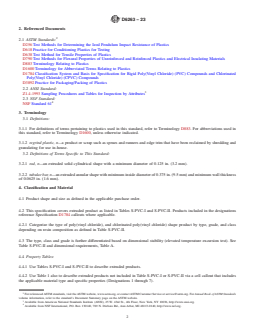
ASTM D6263-23 references and works alongside several industry standards for testing and product classification:
- ASTM D256 - Test Methods for Determining the Izod Pendulum Impact Resistance of Plastics
- ASTM D638 - Test Method for Tensile Properties of Plastics
- ASTM D790 - Test Methods for Flexural Properties of Unreinforced and Reinforced Plastics
- ASTM D1784 - Classification System and Basis for Specification for Rigid PVC and CPVC Compounds
- ASTM D3892 - Practice for Packaging/Packing of Plastics
- ANSIZ1.4-1993 - Sampling Procedures and Tables for Inspection by Attributes
- NSF Standard 61 - Drinking Water System Components-Health Effects
These references reinforce the robustness of ASTM D6263-23, enabling users to efficiently verify compliance and compatibility across a broad range of rigid plastic applications.
Keywords: ASTM D6263-23, rigid PVC, CPVC, extruded rods, plastic bars, material specification, industrial plastics, recycled PVC, dimensional tolerances, ASTM plastics standards
Relations
- Effective Date
- 01-Feb-2024
- Effective Date
- 01-Nov-2023
- Effective Date
- 15-Jan-2020
- Effective Date
- 01-Jan-2020
- Effective Date
- 01-Aug-2019
- Effective Date
- 15-Apr-2019
- Effective Date
- 01-Feb-2019
- Effective Date
- 01-Dec-2018
- Effective Date
- 01-Nov-2018
- Refers
ASTM D1600-18 - Standard Terminology for Abbreviated Terms Relating to Plastics (Withdrawn 2024) - Effective Date
- 01-Jan-2018
- Effective Date
- 15-Aug-2017
- Effective Date
- 01-Jul-2017
- Effective Date
- 01-Dec-2015
- Effective Date
- 01-Dec-2015
- Effective Date
- 01-Sep-2015
Buy Documents
ASTM D6263-23 - Standard Specification for Extruded Rods and Bars Made From Rigid Poly(Vinyl Chloride) (PVC) and Chlorinated Poly(Vinyl Chloride) (CPVC)
REDLINE ASTM D6263-23 - Standard Specification for Extruded Rods and Bars Made From Rigid Poly(Vinyl Chloride) (PVC) and Chlorinated Poly(Vinyl Chloride) (CPVC)
Get Certified
Connect with accredited certification bodies for this standard

DIN CERTCO
DIN Group product certification.

Smithers Quality Assessments
US management systems and product certification.
Sponsored listings
Frequently Asked Questions
ASTM D6263-23 is a technical specification published by ASTM International. Its full title is "Standard Specification for Extruded Rods and Bars Made From Rigid Poly(Vinyl Chloride) (PVC) and Chlorinated Poly(Vinyl Chloride) (CPVC)". This standard covers: ABSTRACT This specification covers requirements and test methods for the material, dimensions, and workmanship, and the properties of extruded shapes of rods and bars made from poly(vinyl chloride) (PVC), and chlorinated poly(vinyl chloride) (CPVC). The type of poly(vinyl chloride), and chlorinated poly(vinyl chloride) shape product may be categorized by type, grade, and class depending on resin composition: Types 01 and 02; Classes 0 and 1; Grades 0 and 1. The type, class and grade is further differentiated based on dimensional stability. The following test methods shall be performed: tensile stress at break; elongation at break; tensile modulus; dimensional stability; lengthwise chamber; flexural modulus; izod impact; and degree of fusion of extruded PVC and CPVC by solvent immersion. SCOPE 1.1 This specification covers requirements and test methods for the material, dimensions, and workmanship, and the properties of extruded shapes of rods and bars made from poly(vinyl chloride) (PVC), and chlorinated poly(vinyl chloride) (CPVC). 1.2 The properties included in this specification are those required for the compositions covered. Use the classification system given in Section 4 to describe requirements necessary to identify particular characteristics important to specialized applications. 1.3 This specification allows for the use of regrind and recycled plastics providing products produced from regrind or recycled PVC material can be shown to meet the requirements of this standard with regard to material classification, physical performance, dimensions and workmanship; and the regrind or recycled plastics used have not been subjected to severe environments in post consumer applications (such as chemical service) which could adversely affect the end products performance when subjected to machining or critical applications or both. 1.4 The values are stated in inch-pound units and are regarded as the standard in all property and dimensional tables. For reference purposes, SI units are also included in Table 1 only. 1.5 The following safety hazards caveat pertains only to the test method portions section of this specification: This standard does not purport to address all of the safety concerns, if any, associated with its use. It is the responsibility of the user of this standard to establish appropriate safety, health, and environmental practices and determine the applicability of regulatory limitations prior to use. Note 1: There is no known ISO equivalent to this standard. 1.6 This international standard was developed in accordance with internationally recognized principles on standardization established in the Decision on Principles for the Development of International Standards, Guides and Recommendations issued by the World Trade Organization Technical Barriers to Trade (TBT) Committee.
ABSTRACT This specification covers requirements and test methods for the material, dimensions, and workmanship, and the properties of extruded shapes of rods and bars made from poly(vinyl chloride) (PVC), and chlorinated poly(vinyl chloride) (CPVC). The type of poly(vinyl chloride), and chlorinated poly(vinyl chloride) shape product may be categorized by type, grade, and class depending on resin composition: Types 01 and 02; Classes 0 and 1; Grades 0 and 1. The type, class and grade is further differentiated based on dimensional stability. The following test methods shall be performed: tensile stress at break; elongation at break; tensile modulus; dimensional stability; lengthwise chamber; flexural modulus; izod impact; and degree of fusion of extruded PVC and CPVC by solvent immersion. SCOPE 1.1 This specification covers requirements and test methods for the material, dimensions, and workmanship, and the properties of extruded shapes of rods and bars made from poly(vinyl chloride) (PVC), and chlorinated poly(vinyl chloride) (CPVC). 1.2 The properties included in this specification are those required for the compositions covered. Use the classification system given in Section 4 to describe requirements necessary to identify particular characteristics important to specialized applications. 1.3 This specification allows for the use of regrind and recycled plastics providing products produced from regrind or recycled PVC material can be shown to meet the requirements of this standard with regard to material classification, physical performance, dimensions and workmanship; and the regrind or recycled plastics used have not been subjected to severe environments in post consumer applications (such as chemical service) which could adversely affect the end products performance when subjected to machining or critical applications or both. 1.4 The values are stated in inch-pound units and are regarded as the standard in all property and dimensional tables. For reference purposes, SI units are also included in Table 1 only. 1.5 The following safety hazards caveat pertains only to the test method portions section of this specification: This standard does not purport to address all of the safety concerns, if any, associated with its use. It is the responsibility of the user of this standard to establish appropriate safety, health, and environmental practices and determine the applicability of regulatory limitations prior to use. Note 1: There is no known ISO equivalent to this standard. 1.6 This international standard was developed in accordance with internationally recognized principles on standardization established in the Decision on Principles for the Development of International Standards, Guides and Recommendations issued by the World Trade Organization Technical Barriers to Trade (TBT) Committee.
ASTM D6263-23 is classified under the following ICS (International Classification for Standards) categories: 83.080.20 - Thermoplastic materials. The ICS classification helps identify the subject area and facilitates finding related standards.
ASTM D6263-23 has the following relationships with other standards: It is inter standard links to ASTM D883-24, ASTM D883-23, ASTM D1784-20, ASTM D883-20, ASTM D883-19c, ASTM D883-19a, ASTM D883-19, ASTM D883-18a, ASTM D883-18, ASTM D1600-18, ASTM D883-17, ASTM D790-17, ASTM D790-15, ASTM D790-15e1, ASTM D3892-15. Understanding these relationships helps ensure you are using the most current and applicable version of the standard.
ASTM D6263-23 is available in PDF format for immediate download after purchase. The document can be added to your cart and obtained through the secure checkout process. Digital delivery ensures instant access to the complete standard document.
Standards Content (Sample)
This international standard was developed in accordance with internationally recognized principles on standardization established in the Decision on Principles for the
Development of International Standards, Guides and Recommendations issued by the World Trade Organization Technical Barriers to Trade (TBT) Committee.
Designation: D6263 − 23
Standard Specification for
Extruded Rods and Bars Made From Rigid Poly(Vinyl
Chloride) (PVC) and Chlorinated Poly(Vinyl Chloride)
(CPVC)
This standard is issued under the fixed designation D6263; the number immediately following the designation indicates the year of
original adoption or, in the case of revision, the year of last revision. A number in parentheses indicates the year of last reapproval. A
superscript epsilon (´) indicates an editorial change since the last revision or reapproval.
INTRODUCTION
This specification is intended to be a means of calling out mechanical grade plastic product used in
the fabrication of end items or parts.
1. Scope* does not purport to address all of the safety concerns, if any,
associated with its use. It is the responsibility of the user of this
1.1 This specification covers requirements and test methods
standard to establish appropriate safety, health, and environ-
for the material, dimensions, and workmanship, and the prop-
mental practices and determine the applicability of regulatory
erties of extruded shapes of rods and bars made from poly(vi-
limitations prior to use.
nyl chloride) (PVC), and chlorinated poly(vinyl chloride)
(CPVC).
NOTE 1—There is no known ISO equivalent to this standard.
1.6 This international standard was developed in accor-
1.2 The properties included in this specification are those
dance with internationally recognized principles on standard-
required for the compositions covered. Use the classification
ization established in the Decision on Principles for the
system given in Section 4 to describe requirements necessary
Development of International Standards, Guides and Recom-
to identify particular characteristics important to specialized
mendations issued by the World Trade Organization Technical
applications.
Barriers to Trade (TBT) Committee.
1.3 This specification allows for the use of regrind and
recycled plastics providing products produced from regrind or
2. Referenced Documents
recycled PVC material can be shown to meet the requirements
2.1 ASTM Standards:
of this standard with regard to material classification, physical
D256 Test Methods for Determining the Izod Pendulum
performance, dimensions and workmanship; and the regrind or
Impact Resistance of Plastics
recycled plastics used have not been subjected to severe
D618 Practice for Conditioning Plastics for Testing
environments in post consumer applications (such as chemical
D638 Test Method for Tensile Properties of Plastics
service) which could adversely affect the end products perfor-
D790 Test Methods for Flexural Properties of Unreinforced
mance when subjected to machining or critical applications or
and Reinforced Plastics and Electrical Insulating Materi-
both.
als
1.4 The values are stated in inch-pound units and are
D883 Terminology Relating to Plastics
regarded as the standard in all property and dimensional tables.
D1600 Terminology for Abbreviated Terms Relating to Plas-
For reference purposes, SI units are also included in Table 1
tics
only.
D1784 Classification System and Basis for Specification for
1.5 The following safety hazards caveat pertains only to the
Rigid Poly(Vinyl Chloride) (PVC) Compounds and Chlo-
test method portions section of this specification: This standard
rinated Poly(Vinyl Chloride) (CPVC) Compounds
D3892 Practice for Packaging/Packing of Plastics
This specification is under the jurisdiction of ASTM Committee D20 on
Plastics and is the direct responsibility of Subcommittee D20.15 on Thermoplastic
Materials (Section D20.20.02). For referenced ASTM standards, visit the ASTM website, www.astm.org, or
contact ASTM Customer Service at service@astm.org. For Annual Book of ASTM
Current edition approved Feb. 1, 2023. Published February 2023. Originally
Standards volume information, refer to the standard’s Document Summary page on
approved in 1998. Last previous edition approved in 2022 as D6263 - 22a. DOI:
the ASTM website.
10.1520/D6263-23.
*A Summary of Changes section appears at the end of this standard
Copyright © ASTM International, 100 Barr Harbor Drive, PO Box C700, West Conshohocken, PA 19428-2959. United States
D6263 − 23
2.2 ANSI Standard: ride) materials covered by this specification. The system uses
Z1.4-1993 Sampling Procedures and Tables for Inspection pre-defined cells to refer to specific aspects of this specification
by Attributes as illustrated below:
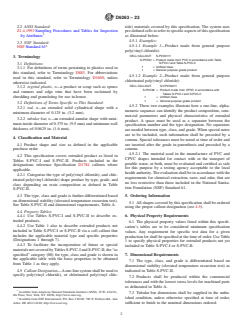
4.5.1 Examples:
2.3 NSF Standard:
4 4.5.1.1 Example 1—Product made from general purpose
NSF Standard 61
poly(vinyl chloride):
CELL CALLOUT: S-PVC0111
3. Terminology
S-PVC01 = Product made from PVC in accordance with Table
S-PVC-I and Table S-PVC-II
3.1 Definitions:
1 = Unfilled class
3.1.1 For definitions of terms pertaining to plastics used in
1 = General purpose grade product
this standard, refer to Terminology D883. For abbreviations
4.5.1.2 Example 2—Product made from general purpose
used in this standard, refer to Terminology D1600, unless
chlorinated poly(vinyl chloride):
otherwise indicated.
CELL CALLOUT: S-CPVC0211
3.1.2 regrind plastic, n—a product or scrap such as sprues
S-PVC02 = Product made from CPVC in accordance with
and runners and edge trim that have been reclaimed by
Tables S-PVC-I and S-PVC-II
shredding and granulating for use in-house.
1 = Unfilled class
1 = General purpose grade product
3.2 Definitions of Terms Specific to This Standard:
4.5.2 These two examples illustrate how a one-line, alpha-
3.2.1 rod, n—an extruded solid cylindrical shape with a
numeric sequence can identify the product composition, com-
minimum diameter of 0.125 in. (3.2 mm).
mercial parameters and physical characteristics of extruded
3.2.2 tubular bar, n—an extruded annular shape with mini-
product. A space must be used as a separator between the
mum inside diameter of 0.375 in. (9.5 mm) and minimum wall
specification number and the type designation. No separators
thickness of 0.0625 in. (1.6 mm).
are needed between type, class, and grade. When special notes
are to be included, such information shall be preceded by a
4. Classification and Material
comma. Special tolerances must be noted at time of order and
4.1 Product shape and size as defined in the applicable are inserted after the grade in parenthesis and preceded by a
purchase order. comma.
4.5.2.1 The material used in the manufacture of PVC and
4.2 This specification covers extruded product as listed in
CPVC shapes intended for contact with or the transport of
Tables S-PVC-I and S-PVC-II. Products included in the
potable water, or both, must be evaluated and certified as safe
designations reference Specification D1784 callouts where
for this purpose by a testing agency acceptable to the local
applicable.
health authority. The evaluation shall be in accordance with the
4.2.1 Categorize the type of poly(vinyl chloride), and chlo-
requirements for chemical extraction, taste, and odor, that are
rinated poly(vinyl chloride) shape product by type, grade, and
no less restrictive than those included in the National Sanita-
class depending on resin composition as defined in Table
tion Foundation (NSF) Standard 61.
S-PVC-II.
4.3 The type, class and grade is further differentiated based
5. Ordering Information
on dimensional stability (elevated temperature excursion test).
5.1 All shapes covered by this specification shall be ordered
See Table S-PVC-II and dimensional requirements, Table A.
using the proper callout designation (see 4.5).
4.4 Property Tables:
6. Physical Property Requirements
4.4.1 Use Tables S-PVC-I and S-PVC-II to describe ex-
truded products.
6.1 The physical property values listed within this specifi-
4.4.2 Use Table 1 also to describe extruded products not
cation’s tables are to be considered minimum specification
included in Table S-PVC-I or S-PVC-II via a cell callout that
values. Any requirement for specific test data for a given
includes the applicable material type and specific properties
production lot shall be specified at the time of order. Use Table
(Designations 1 through 7).
1 to specify physical properties for extruded products not yet
4.4.3 To facilitate the incorporation of future or special
included in Table S-PVC-I or S-PVC-II.
materials not covered by Tables S-PVC-I and S-PVC-II, the “as
specified” category (00) for type, class and grade is shown in
7. Dimensional Requirements
the applicable table with the basic properties to be obtained
7.1 The type, class, and grade is differentiated based on
from Table 1 as they apply.
dimensional stability (elevated temperature excursion test) as
4.5 Callout Designation—A one-line system shall be used to indicated in Table S-PVC-II.
specify poly(vinyl chloride), or chlorinated poly(vinyl chlo-
7.2 Products shall be produced within the commercial
tolerances and with the lowest stress levels for machined parts
as delineated in Table A.
Available from American National Standards Institute (ANSI), 25 W. 43rd St.,
7.3 Tubular bar dimensions shall be supplied in the unfin-
4th Floor, New York, NY 10036, http://www.ansi.org.
ished condition, unless otherwise specified at time of order,
Available from NSF International, P.O. Box 130140, 789 N. Dixboro Rd., Ann
Arbor, MI 48113-0140, http://www.nsf.org. sufficient to finish to the nominal dimensions ordered.
D6263 − 23
7.4 The maximum allowable camber at final inspection at 12. Test Methods
the factory shall be within the limits referenced in Table A.
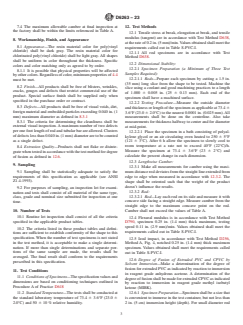
12.1 Tensile stress at break, elongation at break, and tensile
modulus (tangent) are in accordance with Test Method D638,
8. Workmanship, Finish, and Appearance
at the rate of 0.2 in. (5 mm)/min. Values obtained shall meet the
8.1 Appearance—The resin material color for poly(vinyl
requirements called out in Table S-PVC-I.
chloride) shall be dark gray. The resin material color for
12.1.1 All rod specimens are in accordance with Test
chlorinated poly(vinyl chloride) shall be light gray. All shapes
Method D638.
shall be uniform in color throughout the thickness. Specific
12.2 Dimensional Stability:
colors and color matching only as agreed to by order.
12.2.1 Specimen Preparation (a Minimum of Three Test
8.1.1 It is possible that physical properties will be affected
Samples Required):
by other colors. Regardless of color, minimum properties of 4.4
12.2.1.1 Rods—Prepare each specimen by cutting a 1.5 in.
must be met.
(35 mm) long slice from the shape to be tested. Machine the
8.2 Finish—All products shall be free of blisters, wrinkles,
slice using a coolant and good machining practices to a length
cracks, gouges and defects that restrict commercial use of the
of 1.000 6 0.005 in. (25 6 0.13 mm). Each end of the
product. Special surface finish shall be supplied only when
specimen shall have a machined surface.
specified in the purchase order or contract.
12.2.2 Testing Procedure—Measure the outside diameter
8.3 Defects—All products shall be free of visual voids, dirt,
and thickness or length of the specimen as applicable at 73.4 6
foreign material and embedded particles exceeding 0.040 in. (1
3.6°F (23.0 6 2.0°C) to the nearest 0.0001 in. (0.025 mm). All
mm) maximum diameter as defined in 8.3.1
measurements shall be done on the centerline. Also take
8.3.1 The criteria for determining the cleanliness shall be
measurements for thickness halfway to center and for diameter
external visual inspection. A maximum number of two defects
at mid-point.
per one foot length of rod and tubu
...
This document is not an ASTM standard and is intended only to provide the user of an ASTM standard an indication of what changes have been made to the previous version. Because
it may not be technically possible to adequately depict all changes accurately, ASTM recommends that users consult prior editions as appropriate. In all cases only the current version
of the standard as published by ASTM is to be considered the official document.
Designation: D6263 − 22a D6263 − 23
Standard Specification for
Extruded Rods and Bars Made From Rigid Poly(Vinyl
Chloride) (PVC) and Chlorinated Poly(Vinyl Chloride)
(CPVC)
This standard is issued under the fixed designation D6263; the number immediately following the designation indicates the year of
original adoption or, in the case of revision, the year of last revision. A number in parentheses indicates the year of last reapproval. A
superscript epsilon (´) indicates an editorial change since the last revision or reapproval.
INTRODUCTION
This specification is intended to be a means of calling out mechanical grade plastic product used in
the fabrication of end items or parts.
1. Scope*
1.1 This specification covers requirements and test methods for the material, dimensions, and workmanship, and the properties of
extruded shapes of rods and bars made from poly(vinyl chloride) (PVC), and chlorinated poly(vinyl chloride) (CPVC).
1.2 The properties included in this specification are those required for the compositions covered. Use the classification system
given in Section 4 to describe requirements necessary to identify particular characteristics important to specialized applications.
1.3 This specification allows for the use of regrind and recycled plastics providing products produced from regrind or recycled
PVC material can be shown to meet the requirements of this standard with regard to material classification, physical performance,
dimensions and workmanship; and the regrind or recycled plastics used have not been subjected to severe environments in post
consumer applications (such as chemical service) which could adversely affect the end products performance when subjected to
machining or critical applications or both.
1.4 The values are stated in inch-pound units and are regarded as the standard in all property and dimensional tables. For reference
purposes, SI units are also included in Table 1 only.
1.5 The following safety hazards caveat pertains only to the test method portions section of this specification: This standard
does not purport to address all of the safety concerns, if any, associated with its use. It is the responsibility of the user of this
standard to establish appropriate safety, health, and environmental practices and determine the applicability of regulatory
limitations prior to use.
NOTE 1—There is no known ISO equivalent to this standard.
1.6 This international standard was developed in accordance with internationally recognized principles on standardization
established in the Decision on Principles for the Development of International Standards, Guides and Recommendations issued
by the World Trade Organization Technical Barriers to Trade (TBT) Committee.
This specification is under the jurisdiction of ASTM Committee D20 on Plastics and is the direct responsibility of Subcommittee D20.15 on Thermoplastic Materials
(Section D20.20.02).
Current edition approved Nov. 1, 2022Feb. 1, 2023. Published November 2022February 2023. Originally approved in 1998. Last previous edition approved in 2022 as
D6263 - 22.D6263 - 22a. DOI: 10.1520/D6263-22A.10.1520/D6263-23.
*A Summary of Changes section appears at the end of this standard
Copyright © ASTM International, 100 Barr Harbor Drive, PO Box C700, West Conshohocken, PA 19428-2959. United States
D6263 − 23
2. Referenced Documents
2.1 ASTM Standards:
D256 Test Methods for Determining the Izod Pendulum Impact Resistance of Plastics
D618 Practice for Conditioning Plastics for Testing
D638 Test Method for Tensile Properties of Plastics
D790 Test Methods for Flexural Properties of Unreinforced and Reinforced Plastics and Electrical Insulating Materials
D883 Terminology Relating to Plastics
D1600 Terminology for Abbreviated Terms Relating to Plastics
D1784 Classification System and Basis for Specification for Rigid Poly(Vinyl Chloride) (PVC) Compounds and Chlorinated
Poly(Vinyl Chloride) (CPVC) Compounds
D3892 Practice for Packaging/Packing of Plastics
2.2 ANSI Standard:
Z1.4-1993 Sampling Procedures and Tables for Inspection by Attributes
2.3 NSF Standard:
NSF Standard 61
3. Terminology
3.1 Definitions:
3.1.1 For definitions of terms pertaining to plastics used in this standard, refer to Terminology D883. For abbreviations used in
this standard, refer to Terminology D1600, unless otherwise indicated.
3.1.2 regrind plastic, n—a product or scrap such as sprues and runners and edge trim that have been reclaimed by shredding and
granulating for use in-house.
3.2 Definitions of Terms Specific to This Standard:
3.2.1 rod, n—an extruded solid cylindrical shape with a minimum diameter of 0.125 in. (3.2 mm).
3.2.2 tubular bar, n—an extruded annular shape with minimum inside diameter of 0.375 in. (9.5 mm) and minimum wall thickness
of 0.0625 in. (1.6 mm).
4. Classification and Material
4.1 Product shape and size as defined in the applicable purchase order.
4.2 This specification covers extruded product as listed in Tables S-PVC-I and S-PVC-II. Products included in the designations
reference Specification D1784 callouts where applicable.
4.2.1 Categorize the type of poly(vinyl chloride), and chlorinated poly(vinyl chloride) shape product by type, grade, and class
depending on resin composition as defined in Table S-PVC-II.
4.3 The type, class and grade is further differentiated based on dimensional stability (elevated temperature excursion test). See
Table S-PVC-II and dimensional requirements, Table A.
4.4 Property Tables:
4.4.1 Use Tables S-PVC-I and S-PVC-II to describe extruded products.
4.4.2 Use Table 1 also to describe extruded products not included in Table S-PVC-I or S-PVC-II via a cell callout that includes
the applicable material type and specific properties (Designations 1 through 7).
For referenced ASTM standards, visit the ASTM website, www.astm.org, or contact ASTM Customer Service at service@astm.org. For Annual Book of ASTM Standards
volume information, refer to the standard’s Document Summary page on the ASTM website.
Available from American National Standards Institute (ANSI), 25 W. 43rd St., 4th Floor, New York, NY 10036, http://www.ansi.org.
Available from NSF International, P.O. Box 130140, 789 N. Dixboro Rd., Ann Arbor, MI 48113-0140, http://www.nsf.org.
D6263 − 23
4.4.3 To facilitate the incorporation of future or special materials not covered by Tables S-PVC-I and S-PVC-II, the “as specified”
category (00) for type, class and grade is shown in the applicable table with the basic properties to be obtained from Table 1 as
they apply.
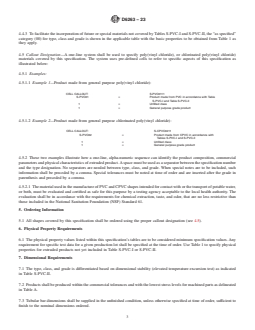
4.5 Callout Designation—A one-line system shall be used to specify poly(vinyl chloride), or chlorinated poly(vinyl chloride)
materials covered by this specification. The system uses pre-defined cells to refer to specific aspects of this specification as
illustrated below:
4.5.1 Examples:
4.5.1.1 Example 1—Product made from general purpose poly(vinyl chloride):
CELL CALLOUT: S-PVC0111
S-PVC01 = Product made from PVC in accordance with Table
S-PVC-I and Table S-PVC-II
1 = Unfilled class
1 = General purpose grade product
4.5.1.2 Example 2—Product made from general purpose chlorinated poly(vinyl chloride):
CELL CALLOUT: S-CPVC0211
S-PVC02 = Product made from CPVC in accordance with
Tables S-PVC-I and S-PVC-II
1 = Unfilled class
1 = General purpose grade product
4.5.2 These two examples illustrate how a one-line, alpha-numeric sequence can identify the product composition, commercial
parameters and physical characteristics of extruded product. A space must be used as a separator between the specification number
and the type designation. No separators are needed between type, class, and grade. When special notes are to be included, such
information shall be preceded by a comma. Special tolerances must be noted at time of order and are inserted after the grade in
parenthesis and preceded by a comma.
4.5.2.1 The material used in the manufacture of PVC and CPVC shapes intended for contact with or the transport of potable water,
or both, must be evaluated and certified as safe for this purpose by a testing agency acceptable to the local health authority. The
evaluation shall be in accordance with the requirements for chemical extraction, taste, and odor, that are no less restrictive than
those included in the National Sanitation Foundation (NSF) Standard 61.
5. Ordering Information
5.1 All shapes covered by this specification shall be ordered using the proper callout designation (see 4.5).
6. Physical Property Requirements
6.1 The physical property values listed within this specification’s tables are to be considered minimum specification values. Any
requirement for specific test data for a given production lot shall be specified at the time of order. Use Table 1 to specify physical
properties for extruded products not yet included in Table S-PVC-I or S-PVC-II.
7. Dimensional Requirements
7.1 The type, class, and grade is differentiated based on dimensional stability (elevated temperature excursion test) as indicated
in Table S-PVC-II.
7.2 Products shall be produced within the commercial tolerances and with the lowest stress levels for machined parts as delineated
in Table A.
7.3 Tubular bar dimensions shall be supplied in the unfinished condition, unless otherwise specified at time of order, sufficient to
finish to the nominal dimensions ordered.
D6263 − 23
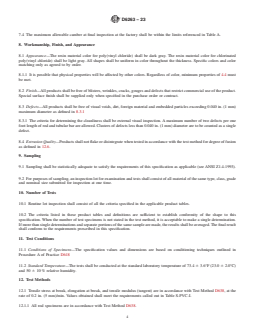
7.4 The maximum allowable camber at final inspection at the factory shall be within the limits referenced in Table A.
8. Workmanship, Finish, and Appearance
8.1 Appearance—The resin material color for poly(vinyl chloride) shall be dark gray. The resin material color for chlorinated
poly(vinyl chloride) shall be light gray. All shapes shall be uniform in color throughout the thickness. Specific colors and color
matching only as agreed to by order.
8.1.1 It is possible that physical properties will be affected by other colors. Regardless of color, minimum properties of 4.4 must
be met.
8.2 Finish—All products shall be free of blisters, wrinkles, cracks, gouges and defects that restrict commercial use of the product.
Special surface finish shall be supplied only when specified in the purchase order or contract.
8.3 Defects—All products shall be free of visual voids, dirt, foreign material and embedded particles exceeding 0.040 in. (1 mm)
maximum diameter as defined in 8.3.1
8.3.1 The criteria for determining the cleanliness shall be external visual inspection. A maximum number of two defects per one
foot length of rod and tubular bar are allowed. Clusters of defects less than 0.040 in. (1 mm) diameter are to be counted as a single
defect.
8.4 Extrusion Quality—Products shall not flake or disintegrate when tested in accordance with the test method for degree of fusion
as defined in 12.6.
9. Sampling
9.1 Sampling shall be statistically adequate to satisfy the requirements of this specification as applicable (see ANSI Z1.4-1993).
9.2 For purposes of sampling, an inspection lot for examination and tests shall consist of all material of the same type, class, grade
and nominal size submitted for inspection at one time.
10. Number of Tests
10.1 Routine lot inspection shall consist of all the criteria specified in the applicable product tables.
10.2 The criteria listed in these product tables and definitions are sufficient to establish conformity of the shape to this
specification. When the number of test specimens is not stated in the test method, it is acceptable to make a single determination.
If more than single determinations and separate portions of the same sample are made, the results shall be averaged. The final
...