

ASTM D8033-22
(Classification)Standard Classification System for Poly(Ether Ether Ketone) (PEEK) Molding and Extrusion Materials
General Information
- Abstract
SCOPE
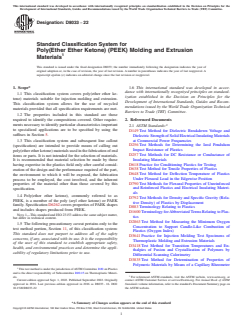
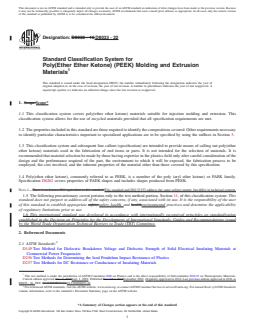
1.1 This classification system covers poly(ether ether ketone) materials suitable for injection molding and extrusion. This classification system allows for the use of recycled materials provided that all specification requirements are met.
1.2 The properties included in this standard are those required to identify the compositions covered. Other requirements necessary to identify particular characteristics important to specialized applications are to be specified by using the suffixes in Section 5.
1.3 This classification system and subsequent line callout (specification) are intended to provide means of calling out poly(ether ether ketone) materials used in the fabrication of end items or parts. It is not intended for the selection of materials. It is recommended that material selection be made by those having expertise in the plastics field only after careful consideration of the design and the performance required of the part, the environment to which it will be exposed, the fabrication process to be employed, the cost involved, and the inherent properties of the material other than those covered by this specification.
1.4 Poly(ether ether ketone), commonly referred to as PEEK, is a member of the poly (aryl ether ketone) or PAEK family. Specification D6262 covers properties of PAEK shapes and includes shapes produced from PEEK.
Note 1: This standard and ISO 23153 address the same subject matter, but differ in technical content.
1.5 The following precautionary caveat pertains only to the test method portion, Section 11, of this classification system: This standard does not purport to address all of the safety concerns, if any, associated with its use. It is the responsibility of the user of this standard to establish appropriate safety, health, and environmental practices and determine the applicability of regulatory limitations prior to use.
1.6 This international standard was developed in accordance with internationally recognized principles on standardization established in the Decision on Principles for the Development of International Standards, Guides and Recommendations issued by the World Trade Organization Technical Barriers to Trade (TBT) Committee.
- Status
- Published
- Publication Date
- 31-Aug-2022
- Technical Committee
- D20 - Plastics
- Drafting Committee
- D20.15 - Thermoplastic Materials
Buy Documents
ASTM D8033-22 - Standard Classification System for Poly(Ether Ether Ketone) (PEEK) Molding and Extrusion Materials
REDLINE ASTM D8033-22 - Standard Classification System for Poly(Ether Ether Ketone) (PEEK) Molding and Extrusion Materials
Overview
ASTM D8033-22: Standard Classification System for Poly(Ether Ether Ketone) (PEEK) Molding and Extrusion Materials provides a comprehensive classification framework for PEEK materials used in injection molding and extrusion processes. The standard supports the selective identification of PEEK grades based on key physical and mechanical properties, facilitating consistent communication among manufacturers, suppliers, and end users. ASTM D8033-22 also allows for the inclusion of recycled materials, provided all specification requirements are met, making it relevant in modern sustainability initiatives in plastics engineering.
PEEK, a member of the poly(aryl ether ketone) (PAEK) family, is recognized for its high thermal stability, excellent chemical resistance, and robust mechanical properties. This standard aids in the specification and procurement of appropriate PEEK resins for diverse industrial applications.
Key Topics
- Classification System: Covers groups, classes, and grades of PEEK materials, clearly identifying variations such as reinforcement type (glass, carbon, lubricants) and filler content by coded designations.
- Physical and Mechanical Properties: Specifies key parameters including melt viscosity, deflection temperature, tensile strength, flexural modulus, impact resistance, and specific gravity. These metrics provide the basis for material comparison and selection.
- Suffixed Requirements: Provides for additional suffixes to specify unique characteristics or supplementary properties as required for specialized applications (e.g., flammability).
- Test Methods: Outlines ASTM standard test methods for determining relevant properties, ensuring methodology consistency (e.g., ASTM D638 for tensile strength, D790 for flexural, D256 for impact).
- Sampling and Certification: Establishes procedures for sampling, testing, and certifying material batches to ensure conformity to defined specifications.
- Use of Recycled Material: Permits the incorporation of recycled PEEK, supporting waste reduction and resource recovery in plastic manufacturing.
Applications
ASTM D8033-22 is essential for industries utilizing PEEK molding and extrusion materials in the fabrication of precision parts. The standard is widely referenced for:
- Automotive components: High-performance bushings, connectors, and housings requiring chemical resistance and mechanical strength.
- Medical devices: Components where biocompatibility and sterilization capability are crucial.
- Electrical and electronic parts: Insulators, connectors, and switch components due to PEEK’s superior dielectric properties.
- Aerospace and defense: Lightweight structural parts that demand thermal stability and flame resistance.
- Industrial and chemical processing equipment: Valves, gears, and pumps exposed to aggressive environments.
By providing a uniform method to specify PEEK material grades, ASTM D8033-22 assists designers, engineers, and procurement specialists in selecting and sourcing the optimal polymer for demanding end uses.
Related Standards
To ensure a holistic approach to material characterization and specification, ASTM D8033-22 references several related standards:
- ASTM D6262: Specification for PAEK shapes, including PEEK-based products, for extruded, compression molded, and injection molded forms.
- ASTM D638: Test Method for Tensile Properties of Plastics.
- ASTM D790: Test Methods for Flexural Properties.
- ASTM D256: Test Methods for Impact Resistance.
- ASTM D648: Test Method for Deflection Temperature.
- ISO 23153: International standards for PEEK molding and extrusion materials, acknowledging subject matter overlap but differing in technical details.
- UL94: Flammability tests for plastic materials, often applied as additional suffix requirements.
When developing product specifications or sourcing PEEK materials, referencing ASTM D8033-22 alongside these related standards ensures compliance with industry best practices and regulatory requirements.
Keywords: ASTM D8033, PEEK, poly(ether ether ketone), PEEK molding, PEEK extrusion, plastics classification, thermoplastic materials, recycled PEEK, material specification, engineering polymers
Relations
- Effective Date
- 01-Feb-2024
- Effective Date
- 01-Nov-2023
- Effective Date
- 01-Oct-2023
- Effective Date
- 29-Sep-2023
- Effective Date
- 01-Jan-2020
- Effective Date
- 01-Jan-2020
- Effective Date
- 01-Oct-2019
- Effective Date
- 01-Aug-2019
- Effective Date
- 15-Apr-2019
- Effective Date
- 01-Feb-2019
- Effective Date
- 01-Dec-2018
- Effective Date
- 01-Nov-2018
- Effective Date
- 01-Apr-2018
- Refers
ASTM D1600-18 - Standard Terminology for Abbreviated Terms Relating to Plastics (Withdrawn 2024) - Effective Date
- 01-Jan-2018
- Effective Date
- 01-Dec-2017
Buy Documents
ASTM D8033-22 - Standard Classification System for Poly(Ether Ether Ketone) (PEEK) Molding and Extrusion Materials
REDLINE ASTM D8033-22 - Standard Classification System for Poly(Ether Ether Ketone) (PEEK) Molding and Extrusion Materials
Get Certified
Connect with accredited certification bodies for this standard

DIN CERTCO
DIN Group product certification.

Smithers Quality Assessments
US management systems and product certification.
Sponsored listings
Frequently Asked Questions
ASTM D8033-22 is a standard published by ASTM International. Its full title is "Standard Classification System for Poly(Ether Ether Ketone) (PEEK) Molding and Extrusion Materials". This standard covers: SCOPE 1.1 This classification system covers poly(ether ether ketone) materials suitable for injection molding and extrusion. This classification system allows for the use of recycled materials provided that all specification requirements are met. 1.2 The properties included in this standard are those required to identify the compositions covered. Other requirements necessary to identify particular characteristics important to specialized applications are to be specified by using the suffixes in Section 5. 1.3 This classification system and subsequent line callout (specification) are intended to provide means of calling out poly(ether ether ketone) materials used in the fabrication of end items or parts. It is not intended for the selection of materials. It is recommended that material selection be made by those having expertise in the plastics field only after careful consideration of the design and the performance required of the part, the environment to which it will be exposed, the fabrication process to be employed, the cost involved, and the inherent properties of the material other than those covered by this specification. 1.4 Poly(ether ether ketone), commonly referred to as PEEK, is a member of the poly (aryl ether ketone) or PAEK family. Specification D6262 covers properties of PAEK shapes and includes shapes produced from PEEK. Note 1: This standard and ISO 23153 address the same subject matter, but differ in technical content. 1.5 The following precautionary caveat pertains only to the test method portion, Section 11, of this classification system: This standard does not purport to address all of the safety concerns, if any, associated with its use. It is the responsibility of the user of this standard to establish appropriate safety, health, and environmental practices and determine the applicability of regulatory limitations prior to use. 1.6 This international standard was developed in accordance with internationally recognized principles on standardization established in the Decision on Principles for the Development of International Standards, Guides and Recommendations issued by the World Trade Organization Technical Barriers to Trade (TBT) Committee.
SCOPE 1.1 This classification system covers poly(ether ether ketone) materials suitable for injection molding and extrusion. This classification system allows for the use of recycled materials provided that all specification requirements are met. 1.2 The properties included in this standard are those required to identify the compositions covered. Other requirements necessary to identify particular characteristics important to specialized applications are to be specified by using the suffixes in Section 5. 1.3 This classification system and subsequent line callout (specification) are intended to provide means of calling out poly(ether ether ketone) materials used in the fabrication of end items or parts. It is not intended for the selection of materials. It is recommended that material selection be made by those having expertise in the plastics field only after careful consideration of the design and the performance required of the part, the environment to which it will be exposed, the fabrication process to be employed, the cost involved, and the inherent properties of the material other than those covered by this specification. 1.4 Poly(ether ether ketone), commonly referred to as PEEK, is a member of the poly (aryl ether ketone) or PAEK family. Specification D6262 covers properties of PAEK shapes and includes shapes produced from PEEK. Note 1: This standard and ISO 23153 address the same subject matter, but differ in technical content. 1.5 The following precautionary caveat pertains only to the test method portion, Section 11, of this classification system: This standard does not purport to address all of the safety concerns, if any, associated with its use. It is the responsibility of the user of this standard to establish appropriate safety, health, and environmental practices and determine the applicability of regulatory limitations prior to use. 1.6 This international standard was developed in accordance with internationally recognized principles on standardization established in the Decision on Principles for the Development of International Standards, Guides and Recommendations issued by the World Trade Organization Technical Barriers to Trade (TBT) Committee.
ASTM D8033-22 is classified under the following ICS (International Classification for Standards) categories: 83.080.20 - Thermoplastic materials. The ICS classification helps identify the subject area and facilitates finding related standards.
ASTM D8033-22 has the following relationships with other standards: It is inter standard links to ASTM D883-24, ASTM D883-23, ASTM D2863-23, ASTM D2863-95, ASTM D149-20, ASTM D883-20, ASTM D2863-19, ASTM D883-19c, ASTM D883-19a, ASTM D883-19, ASTM D883-18a, ASTM D883-18, ASTM D648-18, ASTM D1600-18, ASTM D2863-17a. Understanding these relationships helps ensure you are using the most current and applicable version of the standard.
ASTM D8033-22 is available in PDF format for immediate download after purchase. The document can be added to your cart and obtained through the secure checkout process. Digital delivery ensures instant access to the complete standard document.
Standards Content (Sample)
This international standard was developed in accordance with internationally recognized principles on standardization established in the Decision on Principles for the
Development of International Standards, Guides and Recommendations issued by the World Trade Organization Technical Barriers to Trade (TBT) Committee.
Designation:D8033 −22
Standard Classification System for
Poly(Ether Ether Ketone) (PEEK) Molding and Extrusion
Materials
This standard is issued under the fixed designation D8033; the number immediately following the designation indicates the year of
original adoption or, in the case of revision, the year of last revision. A number in parentheses indicates the year of last reapproval. A
superscript epsilon (´) indicates an editorial change since the last revision or reapproval.
1. Scope* 1.6 This international standard was developed in accor-
dance with internationally recognized principles on standard-
1.1 This classification system covers poly(ether ether ke-
ization established in the Decision on Principles for the
tone) materials suitable for injection molding and extrusion.
Development of International Standards, Guides and Recom-
This classification system allows for the use of recycled
mendations issued by the World Trade Organization Technical
materials provided that all specification requirements are met.
Barriers to Trade (TBT) Committee.
1.2 The properties included in this standard are those
2. Referenced Documents
required to identify the compositions covered. Other require-
ments necessary to identify particular characteristics important
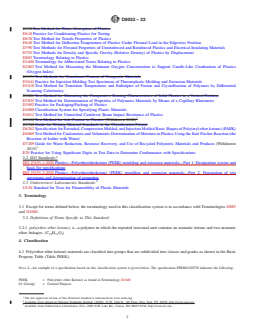
2.1 ASTM Standards:
to specialized applications are to be specified by using the
D149 Test Method for Dielectric Breakdown Voltage and
suffixes in Section 5.
DielectricStrengthofSolidElectricalInsulatingMaterials
at Commercial Power Frequencies
1.3 This classification system and subsequent line callout
D256 Test Methods for Determining the Izod Pendulum
(specification) are intended to provide means of calling out
Impact Resistance of Plastics
poly(etheretherketone)materialsusedinthefabricationofend
D257 Test Methods for DC Resistance or Conductance of
items or parts. It is not intended for the selection of materials.
Insulating Materials
It is recommended that material selection be made by those
D618 Practice for Conditioning Plastics for Testing
having expertise in the plastics field only after careful consid-
D638 Test Method for Tensile Properties of Plastics
eration of the design and the performance required of the part,
D648 Test Method for Deflection Temperature of Plastics
the environment to which it will be exposed, the fabrication
Under Flexural Load in the Edgewise Position
process to be employed, the cost involved, and the inherent
D790 Test Methods for Flexural Properties of Unreinforced
properties of the material other than those covered by this
and Reinforced Plastics and Electrical Insulating Materi-
specification.
als
1.4 Poly(ether ether ketone), commonly referred to as
D792 Test Methods for Density and Specific Gravity (Rela-
PEEK, is a member of the poly (aryl ether ketone) or PAEK
tive Density) of Plastics by Displacement
family. Specification D6262 covers properties of PAEK shapes
D883 Terminology Relating to Plastics
and includes shapes produced from PEEK.
D1600 TerminologyforAbbreviatedTermsRelatingtoPlas-
NOTE1—ThisstandardandISO 23153addressthesamesubjectmatter,
tics
but differ in technical content.
D2863 Test Method for Measuring the Minimum Oxygen
1.5 The following precautionary caveat pertains only to the
Concentration to Support Candle-Like Combustion of
test method portion, Section 11, of this classification system:
Plastics (Oxygen Index)
This standard does not purport to address all of the safety
D3641 Practice for Injection Molding Test Specimens of
concerns, if any, associated with its use. It is the responsibility
Thermoplastic Molding and Extrusion Materials
of the user of this standard to establish appropriate safety,
D3418 Test Method for Transition Temperatures and En-
health, and environmental practices and determine the appli-
thalpies of Fusion and Crystallization of Polymers by
cability of regulatory limitations prior to use.
Differential Scanning Calorimetry
D3835 Test Method for Determination of Properties of
Polymeric Materials by Means of a Capillary Rheometer
This test method is under the jurisdiction ofASTM Committee D20 on Plastics
and is the direct responsibility of Subcommittee D20.15 on Thermoplastic Materi-
als. For referenced ASTM standards, visit the ASTM website, www.astm.org, or
Current edition approved Sept. 1, 2022. Published September 2022. Originally contact ASTM Customer Service at service@astm.org. For Annual Book of ASTM
approved in 2016. Last previous edition approved in 2016 as D8033 - 16. DOI: Standards volume information, refer to the standard’s Document Summary page on
10.1520/D8033-22 the ASTM website.
*A Summary of Changes section appears at the end of this standard
Copyright © ASTM International, 100 Barr Harbor Drive, PO Box C700, West Conshohocken, PA 19428-2959. United States
D8033−22
D3892 Practice for Packaging/Packing of Plastics
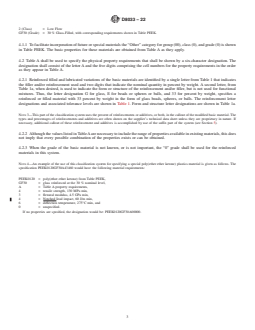
01 (Group) = General Purpose
2 (Class) = Low Flow
D4000 Classification System for Specifying Plastic Materi-
GF30 (Grade) = 30 % Glass-Filled, with corresponding requirements
als
shown in Table PEEK.
D4812 Test Method for Unnotched Cantilever Beam Impact
4.1.1 To facilitate incorporation of future or special materi-
Resistance of Plastics
als the “Other” category for group (00), class (0), and grade (0)
D6262 Specification for Extruded, Compression Molded,
is shown in Table PEEK. The basic properties for these
and Injection Molded Basic Shapes of Poly(aryl ether
materials are obtained from Table A as they apply.
ketone) (PAEK)
D6869 Test Method for Coulometric and Volumetric Deter-
4.2 Table A shall be used to specify the physical property
mination of Moisture in Plastics Using the Karl Fischer
requirements that shall be shown by a six-character designa-
Reaction (the Reaction of Iodine with Water)
tion. The designation shall consist of the letter A and the five
D7209 Guide for Waste Reduction, Resource Recovery, and
digits comprising the cell numbers for the property require-
Use of Recycled Polymeric Materials and Products (With-
ments in the order as they appear in Table A.
drawn 2015)
4.2.1 Reinforced filled and lubricated variations of the basic
E29 Practice for Using Significant Digits in Test Data to
materials are identified by a single letter from Table 1 that
Determine Conformance with Specifications
indicates the filler and/or reinforcement used and two digits
2.2 ISO Standards:
that indicate the nominal quantity in percent by weight. A
ISO 23153-1:2020 Plastics—Polyetheretherketone (PEEK)
second letter, from Table 1a, when desired, is used to indicate
moulding and extrusion materials—Part 1: Designation
the form or structure of the reinforcement and/or filler, but is
system and basis for specifications
not used for functional mixtures.Thus, the letter designation G
ISO 23153-2:2020 Plastics—Polyetheretherketone (PEEK)
for glass, E for beads or spheres or balls, and 33 for percent by
moulding and extrusion materials—Part 2: Preparation of
weight, specifies a reinforced or filled material with 33 percent
test specimens and determination of properties
by weight in the form of glass beads, spheres, or balls. The
2.3 Underwriters’ Laboratories Standards:
reinforcement letter designations and associated tolerance
UL94 Standard for Tests for Flammability of Plastic Mate-
levels are shown in Table 1. Form and structure letter desig-
rials
nations are shown in Table 1a.
NOTE 3—This part of the classification system uses the percent of
3. Terminology
reinforcements or additives, or both, in the callout of the modified basic
3.1 Except for terms defined below, the terminology used in
material. The types and percentages of reinforcements and additives are
often shown on the supplier’s technical data sheet unless they are
this classification system is in accordance with Terminologies
proprietary in nature. If necessary, additional callout of these reinforce-
D883 and D1600.
ment and additives is accomplished by use of the suffix part of the system
3.2 Definitions of Terms Specific to This Standard: (see Section 5).
3.2.1 poly(ether ether ketone), n—a polymer in which the
4.2.2 Although the values listed in TableAare necessary to
repeated structural unit contains an aromatic ketone and two
include the range of properties available in existing materials,
aromatic ether linkages. (C H O )
19 12 3 this does not imply that every possible combination of the
properties exists or can be obtained.
4. Classification
4.2.3 When the grade of the basic material is not known, or
4.1 Poly(ether ether ketone) materials are classified into
is not important, the “0” grade shall be used for the reinforced
groups that are subdivided into classes and grades as shown in
materials in this system.
the Basic Property Table (Table PEEK).
NOTE 4—An example of the use of this classification system for
specifying a special poly(ether ether ketone) plastics material is given as
NOTE 2—An example of a specification based on this classification
follows. The specification PEEK0120GF30A43460 would have the fol-
system is given below. The specification PEEK012GF30 indicates the
lowing material requirements:
following:
PEEK0120 = poly(ether ether ketone) from Table PEEK,
PEEK = Poly(ether ether Ketone) as found in Terminology
GF30 = glass reinforced at the 30 % nominal level,
D1600
A = Table A property requirements,
4 = tensile strength, 130 MPa min,
3 = flexural modulus, 4.5 GPa min,
The last approved version of this historical standard is referenced on
4 = Notched Izod impact, 60 J/m min,
www.astm.org.
6 = deflection temperature, 275°C min, and
Available fromAmerican National Standards Institute (ANSI), 25 W. 43rd St.,
0 = unspecified.
4th Floor, New York, NY 10036, http://www.ansi.org.
Available from Underwriters Laboratories (UL), 2600 N.W. Lake Rd., Camas, If no properties are specified, the designation would be:
WA 98607-8542, http://www.ul.com. PEEK0120GF30A00000.
D8033−22
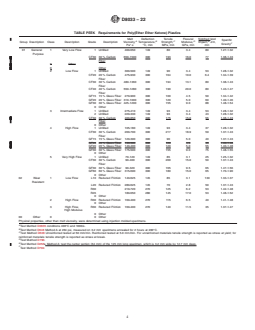
TABLE PEEK Requirements for Poly(Ether Ether Ketone) Plastics
Melt Deflection Tensile Flexural Notched Izod
Specific
A B C D E
Group Description Class Description Grade Description
Viscosity, Temperature, Strength, Modulus, Impact, J/m,
F
Gravity
Pa*.s °C, min MPa, min GPa, min min
01 General 1 Very Low Flow 1 Unfilled 400-650 149 80 3.4 80 1.27-1.32
Purpose
CF30 30 % Carbon 650-1500 300 193 16.0 77 1.38-1.43
Fiber
0 Other
2 Low Flow 1 Unfilled 300-500 149 90 3.4 53 1.28-1.32
CF20 20 % Carbon 475-930 300 164 10.0 6.4 1.34-1.39
Fiber
CF30 30 % Carbon 480-1360 300 194 13.1 80 1.38-1.43
Fiber
CF40 40 % Carbon 550-1280 300 190 20.0 80 1.43-1.47
Fiber
GF15 15 % Glass Fiber 270-900 300 100 4.5 50 1.34-1.42
GF20 20 % Glass Fiber 310-1000 300 120 5.0 60 1.40-1.46
GF30 30 % Glass Fiber 425-1200 300 155 9.0 88 1.48-1.54
0 Other
3 Intermediate Flow 1 Unfilled 275-410 149 93 3.4 53 1.28-1.32
2 Unfilled 220-330 149 93 3.4 43 1.28-1.32
CF30 30 % Carbon 400-850 300 175 15.0 55 1.38-1.43
Fiber
0 Other
4 High Flow 1 Unfilled 105-180 149 93 3.4 37 1.28-1.32
CF30 30 % Carbon 200-700 300 217 18.9 59 1.37-1.43
Fiber
GF15 15 % Glass Fiber 120-390 300 90 5.0 40 1.37-1.43
GF20 20 % Glass Fiber 140-400 300 120 5.0 55 1.40-1.48
GF30 30 % Glass Fiber 175-500 300 155 9.0 75 1.48-1.55
0 Other
5 Very High Flow 1 Unfilled 70-120 149 85 3.1 25 1.25-1.32
CF30 30 % Carbon 90-400 300 200 15.0 50 1.37-1.43
Fiber
GF30 30 % Glass Fiber 90-320 300 165 9.5 65 1.47-1.56
GF60 60 % Glass Fiber 315-690 300 180 15.0 65 1.70-1.90
0 Other
02 Wear 1 Low Flow L10 Reduced Friction 140-625 145 85 3.1 130 1.33-1.37
Resistant
L20 Reduced Friction 280-625 145 70 2.8 50 1.37-1.43
R30 210-720 270 125 6.2 53 1.42-1.48
R45 180-650 280 145 17.0 53 1.48-1.52
0 Other
2 High Flow R30 Reduced Friction 160-400 270 115 6.5 40 1.41-1.48
0 Other
3 High Flow, R30 Reduced Friction 160-400 270 140 11.5 35 1.37-1.47
High Modulus
0 Other
00 Other 0 0 Other
Physical properties, other than melt viscosity, were determined using injection molded specimens.
A
Test Method D3835 conditions 400°C and 1000/s.
B
Test Method D648 Method A at 264 psi, measured on 3.2 mm specimens annealed for 2 hours at 200°C.
C
Test Method D638 Unreinforced tested at 50 mm/min. Reinforced tested at 5.0 mm/min. For unreinforced materials tensile strength is reported as stress at yield; for
reinforced materials tensile strength is reported as stress at break.
D
Test Method D790.
E
Test Method D256, Method A; test the center portion (64 mm) of the 125 mm long specimen, which is 3.2 mm wide by 12.7 mm deep.
F
Test Method D792.
D8033−22
TABLE A Detail Requirements of Special Poly(Ether Ether Ketone) Plastics Using ASTM Methods
Designation
or Order Property 0 1 2 3 4 5 6 7 8 9
Number
A
1 Tensile strength, unspecified 70 90 110 130 150 170 190 210 specify value
B
D638,min,MPa
C
2 Flexural modulus, unspecified 3.0 3.5 4.5 5.5 7.0 9.0 11.0 13.0 specify value
B
D790,(A),min,GPa
D
3 Notched Izod impact resistance, unspecified 30 40 50 60 80 100 120 150 specify value
D256, Method A,
E
min, J/m
F
4 Deflection temperature at 1.8 MPa, unspecified 140 150 200 245 260 275 290 305 specify value
D648,min,°C
5 To be determined unspecified . . . . . . . . . . . . . . . . . . . . . . . . . . .
A
Type I D638 test specimens, unreinforced tested at 50 mm/min, Reinforced tested at 5.0 mm/min.
B
MPa × 145 = psi.
C
Test specimens are nominal 3.2 mm in depth by 12.7 mm wide. Span is a nominal 50 mm. Ra
...
This document is not an ASTM standard and is intended only to provide the user of an ASTM standard an indication of what changes have been made to the previous version. Because
it may not be technically possible to adequately depict all changes accurately, ASTM recommends that users consult prior editions as appropriate. In all cases only the current version
of the standard as published by ASTM is to be considered the official document.
Designation: D8033 − 16 D8033 − 22
Standard Classification System for
Poly(Ether Ether Ketone) (PEEK) Molding and Extrusion
Materials
This standard is issued under the fixed designation D8033; the number immediately following the designation indicates the year of
original adoption or, in the case of revision, the year of last revision. A number in parentheses indicates the year of last reapproval. A
superscript epsilon (´) indicates an editorial change since the last revision or reapproval.
1. Scope Scope*
1.1 This classification system covers poly(ether ether ketone) materials suitable for injection molding and extrusion. This
classification system allows for the use of recycled materials provided that all specification requirements are met.
1.2 The properties included in this standard are those required to identify the compositions covered. Other requirements necessary
to identify particular characteristics important to specialized applications are to be specified by using the suffixes in Section 5.
1.3 This classification system and subsequent line callout (specification) are intended to provide means of calling out poly(ether
ether ketone) materials used in the fabrication of end items or parts. It is not intended for the selection of materials. It is
recommended that material selection be made by those having expertise in the plastics field only after careful consideration of the
design and the performance required of the part, the environment to which it will be exposed, the fabrication process to be
employed, the cost involved, and the inherent properties of the material other than those covered by this specification.
1.4 Poly(ether ether ketone), commonly referred to as PEEK, is a member of the poly (aryl ether ketone) or PAEK family.
Specification D6262 covers properties of PAEK shapes and includes shapes produced from PEEK.
NOTE 1—There is no known ISO equivalent to this standard.This standard and ISO 23153 address the same subject matter, but differ in technical content.
1.5 The following precautionary caveat pertains only to the test method portion, Section 11, of this classification system: This
standard does not purport to address all of the safety concerns, if any, associated with its use. It is the responsibility of the user
of this standard to establish appropriate safety safety, health, and healthenvironmental practices and determine the applicability
of regulatory limitations prior to use.
1.6 This international standard was developed in accordance with internationally recognized principles on standardization
established in the Decision on Principles for the Development of International Standards, Guides and Recommendations issued
by the World Trade Organization Technical Barriers to Trade (TBT) Committee.
2. Referenced Documents
2.1 ASTM Standards:
D149 Test Method for Dielectric Breakdown Voltage and Dielectric Strength of Solid Electrical Insulating Materials at
Commercial Power Frequencies
D256 Test Methods for Determining the Izod Pendulum Impact Resistance of Plastics
D257 Test Methods for DC Resistance or Conductance of Insulating Materials
This test method is under the jurisdiction of ASTM Committee D20 on Plastics and is the direct responsibility of Subcommittee D20.15 on Thermoplastic Materials.
Current edition approved Dec. 1, 2016Sept. 1, 2022. Published December 2016September 2022. Originally approved in 2016. Last previous edition approved in 2016 as
D8033 - 16. DOI: 10.1520/D8033-16.10.1520/D8033-22
For referenced ASTM standards, visit the ASTM website, www.astm.org, or contact ASTM Customer Service at service@astm.org. For Annual Book of ASTM Standards
volume information, refer to the standard’s Document Summary page on the ASTM website.
*A Summary of Changes section appears at the end of this standard
Copyright © ASTM International, 100 Barr Harbor Drive, PO Box C700, West Conshohocken, PA 19428-2959. United States
D8033 − 22
D570 Test Method for Water Absorption of Plastics
D618 Practice for Conditioning Plastics for Testing
D638 Test Method for Tensile Properties of Plastics
D648 Test Method for Deflection Temperature of Plastics Under Flexural Load in the Edgewise Position
D790 Test Methods for Flexural Properties of Unreinforced and Reinforced Plastics and Electrical Insulating Materials
D792 Test Methods for Density and Specific Gravity (Relative Density) of Plastics by Displacement
D883 Terminology Relating to Plastics
D1600 Terminology for Abbreviated Terms Relating to Plastics
D2863 Test Method for Measuring the Minimum Oxygen Concentration to Support Candle-Like Combustion of Plastics
(Oxygen Index)
D3171 Test Methods for Constituent Content of Composite Materials
D3641 Practice for Injection Molding Test Specimens of Thermoplastic Molding and Extrusion Materials
D3418 Test Method for Transition Temperatures and Enthalpies of Fusion and Crystallization of Polymers by Differential
Scanning Calorimetry
D3801 Test Method for Measuring the Comparative Burning Characteristics of Solid Plastics in a Vertical Position
D3835 Test Method for Determination of Properties of Polymeric Materials by Means of a Capillary Rheometer
D3892 Practice for Packaging/Packing of Plastics
D4000 Classification System for Specifying Plastic Materials
D4812 Test Method for Unnotched Cantilever Beam Impact Resistance of Plastics
D5630 Test Method for Ash Content in Plastics (Withdrawn 2022)
D5740 Guide for Writing Material Standards in the Classification Format
D6262 Specification for Extruded, Compression Molded, and Injection Molded Basic Shapes of Poly(aryl ether ketone) (PAEK)
D6869 Test Method for Coulometric and Volumetric Determination of Moisture in Plastics Using the Karl Fischer Reaction (the
Reaction of Iodine with Water)
D7209 Guide for Waste Reduction, Resource Recovery, and Use of Recycled Polymeric Materials and Products (Withdrawn
2015)
E29 Practice for Using Significant Digits in Test Data to Determine Conformance with Specifications
2.2 ISO Standards:
ISO 23153-1:2020 Plastics—Polyetheretherketone (PEEK) moulding and extrusion materials—Part 1: Designation system and
basis for specifications
ISO 23153-2:2020 Plastics—Polyetheretherketone (PEEK) moulding and extrusion materials—Part 2: Preparation of test
specimens and determination of properties
2.3 Underwriters’ Laboratories Standards:
UL94 Standard for Tests for Flammability of Plastic Materials
3. Terminology
3.1 Except for terms defined below, the terminology used in this classification system is in accordance with Terminologies D883
and D1600.
3.2 Definitions of Terms Specific to This Standard:
3.2.1 poly(ether ether ketone), n—a polymer in which the repeated structural unit contains an aromatic ketone and two aromatic
ether linkages. (C H O )
19 12 3
4. Classification
4.1 Poly(ether ether ketone) materials are classified into groups that are subdivided into classes and grades as shown in the Basic
Property Table (Table PEEK).
NOTE 2—An example of a specification based on this classification system is given below. The specification PEEK012GF30 indicates the following:
PEEK = Poly(ether ether Ketone) as found in Terminology D1600
01 (Group) = General Purpose
The last approved version of this historical standard is referenced on www.astm.org.
Available from American National Standards Institute (ANSI), 25 W. 43rd St., 4th Floor, New York, NY 10036, http://www.ansi.org.
Available from Underwriters Laboratories (UL), 2600 N.W. Lake Rd., Camas, WA 98607-8542, http://www.ul.com.
D8033 − 22
2 (Class) = Low Flow
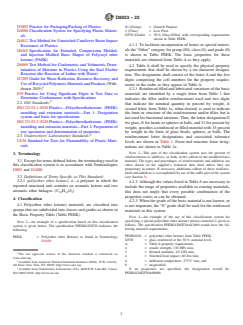
GF30 (Grade) = 30 % Glass-Filled, with corresponding requirements shown in Table PEEK.
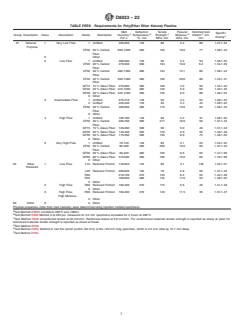
4.1.1 To facilitate incorporation of future or special materials the “Other” category for group (00), class (0), and grade (0) is shown
in Table PEEK. The basic properties for these materials are obtained from Table A as they apply.
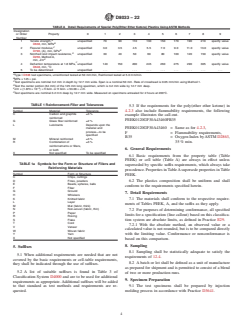
4.2 Table A shall be used to specify the physical property requirements that shall be shown by a six-character designation. The
designation shall consist of the letter A and the five digits comprising the cell numbers for the property requirements in the order
as they appear in Table A.
4.2.1 Reinforced filled and lubricated variations of the basic materials are identified by a single letter from Table 1 that indicates
the filler and/or reinforcement used and two digits that indicate the nominal quantity in percent by weight. A second letter, from
Table 1a, when desired, is used to indicate the form or structure of the reinforcement and/or filler, but is not used for functional
mixtures. Thus, the letter designation G for glass, E for beads or spheres or balls, and 33 for percent by weight, specifies a
reinforced or filled material with 33 percent by weight in the form of glass beads, spheres, or balls. The reinforcement letter
designations and associated tolerance levels are shown in Table 1. Form and structure letter designations are shown in Table 1a.
NOTE 3—This part of the classification system uses the percent of reinforcements or additives, or both, in the callout of the modified basic material. The
types and percentages of reinforcements and additives are often shown on the supplier’s technical data sheet unless they are proprietary in nature. If
necessary, additional callout of these reinforcement and additives is accomplished by use of the suffix part of the system (see Section 5).
4.2.2 Although the values listed in Table A are necessary to include the range of properties available in existing materials, this does
not imply that every possible combination of the properties exists or can be obtained.
4.2.3 When the grade of the basic material is not known, or is not important, the “0” grade shall be used for the reinforced
materials in this system.
NOTE 4—An example of the use of this classification system for specifying a special poly(ether ether ketone) plastics material is given as follows. The
specification PEEK0120GF30A43460 would have the following material requirements:
PEEK0120 = poly(ether ether ketone) from Table PEEK,
GF30 = glass reinforced at the 30 % nominal level,
A = Table A property requirements,
4 = tensile strength, 130 MPa min,
3 = flexural modulus, 4.5 GPa min,
4 = Notched Izod impact, 60 J/m min,
6 = deflection temperature, 275°C min, and
0 = unspecified.
If no properties are specified, the designation would be: PEEK0120GF30A00000.
D8033 − 22
TABLE PEEK Requirements for Poly(Ether Ether Ketone) Plastics
Melt Deflection Tensile Flexural Notched Izod
Specific
A B C D E
Group Description Class Description Grade Description
Viscosity, Temperature, Strength, Modulus, Impact, J/m, F
Gravity
Pa*.s °C, min MPa, min GPa, min min
01 General 1 Very Low Flow 1 Unfilled 400-650 149 80 3.4 80 1.27-1.32
Purpose
CF30 30 % Carbon 650-1500 300 193 16.0 77 1.38-1.43
Fiber
0 Other
0 Other
2 Low Flow 1 Unfilled 300-500 149 90 3.4 53 1.28-1.32
CF20 20 % Carbon 475-930 300 164 10.0 6.4 1.34-1.39
Fiber
CF30 30 % Carbon 480-1360 300 194 13.1 80 1.38-1.43
Fiber
CF40 40 % Carbon 550-1280 300 190 20.0 80 1.43-1.47
Fiber
GF15 15 % Glass Fiber 270-900 300 100 4.5 50 1.34-1.42
GF20 20 % Glass Fiber 310-1000 300 120 5.0 60 1.40-1.46
GF30 30 % Glass Fiber 425-1200 300 155 9.0 88 1.48-1.54
0 Other
3 Intermediate Flow 1 Unfilled 275-410 149 93 3.4 53 1.28-1.32
2 Unfilled 220-330 149 93 3.4 43 1.28-1.32
CF30 30 % Carbon 400-850 300 175 15.0 55 1.38-1.43
Fiber
0 Other
4 High Flow 1 Unfilled 105-180 149 93 3.4 37 1.28-1.32
CF30 30 % Carbon 200-700 300 217 18.9 59 1.37-1.43
Fiber
GF15 15 % Glass Fiber 120-390 300 90 5.0 40 1.37-1.43
GF20 20 % Glass Fiber 140-390 300 120 5.0 55 1.40-1.48
GF20 20 % Glass Fiber 140-400 300 120 5.0 55 1.40-1.48
GF30 30 % Glass Fiber 175-500 300 155 9.0 75 1.48-1.55
0 Other
5 Very High Flow 1 Unfilled 70-120 149 85 3.1 25 1.25-1.32
CF30 30 % Carbon 90-400 300 200 15.0 50 1.37-1.43
Fiber
GF30 30 % Glass Fiber 90-320 300 165 9.5 65 1.47-1.56
GF60 60 % Glass Fiber 315-690 300 180 15.0 65 1.70-1.90
0 Other
02 Wear 1 Low Flow L10 Reduced Friction 140-625 145 85 3.1 130 1.33-1.37
Resistant
L20 Reduced Friction 280-625 145 70 2.8 50 1.37-1.43
R30 210-720 270 125 6.2 53 1.42-1.48
R45 180-650 280 145 17.0 53 1.48-1.52
0 Other
2 High Flow R30 Reduced Friction 160-400 270 115 6.5 40 1.41-1.48
0 Other
3 High Flow, R30 Reduced Friction 160-400 270 140 11.5 35 1.37-1.47
High Modulus
0 Other
00 Other 0 0 Other
Physical properties, other than melt viscosity, were determined using injection molded specimens.
A
Test Method D3835 conditions 400°C and 1000/s.
B
Test Method D648 Method A at 264 psi, measured on 3.2 mm specimens annealed for 2 hours at 200°C.
C
Test Method D638 Unreinforced tested at 50 mm/min. Reinforced tested at 5.0 mm/min. For unreinforced materials tensile strength is reported as stress at yield; for
reinforced materials tensile strength is reported as stress at break.
D
Test Method D790.
E
Test Method D256., Method A; test the center portion (64 mm) of the 125 mm long specimen, which is 3.2 mm wide by 12.7 mm deep.
F
Test Method D792.
D8033 − 22
TABLE A Detail Requirements of Special Poly(Ether Ether Ketone) Plastics Using ASTM Methods
Designation
or Order Property 0 1 2 3 4 5 6 7 8 9
Number
A
1 Tensile strength, unspecified 70 90 110 130 150 170 190 210 specify value
B
D638, min, MPa
C
2 Flexural modulus, unspecified 3.0 3.5 4.5 5.5 7.0 9.0 11.0 13.0 specify value
B
D790, (A), min, GPa
D
3 Notched Izod impact resistance, unspecified 30 40 50 60 80 100 120 150 specify value
D256, Method A,
E
min, J/m
F
4 Deflection temperature at 1.8 MPa, unspecified 140 150 200 245 260 275 290 305 specify value
D648, min, °C
5 To be determined unspecified . . . . . . . . . . . . . . . . . . . . . . . . . . .
A
Type I D638 test specimens, unreinforced tested at 50 mm/min, Reinforced tested at 5.0 mm/min.
B
MPa × 145 = psi.
C
Test specimens a
...