

ASTM G92-20
(Practice)Standard Practice for Characterization of Atmospheric Test Sites
General Information
- Abstract
SIGNIFICANCE AND USE
4.1 This practice gives suggested procedures for characterization of atmospheric test sites. It can be useful to researchers, manufacturers, engineering firms, architects, and construction contractors to provide corrosion and environmental data, materials selection information, and a materials storage practice.
4.2 This practice does not give specific parameters for classifying the type of test site.
SCOPE
1.1 This practice covers procedures for the characterization of atmospheric test sites. Continuous characterization can provide corrosion data, environmental data, or both which will signal changes in corrosivity of the atmospheric environment. This practice can also provide guidance for classification of future test sites.
1.2 Two methods are defined in this practice for the characterization of atmospheric test sites. The methods are identified as characterization Methods A and B. The preferred characterization technique would require using both Method A and B for concurrent data collection.
1.2.1 Method A is to be used when atmospheric corrosion is monitored on a continuing basis at a test site using specified materials and exposure configurations.
1.2.2 Method B is specified when atmospheric factors are monitored on a continuing basis.
1.3 The values stated in SI units are to be regarded as standard. No other units of measurement are included in this standard.
1.4 This standard does not purport to address all of the safety concerns, if any, associated with its use. It is the responsibility of the user of this standard to establish appropriate safety, health, and environmental practices and determine the applicability of regulatory limitations prior to use.
1.5 This international standard was developed in accordance with internationally recognized principles on standardization established in the Decision on Principles for the Development of International Standards, Guides and Recommendations issued by the World Trade Organization Technical Barriers to Trade (TBT) Committee.
- Status
- Published
- Publication Date
- 31-Oct-2020
- Technical Committee
- G01 - Corrosion of Metals
Overview
ASTM G92-20: Standard Practice for Characterization of Atmospheric Test Sites is an international standard developed by ASTM International to guide the procedures for evaluating and monitoring atmospheric test sites. Its primary purpose is to help organizations-including researchers, manufacturers, engineering firms, architects, and construction contractors-systematically collect and analyze environmental and corrosion data at specific locations. This standard enables consistent characterization of site atmospheres, facilitating the selection of suitable materials, understanding of corrosive environments, and informed decisions for long-term material storage and usage.
Continuous site characterization is essential in various industries to monitor changes in atmospheric corrosivity. ASTM G92-20 outlines two primary methods for this process, enabling effective data collection about the site’s ability to accelerate material degradation and the ambient environmental factors contributing to corrosion.
Key Topics
ASTM G92-20 addresses the following key areas for the atmospheric test site characterization:
Method A: Atmospheric Corrosion Data Collection
- Focuses on monitoring corrosion over time using standardized test specimens (e.g., carbon steel and high-purity zinc)
- Specifies procedures for specimen preparation, exposure, identification, and post-test analysis
- Data includes mass loss, corrosion rates, and detailed documentation of changes
Method B: Monitoring Atmospheric Factors
- Focuses on the measurement of environmental conditions influencing corrosion, such as:
- Sulfur dioxide, chloride concentration
- Temperature and relative humidity
- Precipitation and wetness duration
- Atmospheric particulate matter
- Recommends use of monitoring devices such as sulfation plates, wet candles, and hygrothermographs
- Focuses on the measurement of environmental conditions influencing corrosion, such as:
Concurrent Use of Methods A and B
- Encourages simultaneous implementation for comprehensive site characterization
- Allows correlation between material loss and environmental parameters
Data Documentation and Reporting
- Emphasizes careful tracking of specimen data, exposure conditions, and analytical results
- Recommendations for standardized forms and reporting formats
Practical Guidelines and Safety Considerations
- Advises adherence to established safety, health, and environmental practices in all test operations
Applications
The practical value of ASTM G92-20 extends across numerous sectors reliant on accurate environmental and corrosion assessment:
- Materials Selection:
- Engineers and architects can use site-specific data to select durable materials for construction, infrastructure, and manufacturing
- Corrosion Testing:
- Researchers can benchmark atmospheric corrosivity and study degradation mechanisms using standardized procedures
- Infrastructure Maintenance:
- Long-term monitoring supports predictive maintenance and helps optimize protection/coating strategies for bridges, pipelines, and storage facilities
- Environmental Impact Assessment:
- Helps in understanding the impact of atmospheric pollution and climate factors on asset longevity
This standard is particularly valuable for organizations operating in diverse atmospheric environments, enabling them to anticipate challenges and make data-driven decisions to minimize corrosion-related failures and costs.
Related Standards
ASTM G92-20 is closely linked with several other ASTM standards and practices for atmospheric testing and corrosion monitoring, including:
- ASTM G1: Practice for Preparing, Cleaning, and Evaluating Corrosion Test Specimens
- ASTM G50: Practice for Conducting Atmospheric Corrosion Tests on Metals
- ASTM G84: Practice for Measurement of Time-of-Wetness on Surfaces Exposed to Wetting Conditions
- ASTM G91: Practice for Monitoring Atmospheric SO₂ Deposition Rate for Atmospheric Corrosivity Evaluation
- ASTM A36/A36M: Specification for Carbon Structural Steel
- ASTM B6: Specification for Zinc
By referencing and integrating these standards, ASTM G92-20 ensures best practices in corrosion science and site characterization, supporting international harmonization and reliable data collection for atmospheric test sites.
Relations
- Effective Date
- 01-May-2018
- Effective Date
- 01-Feb-2013
- Effective Date
- 01-Nov-2012
- Effective Date
- 01-May-2012
- Effective Date
- 01-Dec-2011
- Effective Date
- 01-Nov-2011
- Effective Date
- 01-Sep-2010
- Effective Date
- 01-Sep-2010
- Effective Date
- 01-Oct-2009
- Effective Date
- 01-Nov-2008
- Effective Date
- 15-May-2008
- Effective Date
- 01-May-2007
- Effective Date
- 01-Dec-2006
- Effective Date
- 01-Mar-2005
- Effective Date
- 01-Nov-2004
Get Certified
Connect with accredited certification bodies for this standard

IMP NDT d.o.o.
Non-destructive testing services. Radiography, ultrasonic, magnetic particle, penetrant, visual inspection.
Inštitut za kovinske materiale in tehnologije
Institute of Metals and Technology. Materials testing, metallurgical analysis, NDT.
Q Techna d.o.o.
NDT and quality assurance specialist. 30+ years experience. NDT personnel certification per ISO 9712, nuclear and thermal power plant inspections, QA/
Sponsored listings
Frequently Asked Questions
ASTM G92-20 is a standard published by ASTM International. Its full title is "Standard Practice for Characterization of Atmospheric Test Sites". This standard covers: SIGNIFICANCE AND USE 4.1 This practice gives suggested procedures for characterization of atmospheric test sites. It can be useful to researchers, manufacturers, engineering firms, architects, and construction contractors to provide corrosion and environmental data, materials selection information, and a materials storage practice. 4.2 This practice does not give specific parameters for classifying the type of test site. SCOPE 1.1 This practice covers procedures for the characterization of atmospheric test sites. Continuous characterization can provide corrosion data, environmental data, or both which will signal changes in corrosivity of the atmospheric environment. This practice can also provide guidance for classification of future test sites. 1.2 Two methods are defined in this practice for the characterization of atmospheric test sites. The methods are identified as characterization Methods A and B. The preferred characterization technique would require using both Method A and B for concurrent data collection. 1.2.1 Method A is to be used when atmospheric corrosion is monitored on a continuing basis at a test site using specified materials and exposure configurations. 1.2.2 Method B is specified when atmospheric factors are monitored on a continuing basis. 1.3 The values stated in SI units are to be regarded as standard. No other units of measurement are included in this standard. 1.4 This standard does not purport to address all of the safety concerns, if any, associated with its use. It is the responsibility of the user of this standard to establish appropriate safety, health, and environmental practices and determine the applicability of regulatory limitations prior to use. 1.5 This international standard was developed in accordance with internationally recognized principles on standardization established in the Decision on Principles for the Development of International Standards, Guides and Recommendations issued by the World Trade Organization Technical Barriers to Trade (TBT) Committee.
SIGNIFICANCE AND USE 4.1 This practice gives suggested procedures for characterization of atmospheric test sites. It can be useful to researchers, manufacturers, engineering firms, architects, and construction contractors to provide corrosion and environmental data, materials selection information, and a materials storage practice. 4.2 This practice does not give specific parameters for classifying the type of test site. SCOPE 1.1 This practice covers procedures for the characterization of atmospheric test sites. Continuous characterization can provide corrosion data, environmental data, or both which will signal changes in corrosivity of the atmospheric environment. This practice can also provide guidance for classification of future test sites. 1.2 Two methods are defined in this practice for the characterization of atmospheric test sites. The methods are identified as characterization Methods A and B. The preferred characterization technique would require using both Method A and B for concurrent data collection. 1.2.1 Method A is to be used when atmospheric corrosion is monitored on a continuing basis at a test site using specified materials and exposure configurations. 1.2.2 Method B is specified when atmospheric factors are monitored on a continuing basis. 1.3 The values stated in SI units are to be regarded as standard. No other units of measurement are included in this standard. 1.4 This standard does not purport to address all of the safety concerns, if any, associated with its use. It is the responsibility of the user of this standard to establish appropriate safety, health, and environmental practices and determine the applicability of regulatory limitations prior to use. 1.5 This international standard was developed in accordance with internationally recognized principles on standardization established in the Decision on Principles for the Development of International Standards, Guides and Recommendations issued by the World Trade Organization Technical Barriers to Trade (TBT) Committee.
ASTM G92-20 is classified under the following ICS (International Classification for Standards) categories: 19.040 - Environmental testing. The ICS classification helps identify the subject area and facilitates finding related standards.
ASTM G92-20 has the following relationships with other standards: It is inter standard links to ASTM G91-11(2018), ASTM B6-13, ASTM A36/A36M-12, ASTM B6-12, ASTM G1-03(2011), ASTM G91-11, ASTM G50-10, ASTM G91-97(2010), ASTM B6-09, ASTM B6-08, ASTM A36/A36M-08, ASTM B6-07, ASTM B6-06, ASTM A36/A36M-05, ASTM G91-97(2004). Understanding these relationships helps ensure you are using the most current and applicable version of the standard.
ASTM G92-20 is available in PDF format for immediate download after purchase. The document can be added to your cart and obtained through the secure checkout process. Digital delivery ensures instant access to the complete standard document.
Standards Content (Sample)
This international standard was developed in accordance with internationally recognized principles on standardization established in the Decision on Principles for the
Development of International Standards, Guides and Recommendations issued by the World Trade Organization Technical Barriers to Trade (TBT) Committee.
Designation:G92 −20
Standard Practice for
Characterization of Atmospheric Test Sites
ThisstandardisissuedunderthefixeddesignationG92;thenumberimmediatelyfollowingthedesignationindicatestheyearoforiginal
adoption or, in the case of revision, the year of last revision.Anumber in parentheses indicates the year of last reapproval.Asuperscript
epsilon (´) indicates an editorial change since the last revision or reapproval.
1. Scope B6 Specification for Zinc
G1 Practice for Preparing, Cleaning, and Evaluating Corro-
1.1 This practice covers procedures for the characterization
sion Test Specimens
of atmospheric test sites. Continuous characterization can
G50 Practice for Conducting Atmospheric Corrosion Tests
provide corrosion data, environmental data, or both which will
on Metals
signal changes in corrosivity of the atmospheric environment.
G84 Practice for Measurement of Time-of-Wetness on Sur-
This practice can also provide guidance for classification of
faces Exposed to Wetting Conditions as in Atmospheric
future test sites.
Corrosion Testing
1.2 Two methods are defined in this practice for the char-
G91 Practice for Monitoring Atmospheric SO Deposition
acterization of atmospheric test sites. The methods are identi-
Rate for Atmospheric Corrosivity Evaluation
fied as characterization Methods A and B. The preferred
characterization technique would require using both MethodA
3. Summary of Methods
and B for concurrent data collection.
3.1 Characterization Method A is to be used when atmo-
1.2.1 MethodAis to be used when atmospheric corrosion is
spheric corrosion data are to be obtained.
monitored on a continuing basis at a test site using specified
3.1.1 Corrosion tests to measure the corrosivity of the test
materials and exposure configurations.
site should follow the procedure established by Practice G50.
1.2.2 Method B is specified when atmospheric factors are
Additional special instructions are identified in this procedure
monitored on a continuing basis.
relating to types of materials for corrosion characterization
1.3 The values stated in SI units are to be regarded as
tests, time of test exposure, positioning of test specimens,
standard. No other units of measurement are included in this
removal of test specimens and proper identification, cleaning
standard.
practices, and reporting of data.
1.4 This standard does not purport to address all of the
3.2 Characterization Method B is to be used when atmo-
safety concerns, if any, associated with its use. It is the
spheric climatological factors influencing the corrosion of
responsibility of the user of this standard to establish appro-
metals are to be monitored.
priate safety, health, and environmental practices and deter-
3.2.1 Several atmospheric factors which have been identi-
mine the applicability of regulatory limitations prior to use.
fied as having significant bearing on the corrosion of metals
1.5 This international standard was developed in accor-
include, but are not limited to, sulfur dioxide, chlorides,
dance with internationally recognized principles on standard-
temperature, humidity, precipitation, time of wetness, and
ization established in the Decision on Principles for the
atmospheric particulate matter.
Development of International Standards, Guides and Recom-
3.3 The preferred technique utilizes both Methods A and B
mendations issued by the World Trade Organization Technical
for concurrent data to be collected.
Barriers to Trade (TBT) Committee.
3.3.1 Should either Method A or B be singled out as the
2. Referenced Documents
primary technique to be used on a continuing basis, both
should be used at some point in time to establish a data base.
2.1 ASTM Standards:
A36/A36M Specification for Carbon Structural Steel The availability of computerized weather stations greatly
facilitates the collection of reliable atmospheric data.
This practice is under the jurisdiction of ASTM Committee G01 on Corrosion
of Metals and is the direct responsibility of Subcommittee G01.04 on Corrosion of
4. Significance and Use
Metals in Natural Atmospheric and Aqueous Environments.
4.1 This practice gives suggested procedures for character-
CurrenteditionapprovedNov.1,2020.PublishedNovember2020.Lastprevious
edition approved in 2015 as G92–86(2015). DOI: 10.1520/G0092-20.
ization of atmospheric test sites. It can be useful to researchers,
For referenced ASTM standards, visit the ASTM website, www.astm.org, or
manufacturers, engineering firms, architects, and construction
contact ASTM Customer Service at service@astm.org. For Annual Book of ASTM
contractors to provide corrosion and environmental data, ma-
Standards volume information, refer to the standard’s Document Summary page on
the ASTM website. terials selection information, and a materials storage practice.
Copyright © ASTM International, 100 Barr Harbor Drive, PO Box C700, West Conshohocken, PA 19428-2959. United States
G92−20
4.2 This practice does not give specific parameters for 5.2 Material Preparation:
classifying the type of test site.
5.2.1 Atmospheric test specimens, as shown for example, in
Fig. 1, shall be cut and finished in a manner that will not
PROCEDURES
detrimentally affect the corrosion behavior of exposed edges.
5. Method A
NOTE 1—Shearing may not be practical for some material section
thicknesses, and may introduce stresses and microcrevices that may
5.1 Materials:
accelerate edge attack if not further machined.
5.1.1 The materials recommended for conducting atmo-
spheric corrosion characterization studies are copper-bearing
5.2.2 An identifying code should be assigned to each
structural carbon steel (such as Specification A36/A36M with
specimen. Locating a permanent code on each test specimen
0.2 % copper min) and high-purity zinc (Specification B6 high
can be accomplished easily by using a code template (Fig. 1).
grade).
5.2.2.1 Pre-assignment of codes for a definite test period is
5.1.2 Materials recommended are the absolute minimum
suggested. After a temporary mark is placed on the specimen,
required to serve as a characterization base for test sites.
a permanent drilled code (a series of 2.5 mm holes) should
Additional materials should be added to meet individual needs.
perforate the test specimen.
Sufficient material should be obtained at the start to insure that
5.2.3 Alltestspecimensofthesamealloyshouldbecleaned
an ample supply of the same heat is available to complete the
by the same procedure to ensure a comparative surface finish
characterization test. If tests are on-going and additional
following the guidance of Practice G1. The recommended
materials must be obtained, care should be taken in attempting
practice for cleaning is (a) degrease and pickle, if necessary, to
to match material compositions.
5.1.3 Sufficient specimens should be prepared to comply remove grease, mill scale, or other impurities; (b) scrub with
with the specific criteria for the planned characterization test. pumice and only a natural fiber or synthetic fiber bristle brush
* Template contains 126 drilled holes
FIG. 1 Sample Atmospheric Specimen Drill Code Identification Template
G92−20
TABLE 1 Sample Data Sheet for Atmospheric Corrosion Data
Test Site: Kure Beach (250 m lot) Latitude: 34° 00' N
Exposure Dates: 10/7/61 to 10/6/62 Longitude: 77° 55' W
Mass (g)
Material Code Exposure Period Mass Loss Per Corrosion
(days) Original Final Loss Unit Area Rate
(mg/m ) (mm/y)
Cu-steel A1-B2 365 196.583 187.332 9.251 2.86 × 10 0.0365
Zinc A2-B2 365 67.521 66.938 0.583 1.84 × 10 0.0026
Test Method Documentation
Steel Zinc
1. Composition (weight %) 0.15 C, 1.0 Mn, 0.01 P, 0.027 S, 0.24 Si, 0.01 Cu, 0.012 Cd, 0.03 Pb, 0.02 Fe,
0.21 Cu, 0.05 Ni, 0.03 Cr, Balance Fe Balance Zn
3 3 3
2. Density (g/cm ) 7.85 g/cm 7.13 g/cm
3. Dimensions (mm) 100 mm × 150 mm × 2.00 mm 100 mm × 150 mm × 2.00 mm
2 2 2
4. Exposed area (cm ) 322.9 cm 317.7 cm
until free of water-break; (c) dry with towels; and (d) place in 5.3.6.1 Initial weather conditions at time of exposure of test
a desiccator for 2 h before weighing.
specimens may have an effect on long term corrosion behavior
5.2.4 Specimens should be weighed (61.0 mg) and original (1).
mass recorded on a data sheet (Table 1). Specific information,
5.4 Removals and Reporting:
such as nominal composition, density, and exposed area should
5.4.1 After the predetermined exposure period is completed
also be recorded.
(for example, one year), the specimens should be removed and
5.2.5 Specimensshouldbestoredinadesiccatororsealedin
placed in pre-labeled envelopes. Observations or photographs
airtight storage bags until the time of exposure.
needed to document appearance can be made at this time or
5.3 Exposure of Test Specimens:
after the specimens reach the laboratory or other process area.
5.3.1 The frequency at which test specimens should be
Wet specimens should be carefully dried if extended storage
exposed at a test site is dictated by the specific needs for data.
(more than 24 h) is anticipated before cleaning.
5.3.2 Triplicate specimens of each material should be ex-
5.4.2 The test specimens being removed should be identi-
posed for each test period.
fied as to exposure location, exposure period, specimen code,
5.3.3 An exposure period of one yea
...
This document is not an ASTM standard and is intended only to provide the user of an ASTM standard an indication of what changes have been made to the previous version. Because
it may not be technically possible to adequately depict all changes accurately, ASTM recommends that users consult prior editions as appropriate. In all cases only the current version
of the standard as published by ASTM is to be considered the official document.
Designation: G92 − 86 (Reapproved 2015) G92 − 20
Standard Practice for
Characterization of Atmospheric Test Sites
This standard is issued under the fixed designation G92; the number immediately following the designation indicates the year of original
adoption or, in the case of revision, the year of last revision. A number in parentheses indicates the year of last reapproval. A superscript
epsilon (´) indicates an editorial change since the last revision or reapproval.
1. Scope
1.1 This practice gives suggested covers procedures for the characterization of atmospheric test sites. Continuous characterization
can provide corrosion data, environmental data, or both which will signal changes in corrosivity of the atmospheric environment.
This practice can also provide guidance for classification of future test sites.
1.2 Two methods are defined in this practice for the characterization of atmospheric test sites. The methods are identified as
characterization Methods A and B. The preferred characterization technique would require using both Method A and B for
concurrent data collection.
1.2.1 Method A is to be used when atmospheric corrosion is monitored on a continuing basis at a test site using specified materials
and exposure configurations.
1.2.2 Method B is specified when atmospheric factors are monitored on a continuing basis.
1.3 The values stated in SI units are to be regarded as standard. No other units of measurement are included in this standard.
1.4 This standard does not purport to address all of the safety concerns, if any, associated with its use. It is the responsibility
of the user of this standard to establish appropriate safety safety, health, and healthenvironmental practices and determine the
applicability of regulatory limitations prior to use.
1.5 This international standard was developed in accordance with internationally recognized principles on standardization
established in the Decision on Principles for the Development of International Standards, Guides and Recommendations issued
by the World Trade Organization Technical Barriers to Trade (TBT) Committee.
2. Referenced Documents
2.1 ASTM Standards:
A36/A36M Specification for Carbon Structural Steel
B6 Specification for Zinc
G1 Practice for Preparing, Cleaning, and Evaluating Corrosion Test Specimens
G50 Practice for Conducting Atmospheric Corrosion Tests on Metals
G84 Practice for Measurement of Time-of-Wetness on Surfaces Exposed to Wetting Conditions as in Atmospheric Corrosion
Testing
G91 Practice for Monitoring Atmospheric SO Deposition Rate for Atmospheric Corrosivity Evaluation
This practice is under the jurisdiction of ASTM Committee G01 on Corrosion of Metals and is the direct responsibility of Subcommittee G01.04 on Atmospheric
CorrosionCorrosion of Metals in Natural Atmospheric and Aqueous Environments.
Current edition approved Nov. 1, 2015Nov. 1, 2020. Published December 2015November 2020. Last previous edition approved in 20102015 as
G92–86(2010).G92–86(2015). DOI: 10.1520/G0092-86R15. 10.1520/G0092-20.
For referenced ASTM standards, visit the ASTM website, www.astm.org, or contact ASTM Customer Service at service@astm.org. For Annual Book of ASTM Standards
volume information, refer to the standard’sstandard’s Document Summary page on the ASTM website.
Copyright © ASTM International, 100 Barr Harbor Drive, PO Box C700, West Conshohocken, PA 19428-2959. United States
G92 − 20
3. Summary of Methods
3.1 Characterization Method A is to be used when atmospheric corrosion data are to be obtained.
3.1.1 Corrosion tests to measure the corrosivity of the test site should follow the procedure established by Practice G50. Additional
special instructions are identified in this procedure relating to types of materials for corrosion characterization tests, time of test
exposure, positioning of test specimens, removal of test specimens and proper identification, cleaning practices, and reporting of
data.
3.2 Characterization Method B is to be used when atmospheric climatological factors influencing the corrosion of metals are to
be monitored.
3.2.1 Several atmospheric factors which have been identified as having significant bearing on the corrosion of metals include, but
are not limited to, sulfur dioxide, chlorides, temperature, humidity, precipitation, time of wetness, and atmospheric particulate
matter.
3.3 The preferred technique utilizes both Methods A and B for concurrent data to be collected.
3.3.1 Should either Method A or B be singled out as the primary technique to be used on a continuing basis, both should be used
at some point in time to establish a data base. The availability of computerized weather stations greatly facilitates the collection
of reliable atmospheric data.
4. Significance and Use
4.1 This practice gives suggested procedures for characterization of atmospheric test sites. It can be useful to researchers,
manufacturers, engineering firms, architects, and construction contractors to provide corrosion and environmental data, materials
selection information, and a materials storage practice.
4.2 This practice does not give specific parameters for classifying the type of test site.
PROCEDURES
5. Method A
5.1 Materials:
5.1.1 The materials recommended for conducting atmospheric corrosion characterization studies are copper-bearing structural
carbon steel (such as Specification A36/A36M with 0.2 % copper min) and high-purity zinc (Specification B6 high grade).
5.1.2 Materials recommended are the absolute minimum required to serve as a characterization base for test sites. Additional
materials should be added to meet individual needs. Sufficient material should be obtained at the start to insure that an ample supply
of the same heat is available to complete the characterization test. If tests are on-going and additional materials must be obtained,
care should be taken in attempting to match material compositions.
5.1.3 Sufficient specimens should be prepared to comply with the specific criteria for the planned characterization test.
5.2 Material Preparation:
5.2.1 Test specimens should be sheared to size, for example, 100 × 150Atmospheric test specimens, as shown for example, in Fig.
1mm., shall be cut and finished in a manner that will not detrimentally affect the corrosion behavior of exposed edges.
NOTE 1—Shearing may not be practical for some material section thicknesses, and may introduce stresses and microcrevices that may accelerate edge
attack if not further machined.
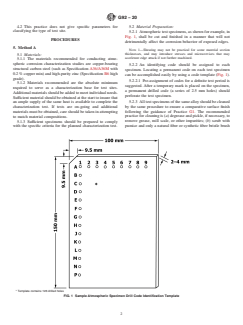
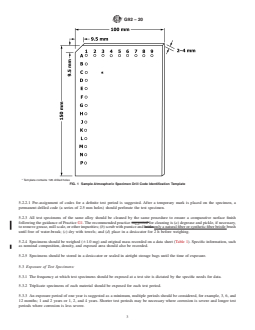
5.2.2 An identifying code should be assigned to each specimen. Locating a permanent code on each test specimen can be
accomplished easily by using a code template (Fig. 1).
G92 − 20
* Template contains 126 drilled holes
FIG. 1 Sample Atmospheric Specimen Drill Code Identification Template
5.2.2.1 Pre-assignment of codes for a definite test period is suggested. After a temporary mark is placed on the specimen, a
permanent drilled code (a series of 2.5 mm holes) should perforate the test specimen.
5.2.3 All test specimens of the same alloy should be cleaned by the same procedure to ensure a comparative surface finish
following the guidance of Practice G1. The recommended practice suggested for cleaning is (a) degrease and pickle, if necessary,
to remove grease, mill scale, or other impurities; (b) scrub with pumice and britle only a natural fiber or synthetic fiber bristle brush
until free of water-break; (c) dry with towels; and (d) place in a desiccator for 2 h before weighing.
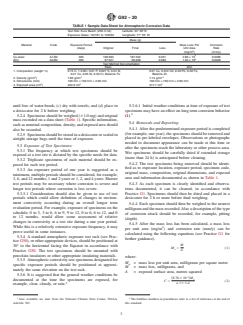
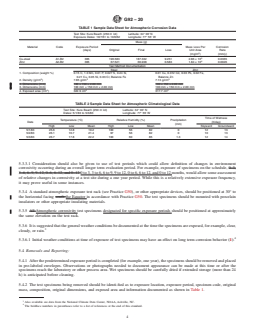
5.2.4 Specimens should be weighed (61.0 mg) and original mass recorded on a data sheet (Table 1). Specific information, such
as nominal composition, density, and exposed area should also be recorded.
5.2.5 Specimens should be stored in a desiccator or sealed in airtight storage bags until the time of exposure.
5.3 Exposure of Test Specimens:
5.3.1 The frequency at which test specimens should be exposed at a test site is dictated by the specific needs for data.
5.3.2 Triplicate specimens of each material should be exposed for each test period.
5.3.3 An exposure period of one year is suggested as a minimum, multiple periods should be considered, for example, 3, 6, and
12 months; 1 and 2 years or 1, 2, and 4 years. Shorter test periods may be necessary where corrosion is severe and longer test
periods where corrosion is less severe.
G92 − 20
TABLE 1 Sample Data Sheet for Atmospheric Corrosion Data
Test Site: Kure Beach (250 m lot) Latitude: 34° 00' N
Exposure Dates: 10/7/61 to 10/6/62 Longitude: 77° 55' W
Mass (g)
Material Code Exposure Period Mass Loss Per Corrosion
(days) Original Final Loss Unit Area Rate
(mg/m ) (mm/y)
Cu-steel A1-B2 365 196.583 187.332 9.251 2.86 × 10 0.0365
Zinc A2-B2 365 67.521 66.938 0.583 1.84 × 10 0.0026
Test Method Documentation
Steel Zinc
1. Composition (weight %) 0.15 C, 1.0 Mn, 0.01 P, 0.027 S, 0.24 Si, 0.01 Cu, 0.012 Cd, 0.03 Pb, 0.02 Fe,
0.21 Cu, 0.05 Ni, 0.03 Cr, Balance Fe Balance Zn
3 3 3
2. Density (g/cm ) 7.85 g/cm 7.13 g/cm
3. Dimensions (mm) 100 × 150 × 2.00 mm 100 × 150 × 2.00 mm
3. Dimensions (mm) 100 mm × 150 mm × 2.00 mm 100 mm × 150 mm × 2.00 mm
2 2 2
4. Exposed area (cm ) 322.9 cm 317.7 cm
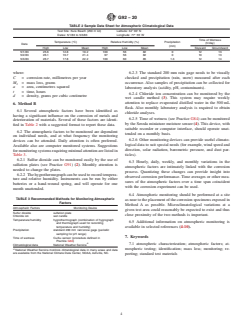
TABLE 2 Sample Data Sheet for Atmospheric Climatological Data
Test Site: Kure Beach (250 m lot) Latitude: 34° 00' N
Dates: 5/1/83 to 5/3/83 Longitude: 77° 55' W
Time of Wetness
Temperature (°C) Relative Humidity (%)
Precipitation
(h/day)
Date
(mm)
High Low Mean High Lo
...