

ASTM D5930-17
(Test Method)Standard Test Method for Thermal Conductivity of Plastics by Means of a Transient Line-Source Technique
General Information
- Abstract
SIGNIFICANCE AND USE
5.1 The relative simplicity of the test method makes it applicable for a wide range of materials (4, 5). The technique is capable of fast measurements, making it possible to take data before the materials suffer thermal degradation. Alternatively, it is possible to study the effect of compositional changes such as chemical reaction or aging (6). Short measurement times permit generation of large amounts of data with little effort. The line-source probe and the accompanying test specimen are small in size, making it possible to subject the sample to a wide range of test conditions. Because this test method does not contain a numerical precision and bias statement, it shall not be used as a referee test method in case of dispute.
SCOPE
1.1 This test method covers the determination of the thermal conductivity of plastics over a temperature range from –40 to 400°C. It is possible to measure the thermal conductivity of filled and unfilled thermoplastics, thermosets, and rubbers in the range from 0.08 to 2.0 W/m.K.
1.2 The values stated in SI units shall be regarded as standard.
1.3 This standard does not purport to address the safety concerns, if any, associated with its use. It is the responsibility of the user of this standard to establish proper safety and health practices and determine the applicability of regulatory limitations prior to use.
Note 1: There is no known ISO equivalent to this test method.
1.4 This international standard was developed in accordance with internationally recognized principles on standardization established in the Decision on Principles for the Development of International Standards, Guides and Recommendations issued by the World Trade Organization Technical Barriers to Trade (TBT) Committee.
- Status
- Published
- Publication Date
- 31-Jul-2017
- Technical Committee
- D20 - Plastics
- Drafting Committee
- D20.30 - Thermal Properties
Buy Documents
ASTM D5930-17 - Standard Test Method for Thermal Conductivity of Plastics by Means of a Transient Line-Source Technique
REDLINE ASTM D5930-17 - Standard Test Method for Thermal Conductivity of Plastics by Means of a Transient Line-Source Technique
Overview
ASTM D5930-17 is the Standard Test Method for Thermal Conductivity of Plastics by Means of a Transient Line-Source Technique, published by ASTM International. This standard outlines an efficient and practical procedure to measure the thermal conductivity of plastics-including thermoplastics, thermosets, and rubbers-using a transient line-source probe. Covering a broad temperature range from –40 to 400°C and thermal conductivities from 0.08 to 2.0 W/m·K, this method is valuable for assessing both filled and unfilled polymers rapidly, minimizing the risk of degradation during testing.
The transient line-source technique is distinguished by its speed, minimal sample size requirements, and adaptability to a wide range of material compositions and conditions. It is particularly well-suited for high-throughput measurements and studies into the effects of chemical changes, aging, or compositional variations on plastics.
Key Topics
- Thermal Conductivity Measurement: Assesses the material’s ability to conduct heat, a crucial property for many engineering and product applications.
- Transient Line-Source Technique: Employs a probe that serves as a linear heat source at the center of the specimen. The time-dependent temperature rise is used to calculate the thermal conductivity.
- Applicable Materials: Includes both filled and unfilled thermoplastics, thermosets, and rubbers. The method caters to a variety of sample types such as pellets, liquids, foams, and soft solids.
- Measurement Range: Suitable for a temperature span from –40°C to 400°C and a thermal conductivity range from 0.08 to 2.0 W/m·K.
- Fast Data Collection: The brief measurement time (typically 30-120 seconds per sample) allows accumulation of large datasets efficiently, essential for material development or quality assurance.
- Minimizing Thermal Degradation: Rapid measurements reduce the risk of the material undergoing unwanted chemical or physical changes during testing.
Applications
- Material Selection and Specification: Enables engineers and designers to choose the appropriate plastic material based on its thermal performance for applications such as insulation, electronics, and automotive components.
- Research and Development: Useful in studies on polymers to explore effects of additives, fillers, and processing on thermal conductivity.
- Quality Control in Manufacturing: Rapid testing method supports process monitoring and product verification across production batches.
- Aging and Degradation Studies: The technique allows the examination of how factors such as chemical reactions or aging impact the thermal properties of materials.
- Specialized Conditions: The compact probe and specimen size make it possible to perform tests under various controlled environments, including cryogenic or elevated temperatures.
Related Standards
ASTM D5930-17 references several related ASTM standards for thermal conductivity and conditioning of plastics:
- ASTM C177: Steady-State Heat Flux Measurements and Thermal Transmission Properties by Means of the Guarded-Hot-Plate Apparatus
- ASTM C518: Steady-State Thermal Transmission Properties by Means of the Heat Flow Meter Apparatus
- ASTM C1113: Thermal Conductivity of Refractories by Hot Wire (Platinum Resistance Thermometer Technique)
- ASTM D618: Conditioning Plastics for Testing
- ASTM D883: Terminology Relating to Plastics
- ASTM D2717: Thermal Conductivity of Liquids
- ASTM E177: Use of the Terms Precision and Bias in ASTM Test Methods
- ASTM E1225: Thermal Conductivity of Solids Using the Guarded-Comparative-Longitudinal Heat Flow Technique
Note: There is no ISO equivalent to ASTM D5930-17 as of the current publication.
Summary
ASTM D5930-17 provides a standardized, fast, and adaptable approach for determining the thermal conductivity of plastics using a transient line-source technique. It offers practical advantages for routine industrial quality checks, materials development, and research, delivering reliable data critical for thermal management applications in plastics. Compliance with this test method ensures consistent reporting and supports informed material selection based on thermal performance.
Relations
- Effective Date
- 01-Aug-2017
- Effective Date
- 01-Feb-2024
- Effective Date
- 01-Nov-2023
- Effective Date
- 01-Jan-2020
- Effective Date
- 01-Aug-2019
- Effective Date
- 15-Apr-2019
- Effective Date
- 01-Feb-2019
- Effective Date
- 01-Dec-2018
- Effective Date
- 01-Nov-2018
- Effective Date
- 15-Aug-2017
- Effective Date
- 01-Sep-2015
- Effective Date
- 01-May-2014
- Effective Date
- 01-May-2013
- Effective Date
- 15-Nov-2012
- Effective Date
- 15-May-2011
Buy Documents
ASTM D5930-17 - Standard Test Method for Thermal Conductivity of Plastics by Means of a Transient Line-Source Technique
REDLINE ASTM D5930-17 - Standard Test Method for Thermal Conductivity of Plastics by Means of a Transient Line-Source Technique
Get Certified
Connect with accredited certification bodies for this standard

DIN CERTCO
DIN Group product certification.

Smithers Quality Assessments
US management systems and product certification.
Sponsored listings
Frequently Asked Questions
ASTM D5930-17 is a standard published by ASTM International. Its full title is "Standard Test Method for Thermal Conductivity of Plastics by Means of a Transient Line-Source Technique". This standard covers: SIGNIFICANCE AND USE 5.1 The relative simplicity of the test method makes it applicable for a wide range of materials (4, 5). The technique is capable of fast measurements, making it possible to take data before the materials suffer thermal degradation. Alternatively, it is possible to study the effect of compositional changes such as chemical reaction or aging (6). Short measurement times permit generation of large amounts of data with little effort. The line-source probe and the accompanying test specimen are small in size, making it possible to subject the sample to a wide range of test conditions. Because this test method does not contain a numerical precision and bias statement, it shall not be used as a referee test method in case of dispute. SCOPE 1.1 This test method covers the determination of the thermal conductivity of plastics over a temperature range from –40 to 400°C. It is possible to measure the thermal conductivity of filled and unfilled thermoplastics, thermosets, and rubbers in the range from 0.08 to 2.0 W/m.K. 1.2 The values stated in SI units shall be regarded as standard. 1.3 This standard does not purport to address the safety concerns, if any, associated with its use. It is the responsibility of the user of this standard to establish proper safety and health practices and determine the applicability of regulatory limitations prior to use. Note 1: There is no known ISO equivalent to this test method. 1.4 This international standard was developed in accordance with internationally recognized principles on standardization established in the Decision on Principles for the Development of International Standards, Guides and Recommendations issued by the World Trade Organization Technical Barriers to Trade (TBT) Committee.
SIGNIFICANCE AND USE 5.1 The relative simplicity of the test method makes it applicable for a wide range of materials (4, 5). The technique is capable of fast measurements, making it possible to take data before the materials suffer thermal degradation. Alternatively, it is possible to study the effect of compositional changes such as chemical reaction or aging (6). Short measurement times permit generation of large amounts of data with little effort. The line-source probe and the accompanying test specimen are small in size, making it possible to subject the sample to a wide range of test conditions. Because this test method does not contain a numerical precision and bias statement, it shall not be used as a referee test method in case of dispute. SCOPE 1.1 This test method covers the determination of the thermal conductivity of plastics over a temperature range from –40 to 400°C. It is possible to measure the thermal conductivity of filled and unfilled thermoplastics, thermosets, and rubbers in the range from 0.08 to 2.0 W/m.K. 1.2 The values stated in SI units shall be regarded as standard. 1.3 This standard does not purport to address the safety concerns, if any, associated with its use. It is the responsibility of the user of this standard to establish proper safety and health practices and determine the applicability of regulatory limitations prior to use. Note 1: There is no known ISO equivalent to this test method. 1.4 This international standard was developed in accordance with internationally recognized principles on standardization established in the Decision on Principles for the Development of International Standards, Guides and Recommendations issued by the World Trade Organization Technical Barriers to Trade (TBT) Committee.
ASTM D5930-17 is classified under the following ICS (International Classification for Standards) categories: 83.080.20 - Thermoplastic materials. The ICS classification helps identify the subject area and facilitates finding related standards.
ASTM D5930-17 has the following relationships with other standards: It is inter standard links to ASTM D5930-16, ASTM D883-24, ASTM D883-23, ASTM D883-20, ASTM D883-19c, ASTM D883-19a, ASTM D883-19, ASTM D883-18a, ASTM D883-18, ASTM D883-17, ASTM C518-15, ASTM E177-14, ASTM E177-13, ASTM D883-12e1, ASTM D883-11. Understanding these relationships helps ensure you are using the most current and applicable version of the standard.
ASTM D5930-17 is available in PDF format for immediate download after purchase. The document can be added to your cart and obtained through the secure checkout process. Digital delivery ensures instant access to the complete standard document.
Standards Content (Sample)
This international standard was developed in accordance with internationally recognized principles on standardization established in the Decision on Principles for the
Development of International Standards, Guides and Recommendations issued by the World Trade Organization Technical Barriers to Trade (TBT) Committee.
Designation: D5930 − 17
Standard Test Method for
Thermal Conductivity of Plastics by Means of a Transient
Line-Source Technique
This standard is issued under the fixed designation D5930; the number immediately following the designation indicates the year of
original adoption or, in the case of revision, the year of last revision. A number in parentheses indicates the year of last reapproval. A
superscript epsilon (´) indicates an editorial change since the last revision or reapproval.
1. Scope D883 Terminology Relating to Plastics
D2717 Test Method for Thermal Conductivity of Liquids
1.1 Thistestmethodcoversthedeterminationofthethermal
E177 Practice for Use of the Terms Precision and Bias in
conductivity of plastics over a temperature range from –40 to
ASTM Test Methods
400°C. It is possible to measure the thermal conductivity of
E1225 Test Method for Thermal Conductivity of Solids
filled and unfilled thermoplastics, thermosets, and rubbers in
Using the Guarded-Comparative-Longitudinal Heat Flow
the range from 0.08 to 2.0 W/m.K.
Technique
1.2 The values stated in SI units shall be regarded as
standard.
3. Terminology
1.3 This standard does not purport to address the safety
3.1 Definitions—Terminology used in this standard is in
concerns, if any, associated with its use. It is the responsibility
accordance with Terminology D883.
of the user of this standard to establish proper safety and
3.2 Definitions of Terms Specific to This Standard:
health practices and determine the applicability of regulatory
3.2.1 temperature transient, n—the temperature rise associ-
limitations prior to use.
ated with the perturbation of a system, initially at a uniform
NOTE 1—There is no known ISO equivalent to this test method.
temperature. The system does not attain thermal equilibrium
1.4 This international standard was developed in accor-
during the transient.
dance with internationally recognized principles on standard-
3.2.2 thermal conductivity, n—the time rate of steady heat
ization established in the Decision on Principles for the
flow/unit area through unit thickness of a homogeneous mate-
Development of International Standards, Guides and Recom-
rialinadirectionperpendiculartothesurfaceinducedbyaunit
mendations issued by the World Trade Organization Technical
temperature difference.
Barriers to Trade (TBT) Committee.
3.2.2.1 Discussion—Where other modes of heat transfer are
present in addition to conduction, such as convection and
2. Referenced Documents
radiation, this property often is referred to as the apparent
2.1 ASTM Standards:
thermal conductivity, λ .
app
C177 Test Method for Steady-State Heat Flux Measure-
3.2.2.2 Discussion—Thermal conductivity must be associ-
ments and Thermal Transmission Properties by Means of
ated with the conditions under which it is measured, such as
the Guarded-Hot-Plate Apparatus
temperature and pressure, as well as the compositional varia-
C518 Test Method for Steady-State Thermal Transmission
tion of the material. It is possible that thermal conductivity will
Properties by Means of the Heat Flow Meter Apparatus
vary with direction and orientation of the specimen since some
C1113 Test Method for Thermal Conductivity of Refracto-
materialsarenotisotropicwithrespecttothermalconductivity.
ries by Hot Wire (Platinum Resistance Thermometer
In the case of thermoset polymers, it is possible that thermal
Technique)
conductivity will vary with the extent of cure.
D618 Practice for Conditioning Plastics for Testing
3.2.3 thermal diffusivity—a heat-transport property given by
the thermal conductivity divided by the thermal mass, which is
a product of the density and the heat capacity.
This test method is under the jurisdiction ofASTM Committee D20 on Plastics
and is the direct responsibility of Subcommittee D20.30 on Thermal Properties.
3.3 Symbols:
Current edition approved Aug. 1, 2017. Published August 2017. Originally
approved in 1997. Last previous edition approved in 2016 as D5930 - 16. DOI: 3.3.1 C—Probe constant.
10.1520/D5930-17.
3.3.2 λ—Thermal conductivity, W/m.K.
For referenced ASTM standards, visit the ASTM website, www.astm.org, or
contact ASTM Customer Service at service@astm.org. For Annual Book of ASTM
3.3.3 Q—Heat output per unit length, W/m.
Standards volume information, refer to the standard’s Document Summary page on
the ASTM website. 3.3.4 T —The temperature (K) recorded at time t .
2 2
*A Summary of Changes section appears at the end of this standard
Copyright © ASTM International, 100 Barr Harbor Drive, PO Box C700, West Conshohocken, PA 19428-2959. United States
D5930 − 17
3.3.5 T —The temperature (K) recorded at time t .
1 1
3.4 Subscript:
3.4.1 av—average.
3.4.2 app—apparent.
3.4.3 ref—reference.
4. Summary of Test Method
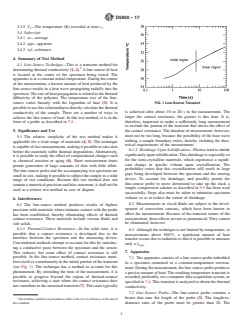
4.1 Line-Source Technique—This is a transient method for
determining thermal conductivity (1, 2). Aline source of heat
is located at the center of the specimen being tested. The
apparatus is at a constant initial temperature. During the course
of the measurement, a known amount of heat produced by the
line-source results in a heat wave propagating radially into the
specimen.The rate of heat propagation is related to the thermal
diffusivity of the polymer. The temperature rise of the line-
source varies linearly with the logarithm of time (3).Itis FIG. 1 Line-Source Transient
possibletousethisrelationshiptodirectlycalculatethethermal
is achieved after about 10 to 20 s in the measurement. The
conductivity of the sample. There are a number of ways to
larger the contact resistance, the greater is this time. It is,
achieve the line source of heat. In this test method, it is in the
therefore, important to make a sufficiently long measurement
form of a probe as described in 7.2.
to exclude the portion of the transient that shows the effect of
5. Significance and Use the contact resistance. The duration of measurement, however,
must not be too long, because the possibility of the heat wave
5.1 The relative simplicity of the test method makes it
striking a sample boundary exists, thereby violating the theo-
applicable for a wide range of materials (4, 5). The technique
retical requirements of the measurement.
iscapableoffastmeasurements,makingitpossibletotakedata
6.1.2 Shrinkage Upon Solidification—Plastics tend to shrink
before the materials suffer thermal degradation. Alternatively,
significantlyuponsolidification.Thisshrinkageisespeciallyso
it is possible to study the effect of compositional changes such
for the semi-crystalline materials, which experience a signifi-
as chemical reaction or aging (6). Short measurement times
cant change in specific volume upon crystallization. The
permit generation of large amounts of data with little effort.
probability exists that this crystallization will result in large
The line-source probe and the accompanying test specimen are
gaps being developed between the specimen and the sensing
smallinsize,makingitpossibletosubjectthesampletoawide
device. To account for shrinkage, and possibly permit the
range of test conditions. Because this test method does not
line-source probe to move downward to take up the slack a
containanumericalprecisionandbiasstatement,itshallnotbe
simple compression scheme as described in 9.5 has been used
used as a referee test method in case of dispute.
successfully. Steps also must be taken to minimize specimen
volume so as to reduce the extent of shrinkage.
6. Interferences
6.2 Measurements in viscid fluids are subject to the devel-
6.1 The line-source method produces results of highest
opment of convection currents, which have been known to
precision with materials where intimate contact with the probe
affect the measurement. Because of the transient nature of the
has been established, thereby eliminating effects of thermal
measurement, these effects are not as pronounced.They cannot
contact resistance. These materials include viscous fluids and
be eliminated, however.
soft solids.
6.1.1 Thermal-Contact Resistance—In the solid state, it is
6.3 Although the technique is not limited by temperature, at
possible that a contact resistance is developed due to the
measurements above 500°C, a significant amount of heat
interface between the specimen and the measuring device.
transfer occurs due to radiation so that it is possible to measure
Conventional methods attempt to account for this by introduc-
only a λ .
app
ing a conductive paste between the specimen and the sensor.
7. Apparatus
This reduces, but some effect of contact resistance is still
possible. In the line-source method, contact resistance mani-
7.1 The apparatus consists of a line-source probe imbedded
festsitselfasanonlinearityintheinitialportionofthetransient
in a specimen contained in a constant-temperature environ-
(see Fig. 1). The technique has a method to account for this
ment. During the measurement, the line-source probe produces
phenomenon. By extending the time of the measurement, it is
a precise amount of heat.The resulting temperature transient is
possible to progress beyond the region of thermal-contact
recorded, preferably, on a computer data-acquisition system, as
resistance, achieving a state where the contact resistance does
specifiedin7.4.Thistransientisanalyzedtoobtainthethermal
notcontributetothemeasuredtransient (7).Thisstatetypically
conductivity.
7.2 Line-Source Probe—The line-source probe contains a
heater that runs the length of the probe (3). The length-to-
The boldface numbers in parentheses refer to the list of references at the end of
this standard. diameter ratio of the probe must be greater than 20. The
D5930 − 17
resistance of the line-source heater must be known to within 7.5.3 Elevated Temperatures—At temperatures above
60.1 %. The probe also contains a temperature sensor to ambient, a special heated cell is required. This consists of a
measure the temperature transient. A typical sensor for the vertical cylindrical heated chamber, fitted with a removable
line-source probe is a high-sensitivity J-type thermocouple plug at the bottom. The specimen is loaded from the top and is
used because of its large Seebeck coefficient. The housing discharged through the bottom, once the test is complete (see
sheath of the probe must be robust enough to ensure that the Fig. 2).
probe does not bend or deform under the adverse conditions it
is subject to during measurements. 8. Conditioning
7.3 Heater Power Source—The power input to the line-
8.1 Many thermoplastic materials must be dried because
source heater comes from a DC voltage source. The precision
moisture has been shown to affect the properties. Moisture
of the voltage source must be within 60.25 % over the entire
causes molten polymer samples to foam, which will affect the
duration of the test.
measured thermal conductivity. Conditioning is generally not a
requirement of this test; if conditioning is necessary, see the
7.4 Recording Device—The temperature transient from the
applicable material specification or Practice D618.
line-source probe is recorded for the duration of the test. A
temperature measurement device with a resolution of 0.1°C is
9. Preparation of Test Specimen
required. Data are acquired for 30 to 120 s depending on the
type of material. Typical temperature rises are between 2 and
9.1 The test specimen prepared from plastic pellets, liquids,
10°C over the duration of the measurement. The frequency of
foams, or soft solids is acceptable. The specimen-preparation
data acquisition must be at least once every second.
method depends on the type of material being tested. If the
7.5 Specimen Environment—A constant-temperature envi- material is believed to be anisotropic, at least three specimens
must be tested. Specimens must be longer than the line-source
ronment must be maintained through the duration of the test so
as to provide a temperature stability in the specimen of within probe and large enough in radius to have at least 4 mm of
material surroun
...
This document is not an ASTM standard and is intended only to provide the user of an ASTM standard an indication of what changes have been made to the previous version. Because
it may not be technically possible to adequately depict all changes accurately, ASTM recommends that users consult prior editions as appropriate. In all cases only the current version
of the standard as published by ASTM is to be considered the official document.
Designation: D5930 − 16 D5930 − 17
Standard Test Method for
Thermal Conductivity of Plastics by Means of a Transient
Line-Source Technique
This standard is issued under the fixed designation D5930; the number immediately following the designation indicates the year of
original adoption or, in the case of revision, the year of last revision. A number in parentheses indicates the year of last reapproval. A
superscript epsilon (´) indicates an editorial change since the last revision or reapproval.
1. Scope
1.1 This test method covers the determination of the thermal conductivity of plastics over a temperature range from –40 to
400°C. It is possible to measure the thermal conductivity of materials filled and unfilled thermoplastics, thermosets, and rubbers
in the range from 0.08 to 2.0 W/m.K covering thermoplastics, thermosets, and rubbers, filled and reinforced.W/m.K.
1.2 The values stated in SI units shall be regarded as standard.
1.3 This standard does not purport to address the safety concerns, if any, associated with its use. It is the responsibility of the
user of this standard to establish proper safety and health practices and determine the applicability of regulatory limitations prior
to use.
NOTE 1—There is no known ISO equivalent to this test method.
1.4 This international standard was developed in accordance with internationally recognized principles on standardization
established in the Decision on Principles for the Development of International Standards, Guides and Recommendations issued
by the World Trade Organization Technical Barriers to Trade (TBT) Committee.
2. Referenced Documents
2.1 ASTM Standards:
C177 Test Method for Steady-State Heat Flux Measurements and Thermal Transmission Properties by Means of the
Guarded-Hot-Plate Apparatus
C518 Test Method for Steady-State Thermal Transmission Properties by Means of the Heat Flow Meter Apparatus
C1113 Test Method for Thermal Conductivity of Refractories by Hot Wire (Platinum Resistance Thermometer Technique)
D618 Practice for Conditioning Plastics for Testing
D883 Terminology Relating to Plastics
D2717 Test Method for Thermal Conductivity of Liquids
E177 Practice for Use of the Terms Precision and Bias in ASTM Test Methods
E1225 Test Method for Thermal Conductivity of Solids Using the Guarded-Comparative-Longitudinal Heat Flow Technique
3. Terminology
3.1 Definitions—Terminology used in this standard is in accordance with Terminology D883.
3.2 Definitions of Terms Specific to This Standard:
3.2.1 temperature transient, n—the temperature rise associated with the perturbation of a system, initially at a uniform
temperature. The system does not attain thermal equilibrium during the transient.
3.2.2 thermal conductivity, n—the time rate of steady heat flow/unit area through unit thickness of a homogeneous material in
a direction perpendicular to the surface induced by a unit temperature difference.
This test method is under the jurisdiction of ASTM Committee D20 on Plastics and is the direct responsibility of Subcommittee D20.30 on Thermal Properties.
Current edition approved Sept. 1, 2016Aug. 1, 2017. Published September 2016August 2017. Originally approved in 1997. Last previous edition approved in 20092016
as D5930 - 09.D5930 - 16. DOI: 10.1520/D5930-16.10.1520/D5930-17.
For referenced ASTM standards, visit the ASTM website, www.astm.org, or contact ASTM Customer Service at service@astm.org. For Annual Book of ASTM Standards
volume information, refer to the standard’s Document Summary page on the ASTM website.
3.2.2.1 Discussion—
*A Summary of Changes section appears at the end of this standard
Copyright © ASTM International, 100 Barr Harbor Drive, PO Box C700, West Conshohocken, PA 19428-2959. United States
D5930 − 17
Where other modes of heat transfer are present in addition to conduction, such as convection and radiation, this property often is
referred to as the apparent thermal conductivity, λ .
app
3.2.2.2 Discussion—
Thermal conductivity must be associated with the conditions under which it is measured, such as temperature and pressure, as well
as the compositional variation of the material. It is possible that thermal conductivity will vary with direction and orientation of
the specimen since some materials are not isotropic with respect to thermal conductivity. In the case of thermoset polymers, it is
possible that thermal conductivity will vary with the extent of cure.
3.2.3 thermal diffusivity—a heat-transport property given by the thermal conductivity divided by the thermal mass, which is a
product of the density and the heat capacity.
3.3 Symbols:
3.3.1 C—Probe constant.
3.3.2 λ—Thermal conductivity, W/m.K.
3.3.3 Q—Heat output per unit length, W/m.
3.3.4 T —The temperature (K) recorded at time t .
2 2
3.3.5 T —The temperature (K) recorded at time t .
1 1
3.4 Subscript:
3.4.1 av—average.
3.4.2 app—apparent.
3.4.3 ref—reference.
4. Summary of Test Method
4.1 Line-Source Technique—This is a transient method for determining thermal conductivity (1, 2). A line source of heat is
located at the center of the specimen being tested. The apparatus is at a constant initial temperature. During the course of the
measurement, a known amount of heat produced by the line-source results in a heat wave propagating radially into the specimen.
The rate of heat propagation is related to the thermal diffusivity of the polymer. The temperature rise of the line-source varies
linearly with the logarithm of time (3). It is possible to use this relationship to directly calculate the thermal conductivity of the
sample. There are a number of ways to achieve the line source of heat. In this test method, it is in the form of a probe as described
in 7.2.
5. Significance and Use
5.1 The relative simplicity of the test method makes it applicable for a wide range of materials (4, 5). The technique is capable
of fast measurements, making it possible to take data before the materials suffer thermal degradation. Alternatively, it is possible
to study the effect of compositional changes such as chemical reaction or aging (6). Short measurement times permit generation
of large amounts of data with little effort. The line-source probe and the accompanying test specimen are small in size, making
it possible to subject the sample to a wide range of test conditions. Because this test method does not contain a numerical precision
and bias statement, it shall not be used as a referee test method in case of dispute.
6. Interferences
6.1 The line-source method produces results of highest precision with materials where intimate contact with the probe has been
established, thereby eliminating effects of thermal contact resistance. These materials include viscous fluids and soft solids.
6.1.1 Thermal-Contact Resistance—In the solid state, it is possible that a contact resistance is developed due to the interface
between the specimen and the measuring device. Conventional methods attempt to account for this by introducing a conductive
paste between the specimen and the sensor. This reduces, but some effect of contact resistance is still possible. In the line-source
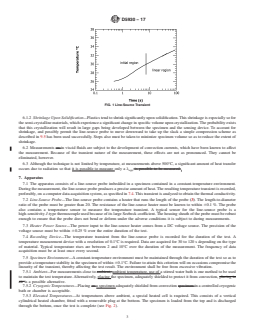
method, contact resistance manifests itself as a nonlinearity in the initial portion of the transient (see Fig. 1). The technique has
a method to account for this phenomenon. By extending the time of the measurement, it is possible to progress beyond the region
of thermal-contact resistance, achieving a state where the contact resistance does not contribute to the measured transient (7). This
state typically is achieved after about 10 to 20 s in the measurement. The larger the contact resistance, the greater is this time. It
is, therefore, important to make a sufficiently long measurement to exclude the portion of the transient that shows the effect of the
contact resistance. The duration of measurement, however, must not be too long, or else the because the possibility of the heat wave
striking a sample boundary exists, thereby violating the theoretical conditionsrequirements of the measurement.
The boldface numbers in parentheses refer to the list of references at the end of this standard.
D5930 − 17
FIG. 1 Line-Source Transient
6.1.2 Shrinkage Upon Solidification—Plastics tend to shrink significantly upon solidification. This shrinkage is especially so for
the semi-crystalline materials, which experience a significant change in specific volume upon crystallization. The probability exists
that this crystallization will result in large gaps being developed between the specimen and the sensing device. To account for
shrinkage, and possibly permit the line-source probe to move downward to take up the slack a simple compression scheme as
described in 9.5 has been used successfully. Steps also must be taken to minimize specimen volume so as to reduce the extent of
shrinkage.
6.2 Measurements on in viscid fluids are subject to the development of convection currents, which have been known to affect
the measurement. Because of the transient nature of the measurement, these effects are not as pronounced. They cannot be
eliminated, however.
6.3 Although the technique is not limited by temperature, at measurements above 500°C, a significant amount of heat transfer
occurs due to radiation so that it is possible to measure only a λ is possible to be measured.
app
7. Apparatus
7.1 The apparatus consists of a line-source probe imbedded in a specimen contained in a constant-temperature environment.
During the measurement, the line-source probe produces a precise amount of heat. The resulting temperature transient is recorded,
preferably, on a computer data-acquisition system, as specified in 7.4. This transient is analyzed to obtain the thermal conductivity.
7.2 Line-Source Probe—The line-source probe contains a heater that runs the length of the probe (3). The length-to-diameter
ratio of the probe must be greater than 20. The resistance of the line-source heater must be known to within 60.1 %. The probe
also contains a temperature sensor to measure the temperature transient. A typical sensor for the line-source probe is a
high-sensitivity J-type thermocouple used because of its large Seebeck coefficient. The housing sheath of the probe must be robust
enough to ensure that the probe does not bend or deform under the adverse conditions it is subject to during measurements.
7.3 Heater Power Source—The power input to the line-source heater comes from a DC voltage source. The precision of the
voltage source must be within 60.25 % over the entire duration of the test.
7.4 Recording Device—The temperature transient from the line-source probe is recorded for the duration of the test. A
temperature measurement device with a resolution of 0.1°C is required. Data are acquired for 30 to 120 s depending on the type
of material. Typical temperature rises are between 2 and 10°C over the duration of the measurement. The frequency of data
acquisition must be at least once every second.
7.5 Specimen Environment—A constant-temperature environment must be maintained through the duration of the test so as to
provide a temperature stability in the specimen of within 60.1°C. Failure to attain this criterion will on occasions compromise the
linearity of the transient, thereby affecting the test result. The environment shall be free from excessive vibration.
7.5.1 Ambient—For measurements close to ambient, ambient temperature, use of a stirred water bath is one method to be used
to maintain the test temperature. Alternatively, placing the specimen, adequately shielded to protect it from convection, placing in
air is a possible alternative.
7.5.2 Cryogenic Temperatures—Placing an a specimen adequately shielded from convection specimen in a controlled cryogenic
bath or chamber is acceptable.
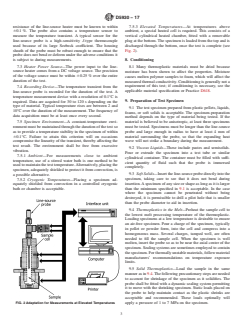
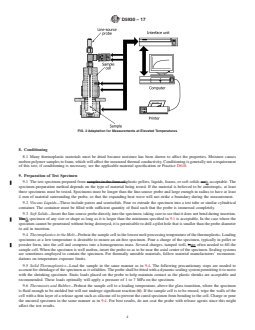
7.5.3 Elevated Temperatures—At temperatures above ambient, a special heated cell is required. This consists of a vertical
cylindrical heated chamber, fitted with a removable plug at the bottom. The specimen is loaded from the top and is discharged
through the bottom, once the test is complete (see Fig. 2).
D5930 − 17
FIG. 2 Adaptatio
...