

ASTM D2854-09(2019)
(Test Method)Standard Test Method for Apparent Density of Activated Carbon
General Information
- Abstract
SIGNIFICANCE AND USE
4.1 This test method provides a method for determining the packed density of a bed of granular activated carbon. Determination of the packed density is essential when designing vessels to hold the material and for ordering purposes when procuring materials to fill existing vessels.
SCOPE
1.1 This test method covers the determination of the apparent density of granular activated carbon. For purposes of this test method, granular activated carbon is defined as a minimum of 90 % being larger than 80 mesh.
1.2 The values stated in SI units are to be regarded as standard. No other units of measurement are included in this standard.
1.3 This standard does not purport to address all of the safety concerns, if any, associated with its use. It is the responsibility of the user of this standard to establish appropriate safety, health, and environmental practices and determine the applicability of regulatory limitations prior to use.
1.4 This international standard was developed in accordance with internationally recognized principles on standardization established in the Decision on Principles for the Development of International Standards, Guides and Recommendations issued by the World Trade Organization Technical Barriers to Trade (TBT) Committee.
- Status
- Published
- Publication Date
- 31-Aug-2019
- Technical Committee
- D28 - Activated Carbon
- Drafting Committee
- D28.04 - Gas Phase Evaluation Tests


Overview
ASTM D2854-09(2019), Standard Test Method for Apparent Density of Activated Carbon, is an internationally recognized ASTM standard that specifies procedures for determining the apparent (packed) density of granular activated carbon. Apparent or bulk density is a critical property for operational, procurement, and design purposes, directly impacting vessel sizing, material ordering, and system performance. This standard is essential for industries that require consistent performance and reliable quality when using granular activated carbon in various filtration, purification, and treatment applications.
Key Topics
- Apparent Density Determination: The test method measures the density of granular activated carbon packed by a free fall from a vibrating feeder into a specified graduated cylinder. Only SI units are considered standard within this method.
- Granular Activated Carbon Definition: The method applies to materials where at least 90% of the carbon is larger than 80 mesh.
- Sample Handling: Proper sample selection and handling, as well as adherence to procedures for sample transfer and weighing, are required to obtain reliable data.
- Measurement and Calculation: The carbon is added to a graduated cylinder using specific equipment, and its mass and packed volume are used to calculate both as-received and dry-basis densities.
- Precision and Reproducibility: The standard provides information regarding the expected repeatability within a laboratory, as well as the reproducibility between different laboratories.
- Reporting Requirements: Reports must include full sample identification, apparatus details, measured values (including moisture content), and all relevant testing conditions.
Applications
- Vessel and Equipment Design: Understanding the apparent density of activated carbon allows engineers to accurately design vessels, beds, and containers, ensuring proper fit and efficient use of materials.
- Material Procurement and Inventory: Accurate density information is essential for ordering the correct amount of granular activated carbon, preventing shortages or overfilling of existing vessels.
- Quality Assurance: Regular density testing using this standardized method provides consistent data for quality control, ensuring that material from different batches or suppliers meets operational requirements.
- Industrial Water and Air Treatment: Facilities that use granular activated carbon for purification processes rely on precise density measurements to optimize filter performance and material lifespan.
- Research and Development: Laboratories and R&D teams utilize this test method to assess and compare various types and brands of activated carbon for product development and application suitability.
Related Standards
- ASTM D2862: Test Method for Particle Size Distribution of Granular Activated Carbon - Defines particle size characteristics relevant to density and performance.
- ASTM D2867: Test Methods for Moisture in Activated Carbon - Addresses determination of moisture, a key factor in calculating dry basis density.
- ASTM E177: Practice for Use of the Terms Precision and Bias in ASTM Test Methods - Provides statistical guidelines for interpreting measurement data.
- ASTM E300: Practice for Sampling Industrial Chemicals - Ensures representative sampling techniques.
- ASTM E542: Practice for Calibration of Laboratory Volumetric Apparatus - Describes calibration procedures for accurate volume measurements.
By aligning with ASTM D2854-09(2019), organizations ensure global best practices in determining the apparent density of granular activated carbon, supporting efficient system designs, reliable procurement, and robust quality control throughout water treatment, air purification, and industrial processing sectors. This standard is widely referenced in technical procurement specifications and helps maintain consistency and reliability across projects and applications.
Relations
- Effective Date
- 01-May-2014
- Effective Date
- 01-May-2013
- Effective Date
- 01-Oct-2010
- Effective Date
- 01-Nov-2009
- Effective Date
- 01-Sep-2009
- Effective Date
- 01-Sep-2009
- Effective Date
- 01-Oct-2008
- Effective Date
- 01-Nov-2007
- Refers
ASTM E177-06b - Standard Practice for Use of the Terms Precision and Bias in ASTM Test Methods - Effective Date
- 15-Nov-2006
- Refers
ASTM E177-06a - Standard Practice for Use of the Terms Precision and Bias in ASTM Test Methods - Effective Date
- 01-Nov-2006
- Effective Date
- 01-Nov-2004
- Effective Date
- 01-Nov-2004
- Refers
ASTM E177-04e1 - Standard Practice for Use of the Terms Precision and Bias in ASTM Test Methods - Effective Date
- 01-Nov-2004
- Effective Date
- 01-Apr-2004
- Effective Date
- 01-Apr-2004
Get Certified
Connect with accredited certification bodies for this standard

ECOCERT
Organic and sustainability certification.

Eurofins Food Testing Global
Global leader in food, environment, and pharmaceutical product testing.

Intertek Bangladesh
Intertek certification and testing services in Bangladesh.
Sponsored listings
Frequently Asked Questions
ASTM D2854-09(2019) is a standard published by ASTM International. Its full title is "Standard Test Method for Apparent Density of Activated Carbon". This standard covers: SIGNIFICANCE AND USE 4.1 This test method provides a method for determining the packed density of a bed of granular activated carbon. Determination of the packed density is essential when designing vessels to hold the material and for ordering purposes when procuring materials to fill existing vessels. SCOPE 1.1 This test method covers the determination of the apparent density of granular activated carbon. For purposes of this test method, granular activated carbon is defined as a minimum of 90 % being larger than 80 mesh. 1.2 The values stated in SI units are to be regarded as standard. No other units of measurement are included in this standard. 1.3 This standard does not purport to address all of the safety concerns, if any, associated with its use. It is the responsibility of the user of this standard to establish appropriate safety, health, and environmental practices and determine the applicability of regulatory limitations prior to use. 1.4 This international standard was developed in accordance with internationally recognized principles on standardization established in the Decision on Principles for the Development of International Standards, Guides and Recommendations issued by the World Trade Organization Technical Barriers to Trade (TBT) Committee.
SIGNIFICANCE AND USE 4.1 This test method provides a method for determining the packed density of a bed of granular activated carbon. Determination of the packed density is essential when designing vessels to hold the material and for ordering purposes when procuring materials to fill existing vessels. SCOPE 1.1 This test method covers the determination of the apparent density of granular activated carbon. For purposes of this test method, granular activated carbon is defined as a minimum of 90 % being larger than 80 mesh. 1.2 The values stated in SI units are to be regarded as standard. No other units of measurement are included in this standard. 1.3 This standard does not purport to address all of the safety concerns, if any, associated with its use. It is the responsibility of the user of this standard to establish appropriate safety, health, and environmental practices and determine the applicability of regulatory limitations prior to use. 1.4 This international standard was developed in accordance with internationally recognized principles on standardization established in the Decision on Principles for the Development of International Standards, Guides and Recommendations issued by the World Trade Organization Technical Barriers to Trade (TBT) Committee.
ASTM D2854-09(2019) is classified under the following ICS (International Classification for Standards) categories: 71.040.30 - Chemical reagents. The ICS classification helps identify the subject area and facilitates finding related standards.
ASTM D2854-09(2019) has the following relationships with other standards: It is inter standard links to ASTM E177-14, ASTM E177-13, ASTM E177-10, ASTM D2867-09, ASTM D2862-97(2009)e1, ASTM D2862-97(2009), ASTM E177-08, ASTM E542-01(2007), ASTM E177-06b, ASTM E177-06a, ASTM E177-04, ASTM E177-06, ASTM E177-04e1, ASTM D2862-97(2004), ASTM D2867-04. Understanding these relationships helps ensure you are using the most current and applicable version of the standard.
ASTM D2854-09(2019) is available in PDF format for immediate download after purchase. The document can be added to your cart and obtained through the secure checkout process. Digital delivery ensures instant access to the complete standard document.
Standards Content (Sample)
This international standard was developed in accordance with internationally recognized principles on standardization established in the Decision on Principles for the
Development of International Standards, Guides and Recommendations issued by the World Trade Organization Technical Barriers to Trade (TBT) Committee.
Designation: D2854 − 09 (Reapproved 2019)
Standard Test Method for
Apparent Density of Activated Carbon
This standard is issued under the fixed designation D2854; the number immediately following the designation indicates the year of
original adoption or, in the case of revision, the year of last revision. A number in parentheses indicates the year of last reapproval. A
superscript epsilon (´) indicates an editorial change since the last revision or reapproval.
This standard has been approved for use by agencies of the U.S. Department of Defense.
1. Scope 3. Summary of Test Method
3.1 Apparent density (bulk density) is determined on a
1.1 This test method covers the determination of the appar-
granular sample by measuring the volume packed by a free fall
ent density of granular activated carbon. For purposes of this
from a vibrating feeder into an appropriately sized graduated
test method, granular activated carbon is defined as a minimum
cylinder and determining the mass of the known volume. Other
of 90 % being larger than 80 mesh.
methods for determining apparent density of granular or
1.2 The values stated in SI units are to be regarded as
powdered materials exist. These may involve vibration or
standard. No other units of measurement are included in this
tapping of the receiving vessel either while it is being filled or
standard.
afterwards. Application of these methods to granular activated
carbon may give packed density values that differ from those
1.3 This standard does not purport to address all of the
determined by this test method.
safety concerns, if any, associated with its use. It is the
responsibility of the user of this standard to establish appro-
4. Significance and Use
priate safety, health, and environmental practices and deter-
4.1 This test method provides a method for determining the
mine the applicability of regulatory limitations prior to use.
packed density of a bed of granular activated carbon. Deter-
1.4 This international standard was developed in accor-
mination of the packed density is essential when designing
dance with internationally recognized principles on standard-
vessels to hold the material and for ordering purposes when
ization established in the Decision on Principles for the
procuring materials to fill existing vessels.
Development of International Standards, Guides and Recom-
mendations issued by the World Trade Organization Technical
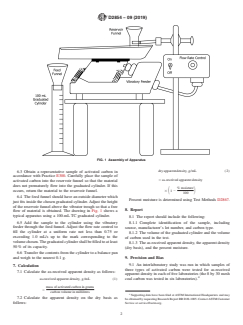
5. Apparatus (see Fig. 1)
Barriers to Trade (TBT) Committee.
5.1 Reservoir Funnel, fabricated of glass or metal.
2. Referenced Documents
5.2 Feed Funnel, glass or metal.
2.1 ASTM Standards: 5.3 Vibratory Feeder, such as shown in Fig. 1 or similar.
D2862 Test Method for Particle Size Distribution of Granu-
5.4 Cylinders,graduated100,250,or500mL,calibrated“to
lar Activated Carbon
contain” (TC).
D2867 Test Methods for Moisture in Activated Carbon
5.5 Balance, having a sensitivity of 0.1 g or better.
E177 Practice for Use of the Terms Precision and Bias in
ASTM Test Methods
6. Procedure
E300 Practice for Sampling Industrial Chemicals
6.1 Select a 100, 250, or 500-mL graduated cylinder appro-
E542 Practice for Calibration of Laboratory Volumetric
priate for the particle size of the activated carbon to be tested.
Apparatus
The inside diameter of the cylinder shall be at least ten times
the mean particle diameter (MPD) as determined by Test
Method D2862.
This test method is under the jurisdiction of ASTM Committee D28 on
Activated Carbon and is the direct responsibility of Subcommittee D28.04 on Gas 6.2 If desired, the graduated cylinder may be calibrated by
Phase Evaluation Tests.
the user in accordance with Practice E542.
Current edition approved Sept. 1, 2019. Published September 2019. Originally
approved in 1970. Last previous edition approved in 2014 as D2854 – 09 (2014).
DOI: 10.1520/D2854-09R19.
2 3
For referenced ASTM standards, visit the ASTM website, www.astm.org, or A suitable vibratory feeder is the model F-TO vibrating feeder with standard
contact ASTM Customer Service at service@astm.org. For Annual Book of ASTM trough 1 ⁄2 by 12 in. and controller. This unit is available from FMC Corporation,
Standards volume information, refer to the standard’s Document Summary page on Material Handling Equipment Division, 57 Cooper Ave., Homer City, PA 15748.
the ASTM website. Similar equipment is available from other suppliers.
Copyright © ASTM International, 100 Barr Harbor Drive, PO Box C700, West Conshohocke
...