

ASTM D8176-18(2023)
(Test Method)Standard Test Method for Mechanically Tapped Density of Activated Carbon (Powdered and Fine Mesh)
General Information
- Abstract
SIGNIFICANCE AND USE
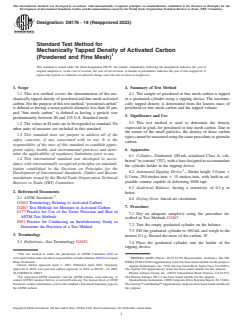
5.1 This test method is used to determine the density expressed in g/mL for powdered or fine mesh carbon. Due to the nature of the small particles, the density of these carbon types cannot be measured using the same procedure as granular carbon.
SCOPE
1.1 This test method covers the determination of the mechanically tapped density of powdered and fine mesh activated carbon. For the purpose of this test method, “powdered carbon” is defined as having a mean particle diameter less than 45 µm, and “fine mesh carbon” is defined as having a particle size predominately between 80 and 325 U.S. Standard mesh.
1.2 The values in SI units are to be regarded as standard. No other units of measure are included in this standard.
1.3 This standard does not purport to address all of the safety concerns, if any, associated with its use. It is the responsibility of the user of this standard to establish appropriate safety, health, and environmental practices and determine the applicability of regulatory limitations prior to use.
1.4 This international standard was developed in accordance with internationally recognized principles on standardization established in the Decision on Principles for the Development of International Standards, Guides and Recommendations issued by the World Trade Organization Technical Barriers to Trade (TBT) Committee.
- Status
- Published
- Publication Date
- 31-Mar-2023
- Technical Committee
- D28 - Activated Carbon
- Drafting Committee
- D28.02 - Liquid Phase Evaluation


Overview
ASTM D8176-18(2023) is a standard test method developed by ASTM International for determining the mechanically tapped density of activated carbon in powdered and fine mesh forms. This test method is essential for industries requiring precise measurements of activated carbon density, expressed in grams per milliliter (g/mL). The method specifically addresses the challenges posed by the fine particle sizes of powdered (mean diameter less than 45 µm) and fine mesh (predominant size between 80 and 325 U.S. Standard mesh) activated carbons, which cannot be accurately measured using the same techniques as granular carbons.
Key Topics
- Mechanically Tapped Density: The core of the standard is the procedure for determining the density after mechanically tapping a sample of activated carbon in a graduated cylinder. The final value reflects the packing efficiency and true density of the fine particles.
- Apparatus and Procedure: Key equipment includes a serialized 100-mL Class A graduated cylinder, an automated tapping device capable of delivering consistent taps, and an analytical balance with a 0.1 g sensitivity. The method calls for repeated cycles of tapping and volume measurement until no further compaction is observed.
- Precision and Repeatability: ASTM D8176 provides data and guidance on assessing repeatability (same operator, same apparatus) and reproducibility (different operators and labs). The standard includes established statistical limits to help users gauge test reliability.
- Safety and Units: The method uses SI units exclusively and emphasizes the responsibility of users to observe appropriate safety, health, and environmental practices.
Applications
Implementing ASTM D8176-18(2023) is critical for a variety of applications involving powdered and fine mesh activated carbon, such as:
- Quality Control: Ensuring consistency and quality in the production and supply of activated carbon materials used in water and air purification, food processing, and pharmaceuticals.
- Research and Development: Supporting consistent, repeatable data on the density of activated carbon for characterization and comparison of new materials.
- Specification Compliance: Assisting manufacturers and suppliers in meeting material specifications and regulatory requirements by providing a universally recognized method for density determination.
- Process Optimization: Enabling process engineers to optimize dosing, blending, and transport of fine carbon materials based on accurate tapped density measurements.
Related Standards
For comprehensive characterization and testing of activated carbons, the following related ASTM standards are often used in conjunction with ASTM D8176:
- ASTM D2652: Terminology Relating to Activated Carbon, providing definitions and clarifications used throughout standards in this area.
- ASTM D2867: Test Methods for Moisture in Activated Carbon, essential for preparing samples before density testing.
- ASTM E177: Practice for Use of the Terms Precision and Bias in ASTM Test Methods, applied to ensure consistency and clarity in data evaluation.
- ASTM E691: Practice for Conducting an Interlaboratory Study to Determine the Precision of a Test Method.
Practical Value
Adopting ASTM D8176-18(2023) ensures reliable, consistent determination of the mechanically tapped density of activated carbon powders and fine mesh grades. This standard supports industries in product development, certification, and quality assurance, reinforcing trust in material performance and supply chain consistency. By following this internationally recognized method, organizations can improve efficiency, reduce testing variability, and align with global best practices for activated carbon density measurement.
Relations
- Effective Date
- 01-May-2014
- Effective Date
- 01-May-2013
- Effective Date
- 01-May-2013
- Effective Date
- 01-Nov-2011
- Effective Date
- 15-Jun-2011
- Effective Date
- 01-Oct-2010
- Effective Date
- 01-Nov-2009
- Effective Date
- 01-Oct-2008
- Effective Date
- 01-Oct-2008
- Refers
ASTM E177-06b - Standard Practice for Use of the Terms Precision and Bias in ASTM Test Methods - Effective Date
- 15-Nov-2006
- Refers
ASTM E177-06a - Standard Practice for Use of the Terms Precision and Bias in ASTM Test Methods - Effective Date
- 01-Nov-2006
- Effective Date
- 01-Nov-2005
- Effective Date
- 01-Jul-2005
- Effective Date
- 01-Jun-2005
- Effective Date
- 01-Nov-2004
Get Certified
Connect with accredited certification bodies for this standard

ECOCERT
Organic and sustainability certification.

Eurofins Food Testing Global
Global leader in food, environment, and pharmaceutical product testing.

Intertek Bangladesh
Intertek certification and testing services in Bangladesh.
Sponsored listings
Frequently Asked Questions
ASTM D8176-18(2023) is a standard published by ASTM International. Its full title is "Standard Test Method for Mechanically Tapped Density of Activated Carbon (Powdered and Fine Mesh)". This standard covers: SIGNIFICANCE AND USE 5.1 This test method is used to determine the density expressed in g/mL for powdered or fine mesh carbon. Due to the nature of the small particles, the density of these carbon types cannot be measured using the same procedure as granular carbon. SCOPE 1.1 This test method covers the determination of the mechanically tapped density of powdered and fine mesh activated carbon. For the purpose of this test method, “powdered carbon” is defined as having a mean particle diameter less than 45 µm, and “fine mesh carbon” is defined as having a particle size predominately between 80 and 325 U.S. Standard mesh. 1.2 The values in SI units are to be regarded as standard. No other units of measure are included in this standard. 1.3 This standard does not purport to address all of the safety concerns, if any, associated with its use. It is the responsibility of the user of this standard to establish appropriate safety, health, and environmental practices and determine the applicability of regulatory limitations prior to use. 1.4 This international standard was developed in accordance with internationally recognized principles on standardization established in the Decision on Principles for the Development of International Standards, Guides and Recommendations issued by the World Trade Organization Technical Barriers to Trade (TBT) Committee.
SIGNIFICANCE AND USE 5.1 This test method is used to determine the density expressed in g/mL for powdered or fine mesh carbon. Due to the nature of the small particles, the density of these carbon types cannot be measured using the same procedure as granular carbon. SCOPE 1.1 This test method covers the determination of the mechanically tapped density of powdered and fine mesh activated carbon. For the purpose of this test method, “powdered carbon” is defined as having a mean particle diameter less than 45 µm, and “fine mesh carbon” is defined as having a particle size predominately between 80 and 325 U.S. Standard mesh. 1.2 The values in SI units are to be regarded as standard. No other units of measure are included in this standard. 1.3 This standard does not purport to address all of the safety concerns, if any, associated with its use. It is the responsibility of the user of this standard to establish appropriate safety, health, and environmental practices and determine the applicability of regulatory limitations prior to use. 1.4 This international standard was developed in accordance with internationally recognized principles on standardization established in the Decision on Principles for the Development of International Standards, Guides and Recommendations issued by the World Trade Organization Technical Barriers to Trade (TBT) Committee.
ASTM D8176-18(2023) is classified under the following ICS (International Classification for Standards) categories: 71.040.30 - Chemical reagents. The ICS classification helps identify the subject area and facilitates finding related standards.
ASTM D8176-18(2023) has the following relationships with other standards: It is inter standard links to ASTM E177-14, ASTM E691-13, ASTM E177-13, ASTM E691-11, ASTM D2652-11, ASTM E177-10, ASTM D2867-09, ASTM E177-08, ASTM E691-08, ASTM E177-06b, ASTM E177-06a, ASTM E691-05, ASTM D2652-05a, ASTM D2652-05, ASTM E177-04. Understanding these relationships helps ensure you are using the most current and applicable version of the standard.
ASTM D8176-18(2023) is available in PDF format for immediate download after purchase. The document can be added to your cart and obtained through the secure checkout process. Digital delivery ensures instant access to the complete standard document.
Standards Content (Sample)
This international standard was developed in accordance with internationally recognized principles on standardization established in the Decision on Principles for the
Development of International Standards, Guides and Recommendations issued by the World Trade Organization Technical Barriers to Trade (TBT) Committee.
Designation: D8176 − 18 (Reapproved 2023)
Standard Test Method for
Mechanically Tapped Density of Activated Carbon
(Powdered and Fine Mesh)
This standard is issued under the fixed designation D8176; the number immediately following the designation indicates the year of
original adoption or, in the case of revision, the year of last revision. A number in parentheses indicates the year of last reapproval. A
superscript epsilon (´) indicates an editorial change since the last revision or reapproval.
1. Scope 4. Summary of Test Method
1.1 This test method covers the determination of the me- 4.1 The sample of powdered or fine mesh carbon is tapped
chanically tapped density of powdered and fine mesh activated in a graduated cylinder using a tapping device. The mechani-
carbon. For the purpose of this test method, “powdered carbon” cally tapped density is determined from the known mass of
is defined as having a mean particle diameter less than 45 μm, powdered or fine mesh carbon and the tapped volume.
and “fine mesh carbon” is defined as having a particle size
5. Significance and Use
predominately between 80 and 325 U.S. Standard mesh.
5.1 This test method is used to determine the density
1.2 The values in SI units are to be regarded as standard. No
expressed in g/mL for powdered or fine mesh carbon. Due to
other units of measure are included in this standard.
the nature of the small particles, the density of these carbon
1.3 This standard does not purport to address all of the
types cannot be measured using the same procedure as granular
safety concerns, if any, associated with its use. It is the
carbon.
responsibility of the user of this standard to establish appro-
priate safety, health, and environmental practices and deter- 6. Apparatus
mine the applicability of regulatory limitations prior to use.
6.1 Cylinder—Graduated 100-mL serialized Class A, cali-
1.4 This international standard was developed in accor-
brated “to contain” (TC), with a base designed to accommodate
dance with internationally recognized principles on standard-
the cylinder holder in the tapping device.
ization established in the Decision on Principles for the
6.2 Automated Tapping Device —Stroke height 3.0 mm 6
Development of International Standards, Guides and Recom-
0.3 mm, 250 strokes ⁄min 6 15 strokes ⁄min, with built-in ad-
mendations issued by the World Trade Organization Technical
justable counter capable of delivering 5000 taps.
Barriers to Trade (TBT) Committee.
6.3 Analytical Balance, having a sensitivity of 0.1 g or
2. Referenced Documents
better.
2.1 ASTM Standards:
6.4 Drying Oven, forced-air circulation.
D2652 Terminology Relating to Activated Carbon
7. Procedure
D2867 Test Methods for Moisture in Activated Carbon
E177 Practice for Use of the Terms Precision and Bias in
7.1 Dry an adequate sample(s) using the procedure de-
ASTM Test Methods
scribed in Test Methods D2867.
E691 Practice for Conducting an Interlaboratory Study to
7.2 Tare the empty graduated cylinder on the balance.
Determine the Precision of a Test Method
7.3 Fill the graduated cylinder to 100 mL and weigh to the
3. Terminology
nearest 0.1 g. Record the mass of the carbon, W.
3.1 Definitions—See Terminology D2652.
7.4 Place the graduated cylinder into the holder of the
tapping device.
This test method is under the jurisdiction of ASTM Committee D28 on
Activated Carbon and is the direct responsibility of Subcommittee D28.02 on Liquid ERWEKA GmbH (Ottostr. 20-22 63150 Heusenstamm, Germany). The ER-
Phase Evaluation. WEKA SVM-121/221 tapped density tester has been found suitable for this purpose.
Current edition approved April 1, 2023. Published April 2023. Originally Agilent Technologies, Inc. (5301 Stevens Creek Blvd. Santa Clara, CA 95051).
approved in 2018. Last previous edition approved in 2018 as D8176 – 18. DOI: The Agilent 350 tapped density tester has been sound suitable for this purpose.
10.1520/D8176-18R23. Pharma Alliance Group, Inc. (28518 Constellation Road Valencia, CA 91333).
For referenced ASTM standards, visit the ASTM website, www.astm.org, or The Pharma Alliance TD-1-2 has been found suitable for this purpose.
contact ASTM Customer Service at service@astm.org. For Annual Book of ASTM Quantachrome Instruments (1900 Corporate Drive Boynton Beach, FL 33426).
Standards volume information, refer to the standard’s Document Summary page on The Autotap™ and Dualtap™ tapped density analyzers have been found suitable for
the ASTM website. this purpose.
Copyright © ASTM International, 100 Barr Harbor Drive, PO Box C700, West Conshohocken, PA 19428-2959. United States
D8176 − 18 (2023)
7.5 Preset the counter to 1000 taps and start the tapping 9.1.1.1 Repeatability can be interpreted as the maximum
device. difference between two results obtained under repeatability
conditions that is accepted as plausible due to random causes
7.6 When tapping is completed, read the tapped volume, V,
under normal and correct operation of the test method.
to the nearest 1 mL by estimating the average level of the
carbon surface in the cylinder.
9.1.1.2 Repeatability limits are listed in Table 1.
9.1.2 Reproducibility (R)—The difference between two
7.7 Place the graduated cylinder back into the holder of the
tapping device and repeat steps 7.5 and 7.6 until no changes in single and independent results obtained by different operators
th
...