

ASTM D6586-03(2021)
(Practice)Standard Practice for the Prediction of Contaminant Adsorption on GAC in Aqueous Systems Using Rapid Small-Scale Column Tests
General Information
- Abstract
SIGNIFICANCE AND USE
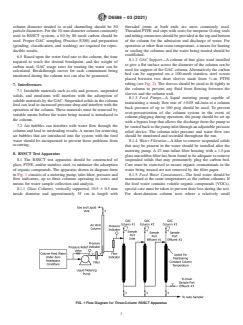
5.1 Granular activated carbon (GAC) is commonly used to remove contaminants from water. However if not used properly, GAC can not only be expensive but can at times be ineffective. The development of engineering data for the design of full-scale adsorbers often requires time-consuming and expensive pilot plant studies. This rapid standard practice has been developed to predict adsorption in large-scale adsorbers based upon results from small column testing. In contrast to pilot plant studies, the small-scale column test presented in this practice does not allow for a running evaluation of factors that may affect GAC performance over time. Such factors may include, for example, an increased removal of target compounds by bacterial colonizing GAC3 or long-term fouling of GAC caused by inorganic compounds or background organic matter.4 Nevertheless, this practice offers more relevant operational data than isotherm testing without the principal drawbacks of pilot plant studies, namely time and expense; and unlike pilot plant studies, small-scale studies can be performed in a laboratory using water sampled from a remote location.
5.2 This practice known as the rapid small-scale column test (RSSCT) uses empty bed contact time (EBCT) and hydraulic loading to describe the adsorption process. Mean carbon particle diameter is used to scale RSSCT results to predict the performance of a full-scale adsorber.
5.3 This practice can be used to compare the effectiveness of different activated carbons for the removal of contaminants from a common water stream.
SCOPE
1.1 This practice covers a test method for the evaluation of granular activated carbon (GAC) for the adsorption of soluble pollutants from water. This practice can be used to estimate the operating capacities of virgin and reactivated granular activated carbons. The results obtained from the small-scale column testing can be used to predict the adsorption of target compounds on GAC in a large column or full-scale adsorber application.
1.2 This practice can be applied to all types of water including synthetically contaminated water (prepared by spiking high-purity water with selected contaminants), potable waters, industrial wastewaters, sanitary wastes, and effluent waters.
1.3 This practice is useful for the determination of breakthrough curves for specific contaminants in water, the determination of the lengths of the adsorbates mass transfer zones (MTZ), and the prediction of GAC usage rates for larger scale adsorbers.
1.4 The following safety caveat applies to the procedure section, Section 10, of this practice: This standard does not purport to address all of the safety concerns, if any, associated with its use. It is the responsibility of the user of this standard to establish appropriate safety, health, and environmental practices and determine the applicability of regulatory limitations prior to use.
1.5 This international standard was developed in accordance with internationally recognized principles on standardization established in the Decision on Principles for the Development of International Standards, Guides and Recommendations issued by the World Trade Organization Technical Barriers to Trade (TBT) Committee.
- Status
- Published
- Publication Date
- 31-May-2021
- Technical Committee
- D28 - Activated Carbon
- Drafting Committee
- D28.02 - Liquid Phase Evaluation
Overview
ASTM D6586-03(2021) - Standard Practice for the Prediction of Contaminant Adsorption on GAC in Aqueous Systems Using Rapid Small-Scale Column Tests - provides a standardized method for evaluating the adsorption capabilities of granular activated carbon (GAC) in removing contaminants from water. This practice enables laboratories and engineers to estimate the operational capacity of GAC in full-scale treatment systems by using data generated from rapid small-scale column tests, known as RSSCT (Rapid Small-Scale Column Tests). By simulating large-scale adsorption performance in the laboratory, this approach saves both time and expense compared to traditional pilot plant studies.
Key Topics
- Granular Activated Carbon (GAC) Performance: The standard outlines a reliable technique for assessing and predicting the adsorption performance of both new and reactivated GAC for removing soluble pollutants from a variety of water sources.
- RSSCT Methodology: RSSCT leverages small laboratory columns to model contaminant removal under controlled conditions. Essential parameters include empty bed contact time (EBCT), hydraulic loading, and mean carbon particle size.
- Scaling and Prediction: The practice details how data from small-scale experiments can be used to project GAC behavior in full-scale water treatment systems. This process involves matching key operational variables to ensure predictive accuracy.
- Breakthrough Curve Analysis: Allows for determination of breakthrough curves for contaminants, offering insight into when adsorption capacity will be exhausted and when replacement or regeneration of GAC is necessary.
- Mass Transfer Zone (MTZ): The method facilitates evaluation of the MTZ, aiding in the design and operation of more efficient adsorber systems.
Applications
The ASTM D6586-03(2021) standard practice has significant utility in a variety of scenarios related to water treatment and environmental engineering:
- Assessment and Comparison of GAC Products: Organizations can use RSSCT to identify the most effective GAC type for specific contaminants by comparing performance under identical conditions.
- Design of Water Treatment Facilities: Engineers can optimize the sizing and operational parameters (such as EBCT and hydraulic loading) for full-scale GAC adsorbers, improving contaminant removal while controlling costs.
- Regulatory Compliance: Water utilities and industrial wastewater plants can validate their adsorption processes using this standard, ensuring compliance with environmental guidelines.
- Versatile Water Types: The standard applies to a broad spectrum of water matrices, including potable water, industrial wastewaters, sanitary wastes, effluents, and synthetically contaminated waters.
- Predictive Maintenance: Facilities can use breakthrough and MTZ data to predict carbon exhaustion, plan timely GAC replacement or regeneration, and maintain consistent water quality.
Related Standards
To ensure a comprehensive approach to GAC adsorption studies, the following ASTM standards are referenced within ASTM D6586 and are recommended for use:
- ASTM D1129: Terminology Relating to Water
- ASTM D1193: Specification for Reagent Water
- ASTM D2652: Terminology Relating to Activated Carbon
- ASTM D2854: Test Method for Apparent Density of Activated Carbon
- ASTM D2862: Test Method for Particle Size Distribution of Granular Activated Carbon
- ASTM D2867: Test Methods for Moisture in Activated Carbon
Practical Value
By following ASTM D6586-03(2021), laboratories, engineers, and water treatment professionals gain a fast, cost-effective, and reliable means of predicting contaminant removal using GAC, supporting improved process design, product selection, regulatory compliance, and operational efficiency in water and wastewater treatment systems. With direct and scalable laboratory results, the standard enables informed decision-making to protect water quality and public health.
Keywords: activated carbon, GAC, rapid small-scale column test, RSSCT, water treatment, contaminant adsorption, breakthrough curve, mass transfer zone, water quality, ASTM D6586.
Relations
- Effective Date
- 01-May-2020
- Effective Date
- 01-Jul-2014
- Effective Date
- 15-Jun-2011
- Effective Date
- 01-Mar-2010
- Effective Date
- 01-Nov-2009
- Effective Date
- 01-Sep-2009
- Effective Date
- 01-Sep-2009
- Effective Date
- 01-Apr-2009
- Effective Date
- 01-Sep-2006
- Effective Date
- 01-Sep-2006
- Effective Date
- 01-Mar-2006
- Effective Date
- 15-Feb-2006
- Effective Date
- 01-Jul-2005
- Effective Date
- 01-Jun-2005
- Effective Date
- 01-Oct-2004
Get Certified
Connect with accredited certification bodies for this standard

ECOCERT
Organic and sustainability certification.

Eurofins Food Testing Global
Global leader in food, environment, and pharmaceutical product testing.

Intertek Bangladesh
Intertek certification and testing services in Bangladesh.
Sponsored listings
Frequently Asked Questions
ASTM D6586-03(2021) is a standard published by ASTM International. Its full title is "Standard Practice for the Prediction of Contaminant Adsorption on GAC in Aqueous Systems Using Rapid Small-Scale Column Tests". This standard covers: SIGNIFICANCE AND USE 5.1 Granular activated carbon (GAC) is commonly used to remove contaminants from water. However if not used properly, GAC can not only be expensive but can at times be ineffective. The development of engineering data for the design of full-scale adsorbers often requires time-consuming and expensive pilot plant studies. This rapid standard practice has been developed to predict adsorption in large-scale adsorbers based upon results from small column testing. In contrast to pilot plant studies, the small-scale column test presented in this practice does not allow for a running evaluation of factors that may affect GAC performance over time. Such factors may include, for example, an increased removal of target compounds by bacterial colonizing GAC3 or long-term fouling of GAC caused by inorganic compounds or background organic matter.4 Nevertheless, this practice offers more relevant operational data than isotherm testing without the principal drawbacks of pilot plant studies, namely time and expense; and unlike pilot plant studies, small-scale studies can be performed in a laboratory using water sampled from a remote location. 5.2 This practice known as the rapid small-scale column test (RSSCT) uses empty bed contact time (EBCT) and hydraulic loading to describe the adsorption process. Mean carbon particle diameter is used to scale RSSCT results to predict the performance of a full-scale adsorber. 5.3 This practice can be used to compare the effectiveness of different activated carbons for the removal of contaminants from a common water stream. SCOPE 1.1 This practice covers a test method for the evaluation of granular activated carbon (GAC) for the adsorption of soluble pollutants from water. This practice can be used to estimate the operating capacities of virgin and reactivated granular activated carbons. The results obtained from the small-scale column testing can be used to predict the adsorption of target compounds on GAC in a large column or full-scale adsorber application. 1.2 This practice can be applied to all types of water including synthetically contaminated water (prepared by spiking high-purity water with selected contaminants), potable waters, industrial wastewaters, sanitary wastes, and effluent waters. 1.3 This practice is useful for the determination of breakthrough curves for specific contaminants in water, the determination of the lengths of the adsorbates mass transfer zones (MTZ), and the prediction of GAC usage rates for larger scale adsorbers. 1.4 The following safety caveat applies to the procedure section, Section 10, of this practice: This standard does not purport to address all of the safety concerns, if any, associated with its use. It is the responsibility of the user of this standard to establish appropriate safety, health, and environmental practices and determine the applicability of regulatory limitations prior to use. 1.5 This international standard was developed in accordance with internationally recognized principles on standardization established in the Decision on Principles for the Development of International Standards, Guides and Recommendations issued by the World Trade Organization Technical Barriers to Trade (TBT) Committee.
SIGNIFICANCE AND USE 5.1 Granular activated carbon (GAC) is commonly used to remove contaminants from water. However if not used properly, GAC can not only be expensive but can at times be ineffective. The development of engineering data for the design of full-scale adsorbers often requires time-consuming and expensive pilot plant studies. This rapid standard practice has been developed to predict adsorption in large-scale adsorbers based upon results from small column testing. In contrast to pilot plant studies, the small-scale column test presented in this practice does not allow for a running evaluation of factors that may affect GAC performance over time. Such factors may include, for example, an increased removal of target compounds by bacterial colonizing GAC3 or long-term fouling of GAC caused by inorganic compounds or background organic matter.4 Nevertheless, this practice offers more relevant operational data than isotherm testing without the principal drawbacks of pilot plant studies, namely time and expense; and unlike pilot plant studies, small-scale studies can be performed in a laboratory using water sampled from a remote location. 5.2 This practice known as the rapid small-scale column test (RSSCT) uses empty bed contact time (EBCT) and hydraulic loading to describe the adsorption process. Mean carbon particle diameter is used to scale RSSCT results to predict the performance of a full-scale adsorber. 5.3 This practice can be used to compare the effectiveness of different activated carbons for the removal of contaminants from a common water stream. SCOPE 1.1 This practice covers a test method for the evaluation of granular activated carbon (GAC) for the adsorption of soluble pollutants from water. This practice can be used to estimate the operating capacities of virgin and reactivated granular activated carbons. The results obtained from the small-scale column testing can be used to predict the adsorption of target compounds on GAC in a large column or full-scale adsorber application. 1.2 This practice can be applied to all types of water including synthetically contaminated water (prepared by spiking high-purity water with selected contaminants), potable waters, industrial wastewaters, sanitary wastes, and effluent waters. 1.3 This practice is useful for the determination of breakthrough curves for specific contaminants in water, the determination of the lengths of the adsorbates mass transfer zones (MTZ), and the prediction of GAC usage rates for larger scale adsorbers. 1.4 The following safety caveat applies to the procedure section, Section 10, of this practice: This standard does not purport to address all of the safety concerns, if any, associated with its use. It is the responsibility of the user of this standard to establish appropriate safety, health, and environmental practices and determine the applicability of regulatory limitations prior to use. 1.5 This international standard was developed in accordance with internationally recognized principles on standardization established in the Decision on Principles for the Development of International Standards, Guides and Recommendations issued by the World Trade Organization Technical Barriers to Trade (TBT) Committee.
ASTM D6586-03(2021) is classified under the following ICS (International Classification for Standards) categories: 71.040.30 - Chemical reagents; 71.100.80 - Chemicals for purification of water. The ICS classification helps identify the subject area and facilitates finding related standards.
ASTM D6586-03(2021) has the following relationships with other standards: It is inter standard links to ASTM D1129-13(2020)e2, ASTM D2854-09(2014), ASTM D2652-11, ASTM D1129-10, ASTM D2867-09, ASTM D2862-97(2009)e1, ASTM D2862-97(2009), ASTM D2854-09, ASTM D1129-06a, ASTM D1129-06ae1, ASTM D1193-06, ASTM D1129-06, ASTM D2652-05a, ASTM D2652-05, ASTM D2854-96(2004). Understanding these relationships helps ensure you are using the most current and applicable version of the standard.
ASTM D6586-03(2021) is available in PDF format for immediate download after purchase. The document can be added to your cart and obtained through the secure checkout process. Digital delivery ensures instant access to the complete standard document.
Standards Content (Sample)
This international standard was developed in accordance with internationally recognized principles on standardization established in the Decision on Principles for the
Development of International Standards, Guides and Recommendations issued by the World Trade Organization Technical Barriers to Trade (TBT) Committee.
Designation: D6586 − 03 (Reapproved 2021)
Standard Practice for the
Prediction of Contaminant Adsorption on GAC in Aqueous
Systems Using Rapid Small-Scale Column Tests
This standard is issued under the fixed designation D6586; the number immediately following the designation indicates the year of
original adoption or, in the case of revision, the year of last revision.Anumber in parentheses indicates the year of last reapproval.A
superscript epsilon (´) indicates an editorial change since the last revision or reapproval.
1. Scope 2. Referenced Documents
2.1 ASTM Standards:
1.1 This practice covers a test method for the evaluation of
D1129Terminology Relating to Water
granular activated carbon (GAC) for the adsorption of soluble
D1193Specification for Reagent Water
pollutantsfromwater.Thispracticecanbeusedtoestimatethe
D2652Terminology Relating to Activated Carbon
operating capacities of virgin and reactivated granular acti-
D2854Test Method for Apparent Density of Activated
vated carbons. The results obtained from the small-scale
Carbon
column testing can be used to predict the adsorption of target
D2862Test Method for Particle Size Distribution of Granu-
compounds on GAC in a large column or full-scale adsorber
lar Activated Carbon
application.
D2867Test Methods for Moisture in Activated Carbon
1.2 This practice can be applied to all types of water
3. Terminology
including synthetically contaminated water (prepared by spik-
3.1 Definitions:
ing high-purity water with selected contaminants), potable
3.1.1 For definitions of terms in this practice relating to
waters, industrial wastewaters, sanitary wastes, and effluent
activated carbon, refer to Terminology D2652.
waters.
3.1.2 For definitions of terms in this practice relating to
1.3 This practice is useful for the determination of break-
water, refer to Terminology D1129.
through curves for specific contaminants in water, the deter-
4. Summary of Practice
mination of the lengths of the adsorbates mass transfer zones
(MTZ), and the prediction of GAC usage rates for larger scale
4.1 This practice consists of a method for the rapid deter-
adsorbers.
mination of breakthrough curves and the prediction of GAC
usage rates for the removal of soluble contaminants from
1.4 The following safety caveat applies to the procedure
water.Thisisaccomplishedbypassingthecontaminatedwater
section, Section 10, of this practice: This standard does not
at a constant, controlled rate down flow through a bed of a
purport to address all of the safety concerns, if any, associated
specially sized granular activated carbon until predetermined
with its use. It is the responsibility of the user of this standard
levels of breakthrough have occurred.
to establish appropriate safety, health, and environmental
4.2 When the assumption is made that conditions of con-
practices and determine the applicability of regulatory limita-
stant diffusivity exist within the GAC column, the break-
tions prior to use.
through data obtained from the column test can be used to
1.5 This international standard was developed in accor-
estimate the size and operational conditions for a full-scale
dance with internationally recognized principles on standard-
carbon adsorber.
ization established in the Decision on Principles for the
Development of International Standards, Guides and Recom-
5. Significance and Use
mendations issued by the World Trade Organization Technical
5.1 Granular activated carbon (GAC) is commonly used to
Barriers to Trade (TBT) Committee.
remove contaminants from water. However if not used
properly, GAC can not only be expensive but can at times be
ineffective.Thedevelopmentofengineeringdataforthedesign
This practice is under the jurisdiction of ASTM Committee D28 on Activated
Carbon and is the direct responsibility of Subcommittee D28.02 on Liquid Phase
Evaluation. For referenced ASTM standards, visit the ASTM website, www.astm.org, or
Current edition approved June 1, 2021. Published June 2021. Originally contact ASTM Customer Service at service@astm.org. For Annual Book of ASTM
approved in 2000. Last previous edition approved in 2014 as D6586–03 (2014). Standards volume information, refer to the standard’s Document Summary page on
DOI: 10.1520/D6586-03R21. the ASTM website.
Copyright © ASTM International, 100 Barr Harbor Drive, PO Box C700, West Conshohocken, PA 19428-2959. United States
D6586 − 03 (2021)
of full-scale adsorbers often requires time-consuming and EBCT R t
sc sc sc
5 5 (1)
S D
expensive pilot plant studies. This rapid standard practice has EBCT R t
lc lc lc
been developed to predict adsorption in large-scale adsorbers
where: EBCT and EBCT are the empty-bed contact times
sc lc
based upon results from small column testing. In contrast to
forthesmallcolumn(RSSCT)andthelargecolumn(full-scale
pilotplantstudies,thesmall-scalecolumntestpresentedinthis
adsorber), respectively; R and R are the radii of the carbon
sc lc
practice does not allow for a running evaluation of factors that
particlesusedinthesmallandlargecolumns,respectively;and
may affect GAC performance over time. Such factors may
t and t are the elapsed times required to conduct the small-
sc lc
include, for example, an increased removal of target com-
and large-column tests, respectively.The condition of constant
pounds by bacterial colonizing GAC or long-term fouling of
diffusivity also requires the Reynolds numbers for the RSSCT
GAC caused by inorganic compounds or background organic
and the large column be equal. This means the following
matter. Nevertheless, this practice offers more relevant opera-
equation must also be satisfied:
tional data than isotherm testing without the principal draw-
V R
backs of pilot plant studies, namely time and expense; and sc lc
5 (2)
V R
lc rc
unlikepilotplantstudies,small-scalestudiescanbeperformed
in a laboratory using water sampled from a remote location.
where: V and V are the hydraulic loadings in the RSSCT
sc lc
5.2 Thispracticeknownastherapidsmall-scalecolumntest and large columns, respectively. Based upon the above
equations, the operating conditions for the RSSCT can be
(RSSCT) uses empty bed contact time (EBCT) and hydraulic
loading to describe the adsorption process. Mean carbon selected to precisely simulate the desired (specified) operating
conditions for a full-scale adsorber.
particle diameter is used to scale RSSCT results to predict the
performance of a full-scale adsorber.
NOTE 1—There is an important issue relating to RSSCT design using
Eq 2. Sometimes using leads to a design with a high head loss, which
5.3 This practice can be used to compare the effectiveness
increases dramatically with operating time, as the GAC is crushed by a
of different activated carbons for the removal of contaminants
large pressure drop across the RSSCT. This may be avoided by lowering
from a common water stream.
the superficial velocity as long as dispersion does not become the
dominant transport mechanism and intraparticle mass transfer is limiting
6. Summary of Practice
theadsorptionrate.ThePecletnumberbasedondiametercanbeestimated
from the following equation:
6.1 The development of the RSSCT is based on the
Pe 50.334 for160#Re·Sc#40,000
d
dispersed-flow pore surface diffusion model (DFPSDM)
When the velocity is reduced below what is given in EquationA, axial
(Crittenden, et al. ) which takes into account many of the dispersion,whichiscausedbymoleculardiffusion,canbemoreimportant
intheRSSCTthaninthefull-scaleprocess.Consequently,EquationAcan
mechanisms that are known to occur in fixed-bed adsorption.
be used to check whether dispersion becomes important as the velocity of
The following mechanisms which cause the breakthrough
the RSSCT is reduced in an effort to reduce the head loss. Typical Sc
curves for an adsorber to spread out and create the mass
values for SOCs is ~2000; consequently, the Re for the RSSCT must be
transfer zone are included in the DFPSDM: external mass-
kept greater than ~0.1 and the Pe must be kept above 50 for the length of
transfer resistance or film transfer, axial mixing due to the mass transfer zone.
NOTE2—Empty-bedcontacttime(EBCT)isdefinedasthebedvolume
dispersion, and the internal mass-transfer resistances of pore
(in liters) divided by the water flow rate in liters/minute. For example if a
and surface diffusion.
full-scale adsorber holds 20 000 Lof activated carbon and the water flow
rate is 2500 L/min, the EBCT would be equal to 20 000/2500 or 8.0 min.
6.2 To simulate full-scale performance, the amount of
spreading in the breakthrough curve relative to column depth
6.3 The assumption that conditions of constant diffusivity
must be identical for the RSSCT and the full-scale column. To
existwithintheGACcolumndoesnotapplytoallwatersorall
achieve this, the relative contributions of the mechanisms that
targetcompounds.Forexamplethisassumptiondoesnotapply
cause most of the spreading are matched by maintaining
for the decolorization of water and the adsorption of large
similarity as the GAC process is scaled. Studies have shown
molecules, such as humic and fulvic acids. It is recommended
that matching of the spreading of the breakthrough curve can
thatatleastoneRSSCTpilot-columncomparisonbeconducted
beachievedbyequatingthedimensionlessgroupsinPFPSDM
to aid in selecting the RSSCT design variables for a given
(Plug Flow Pore Surface Diffusion Model). Under the condi-
water matrix (Crittenden, et al.). A detailed comparison
tions that intraparticle diffusivities are assumed to be indepen-
between the constant diffusivity and proportional diffusivity
dent of the carbon particle radius, i.e. the condition of constant
approaches and their respective domains of application is
diffusivity, the following equation describes the relationship
beyond the scope of this practice.
between the small and large columns:
6.4 GAC bed volume and preparation methods are impor-
tant design parameters for the RSSCT. The GAC bed volume
usedwilldeterminetherequiredwaterpumpingrateandaffect
Owen, D. M., Chowdhury, Z. K., Summers, R. S., Hooper, S. M., and Solarik,
theamountofwaterneededtocompletethetest.Theminimum
G., “Determination of Technology and Costs for GAC Treatment Using the ICR
Methodology,”AWWAGAC&MembraneWorkshop,March1996,Cincinnati,OH.
Knappe, D., Snoeyink, V., Roche, P., Prados, M., and Bourbigot, M., “The
Effect of Preloading on RSSCT Predictions of Atrazine Removal by GAC Crittenden, J. C., Berrigan, Jr., J. K., Hand, D. W., and Lykins, Jr., B. W.,
Adsorbers,” Water Research, Vol 31, No.11, 1997, pp. 2899–2909. “Design of Rapid Fixed-Bed Adsorption Tests for Non-Constant Diffusivities,”
Crittenden, J. C., Berrigan, Jr., J. K., and Hand, D. W., “Design of Rapid Journal of Environmental Engineering, Vol 113, No. 2, 1987, pp. 243–259.
Small-Scale Adsorption Tests for a Constant Surface Diffusivity,” Journal Water Fried, J. J., Groundwater Pollution, Elsevier Scientific, Amsterdam, The
Pollution Control Federation, Vol 58, No. 4, 1986, pp. 312–319. Netherlands, 1975.
D6586 − 03 (2021)
column diameter needed to avoid channeling should be 50 threaded joints at both ends are most commonly used.
particlediameters.Forthe10-mmdiametercolumncommonly Threaded PTFE end caps with seats for neoprene O-ring seals
used in RSSCT systems, a 60 by 80 mesh carbon should be andtubingconnectorsshouldbeprovidedatthetopandbottom
used. Proper GAC sampling (Practice E300) and preparation of the column for the admission and discharge of water. For
(grinding, classification, and washing) are required for repro- operation at other than room temperature, a means for heating
ducible results. or cooling the columns and the water being treated should be
established.
6.5 Based upon the water feed rate to the column, the time
8.1.2 GAC Support—A column of fine glass wool installed
required to reach the desired breakpoint, and the weight of
to give a flat surface across the diameter of the column can be
carbon used, GAC usage rates for treating the water can be
used for support of the GAC column.Alternatively the carbon
calculated. Breakthrough curves for each contaminant being
bed can be supported on a 100-mesh stainless steel screen
monitored during the column test can also be generated.
placed between two short sleeves made from ⁄2-in. PTFE
tubing (see Fig. 2).The sleeves should be sized to fit tightly in
7. Interferences
the column to prevent any fluid from flowing between the
7.1 Insoluble materials such as oils and greases, suspended
sleeves and the column wall.
solids, and emulsions will interfere with the adsorption of
8.1.3 Feed Pum
...