

ASTM D5017-17
(Test Method)Standard Test Method for Determination of Linear Low Density Polyethylene (LLDPE) Composition by Carbon-13 Nuclear Magnetic Resonance
General Information
- Abstract
SIGNIFICANCE AND USE
5.1 Performance properties are dependent on the number and type of short chain branches. This test method permits measurement of these branches for ethylene copolymers with propylene, butene-1, hexene-1, octene-1, and 4-methylpentene-1.
SCOPE
1.1 This test method determines the molar composition of copolymers prepared from ethylene (ethene) and a second alkene-1 monomer. This second monomer can include propene, butene-1, hexene-1, octene-1, and 4-methylpentene-1.
1.2 Calculations of this test method are valid for products containing units EEXEE, EXEXE, EXXE, EXXXE, and of course EEE where E equals ethene and X equals alkene-1. Copolymers containing a considerable number of alkene-1 blocks (such as, longer blocks than XXX) are outside the scope of this test method.
1.3 This standard does not purport to address all of the safety concerns, if any, associated with its use. It is the responsibility of the user of this standard to establish appropriate safety and health practices and determine the applicability of regulatory limitations prior to use. See Section 8 for a specific hazard statement.
Note 1: There is no known ISO equivalent to this standard.
- Status
- Published
- Publication Date
- 28-Feb-2017
- Technical Committee
- D20 - Plastics
- Drafting Committee
- D20.70 - Analytical Methods
Buy Documents
ASTM D5017-17 - Standard Test Method for Determination of Linear Low Density Polyethylene (LLDPE) Composition by Carbon-13 Nuclear Magnetic Resonance
REDLINE ASTM D5017-17 - Standard Test Method for Determination of Linear Low Density Polyethylene (LLDPE) Composition by Carbon-13 Nuclear Magnetic Resonance
Overview
ASTM D5017-17 outlines the standard test method for determining the composition of Linear Low Density Polyethylene (LLDPE) using Carbon-13 Nuclear Magnetic Resonance (C-13 NMR) spectroscopy. This method enables accurate quantification of the molar percentage of comonomer units in ethylene-based copolymers, including those with propylene, butene-1, hexene-1, octene-1, and 4-methylpentene-1 as the secondary monomer. The test is crucial for understanding the effects of short chain branching on polymer properties, supporting both quality control and product development in the plastics industry.
Key Topics
- LLDPE Composition Analysis: This method determines the molar composition of LLDPE copolymers by quantifying the amount and type of short chain branches present, which can significantly influence polymer performance.
- Applicable Comonomers: The procedure is valid for copolymers of ethylene with a second alkene-1 monomer, such as propylene, butene-1, hexene-1, octene-1, and 4-methylpentene-1. The calculation methods are refined for specific copolymer structures, ensuring accuracy within defined compositional limits.
- C-13 NMR Spectroscopy: Polymer samples are analyzed in solution using high-resolution Carbon-13 NMR to identify structural features and branch types. Measured spectral integrals are used to calculate copolymer composition.
- Critical Performance Data: The number and type of short chain branches, determined by this standard, are directly linked to key physical properties of LLDPE such as flexibility, strength, and clarity.
Applications
ASTM D5017-17 offers practical benefits in several domains:
- Quality Control: Manufacturers utilize this method to verify the composition of LLDPE grades, ensuring product consistency and adherence to technical specifications.
- Research and Development: Polymer scientists and engineers apply this test to study structure-property relationships for new copolymer formulations, supporting innovations in flexible packaging, films, and molded products.
- Regulatory Compliance: This standardized approach helps organizations demonstrate compliance with industry and customer requirements for material characterization.
- Process Optimization: Determining the precise molar ratio of comonomers and branching levels assists in optimizing polymerization processes for target performance parameters.
Related Standards
- ASTM D883 - Terminology Relating to Plastics
- ASTM E177 - Practice for Use of the Terms Precision and Bias in ASTM Test Methods
- ASTM E691 - Practice for Conducting an Interlaboratory Study to Determine the Precision of a Test Method
- ASTM E2977 - Practice for Measuring and Reporting Performance of Fourier-Transform Nuclear Magnetic Resonance (FT-NMR) Spectrometers
- IEEE/ASTM SI-10 - Standard for Use of the International System of Units (SI)
- There is currently no ISO equivalent to ASTM D5017-17.
Keywords: LLDPE composition, ASTM D5017-17, carbon-13 NMR, polyethylene copolymer analysis, polymer branching, plastics quality control, comonomer content, linear low-density polyethylene, polymer spectroscopy, material characterization.
By following ASTM D5017-17, laboratories and manufacturers ensure high standards in LLDPE composition analysis, supporting innovation and quality in polyethylene production.
Relations
- Effective Date
- 01-Feb-2024
- Effective Date
- 01-Nov-2023
- Effective Date
- 01-Jan-2020
- Effective Date
- 01-Aug-2019
- Effective Date
- 15-Apr-2019
- Effective Date
- 01-Feb-2019
- Effective Date
- 01-Dec-2018
- Effective Date
- 01-Nov-2018
- Effective Date
- 15-Aug-2017
- Effective Date
- 01-Aug-2014
- Effective Date
- 01-May-2014
- Effective Date
- 01-May-2013
- Effective Date
- 01-May-2013
- Effective Date
- 15-Nov-2012
- Effective Date
- 01-Nov-2011
Buy Documents
ASTM D5017-17 - Standard Test Method for Determination of Linear Low Density Polyethylene (LLDPE) Composition by Carbon-13 Nuclear Magnetic Resonance
REDLINE ASTM D5017-17 - Standard Test Method for Determination of Linear Low Density Polyethylene (LLDPE) Composition by Carbon-13 Nuclear Magnetic Resonance
Get Certified
Connect with accredited certification bodies for this standard

DIN CERTCO
DIN Group product certification.

Smithers Quality Assessments
US management systems and product certification.
Sponsored listings
Frequently Asked Questions
ASTM D5017-17 is a standard published by ASTM International. Its full title is "Standard Test Method for Determination of Linear Low Density Polyethylene (LLDPE) Composition by Carbon-13 Nuclear Magnetic Resonance". This standard covers: SIGNIFICANCE AND USE 5.1 Performance properties are dependent on the number and type of short chain branches. This test method permits measurement of these branches for ethylene copolymers with propylene, butene-1, hexene-1, octene-1, and 4-methylpentene-1. SCOPE 1.1 This test method determines the molar composition of copolymers prepared from ethylene (ethene) and a second alkene-1 monomer. This second monomer can include propene, butene-1, hexene-1, octene-1, and 4-methylpentene-1. 1.2 Calculations of this test method are valid for products containing units EEXEE, EXEXE, EXXE, EXXXE, and of course EEE where E equals ethene and X equals alkene-1. Copolymers containing a considerable number of alkene-1 blocks (such as, longer blocks than XXX) are outside the scope of this test method. 1.3 This standard does not purport to address all of the safety concerns, if any, associated with its use. It is the responsibility of the user of this standard to establish appropriate safety and health practices and determine the applicability of regulatory limitations prior to use. See Section 8 for a specific hazard statement. Note 1: There is no known ISO equivalent to this standard.
SIGNIFICANCE AND USE 5.1 Performance properties are dependent on the number and type of short chain branches. This test method permits measurement of these branches for ethylene copolymers with propylene, butene-1, hexene-1, octene-1, and 4-methylpentene-1. SCOPE 1.1 This test method determines the molar composition of copolymers prepared from ethylene (ethene) and a second alkene-1 monomer. This second monomer can include propene, butene-1, hexene-1, octene-1, and 4-methylpentene-1. 1.2 Calculations of this test method are valid for products containing units EEXEE, EXEXE, EXXE, EXXXE, and of course EEE where E equals ethene and X equals alkene-1. Copolymers containing a considerable number of alkene-1 blocks (such as, longer blocks than XXX) are outside the scope of this test method. 1.3 This standard does not purport to address all of the safety concerns, if any, associated with its use. It is the responsibility of the user of this standard to establish appropriate safety and health practices and determine the applicability of regulatory limitations prior to use. See Section 8 for a specific hazard statement. Note 1: There is no known ISO equivalent to this standard.
ASTM D5017-17 is classified under the following ICS (International Classification for Standards) categories: 83.080.20 - Thermoplastic materials. The ICS classification helps identify the subject area and facilitates finding related standards.
ASTM D5017-17 has the following relationships with other standards: It is inter standard links to ASTM D883-24, ASTM D883-23, ASTM D883-20, ASTM D883-19c, ASTM D883-19a, ASTM D883-19, ASTM D883-18a, ASTM D883-18, ASTM D883-17, ASTM E2977-14, ASTM E177-14, ASTM E177-13, ASTM E691-13, ASTM D883-12e1, ASTM E386-90(2011). Understanding these relationships helps ensure you are using the most current and applicable version of the standard.
ASTM D5017-17 is available in PDF format for immediate download after purchase. The document can be added to your cart and obtained through the secure checkout process. Digital delivery ensures instant access to the complete standard document.
Standards Content (Sample)
This international standard was developed in accordance with internationally recognized principles on standardization established in the Decision on Principles for the
Development of International Standards, Guides and Recommendations issued by the World Trade Organization Technical Barriers to Trade (TBT) Committee.
Designation: D5017 − 17
Standard Test Method for
Determination of Linear Low Density Polyethylene (LLDPE)
Composition by Carbon-13 Nuclear Magnetic Resonance
This standard is issued under the fixed designation D5017; the number immediately following the designation indicates the year of
original adoption or, in the case of revision, the year of last revision.Anumber in parentheses indicates the year of last reapproval.A
superscript epsilon (´) indicates an editorial change since the last revision or reapproval.
1. Scope* NMR) Spectrometers for Liquid Samples
IEEE/ASTM SI-10Standard for Use of the International
1.1 This test method determines the molar composition of
System of Units (SI): The Modern System
copolymers prepared from ethylene (ethene) and a second
alkene-1monomer.Thissecondmonomercanincludepropene,
3. Terminology
butene-1, hexene-1, octene-1, and 4-methylpentene-1.
3.1 Some units, symbols, and abbreviations used in this test
1.2 Calculations of this test method are valid for products
method are summarized in IEEE/ASTM SI-10 and Practice
containing units EEXEE, EXEXE, EXXE, EXXXE, and of
E386. Other abbreviations are listed as follows:
course EEE where E equals ethene and X equals alkene-1.
Copolymers containing a considerable number of alkene-1
3.2 Abbreviations:
blocks(suchas,longerblocksthanXXX)areoutsidethescope
3.2.1 C—carbon 13,
of this test method.
3.2.2 LLDPE—linear low-density polyethylene,
1.3 This standard does not purport to address all of the
3.2.3 T1—relaxation time, and
safety concerns, if any, associated with its use. It is the
3.2.4 TR—pulse repetition time.
responsibility of the user of this standard to establish appro-
3.3 Definitions of Terms Specific to This Standard:
priate safety and health practices and determine the applica-
3.3.1 With a few modifications, terms used to designate
bility of regulatory limitations prior to use. See Section 8 for a
different carbon types were suggested by Carman. Methine
specific hazard statement.
carbons are identified by CH and branch carbons are labeled
according to branch type as summarized in Table 1. Branch
NOTE 1—There is no known ISO equivalent to this standard.
carbons are numbered starting with the methyl as number one.
2. Referenced Documents
3.3.2 Backbone methylene carbons are designated by a pair
ofGreeklettersthatspecifythelocationofthenearestmethine
2.1 ASTM Standards:
carbonineachdirection.Forexample,α,α-methylenecarbonis
D883Terminology Relating to Plastics
+
between two methine carbons or an α,δ methylene carbon has
E177Practice for Use of the Terms Precision and Bias in
one immediate methine neighbor and the second methine
ASTM Test Methods
carbon is located at least four carbons away.
E386Practice for Data Presentation Relating to High-
Resolution Nuclear Magnetic Resonance (NMR) Spec-
4. Summary of Test Method
troscopy (Withdrawn 2015)
E691Practice for Conducting an Interlaboratory Study to
4.1 Polymer samples are dispersed in hot solvent and
Determine the Precision of a Test Method
analyzed at high temperatures using Carbon-13 nuclear mag-
E2977PracticeforMeasuringandReportingPerformanceof
netic resonance (NMR) spectroscopy.
Fourier-Transform Nuclear Magnetic Resonance (FT-
4.2 Spectra are recorded under conditions such that the
response of each chemically different carbon is identical.
ThistestmethodisunderthejurisdictionofASTMCommitteeD20onPlastics
Integrated responses for carbons originated from the different
and is the direct responsibility of Subcommittee D20.70 on Analytical Methods.
comonomers are used for calculation of the copolymer com-
Current edition approved March 1, 2017. Published March 2017. Originally
ε1 position.
approved in 1991. Last previous edition approved in 2009 as D5017–96(2009) .
DOI: 10.1520/D5017-17.
For referenced ASTM standards, visit the ASTM website, www.astm.org, or
contact ASTM Customer Service at service@astm.org. For Annual Book of ASTM
Standards volume information, refer to the standard’s Document Summary page on Available from ASTM International Headquarters, 100 Barr Harbor Drive,
the ASTM website. C700, West Conshohocken, PA 19428.
3 5
The last approved version of this historical standard is referenced on Carman,C.J.,Harrington,R.A.,andWilkes,C.E., Macromolecules1977,Vol
www.astm.org. 10, p. 536.
*A Summary of Changes section appears at the end of this standard
Copyright © ASTM International, 100 Barr Harbor Drive, PO Box C700, West Conshohocken, PA 19428-2959. United States
D5017 − 17
−1
TABLE 1 Designations for Different Carbon Types
9.8 Pulse width, <[4×sweep width Hz]
Monomer Branch Type Label
9.9 Decoupling, complete
Propene (P) methyl M1
Butene-1 (B) ethyl E1–E2 NOTE6—ThenuclearOverhauserenhancementforthecarbonsusedfor
4, 7, 8
Hexene-1 (H) butyl B1–B4
quantitative analysis have been shown to be full.
4-Methylpentene-1 (MP) isobutyl IB1–IB3
Octene-1 (O) hexyl H1–H6
10. Procedure
10.1 Weigh a 1.2-g sample into a 10-mm NMR tube. Add
1.5 mLof solvent (7.1) and 1.3 mLdeuterated solvent (7.2)to
5. Significance and Use
the tube. Cap the tube.
5.1 Performance properties are dependent on the number
NOTE 7—Solution concentration can be varied with instruments of
and type of short chain branches. This test method permits
different field strength as long as one meets the minimum signal-to-noise
measurement of these branches for ethylene copolymers with
requirement of 9.4.
propylene, butene-1, hexene-1, octene-1, and
10.2 Homogenize the sample in an oven at 150°C for 3 to 4
4-methylpentene-1.
h. Keep the tube in a vertical position during the heating step.
6. Apparatus
10.3 Set spectrometer parameters as detailed in Section 9.
6.1 NMR Spectrometer, C pulse-Fourier transform spec- 10.4 Transfer the tube to the NMR spectrometer and equili-
trometer with a field strength of at least 2.35 T.
brate 10 to 15 min at 130°C.
10.5 Scan the sample with complete broadband decoupling
NOTE 2—The system should have a computer size of at least 32 K for
50-MHz carbon frequency with digital resolution of at least 0.5 Hz/point
using the parameters of Section 9.
in the final spectrum.
10.6 Record the spectrum and the accurate full-scale inte-
6.2 Sample Tubes, 10-mm outside diameter.
gral from 10 to 50 ppm.Adjust partial integrals so that integral
of the second largest peak in the spectrum is at least 50% of
NOTE 3—Sample tube size can be varied; however, the sample
preparation procedure described in 10.1 may need to be altered to
full-scale.This partial integral must be flat before and after the
maintain the minimum signal-to-noise requirement of 9.4.
area to be measured.
7. Reagents and Materials NOTE 8—The combination of sample preparation time and acquisition
timenecessarytoobtainthesignal-to-noiserequirementof9.4canleadto
7.1 Ortho-dichlorobenzene or 1,2,4-trichlorobenzene, re-
prohibitively long experiments if samples are run multiplicatively. It is
agent grade
acceptable to perform sample determinations using a single analysis.
Duplicate runs in accordance with 13.1 were performed for the round-
7.2 Deuterated o-dichlorobenzene or p-dichlorobenzene.
robin exercise.
This material is used at a concentration up to 20% with the
reagent specified in 7.1 as an internal lock.
11. Calculation
11.1 Measure the area between the appropriate integration
8. Hazards
limits outlined in Annex A1.
8.1 Warning—Solvents shall be handled in a well-
11.2 Substitute the integrals into the appropriate equations
ventilated fume hood.
from Annex A2 to calculate the mole percent alkene-1.
9. Instrument Parameters
11.3 Annex A3 gives a sample calculation for an ethylene-
9.1 Pulse angle, 90° octene copolymer using integrals and equations in accordance
with 11.1 and 11.2.
9.2 Pulse repetition, 10 s
NOTE 9—With the prescribed repetition time (10 s) and pulse angle
9.3 Sample temperature, 130°C
(90°), the maximum allowable relaxation time (T ) for carbons used for
NOTE 4—The precise temperature should be measured using the NMR quantitative analysis is 2 s. To shorten the analysis time, a shorter pulse
thermometer (cyclooctane/methylene iodide).
repetition time can be used if one accounts for the relaxation time
differences. Relaxation times of carbons for the five copolymers were
9.4 Minimum signal-to-noise, 5000:1
determinedatacarbonfrequencyof50MHzusingtheinversionrecovery
9, 10
method. Appendix X1 summarizes these relaxation times and correc-
NOTE 5—The signal-to-noise ratio is defined as 2.5 times the signal
tion factors (reciprocal of the relative intensities) for a 4-s repetition time
intensity of the 30.0-ppm peak (isolated methylenes) divided by the peak
(T ). With the shorter T , multiply integrals by these correction factors
to peak noise for the region from 50 to 70 ppm. Calculation of R R
before using the equations in AnnexA2. The T values would have to be
signal-to-noise is permitted using an equivalent software procedure.
remeasuredforanalysesperformedatspectrometerfrequenciesotherthan
9.5 Sweep width, 175 ppm
50 MHz.
9.6 Transmitter frequency (F1), 50 to 55 ppm
9.7 Apodisation, 2 (exponential) Hz
Randall, J. C., “NMR and Macromolecules,” Chapter 9, American Chemical
Society Symposium Series 247, 1984 .
Farrar,T.C.,andBecker,E.D., Pulse and Fourier Transform NMR,Chapter2,
Available from Wilmad Scientific Glass Co. Academic Press, New York, 1971.
7 10
Vidrime, D. W., and Peterson, P. E., Analytical Chemistry , Vol 48, 1976, p. Cheng, H. N., and Bennet, M.A., Macromolecule Chemistry , Vol 188, 1987,
1301. pp. 2665–2677.
D5017 − 17
11.4 If desired, convert results from mole percent alkene-1 accordancewithPracticeE691,involvingninematerialstested
tobranchesper1000carbons(br/1000C)usingtheequationsin by six laboratories. For each material, all the samples were
Annex A4. prepared at one source, but the individual specimens were
prepared at the laboratories that tested them. Each “test result”
12. Report
was the average of two individual determinations. Each labo-
ratory obtained one test result for each material. (Warning—
12.1 Report the mole percent alkene-1 from 11.2 or
The following explanations of r and R (13.2 – 13.2.3) are only
branches/1000C from 11.4, or both.
intended to present a meaningful way of considering the
13. Precision and Bias
approximate precision of this test method. The data in Table 2
are not to be rigorously applied to acceptance or rejection of
13.1 Table2isbasedonaroundrobinconductedin1988in
material, as those data are specific to the round robin and are
not representative of other lots, conditions, materials, or
laboratories. Users of this test method need to apply the
Supporting data are available from ASTM Headquarters. Request RR:D20-
1192.
principlesoutlinedinPracticeE691togeneratedataspecificto
thei
...
This document is not an ASTM standard and is intended only to provide the user of an ASTM standard an indication of what changes have been made to the previous version. Because
it may not be technically possible to adequately depict all changes accurately, ASTM recommends that users consult prior editions as appropriate. In all cases only the current version
of the standard as published by ASTM is to be considered the official document.
´1
Designation: D5017 − 96 (Reapproved 2009) D5017 − 17
Standard Test Method for
Determination of Linear Low Density Polyethylene (LLDPE)
Composition by Carbon-13 Nuclear Magnetic Resonance
This standard is issued under the fixed designation D5017; the number immediately following the designation indicates the year of
original adoption or, in the case of revision, the year of last revision. A number in parentheses indicates the year of last reapproval. A
superscript epsilon (´) indicates an editorial change since the last revision or reapproval.
ε NOTE—Reapproved with editorial changes in April 2009.
1. Scope Scope*
1.1 This test method determines the molar composition of copolymers prepared from ethylene (ethene) and a second alkene-1
monomer. This second monomer can include propene, butene-1, hexene-1, octene-1, and 4-methylpentene-1.
1.2 Calculations of this test method are valid for products containing units EEXEE, EXEXE, EXXE, EXXXE, and of course
EEE where E equals ethene and X equals alkene-1. Copolymers containing a considerable number of alkene-1 blocks (such as,
longer blocks than XXX) are outside the scope of this test method.
1.3 This standard does not purport to address all of the safety concerns, if any, associated with its use. It is the responsibility
of the user of this standard to establish appropriate safety and health practices and determine the applicability of regulatory
limitations prior to use. See Section 8 for a specific hazard statement.
NOTE 1—There is no equivalent ISO known ISO equivalent to this standard.
2. Referenced Documents
2.1 ASTM Standards:
D883 Terminology Relating to Plastics
E177 Practice for Use of the Terms Precision and Bias in ASTM Test Methods
E386 Practice for Data Presentation Relating to High-Resolution Nuclear Magnetic Resonance (NMR) Spectroscopy
(Withdrawn 2015)
E691 Practice for Conducting an Interlaboratory Study to Determine the Precision of a Test Method
E2977 Practice for Measuring and Reporting Performance of Fourier-Transform Nuclear Magnetic Resonance (FT-NMR)
Spectrometers for Liquid Samples
IEEE/ASTM SI-10 Standard for Use of the International System of Units (SI): The Modern System
3. Terminology
3.1 Some units, symbols, and abbreviations used in this test method are summarized in IEEE/ASTM SI-10 and Practice E386.
Other abbreviations are listed as follows:
3.2 Abbreviations:
3.2.1 C—carbon 13,
3.2.2 LLDPE—linear low-density polyethylene,
3.2.3 T1—relaxation time, and
3.2.4 TR—pulse repetition time.
3.3 Definitions of Terms Specific to This Standard:
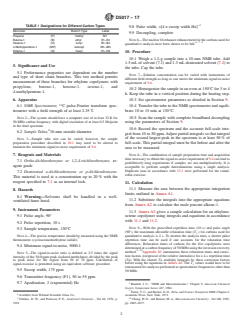
3.3.1 With a few modifications, terms used to designate different carbon types were suggested by Carman. Methine carbons
are identified by CH and branch carbons are labeled according to branch type as summarized in Table 1. Branch carbons are
numbered starting with the methyl as number one.
This test method is under the jurisdiction of ASTM Committee D20 on Plastics and is the direct responsibility of Subcommittee D20.70 on Analytical Methods.
Current edition approved April 1, 2009March 1, 2017. Published June 2009March 2017. Originally approved in 1991. Last previous edition approved in 20032009 as
ε1
D5017 – 96(2003)(2009) . DOI: 10.1520/D5017-96R09E01.10.1520/D5017-17.
For referenced ASTM standards, visit the ASTM website, www.astm.org, or contact ASTM Customer Service at service@astm.org. For Annual Book of ASTM Standards
volume information, refer to the standard’s Document Summary page on the ASTM website.
The last approved version of this historical standard is referenced on www.astm.org.
Available from ASTM International Headquarters, 100 Barr Harbor Drive, C700, West Conshohocken, PA 19428.
Carman, C. J., Harrington, R. A., and Wilkes, C. E., Macromolecules 1977, Vol 10, p. 536.
*A Summary of Changes section appears at the end of this standard
Copyright © ASTM International, 100 Barr Harbor Drive, PO Box C700, West Conshohocken, PA 19428-2959. United States
D5017 − 17
TABLE 1 Designations for Different Carbon Types
Monomer Branch Type Label
Propene (P) methyl M1
Butene-1 (B) ethyl E1–E2
Hexene-1 (H) butyl B1–B4
4-Methylpentene-1 (MP) isobutyl IB1–IB3
Octene-1 (O) hexyl H1–H6
3.3.2 Backbone methylene carbons are designated by a pair of Greek letters that specify the location of the nearest methine
+
carbon in each direction. For example, α,α-methylene carbon is between two methine carbons or an α,δ methylene carbon has one
immediate methine neighbor and the second methine carbon is located at least four carbons away.
4. Summary of Test Method
4.1 Polymer samples are dispersed in hot solvent and analyzed at high temperatures using Carbon-13 nuclear magnetic
resonance (NMR) spectroscopy.
4.2 Spectra are recorded under conditions such that the response of each chemically different carbon is identical. Integrated
responses for carbons originated from the different comonomers are used for calculation of the copolymer composition.
5. Significance and Use
5.1 Performance properties are dependent on the number and type of short chain branches. This test method permits
measurement of these branches for ethylene copolymers with propylene, butene-1, hexene-1, octene-1, and 4-methylpentene-1.
6. Apparatus
6.1 NMR Spectrometer, C pulse-Fourier transform spectrometer with a field strength of at least 2.35 T.
NOTE 2—The system should have a computer size of at least 32 K for 50-MHz carbon frequency with digital resolution of at least 0.5 Hz/point in the
final spectrum.
6.2 Sample Tubes, 10-mm outside diameter.
NOTE 3—Sample tube size can be varied; however, the sample preparation procedure described in 10.1 may need to be altered to maintain the minimum
signal-to-noise requirement of 9.4.
7. Reagents and Materials
7.1 Ortho-dichlorobenzene or 1,2,4-trichlorobenzene, reagent grade
7.2 Deuterated o-dichlorobenzene or p-dichlorobenzene. This material is used at a concentration up to 20 % with the reagent
specified in 7.1 as an internal lock.
8. Hazards
8.1 Warning—Solvents shouldshall be handled in a well-ventilated fume hood.
9. Instrument Parameters
9.1 Pulse angle, 90°
9.2 Pulse repetition, 10 s
9.3 Sample temperature, 130°C
NOTE 4—The precise temperature should be measured using the NMR thermometer (cyclooctane/methylene iodide).
9.4 Minimum signal-to-noise, 5000:1
NOTE 5—The signal-to-noise ratio is defined as 2.5 times the signal intensity of the 30.0-ppm peak (isolated methylenes) divided by the peak to peak
noise for the region from 50 to 70 ppm. Calculation of signal-to-noise is permitted using an equivalent software procedure.
9.5 Sweep width, 175 ppm
9.6 Transmitter frequency (F1), 50 to 55 ppm
9.7 Apodisation, 2 (exponential) Hz
−1
9.8 Pulse width, <[4 × sweep width Hz]
Available from Wilmad Scientific Glass Co.
Vidrime, D. W., and Peterson, P. E., Analytical Chemistry , Vol 48, 1976, p. 1301.
D5017 − 17
9.9 Decoupling, complete
4, 7, 8
NOTE 6—The nuclear Overhauser enhancement for the carbons used for quantitative analysis have been shown to be full.
10. Procedure
10.1 Weigh a 1.2-g sample into a 10-mm NMR tube. Add 1.5 mL of solvent (7.1) and 1.3 mL deuterated solvent (7.2) to the
tube. Cap the tube.
NOTE 7—Solution concentration can be varied with instruments of different field strength as long as one meets the minimum signal-to-noise
requirement of 9.4.
10.2 Homogenize the sample in an oven at 150°C for 3 to 4 h. Keep the tube in a vertical position during the heating step.
10.3 Set spectrometer parameters as detailed in Section 9.
10.4 Transfer the tube to the NMR spectrometer and equilibrate 10 to 15 min at 130°C.
10.5 Scan the sample with complete broadband decoupling using the parameters of Section 9.
10.6 Record the spectrum and the accurate full-scale integral from 10 to 50 ppm. Adjust partial integrals so that integral of the
second largest peak in the spectrum is at least 50 % of full-scale. This partial integral must be flat before and after the area to be
measured.
NOTE 8—The combination of sample preparation time and acquisition time necessary to obtain the signal-to-noise requirement of 9.4 can lead to
prohibitively long experiments if samples are run multiplicatively. It is acceptable to perform sample determinations using a single analysis. Duplicate
runs in accordance with 13.1 were performed for the round-robin exercise.
11. Calculation
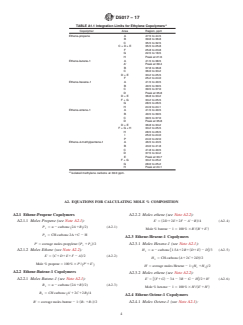
11.1 Measure the area between the appropriate integration limits outlined in Annex A1.
11.2 Substitute the integrals into the appropriate equations from Annex A2 to calculate the mole percent alkene-1.
11.3 Annex A3 gives a sample calculation for an ethylene-octene copolymer using integrals and equations in accordance with
11.1 and 11.2.
NOTE 9—With the prescribed repetition time (10 s) and pulse angle (90°), the maximum allowable relaxation time (T ) for carbons used for quantitative
analysis is 2 s. To shorten the analysis time, a shorter pulse repetition time can be used if one accounts for the relaxation time differences. Relaxation
9, 10
times of carbons for the five copolymers were determined at a carbon frequency of 50 MHz using the inversion recovery method. Appendix X1
summarizes these relaxation times and correction factors (reciprocal of the relative intensities) for a 4-s repetition time (T ). With the shorter T , multiply
R R
integrals by these correction factors before using the equations in Annex A2. The T values would have to be remeasured for analyses performed at
spectrometer frequencies other than 50 MHz.
11.4 If desired, convert results from mole percent alkene-1 to branches per 1000 carbons (br/1000C) using the equations in
Annex A4.
12. Report
12.1 Report the mole percent alkene-1 from 11.2 or branches/1000C from 11.4, or both.
13. Precision and Bias
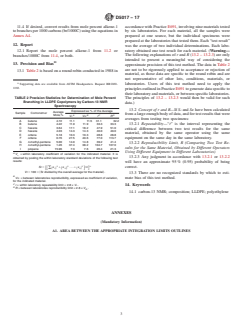
13.1 Table 2 is based on a round robin conducted in 1988 in accordance with Practice E691, involving nine materials tested by
six laboratories. For each material, all the samples were prepared at one source, but the individual specimens were prepared at the
laboratories that tested them. Each “test result” was the average of two individual determinations. Each laboratory obtained one
test result for each material. (Warning—The following explanations of r and R (13.2 – 13.2.3) are only intended to present a
meaningful way of considering the approximate precision of this test method. The data in Table 2 shouldare not to be rigorously
applied to acceptance or rejection of material, as those data are specific to the round robin and mayare not be representative of other
lots, conditions, materials, or laboratories. Users of this test method should need to apply the principles outlined in Practice E691
to generate data specific to their laboratory and materials, or between specific laboratories. The principles of 13.2 – 13.2.3 would
then be valid for such data.)
13.2 Concept of r and R—If S and S have been calculated from a large enough body of data, and for test results that were
r R
averages from testing two specimens:
13.2.1 Repeatability—Two test results obtained within one laboratory shall be judged not equivalent if they differ by more than
...